Pages Menu
RssFacebook
Categories Menu

Posted by on Jun 21, 2008

St. Aloysius Gonzaga – June 21

St. Aloysius Gonzaga – June 21

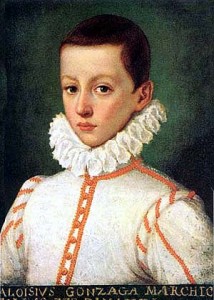
St. Aloysius Gonzaga (1568-1591) is often portrayed as a weak dreamy sort of figure. Worse, he has been presented to young people as a patron and role model who rejected all of the fun, adventure, and rebellion of youth. The real story is far more compelling.

How St. Luigi Gonzaga became St. Aloysius in English is not clear. The Latin for Luigi would be Ludovicus. Alois would be the German equivalent.

The “spin” of 17th and 18th century writers on his life was more a pietist anti-intellectual critique of the secularist Enlightenment. To be impolitic, he comes across as some sort of bloodless, lily toting wimp with upward cast eyes. Although it is not uncommon for saints to be “martyred” posthumously and their lives used to advance a contemporary cause, the Renaissance Luigi Gonzaga, Marquis of Castiglione is more relevant to us as post-modern Christians.

The overall sketch of his life is a simple as it is dramatic. Luigi was the oldest son of Ferrante, the Marquis of Castiglione, and named for the founder of the Gonzaga family Luigi, Lord of Mantua (1328). He was a pious youth, despised the things of this world, joined the Jesuits, and died of the plague after contracting it from nursing its abandoned victims in the streets of Rome when he was barely 23.

The context of his life and his status as an imperial prince give us a fuller understanding of who he was. According to John Coulson, the editor of The Saints: A Concise Biographical Dictionary:

It is impossible to estimate Aloysius’ (Luigi’s) career without some idea of his appalling heredity and environment. The Gonzaga tyrants rank with the Visconti, the Sforza, and the D’Este. They entered history about 1100; the first Gonzaga, lord of Mantua, was Luigi (1328), whose third marriage took place on the same day as his son’s and grandson’s: the three brides entered Mantua together in triumph. Already their cliff-like fortress was looming over the city. These despots displayed an amazing mixture of qualities. The Gonzaga clan survived one assassination after another and became allied to most of the reigning houses; but Luigi Gonzaga (141), grimly surnamed ‘The Turk,’ kept up three printing-presses and had for clients men like Platina, or Mantegna, who painted the scenery–now at Hampton Court–for the plays to which the Gonzaga were devoted. The French Parliament petitioned against the introduction of these plays into France–they were a ‘high school of adultery’–and no one would now dare paint the pictures with which some of the Gonzaga palaces were adorned. Yet these princes could care for agriculture, irrigation, checks on usury; and their insane debaucheries alternated with explosions of a genuine underlying faith. Their subjects, bled white by taxation, thrilled by their exotic pageantries, worshipped them till they broke into bloody but useless revolution.

The life of a Renaissance prince was far from any story book. St. Aloysius’ primary schooling was at the Medici Court in Florence. While he received the best academic training of the day, there was a bigger focus on swordsmanship, riding, and intrigue. He also spent significant time at the Spanish Court of King Philip II. His mother was a Valois and a relative of the Queen and his father had turned down a position of Master of the Horse in the English Court of Henry VIII in favor of Spain. At the time, the Spanish Empire was at its height of power and global dominance. Philip II also became king of Portugal as Philip I and ruled the Portuguese Empire as well.

As the oldest son, Luigi was trained to fulfill the duties of a prince and to prepare to succeed his father in the wealth, power, and literal back stabbing of the Gonzagas. As a child, though, he was appalled at what he saw and experienced, including the murder of close relatives. Fortunately, he came under the influence of St. Robert Bellarmine, who gave him his First Communion as a teenager. His rebellion was to reject it all and to enter the Church. His mother was not opposed to the idea, since it was not uncommon for powerful families to place prominent younger sons in key church positions that controlled considerable wealth and property. Luigi’s desire to join the Society of Jesus (Jesuits) was another matter. It would mean that he would forgo any type of service that could make him a powerful or wealthy cleric. Ironically, it was a wealthy and powerful churchman – Luigi’s cousin Cardinal Scipione Gonzaga – who prevailed on Ferrante to permit his son to join the Jesuits.

However, even as a Jesuit scholastic (student for the priesthood), he was still a celebrity who received celebrity treatment by those outside the order. Luigi probably over-compensated for this and his spiritual director and personal mentor, St. Robert Bellarmine, told him to ease up on prayer and penance and live a more moderate life. If we look between the lines, fitting a Renaissance prince into a religious house was not the easiest task for Luigi or his fellow religious. In fact, St. Ignatius’ famous letter on obedience was motivated in part to try to redirect the religious enthusiasm of these men to the ultimate in penance – to do what you are told whether you like it or not.

One can only imagine what it was to see a Gonzaga nursing victims of the plague on the streets of Rome.

There is a wonderful statue of St. Luigi outside St. Aloysius parish on the grounds of Gonzaga University in Spokane, Washington which shows a vital, caring, young man tending to a plague victim.

For some time when Gonzaga University was at the height of its fame as a basketball champion, there was a slogan which the University ran on national TV – Gonzaga: a Way of Life. The possibility of taking a brand like “Gonzaga” and making it stand for an impassioned life of faith inspired service is due to a young man caught up in grace. Isn’t that what we want for all young men and women?

Read More

Posted by on Jun 20, 2008

St. Aloysius Gonzaga – June 21

Your Own Directory at Theologika.net

NEWS FLASH!

Theologika.net will begin offering workshops and classes in collaboration with our trustees and other theologians, philosophers and social scientists in early 2011. As part of this new development, the ways you will search for information and create tags will change.

Check out these two posts for details about the upcoming changes and how to save your own personal directory materials.

2011 Brings Classes and Big Improvements to Theologika.net

We’re Moving: Time to Pack Up Your Data

More information about the changes will be posted on our blog at https://blog.theologika.net as they develop .

If you yourself have a website yourself, please put our site, www.theologika.net, into your links and recommendations.  We’ve even got a neat logo you can put with it if you’d like. You may copy it from this post.

We hope Theologika.net will be helpful in your work and spiritual journey. Looking forward to hearing from you.

Randy and Kathy

Read More

Posted by on Jun 13, 2008

St. Aloysius Gonzaga – June 21

Saint of the Day: St Anthony of Padua – June 13

Doctor Evangelicus

FRIAR MINOR
MINISTER PROVINCIAL OF ROMAGNA
CANON REGULAR OF ST. AUGUSTINE
DOCTOR OF THE CHURCH
PATRON OF PREACHERS

St. Anthony has always been a special family patron. I suppose my paternal grandfather, Doroteo Pozos, is to blame. My father was born on August 26 and, according to custom, was supposed to have been named Seferino after the Saint of the Day, Pope St. Zephyrinus (pontificate 198 -217). My grandfather didn’t like the name and instead named his only son Antonio. This started a chain of Antonian events. My oldest brother was name Anthony, and my sister Antoinette. To drive the point home, Providence sent my brother Arnold to us on June 13. Kathy and I did not help things either by naming our second son Antonio.

So who was St. Anthony / San Antonio? Actually St. Anthony (ca. 1195 – 1231) was Portuguese and is sometimes referred to as St. Anthony of Lisbon, where he was born and baptized Fernando Martin de Bulhoes. His parents were wealthy and powerful nobles. How his life took him from Lisbon as a member of the Canons Regular of St. Augustine to become the Franciscan St. Anthony of Padua in northern Italy is a story with many twists and turns.

When he was 15, the young Fernando entered St. Vincent, the monastery of the Canons Regular of St. Augustine. This group served as pastors and were not monks. After a couple of years Fernando asked to be transferred to the group’s Abbey of the Holy Cross in Coimbra, which was the capital of Portugal at the time. Apparently, he had not been happy with the visits and interruptions of family and friends in Lisbon and felt that his studies and his vocation were suffering as a result.

After he completed his studies and was ordained in Coimbra, Fr. Fernando was placed in charge of hospitality for the abbey, which meant that he was responsible for taking care of guests. A group of Franciscans, who were a new an dynamic movement at the time, were his guests as they traveled to Islamic Spain and Morocco as missionaries. They moved him deeply and when their martyred remains returned to Coimbra, Fr. Fernando managed to get the permission of his superiors to join the Franciscans. He received the Franciscan habit, took the name Antonio, and was intent on going to Morocco to die for the faith.

When St. Anthony landed in Morocco, along with another Franciscan, he was so ill that he had to return to Portugal. On his premature return trip, his ship was blown off course by a huge storm which swept him all the way to Sicily. He made his way to Assisi and was in very poor health. He ended up in a small hospice in the countryside, where he lived as a hermit and helped out in the kitchen.

St. Anthony’s marvelous gifts as a preacher and scriptural theologian were discovered when he was asked to preach at an ordination. Although it is unlikely that St. Anthony ever met St. Francis, the Poverello appointed St. Anthony to teach theology to his brothers. This was an unusual endorsement, since St. Francis had many reservations about the ego of scholars and theologians. He did not want to foster this type of unfortunate self-centeredness in his own group.

St. Anthony not only spent time as a teacher but also traveled extensively, preaching in the countryside and serving in administrative offices of the order. He took on various groups which had deviated from orthodoxy. Although St. Anthony is called the “Hammer of the Heretics,” he has a more pastoral legacy which underscores his genuine concern for people. There are many stories of miracles which seem to strain our post-modern credulity. Although many may be legends or devotional fabrications, St. Anthony was known to have transformed many lives and had a definite impact on a long line of Franciscan scholars and saints who would come after him.

He was to set an ideal for Franciscan intellectuals, who were great preachers, mystics, ascetics, and competent administrators. St. Bonaventure is one of the more famous examples of this cluster of gifts, as is Blessed Junipero Serra the Apostle of California.

Most often, St. Anthony is depicted holding the Christ Child. Except for the Blessed Mother and St. Joseph, no other saint is presented this way. Apparently, this depiction began in the 17th century, based on a legend from the saint’s life. Symbolically though, this image presents much of Franciscan spirituality in terms of encountering, modeling and presenting Christ – poor, vulnerable, and welcoming.

St. Anthony died near Padua at the age of 36. This was not an unusual lifespan for the 13th century and yet it is amazing what he gave to us in such a brief span of years.

Read More

Posted by on May 24, 2008

St. Aloysius Gonzaga – June 21

Corpus Christi: The Body of Christ

Stephen’s bright blue eyes smiled as we said, “Lamb of God, Give us Peace.” According to the rubrics we were now to show each other a sign of peace. Yet with Stephen’s attention deficit disorder, which had already taken him in and out the brief service at least twice, it seemed that a little catechesis might help him be a little more aware of what we were about to do. Stephen is not a little boy. He is a handsome man in his early 30s, with a number of tattoos poking out of the v-neck and short sleeves of his starched jail issued smock.

The readings had been those of Pentecost. The second reading was from First Corinthians 12. “No one can say Jesus is Lord except by the power of the Holy Spirit.” This had struck all four of the men, but had made a special impression on Stephen. “Does that mean that when I pray the Holy Spirit moves my heart?” Stephen had asked. When I answered “Yes” his eyes got wide and he said that since his attention came and went and his thoughts were often jumbled, he thought his prayers were more bothersome and must be irritating. The notion that he is a temple of the Holy Spirit was as novel to him as it was consoling.

Stephen was back now and I shared a few words on the Lamb of God, recounting the Last Supper and the passion, death, and resurrection of the Lord. We do this in His memory as He requested of us. We are invited to the Lord’s table. Stephen and his companions were not new to the faith, but this brief memorial of our Great Memorial brought a renewed awareness to the others and a slack jaw from Stephen. He did not doubt, but could not help but marvel at the wonder of it.

As we shared the wonder of the Blessed Sacrament, our communion was truly a sharing in the Body and Blood of Christ. Bread blessed and broken at the Eucharist, celebrated in the parish, given to all, shared with all, and sent to those in need and to those in prison. The Body of Christ – Corpus Christi – saving us all from our prison of loneliness, our hunger for love, and admitting us to the feast of heaven here and now.

Read More

Posted by on May 5, 2008

St. Aloysius Gonzaga – June 21

Ascension Blahs

water_ripple.JPG

There is only so much joy and sunshine the soul can take. There is a rhythmic moodiness to California’s central coast. Unlike the interior valleys and the Sierra, which have more constant moods in concert with the sun and stars, the ribbon world on the sands and coastal planes changes from delight to gloom overnight — or sometimes within the hour. On our street, the fog, known by its more fluffy image as “the marine layer,” sometimes tiptoes and sometimes billows through the cypresses on Lighthouse Field and blots out the sun, roiling half way down the block before stopping on a whim in an evanescent whirl.

The Resurrection blossoms and the fulgent greens are quickly muted in the filtered gray light of the salty chill. The natives, loath to give up their flip flops and shorts, shiver in their sweatshirts as they pull their hoods over their brows to the bridge of their sunglasses.

So where has the Son gone? Why do we stand here looking up in the chill? Who turned off the party? Just when we found Him, they took him away again. No that would have been easier. It would be renewed grief. He said that it was time for Him to return to the Father and that He would send the Advocate who would teach us all the things that He still had for us to learn. Left behind … our consolation turned to desolation.

… And what to do? According to Father Ignatius, it is time to discern, to prepare for the movements of the soul that eddy from the Paraclete, that ripple from the heart, and echo in the fountain drops of the barely conscious. What now? Be still and know that I am the Lord.

Read More

Posted by on May 2, 2008

St. Aloysius Gonzaga – June 21

The Prophet and the Politician: Sen. Obama and Rev. Wright

obama_wright-rev.jpg

Many friendships have been lost on the rocks and shoals of political campaigns. The falling out between Senator Barak Obama and the Reverend Jeremiah Wright is the latest example of such casualties. What is most striking is the Rev. Wright’s strident message. He would probably say that this style is a cultural feature of the African-American church. In a response to questions at the Washington Press Club, Rev. Wright said that he had told Mr. Obama, that if he is elected President, Rev. Wright would be coming after him as the leader of a repressive government.

Is this prophecy – speaking truth to power – or is it an ego trip? Rev. Wright went to some effort in his address to the National Association for the Advancement of Colored People (NAACP) to stress the prophetic nature of his ministry and its African-American style. However, Rev. Wright appeared to have transgressed certain boundaries of acceptable political speech. His condemnation of the United States after the 9/11 terrorist attacks, positing them as something that was the natural outcome of United States’ policies abroad, went too far in many people’s minds. His appraisal of Louis Farrakanh, the Black Muslim leader who advocates Black separatism and superiority, as one of the most influential persons in the 20th and 21st centuries raised additional hackles More alarming was his support for the idea that the United States had created the HIV/AIDS virus to decimate African-Americans.

It was all too much for Barak Obama and for most of the people of the United States.

So how far do you go in prophecy, especially in the prophecy of invective? There is an argument to be made that the 9/11 attack had a lot to do with American actions against Osama Bin Laden that drove him from exile in Sudan to Afghanistan. Any student of U.S. history knows that American policies in many parts of the world have been part of oppression. Yet do you condemn a nation that has also had a history of doing many good things on the world stage?

What struck me most was the Rev. Wright’s anger. Was it the anger of a prophet zealous for his God or was it the anger of African-American oppression, frustration, and futility? When Sen. Obama first addressed the issue of the Rev. Wright’s preaching in a landmark speech on race in America, his talk was full of restraint, understanding, and hope. The element of hope has been greatly reduced in the Rev. Wright’s recent speeches.

Ironically, the title of Sen Obama’s second book, The Audacity of Hope, is taken from one of Rev. Wright’s sermons. In fact, it actually concludes his autobiography, Dreams From My Father. It is clear that Rev. Wright infused Sen. Obama with a deep sense of hope over 20 years ago. The prophecies of Jeremiah and others in the Old Testament tend to hold out an element of hope of future redemption – of reconciliation.

Unfortunately, two roads are diverging in the wood and the nation must decide whether it will pursue the road of hope or the politics of despair, division, and personal destruction.

Read More

Posted by on Apr 23, 2008

St. Aloysius Gonzaga – June 21

St. Anselm of Canterbury – Faith Seeking Understanding

st-anselm.jpg

Fides Quaerens Intellectum – Faith Seeking Understanding – is the theme of the philosophy and theology of St. Anselm (1033 – 1109). His feast day is April 21.  St. Anselm is regarded as the greatest philosopher of the 11th century and set the tone for the scholastic thinking of the early Middle Ages. Anselm represents a new beginning of a new civilization that ends the Dark Ages. His thinking is very much in line with the Neo-Platonism of St. Augustine.

St. Anselm’s writing on the nature of God and his proof for the existence of God emphasize the role of reason in understanding and shaping faith. His proof for the existence of God is meant to show that we can come to a knowledge that God exists from our own reason. Belief in God and His revelation is a gift of faith. However, faith is a reasonable course to take and of itself enlightens and encourages understanding.

It is often fashionable to dismiss the Middle Ages as a pre-rational time before the Renaissance and the Enlightenment. Unfortunately, this overlooks the importance of reason and the intertwining of faith and reason since the origins of Christianity. Although many of its concepts and their cultural context are foreign to us, the content and style of Anselm’s reasoning demonstrates a critical, analytical, and logical approach to dealing with questions of faith and living the Christian life.

Anselm’s notion of atonement, the redemption of the human race brought about by the death of Christ, is based on a concept of justice that seems – well – Medieval, and that is what it is. While it might strike some of us as portraying a vindictive God, St. Anselm presents it as arising out of the will of the Father and the Son to restore the human race. While we as post-moderns might see echoes of European tribal notions of compensation for injury or damage, St. Anselm is following the lead of many preceding philosophers and theologians to place the witness of scripture in a rational context.

Most of St. Anselm’s life was spent as a scholar and abbot. As Archbishop of Canterbury, St. Anselm had the unenviable position of being subject to two kings who attempted to exercise control over the church and plunder its treasury. St. Anselm spent years in exile.

Western critical thought and reasoning owes a debt to St. Anselm. As much as we might be inclined to relegate faith to the psychology of religious experience, St. Anselm reminds us that while the heart might claim our allegiance, our mind and reason challenge us to understand and live the faith of our hearts with the best of our minds enlightened by grace.

Read More

Posted by on Apr 18, 2008

St. Aloysius Gonzaga – June 21

Tectonic Faith Shift: Evangelicals – Pro Life, Pro Obama

religion-and-politics.jpg

Those who would dismiss theology as a parlor game need only look at the alliance of evangelicals with the political right in the United States. Before the emphasis on “family values,” evangelicals had a rich tradition of struggling for social justice and equality as sign of announcing the Kingdom.

There has been another Great Awakening – a cyclical occurrence in United States history. Evangelicals are disenchanted with the policies of the political right on global warming, military adventures, and the neglect of those in need. There is a growing feeling among evangelicals that they have been used by the large financial and industrial interests to further an agenda which is far from pro-life in the broader sense of the health, well being, and development of people and the environment.

Frank Schaeffer, a scion of one the founders of the Religious Right, issues a writ of divorce with his post at http://vox-nova.com entitled Pro Life, Pro Obama. Check it out.

Read More

Posted by on Apr 10, 2008

St. Aloysius Gonzaga – June 21

Memory, Identity, and Resurrection

sky-computer-generated.jpg

This Easter Season, I have been puzzling over why the people who lived with Jesus and shared the intimacies and hardships of his travels didn’t recognize him when they encountered the Risen Christ.

I have been reading Oliver Sacks’, Musicophilia: Tales of Music and the Brain, and came across the notion of emotional memory. Sacks relates the very tragic case of a brilliant music scholar and choral director who suffers an almost total amnesia as the result of encephalitis. He had no episodic memory, which meant that everything kept popping into existence all of the time. However, his ability to sight read and play music from memory was quite intact. He also “recognized” his wife and clung to her. Apparently, according to Sacks, our physical and emotional memory is somehow distinct from our memory of events past and present. It is something much deeper. He also states that our development of episodic memory comes to the fore after the age of two. In those first two pivotal years we develop deep emotional bonds. Learning music, riding a bike, and other types of motor learning have their own place outside of episodic memory. The bonds of deep love even transcend the loss of memory of specific events.

The scene in the garden with the Risen Christ and Mary of Magdala has always resonated deeply within me. Mary is still in a serious state of shock on top of her tremendous grief. Her disorientation seems almost complete when she hears her name in the music of a voice that transcends the memory of events.

So many oceans of ink and uncounted forests have been lost to the question of how we can find the Jesus of history. The disciples left us stories and experiences that are far beyond episodic memory. Their invitation is catechetical – an invitation into the mystery of a love and relationship so intense it is beyond time and memory.

Read More

Posted by on Apr 9, 2008

St. Aloysius Gonzaga – June 21

Theologika.net Welcomes Terry Hershey

terry-hershey.jpg

A sign of a person’s true enlightenment is how he or she handles the gods of the internet. Kathy and I had a wonderful telephone visit with Terry Hershey and his webmaster, Todd Roseman. We gave Terry and Todd a tour of Theologika.net and began the process of setting up the TerryHershey directory, where you can find many of his recommended books, materials, and web content. Generally, setting up a directory – which you can do by registering at www.theologika.net/search  – only takes a few minutes.

As fate would have it, we ran into a snag. My many years of experience in business, working with VIPs, began to haunt me. The pressure started to build. Not to worry, though. As advertised, Terry Hershey, a minister with degrees in philosophy and theology, landscape architect, speaker and writer, was delightfully calm and soothing. Just the sort of balance he talks and writes about. Terry is very upfront about the challenges of his life, which makes it easier to see our own lives in a calm and honest manner that helps us stretch and grow.

Kathy and I are sure that you will enjoy Terry’s newsletters and other great items on his website. You can find them easily by typing “Terry Hershey” into Theologika.net’s discovery engine at www.Theologika.net/search. Click on the items and you will be transported to the very peaceful and inspiring dimension known as www.TerryHershey.com.

Enjoy!

Read More