Pages Menu
RssFacebook
Categories Menu

Posted by on Apr 6, 2008

The Encounter at Emmaus

The Encounter at Emmaus

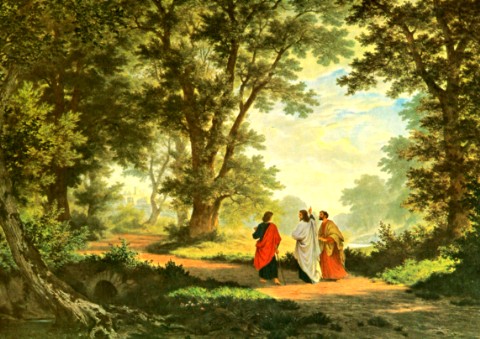
emmaus.jpg

I have been struck by the stories this Resurrection Season because for the first time, they strike me not as eye witness accounts of the Risen Christ, but as the challenge of faith for the disciples and us. The disciples on the way to Emmaus are leaving Jerusalem – returning home, perhaps, – grief stricken, but more importantly, disillusioned. The teacher has failed. The forces of evil have destroyed a very good and wonderful young man.

One way to see this story is to take it as another proof of the Risen Christ as encountered by his disciples. The story does convey this message. However, the story also tells us that we find the Risen Christ when He opens our minds to see the scriptures and when our hearts are opened at the Breaking of the Bread. Look for Him in the scriptures and invite Him in to dinner and your hospitality will be more than repaid.

There is just a glimpse – a flash of recognition and he disappears from our midst. The presence of the Risen Christ is a momentary and ongoing discovery. It is the result of searching, wandering, questing in grief and disillusionment and being open to the challenge of the Stranger.

All of us have moments, years, decades, in which everything we knew and had hoped for is swept away. The disciples had no clue of what was to become of their beloved teacher, but his torture and death threw them into utter grief and confusion. Yet their confusion only increased when they heard that other disciples had found the empty tomb and seen the angels. They were re-grouping, leaving town, trying to get some distance. A Stranger notices their grief and inquires. They listen and reflect on the scriptures and Break Bread.

This is the Christian life – the quest and the encounter in the village of Emmaus – continuing through all generations.

Read More

Posted by on Mar 31, 2008

The Encounter at Emmaus

Religious Environmentalism – Gottlieb: A Greener Faith

Mt. Fuji

Japan’s Mt. Fuji presents a beautiful backdrop for Tokyo, home to more than 32 million people. The last major eruption of this perfectly symmetrical stratovolcano came in 1707. Image from the Shuttle Radar Topography Mission.

The coming of Spring and all things green, including Earth Day, is a good time to read Roger S. Gottlieb’s book, “A Greener Faith.” Megan Jones, of the Department of History at the University of Delaware, has published a very good review on H-Net Catholic Discussion Network on the history and culture of Catholicism.

Gottlieb’s vision of religion takes in all of the major world religions and all indigenous or native expressions. For someone like myself, who studied environmental biology and social ethics in the 1970’s, it’s deja vu all over again. What strikes me as a card carrying anthropologist, though, is the assumption that since religion reflects culture and society, thinkers and practitioners of religion, from the New Age suburban shaman to the Archbishop, should embrace environmentalism as a way to validate religious experience in the face of the current atheistic onslaught from Dawkins et al.

On the one hand, there is the Christian notion of watching the signs of the times and the injunction to witness to justice. As Gottlieb observes, religion can bring hope to what seems to be a hopeless situation. However, I cannot help but resist the notion of “using” religion, of whatever stripe. As a universal anthropological phenomenon, religion closely mirrors the current situation of its social context. Re-interpreting religious texts and folk traditions does occur at times of crisis – in ways that are in keeping with the group’s social construction of reality.

What gives me pause are the laws of unintended consequences which I have seen first hand as a public health planner. Encouraging people to explore the environmental challenge is a social imperative. However, adopting a public policy agenda draped in the folds of religion appears to play into the criticism that religion is at base a tool of social control, without any transnatural referent that is not delusional.

So… Lead us not into religious environmentalism and deliver us from the temptations of the moment.

Read More

Posted by on Mar 31, 2008

The Encounter at Emmaus

Easter Communion or Condemnation?

holy-communion.jpg

To receive communion during the Easter season has been a long established precept of the Catholic Church. It is a practice that we should examine more closely. To receive Christ in the Holy Eucharist requires one to be in the state of grace – free of serious or mortal sin. We are advised – wisely – to put our souls in order. We are to turn away from sin and return to the community through the grace of absolution. There must be peace and love in our hearts and a definite change in our lives.

Fr. Burke, a Discalced Carmelite from Australia, expands on the notion of communion in terms of our living out the Sacrament of the Holy Eucharist in our shared lives as Catholics and Christians. In his article, “St. Teresa and Two Spiritualities in the Church Today,” at http://www.carmelite.com/, Fr. Burke explains St. Teresa of Avila’s views on legalism as opposed to true and complete union with God and each other. It is well worth reading.

Fr. Burke has put into words what I have been feeling ever since I read selections from the popular blog, Cafeteria Closed, by Gerald Naus, who writes as Gerald Augustinus. Naus came to the United States from Austria in 1997. A former Jehovah Witness, he became a Catholic in 2005. His views are decidedly Restorationist. Unfortunately, they are generally stated in tones of arrogance, condescension, or condemnation. His posts on culture, politics, and religion are inflammatory and provocative, akin to those of Rush Limbaugh and Ann Coulter, except that Catholicism is now the justification for neo-fascism. Naus’s recent post, On the Status of Palestinian Education, uses photos and a few inflammatory lines to libel all young Palestinian men. One might argue that many of Naus’s views are Catholic in the officially regressive sense, but there seems to be little of Christian charity or communion about them. From this narrow point of view anyone who does not agree with him is wrong and should be attacked. As a major blogger, Naus has a large following in which to sow his seeds of dissension.

You will know them by their fruits. (Mt 7:20)

Read More

Posted by on Mar 30, 2008

The Encounter at Emmaus

Easter Tide: The Age of Faith

christ-carmelite-icon.jpg

It’s all so obvious – right? Jesus is Risen. The women and men closest to Him have all seen Him, touched Him.

Yet they only recognized Him with difficulty. St. Mary of Magdala’s grief was not broken until Jesus called her by name. The Apostles recognize Him with difficulty and Jesus takes the initiative to introduce Himself. There is an air of surprise – an awkwardness that Jesus breaks with the greeting used by Angels and other heavenly visitors, “Peace be with You”. It is easy enough to see this as a blessing, but not as the gesture of reassurance that it is. The Risen Christ is not the historical Jesus that He was. Beyond time and space, the Divine Word – God Eternal – is now and ever was.

We can all now live in the Risen Christ and He in us.

“Without seeing you, We love you;

Without touching you, We embrace;

Without knowing you, We follow;

Without seeing you, We believe.”

– David Haas, “Without Seeing You”, from the album “Glory Day”.

Read More

Posted by on Mar 30, 2008

The Encounter at Emmaus

First Sunday of Easter – “Thomas Take Your Hand…”

st-thomas-doubting.jpg

St. Thomas the Apostle is better known for his doubt than his faith. The story takes place after Jesus has appeared to the Apostles and shown them the wounds in His hands, feet, and side. The resurrected, glorified Christ still has his wounds. Why wasn’t He restored to His original whole state? Was it the way for His disciples to recognize Him, or is His passion and death such a part of Him that His very wounds have become part of His identity? It all sounds a little too good to St. Thomas when the others tell him of the Lord’s visit. The message to Thomas, and the rest of us, when he encounters Christ, is “blessed are those who have not seen and believe.” (John 20:29)

Faith.. Blessed are those with faith.

Blessed be the God and Father of our Lord Jesus Christ,
who in his great mercy gave us a new birth to a living hope
through the resurrection of Jesus Christ from the dead,
to an inheritance that is imperishable, undefiled, and unfading,
kept in heaven for you
who by the power of God are safeguarded through faith,
to a salvation that is ready to be revealed in the final time.
In this you rejoice, although now for a little while
you may have to suffer through various trials,
so that the genuineness of your faith,
more precious than gold that is perishable even though tested by fire,
may prove to be for praise, glory, and honor
at the revelation of Jesus Christ.
Although you have not seen him you love him;
even though you do not see him now yet believe in him,
you rejoice with an indescribable and glorious joy,
as you attain the goal of your faith, the salvation of your souls. (1Peter1:3-9)

Christ died for all, but salvation comes to us through faith? Why? Stay tuned…

Read More

Posted by on Mar 29, 2008

The Encounter at Emmaus

Seven Stanzas at Easter – John Updike

resurrection-of-jesus-kenya.jpg


Make no mistake: if He rose at all
it was as His body;
if the cells’ dissolution did not reverse, the molecules
reknit, the amino acids rekindle,
the Church will fall.

It was not as the flowers,
each soft Spring recurrent;
it was not as His Spirit in the mouths and fuddled
eyes of the eleven apostles;
it was as His Flesh: ours.

The same hinged thumbs and toes,
the same valved heart
that — pierced — died, withered, paused, and then
regathered out of enduring Might
new strength to enclose.

Let us not mock God with metaphor,
analogy, sidestepping transcendence;
making of the event a parable, a sign painted in the
faded credulity of earlier ages:
let us walk through the door.

The stone is rolled back, not papier-mache,
not a stone in a story,
but the vast rock of materiality that in the slow
grinding of time will eclipse for each of us
the wide light of day.

And if we will have an angel at the tomb,
make it a real angel,
weighty with Max Planck’s quanta, vivid with hair,
opaque in the dawn light, robed in real linen
spun on a definite loom.

Let us not seek to make it less monstrous,
for our own convenience, our own sense of beauty,
lest, awakened in one unthinkable hour, we are
embarrassed by the miracle,
and crushed by remonstrance.

Telephone Poles and Other Poems © 1961 by John Updike. Reprinted by permission of Alfred A. Knopf, a division of Random House Inc.

Read More

Posted by on Mar 26, 2008

The Encounter at Emmaus

St. Mary at Easter Tide

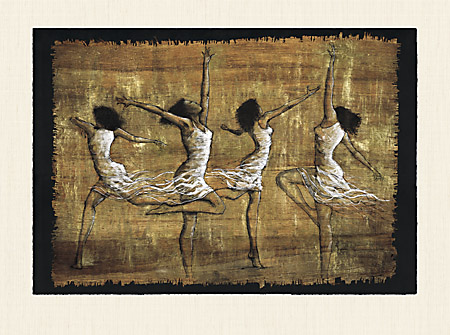
rejoice-monica-stewart.jpg

The Blessed Virgin Mary has many beautiful titles. St. Mary at Easter Tide is my very own. Scripture is very silent about the Mother of Jesus after the Resurrection. We know that she is present in the upper room when the Spirit comes upon the Apostles at Pentecost. At the Annunciation, the Angel Gabriel tells her nothing about her future, except that her Son will be destined for the rise and fall of many in Israel. Mary’s first post-partum visit to the Temple portends a life of sorrow. According to Simeon, a sword will pierce her heart seven times. This most beloved young woman is left to ponder these things in her heart.

There are many good years together, until He leaves to find his cousin John at the Jordan. Then things go from bad to worse. Her friends and neighbors toss Him out of Nazareth. Jesus dies a horrible death; His mission a failure; her maiden’s vision becomes a bitter delusion. In his final words, Jesus entrusts St. John and Mary to each other – a final testament that seals the depth of grief.

There is no record of how Mary hears the news; of how she reacts. Who tells her? Jesus Himself? It seems that this duty falls to us. The noonday prayer echoes a wonderful joy – Regina Coeli laetare alleluia! Queen of Heaven Rejoice alleluia! … Resurexit sicut dixit! He has risen as He said (he would)!

Even though the words echo from my childhood at “Mid-century,” how well I remember and still experience the delightful childish skip in our hearts and step that we shared at Easter Tide. These are not the inspired words of the Gospel in the Hail Mary, nor the briefest of summaries of the Mystery of the Incarnation in the Angelus. For a prayer, Regina Coeli seems strangely out of character. There is no formality, no reserve. In our joy, we proclaim the Good News to the Mother of the Word Incarnate. God has turned our mourning into joy, but how could we ever begin to fathom what his news meant to the woman whose faith gave birth to us all?

Read More

Posted by on Mar 25, 2008

The Encounter at Emmaus

Easter Monday: Whale Watching With Angels

light-house-pt-santa-cruz.gif

I had read in a book way back in grammar school at Holy Cross School in Ventura, CA, in a time that is now referred to as “Mid-Century,” about boys hiking in the Alps on Easter Monday for a traditional lunch at high altitude with the angels. That custom may or may not have been true, but the thought of having lunch with the angels has always intrigued me. Perhaps, because my patron is St. Raphael the Archangel, the thought has always been somewhat appealing. After all, if you were an angel, wouldn’t you want a little break after all the hullabaloo of Holy Week?

Circumstances prevented me from wandering into the Santa Cruz mountains looking for angels to share ham and Easter eggs. The day was perfect, with a mild breeze, as I headed out across Lighthouse Field to Point Santa Cruz. The sky and the water were dazzling as I headed west up the coast along the ocean before it rounds the Point into Monterey Bay. There was excitement in the air. Whales migrating south to the Sea of Cortez around the tip of Baja California were passing by 100 to 300 feet offshore. They showed some interest in a kayak heading in the opposite direction, but continued on in graceful arcs, undulating effortlessly in the current as they coursed through the water.

It was a strange moment. The moment the houses along West Cliff, the roiling waves and sunlight all got stretched onto an impressionist canvas. I could see the brush strokes, the layering of the oil, the weave of the canvas. My neighborhood of almost 20 years became completely magical, serene, and spirit filled. I had pounded this walk many, many times before and it was always striking, even when cares and illness were heaviest on my heart, but today it was literally unreal.

Well, I guess my patron Archangel and his buddies were not waiting for me in the redwoods after all. It wasn’t the picnic with the angels that I had imagined as a boy. Whale watching with the angels on Easter Monday is something else.

Read More

Posted by on Mar 24, 2008

The Encounter at Emmaus

Dance: The Easter Sacrament

dancing-children-nolde-1913.jpg

Yesterday on Easter Sunday, we sang a second communion hymn in Spanish and English “Resucitó” (He Is Risen). The latin beat, punctuated by conga drums and a driving bass line, turned most of us cradle Catholics into momentary Baptists, as our middle class “cool” gave way to clapping, toe tapping and widespread joyous singing. We were too well brought up to be too demonstrative, but this did not stop the smaller children from launching into a marvelously free dance of joy, aided by their older siblings. It was all in keeping with our name – Resurrection. Granted, we are not the most conventional group, which is saying something in Santa Cruz County. The concluding bars were punctuated by “gritos,” those characteristically Mexican musical shouts of joy, from the smaller children, whether Mexican or not. Things got more animated when we ended Mass with the spiritual, “O They Rolled The Stone Away”.

Terry Hershey, in the March 24, 2008 issue of his newsletter, Sabbath Moments, is also carried away by dance. Yes, Easter Week is a time to stop pursuing happiness and to just be happy.

Read More

Posted by on Mar 24, 2008

The Encounter at Emmaus

Easter: Not Recognizing the Risen Christ

mary-magdalene.jpg

The very core of Christianity is the amazing tenacity of the believers to assert the impossible – a man publicly tortured to death rose from the dead. What is even more surprising is that they did not recognize Him.

Seeing loved ones after they are dead is not that uncommon among those stricken with grief. According to psychologists, this delusion always produces an immediately recognizable image of the dead person.

One of the most affecting scenes in the Gospel is the encounter between that most faithful of disciples, Mary of Magdala, and the Gardener in the Gospel According to St. John, Chapter 20: 10-18.

Then the disciples went back to their homes, but Mary stood outside the tomb crying. As she wept, she bent over to look into the tomb and saw two angels in white, seated where Jesus’ body had been, one at the head and the other at the foot.

They asked her, “Woman, why are you crying?”

“They have taken my Lord away,” she said, “and I don’t know where they have put him.” At this, she turned around and saw Jesus standing there, but she did not realize that it was Jesus.

“Woman,” he said, “why are you crying? Who is it you are looking for?”
Thinking he was the gardener, she said, “Sir, if you have carried him away, tell me where you have put him, and I will get him.”

Jesus said to her, “Mary.”
She turned toward him and cried out in Aramaic, “Rabboni!” (which means Teacher).

Jesus said, “Do not hold on to me, for I have not yet returned to the Father. Go instead to my brothers and tell them, ‘I am returning to my Father and your Father, to my God and your God.’ “

Mary Magdalene went to the disciples with the news: “I have seen the Lord!” And she told them that he had said these things to her.

In the the other encounters of the disciples with the Risen Christ, there is a similar pattern. The very people who lived with Him on a daily basis, shared His travels, and even argued with Him, didn’t recognize Him. The reality was so much beyond a delusion of grieving friends and followers, so much beyond irrational expectation, that we only get a glimpse of how preposterous it was in the expressed doubts of Thomas. (John, chapter 20)

More than any other event in the Gospels, the stories of the empty tomb, the encounters, the general chaos that occurred is hard for us to fathom, let alone appreciate, since we have heard the story so many times. The story of the suffering and death of Christ is always muted for us because we know how the story ends. The men and women who followed Jesus were more bewildered and confused on that first Easter because what they heard was so outlandish.

The term for Easter in Romance languages drives from Passover – “Pascua” in Spanish and Italian, and “Paques” in French. Since the English term doesn’t bear this heavy direct reference to Passover – the Passover of the Lord – we can miss a key fact of experiencing the Resurrection – being led out of bondage is a tumultuous, confusing, and fearful process. We can cope with grief, disillusionment, and grinding oppression, finding comfort in cynicism, skepticism, or addiction. Resurrection for us is only a painful beginning, an inconvenient surprise, getting stretched on a rack of hope.

Having seen the worst, Mary of Madgala, like us, could conceive of only the worst when she saw the empty tomb. These glorious “men” in white must have taken the only memento left of the Teacher whom she so desperately loved. Where was his body? She had come to do the courageous and loving act allowed to women of her time. But there was no body.

Everything shattered when she heard her name, in a voice that no other could have uttered. Her love would only cause more problems. Are we ready for that?

Read More