Pages Menu
RssFacebook
Categories Menu

Posted by on Mar 22, 2008

Good Friday: Identifying with Christ or Christ Identifying With Us?

Good Friday: Identifying with Christ or Christ Identifying With Us?

christ-of-maryknoll.jpg

For those who love Christ, remembering His passion and death is always an occasion for sorrow. However, such human acts as compassion are never simple. The pain of the impending loss of a loved one – anticipatory grief – can be worse than the actual loss. In fact, when death finally comes, we often feel guilty about experiencing relief. My friend Jim lost his father when Jim was in eighth grade, after a protracted two year battle with cancer. When we talked about it a couple of years later, Jim confessed that he still felt more relief than grief.

Of course, we couldn’t experience compassion without a close identification with the other. This becomes very complex in the person of the Christ. He did not fight his enemies. He did not curse. He did not condemn. He forgave. He blessed. This human-divine reaction to an injustice that is almost as inconceivable as it is enraging provides no adequate psychological outlet for the post-Freudian soul. How can we proclaim and fight for justice if God Himself did not? Tragically, the consolation in the Gospels and the wider testimony of the New Testament – that no evil, no matter how overwhelming, how senseless, can ever separate us from the love of God in Christ Jesus – escapes us. (Romans 8:38-39) Instead of experiencing this Passover of the Lord – the Blood of the Lamb on the door posts and lintel of our home that spares us from the Angel of Death – we run out into that night of despair by focusing on the ways we have been complicit with that evil.

When we hear that we are saved from a life defined by suffering and pain without meaning and no exit, we can think that we were saved from something we deserved. “Evil as you are … who among you would give his son a scorpion when he asked for bread?” (Loosely taken from Luke 11: 11-13) is a stark reminder to the disciples that Jesus could not conceive of His Father wanting anything less than we ourselves would want for our own children. Just as our children are all too much in our own image and likeness, we are in God’s. The teaching and life of Jesus in this regard is at odds with the vengeful patriarch of the Old Testament who punishes and chastises. (Lest we be tempted to think that Jews hold or held onto to this concept, we should remember that Jesus was not the only Jew who presented a view that had grown beyond it. The are interesting similarities between Jesus and his contemporary, Hillel the Elder.)

Enter God’s protectors:

“Ah hah! Now he has said it on his very own blog! Your own words condemn you. God doesn’t care about sin, you say. There are no consequences, no punishment, no reckoning. You present a God who is merciful, but not just. If Christ did not die for our sins how was the Father appeased? How is he the sacrificial victim?”

The Blogger Offers a Parable:

Once upon a time, there was a wonderful teacher who healed by word and touch and saved people from all kinds of physical, psychological, and social maladies. He made the mistake of speaking truth to power and telling religious and civil leaders that outward observance only made them into whitened sepulchers. They waited for the right time and got a close friend to betray him, and they took him off to Guantanamo, and then transferred him to a third world country, where he was tortured to death by specialists trained at the School of the Americas. Like so many thousands of his time, he was supposed to have become one of the disappeared. Fortunately for us, He didn’t stay dead and he didn’t stay hidden. Strangely though, he left again, said he would return, and in the meantime the were supposed to wait for a Holy Wind to make everything clear.

Yet His disciples wanted an explanation. If He was truly God’s Son, how could this have happened to Him? If he really was the Messiah, how could he have failed? He was just as maddening as those parables he used to tell them. Where are the answers? It was like one of those Eastern religions. “The question is the answer.” And that other junk the Beatles found in India, under the influence of something other than the great American mystic, Jack Daniels.

God finally sent them someone they could understand – sort of. “Like, well, yuh see, dude- God don’t need sacafices, ” The voice of the aging surfer was hoarse with too many years of funny cigarettes, his faced etched with too much salt and sun, his eyes opaque while he waited for the waves to rise. “It’s like, all ’bout love. All God wants is love. The torture and sufferin’ part, that’s what we do to us and each other. Man, like the Teacher Dude, the Guru Guy, like he couldn’t hang out forever. ‘Cause like, you guys were all brain dead on a kind a gnarly bad trip. Like he let it happen. The tube was closin’. Like there was just the wipeout; like really bad at Mavericks. He did it to show y’all that if yah stay in the water and go for it, sooner or later it’s gonna happen if ya stay true to the search for the Big One.  Dude, got some extra change? My old lady’s on me for the rent, like ya know.”

The words of reproach, as the seeker turned away, were familiar. “That sucks man. What a waste. I came to hear some guy explain some @$#%?! blogger’s crappy parable. I could’a been watchin’ the game on my big screen.” So he zipped up his jacket and marched straight home, out of the saving mystery, ignoring the glory of the sky, the dazzle of the water, and the carpet of color and bird song all about him.

Read More

Posted by on Mar 20, 2008

Good Friday: Identifying with Christ or Christ Identifying With Us?

Holy Thursday on the California Coast

cal-coast-spring.jpg

Holy Week on the California coast, from Pt. Mendocino above San Francisco to the Mexican border, is a place of spring time sun, deep blue skies, and blossoming flowers. At the Equinox, the ocean loses its grayness and picks up more yellows, subtle greens and muted turquoise. The salt air becomes more pungent, as the kelp forests put on new growth to accommodate the explosion of trillions upon trillions of sea plants and animals. The succulents and coastal chaparral burst out in purples, roses, and pinks, peppered with the bright yellow of sour grass blossoms. The Santa Cruz redwoods seem to stretch, fresh washed from the winter storms, looking forward to the morning and evening fog that gives them sustenance and flourishes their layered ecosystems that change every 20 feet upward, dancing in the dappled ray filled sunlight of the forest canopy.

It is a time of happiness and rejoicing. Sunglasses come out, flip flops slap the pavement, and shorts replace the winter denim, even though the day time temperatures are barely in the mid-60s. It is the coming of First Summer, before the Fog Season that begins on Memorial Day in late May and ends on Labor Day in early September. On the Central Coast, we host our first guests during Spring Break and settle in to enjoy the peaceful days before our June to August onslaught of shivering, fog-bitten visitors and their much welcome tourist dollars.

Aren’t we supposed to be down or at least subdued during Holy Week? How can we rejoice Saturday evening and Easter if we have somehow not rationed that joy? We should at least lament our unfaithful adherence to our Lenten resolutions – right? Christ’s terrible torture and death stayed the arm of a rightfully vengeful Father, so shouldn’t we show at least some token of fear for not being swept out into hellfire? If God’s Spring and Passover are any indication, maybe Cotton Mather had it wrong. Maybe we are a lot more than “Sinners in the Hand of an Angry God.”

If we, and all creation, are the overflowing love of the Trinity, are we the products of a God who can somehow demand the death of the the Eternal Word Made Flesh, God’s very immediate recognition and instantaneous self-acceptance, who shares the eternal dance of the Three in the joy of the Holy Spirit? Yes, much of the language that shapes our souls is a reflection of the fallen world where the Word “pitched his tent” – the actual Greek expression we use in the Creed. Yes, Jesus died and saved us in his rising from the dead. Yes, Jesus is the Lamb of God. Yes, we are the reason, we are his motivation for sharing our lives and submitting to the capital punishment of being tortured to death by an occupying superpower. Perhaps, the gravest sin of pride is to even think that we were the cause. Yes, God as Love couldn’t bear to leave us to the fate of hatred, despair, and alienation.

Why should people celebrating their rescue be glum, depressed, lost in narcissistic guilt? Why is this night different from any other night? It is the Passover of the Lord. If we are not washed in joyful Spring, can we share the Passover meal? Can we have any part in Him?

Read More

Posted by on Mar 18, 2008

Good Friday: Identifying with Christ or Christ Identifying With Us?

Holy Week – Salvation Through Suffering or Self Actualization?

cherry-blossom.jpg

The profound Christian mysteries of Holy Week – the Last Supper, the Passion, Death, and Resurrection – are part of a cycle that we often break up into pieces. We can focus on the suffering Christ or move more comfortably to the Resurrected Christ. We can focus on the suffering humanity of Christ or His triumphant divinity. The problem of course is holding the contradiction to arrive at the truth by affirming the opposites. Is Christ human or divine? Yes.

In our lives, are we supposed to unfold and blossom in all of our God given gifts or do we have to exercise discipline and self-scrutiny and trim away important parts of ourselves – our sensuality, our connectedness with the earth, our search for joy and happiness? It seems that from the 1700s to the mid-20th century there was an emphasis on asceticism – a word created in the enlightenment – for the rational and spiritual to dominate at the expense of the heart, the emotions, and all things physical. Even the great secular Freudian construct of the human person posits a dominant super ego, the besieged ego, and the troublesome impish id of desire and impulse that seeks to undo the ethical correctness of the super ego and the reasonableness of the ego.

The psychology of Maslow is known for its emphasis on the self-actualization of the human person. The focus of Christian existentialism in the 20th century was on authenticity. In the late 20th century, the immanence of God with us was emphasized, as opposed to the previous focus on God’s utter transcendence. The re-emergence of Catholic and Protestant teaching of the social gospel has focused on the rights and dignity of individuals and communities to develop their gifts, free of domination and exploitation.

Of course, as we all know, we pay a price for our self-actualization and for advocating this freedom for others. That price is suffering – due to our own imperfect attempts at being authentic or “real”, the fear and resistance of ourselves and others to freedom, and the forces of oppression which come upon us in violence, social disapproval, or our own lack of will.

When we come right down to it, it is often more comfortable to stay in our zone of known suffering than to accept the insecure joy of resurrection. If I experience love, joy, and some glimmer of self-actualization, it will always be imperfect, and the “blues” (the dark days) will return. It may be a spiral upward, but it’s also a lot of insecurity and hassle and change. We have to live ambiguously. We don’t have the answers. In fact, we have to affirm opposites. Who needs this tension?

The bad times and the good times – through both there is only one guarantee – challenge.

Read More

Posted by on Mar 17, 2008

Good Friday: Identifying with Christ or Christ Identifying With Us?

Saint of the Day: St. Patrick – March 17

st-patrick.jpg

St. Patrick (Patricius in Latin and Naomh Padraig in Irish) lived from 378 to 493 according to accepted estimates. There is actually very little that we know about him which is not legend. Scholars tend to accept his Declaration (Confessio) as genuine and some will accept a letter addressed to Corotic as the work of the Saint.

What we do know is that he probably came from Great Britain or Brittany and that his family had connections with the Romans who still ruled the area until they left Great Britain in 406. His father was a deacon and his grandfather was a priest. He was captured at age 16 by slavers, along with many of the people on his father’s estate. St. Patrick lived as slave shepherd, exposed to the elements and deprived of adequate food and clothing for six years until he was able to escape. He experienced a very definite call to return to Ireland as a missionary and was ordained a priest.

St. Patrick was not the first missionary to go to Ireland. Palladius, a deacon from Gaul (present day France for the most part), may have been sent by Pope Celestine I, who died in 431. Apparently, Palladius was still active until around 461. Saints Auxilius, Secundus, and Irsenius also appear to have been early missionaries.

In fact, much of what has become attributed to St. Patrick appears to be the blending or conflation of traditions related to Palladius, according to T. F. O’Rahilly’s “The Two Patricks” in a 1942 landmark published lecture. O’Rahilly was a controversial Celtic scholar who brought modern methods of linguistic and historical criticism to bear on Irish history and literature such as St. Fiacc’s hymn of St. Patrick.

The Rev. Alban Butler, in his 1864 Lives of the Saints, presents the more common traditional view of the life of St. Patrick, while avoiding much of the devotional accounts which had no historical basis. Indeed, this absence of historical information has allowed various generations to re-invent St. Patrick in different ways. Irish Catholics see him as the founder and bulwark of the church in union with Rome. Irish Protestants see him as the founder of the Irish Church, with its own particular traditions and identity. St. Patrick is beloved by New Age devotees as the priest who conserves the Druidic relationship to the elements of the earth and the heavens with the sun centered cross. Raucous celebrations of the Saint’s feast day in the United States by Irish immigrants and their descendants began as a defiant affirmation by oppressed and reviled refugees and have developed into a celebration of Irish success and acceptance in a land that had received them with hostility.

What is common in these visions of St. Patrick is his concern for the oppressed, the enslaved, and the forgotten. Obviously, this was the greater part of his motivation to return to Ireland, the land of his captivity. He opposed not only the enslavement of his converts, but the institution of slavery itself, 1300 years before Christianity would take the same stance in the mid 1800’s. Ireland is unique in the early history of Christian expansion because violence was not used to introduce the new religion. St. Patrick and his fellow missionaries helped abolish human sacrifice, limit tribal warfare, and laid the foundations of a culture and civilization that would be one of the marvels of the West, until its conquest and destruction by the English under Cromwell, from 1649-52.

Nevertheless, the spirit of Celtic Christianity has been preserved in the worldwide Irish diaspora and laid the foundation for vibrant Catholic communities in North America, Australia, and the rest of the English speaking world. Just as Ireland kept alive the flame of learning in the Dark Ages and returned that light back to Europe, the oppression of English rule and economic hegemony over the last three centuries has led ongoing waves of Celtic culture to spread around the world. Ireland’s current success as a center of hardware and software development in the Information Age heralds a new day, in which the non-Celtic are coming to the Emerald Isle to find peace and prosperity.

Every culture and civilization has its foundational myth. In St. Patrick ( and Palladius), Ireland has a founder whose faith and enduring achievements are not only the subject of legend but the historical basis of the Irish trajectory in world culture.

Read More

Posted by on Mar 13, 2008

Good Friday: Identifying with Christ or Christ Identifying With Us?

Campaign USA 2008 – Moral Choices #1 – Priorities

religion-and-politics.jpg

The coming of God’s kingdom in a free society can be a messy affair – since we enjoy the wonderful freedom and moral obligation to vote. Morality – what we actually do – is about the dialog between the heart and the mind over the best thing to do. Ethics is the reasoned system we use to evaluate choices.

This post is the first in a series on the moral choices in picking a candidate. Beliefnet’s “God-0-meter” tracks the statements of U.S. candidates for president and rates them on a scale from secularist (we don’t need God or religion) to theocrat (God will run the country through our clergy.) The secularist and theocrat labels are unfortunate because they are so extreme in our political system that they seem comical.

Generally, the hot button moral issues are questions of individual sexual morality: abortion, homosexuality, gay marriage, sex education, condoms for HIV / AIDs prevention, U.S. funding for overseas birth control. Many believers focus on the abortion issue and want to make the procedure illegal once more. For the most part, these are efforts to make public policy reflect traditional personal Judaeo-Christian morality as it did in the mid-20th century.

Social issues are usually things such as prayer in the schools, creationism versus evolution, displaying the Ten Commandments in courtrooms, and religious displays in public spaces. Public funding for private religious schools by voucher payments garners a lot of support. These issues are actually questions of the relationship between faith communities and the government.

There is a movement to broaden the question of moral choices in public policy. “Covenant for a New America” is an effort led by Jim Wallace of Sojourner’s magazine to unite liberals and conservatives to “make overcoming poverty a non-partisan agenda. look at the very broad priorities of human dignity and freedom: poverty, health care, education, equality of opportunity, and economic development. Stewardship of creation in terms of protecting the environment and minimizing global warming is now being emphasized. This movement represents a return by Evangelicals to social reform issues that were a focus during the first half of the 20th century. Major liturgical churches, such as Catholics, Episcopalians, Lutherans, and Presbyterians, are placing a renewed emphasis on social gospel issues.

How do you choose a candidate morally? If your candidate wants to outlaw abortion, prevent the legalization of gay marriage, and require every courtroom to display the Ten Commandments, is that a morally correct choice? What if your candidate gets into office and then cuts support services for mothers, including access to birth control, and women are again forced to risk their lives in illegal back street abortions? What if your candidate wants to outlaw the death penalty, increase social programs, and use more diplomacy than military force in international relations? Is it a moral choice to support that candidate if he or she also advocates birth control to prevent the need for abortion and allows the price of energy to stay high to encourage new energy saving technologies and reduce green house gas emissions?

The problem is that there is a broad spectrum of Christian values with a variety of applications to public policy.

In the following posts we will take a look at the leading U.S. presidential candidates against the backdrop of a broad moral spectrum.

Read More

Posted by on Mar 12, 2008

Good Friday: Identifying with Christ or Christ Identifying With Us?

Will Robots Have Souls?: Singularity and the Nerdpacolipse

hal-2001.jpg“Hello Dave.”

There is a point of view among artificial intelligence researchers and speculators that human intelligence will be surpassed in a burst of development by machines, called the singularity. Others have referred fancifully to this event as the “nerdpocalypse,” obviously playing on the term apocalypse. A materialist view of the human mind is very compatible with this type of speculation. If human consciousness and intelligence can be reduced to the chemistry and physics of neurons, machines should, logically, arrive at the point of complexity in which they experience their own conscious intelligence. The first example of this sudden and surprising emergence of identity and agency is the computer HAL in Kubric’s 1968 epic film, “2001: A Space Odyssey.” HAL’s calm and chilling response to the astronaut’s request to save his life and open the pod doors was, “I am sorry, I don’t think I can do that, Dave,” and made the implications of artificial intelligence far from theoretical.

What is more interesting is keeping the non-materialist view of mind as a faculty of the non-physical soul. When machines display animal levels of intelligence, have they received an animal soul in the sense that Aristotle and St. Thomas described it? Will highly advanced machines – some of them large carbon based self replicating systems in water – have a “human” soul when they manifest a personality?

Some of the options are grim, like the Matrix in the 1999 movie of the same name which conquers and almost obliterates the human race. Others, like Marvin, the paranoid android ( who is also desperately depressed ) in Douglas Adams 1978 “Hitchhiker’s Guide to the Galaxy,” show that the Sirius Cybernetics Corporation’s line of “real people personalities” was, maybe, not such a good idea. The computer which operates the Starship “Heart of Gold” and its infinite improbability drive has at least three very human and irritating personalities.

If and when artificial intelligence stops being artificial will we have created something in our own likeness or in God’s?

Read More

Posted by on Mar 11, 2008

Good Friday: Identifying with Christ or Christ Identifying With Us?

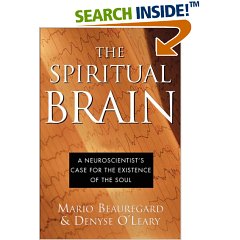
The Spiritual Brain – A Neuroscientist’s Case for the Existence of the Soul

the-spiritual-brain-2.jpgHarper Collins

Neuroscientist Mario Beauregard, Ph.D. and journalist Denyse O’Leary have written a very detailed and easy to understand account of the debate about whether the mind is merely the result of the chemical action of billions of neurons or whether it is something non-material, something spiritual.

Their conclusion, not surprisingly, is that there is rational scientific evidence indicating that the mind, a faculty of the soul, is spiritual. The approach is painstakingly rational. The book begins by examining the most recent affirmations of the materialist approach. Currently, Breaking the Spell: Religion as a Natural Phenomenon (Daniel Dennett), The God Delusion (Richard Dawkins), God is Not Great (Christopher Hitchens), and Letters to a Christian Nation (Sam Harris) are very popular anti-theistic books. There are conferences such as the Science Network’s “Beyond Belief” and the popular You-Tube Blasphemy Challenge. This materialist trend argues that science proves that there is nothing beyond the chemistry and physics of matter and energy.

Beauregard and O’Leary take these arguments apart very carefully in a scientifically rigorous manner and disprove them. More importantly, the book presents the results of Beauregard’s neuro-imaging studies of Carmelite nuns to actually document the neuronal activity associated with religious experience. Basically, religious states / mystical experiences (RSMEs according to the authors) are complex phenomena that involve many parts of the brain. They are not the result of genes or the by-product of certain parts of the brain. None of this proves the existence of God or of the soul. However, it does re-affirm the rationality and the moral dimensions of the choice of material versus spiritual explanations of religious experience.

This is a very good book for college students and educated members of the general public. An important book not only for the apologetics of faith in the post-modern world, The Spiritual Brain establishes the objective reality of religious states / mystical experiences (RSMEs) that are related to complex interpersonal transcendent encounters.

Tolle Lege.

Read More

Posted by on Mar 10, 2008

Good Friday: Identifying with Christ or Christ Identifying With Us?

In Search of God: Dr. Rowan Williams, Archbishop of Canterbury

sunrise.jpg

What do you tell yourself or others when there is doubt about the existence of God? I would like to recommend an interview with Dr. Rowan William, the Archbishop of Canterbury and head of the Church of England. The interviewer, John Humphrys, is from Channel 4 of the BBC.

The interview starts off in a genteel enough manner but builds into some rather intense exchanges. It is not a debate. In fact Humphrys begins by asking for a sales pitch – to be converted. Wisely, the Archbishop leads Humphrys to question his own questions in a manner similar to Socratic dialog.

It is a very good example of pastoral teaching, even if the inquirer does not seem to be entirely sincere. Take a look at the text or listen to the podcast.

Read More

Posted by on Mar 8, 2008

Good Friday: Identifying with Christ or Christ Identifying With Us?

Saint of the Day: St. John of God – March 8

st-john-of-god-2.jpg

St. John of God (1495 -1555) was born Joao Cidade in Montemor-o-Novo (Evora) in Portugal on March 8, 1495. He spent much of his life working in Spain for the Mayoral family in Oropeza as a shepherd. Later he became a soldier of fortune, enlisting twice in the army. After his second enlistment, which had taken him to Austria to fight the Turks, he traveled through Spain and North Africa. Juan Ciudad, as he was known in Spanish, settled in Granada and became a seller of books on chivalry and religion.

In 1537, St. John of God heard a sermon by St. John of Avila and underwent an intense conversion experience. His reaction was extreme. He destroyed his book shop and acted deranged for several days. He was finally committed to the Royal Hospital of Granada, since he seemed to have gone mad. A few months later, he left, calm of spirit, and put himself under the direction St. John of Avila. After a brief pilgrimage to the shrine of Our Lady of Guadalupe in southern Spain, he returned to Granada and took up his work in service of the poor.

He became known as Juan de Dios, John of God, because of his great love and service to the destitute and the ill. St. John of God was given a habit by the local bishop, who also confirmed the name everyone had given him. He was very good not only at soliciting money and support for his hospital but he also created a relationship between the donors and the recipients. Volunteers provided services and the recipients were encouraged to pray for their benefactors. He was at ease with all levels of society and was especially known for listening to people’s problems and offering encouragement if nothing else. St. John of God reached out to the most despised members of society, the prostitutes, and helped many to find other ways to support themselves and lead lives of dignity.

On his birthday, March 8, 1555, a day that would become his feast day, St. John of God went to his reward. The co-workers he had attracted, formed a religious order, the Hospitaller Brothers of St. John of God, to carry on his work all over the world. The core of St. John of God’s spirituality is hospitality – that virtue of acceptance and care that sees Christ in the guest at the door and among those most in need.

Read More

Posted by on Feb 11, 2008

Good Friday: Identifying with Christ or Christ Identifying With Us?

Feast of the Day: Our Lady of Lourdes – February 11

our-lady-of-lourdes.jpg

“The Lady took the rosary that she held in her hands and she made the sign of the cross. Then I commenced not to be afraid. I took my rosary again; I was able to make the sign of the cross; from that moment I felt perfectly undisturbed in mind. I knelt down and said my rosary, seeing this Lady always before my eyes. The Vision slipped the beads of her rosary between her fingers, but she did not move her lips. When I had said my rosary the Lady made a sign for me to approach, but I did not dare. I stayed in the same place. Then, all of a sudden, she disappeared. I started to remove the other stocking to cross the shallow water near the grotto so as to join my companions. And we went away. As we returned, I asked my companions if they had seen anything. ‘No,’ they replied. ‘And what about you? Did you see anything?’ ‘Oh, no, if you have seen nothing, neither have I.’

“I thought I had been mistaken. But as we went, all the way, they kept asking me what I had seen. I did not want to tell them. Seeing that they kept on asking I decided to tell them, on condition that they would tell nobody. They promised not to tell. They said that I must never go there again, nor would they, thinking that it was someone who would harm us. I said no. As soon as they arrived home they hastened to say that I had seen a Lady dressed in white. That was the first time.” [2]

On realising that she alone had seen the apparition, and not her companions, she asked her sister Toinette not to tell anyone what had happened. Toinette, however, was unable to keep silent, and told their mother, Louise Soubirous. Both girls received a beating, and Bernadette was forbidden by her mother from returning to the Grotto again.[3]

On Thursday February 11, 1858, Bernadette Soubirous, an impoverished, uneducated, 14 year old French peasant, had an experience that would not only change her life but would make would make her home town an international destination for pilgrims. Bernadette was not unlike many of the millions of girls around the world today growing up in stark poverty. Her parents and 5 siblings lived in a one room prison cell that had been abandoned because it was no longer fit for prisoners. Bernadette’s father was a miller and her mother took in laundry.

St. Bernadette would have a total of 18 encounters with the Lady of the grotto. The last one would be July 16. In the process of these visits, a miraculous spring of water would appear. People would be healed. The Lady would refer to herself as the Immaculate Conception. The grotto would be closed by authorities and people forbidden to pray there by the mayor of Lourdes.

Today, Lourdes hosts 15 million pilgrims a year. Paris is the only city in France that has more hotel rooms. The beautiful young woman, who died at the age of 33 from tuberculosis of the bone, refused to return to the grotto seeking a cure, saying only that the water was for others. Today 150 years after the first apparition, St. Bernadette’s body is still marvelously intact and uncorrupted.

St. Bernadette and the events of Lourdes met with intense skepticism and careful investigation by religious, political, and scientific authorities. Subject to medical and scientific review, thousands of healings have been documented which do not have a natural explanation. Yet only a fraction of the sick and infirm are healed physically. The prayerfulness and the experience of a community of faith continues to draw millions every year.

There is a saying associated with Lourdes that is especially appropriate. “To those who believe no explanation is necessary; to those who do not believe no explanation is possible.”

st-bernadette-of-lourdes.jpg St. Bernadette – the young girl

st-bernadette-soubirous.jpg St. Bernadette – at rest

Read More