Pages Menu
RssFacebook
Categories Menu

Posted by on May 24, 2008

Corpus Christi: The Body of Christ

Corpus Christi: The Body of Christ

Stephen’s bright blue eyes smiled as we said, “Lamb of God, Give us Peace.” According to the rubrics we were now to show each other a sign of peace. Yet with Stephen’s attention deficit disorder, which had already taken him in and out the brief service at least twice, it seemed that a little catechesis might help him be a little more aware of what we were about to do. Stephen is not a little boy. He is a handsome man in his early 30s, with a number of tattoos poking out of the v-neck and short sleeves of his starched jail issued smock.

The readings had been those of Pentecost. The second reading was from First Corinthians 12. “No one can say Jesus is Lord except by the power of the Holy Spirit.” This had struck all four of the men, but had made a special impression on Stephen. “Does that mean that when I pray the Holy Spirit moves my heart?” Stephen had asked. When I answered “Yes” his eyes got wide and he said that since his attention came and went and his thoughts were often jumbled, he thought his prayers were more bothersome and must be irritating. The notion that he is a temple of the Holy Spirit was as novel to him as it was consoling.

Stephen was back now and I shared a few words on the Lamb of God, recounting the Last Supper and the passion, death, and resurrection of the Lord. We do this in His memory as He requested of us. We are invited to the Lord’s table. Stephen and his companions were not new to the faith, but this brief memorial of our Great Memorial brought a renewed awareness to the others and a slack jaw from Stephen. He did not doubt, but could not help but marvel at the wonder of it.

As we shared the wonder of the Blessed Sacrament, our communion was truly a sharing in the Body and Blood of Christ. Bread blessed and broken at the Eucharist, celebrated in the parish, given to all, shared with all, and sent to those in need and to those in prison. The Body of Christ – Corpus Christi – saving us all from our prison of loneliness, our hunger for love, and admitting us to the feast of heaven here and now.

Read More

Posted by on May 5, 2008

Corpus Christi: The Body of Christ

Ascension Blahs

water_ripple.JPG

There is only so much joy and sunshine the soul can take. There is a rhythmic moodiness to California’s central coast. Unlike the interior valleys and the Sierra, which have more constant moods in concert with the sun and stars, the ribbon world on the sands and coastal planes changes from delight to gloom overnight — or sometimes within the hour. On our street, the fog, known by its more fluffy image as “the marine layer,” sometimes tiptoes and sometimes billows through the cypresses on Lighthouse Field and blots out the sun, roiling half way down the block before stopping on a whim in an evanescent whirl.

The Resurrection blossoms and the fulgent greens are quickly muted in the filtered gray light of the salty chill. The natives, loath to give up their flip flops and shorts, shiver in their sweatshirts as they pull their hoods over their brows to the bridge of their sunglasses.

So where has the Son gone? Why do we stand here looking up in the chill? Who turned off the party? Just when we found Him, they took him away again. No that would have been easier. It would be renewed grief. He said that it was time for Him to return to the Father and that He would send the Advocate who would teach us all the things that He still had for us to learn. Left behind … our consolation turned to desolation.

… And what to do? According to Father Ignatius, it is time to discern, to prepare for the movements of the soul that eddy from the Paraclete, that ripple from the heart, and echo in the fountain drops of the barely conscious. What now? Be still and know that I am the Lord.

Read More

Posted by on May 2, 2008

Corpus Christi: The Body of Christ

The Prophet and the Politician: Sen. Obama and Rev. Wright

obama_wright-rev.jpg

Many friendships have been lost on the rocks and shoals of political campaigns. The falling out between Senator Barak Obama and the Reverend Jeremiah Wright is the latest example of such casualties. What is most striking is the Rev. Wright’s strident message. He would probably say that this style is a cultural feature of the African-American church. In a response to questions at the Washington Press Club, Rev. Wright said that he had told Mr. Obama, that if he is elected President, Rev. Wright would be coming after him as the leader of a repressive government.

Is this prophecy – speaking truth to power – or is it an ego trip? Rev. Wright went to some effort in his address to the National Association for the Advancement of Colored People (NAACP) to stress the prophetic nature of his ministry and its African-American style. However, Rev. Wright appeared to have transgressed certain boundaries of acceptable political speech. His condemnation of the United States after the 9/11 terrorist attacks, positing them as something that was the natural outcome of United States’ policies abroad, went too far in many people’s minds. His appraisal of Louis Farrakanh, the Black Muslim leader who advocates Black separatism and superiority, as one of the most influential persons in the 20th and 21st centuries raised additional hackles More alarming was his support for the idea that the United States had created the HIV/AIDS virus to decimate African-Americans.

It was all too much for Barak Obama and for most of the people of the United States.

So how far do you go in prophecy, especially in the prophecy of invective? There is an argument to be made that the 9/11 attack had a lot to do with American actions against Osama Bin Laden that drove him from exile in Sudan to Afghanistan. Any student of U.S. history knows that American policies in many parts of the world have been part of oppression. Yet do you condemn a nation that has also had a history of doing many good things on the world stage?

What struck me most was the Rev. Wright’s anger. Was it the anger of a prophet zealous for his God or was it the anger of African-American oppression, frustration, and futility? When Sen. Obama first addressed the issue of the Rev. Wright’s preaching in a landmark speech on race in America, his talk was full of restraint, understanding, and hope. The element of hope has been greatly reduced in the Rev. Wright’s recent speeches.

Ironically, the title of Sen Obama’s second book, The Audacity of Hope, is taken from one of Rev. Wright’s sermons. In fact, it actually concludes his autobiography, Dreams From My Father. It is clear that Rev. Wright infused Sen. Obama with a deep sense of hope over 20 years ago. The prophecies of Jeremiah and others in the Old Testament tend to hold out an element of hope of future redemption – of reconciliation.

Unfortunately, two roads are diverging in the wood and the nation must decide whether it will pursue the road of hope or the politics of despair, division, and personal destruction.

Read More

Posted by on Apr 23, 2008

Corpus Christi: The Body of Christ

St. Anselm of Canterbury – Faith Seeking Understanding

st-anselm.jpg

Fides Quaerens Intellectum – Faith Seeking Understanding – is the theme of the philosophy and theology of St. Anselm (1033 – 1109). His feast day is April 21.  St. Anselm is regarded as the greatest philosopher of the 11th century and set the tone for the scholastic thinking of the early Middle Ages. Anselm represents a new beginning of a new civilization that ends the Dark Ages. His thinking is very much in line with the Neo-Platonism of St. Augustine.

St. Anselm’s writing on the nature of God and his proof for the existence of God emphasize the role of reason in understanding and shaping faith. His proof for the existence of God is meant to show that we can come to a knowledge that God exists from our own reason. Belief in God and His revelation is a gift of faith. However, faith is a reasonable course to take and of itself enlightens and encourages understanding.

It is often fashionable to dismiss the Middle Ages as a pre-rational time before the Renaissance and the Enlightenment. Unfortunately, this overlooks the importance of reason and the intertwining of faith and reason since the origins of Christianity. Although many of its concepts and their cultural context are foreign to us, the content and style of Anselm’s reasoning demonstrates a critical, analytical, and logical approach to dealing with questions of faith and living the Christian life.

Anselm’s notion of atonement, the redemption of the human race brought about by the death of Christ, is based on a concept of justice that seems – well – Medieval, and that is what it is. While it might strike some of us as portraying a vindictive God, St. Anselm presents it as arising out of the will of the Father and the Son to restore the human race. While we as post-moderns might see echoes of European tribal notions of compensation for injury or damage, St. Anselm is following the lead of many preceding philosophers and theologians to place the witness of scripture in a rational context.

Most of St. Anselm’s life was spent as a scholar and abbot. As Archbishop of Canterbury, St. Anselm had the unenviable position of being subject to two kings who attempted to exercise control over the church and plunder its treasury. St. Anselm spent years in exile.

Western critical thought and reasoning owes a debt to St. Anselm. As much as we might be inclined to relegate faith to the psychology of religious experience, St. Anselm reminds us that while the heart might claim our allegiance, our mind and reason challenge us to understand and live the faith of our hearts with the best of our minds enlightened by grace.

Read More

Posted by on Apr 18, 2008

Corpus Christi: The Body of Christ

Tectonic Faith Shift: Evangelicals – Pro Life, Pro Obama

religion-and-politics.jpg

Those who would dismiss theology as a parlor game need only look at the alliance of evangelicals with the political right in the United States. Before the emphasis on “family values,” evangelicals had a rich tradition of struggling for social justice and equality as sign of announcing the Kingdom.

There has been another Great Awakening – a cyclical occurrence in United States history. Evangelicals are disenchanted with the policies of the political right on global warming, military adventures, and the neglect of those in need. There is a growing feeling among evangelicals that they have been used by the large financial and industrial interests to further an agenda which is far from pro-life in the broader sense of the health, well being, and development of people and the environment.

Frank Schaeffer, a scion of one the founders of the Religious Right, issues a writ of divorce with his post at http://vox-nova.com entitled Pro Life, Pro Obama. Check it out.

Read More

Posted by on Apr 10, 2008

Corpus Christi: The Body of Christ

Memory, Identity, and Resurrection

sky-computer-generated.jpg

This Easter Season, I have been puzzling over why the people who lived with Jesus and shared the intimacies and hardships of his travels didn’t recognize him when they encountered the Risen Christ.

I have been reading Oliver Sacks’, Musicophilia: Tales of Music and the Brain, and came across the notion of emotional memory. Sacks relates the very tragic case of a brilliant music scholar and choral director who suffers an almost total amnesia as the result of encephalitis. He had no episodic memory, which meant that everything kept popping into existence all of the time. However, his ability to sight read and play music from memory was quite intact. He also “recognized” his wife and clung to her. Apparently, according to Sacks, our physical and emotional memory is somehow distinct from our memory of events past and present. It is something much deeper. He also states that our development of episodic memory comes to the fore after the age of two. In those first two pivotal years we develop deep emotional bonds. Learning music, riding a bike, and other types of motor learning have their own place outside of episodic memory. The bonds of deep love even transcend the loss of memory of specific events.

The scene in the garden with the Risen Christ and Mary of Magdala has always resonated deeply within me. Mary is still in a serious state of shock on top of her tremendous grief. Her disorientation seems almost complete when she hears her name in the music of a voice that transcends the memory of events.

So many oceans of ink and uncounted forests have been lost to the question of how we can find the Jesus of history. The disciples left us stories and experiences that are far beyond episodic memory. Their invitation is catechetical – an invitation into the mystery of a love and relationship so intense it is beyond time and memory.

Read More

Posted by on Apr 9, 2008

Corpus Christi: The Body of Christ

Theologika.net Welcomes Terry Hershey

terry-hershey.jpg

A sign of a person’s true enlightenment is how he or she handles the gods of the internet. Kathy and I had a wonderful telephone visit with Terry Hershey and his webmaster, Todd Roseman. We gave Terry and Todd a tour of Theologika.net and began the process of setting up the TerryHershey directory, where you can find many of his recommended books, materials, and web content. Generally, setting up a directory – which you can do by registering at www.theologika.net/search  – only takes a few minutes.

As fate would have it, we ran into a snag. My many years of experience in business, working with VIPs, began to haunt me. The pressure started to build. Not to worry, though. As advertised, Terry Hershey, a minister with degrees in philosophy and theology, landscape architect, speaker and writer, was delightfully calm and soothing. Just the sort of balance he talks and writes about. Terry is very upfront about the challenges of his life, which makes it easier to see our own lives in a calm and honest manner that helps us stretch and grow.

Kathy and I are sure that you will enjoy Terry’s newsletters and other great items on his website. You can find them easily by typing “Terry Hershey” into Theologika.net’s discovery engine at www.Theologika.net/search. Click on the items and you will be transported to the very peaceful and inspiring dimension known as www.TerryHershey.com.

Enjoy!

Read More

Posted by on Apr 6, 2008

Corpus Christi: The Body of Christ

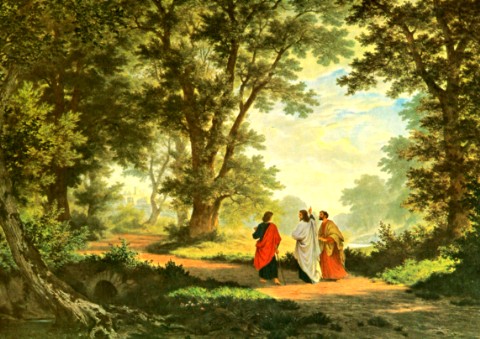
The Encounter at Emmaus

emmaus.jpg

I have been struck by the stories this Resurrection Season because for the first time, they strike me not as eye witness accounts of the Risen Christ, but as the challenge of faith for the disciples and us. The disciples on the way to Emmaus are leaving Jerusalem – returning home, perhaps, – grief stricken, but more importantly, disillusioned. The teacher has failed. The forces of evil have destroyed a very good and wonderful young man.

One way to see this story is to take it as another proof of the Risen Christ as encountered by his disciples. The story does convey this message. However, the story also tells us that we find the Risen Christ when He opens our minds to see the scriptures and when our hearts are opened at the Breaking of the Bread. Look for Him in the scriptures and invite Him in to dinner and your hospitality will be more than repaid.

There is just a glimpse – a flash of recognition and he disappears from our midst. The presence of the Risen Christ is a momentary and ongoing discovery. It is the result of searching, wandering, questing in grief and disillusionment and being open to the challenge of the Stranger.

All of us have moments, years, decades, in which everything we knew and had hoped for is swept away. The disciples had no clue of what was to become of their beloved teacher, but his torture and death threw them into utter grief and confusion. Yet their confusion only increased when they heard that other disciples had found the empty tomb and seen the angels. They were re-grouping, leaving town, trying to get some distance. A Stranger notices their grief and inquires. They listen and reflect on the scriptures and Break Bread.

This is the Christian life – the quest and the encounter in the village of Emmaus – continuing through all generations.

Read More

Posted by on Mar 31, 2008

Corpus Christi: The Body of Christ

Religious Environmentalism – Gottlieb: A Greener Faith

Mt. Fuji

Japan’s Mt. Fuji presents a beautiful backdrop for Tokyo, home to more than 32 million people. The last major eruption of this perfectly symmetrical stratovolcano came in 1707. Image from the Shuttle Radar Topography Mission.

The coming of Spring and all things green, including Earth Day, is a good time to read Roger S. Gottlieb’s book, “A Greener Faith.” Megan Jones, of the Department of History at the University of Delaware, has published a very good review on H-Net Catholic Discussion Network on the history and culture of Catholicism.

Gottlieb’s vision of religion takes in all of the major world religions and all indigenous or native expressions. For someone like myself, who studied environmental biology and social ethics in the 1970’s, it’s deja vu all over again. What strikes me as a card carrying anthropologist, though, is the assumption that since religion reflects culture and society, thinkers and practitioners of religion, from the New Age suburban shaman to the Archbishop, should embrace environmentalism as a way to validate religious experience in the face of the current atheistic onslaught from Dawkins et al.

On the one hand, there is the Christian notion of watching the signs of the times and the injunction to witness to justice. As Gottlieb observes, religion can bring hope to what seems to be a hopeless situation. However, I cannot help but resist the notion of “using” religion, of whatever stripe. As a universal anthropological phenomenon, religion closely mirrors the current situation of its social context. Re-interpreting religious texts and folk traditions does occur at times of crisis – in ways that are in keeping with the group’s social construction of reality.

What gives me pause are the laws of unintended consequences which I have seen first hand as a public health planner. Encouraging people to explore the environmental challenge is a social imperative. However, adopting a public policy agenda draped in the folds of religion appears to play into the criticism that religion is at base a tool of social control, without any transnatural referent that is not delusional.

So… Lead us not into religious environmentalism and deliver us from the temptations of the moment.

Read More

Posted by on Mar 31, 2008

Corpus Christi: The Body of Christ

Easter Communion or Condemnation?

holy-communion.jpg

To receive communion during the Easter season has been a long established precept of the Catholic Church. It is a practice that we should examine more closely. To receive Christ in the Holy Eucharist requires one to be in the state of grace – free of serious or mortal sin. We are advised – wisely – to put our souls in order. We are to turn away from sin and return to the community through the grace of absolution. There must be peace and love in our hearts and a definite change in our lives.

Fr. Burke, a Discalced Carmelite from Australia, expands on the notion of communion in terms of our living out the Sacrament of the Holy Eucharist in our shared lives as Catholics and Christians. In his article, “St. Teresa and Two Spiritualities in the Church Today,” at http://www.carmelite.com/, Fr. Burke explains St. Teresa of Avila’s views on legalism as opposed to true and complete union with God and each other. It is well worth reading.

Fr. Burke has put into words what I have been feeling ever since I read selections from the popular blog, Cafeteria Closed, by Gerald Naus, who writes as Gerald Augustinus. Naus came to the United States from Austria in 1997. A former Jehovah Witness, he became a Catholic in 2005. His views are decidedly Restorationist. Unfortunately, they are generally stated in tones of arrogance, condescension, or condemnation. His posts on culture, politics, and religion are inflammatory and provocative, akin to those of Rush Limbaugh and Ann Coulter, except that Catholicism is now the justification for neo-fascism. Naus’s recent post, On the Status of Palestinian Education, uses photos and a few inflammatory lines to libel all young Palestinian men. One might argue that many of Naus’s views are Catholic in the officially regressive sense, but there seems to be little of Christian charity or communion about them. From this narrow point of view anyone who does not agree with him is wrong and should be attacked. As a major blogger, Naus has a large following in which to sow his seeds of dissension.

You will know them by their fruits. (Mt 7:20)

Read More