Peter Maurin, with Dorothy Day, was a cofounder of the Catholic Worker — the newspaper and movement begun in 1932 to advance the social message of the Gospel for our times. Maurin believed that disconnecting social values from their basis in the Gospels causes the majority of the problems of contemporary society. He believed in the power of individuals to make a difference by living according to a new set of values — ones based on the radical social message of the Gospel.
Though Maurin died in 1949, these words of his offer hope for those who work to create a more just society today.
“The future will be different if we make the present different.”
Summer-like weather had kissed the coastal city in mid-winter. The warm sun shone brightly, not a cloud in the sky. Birds sang happily, chattering away noisily with their peers while enjoying their southern sojourn. Flowers bloomed merrily in every garden and by the wayside paths. It was the kind of day when no one should be stuck inside. But that was where she had been all day. There were dishes to wash, groceries to purchase, documents to proof-read, checkbooks to be balanced. That was all on top of caring for a small child and keeping him safe as he explored the many nooks and crannies of his world. By the time all was done and they could go outside, it was already time for her to begin dinner preparations, so someone else got to go out with him!
By late evening, as bedtime approached, dinner now having been completed, dishes done, beds ready for their occupants, the little guy decided he didn’t want to stop playing and get ready for bed. She was frustrated and tired — not at all in a mood to be patient and gentle. Fortunately, she recognized the need for a quick break and walked into another room long enough to regain a bit of peace. When she came out, the child ran towards her, his face one big smile from ear to ear. All memory of the battle waged a few moments earlier long gone from his mind. He had a story for bedtime. Could they read it? Of course, they could, and the rest of the evening ritual proceeded pleasantly. She even got a few minutes of quiet before retiring herself.
The experience of our “heroine” is, I think, all too common for many of us today. There is so much to be done. So many expectations of how quickly we must respond, so many opportunities to be “busy about many things,” that we end up over-stressed and missing the wonders of the present moment. Yet we would be well advised to notice the child’s way of living in each moment. After all, Jesus told his followers that the Kingdom is made of child-like people — people who can be present in the moment.
God exists in the Eternal Present. Every moment is new in that Eternal Present. Nothing carries over except God’s ever outpouring love. God does not hold on to the past — all is new and everything is possible. “Your sins I remember no more.” (Isaiah 43:25)
We, on the other hand, get stuck in the upsets, angers, resentments and disappointments of the past. Our ability to see and respond to love gets paralyzed. We become separated from our loving, ever present God and the wonder of ever new life flowing out as the present moment.
Jesus comes to lead us from that separation, that paralysis of living and re-living the past (aka, our sinfulness). Once we accept that healing, we can once again rise from our mats as did the paralyzed man in the Gospel (Mark 2:1-12), dancing in the joy of new life in God’s NOW.
Ash Wednesday, the first day of Lent, brings with it a reminder from Jesus of the importance of 1) caring for each other, especially those in need, 2) staying in close communication with God, and 3) strengthening our physical, mental, and spiritual lives through actions that help us develop more control over the urges that don’t lead us to God. The traditional names for such activities are almsgiving, prayer, and fasting.
Catholics who grew up before and during the years of Vatican II often think first of fasting or giving up something as the activity of choice for Lent. This practice was generally phrased in terms of “What are you giving up for Lent?” There were (and still are) days in which fasting from normal amounts of food was required of adults between the ages of 21 and 59. However, there were other days in the year which were also set aside for fasting, so that was not unique to Lent. What was unique to Lent was giving up something: candy, television, movies, cigarettes, drinking, etc.
Ash Wednesday’s reading from Matthew 6:1-18 is a reminder that all three practices are important and even interdependent. They are also to be done quietly, without great fanfare, and without even congratulating ourselves on how well we’re managing to do them! So, how can we — citizens of a busy, busy world — find time to pray, identify and organize resources to share with others, and make fasting somehow different than dieting?
A few thoughts come to mind.
1) Almsgiving: The sharing of worldly treasures has been a mark of the Christian community since its earliest years. Christians recognized from at least the time of St. John’s Gospel, and before, that Jesus is present in the community. To the extent that anyone is suffering from lack of basic necessities, those who do not lack them have failed to meet the needs of Jesus. This is a hard teaching sometimes, especially when times are tough and there is little left over to share. Remember: we are called to share our time, talents, and treasures. If what you have is time, then give of that. If what you have is talent (maybe for telephoning or organizing a bake sale), offer that talent to help provide for those who need food or shelter. If you have enough money (treasure) to support yourself and your family, then share from what you have; maybe eating more simply for a few meals or waiting an extra month before buying that new pair of jeans, and giving the savings to feed those who don’t have enough.
The important thing is to be open to sharing what you have and creatively listening for the opportunities to do so.
2) Prayer: Time for prayer is not easy to find — if you think you have to set aside an hour a day to pray. On the other hand, if you remember to intersperse prayer into your entire day, then it becomes easier. A quick thank you for the morning as you open your eyes, a blessing over breakfast, a smiled expression of gratitude for a pretty sight on the way to work or the joy of a child exploring her world, a few moments of reflection on how the day is going at lunchtime, a quick prayer for the right words to say in conversation with a friend or co-worker, a blessing at the end of the day, a few moments of reading scripture while supervising a child’s bathing — all are ways to pray in a busy life. God is present in all of these moments and in the unpleasant, difficult moments as well. But God generally doesn’t burst into our lives and shout, “Do This Now!” God is much more subtle, inviting us to notice the presence of the divine in the everyday creation in which we live, and always leaving us free to respond to that presence as we choose.
3) Fasting: Limiting the amount of food eaten, or not eating at all, is the generally understood meaning of fasting. Going hungry on occasion is a good thing to do. It helps develop a greater appreciation of the gift of food. It also helps strengthen the will, so when other things must be declined, the will is strong enough to do so. However, fasting from food is only one way to fast. The practice of “giving up something” was a form of fasting. When we turned off the television on weekdays during Lent during my childhood, we broke its spell and no longer felt we had to watch any programs. We had time to do things together as a family that we didn’t do when the television was on: board games, music, conversation, outdoor play, cooking together, etc.
Fasting today may mean limiting our consumption of: consumer goods, recreational activities, social media including Facebook, television, text messages, tweets, online games, lunches or dinners out, or (insert your own time-consuming activity). It creates a space for other things – for God to be noticed and heard.
Perhaps, out of fasting in this broader sense will come opportunities for prayer and resources for almsgiving as well. Then the circle of activities that quietly draw us closer to God will have become complete.
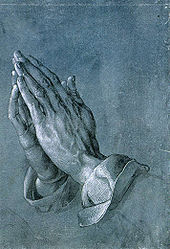
Praying Hands by Albrecht Durer – Public domain image
St. Catherine of Alexandria was born towards the end of the 3rd century. According to legend, she became a Christian at the age of 14 following a vision. She was known for her wisdom and is said to have successfully debated 50 non-Christian philosophers when she was only 18. Responsible for the conversion of hundreds of people, she was eventually martyred (around 310 AD). Condemned to death on the wheel, instead she was beheaded because the wheel broke at her touch. Catherine is remembered since the 14th century as one of the Fourteen Holy Helpers saints to whom people prayed especially for healing and protection from diseases.
In the middle ages, a tradition arose of celebrating her feast by visiting neighbors, singing songs requesting food and drink (cakes and breads or apples and beer). I came across this recipe for Catherine’s Cake (Kattern Cakes or Catterning Cakes). It is simple to make and would make a great project to do with children to help make it fun to be Catholic Christians. The detailed recipe on the web is written in metric system, however, there’s a basic description with quantities in the old English system we still use in the United States.
Catherine’s Cake
2 pounds yeast bread dough
2 oz (1/4 cup) butter
2 oz (1/4 cup) sugar
1 egg, beaten
A few caraway seeds
Frozen bread dough may be used, or make your own. Soften the butter and mix with sugar, egg, and caraway seeds, then knead into the dough. Allow to rise in a warm place for approximately 2 hours.
Once the dough has risen, either divide it into tennis ball sized loaves or form it into a larger loaf and place on/in a floured baking pan. Allow to rise another 30 minutes. If you have made the smaller loaves, flatten them slightly to make “cakes” for individual servings.
Bake in a moderate oven (350 degrees) for two hours. (Smaller cakes may require a shorter baking time.)
Invite in the neighbors and enjoy with sparkling cider or other festive drink!
Image in the Public domain –
From St. Catherine’s Monastery, Mount Sinai, Egypt
The great Carmelite reformer, mystic, and saint, Teresa of Avila, was known for sometimes blunt statements about the spiritual life and life in community. She insisted that the spiritual life was not about being gloomy or depressed. (“God, deliver me from sullen saints.”) Life in community required all to share in the daily work of the community so all might share in the joys of relaxation and the natural world. She knew that the fundamental reality for Christians is the love of Christ, a love that reaches beyond church buildings and monasteries into all of creation.
One of her statements, a sentence from a larger work, struck me today.
“Whenever we think of Christ we should recall the love that led him to bestow on us so many graces and favors, and also the great love God showed in giving us in Christ a pledge of his love; for love calls for love in return.”
What does this mean in my life or in your life? Take some time to reflect on this with me. Be practical. Some might find it means minding a tongue that can speak spitefully or spreading gossip. Some might find it mean patiently reading a story to a small child for the fifth time in one day. For some it might mean getting up and out to door to work. Others might be called to smile at a panhandler and offer a friendly greeting rather than walking past with eyes averted.
Then move to the larger world – regional, national and international concerns. What does love mean in these contexts? How responsible am I for what happens in my city, county, state or nation? Does it matter whether I get involved in political debates or not? Do I have any responsibility to those less well-off than I or to the children of other families? Do we as a nation (community) have responsibilities to protect and support those to whom we are not related by blood? What does love demand of us? What does it mean to love? Can I act in love and still support the national and international status quo?
I don’t have answers to these questions for everyone. I don’t even have answers to all of them for myself. I know I fail all too often to “love in return” in practical ways. Yet I believe these questions must be raised and it seems to me that Teresa of Avila’s reflection on God’s love offers a challenge for us today.
For St. Ignatius, the spiritual journey is a pilgrimage to the Holy Land and into the very life of Christ. The application of the sense is a type of prayer that is just the opposite of a “mind trip.” Here are some excerpts from Fr. Bob Gilroy, SJ, a Jesuit priest who is an artist, art therapist, hospital and jail chaplain and his beautiful site Prayer Windows.
Becoming Free for God’s Sake
In many ways, Ignatius helps retreatants paint a picture with the mind and senses. The aim of his manual was to inspire people, so that they could enflesh the Gospel of Jesus Christ and live their lives for God and others. This methodology heightened one’s awareness of personal weaknesses and strengths in order to know how best to serve others. The object is to undergo conversion in order to be free for God’s sake.
Composition of Place: An Example
For example, let us look at a selection from the second phase of the Spiritual Exercises, called “The Blind Beggar.” (Fig.15) As I prayed with Mk 10:46-52, which is the story of Bartimaeus, a blind man, I began to imagine the landscape of the setting. It was dry, hot and dusty as I found myself being Bartimaeus, sitting by the roadside. I can smell the animals as they pass by and hear people’s voices in the background. Then I realize from the conversation that Jesus is near, so I cry out to him. I hear the footsteps of someone I believe to be Jesus approach me. I become filled with eager anticipation. Jesus is so close I feel his breath on my face and I hear him say, “I trust you. If there is anything you want to tell me I will listen to you.”
At this point in my life I was wondering whether to consider other job opportunities. As I revealed my fears and hopes in prayer, I felt more freedom to continue looking for confirmation to remain in my present situation. I was asking to see how I could grow spiritually in order to help others by encountering Jesus in a deeper way. This was one example of Jesus restoring my sight in order to follow him.
The revelation of God through the stories of Jesus is made present through imaginative participation. The mind engages the heart. As Hugo Rahner comments, “… the aim of this mode of prayer is to make the events of salvation ‘present’ in the mind, and thus to attain that direct experience.” Ignatian Prayer Windows
Exercise
What scene in the life of Christ is your favorite. Spend some time there, in the moment, with the sights, sounds, smells, and feelings of the instant. What does Christ say and do to you and for you. How do you respond?
Concluding Prayer
St. Ignatius, you signed your letters “pobre de bondad,” poor in goodness, and called yourself a pilgrim. Please pray for me to be open to what God is calling me to do to announce and build up the kingdom. Transform my petitions into questions of discernment and pray for us to remember that all of our true needs and desires are already known to God. Pray that I be taken beyond my wants, beyond my fears, from death into life.
In your writings and by your example we are reminded to pray for the Church and the Holy Father, for all who dwell in darkness, and for the millions lacking food, water, and other necessities. We join our prayer with yours for true openness so that we can contemplate the Divine presence in all things and praise, reverence, and serve God Our Lord in action.Pray for us to have the courage to meet and to serve the Lord Jesus in the poor and the suffering.
Praise be to the Father, the Son, and the Holy Spirit
Now and Forever. Amen.
Roland Joffe’s 1986 Movie “The Mission” traces and telescopes the Jesuit missionary efforts in Paraguay. In 1995, the Vatican Film List singled out “The Mission” as one of 15 films of special religious significance. In this scene Fr. Gabriel (Jeremy Irons) plays his oboe to make contact with the Guarani after several of his brothers had been killed in similar attempts. The song is the now famous “Gabriel’s Oboe” by Morricone. Right click on this link to open it in another tab for a symphonic and choral arrangement as a background for your own meditation on this day of the novena.
The Invitation of Christ
St. Ignatius is very clear in his distinction between the Call of Christ and that of Satan. Like Gabriel’s Oboe, the call of Christ is peaceful, inviting, encouraging. The snares of Satan are fear, anxiety, and compulsion. These are the primary ways in which we can begin to discern the source of motions and movements within our soul. The banner of Satan has been called the path of least resistance while the banner of Christ is that of consciousness.
The banner of Christ requires openness, humility, and real courage, as we see in the scene from the movie. In fact, the Jesuit missionary experience in Paraguay would follow the path of the cross as the Portuguese killed the missionaries and enslaved the Guarani. This in turn was only the prelude to the suppression of the Society of Jesus in 1767 because of its opposition to the absolute power given to kings and emperors during the Enlightenment. The Society was restored in 1814.
A Growing Sensitivity
Wholeheartedness in the service of God demands a constant effort of discernment, a growing sensitivity to the will of God. Without this, generosity can lead only to ‘the expense of spirit in a waste of shame’…
At all events, Ignatius characterizes Lucifer as a tyrant who drives and compels his subjects (he uses a vocabulary of compulsion and trickery), whereas when describing Christ his vocabulary is one of friendship, persuasion, gentleness…
What I have to see is that my personal option must be made in the light of this universal vision. My choice must integrate me into the great movement of salvation already accomplished in Christ and now being worked out on earth. My choice will be a reproduction in me of the option of Christ who chose the cross, despising its shame. We may note that this idea finds its first development with Origen but is already contained in germ in the phrase of Ignatius of Antioch – ‘Let me be an imitator of the passion of my God’. – William Yeomans (emphasis not in the original)
Exercise:
Placing myself in God’s presence, I ask these questions of myself and the Holy Spirit. What is my path of consciousness? What is my path of least resistance?
Concluding Prayer
St. Ignatius, you signed your letters “pobre de bondad,” poor in goodness, and called yourself a pilgrim. Please pray for me to be open to what God is calling me to do to announce and build up the kingdom. Transform my petitions into questions of discernment and pray for us to remember that all of our true needs and desires are already known to God. Pray that I be taken beyond my wants, beyond my fears, from death into life.
In your writings and by your example we are reminded to pray for the Church and the Holy Father, for all who dwell in darkness, and for the millions lacking food, water, and other necessities. We join our prayer with yours for true openness so that we can contemplate the Divine presence in all things and praise, reverence, and serve God Our Lord in action.Pray for us to have the courage to meet and to serve the Lord Jesus in the poor and the suffering.
Praise be to the Father, the Son, and the Holy Spirit
Now and Forever. Amen.
“May Christ our Lord give us his grace so that we may be always sensitive to his will and fulfill it entirely.”
This quotation is the closing salutation St. Ignatius used commonly in his letters and represents the state of openness that is the goal of the Exercises.
The Forces of Good and Evil
The Second Week of the Spiritual Exercises prepares us to make the “Election” or the choice to serve Christ the way he has served us in complete humility by the way of the cross. St. Ignatius takes us through the life of Christ from the Incarnation to the Baptism at the River Jordan.
Before we can get to this election we have to deal with the parts of ourselves that still hold on to sinful ways, attitudes, and tendencies. For St. Ignatius, there are two competing kingdoms symbolized by their own flags or standards. By accepting the banner of Christ and His Kingdom, we reject sin and evil within ourselves and move from a position of self-interest to one of complete surrender to the Divine Will.
The Banner of Christ
“The issue at stake at this stage of the Exercises is not the fact of salvation or of Christ’s victory over Lucifer. That has never been in doubt and the whole theology of the First Week presupposes it. The question is how this victory is to be made a reality for mankind here and now, through my choice. There is no doubt in Ignatius’ mind that the banner of Christ is the Vexilla Regis, the banner of the cross, and the Election is going to be a setting out on the way of the cross.” William Yeomans, “The Two Standards”
Exercise:
What comes to my mind and heart when I say this prayer? What part do I play in God’s plan of salvation here and now: day in and day out?
Lord, teach me to be generous.
Teach me to serve you as you deserve;
to give and not count the cost;
to fight and not heed the wounds;
to toil and not seek for rest;
to labor and not ask for reward, except to know
that I am doing your will.
Concluding Prayer
St. Ignatius, you signed your letters “pobre de bondad,” poor in goodness, and called yourself a pilgrim. Please pray for me to be open to what God is calling me to do to announce and build up the kingdom. Transform my petitions into questions of discernment and pray for us to remember that all of our true needs and desires are already known to God. Pray that I be taken beyond my wants, beyond my fears, from death into life.
In your writings and by your example we are reminded to pray for the Church and the Holy Father, for all who dwell in darkness and for the millions lacking food, water, and other necessities. We join our prayer with yours for true openness so that we can contemplate the Divine presence in all things and praise, reverence, and serve God Our Lord in action.Pray for us to have the courage to meet and to serve the Lord Jesus in the poor and the suffering.
Praise be to the Father, the Son, and the Holy Spirit
Now and Forever. Amen.
Thank God for His mercy and grace. If not for His grace and mercy, I would have been so lost in drugs and alcohol and misery. He sent His son to die for each of us. What I have now is peace that passes all understanding, and His Spirit that lives in me to give me actual joy in life. finally joy and peace that I thought was in pain killers and booze. That wasn’t joy, that was being numb. Not now! Not anymore! Thank God for His grace. – blog comment on “Your Grace Is Enough for Me” by stormyweather
Reflection:
This testimony is a beautiful example of true reconciliation. It involves a transformative healing and could have come right out of the pages of the Gospel – The Good News.
Confession, or the Sacrament of Reconciliation, is high on St. Ignatius’ list of priorities for the First Week of the Exercises. The challenge for most cradle Catholics is focusing on a long Church approved check list of sins, as opposed to focusing on the person of Christ. The things that bother us the most are obvious if we are honest with ourselves. Often we can become neurotically obsessed with our own behavior in terms of small things, without facing major issues like alcoholic parents; sexual, physical, or psychological abuse; refusing to forgive. People in lifestyles or marriages that don’t meet Church standards can feel that somehow God is not interested in them; somehow He died only for the good people.
Most of the detailed lists cover symptoms of some type of break-down in our relationship with God as codified in the Ten Commandments or the Seven Deadly Sins: pride, avarice, lust, envy, gluttony, anger, and sloth. However, this can lead to a denial of our own feelings and cause damage in other areas of our lives. If my anger is always close to the surface, it is not really helpful to keep confessing it and beating myself up over it without looking more deeply at what its cause is. My marriage can be problematic and my sex life unsatisfying. However, if I just keep focusing on the symptoms instead of these deeper issues, I am wasting time and energy and building up to something that will be very bad for everyone concerned.
Sin, guilt, and remorse can be very complicated. Returning veterans from the Middle East have not sinned when they killed people if you believe in the just war theory of morality. That doesn’t mean that they don’t carry a great burden. When they lash out in destructive ways as part of Post-Traumatic Stress Disorder, marriages are lost, children are harmed, suicide can follow. Going down a checklist doesn’t even begin to offer the healing we all need in these and most situations. Let us look at ourselves, our loved ones, and all others with honesty and compassion as we embrace the forgiving Christ. We are worth everything to God. Perhaps the greatest sin when we don’t see ourselves as worth saving. God does not make junk.
Examination of Conscience
Place yourself in God’s presence and know that you are with a trusted friend. Put out of your mind all thoughts of an avenging father figure or some tyrannical authority figure. You are with the God who came to dwell among us and shared all things we endure except sin. Jesus was open and frank with people who came and spoke with him. He expects no less from you. If you are upset or confused, listen for the healing voice of your Friend. Open your heart and listen.
Start with a thank you for being redeemed and saved and for protection. Ask the tough questions. Why did my child die? What do I do with my alcoholic husband? My heart is broken. Can you mend it? I tampered with evidence to get innocent people convicted. I fought for tax laws that would protect me and take food, healthcare, housing, and education from the poor. I did my best to be careful, but I killed women and children in that village. I think the Church is wrong when it says we should get rid of the death penalty.
Be open to finding out the facts. Have I brought these issues to a counselor? How do I start to change things and to make amends. What is the deeper issue here?
Talk with Jesus. Accept His forgiveness. When he says “Go in peace and sin no more,” what will I do to make that a reality? If you are glum or downcast, something is wrong. You have been pardoned. Stretch, breathe, cry for happiness. Break out in song. Jump for joy. This day salvation has come to your house.
Concluding Prayer
St. Ignatius, you signed your letters “pobre de bondad,” poor in goodness, and called yourself a pilgrim. Please pray for me to be open to what God is calling me to do to announce and build up the kingdom. Transform my petitions into questions of discernment and pray for us to remember that all of our true needs and desires are already known to God. Pray that I be taken beyond my wants, beyond my fears, from death into life.
In your writings and by your example we are reminded to pray for the Church and the Holy Father, for all who dwell in darkness and for the millions lacking food, water, and other necessities. We join our prayer with yours for true openness so that we can contemplate the Divine presence in all things and praise, reverence, and serve God Our Lord in action.Pray for us to have the courage to meet and to serve the Lord Jesus in the poor and the suffering.
Praise be to the Father, the Son, and the Holy Spirit
Now and Forever. Amen.
Soul of Christ, sanctify me.
Body of Christ, save me.
Blood of Christ, inebriate me.
Water from the side of Christ, wash me.
Passion of Christ, strengthen me.
O Good Jesus, hear me.
Within Thy wounds hide me.
Suffer me not to be separated from thee.
From the malignant enemy defend me.
In the hour of my death call me.
And bid me come unto Thee,
That with all Thy saints,
I may praise thee
Forever and ever.
Amen.
A favorite prayer of St. Ignatius, the Anima Christi has its origins in the 13th century, but the author remains unknown. It may seem a little jarring to juxtapose the exuberant “Worthy Is the Lamb” with the ancient and more subdued Anima Christi. However, they focus on our recognition of the source of our salvation and the compelling power of God’s grace. Across 800 years, the cultural idiom may have changed but not the Holy Spirit.
Reflection
St. Ignatius focuses the First Week of the Exercises on sin and conversion. The activities concentrate on becoming aware of our sinfulness, our unworthiness, and God’s willing pardon. Sometimes this awareness can be overwhelming in inappropriate ways. The purpose of these actions is to change our hearts. In this regard, St. Ignatius is something of a behaviorist. His approach is to notice particular tendencies or actual sins and to keep a scorecard of our victories and defeats. Clearly, it is not enough to know our failings; it is more important to do something about them.
For those who are newly turned from sinful and self-destructive lifestyles, the First Week is a time of awareness, repentance, and a behavioral change in our awareness of our thoughts and actions. In many ways this mirrors St. Ignatius’ own experience during his conversion and pilgrim years. As a man of his times, he lived in a time of strict and rigid codes of honor, duty, and obligation. Feudal lords could exact terrible consequences from any of their vassals or peasants who breached obligations, whether the breach was real or perceived.
For many people today, Christian conversion is experienced in the intensity of the charismatic experience. The focus is on forgiveness, the terrible price Christ paid for each one of us, and the joy of our salvation. The reformation of our lives is worked out in this broader context.
Regardless of whether we are in the 16th or the 21st centuries, our journey begins with the experience of our salvation and the changing of hearts shown in our actual behavior.
Placing Ourselves in God’s Presence
Inhale slowly and deeply. Exhale slowly and mindfully.
Relax. Be at peace. Be aware that you are in God’s loving presence wherever you are.
Reviewing Our Lives With Gratitude
When did I first become aware of my sinfulness and God’s forgiving love? Who were the people in my life who showed me their changed hearts by their example? When did I first give or receive forgiveness from someone important in my life? When did I first stop looking at a check list of sins and realize that my actions could hurt and offend God?
Reflecting on Our Feelings and Spiritual Movements
What thoughts and feelings come to my mind and heart when I let God and others down? What do I feel when I see and reflect on the suffering and death of Christ? How do I feel when my love is not returned? Why is God’s love so encompassing?
Focusing on What Comes to Us
Let your feelings and images well up within you. What strikes you the most about the course of your life? What feeling or images come to you more clearly and peacefully?
Talking With Jesus Our Friend
Converse with Jesus as He is right now, right here – your friend. Share what comes from your heart – in a look, a few words, a smile. Talk frankly about the things that you are doing wrong in your life. Talk about grudges, bitterness, your regret, your shame. Ask for his healing and make a plan to start changing things, little by little, day by day.
Jesus, your love and your grace are enough for me. Let nothing come between us.
Concluding Prayer
St. Ignatius, you signed your letters “pobre de bondad,” poor in goodness, and called yourself a pilgrim. Please pray for me to be open to what God is calling me to do to announce and build up the kingdom. Transform my petitions into questions of discernment and pray for us to remember that all of our true needs and desires are already known to God. Pray that I be taken beyond my wants, beyond my fears, from death into life.
In your writings and by your example we are reminded to pray for the Church and the Holy Father, for all who dwell in darkness and for the millions lacking food, water, and other necessities. We join our prayer with yours for true openness so that we can contemplate the Divine presence in all things and praise, reverence and serve God Our Lord in action.Pray for us to have the courage to meet and to serve the Lord Jesus in the poor and the suffering.
Praise be to the Father, the Son, and the Holy Spirit
Now and Forever. Amen.
St Thomas the Apostle is often known as Doubting Thomas because he refused initially to believe the reports of the resurrection of the Lord. In today’s gospel reading from St. John (Jn 11:1-45), the raising of Lazarus from the dead, I saw something for the first time about St. Thomas that changed my view of him.
Jesus receives word that his fried Lazarus is seriously ill and prepares to head back to Bethany near Jerusalem. The apostles don’t think this is a good idea because they had just left the area after threats against the Master’s life. Jesus tells his uncomprehending followers that Lazarus is dead, but they are returning to Bethany so that his followers can see Him for who He is. This doesn’t appear to make any sense. It is a pointless suicide mission. Thomas doesn’t doubt. He is quite certain, but he is loyal and will not leave his master. His statement, “Let us go and die with Him,” is not skeptical. It is very certain. It is almost absurd in a 20th century style worthy of an an existentialist play.
In fact, Thomas is the grown up we are supposed to be. Look at the facts. Be reasonable, sensible. You may be willing, out of love, to sacrifice yourself for a great cause or a great love, but you approach it with knowledge, with courage, stoically.
This scene actually creates a set of book ends. The matching scene is the encounter with Jesus after the Resurrection, after Thomas had declared that he wouldn’t believe the reports until he saw Jesus personally. None of the apostles died with Jesus. In fact, at the time of his arrest Jesus told the authorities to take Him but to leave them alone. We all know the story of how they – and all of us – scattered in the night when the Shepherd was struck. Peter follows at some distance only to deny Him three times. John is the only man at the foot of the cross. In His time of need Jesus can count on His mother and a handful of women. All too true – real enough for the followers then and now.
Somehow it is easier to “to go and die with Him.” It sounds noble, altruistic. It is easier to believe in the finality of death than the open endedness that is resurrection. El sentido trágico de la vida – the famous Spanish existentialist manifesto – The meaning of life is tragedy. Yes, I know that is not the more literal translation – the tragic sense of life. The death of Jesus would indeed be the Great Tragedy another one of his great disappointments, another cosmic joke perpetrated on an accidentally occurring Homo sapiens.
As post modern people and followers, we are so overcome with the senseless suffering and death of millions that we claim that we believe. Yet our faith is more of an adolescent, impotent tantrum of defiance, because, in the end the facts are the facts. So, let us go and die with Him.
This is an interesting set up for Palm Sunday and Easter. Of course, this is just what St. John’s Gospel does. Jesus is the Resurrection and the Life. The challenge to us and to Thomas is to believe in a life beyond tragedy, absurdity, meaninglessness.
Yeah, well, heard that, been there… but it can’t work. It’s foolish. We are all dying. Just be brave about it. It is what it is. Resignation to the inevitable makes sense. Resurrection by our Best Friend who cries in grief and loss for us doesn’t make any sense at all. Or does it?
Image by Robert & Mihaela Vicol – Released to the Public Domain
The Gospel reading for today, the 31st Sunday of Ordinary time, Cycle C, is the story of the tax collector, Zacchaeus.
Zacchaeus lived in Jericho. He was despised by the people of the community because he was a tax collector. Being a tax collector in those days meant that he was free to extort as much as he could get from the people and had only to send a portion of it to the authorities at higher levels of government (ie, Jerusalem and Rome). He was the chief tax collector, taking money from all the tax collectors under his supervision and from his own work as well. The gospel notes that he was a wealthy man.
Now Zacchaeus was curious about Jesus and when he heard that Jesus would be passing through town, he went out with the crowd to see him. We do the same today when celebrities come through our own towns. However, Zacchaeus had a problem. He was a short man and there were lots of people in front of him. So he climbed a tree to get a better view.
Jesus saw him in the tree, stopped and called him by name to come down, saying that he (Jesus) would dine at the home of Zacchaeus that night. The people were horrified and scandalized. They asked if Jesus really could know who Zacchaeus was, that he was a terrible sinner? But Zacchaeus was touched by the healing love of Jesus in that moment and volunteered that he would return fourfold all that he had stolen and give half of his possessions to the poor. Jesus told all “Today salvation has come to this house because this man too is a descendant of Abraham. For the Son of Man has come to seek and to save what was lost.” (Lk 19:1-10)
This story got me to thinking. Who is Zacchaeus in our lives today?
It’s easy to point the finger of blame at celebrities who are promiscuous or who drink too much or who use illicit drugs. It’s easy to look at politicians who misuse their power. It’s easy to say that those who provide or seek abortions are great sinners. It’s easy to scapegoat people whose sexual orientation does not match our own. It’s easy to gloat when a minister is caught in some sin he or she has denounced from the pulpit.
But I don’t think that’s the lesson we need to draw from this account. We need to look at ourselves and see the areas in which we fail. We need to ask ourselves who we cheat, from whom do we steal, whose hearts do we break? To some extent each of us is Zacchaeus.
Then I suggest we go a step further. Who are the people in our lives whom we blame for what is wrong in society? Who are the people we would choose to block from access to the goods of life? To whom would we deny education, health care, food, clothing, shelter?
Do we blame undocumented immigrants and seek to exclude them and their children from the goods and services they need to live full, healthy lives? Do we suggest that the children of the undocumented who are born here should not be citizens by birth, thereby denying them the protection of the 14th Amendment of the Constitution? Do we look down on the laid off teacher, the unwed mother, or the disabled worker who receive unemployment, food stamps and Medicaid? Do we insist that people who can’t afford health insurance should just not get sick and/or need preventive care services? Do we say that only the well-to-do should be able to stay home with their young children and that mothers in poorer families should have to put their children in day care for long periods of time and work at minimum wage or less trying to earn enough to cover rent, food and childcare? Do we assume that all children of minority groups are probably gang members? Do we expect that the poor are somehow less intelligent and deserve to live in poverty?
I suggest that perhaps Zacchaeus takes many forms in the United States today. Some people we treat as if they were public sinners (Zacchaeus) because they are less fortunate or have made poor decisions in their lives. Somehow we are inclined to believe that those for whom all is going well are holy and specially rewarded by God for their good lives and that the opposite is true for those in difficult circumstances. Some of us are Zacchaeus in our world because of choices we have made that hurt others.
The good news is that Jesus came to bring salvation to us all, in whatever way we may personally be Zacchaeus and to whomever we treat with scorn or exclude as if he or she were Zacchaeus. And why does Jesus come to bring this salvation? Because “the Son of Man has come to seek and to save what was lost” and because the Lord will “overlook people’s sins that they may repent.” (Wis 11:23)
Good news indeed. May we be open to receive that salvation ourselves and to support others whom we might otherwise push aside as unworthy of the grace and blessings of the Lord.
In the Gospel for the 26th Sunday of Ordinary Time, Cycle C, Jesus tells the story of the Rich Man and Lazarus (Lk 16:19-31).
A rich man lived sumptuously, with everything money could by at his disposal. We don’t know how he came to have his money. Probably he was not a bad man. He was, however, a man who was not overly concerned with the plight of the poor of his community. We can assume this because a poor man called Lazarus lay on the doorstep of the rich man day after day, covered with sores, and the rich man did not take care of him. Even the dogs paid more attention to Lazarus than the rich man did. They came and licked his sores.
Now, in defense of the rich man, there were lots and lots of poor people around. Lots and lots of sick people. Maybe even some people who didn’t work when they could have worked to support themselves. Jesus doesn’t tell us what the rich man was thinking or why he didn’t stop to help Lazarus. He just notes that Lazarus was hungry, sick, and licked by dogs.
As Americans, the idea of having a dog lick one’s sores is not appealing, but it was even worse in those days. Dogs were not the much loved pets that they are for us. Dogs worked for a living or they were strays that fended for themselves. In many countries, dogs that were not working (tending flocks or guarding something/someone) were considered fair game as food by the poor. So here is Lazarus, lying sick and hungry at the door, having stray dogs licking his sores and unable to chase them away. Not a pretty picture.
As happens in life, Lazarus died. The angels of God swooped down, picked him up and took him to Abraham. Abraham, father of the Jewish nation, welcomer of all who came to him, welcomed Lazarus as well. He cared for Lazarus as one of his own.
As also happens in life, the rich man’s turn came to die. He died and was buried. But he did not find himself with Abraham. He was alone and in torment. He could see Abraham. He could see Lazarus with Abraham. He longed for a single drop of water to ease his pain, so he asked Abraham to send Lazarus with a drop of water for him. Note well — he didn’t ask Lazarus for forgiveness or for the gift of a drop of water. He asked Abraham to send/order Lazarus to bring the water.
Abraham reminds the rich man of the relationship that had existed in life between the two men. He also tells the rich man that there is a great chasm fixed between them, one that neither side may cross freely.
I had always wondered about that chasm. Why would a loving God set up a barrier that would keep those in His presence and company (Heaven) from reaching out and helping those who were not (Hell)? Wouldn’t those who were united with Love and in Love be so overflowing with love themselves that they’d want to help those who were separated from Love?
Our homilist this Sunday, Fr. Ken Lavarone, OFM, addressed this question. Fr. Ken pointed out that the chasm between the two men was one of lack of relationship. Lazarus could not come to the aid of the rich man because there was not a relationship between them. The rich man had always stepped over Lazarus or ignored him. Even after death, the chasm remained. The rich man spoke to Abraham, not to Lazarus.
Jesus’ story continued. The rich man asked Abraham to send Lazarus to warn his brothers of the fate that awaited them – sort of like in Charles Dickens’ A Christmas Carol. Abraham responded that the brothers had Moses and the prophets to warn him, as the rich man himself had had. When the rich man noted that the brothers wouldn’t listen to Moses and the prophets, Abraham retorted that those brothers would also not listen to one who returned from the dead.
These final lines of the story are of huge import for us as well. They were directed to the religious, church-going folks of Jesus time and of the early Church. Jesus returned from the dead. Affirming the message of Moses and the Prophets, Jesus said we are to care for the poor and helpless among us. How we do it will vary. Some will have monetary resources that will be shared. Others will have talents that can help make life more bearable for their less fortunate sisters and brothers. Some will only be able to offer a smile and a kind word — a recognition that the other person is also human and worthy of respect. Each of these responses is a way of entering into relationship with the other person. Each of these bridges chasms that would otherwise keep them apart.
In Jesus’ story, both men were children of Abraham due to their identity as Jews. Today, we know that we are all children/descendents of one woman who was a member of a group of people who lived in Africa around 200,000 years ago — a woman known as “Mitochondrial Eve.” We all have a responsibility to each other. We all can give the gift of a smile that raises another’s hopes and heart. We all sometimes turn away from the circle of community of God’s children. The good news is that someone did return from beyond the grave with a reminder that we can turn back at any time. We just need to remember that care of God’s little ones (the poor and the powerless) comes first when we choose our elected officials, design our social safety nets, vote for funding of community services, and allocate our personal resources of time, talents and treasure.
“… What woman having ten coins and losing one would not light a lamp and sweep the house, searching carefuly until she finds it? And when she does find it, she calls together her friends and neighbors and says to them, ‘Rejoice with me because I have found the coin that I lost.’ In just the same way, I tell you, there will be rejoicing among the angels of God over one sinner who repents.” (Lk 15:8-10)
This passage of Luke’s gospel falls between the account of the shepherd who goes searching for one lost lamb from a flock of 100 sheep and the story of the Prodigal Son whose father, even more prodigal in his love, welcomes home the child who has betrayed him, the family and the community then returned to ask forgiveness.
As I listened to the Gospel at Mass this morning, I found myself musing that most of us wouldn’t really worry all that much if we lost a coin. It’s not an image that awakens immediate comprehension in an American audience. After all, for most of us the loss of a penny, nickel, dime, quarter or even a dollar coin will not make a huge difference in whether or not we eat or have a place to sleep tonight!
As happens sometimes, I began musing about what might make the gospel more immediate for Americans and I remembered an experience from my early teenage years.
When I was about 12 or 13 years old, my father led members of our parish in starting a credit union. For many years, the credit union “office” was our dining room table. Eventually a porch was enclosed and the new room became a more formal office. A few years after I got married, the credit union moved out of the family home to an office of its own. But there were many memorable moments before that move took place.
One of those moments happened on a bright summer morning when the phone rang around 10 o’clock. An elderly man in the parish had passed away a few months earlier. His children were cleaning out his home before selling it. They had moved the mattress off the bed and found an envelop containing ten one thousand dollar bills. They asked my mother to come over to the house and pick up the money as a deposit to their credit union account. Mom was bonded, so if anything happened to the money on the way to the bank, it would be insured.
Mom brought the envelop home to prepare the bank deposit and each of us got a chance to hold a $1,000 bill before she took it all to the bank. Now there was a “coin” for which an American woman (or man) would scour the house and even have a party when it was found!
Still, Jesus didn’t come to call only those with lots of $1,000 bills. And the point of the story was that there is rejoicing in Heaven when even seemingly small, unimportant folks are found. God, who is Love, welcomes all and is especially pleased when those who have turned away in ways great or small, turn back again to love.
Our pastor, Fr. Ron Shirley, spoke of an observation made by the director of Covenant House, a program for children living on the streets in the United States, Canada and Central America. The director noted that although the children/teens ask questions about practical needs, their deeper, unspoken concern is whether God could still love and forgive them for what they’ve had to do to survive their lives on the streets.
The story of the woman searching for her coin – her penny, nickel or dime – is the answer to the children’s question. Of course God still loves and forgives them. And even better, God still loves and forgives us – the adults who allow conditions to continue in which children are exploited, the poor are left to struggle on their own, the elderly are ignored or abandoned and people around the world are denied the opportunity to live with basic human dignity, food, clothing, shelter, health care and education.
The catch, of course, is that we are expected to do our part to make this a world with justice and peace for all as we turn back to our God. We are to pray for each other, including those who have harmed us, and we are to work to bring the kingdom of justice and peace into being here and now. That’s the good news Jesus brought to the men, women and children of His time. It’s the same word He speaks to us today. We all matter to God and the angels rejoice as we return to God and love others in turn. That love is to have practical consequences in our world.
I’ve seen this quote from Father Pedro Arrupe, S.J. in the past and always been delighted with it. I came across it again today. It seems quite apt as we are celebrating the time of the Holy Spirit of Love during this season of Ordinary Time.
Nothing is more practical than
finding God, that is, than
FALLING IN LOVE
in a quite absolute, final way.
What you are in love with,
what seizes your imagination,
will affect everything.
It will decide
what will get you out of bed
in the morning,
what you do with your evenings,
how you spend your weekends,
what you read, who you know,
what breaks your heart,
and what amazes you with
joy and gratitude.
Fall in love, stay in love,
and it will decide everything.
Your subscription gift helps make this ministry possible. Thank you!
Our Vision
The mystery of God’s love and presence in creation and in our daily lives awakens a sense of wonder and awe in us. We reflect here on the moments in which we become aware of the divine presence and begin to enter the dance.
The Synod has ended. Bishops, priests, nuns, and lay persons from around the world have again gathered in Rome to pray, listen, and reflect on where the Holy Spirit is leading us as a community in this new era. As their reflections and recommendations are offered to us, we are invited to join them in prayer as we move forward, always open to the guidance and inspiration of the Spirit.
Our Supporters and Friends
Help Support Theologika
Theologika.net is a participant in the Amazon Services LLC Associates Program, an affiliate advertising program designed to provide a means for sites to earn advertising fees by advertising and linking to Amazon.com.
Your purchases of resources through our links to Amazon products help support this ministry. Thank you.