Pages Menu
RssFacebook
Categories Menu

Posted by on Apr 9, 2010

Great Love or Great Suffering – Two Paths to Non-duality

Great Love or Great Suffering – Two Paths to Non-duality

Richard Rohr, OFM

Recently I’ve been listening to Fr. Richard Rohr’s three CD set, Exploring and Experiencing The Naked Now, a recording of two webcasts in which he talks about his work on non-dual thinking and the insights of the contemplative/mystic tradition of Christianity. Rohr’s work provides a fine background for the last couple of weeks of Lent and moving into Easter.

A central insight of Rohr’s work is that non-dualistic thinking is central to experiencing the mystery of Christ and the Trinity. God is One, yet we know God as Father, Son and Holy Spirit. The contrast boggles the mind when we try to explain, define or otherwise pin down the mystery. Our minds, trained to make logical distinctions and put all we experience into categories of “this/not that,” find it hard to deal with the “yes/and”  of combining such seemingly irreconcilable statements. Nevertheless, Jesus calls us into the mystery and teaches through example, images and stories that seem to contradict each other. In one place, for example, he says that his followers are to turn the other cheek when someone strikes them. In another, he counsels that it’s time to take swords along to the place where he and is friends planned to spend the night. At yet another, he turns over the tables of the money-changers in the temple and drives them out. Then when the chips are down, he heals the ear of the servant of the High Priest in the Garden of Gethsemane and goes to his death without offering resistance. So which is it? Non-violent always or Violent sometimes? Do we simply choose one meaning – the one that suits what we want to do – or are we supposed to try to make some logical sense of the contrasting statements/actions or must we somehow live in the mystery, without needing to explain it logically. And if we do that, won’t we be seen as somehow immature and childish?

Rohr suggests that a return to the contemplative mindset is essential in the long-run. It is the ultimate goal of the spiritual life. Union with God, a return to the non-duality of the Garden of Eden, is the final goal of our lives and quest. We start non-dualistically as infants and small children. We move away from non-dualism around the age of reason and begin to be able to separate from God, make wrong choices, and, dare I say it, to sin. We learn what is right and what is wrong. We learn to make distinctions. Then we think we’ve got it all set for the rest of our lives. But we’re right smack dab in the middle of a dualistic world and mindset. So everything gets phrased in terms of win/lose or “limited good” (a concept from anthropology) — what is good for you will take something from me. We forget, or perhaps haven’t consciously experienced, that God’s love comes to us like water flowing through a pipeline or electricity flowing down a wire. As long as there’s no blockage, it just keeps coming. The critical thing is to keep the pipe open, the transmission line unbroken. But that gets scary. The “what ifs” start raising their ugly heads. And we fight against anyone or anything that seems to threaten the way things are now, even if it’s not ideal. And so we block the flow, partially or totally.

Rohr argues that the only way we can move beyond dualism in our thinking and again enter non-dualistic reality is through the path of great love or the path of great suffering.  In both situations, the normal ways of coping or experiencing reality fall away.  We don’t have the energy to block the flow. We’re too deeply in the joy or sorrow. “Everything’s coming up roses …” as the song says. Or, alternatively, we cry out, “My God, my God, why have you abandoned me?” Where are you when I need you God? In either condition, we are open to experience the wonder of God’s love and compassion without trying to (or even being capable of) splitting it into dualistic compartments or categories. The experiences are too overwhelming, too all encompasing, too intense to allow for separation and dualism. And then we can grow in wisdom. And we experience redemption – a return to union with our God – set free from the normal ties that hold us bound in worry of losing our “secure” duality.

Meanwhile, “back at the farm,” the troubles and tragedies of world events continue through Holy Week.  A small group of people are arrested for plotting to kill a police officer and then kill more officers at his funeral, all in the name of Christ. What madness is this? Bombs explode in crowded places around the world, in the name of God. What madness is that? How can religious people believe that the creator of all of us and of all of the wonders of the universe could want us to be killing each other? And how could we dare to think we do it in his name, by his authorization? How can Christians be terrorists, as Leonard Pitts notes in a recent column? Is our God really so helpless or so impotent that he could condone such action, such dualistic us/them action?

Jesus went to the cross rather than try to force God’s hand to free his nation from the Romans by inciting a rebellion, as some would have liked. He went to the cross rather than deny the truth that God is more interested in the way we treat each other than in the sacrifices we bring to the altar. He went to the cross rather than run away and deny that he had experienced a very special relationship with his Father, one that the Father wants to share with the rest of us too. And redemption came out of that great passionate love and suffering. Easter came to all the world and our separation from God came to a resounding end.

May each of us move forward in this Easter season in joy and trust, building on the faith of our younger years and beginning to enter into the world of contemplation, of not dividing the “real” from the “ideal,” of really believing the Good News, that love is all that really matters, and love will make all the suffering lead to the peace and deep, deep joy of the children of God.

Read More

Posted by on Mar 29, 2010

Great Love or Great Suffering – Two Paths to Non-duality

God to the Rescue

The Resurrection of Lazarus - Byzantine icon - 14th-15th century

As we move more deeply into Holy Week, I find myself still reflecting on the reading from the Gospel of John that is used in the liturgies for the Scrutinies as part of the Rite of Christian Initiation of Adults — the story of the raising of Lazarus. In our parish, we celebrate the Scrutinies as a community, with all invited to examine our own lives for areas of thirst, blindness, and death within us. Generally during the week following the third scrutiny, area parishes schedule Reconcilation services in preparation for Holy Week and Easter. The three weeks of RCIA celebrations are a good preparation for Reconciliation.

But back to the story of Lazarus. Our celebrant and  homilist on the third Sunday this year was a visitor who had been pastor of our parish many years earlier. I always look forward to hearing new insights from him and I often remember homilies from those earlier years as well. This year he explained that the name Lazarus could be roughly translated as “God to the Rescue.” It comes from the Hebrew name, Eleazar, which is translated “God has helped.” In both the story of the raising of Lazarus and the parable of Lazarus and the Rich Man, God comes to the rescue of an individual in great need. The raising of Lazarus is one of the great signs in John’s telling of the Good News to lead us to faith in Jesus.

Another point that always strikes me in the story of the raising of Lazarus is the order Jesus gives the bystanders when Lazarus comes out of the tomb. He tells them, “Unbind him and set him free.” Lazarus can’t do it himself. And we can’t do it for ourselves.

We are each tied up by so many expectations, fears, patterns of behavior, traditions, and so forth that it can be next to impossible to try something new or to discover deeper levels of meaning or being in our lives. Going away to another community or to college can be a way that an individual becomes freed to experiment and learn who he or she is or wants to become. But not everyone has that opportunity. And for the majority of our lives, we live in communities where we are known, with people/family/friends who know us and expect certain behaviors and responses from us. Because of this each of us needs our family and friends to unbind us and set us free, just as Lazarus needed his community to set him free to live again.

In the Gospel of John, Lazarus is a “type” of the Christian disciple. He is the “everyman” character who represents all of us. We are all the ones whom God has rescued. We are all the ones freed and instructed to set the other free.

During this Holy Week, as we prepare for the Easter mysteries, plumbing the depths of sadness and rising to the peaks of joy in our liturgies, may we all be ready, like Lazarus, for God to come to our rescue, for our family and friends to set us free, and in turn to be the ones ready and willing to give that same gift to those with whom we share our lives.

Read More

Posted by on Feb 16, 2010

Great Love or Great Suffering – Two Paths to Non-duality

And Once Again, The Seasons Turn

Mardi Gras beads

It’s Tuesday afternoon, the day before Ash Wednesday, a day called Mardi Gras  or Carnival in many places. The sun is shining yet again here in Santa Cruz, as it did all weekend, with warm breezes, bird song, blooming fruit trees, sour grass, wild radish, camelias and daffodils to celebrate the wonder and promise of Spring. A far cry from the winter so many people are still experiencing here in the Northern Hemisphere. It should be noted, that this beautiful weather will not last for long. Already storms are lining up out on the ocean for the end of the week. But today it is beautiful.

I’m sitting here thinking about the interesting confluence of themes that have met this week. Sunday was Valentine’s Day, a day of hearts and flowers, a day of many marriages, the birthday of a friend from graduate school whom I remember fondly, a day of gifts and remembrances for those we love. For some it’s a day of disappointment or sadness, when a loved one is not thrilled, or when no one is there to say “I love you,” or when a relationship has ended and the hurt has not begun to heal.  

Sunday was also the day many people in the world celebrate the beginning of a new year, a day we call Chinese New Year, though it isn’t only the Chinese who celebrate this day. Parades, parties, special foods, gifts, and good wishes abound.  It’s a day of hope for the future.

This particular Sunday, the readings of Cycle C from Jeremiah, Paul and Luke challenged us to keep our focus on the Lord and not put our fundamental trust in the things of this world. Calling the poor, the hungry, the weeping and the excluded ones among us blessed, Jesus warns that those who find life easy and who never challenge the status quo for fear of arousing the enmity of those in power are not close to the kingdom of God. It’s a message that is far from our American cultural concept, drawn from the earliest colonial days, that those who are economically secure and respected by their fellows are those blessed by God, while those who are poor, sick, injured, or otherwise disadvantaged are somehow not pleasing to God and are being punished.

Father Ron Shirley, our pastor, in his homily told the story of a wedding toast. The best man offered a toast wishing only the best for the bride and groom, with never a moment of pain or sadness. Then a stranger stepped up and offered a toast. He was dressed simply and seemed out of place. He assured the couple that he loved them deeply then offered a series of strange wishes for them – that poverty, sorrow, pain, and controversy would be part of their lives.

Today we celebrate Mardi Gras – with rich foods, parties, celebrations of abundance and the promise of good things to come.  And tomorrow we enter into a time of reflection, of conversion, and of returning our attention and our intentions to God and the works of God. Are they opposites or mutually exclusive? I don’t think so. Jesus and his followers certainly didn’t go around in sack cloth and ashes, continually fasting. They were criticized for their love of good times and celebrations. But there is a time and a place for abstaining from some of the good things of live in order to be open to the deeper fundamentals of God’s life and love for us. Jesus and his followers quietly entered into those times as well.

And so we follow them into these weeks of reflection and self-control, as we break our addictions to the excesses of the world around us and try to be more open to the quiet wonders of God’s love in people and in nature. The season is turning. New hope is in the air. Easter is coming soon.

May these days of Lenten preparation be full of the awareness of the Lord’s presence in your life and of the abundance of His love and support in all of life’s challenges.

Read More

Posted by on Feb 5, 2010

Great Love or Great Suffering – Two Paths to Non-duality

A Community of Fishermen (and Women)

Going Fishing

The Sunday readings over the past few weeks have touched on the theme of being called. Called to speak on the Lord’s behalf as a prophet, called to preach the good news, called to teach, called to lead the people, and so forth. In years past and today, in all times and places, the Lord calls ordinary people to speak and act on his behalf.

The readings for this coming Sunday, the 5th Sunday in Ordinary Time, Year C, tell of the vision and call of Isaiah, the call of Paul to be an apostle and the call of Peter, James and John. Each of them responded in a similar manner when they realized Who was calling them. “Woe is me, I am doomed!” says Isaiah. “…I am the least of the apostles, not fit to be called an apostle, because I persecuted the church of God,” says Paul. “Depart from me, Lord, for I am a sinful man,” says Peter.

However, the Lord does not leave. Instead, a seraphim takes an ember from the altar of the Lord and purifies the mouth of Isaiah. Paul comes to faith through a period of physical blindness, receiving care from those he had journeyed to persecute. Peter and his companions are comforted, “Do not be afraid; from now on you will be catching men.”

Each then responds with willing service. Isaiah hears the voice of the Lord, “Whom shall I send?” and responds “Here I am. … send me.”  Paul tells us, “by the grace of God I am what I am and his grace to me has not been ineffective.” Peter, James and John took their boats to the shore, left everything and followed Jesus.

Each of these ordinary people heard the Lord’s call in his own way and within his own everyday world. Their response is remembered today. Unfortunately, we often think that they were some sort of unusual people, extra holy or something – worthy to be called by God. But really, they were just ordinary people. When they heard God’s call, they answered “yes.” They hadn’t gone out of their way looking for God. They didn’t consider themselves particularly prepared or inclined to teach or preach or lead a community. Yet when the Lord asked them to do these things, they did them.

We too are called. We too have something the Lord needs and wants us to do. Each of us is to listen for the voice of the Holy Spirit guiding our way and leading us into our worlds to share the good news, to remind others that God loves even those whose lives seem least worthwhile or important. We don’t know when or how it will happen that we will speak the Lord’s words to the person who needs to hear them. That’s OK. It doesn’t matter if we know. All we have to do is keep trusting the Holy Spirit to guide and then live as lovingly as we can.

A woman I’ve known since childhood has an approach that I often remember. She talks of “going fishing” when she finds herself in a position to share her experience of God’s love and care with others. Each of us is called to “go fishing” with the Lord. He’ll make us partners in his mission of fishing for men, women and children to build the kingdom of God together.

Read More

Posted by on Aug 30, 2009

Great Love or Great Suffering – Two Paths to Non-duality

Act on God’s Word – August 30, 2009

Fr. Ron Shirley

Fr. Ron Shirley

The following is today’s homily from Fr. Ron Shirley, pastor of Resurrection Parish in Aptos, CA. Today’s readings are for the 22 Sunday of Ordinary Time, Cycle B. (DT 4:1-2,6-8, JAS 1:17-18,21b-22,27, MK 7:1-8, 14-15, 21-23)

Fr. Ron’s homilies are available every week at www.FatherRon.com.

An elderly priest made a retreat. In the course of it he was struck deeply by three things that he’d always been aware of but never had really taken to heart.

First, there are millions of people in the world who are hungry and homeless. Second, he had spent his entire priestly life preaching comfortable sermons to comfortable people. Third, he had bent over backwards to avoid disturbing or alienating people.

In other words, the priest found himself to be much like the priest played by Jack Lemmon in the film “Mass Appeal.” He preached only about those things that didn’t disturb his parishioners and made them feel good.

And now, like the priest in “Mass Appeal,” the old priest suddenly realized that he had been more worried about pleasing his people than about preaching the Gospel. He had been more worried about rocking the boat than about challenging his parishioners to look into their hearts to see if they were satisfied with what they saw there.

The week following his eye-opening retreat, the old priest looked up the Scripture readings to prepare his Sunday homily.

As he read the Gospel, these words of Jesus leaped right off the page: “These people honor me with their lips, but their hearts are far from me.”

The priest resolved, then and there, that he was going to share his soul-searching with his parishioners. So he began his homily by saying:

“My homily this morning will be exactly 30 seconds long. That’s the shortest homily that I’ve ever preached in my life, but it’s also the most important homily I’ve ever preached.”

With that attention-grabbing introduction, the priest gave his 30-second homily. He said:

“I want to make just three points. First, millions of people in the world are hungry and homeless. Second, most people in the world don’t give a damn about that. Third, many of you are more disturbed by the fact that I just said damn in the pulpit than by the fact that I said there are millions of hungry and homeless people in the world.”

With that the elderly priest made the sign of the cross and sat down.

That homily did three things that many homilies don’t do.

First, it caught the attention of the people.
Second, it caught the spirit of Jesus’ words in the gospel.
Third, hopefully it made the people look into their hearts.

The story of this priest and the gospel reading make the same point.

Religion is not something we do on Sunday. It’s not primarily, observing certain laws, saying certain prayers, or performing certain rituals.

That’s what many people in Jesus’ time had turned religion into. To observe these rituals was to please God. Not to observe them was to sin. In short, observing rituals became identified with being religious.

To illustrate the hypocrisy of such legalism, William Barclay tells this story – about a Muslim pursing an enemy to kill him. In the midst of the chase, the Azan, or public call to prayer sounded. Instantly the Muslim got off his horse, unrolled his prayer mat, knelt down, and prayed the required prayers as fast as he could. Then he leaped back on his horse to pursue his enemy in order to kill him.

It was precisely this kind of legalism that Jesus opposed so vigorously in his time.

Jesus made it clear that religion isn’t something you do at certain times on certain days. It’s not saying certain prayers or performing certain rituals. It’s a thing of the heart. It’s a thing of the heart called love – love of God and love of neighbor. Love in action.

Today’s Scripture reading invites us to look into our hearts and to ask ourselves to what extent the words of Jesus in today’s gospel reading apply to us: “This people honor me with their lips, but their hearts are far from me.”

The Scriptures also invite us to look into our own hearts and ask ourselves to what extent the words of James in today’s second reading apply to us:

Act on (God’s) word.
If all you do is listen to it, you are deceiving yourselves.”

I hope this homily today did 3 things:

First – it caught your attention.
Second – it caught the spirit of Jesus’ words in the Gospel.
Third – it makes all of us look into our hearts!

Read More

Posted by on Aug 18, 2009

Great Love or Great Suffering – Two Paths to Non-duality

Aurelius Augustinus – You Done Us Wrong?

Redwoods

While camping recently with my wife and daughter in the redwoods near Santa Cruz, I spent some time with an enlightening and very readable book.

Christopher Hall in Learning Theology With the Church Fathers does a good job of summarizing St. Augustine’s notion of the fallen nature of humanity. St. Augustine is convinced that something went terribly wrong when Adam ate the forbidden fruit so that we are not capable of really loving and knowing the good until we are redeemed in Baptism. Of course this led not only to the notion of infant baptism but also to the notion that unbaptized infants would suffer the wrath of God in eternal punishment. It is logically consistent but it seems to be extreme and never became as much of a prominent idea in the Orthodox East as it did in the Catholic and Protestant West.

This doesn’t square with the Black civil rights assertion of human dignity: “God don’t make no trash!” In fact, it seems at odds with the fundamental goodness of creation which St. Augustine upheld in the face the Gnostic conception that creation was a mistake by a lesser god and matter is evil.

Today we might explain these things as laziness, psychological conflicts, compulsions, addictions, or unhealthy repression.

In St. Augustine’s defense, we should remember that he is also considered one of the founders of psychology. His concepts of memory, will, and understanding as the core of individual identity still hold up in the face of contemporary neuroscience. It seems that the key problem he wrestled with from his own experience and that of people he observed was our ability to know what is good and not to be drawn to it in a way that compels our will. In other words, we know the right thing to do and we do the opposite.

For Augustine, the arena of sexual behavior was particularly problematic. Unfortunately, for example, he didn’t have our understanding of human sexual anatomy and physiology and he felt that what we would call involuntary responses were a sign of lack of control and the conquest of the will. His promiscuous sexual behavior prior to his conversion appears to us post-moderns as bordering on addiction. Today, in contrast, we might view orgasm as something healthy and transformative. In fact, we have made it something holy at the core of the sacrament of matrimony. However, the momentary obliteration of memory, understanding, and will made it highly suspect for an upper class Roman like St. Augustine living during the decline and fall of the empire.

Relaxing in the redwoods enjoying creation seems an awful lot like a certain lost garden. Does God really need to be appeased or does he just continue to reach out to us in love – the beautiful love of creation? Are we only saved in Christ if we are baptized? Is salvation questionable outside the community of the baptized faithful? The traditional and orthodox answers are yes. Is everything else outside the assembly’s official teaching false? The official answer is yes.

What about the Spirit hovering over the abyss? About the eruption of God in space-time? Is our teaching about faith or about certainty? The church fathers sought revelation in the written books and the book of nature. Does not all creation shout the glory of God? Did not Jesus put all things right? Would a God of love do it for just a few?

Would a father or mother provide for only some of their children and leave the rest in eternal darkness? “Evil as you are would any of you give your son a scorpion when he asked for bread…” Would a father or mother require death by hideous torture of a beloved son?

In terms of making some sense of the death of Jesus in a culture in which thousands of animals were sacrificed each day as part of official worship, the notion of Christ as the final and only suitable victim is comprehensible. His final and complete sacrifice also explain the loss of the Temple and the genocide of a people lost in hopeless insurrection. How else could the death of God’s son make any sense? Yet once we begin this paternal projection and anthropomorphism of the One God, our words and images fall on hard ground.

Per usual, I have begun at the end, since Learning Theology With the Church Fathers actually begins with wonderful treatments of what we used to call De Deo Uno (the one God) and De Deo Trino (the triune God). Hall takes the wise course of not trying to explain the indescribable but begins by the efforts of the early Hellenistic church trying somehow to grasp the reality behind the hymns of praise to the Father, Son, and Holy Spirit as the one God and to Jesus as the Eternal Word.

How can this be? Yes, that is the question, whether one is caught up in the majesty of the redwoods or the radiant light from light, begotten not made causing them to break forth into the Song beyond all hearing that is Music, Word, and Divine Rhythm.

St. Augustine’s famous Chapter 10 of The Confessions says it much better than I could.

Late have I loved you,
O Beauty ever ancient, ever new,
late have I loved you!

You were within me, but I was outside,
and it was there that I searched for you.
In my unloveliness I plunged into the lovely things which you created.

You were with me, but I was not with you.
Created things kept me from you;
yet if they had not been in you they would not have been at all.

You called, you shouted, and you broke through my deafness.
You flashed, you shone, and you dispelled my blindness.
You breathed your fragrance on me;
I drew in breath and now I pant for you.

I have tasted you, now I hunger and thirst for more.
You touched me, and I burned for your peace.

Read More

Posted by on Jul 17, 2009

Great Love or Great Suffering – Two Paths to Non-duality

“Who was that saint who was a mercenary, Mom?”

St. Camillus de Lellis

St. Camillus de Lellis (feast day July 18) was the man in question. An earlier post gives more details of his life. However, in brief, here’s a thumbnail sketch of it. Born in the mid-1500s, he founded an order of religious men who dedicate their lives to the care of the sick and dying. But before be became the founder of a religious order, he was a soldier, a mercenary, a gambler, and overall rowdy fellow. His mother, who was nearing age 60 when he was born, had a dream in which she saw him wearing a cross on his chest. Those condemned to death wore crosses on their chests on their way to their execution, so she feared that he would grow up to be a criminal or leader of criminals. She died when he was about 13 and didn’t see his rowdy adolescence and young manhood. I assume she continued to intercede on his behalf after her death — and her prayers were answered. By the time he was 25, his life turned around and he dedicated his remaining years to care of the sick.

Today we take it for granted that Christians/Catholics will care for the sick and dying. We have many hospitals and religious orders that do just that. But in his time, it was a new idea. Sick and dying people who found themselves in hospitals rather than receiving care from loved ones in their beds at home were often neglected, fed as little as possible, sometimes beaten and even taken to the morgue before they were actually dead. Camillus believed that was wrong and set about to change that reality. He began working in a hospital from which he had been ejected as an unruly patient. He got rid of employees who abused patients and brought in others who would treat their patients with care and compassion. As he explained, “We want to assist the sick with the same love that a mother has for her only sick child.” It was not to be just a job or an impersonal service. In caring for the sick, the understanding of St. Camillus and his brothers in the order was that they were caring for Christ as they cared for the sick and dying.

Camillians were among the first to go out onto battlefields and care for the injured and dying. In this, they preceded today’s Red Cross by approximately three centuries. The red cross on a black cassock worn by Camillus and his followers was a reminder to them that hospitals, like churches, were also houses of God and the voices of the sick were music in God’s garden.

The life of Camillus de Lellis is a reminder to us that God does not call perfect people to do great works. God calls everyday, ordinary people to step up and try to make things better in the day to day world of their lives. Those who have not suffered a bit, gotten bumped around a bit by life, or even crashed into chasms of suffering from which they could not emerge without help are generally not going to be as capable of letting God work through them. If we think we can do whatever it is ourselves, then we don’t let the power of God burst through us to do it so much better. Saints like Camillus de Lellis show us how much can be done when we let God lead.

Read More

Posted by on Apr 12, 2009

Great Love or Great Suffering – Two Paths to Non-duality

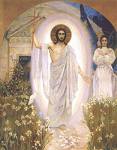
Resurrection Sunday – 2009: Jesus Did Not Die for Me

Resurrection of Christ - Mikhail Nesterov (late 1890s)

Resurrection of Christ - Mikhail Nesterov (late 1890s)

Jesús No Murio Por Mi

Jesus Did Not Die for Me

Holy Weekend
The time of customary rituals
Of words spoken a thousand times
A season of the silence of death
Fasting, resolutions, and processions
A time of self-contained euphoria
As it seems sin sees the ending
We already know
and will flood all with life
A shallow season of hypocrisy
“Happy Easter”

A season of churches in a thousand different ways
yet a thousand ways the same
Cannot say other than what they have always said
“Jesus died for our salvation”
But “You know what?”
Jesus didn’t die for me
Jesus died because of cowardice,
greed, arrogance, love of power
by those who did not understand his message
by those afraid of the new
by those who had made a god to their own stature
by those who did not accept his offer of life to the full
not for just a few but for all men and women.
That death did not save anybody
Not even those who believed that they are saved by Jesus.

What saved me and you
And continues to save
Is that Jesus who became a person
Who identified with the people
Who was a baby and cried,
Who was a boy and played
Who grew and worked
Who was called to a mission and took it on
Who paused before the pain of men and women
Who in solidarity of gestures, words, and actions
Who did not silence what had to be said
And who though fearful, moved ahead
out of love, sheer love.

It was not his death, so cruel and unjust.
It was his life!
If death can be salvation
Whan can resurrection mean?
What sense does it make to celebrate Easter?
Death does not save
Even if it scandalizes theology
Life saves.
That is why resurrection is the great cry,
The lead story, the great news of our time
For this the stone rolls aways, the tomb opens
And foot steps are heard in the garden

God raises up Jesus
To condemn death forever
To announce that Life has won out
and that faith in the this Jesus who lives
who conquers the mercenaries of terror
is the faith that saves and
is the faith that makes us free.
What Peter said with such clarity
“This same Jesus whom you crucified
God has made Messiah and Lord”.

Jesus did not die for me.
They killed Jesus!
Jesus died because they tortured him in a blind rage
Because they wanted to shut him up and make him disappear
And because the powerful have always killed Him.

Yes, Jesus was born for me.
He also lived for me,
He taught, healed, pardoned, loved and rose again for me
for you and and for everyone.

Jesus did not die for me
nor for you nor anyone else
Perhaps, some day
We will stop honoring his death
In order to begin celebrating His LIFE.

Gerardo Oberman

translated by Randolfo R. Pozos 2009

Read More

Posted by on Feb 18, 2009

Great Love or Great Suffering – Two Paths to Non-duality

Day to Day Evangelization

evangelization1

The term “evangelization” means to share or spread good news. For Christians, the Good News we spread is of Jesus’ life, death and resurrection. Evangelization has been the privilege and role of followers of Jesus, Followers of the Way, from the very beginning. In the Gospels we read that Jesus gave this directive to His followers after the Resurrection when He said, “Go therefore and make disciples of all nations, baptizing them in the name of the Father and of the Son and of the Holy Spirit …” (Mt 28:19) 

From the day of Pentecost forward, empowered by the Holy Spirit, Christians have shared their beliefs with family, friends, neighbors and total strangers. Sometimes sharing the Good News takes the form of words. More often, it comes through action. One of the first things we know about early Christian community and life was the recorded observation that they were “of one heart and mind, … they had everything in common.” (Acts 4:32) They were known for their love and caring for each other.

We evangelize and in turn we are evangelized by others. Each of us had had times when a kind word or a helping hand served as a reminder that we are loved. Someone taught each of us about God and God’s love for us in sending Jesus and their Holy Spirit.

I was reminded of this the other day at Mass. A mother was there with toddler firmly in arms. She has been bringing her son with her since he was tiny. Sometimes he sleeps, but increasingly he is awake, watching all with wide eyes. When it came time to pray the Our Father, his mother raised one hand and he raised his opposite hand. Together they joined in prayer with the rest of the community. Someday he’ll learn the words of the prayer, and perhaps some theology too. But the most important learning has already begun. He is part of a community of people who love God and care for each other. A community that bears witness through their everyday lives to the love they have received.

Pope John Paul II called the Church to a New Evangelization, reaching out again to our world, bringing the good news into every aspect of our lives and communities. We begin within our daily activities, sharing our hopes and dreams and visions, reaching out in love to those we meet, answering questions about our faith when asked, and trusting the Holy Spirit to guide our words and our ways. The men and women of faith who have gone before us have brought tremendous change for the better to the world. It’s our turn now. May we have the courage and grace to be evangelists in our day to day lives.

Read More

Posted by on Jul 18, 2008

Great Love or Great Suffering – Two Paths to Non-duality

St. Camillus de Lellis – July 18 – “The Original Red Cross”

St. Camillus de Lellis is one of those saints that remain quietly in the background of our Catholic lives, despite having sown seeds that continue to bear fruit into our present day. He was born in Italy in the mid-1500s and lived to the age of 64. His mother died when he was thirteen and his father was in the military, so he did not receive as much attention and loving care as he should have as an adolescent. He grew up to be an agressive, hot-headed, compulsive gambler. He worked as a mercenary soldier, selling his services to whichever ruler’s army would pay him. Between stints as a soldier, he spent time working in a hospital for the incurably ill. But his gambling and agressive behavior cut short that employment and he returned to being a soldier, serving in the war against the Turks in 1569.

Following the war, when he was working in construction on a building at Manfredonia for the Capuchins, he was touched by a talk from the guardian of the community there and at the age of 25, his life changed. His legs had been injured when he was younger and they never really healed completely. He spent time in hospitals both receiving treatment and helping with the care of other patients. Following his conversion, he dedicated the rest of his life to caring for the ill and injured. He eventually became a priest and founded a religious order, the Fathers of a Good Death, in 1584. Wearing a red cross on their black cassocks, they cared for the sick, including victims of the plague, in hospitals, in the homes of their patients and on the battlefields. The order continued to grow through the years, and today they are known as Camillians (Clerks Regular Ministers to the Sick). Camillians work all over the world.

St. Camillus de Lellis was called the “Founder of a new school of charity” when he was canonized by Pope Benedict XIV in 1726. He taught that God is present in people confined to hospitals and sick beds, reminding his followers, “The poor and the sick are the heart of God.  In serving them, we serve Jesus the Christ.”

A Camillian priest visited our parish last year, raising money for their work in the missions. He spoke compellingly about the people he had served and their stories. It was quite inspiring. When he introduced himself and his order, he told us that Camillians were the “original Red Cross” because of the color of the cross on their habits. Their work through the centuries in hospitals, battlefields and sick rooms would seem to bear that out.

Once again it seems that “God writes straight with crooked lines.” A mercenary, who is a compulsive gambler and brawler, with injured legs, becomes the founder of a group of men who spend their lives working to heal the sick and care for the dying – the patron saint of gamblers and nurses. Truly a life story to be told more widely.

Read More

Posted by on Jun 30, 2008

Great Love or Great Suffering – Two Paths to Non-duality

The Feast of Sts. Peter and Paul – June 29

It’s the time of year when we remember and celebrate the witness of two men who played foundational roles in the community of believers that has grown to include well over 1 billion people – St. Peter and St. Paul.

Peter was a fisherman from Galilee. He was known as Simon. He was brash and decisive and protective of his friends. He didn’t hesitate to argue if he thought a request was unreasonable (but we’ve been fishing all night and haven’t caught anything!) or a plan was unwise (they want to kill you in Jerusalem!). Yet when Jesus came into his life, he was open enough to the Spirit that he left everything and followed when he was called. Jesus named him Peter, calling him the Rock on which the community would be built. (Jn 1:42)

Peter became the leader of Jesus’ followers, at least in part because he spoke his mind and looked out for the safety of them all. He was the one who answered Jesus’ question, “Who do you say that I am?” with the profession of faith, “You are the Messiah, the Son of the living God.” (Mt 16:15-16)

Peter was not perfect. He expressed his doubts about Jesus’ plans to go to Jerusalem, trying to dissuade him from that plan, and was rebuked as “Satan” for his efforts. He walked on water towards the Lord, and sank into the waves when he stopped to think about what he was doing. He promised undying support for Jesus at the Last Supper, and denied him 3 times before the sun came up.

No, Peter was not perfect. But he was a perfect leader for the new community because he knew he was imperfect and still loved, chosen, and trusted to do his best. It was a big job for a big person. Figuring out who this Jesus was and is, how to live as a community who follow His ways, how it all fit into the faith in which he was born and raised, what to do about all those non-Jews who also received the Spirit and wanted to be part of the community. A big job.

Paul was from Tarsus, a Roman city. So he was a Roman citizen. He had been trained as a tent maker, but he had also been educated. He was a Pharisee, the son of a Pharisee, and a student of the great teacher Gamaliel. He was not a follower of Jesus before the Crucifixion and Resurrection. In fact, he was one of those who saw the new Way of living as a huge threat to the larger Jewish community and to their faith. The Romans were not gentle with those who opposed them or to those who upset the day-to-day routine of life in the provinces. And certainly, the Jews had seen time after time through history what happened to the whole people if groups of them stopped worshipping according to the traditional ways of their people. War, exile, persecution by conquerors. It was not something to risk.

The first time we hear of Paul is at the trial and stoning of St. Stephen, the first martyr. He was called Saul at the time and he consented to Stephen’s death. Saul was an enthusiatic participant in the persecution of Jesus’ followers that followed. He saw that the new teachings were doctrinally quite different from those of traditional Jewish Law and worship at the temple. He was determined to crush the new movement. (Acts 8:3)

When the persecution began in Jerusalem, followers of the Way (as Christians called themselves at that time) had scattered throughout the surrounding area. So Saul got letters from the authorities and traveled north to Damascus, to arrest them there too and bring them back to Jerusalem for trial. It was on the road to Damascus that he met the Lord. A bright light flashed around him. He fell down. A voice called to him, “Saul, Saul, why are you persecuting me?” He asked who was speaking and was told, “I am Jesus, whom you are persecuting. …” Acts 9:1-30 tells the story of his conversion, his first preaching, the reactions of his fellow Christians and of his fellow Jews, and his return to Tarsus (where he would be safe from those who wanted to kill him). And then in Acts 9:31 we read, “The church throughout all Judea, Galilee and Samaria was at peace.”

Peace. A lovely thought. But peace is a state that seems never to last very long – perhaps because growth so often brings unexpected changes, stresses, and strains in its wake. Perhaps because some growth can’t happen except in times of difficulty, when new ideas and new solutions must be discovered. Perhaps because God is too unlimited, too expansive, too inclusive, TOO BIG to be kept in any of our human boxes.

And so the Fisherman baptized a Gentile, Cornelius, and his family. And the community adjusted its thinking about who could be called to the new Way. (Acts 10:1-49, 11:1-18)

Those who had been scattered from Jerusalem shared their faith in new communities in Phoenicia, Cyprus and Antioch. They spoke not just to Jews, but also to Greeks and many believed. The community in Jerusalem sent Barnabas to meet them. Barnabas was so impressed that he went down to Tarsus, collected Saul, and went back to Antioch for a year, teaching the growing community there – where followers of Jesus were first called Christians.

Saul and Barnabas were sent forth from the community at Antioch, to proclaim the word of God in Cyprus. It was the first of Saul’s many missionary trips. (From this point on, he is called Paul in the Acts of the Apostles.)

And things would never again be the same. The Fisherman and the Pharisee didn’t always see eye to eye. They argued. They tussled. They sent letters and messengers back and forth to each other. They had meetings. And through it all, they (and the community) worked things out. And the Christian community became more and more a separate community and faith from the Jewish one into which they had been born.

It was not a time of perpetual peace and smiles. But at the end of their lives, both Peter and Paul, in Rome, died as witnesses to their faith in the Lord – Peter upside down on a cross and Paul, the Roman citizen, by the sword. And the tensions and struggles within the growing community, as well as the growth in understanding of the Good News, and of who Jesus was/is, and of how we are to relate to the Father, and of many, many other things, continued.

In future posts, I’ll talk about some of those “other things” that came along, and use some of the tools of anthropology to look at them. For now, it’s enough to say that Peter and Paul can be seen as representing two essential roles within our community of faith. Their passion and courage in hearing the Lord’s call and stepping out faithfully to spread the Good News is a gift to us all.


Read More

Posted by on Jun 19, 2008

Great Love or Great Suffering – Two Paths to Non-duality

Saint of the Day – St. Romuald, Abbot – June 19

St. Romuald the Abbot was born around 950 into a powerful, wealthy family. He entered a Benedictine monastery at the age of 20. He had lived the life of a powerful, wealthy young man until the day he had to serve as his father’s “second” in a duel with a relative over a piece of land. His father killed the opponent, but Romuald was so horrified by the experience that he turned away from the life he had been living.

Once in the monastery, he found that he was attracted by the life of a hermit, more than to the communal life of the monastery as he was experiencing it at Sant’ Apollinare in Classe. He spent most of his life moving back and forth between monastic life and the life of the hermit, traveling from monastery to monastery and leading reforms. He eventually founded a new community who combined those two forms of religious life, the Camaldolese order.

St. Romuald developed a “Brief Rule” of how to live in openness to God.

Sit in your cell as in paradise. Put the whole world behind you and forget it. Watch your thoughts like a good fisherman watching for fish.

The path you must follow is in the Psalms: never leave it. If you have just come to the monastery, and in spite of your good will you cannot accomplish what you want, then take every opportunity to sing the Psalms in your heart and to understand them in your mind.

And if your mind wanders as you read, do not give up: hurry back and apply your mind to the words once more.

Realize above all that you are in God’s presence, and stand there with the attitude of one who stands before the emperor.

Empty yourself completely and sit waiting, content with the grace of God, like the chick who tastes nothing and eats nothing but what his mother gives him.

St. Romuald’s rule may seem like it has no relationship whatsoever to the lives of most of us – those called to life as men and women, married and single, in the contemporary world – earning our living, raising our families, trying to do our little bit to make the world a better place for everyone. Yet there are elements of his rule that are applicable to all of our lives. We’re called both to a relationship with God and to engagement with the world.

A challenge many of us face is finding a place where we won’t be observed or disturbed by anyone. I remember the amusement of a group of my parents’ friends who discovered a Bible in the bathroom of mutual friends. It was the only place in that home where a parent could have a few minutes of privacy to read the word of God. I remember the religious magazines and books kept for reading in the same room in the homes of my grandparents and other relatives. These people knew that time for the Lord is precious and is to be snatched wherever possible.

Today, we have so many means of communication and response is expected so quickly, that even walking by the beach without having a telephone along can be seen as selfish and/or anti-social. We forget that paradise begins here when we open to the Lord. Our alone place may have to be the bathroom. It may be standing at the kitchen sink washing dishes. It may be driving home from work. The essential thing is to find a few quiet moments somewhere each day.

St. Romuald recommends praying with the Psalms. That’s really good advice and easier than it might seem. Many of the songs we use in liturgy are taken directly from the Psalms. Let the songs from Church run through your head during the day. There are songs/Psalms for all occasions. Then as now, they help turn our focus to the Lord.

“Realize above all that you are in God’s presence…” There’s not much to add to that. The trick is to remember and be open to see and experience that reality. Then all we need will be provided, just as the chick who receives food from its mother. We still have to work. But the work we do takes on a bigger, broader meaning when it is tied to God’s presence in the world and to our call to make that presence visible through our lives.

May peace and joy be yours.

Read More

Posted by on Jun 5, 2008

Great Love or Great Suffering – Two Paths to Non-duality

Saint of the Day – St. Boniface, June 5


I must confess that I never knew much about St. Boniface until I began to do a little research about him today. My maternal Grandmother’s home parish was St. Boniface in Uniontown, Washington. So his name was familiar to me, but not any details of his life.

Uniontown was, and still is, a very small town in the middle of fertile farmlands. People spoke mostly German there when Grammy was a girl in the years leading up to World War I. Sermons at Mass were always in German, a language she did not speak well because her parents did not speak the same versions of German. They spoke English at home. (She could never understand why we complained about bad homilies when we were kids. After all, at least they were in English so we could understand them!) Uniontown was settled largely by Catholic German immigrants. They chose the patron of their former homeland as patron of their local community.

St. Boniface is known as the Apostle of Germany and is its patron saint. He was born in England around 672 and named Winfrid. He studied at Benedictine monasteries near Exeter and Nursling in the diocese of Winchester. He was noted for being a fine student and scholar, compiling a Latin Grammar during his time there.

In 716 he set off to Frisia to convert the residents of that area. However, there was a war raging in Frisia at the time and people were otherwise occupied. So he returned home without success. In 718 he traveled to Rome and in 719 Pope Gregory II gave him the name Boniface and commissioned him to return to Germany to evangelize and reorganize the church there. He also learned from people who had been working already among the German tribes how best to reach them. He spent most of the rest of his life working in Germany.

The felling of Thor’s Oak at Frizlar in northern Hesse is one of the stories told of his work. In the presence of leaders of the local people, he called on Thor to strike him dead if he destroyed an oak tree sacred to Thor. Then he began to chop down the tree.  A great wind blew the tree down. Thor did not strike down Boniface, so the people became Christians. Boniface used some of the wood from the tree to build a chapel at the site.

Boniface chopped down other oak trees dedicated to Thor as well, in challenges to the ancient pre-Christian religion. It is said that at Geismar, there was a fir tree growing out of the roots of the oak tree that fell. Boniface told the people, “This humble tree’s wood is used to build your homes: let Christ be at the centre of your households. Its leaves remain evergreen in the darkest days: let Christ be your constant light. Its boughs reach out to embrace and its top points to heaven: let Christ be your Comfort and Guide”. The German tradition of using evergreen trees in the celebration of Christmas may have come from this event. (Think of him next time you see a Christmas tree!)

The years in which Boniface lived and worked were far from peaceful. Battles raged between the Franks, the non-Christian Saxons, and the northern Germanic tribes. Struggles for power over the church by civil authorities and for independence from civil authority by church leaders were common. The conversion of the Germanic tribes was part of the process that eventually led to their incorporation into Charlemagne’s empire. In 754, while again working to convert the Frisians, Boniface was killed by a group of brigands.

It seems fitting that Boniface was chosen as patron of the church at Uniontown. Many Catholic Germans who came to the United States during the 19th century did so as religious refugees. It wasn’t something they spoke about much. My grandparents weren’t sure why their parents or grandparents had come here, except they knew the men came so they would not have to serve in the Kaiser’s army. But from an old German Dominican nun, my mother learned that many came because their only choice at home was to convert to the Protestant religion of their new ruler, the Kaiser, or to worship secretly in defiance of the curfews. The young men came because they would have to leave the Catholic church when they were drafted into the Kaiser’s army. They chose to leave instead, bringing their faith with them to little towns like Uniontown all over the United States. Once here, they chose St. Boniface to continue to be their patron.


Read More

Posted by on May 28, 2008

Great Love or Great Suffering – Two Paths to Non-duality

What Keeps Me From Seeing?


I like to take a walk in late morning each day. It helps clear my mind and stretch my muscles before I plunge into the work and activities of afternoon and evening. Living beside Monterey Bay, I never know what I’ll see on my outing.

Today, when I arrived at the water’s edge (actually at the cliff beside the water!), I got a wonderful surprise. I could see all of Monterey Bay – from the Lighthouse at Point Santa Cruz, around past Santa Cruz, Capitola, Aptos, Moss Landing, to the flatter lands where the Salinas River enters the Bay. Then the Big Sur mountains rise up behind Monterey and go out all the way to the ocean.  The water was calm – very few waves for the surfers. The kelp beds were spreading out to enjoy the sunshine. The sea lions on the rock were chatting among themselves. Sea gulls soared over the water. I could see it all.

In “the olden days,” when I was a girl, I would never have thought that seeing all the way around a bay was anything special. I grew up in Eastern Washington state. We had clouds or sunshine. Sometimes we had fog. But you could always see across the river! And normally, you could see the surrounding mountains too.

Living on the coast, we never know from day to day whether the fog will be in or not. Even on a sunny day, the fog often sits in the middle of the Bay, blocking the view of the other towns and the mountains. But today it is clear. The smoke from the Summit fire is gone from the sky. The clouds we have are high and moving inland. The fog is sitting way off the coast, barely visible from land. And the view is stunning.

It occurs to me that the spiritual life is something like our views of Monterey Bay. Like the Bay, God is always present here – within us, among us, around us. I exist only because God has imagined me, given me breath, breathes through me, loves me continually into being. Yet all too often I don’t notice. I don’t see the beauty all around me. I miss the “love notes” scattered all around me – the flowers, the birds, the native bees in the weeds, the smiles of young mothers and their babies, the laughter of teens and the comfortable togetherness of retired couples out for a walk. I don’t see them for what they are, or worse, I don’t see them at all. I move through my life’s conversation doing all the talking, forgetting to look and listen for the presence of the Divine.

Today I pray that I’ll remember to open my eyes, ears, heart, mind to notice God’s presence. I’ll remember to ask myself, “What keeps me from seeing today?” I’ll remember to be grateful. I invite you to do the same. And maybe while we’re at it, we could also stop gratefully for a moment and ask, “What keeps us as a people from seeing today?”

Read More

Posted by on Apr 25, 2008

Great Love or Great Suffering – Two Paths to Non-duality

A Theologian’s Reflections on Mark’s Gospel

on-your-mark.jpg

Theologian and storyteller Megan McKenna’s book, On Your Mark: Reading Mark in the Shadow of the Cross, is a powerful example of the contribution of theology and biblical research to our understanding of the Good News. When the gospels were written, nearly 2000 years ago, they were written for a specific audience, with certain shared beliefs and experiences. Each was written for a different audience, but each audience had much in common. They were written as teaching materials, to help new believers come to know about Jesus, become His faithful followers, and live according to His Way.

We live in a dramatically different world. Many things the ancients took for granted or understood to be significant, we don’t even notice in passing when reading Scripture.

In the past century, thanks to the work of theologians, biblical scholars, anthropologists, archeologists, linguists and many other professional researchers, we have gained a tremendous amount of knowledge about the world in which Christianity began and of the beliefs and life of the early Christian community. The Holy Spirit has worked through these people to bring the Word to us as excitingly fresh teaching. 

Megan McKenna’s presentation of Mark’s Gospel lays out the requirements of Christian discipleship through exploration of the meaning of the texts. She shows what their meaning might have been for the disciples and the early community – how they served as a roadmap for discipleship. Because she is also master storyteller, Megan presents other stories  as well that serve to reinforce the Gospel. And always, for Megan, the bottom line is, what this means for us today.

Take a look at her work. You won’t regret it!

Read More