Pages Menu
RssFacebook
Categories Menu

Posted by on Mar 23, 2015

Finding Our Own Sanctuary in Daily Living

Finding Our Own Sanctuary in Daily Living

Springtime budsTerry Hershey defines sanctuary as “a place where your soul can catch up with your body.” We all need these places, yet we don’t often give ourselves permission to go there. Nevertheless, a healthy physical and spiritual life requires taking time to rest and simply be at peace.

Terry offers the image of “two dogs” that live within each person. The first dog is the list-maker, the one who gets things done. The second dog is the one who does nothing. This dog just rests and enjoys sanctuary. Which dog do we feed, and when do we feed it? Can we take a chance and feed the second dog?

Sanctuary is not simply an ideal, far-off place that can only be experienced by hermits or others who leave the modern world behind. Sanctuary is a place here and now that can be entered by any one of us. We simply have to decide to do it and recognize what it is for us personally.

Entering Into Sanctuary

1) A portal exists through which we must pass to enter into our sanctuary. There’s something we do, somewhere we go, or a mental image we invoke that opens a different “space” to us.

2) A sanctuary has boundaries. It’s a type of container/space in which we can be ourselves unreservedly.

3) Sanctuary is a place to slow down. As a wise grandfather once said, “Sometimes it’s not the fish we’re after, it’s the fishing.”

4) A place of sanctuary engages all the senses. When we enter into the “holy ground” of sanctuary, we take our shoes off, figuratively if not literally. Like Moses, we need to feel the holy ground, savor it with all our senses, and enjoy our time there.

5) Finally, entering into sanctuary is an intentional action. We need to set a time and enter regularly. We do it for ourselves, not for anyone else. To the extent we fail to enter our sanctuary, we have less to offer to others. We must enter sanctuary in order to be re-charged and ready to carry out our own calling and mission in life.

Terry is an engaging speaker and an inspirational author. His most recent book, Sanctuary: Creating a Space for Grace in Your Life, is available now. For a taste of his wit and engaging style, take a look at this video of his presentation at “Congress”.

Read More

Posted by on Feb 21, 2015

Finding Our Own Sanctuary in Daily Living

Light

800px-Sunrise on Mt Sinai in Egypt - June2006 - by Mabdalla - public domainLight is fascinating. At Christmas time we are enthralled with the lights all around us, candles and Yule fires. We feel safe in light. Light is beautiful to us. At Epiphany and the Feast of the Presentation (Candlemas) we hear that a light for the nations has come into the world and that people from afar have come to witness its arrival. Light is a physical, energetic reality so fundamental that it takes on symbolic meanings as well.

An energetic force

Light is so basic and essential that we take it for granted. It travels at 186,000 miles per second. So amazingly fast. It is an electromagnetic radiation, a specific energy, that has a spectrum of forms from short waves (ultraviolet) to long waves (infrared). In the middle are the manifestations of light we can see, such as colors. Its most notable characteristic for humans is that light stimulates the organs that help us see: the retina, the optic nerve, etc. We are richly blessed to see ourselves, people, and objects. Light is so important to humans that we can become very ill if we lack it for a long time.

A symbolic image

But, light is much more. It is also spoken of as mental illumination or insight. The word itself can mean to understand. It can also be used to describe being guided, as John of the Cross describes his own journey in spiritual darkness during which he is guided by nothing “save only the light burning in my heart.” (Dark Night of the Soul).

Light has been experienced as God presence, enlightenment and strength (Psalm 27:1). God is described in the Scriptures as our light, a light that shines in our darkness (John 1:5), a light who calls us out of darkness
(1 Peter 2:9). Jesus himself tells us in turn to be the light of the world and not to hide our light (Matt 5:14).

God is our light. Our lives can be in darkness, darkness from letting ourselves be in agitation from bad habits or denial. We can give in to negative thoughts or fear. On the other hand, if we practice openness to seeing and hearing God speaking in our hearts, we can see and hear a desire in us to be illuminated and strengthened. We can feel the fog lifting and an ability to live in light. It is our choice to say yes to this. We don’t have to earn it or produce it, we just have to consent to it.

Image by Mabdalla, Sunrise at Mt Sinai in Egypt, public domain

Read More

Posted by on Jan 21, 2015

Martin Luther King, Jr. — A Gift of One’s Self

Martin Luther King, Jr. — A Gift of One’s Self


January 19, 2105 is the Martin Luther King holiday in the United States. The first reading of the day in the lectionary is Hebrews 5: 1-10. Christ’s adherence to the will of the Father has led Him on a path of suffering, death and glorification. Dr, King took this path of God’s will to which we are all called.

“In the days when he was in the Flesh, he offered prayers and supplications with loud cries and tears to the one who was able to save him from death, and he was heard because of his reverence. Son though he was, he learned obedience from what he suffered; and when he was made perfect, he became the source of eternal salvation for all who obey him.” – Hebrews 5: 5-10

The Feast of Martin Luther King, Jr is not a feast of the Roman calendar, but it is a national holiday to celebrate a civil rights leader and a Baptist minister who advocated non-violence. Today is a tribute to all who work for human and civil rights for African-Americans and all people. Many of us are of an age to remember the Reverend King. The three television networks brought us live coverage in black and white of the marches, the sit-ins, and the fire hoses and police dogs that were part of the black struggle against white oppression. There was the famous “I have a dream speech” at the Lincoln Memorial. The haunting last speech before Dr. King was gunned down, “I Have Been to the Mountain Top” in which he saw the promised land of freedom, “I may not get there with you but I have seen it.”

Like all of us, Dr. King was an imperfect human being. Like all of us he was a sinner, but his redemption, like ours, is based in obedience to Christ, the source of eternal salvation for all. We know that precisely because Jesus is the Son of God, His will is perfectly aligned with that of the Father. Since Jesus was truly divine and truly human, his obedience came at a human cost. “In the days when he was in the Flesh, he offered prayers and supplications with loud cries and tears to the one who was able to save him from death, AND HE WAS HEARD because of His Reverence.

In his work of announcing the kingdom, healing the sick, feeding the multitudes, Jesus did not shy away from doing the will of his Father. But he knew where his call was leading. It became more and more obvious that if he stayed true to the person he was — the Divine Word become human — that His hands that had been raised in blessing and healing would be nailed to the cross. With loud cries and tears he asks the Father to take this cup away, but he is true to his calling and the will of the Father. “Let not my will be done but yours.” It is through this obedience that Jesus goes to his excruciating death on the cross and to the glory of the resurrection. He WAS HEARD because of His Reverence.

For Dr. King, Mahatma Gandhi, all Christian saints and martyrs, and ourselves, this call to obedience is not only a question of observing certain commandments but a deeper call to be the person God created us to be, to be at one with God, to hear at one with God, to accept God’s truth about our mission in life to advance the kingdom of heaven.

There were many black leaders in the civil rights movement of the 1960s. Dr. King didn’t need to have such a high profile in the movement. Yet it was something that Dr. King was drawn into despite all of the obvious risks to himself and his family. He was born and raised in Atlanta in a strictly segregated society. Dr. King knew what happened to black people who broke the rules. He certainly could have taken an easier type of ministry, but he heard the Word of God, the Will of the Father for his life and his death.

Most of us think that we are not called to such types of work. We are certain that God’s will for us involves something less “glamorous,” nothing so heroic as what Jesus and the saints like Mother Teresa and Dr. King did. But I wonder. All of us have that little voice within us to do something special, something only we can do, but we know that it will cost us. Dr. King used his gift of oratory, of speaking and preaching, to give voice to the prayers and aspirations of the millions enslaved and oppressed using the language, song, and rhythm that the Spirit had given them in their bondage and oppression.

Many of us see fewer years ahead of us than the ones that have fled so swiftly. The babies we held are now grown adults with their own babies. What are we called to do to announce the Kingdom of Heaven and to make it a reality? What can we do to end poverty, hunger, oppression, and violence? How do we draw closer to God and each other in prayer? How do we move toward reconciliation and forgiveness?

We can only do it if we take the time to be quiet and to listen — to pay attention to that little voice that comes to us or the massive cry that comes to us in outrage at the atrocities of the world visited upon the young, the poor, the defenseless. There is a price to be paid, and eternal life to be gained.


Read More

Posted by on Jan 20, 2015

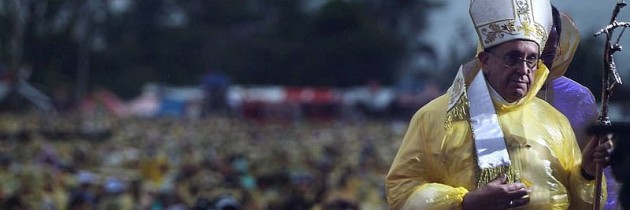
Why Do Children Suffer? Pope Francis Speaks to Filipino Youth

Why Do Children Suffer? Pope Francis Speaks to Filipino Youth


The video and the text are largely in Spanish, though a simultaneous translation into English is included. This is a summary of a small part of the Pope’s extemporaneous speech.

During a presentation to young people in the Philippines, the Holy Father set aside his prepared text to answer a question that had been raised by a 12 year old girl who had been rescued from the street. Tearfully weeping, Glyzelle Palomar, recounted the miseries of her life in a few words and asked, “Many children are abandoned by their own parents, many are victims of many terrible things such as drugs and prostitution. Why does God permit these things even though the children are not at fault.Why do so few people come forward to help?” In this video we can view the scene and the Pope’s compassionate embrace of the child.

What response is possible to the perennial problem of evil? Pope Francis did not try to evade the question with platitudes. He took the question head-on, educating about 30,000 of the faithful and challenging them. First, he noted the shortage of women among those making presentations and he emphasized the importance of the point of view of women. The Pope said that women pose questions which men could never stop trying to understand, that is, never grasp.

We can understand something, added the Holy Father, “when the heart reaches the place in which it can ask the questions and cry. Only through tears do we arrive at a true compassion which can transform the world.” Pope Francis described a common, worldly type of compassion as one in which we just take a coin out of our pocket. He added that if Christ had shown this type of compassion, he would simply have spent a little time with a few people and gone back to the Father. Jesus could comprehend our lives, the Pope said, when He was able to cry and did cry.

He notes, “In today’s world, there is a lack of crying. Although the marginalized, the poor, and the outcasts cry, those of us who do not lack anything essential do not cry. Only those eyes that have been cleansed by tears are able to so see things as they are.”

The Pope challenged the faithful. “Let us not forget (this young woman’s) testimony. She asked the great question ‘why do children suffer?’ crying. And the great answer all of us can give is to learn how to cry.”


Read More

Posted by on Jan 17, 2015

Finding Our Own Sanctuary in Daily Living

Would You Baptize an Extraterrestrial? – The Gift of Inquiry


Hubble's View of NGC 5584Vatican astronomers, Br. Guy Consolmagno and Fr. Paul Mueller have penned this provocative question as the title of their new book. Would You Baptize an Extraterrestrial? deals with the most common questions they receive. Generally the questions assume a conflict between science and faith. Their first task is to reduce the assumption of conflict and to look at the information in an analytical and thoughtful way.

For example, they take on the star of Bethlehem and rule out many of the scientific explanations. It was most likely not a supernova as Kepler had proposed. It may have been a conjunction of planets as proposed by Molnar in his 1999 book, The Star of Bethlehem: The Legacy of the Magi. However, limiting the question to how it occurred and which laws of nature were violated can miss the point. According to Fr. Mueller, miracles don’t always mean a suspension of the laws of nature. The point of the star of Bethlehem is that God gave a great sign. According to Fr. Mueller, miracles, whether they accord with the laws of science or not, are some great sign of the coming of the Kingdom of God.

Br. Consolmagno defines science as an ongoing conversation about facts. It is not a book of rules. Likewise religion is conversation we have within our church, among ourselves, and with God. He concludes, “One of the joys of science and philosophy is learning how to live and enjoy a mystery.”

Read More

Posted by on Jan 16, 2015

The Magi and the Gift of Holy Discontent

The Magi and the Gift of Holy Discontent


http://youtu.be/m8jHx7W-iI4
Fr. Geoffrey Plant of Sydney, Australia has prepared a multimedia homily for the feast of the Epiphany. In his homily, Fr. Plant presents the main points of the feast.

The term “epiphany” comes from the Greek meaning to “shine forth”. We tend to assume that there were three kings because there were three gifts named: gold, frankincense, and myrrh.  Fr. Plant notes that they were not called kings but “magi” in Greek, with stands for wise men or sages.

The gifts are symbolic of the nature and meaning of Jesus. Gold is a symbol of royalty, frankincense is a sign of the divine, and myrrh is for burial, indicating that Jesus will triumph through suffering and death.

Fr. Plant suggests the wise men also brought the gift of Holy Discontent. Examples of holy discontent may be seen in the character of Popeye. An example of unholy indifference is seen in the the character of Bilbo Baggins in The Hobbit. Fr. Plant sees the magi as showing a holy discontent: a willingness to search, to be changed, and not to feel comfortable again. He compares them to Herod’s wise men who despite being so close to Bethlehem fail to see the signs in the heavens though others have seen them from afar.  Quoting W. H. Auden, Fr. Plant compares the hardness of heart of Herod’s wise men to our own post-modern era:

We would rather be ruined than changed

We would rather die in our dread

Than climb the cross of the moment

And let our illusions die

W.H. Auden, The Age of Anxiety

This gift of Holy Discontent — the gift of prophecy and activism — is what the wise men bring to the Christ child and to us according to Fr. Plant. It is the divine call to the kingdom through suffering, death, and resurrection.


Read More

Posted by on Jul 20, 2014

Theology As the Everyday Awareness of God in Our Lives

Theology As the Everyday Awareness of God in Our Lives

Anthony F. Krisak writes in “Theological Reflection: Unfolding the Mystery” that theology “is not an abstract musing ..but it is a challenging and thoughtful reflection on the way God’s hand is involved in the day to day experiences of men and women…Rather, theology is about God-with-Us (Emmanuel).”

The window of theology

Krisak makes it clear that reflecting on this divine encounter leads the observer to face “concrete, historical, and passionate movements and experiences.” Our experience becomes the “window of theology”. This window is useless if we understand mystery to be “unknowable ideas and complicated theories”. According to Krisak, if we understand  mystery as a continual unfolding event in and around us, theology can be that window to observe and interpret our own experience.

Theology as a window goes against the claims that God is unknowable and that we should just accept secondhand understandings of God provided to us by an intellectual elite. Theology as a window of observing and interpreting experience is a fundamental assumption in the primary project of Jesus, the coming of the Kingdom of Heaven. In the Gospels, Jesus tells us to observe the signs of the times and everyday experience — a person who sells everything for a fine pearl, the  rapid growth of the mustard tree from a tiny seed, the one who goes out to harvest a crop. It is faith that allows the sun to shine through the window of theology. “Through theological reflection, our intertwined lives with God become conscious and faithfully deliberate; in other words, we begin to take in more profoundly the sights and sounds and smell of our life with God and each other.”

Without theological reflection, the pressures of everyday living can cause us to lose sight of what we are all about. Krisak particularly warns ministers of this hazard, since his article appears in the Handbook of Spirituality for Ministers. However, it is easy to see how everyday lay people can also fail to pay attention to the action of God in their lives. Unfortunately, many are not even aware that they are called to reflect upon and deepen their experience of God by reflecting on and noticing God’s actions.

This is especially ironic since we live in a culture that focuses very heavily on relationships. We have large psychological, educational, and popular movements to help us find the right partners, to save our marriages, to raise our children properly, to organize our businesses, corporations, and churches. How do we improve our love life with God? How do we even relate to God? When we think about it, we know we do or at least we think we do. We are called to enter the Kingdom of Heaven, to proclaim it, and to bring it about in God’s grace. It is unfolding within us and around us.

What does theological reflection require?

Krisak wisely points out that the backdrop or context for our theological reflection is our shared faith in both the Hebrew and Christian traditions. To engage in fruitful theological reflection according to Krisak, we need to:

(1) understand the tools necessary for “cleaning up the window of theology”,

(2) consider the process of reflection in relationship to human experience, and

(3) take a look at the “major themes of our theological tradition” such as the incarnation and redemption,  among others.

In subsequent posts, I will review these three areas of focus that Krisak recommends for doing theological reflection and understanding the ways in which we are part of something much bigger than ourselves.

Image: “Simultaneous Windows” by Robert Delaunay,
1912, Public Domain


Read More

Posted by on Dec 1, 2013

Finding Our Own Sanctuary in Daily Living

Stay Awake! See the Power of Hope!

Hope


The First Sunday of Advent brings a direct command from the Lord: “Stay awake! For you do not know on what day your Lord will come.” (Mt 24:42) Our eyes are to be open. Our hearts are to be hopeful. Our hands and feet are to be active in preparing for the Lord’s coming. In the face of all of the anger, pain, violence, and darkness in the world around us, we are to be people of hope  who “put on the armor of light” (Rom 13:12). Rather than being a people overwhelmed by darkness, we are to focus on the power of hope and light.

Stay Awake! Look to the Lord’s mountain. Listen to the Lord’s words. Learn the Lord’s ways. Walk in his paths. Become a people who turn swords and spears into useful tools for providing food and shelter for all, including the weakest and most vulnerable. Be a people who respect each other, refusing to exploit children or women for our own pleasure. Be a people who treasure differences in learning styles, abilities, talents, intelligence, gender identification, cultures, physical abilities. Seek out the lonely; learn how to be present in the moment; notice the gifts of the people the Lord sends into your life.

We sing, “Oh Come, Oh Come, Emmanuel.” Will we be awake when He comes? Will we see Him? Will we recognize Him? As we go rejoicing on our way up to the house of the Lord, see the little ones on the city streets who travel with us. See the those who hunger for physical food. See the people on the street who hunger for someone to talk with them or simply smile a greeting to them. See the old man or woman who longs for the touch of a gentle hand or a patient ear to hear a story for the umpteenth time. See the one who needs health care. See the one who needs help to learn how to read. See the one who struggles to walk. See the Lord, present in His most desperate reality. Reach out and welcome Him. Lend Him your hands, feet, and voice, so together we may see the power of hope transform our world.


Read More

Posted by on Nov 17, 2013

Finding Our Own Sanctuary in Daily Living

“Life, the Universe and Everything”: The Ultimate Question and Jesus the Christ

Christ the King - From Annunciation Melkite Catholic Cathedral

Christ the King

What is the most fundamental question in my life? For what personal “ultimate concern” does the statement “Jesus is the Christ” provide the answer? Is this concern peculiar to me or can it be generalized to others? Do we ask this question about Christ differently today than people have asked it in the past because of any elements of our present situation?

These questions, asked as part of a class in Christology, bring to mind a novel by Douglas Adams, The Hitchhiker’s Guide to the Galaxy. In one part of the story, Adams tells of an ancient people who decide to create a computer that will give them the answer to the question of “life, the universe and everything.” The computer, known as Deep Thought, takes millions of years to ponder the question, finally coming up with the answer: forty-two.  When challenged by descendants of the people who had commissioned the work to explain why the answer was simply a number, Deep Thought explains that the problem is that perhaps they don’t really know what the question is.

“Jesus is the Christ”

In order to identify an ultimate concern for which this statement would be the best answer, the first question that must be addressed is what is meant by “the Christ.” As in Deep Thought’s response, to a very real degree, the meaning of “the Christ” depends on what concern is being addressed.  Literally and historically, the term “Christ” refers to the one who is anointed with oil: a ruler, an athlete, or a messiah/savior.  The anointing sets the individual aside for a special role.  Yet today, in industrialized societies, this meaning is generally not understood. “Christ” is all too often used as if it were the surname of Jesus rather than the title that explains who he is for us. The simple notion that the Christ will come and restore an earthly monarchy or re-establish a people in a powerful and independent homeland is not particularly relevant to most of us today. The notion that the Christ will come at the end of time to punish sinners and reward the good offers only slight consolation to those who are suffering from today’s injustice. While this vision may seem to fit with the story of the Last Judgment – Jesus was very clear in teaching that the criterion for admittance to the presence of the Father was having cared for the least of his brothers and sisters – the implication remains that something more than simply waiting for the end of time and space is at stake here. Even the notion of “savior from our sins” does not move many contemporary hearts – hearts that demand to know how a god who is supposed to be a loving parent could demand the bloody sacrifice of an innocent victim to make up for the sins of others.

“Where have you been, Lord?”

The question of ultimate concern in my life that is answered by the question, “Jesus is the Christ,” is this one: “Where have you been, Lord?” Coming from a Catholic family, nurtured in faith in the traditions of that family, and having experienced the presence of God in my life from a very early age, I still found myself asking God that question with great sadness and not a little anger one night following the loss of a long-desired pregnancy.

The response came immediately. My mind was flooded with images of the care-givers who had been so kind to me as they told me of the baby’s death; the woman at the local family planning clinic who made the appointment for me to have a D&C; the nurses and doctors at Kaiser who ended up performing the D&C when I began bleeding a few days before my clinic appointment; the nurse who reassured me that losing this child did not mean we would never have another because she too had miscarried but later had a successful pregnancy; my mother who sent flowers (she rarely ever does that); the babysitter who stayed with us and helped take down the Christmas tree that first awful day when I knew I was carrying a dead child; the friends who remained after our son’s birthday party so we wouldn’t be alone with our pain; another  child’s teacher (a young widow) who dropped by one afternoon to share a cup of tea and be with me; the husband who held my hand through it all and matter-of-factly cleaned up the blood that splashed on the floor when I stood up to dress to go home from the hospital; the friends who had cared for our children after school; and so many others who had cried with me and supported me in that first week. I understood then where the Lord had been. He had been with me in all of those people – his Body here and now. It was not any easier to have lost that child, but I knew I was not alone. And perhaps more importantly, I knew that God cries with us in such moments and wants nothing more than to hold us close, as a parent holds and comforts an injured child.

How does this relate to Jesus as the Christ?

Through the incarnation, God became truly one of us. As a result of the incarnation, Jesus is the most human of all human beings who have ever lived or will ever live. Jesus’ life is the most authentically human life ever lived. Because God entered totally into human existence and experience through the life of Jesus, our human experiences have become part of God’s being in a very real way. God did not demand that we suffer or that Jesus suffer in order to bring us back to the unity of love overflowing from which all of creation sprang in the first instant of creation. Suffering can bring us to the point of noticing that we do not really control much in our lives and that we need to be part of a greater reality, but in and of itself, suffering is not what God wants for us. Sometimes suffering comes as a result of our own choices, but often it comes because of forces outside our control. Sometimes suffering even comes because we choose to remain authentic to who we are and what we are called to bring to the world. In the case of Jesus and many other good men and women through the ages, that choice resulted in death – a death that was/is the entry into eternity and a different degree of life. Jesus, in his life, death, and resurrection, is the Christ, the one “anointed” or called and set aside by God to open our eyes to this wondrous reality of a God who is Love and who cannot be anything other than Love. In this, he is our savior from the more common notion of a deity that is angry, vengeful, rejoicing in the misfortune of its subjects, and eager to punish them severely. His coming, and the sharing of his experience, is truly good news for the world. He is the one through whom Love enters directly into our lives, including the times of pain and suffering. He is the one who reaches out through each of us to ease the pain and suffering of others. He is the one who turns tears into dancing as healing comes to battered hearts at his touch.

Does our present situation change how we ask this ultimate question?

To the extent that we are more aware of the suffering of people around us and around the world, we may find ourselves asking this ultimate question more frequently than did people of past ages or people in non-industrialized communities. Why do children get killed at school by a person who should never have had access to guns? Why do people get blown up by suicide bombers? Why do humans so quickly resort to wars, both with physical weapons and with words and actions in our homes and workplaces? Why do bad things happen to good people? Shouldn’t becoming a Christian mean that everything should be fine and dandy from here on out? How can good Christian people lose their homes and savings and livelihoods as a result of bad decisions by investment bankers or real estate speculators?

Our access to news and information on a 24/7 basis is a blessing and a curse. We hear far too much of the suffering humans inflict on each other, whether directly or indirectly. We also hear too much about the suffering that results from natural disasters. The simple formula that promises happiness once they have died to those who suffer (“Life is hard and then you die”) rings hollow. We become numb to the suffering of those in other lands or those whose experience of life and faith even in our own nation is different than ours. We still cry out in sadness, anger, fear: Where have you been, Lord? How can a loving God let such things happen?

Into this reality, Jesus continues to come as the Christ, the anointed one. Jesus is the one who understands the pain of human life from the inside. Through the incarnation, through Jesus’ life, God too understands the pain of human life, as well as the joys and wonders of it. In Jesus, God reaches out and touches each of us and all of creation in a new, deeply intimate way. The everlasting, ever-living, all-powerful One can touch and raise up the created ones to share in the divine life of Love, to become fully human. The light of Love shines in the darkness, a darkness that cannot overcome it. So for this age and the ages to come, “Jesus is the Christ” still answers the ultimate question(s) of human existence.

 Image from Annunciation Melkite Catholic Cathedral

Read More

Posted by on Aug 31, 2013

No Two Alike – Each a Unique Creation

Summer 2013 has brought a marvelous experience of the ways God creates each person as a unique individual, even twins who are nearly identical in outward appearance. Each person is a unique creation.

For about four months this year, twin boys who are ten years old have lived with us and shared our activities, including a long road trip to visit family and a short camping trip this summer. They are not from the United States and English is their second language. When we first met them in January and spent six weeks together then, they did not understand much of the family conversation. Now, after an additional 2½ months, they are able to understand much more and have spent many hours in the past two weeks composing brief stories about the many things we have done while they have been here.

The boys are very talented musically and share many interests in common. They are nearly the same height and weight. They look very much alike. Each day, their clothing matches. They play the same games and learn to play each other’s instruments. One’s face is slightly more rounded and the other’s is a bit longer. It’s much easier to know which one I am speaking with when they are together!

Yet despite all of these similarities, they are different people. One speaks more slowly and seemingly with greater difficulty. The other speaks more easily and quickly. However, when the time comes to write, the one who speaks slowly writes many pages and the one who speaks easily struggles to think what to write. One is more daring and has learned the basics of swimming. The other is still very nervous in the water and barely dog paddles. He struggles to relax enough to float. One eats quickly, the other slowly. One is quick to seek his mother’s help. The other is more independent. One tries to draw dogs while the other makes stick figures on a baseball field.

Both of these boys have one foot in younger childhood and the other firmly in middle childhood. Our family four-year-old’s tricycle is so very attractive, but all the adults keep insisting they use their own bicycles instead! One minute they are playing with a fabric ball and the next they are outside kicking a soccer ball. Chutes and Ladders is the game of choice one minute and Go is preferred the next.

Still, each is a unique individual. It surprises them to discover their differences. “He weighs more than I do!” “He isn’t writing as much as I am.” “I can swim better than he can.” “He doesn’t play this piece as well as I do.” “He doesn’t want to play this game with me.”

The boys will be returning home very soon now and our home will become a much quieter place for a while. Our families have become close, however, and I expect we’ll spend time together again in the coming years.

The time we’ve had together this summer has helped me see in ways I would not otherwise have experienced how truly creative our God is. Despite the fact that these two boys are so alike, they are separate and unique individuals. God does not create identical people, even if they happen to have the same genetic signature. No two of us are alike. We each have our own relationships with God and with each other. Each of us has our own path through life and we are blessed to share it with family and friends. Yet each of us is the unique handiwork of an infinitely creative God — a God who is love overflowing into Creation.


Read More

Posted by on May 6, 2013

Finding Our Own Sanctuary in Daily Living

When Christian Life is Like Going to the Library with a Cat

Orange-Tabby-Cat_Big-Cat_14052-480x320 by Robert and Mihaela Vicol


Living a Christian life requires a great sense of adventure, curiosity, trust, and a recognition that some things are too serious to be faced alone. In a real way, Christian life is like going to the library with a cat.

This morning, my grandson and I set out walking to our local library for story-time. Our cat noticed our departure and began to follow after us. She often follows us around the block or to the local park, so it was not out of character for her to come along. None of the cats that normally give her an argument about passing through their territory were around today, so it was smooth sailing until we got half way around and surprised her. Instead of turning the second corner, we walked across the street and down the next block. She was a bit surprised, but gamely followed, probably thinking we simply planned to walk around two blocks instead of one. By the time we had crossed two more streets and were still going away from home, she was getting a bit nervous, but now she wasn’t sure she wanted to let us out of her sight. We were getting to be a long ways from her territory. A few more blocks and she was positive she was on very thin ice.

One block from the library, two relatively busy streets meet at a four-way stop. We waited for the cat to catch up with us just before the corner. My grandson carried the bag with the book we were returning and I picked up the cat. This in itself was quite a feat as she and I have had a rather rocky relationship through the years due to differing opinions regarding the place of a cat in a household. Nevertheless, she was quite willing to be carried across the the first street and tolerated being carried across the second. Then she wanted DOWN. NOW! So I let her down.

At that moment, what should arrive but two large, noisy dragons, screeching in protest as they bore down on the intersection from opposite directions. (Humans might have said they were garbage trucks, but she knew the truth of the matter. They were definitely fearsome dragons.) She tried to escape through a picket fence but found that she was too big. So in a moment of total panic, she turned and raced across the street in front of the dragons, hoping they would not turn and chase her. Fortunately, they did notice (or at least their drivers did) and they patiently waited for her to make her escape.

We followed after her when it was safe, calling to her reassuringly, but she remained safely hidden in the bushes in front of one of the houses. So we left her there and went to story-time, where we enjoyed some lovely tales of children’s gardening adventures. The librarian had bean seeds for the children to plant after decorating a pot in which the seeds could sprout. We returned our library book and found another before leaving the library about 45 minutes later.

Crossing the street again, we called and whistled for our cat. (Yes, she does come when we whistle for her.) With obvious relief, she emerged from the bushes and once again began to follow us, but the cars zooming down the street clearly were frightening to her. When we got to the corner, we waited and again called her. She came and allowed me to pick her up once more to cross the street. By the time we got to the other side, she was jumping out of my arms with nervousness, wanting to be sure she could find a safe place if necessary. We continued on our way home and she followed a little ways behind. Sometimes she stopped to explore something interesting, then hurried to catch up with us. By the time we got home, she was one tired cat. She spent most of the rest of the day sleeping close to the screen doors on the deck, not wanting to be far away from me at all. Once she even invited me to pet her.

Reflecting on our adventure, the thought struck me that our Christian lives are not all that different from the experience of that cat. We may start out our daily journey with an idea of what is ahead of us. We’ve been down this road in the past. We know where we’re going and what to expect along the way. But then someone throws us a curve ball. Something is different and unexpected. We trust the Lord, so we keep going forward, but we look around nervously, watching for those who might challenge or hurt us. Sometimes we hide for a bit until we’re sure it’s safe to come out. Sometimes we try to stay very close to anything or anyone familiar to us, even those who haven’t been our favorites in the past. When things get really dangerous or hard for us, sometimes the Lord picks us up and carries us across to a safer place. But then we get scared again and run away to hide. Always, though, the Lord sticks around and waits for us. He calls us by name and carries us to safety again and again. Then, when we reach our home again, he strokes us kindly and smiles at us fondly. And who would not melt with joy to be safely at home with such a One.

Yes, the Christian life can be like going to the library with a cat.

 Orange Tabby Cat by Robert & Mihaela Vicol, PublicPhoto.org

Read More

Posted by on Mar 24, 2013

Finding Our Own Sanctuary in Daily Living

Singing Leaves Time and Palm Sunday


Palm Sunday Fronds

Palm Sunday– “Singing Leaves”

Faith is passed from generation to generation through simple gestures, songs, foods, and activities. As children live the activities of daily life in the cycles of the year, they notice more than we realize. Life, especially for the little ones, is heavily focused on the present moment, but they too become aware of the changing seasons in our church life and come to look forward to the next celebration.

I was reminded of this yesterday when a sweet four-year-old boy asked me if it were time for the “singing leaves” yet. It took me a moment to realize that he was referring to Palm Sunday. In our parish, as Catholics do in parishes around the world, we all gather in a courtyard outside the church on Palm Sunday. Each person has a palm frond and members of our parish youth group wave large palm branches, leading the congregation out of the church building to hear the story of Jesus’ triumphal entry into Jerusalem on that Sunday morning so long ago. Then, singing “The King of Glory Comes,” we all process back into the church for the Passion Sunday liturgy. (Palm Sunday and Passion Sunday occur on the same day.) This little boy remembered waving the palms last year and the singing as we re-entered the church. He was quite excited when I responded that this was the Sunday for the singing leaves.

As parents, grandparents, aunts, uncles, cousins, godparents, or simply friends, we share our faith best through the examples of our lives. Do we pause to thank God and ask a blessing before we eat? Do we greet the morning with a prayer? Do we remember to give thanks for our day and ask God’s blessing on our families, friends, and activities before we go to sleep at night? Do we gather regularly as a community of faith to celebrate Eucharist? Is Reconciliation (sacramental or simply interpersonal) a part of our lives? Do we pause in times of joy and times of sorrow to call the Lord into our midst? Do we time our holy day activities to match the liturgical timetable, not jumping to celebrate major feasts before their time but rather savoring the periods of anticipation and preparation for the feasts as well? Do we do these things with the children in our lives?

Children learn by observing and imitating. Only in later childhood and early adolescence do children begin to hunger for the meatier reasons for why we believe and do certain things. For a young child, “because that’s what we do now” can explain quite acceptably the timing of an activity. An older child will want to know that we do it “because that’s what Jesus told his friends to do before he died.” As adults, we too have opportunities to learn and grow more deeply in our faith and understanding of it — through both intellectual and spiritual practices. However, to reach our children, we do well to rely on activities, stories, songs, and celebrations.

As we move into this Holy Week and then on into Easter-tide, let’s remember to celebrate each in its own time. Holy Week is a good time to make and enjoy traditional Lenten dishes including Hot Cross Buns. It’s not time yet for Easter eggs or chocolate bunnies!

Mass on Holy Thursday can be a special time to celebrate caring for each other and the gifts of the Eucharist and the priesthood. Have a special meal, enjoy time together on this day, then join with your community to celebrate Eucharist and enter into the mystery of Jesus’ Passion — His great love for us.

Good Friday brings many opportunities to share faith with children. Little ones don’t need to know in great detail of the tortures inflicted on Jesus. They just need to know that Jesus loves them totally. So as we fast and reflect on the events of the day, let’s remember to be patient and peaceful. If the Solemn celebration for Good Friday is going to be too late or too “heavy” for the little children, then do something peaceful and loving at home with them. As they get older, take them with you to enter more deeply into the mystery.

Holy Saturday is a quiet day of preparation and anticipation. Coloring eggs, baking special breads or desserts, getting the house in order for the Easter celebration — all will become part of the faith tradition for our children. Happy memories or sad ones will remain with them based on the love they see through our bustle of activities and the times we stop for reflection or story-telling.

Easter Vigil brings the story of salvation history and its culmination in the Resurrection alive. Children from 3rd or 4th grade and older can appreciate this celebration, particularly if the passages from Scripture are proclaimed in an engaging fashion.

If we remember to celebrate each of these mysteries of Jesus’ Passion, Death, and  Resurrection during this week each year, our children will learn to treasure them as well. They may not always celebrate them as they move through adolescence and into adulthood. There may be times in their lives when they move away from the community and travel their own road to God, but the foundations will be there, always calling them to the Lord.

May this week, from the Singing Leaves to the Alleluias of Easter Vigil be a time of rich blessing for you and for your families and communities.


Read More

Posted by on Dec 20, 2012

Las Posadas: Food, Fiesta and Community

Singing echoes through the softly lit streets of the towns, cities, and neighborhoods of Mexico as residents prepare for Christmas, through the para-liturgical tradition of Las Posadas. Processions of townspeople, led by a couple dressed as Mary and Joseph, wind their way through the streets, going from home to home asking for “posada” (shelter). Finally, the procession is welcomed into a home, and the people pray together as the “fiesta” commences.

Las Posadas is a Mexican Catholic Advent tradition that marks the beginning of the Christmas season. Taking place from the 16th-24th of December every year, Las Posadas is a nine day community celebration in preparation for the birthday of Christ; a novena that is a mix of religious devotion and relaxation. Ultimately, Las Posadas is about accepting Christ, the Bread of Life, into one’s home and heart. It functions as an extension of the Eucharist, catalyzed by the fiesta culture. Food, both physical and spiritual, is an important element of the fiesta, because it is nearly impossible to have a Christian festival without food.

Las Posadas is a fiesta; a religious fiesta in the sense that it provides sacred time and space to show a sacred event.  The fiestas of Las Posadas reenact Mary and Joseph’s journey to Bethlehem, a journey that is considered sacred because it directly led to the birth of Christ in Bethlehem. Also, the fiestas gather the community in a ritual that parallels the structure of a Mass, emphasizing two more sacred elements of Las Posadas: the community and the Eucharist.

Evangelization in a New World

Las Posadas began in 1578 in Mexico in the village of San Agustín Acolman. Augustinian missionaries received permission from Pope Sixtus V to celebrate special Masses in order to make Christianity more attractive and  to evangelize the Aztecs. Because of the syncretism that occurred when the missionaries introduced Catholicism to indigenous Americans, Las Posadas resembles the Aztec celebration of the birth of the sun and war god, Huitzilopochitli. The missionaries wanted a way to teach the gospel and extend the Eucharist to a large, illiterate population and needed a way that the Aztecs would accept, so they took advantage of the timing of the birth of Huitzilopochitli to introduce the birthday of their own important, sacred figure, Jesus Christ. In las misas del Aguinaldo (special Masses for the Advent season), they included nativity scenes and lights, sang villancicos (Christmas carols), and broke a piñata. The celebration of Las Posadas grew from these original Masses. Mary and Joseph’s journey to Bethlehem, as told in Luke 2:1-7, is featured in Las Posadas, a celebration that includes elements similar to those of the celebration for Huitzilopochitli. (All night and during the day after Huitzilopochitli’s birthday, people customarily had parties in many houses throughout the town, at which guests delighted in foods and statues of their gods made from blue corn dough.)

Days of Prayer and Celebration

Las Posadas begins on the evening of December 16th and ends on Christmas Eve. These nine days dedicated to prayer are called a “Novena.” Originally, a novena referred to the nine days of prayer before the Feast of Pentecost, but in Las Posadas it also represents the nine months of Mary’s pregnancy. Each night, a young woman and a young man – usually teenagers – dress as Mary and Joseph and go to three different, predetermined houses, asking for posada (shelter). They are accompanied by a candle-lit procession that includes musicians, children dressed as angels and shepherds, and anyone else who would like to join. At the first two houses, the procession of peregrinos (pilgrims) is turned away by groups of people inside the houses, who play the part of the innkeepers who denied Mary and Joseph shelter. The interactions between the peregrinos and the “innkeepers” happen in the form of call-and-response songs. Through several verses, the peregrinos ask for shelter and are denied entry by the innkeepers. The last verse is sung only when the procession is welcomed into the last house.

At the last house, the peregrinos are welcomed and the whole community gathers for prayers and a party. Once all the peregrinos have entered, everyone prays the Act of Contrition, asking for forgiveness for their sins. Often, they will also pray the rosary, and/or hold a short prayer service. This part of the fiesta mirrors the Liturgy of the Word (the first part of a Mass). Soon the prayerful ritual gives way to food, games, and dancing. Nevertheless, ritual that promotes spiritual communion is still present in the fiestas, and parallels the Liturgy of the Eucharist (the second part of a Mass) — sharing a meal and celebrating the forgiveness of sin in the Eucharist. The fiestas grow in excitement with each passing night, but at each are ritual elements, including food and drink, candles, Nativity scenes, and piñatas filled with fruits, nuts, and candies.

Piñatas, Sin and Forgiveness

Traditional piñatas are shaped like stars and have seven points, each point representing a cardinal sin. People swing at the piñata with their eyes covered by blindfolds to signify their true faith in God and His mercy. Thus, when they break the piñata and are showered with sweet candies, the people act out the experience of conquering sin and receiving forgiveness and blessing from God. This is also a dramatization of how everyone’s sins are forgiven during the Eucharist, when Catholics remember how Christ died so that the sins of the world would be forgiven and confess their own sin through the Confiteor. Although perhaps not broken every night, the piñata nevertheless demonstrates the way food is used to teach religion, extend the message of the Eucharist into the home, and catalyze the fiesta spirit.

Sharing Food and Creating Communitas

The fiesta spirit continues through each of the nine days, never seeming to lag. On Christmas Eve, the final stop for the peregrinos is the church, where they celebrate La Misa de Gallo, a Midnight Mass, in which they share in the Body and Blood of Christ – a shorter but still powerful religious fiesta in which a sacred meal is re-enacted. After the Mass, the longest fiesta of Las Posadas commences. Along with a piñata and the small dessert items served at the fiestas on each of the previous nights, people prepare and share their favorite foods at the reception after Mass. Typical foods include tamales, pozole (pork soup), sopa de albóndigas (meat-ball soup), pollo con mole (chicken in mole sauce), bacalao (codfish stew), natillas (a type of thick custard), and buñelos (deep-fried pancakes sprinkled with sugar). Champurado (spiced hot chocolate), atole (a corn based drink), and ponche (punch) are also served. Although these are some of the more traditional foods consumed during the Advent and Christmas seasons, there are no foods that are specifically reserved for Las Posadas. Therefore, it does not matter what food is served, since the sharing of food itself symbolizes and strengthens the community.

Las Posadas makes the Gospel come alive in a cultural experience of spiritual communion in which the people welcome Christ into their homes and lives. This spiritual communion results from the transformation of Jesus’ body, “…the living bread that came down from heaven” (John 6:51), in the Eucharist into spiritual food. The ritual of Las Posadas reflects the mystery of the Eucharist because the people of the community act as living bread through their acts of hospitality and generosity in caring for others. Additionally, the fact that Las Posadas is a religious fiesta, and thus directly tied to Catholic Hispanic fiesta culture, draws the community together and builds the spirit of communitas. Communitas is a deep spirit of community – a spiritual communion where all the members are united in the same consciousness, usually through a ritual. Las Posadas is a way in which Mexican Catholics realize communitas through the Eucharist and fiesta. Thus, the fiesta catalyzes, yet also results from, the ritual of Las Posadas and is thoroughly intertwined with food, both spiritual and physical; physical food is the visceral symbol that gathers the community and provides the base for rituals, in which it is transformed into spiritual food. Therefore, it nourishes the body and the spirit.

Although there are traditions around the world in many different religions that fulfill the same functions, Las Posadas is one of the best examples of the way Mexican Catholics have taken the Eucharist and made it part of their cultural experience through the fiesta. Today, the fiesta spirit is spreading beyond Mexicans and Latinos. In some cases non-Latinos are attracted to the religious and spiritual aspects of Las Posadas. For others, Latinos and non-Latinos, a more secularized version of Las Posadas, in which the prayerful aspects are downplayed or ignored and the focus is on family and community, is more comfortable and attractive. Nevertheless, although those who celebrate a secular version of Las Posadas think that they are leaving Catholicism behind, they cannot escape the fact that even in any secular form, Las Posadas is still a religious fiesta celebrating and strengthening the spiritual connection between community members. Despite dropping all of the prayers, they are living the communitas of the Eucharist in their celebration, since even the secularized ritual parallels the structure of a Mass. Thus, without realizing it, many people are attracted to the religious and spiritual aspect of Las Posadas. What they experience is a community dimension of the Eucharist as seen in the transformation of profane (non-sacred) food into sacred nourishment for the spirit and community. Through that shared experience of celebrating a religious fiesta, people of all cultures strengthen their bond with their communities, uniting community, religion, and food.

Read More

Posted by on Dec 17, 2012

Finding Our Own Sanctuary in Daily Living

Rejoicing When our Hearts are Breaking

Gaudete!

During the third week of Advent, we are called to rejoice because the Lord’s coming is imminent. The very name of the third Sunday of Advent, Gaudete, comes from the first word of the Entrance Antiphon for the day’s Mass, “Rejoice.” The prayer continues, quoting St. Paul, “Rejoice in the Lord always; again I say rejoice” (Phil 4:4). That little word, “always,” is not to be ignored.

Sometimes terrible things happen in our world. This past week we’ve seen the killing of many innocent children and adults at a school in the United States. In other parts of the world civil wars are raging, religious persecution is taking the lives of people as they gather for worship, girls and women are beaten or shot for daring to seek an education, and more mundanely, people die as a result of accidents, miscarriages, illness, or old age — holiday season or not! We find ourselves asking how a loving God can do that to us. How can God take the lives of innocent people? Where is God when we are hurting?

“Rejoice … Always”

Yet St. Paul is there to remind us with that little word, “always,” that there’s much more going on than we might actually see or recognize. Perhaps we’re not even noticing that it isn’t God who’s doing these terrible things to us. In our pain, with our hearts breaking, we don’t always see God present in the ones who step forward to help, in the ones who risk and sometimes give their own lives to protect the lives of others, in the ones who must help individuals and families pick up the pieces of their lives and continue onward despite the great hole left in their hearts. Yet that is exactly where God is. God is there with each grieving person, present in the friends and family who gather to be with those who have suffered a loss. God is there in the doctors, nurses and other healthcare providers who care for the sick or injured. God is there in those who send flowers because they can’t come in person. God is there. God is here. God is present in the silence of hearts that cannot speak because the pain is too great. God is present — crying with them and holding them close.

So we struggle to trust in God and find ways to give thanks through our tears for God’s presence. We try to rejoice that God notices each life born, each life lived, and each life that reaches its point of transition to new birth into eternity. We sing through our tears at funerals. We gather in family and religious communities to remember those who have passed on and to support and encourage each other in faith. We rejoice for the gift of life, however short, that each person has brought to our world. And we remember another one who died too young, taken in His prime, subjected to terrible torture, and publicly executed on trumped up charges. One whose birth we soon will celebrate. One who was raised up and will never die again — the Firstborn of the dead. And because we remember, we can begin to rejoice even when our hearts are breaking.

May peace and joy return to each of our hearts as we remember God’s great love. May we recognize God present in each other and work to help bring about the changes necessary to reduce the numbers of new people who will have to experience tragic deaths of loved ones and somehow find their way to seeing and rejoicing in God present, Emmanuel, among the ashes of their dreams and hopes.

Photo (Three Candles) by Alice Birkin – public domain

Read More

Posted by on Jul 31, 2012

Finding Our Own Sanctuary in Daily Living

Planting Love and Seeing Its Flowering: The Two Ends of Life in a Weekend

Easter Candle

In the life of a Catholic community, all of the events of life are celebrated by gathering for liturgy. Most of us don’t see the ebb and flow of joyful and sorrowful events clearly in our day-to-day lives, though parish staff do. Saturday and Sunday this past weekend, the rhythm was clear for all to experience.

A wonderful, long-term member of the parish was killed in a traffic accident. Blessedly, the three passengers in her vehicle survived, but she died at the scene. Because she had been so involved in the life of our community, most people knew her and her family. The church was as full on Saturday morning for her funeral as for a normal Sunday morning “family” Mass. We cried, laughed, remembered, sang, and prayed with her family for a couple of hours, then joined together for a feast in the hall, courtesy of the Women’s Guild. We all went home afterward with many memories shared and a certain numbness at the way all can change in a instant – the ephemeral quality of our time here on earth, the strength of faith and love shared in family life, and the many ways an individual in her life touches those around her.

Sunday morning, many of us gathered again in the same space for liturgy. This time as we walked in the door, the many visitors were smiling and towels, candles and baptismal oils were waiting near the font from which we take water to bless ourselves as we enter and leave our sacred space. The water was warmed and the Easter candle was again burning. This time, two babies awaited entry to our Catholic family. The love of their families and friends was plain to see, and the joy of the community welcoming them was clear. The joy of their baptisms, after the sadness of the prior day, raised everyone’s spirits.

It’s not often that we see the two ends of life in a community so clearly. The same Easter candle — once welcoming new lives into the community and once reminding everyone of the life lived in faith by one of its members. The same white garments, the same Eucharist shared, the same wish shared that all would live in “the Peace of Christ.”

Jessica Powers’ poem, “The Flower of Love,” spoke to me in this experience. Reflecting on the experience of planting the seed of love in soil that had never seen it, then cultivating and supporting the love that grows, she proclaims:

“Blessed are they who battle jest and scorn
to keep love growing
from embryo immaculately born
to blossom showing.

Primarily for them will petals part
to draw and win them.
It, when the pollen finds their opened hearts,
will bloom within them.”

Poem from, The Selected Poetry of Jessica Powers
Image by Chris Nyborg – GNU Free Documentation License

Read More