Pages Menu
RssFacebook
Categories Menu

Posted by on May 26, 2012

A Canada Lynx as an Image of God

Instructed to select a picture that catches my eye, gaze on it for a while and see what the Holy Spirit might have for me to see in it, I am drawn to a picture of a Canada lynx and her kitten lying relaxed in a meadow of wildflowers, both with their paws resting on a log. The mother’s eyes are half-closed and the kittens’ eyes are wide open. The mother’s expression at first glance is threatening. If she were a human, I’d say she had a scowl on her face. I wouldn’t want to cross her. The tufts on her ears are pointed up and alert. The kitten, on the other hand, seems relaxed and curious.

After looking at the picture for a while, I realize the mother’s expression is that of a cat who is more relaxed than anxious or threatening. The eyes half-closed are awake and alert, but not concerned that anything threatens her kitten. The two are at peace amid the wildflowers in the spring meadow.

I look at the picture a bit longer, then close my eyes and see something more. Whereas at first glance I identified more with the mother, vigilant for the safety of her kitten, I now see myself as the wide-eyed, unsuspecting kitten, taking each day’s adventure as it comes, feeling safe and peacefully surveying my world from my secure position — resting side-by-side with my protective mother. This image of the protective mother becomes an image of my relationship with God — a God who rests beside me, peaceful and secure yet ever vigilant for my safety.

Check here to see the picture yourself.

Read More

Posted by on Apr 4, 2012

Celebrations and Heartbreaks – There’s Always a “Day After”

Celebrations and Heartbreaks – There’s Always a “Day After”

Sun Shining Through Clouds

As part of our family’s domestic church experience, we celebrate feasts of major saints and feast days such as the Annunciation or Holy Thursday by eating favorite foods and having special desserts. We also used nicer dishes than our everyday ones – though the “good china” is reserved for Easter and other major celebrations. This “pink plate” celebration tradition developed over a period of time, as our children were born over a fourteen year period. With the coming of our grandson into our household, we have continued to expand the number of feasts celebrated with the pink plates, as well as the types of foods.

Recently we celebrated the Annunciation – with waffles for dinner (a Swedish tradition) and angel food cake (for the coming of Gabriel) with blueberry topping (blue for Our Lady’s cloak). The next day, as I warmed left-over waffles for a little boy’s breakfast, I was struck by the reality that there’s always a “day after” a feast or other celebration.

A “day after” is often a lower energy day. Sometimes we find ourselves feeling tired or cranky, especially after a major celebration like Christmas with its late nights and early mornings. Sometimes, however, we are pleasantly relaxed and peaceful on the “day after.”

The spiritual life is reflected in these experiences. We have highs and lows — times when God seems very near and times (the harder ones) when God seems far away and totally uncaring. Wonderful celebrations such as Baptism, First Communion, Confirmation, or a wedding, ripple through our lives — sometimes for a few days, weeks or months. Then the glow begins to fade and ordinary life concerns move again to the center of our attention. It’s a normal pattern and not unhealthy. The highs can’t be sustained — they take too much energy. More importantly, we meet God equally profoundly, if not more profoundly, in the rough times. Jesus, after all, went through His passion and death before He was raised up. In the hard times, we meet and experience the love of a God who has experienced rejection personally. God cries with us and kisses away our tears. Then in the “days after,” we know in the depths of our being that we are loved and all will be well. Maybe not what we expected it to be, but right and well. Not a bad result.

Image by Robert and Mihaela Vicol – Released to the Public Domain

Read More

Posted by on Mar 8, 2012

Celebrations and Heartbreaks – There’s Always a “Day After”

Who Can I Blame for the Mess We’re In?

"Grrrr!"

Conflict on individual, interpersonal, and larger societal levels seems to be a common experience of humans around the world. As the world has gotten smaller and contact made between members of  industrialized societies and hunter-gatherers in ever more isolated jungle settings, it has become increasingly clear that any sort of Eden in which everyone lives in harmony with each other, with nature, and with God simply is not to be found on planet Earth.

In the industrialized world, the airwaves are filled with voices of broadcasters and their guests “cussing and discussing” the issues of the day. How big should government be? What is the proper role of (women, men, government, church – insert noun here)? Who is responsible for the economic (crash, success, recovery – again, insert noun here)? How much wealth should one person have? Should wealth be redistributed? How should that be done? Who has a right to private property, health care, life, liberty, …? Why do some children not do well in school? Why are some neighborhoods more dangerous than others? Who should raise our children? If people can’t work, should we make sure they get to eat and have a roof over their heads?

On social media sites, coffee shops, school parking lots, family dinner tables, etc., the conversation rages on. “Did you hear about the person who did …..? Isn’t it awful? … There ought to be a law!” “I’ve always said that if we allow …  we’ll all end up in the gutter.”

Half-truths, statements taken out of context, down-right lies repeated until they take on an aura of truth, and even honest misconceptions get tossed into a pot with legitimate differences of opinion, cultural interpretations, and contrasting visions of an ideal society to create a smelly stew of controversy that poisons civil conversation. Everyone begins to speak loudly and with great conviction about what is RIGHT, without really stopping to listen deeply to what their opponent is trying to convey – the deeper concerns and fears that underlie seemingly simplistic notions of what might be needed to create a livable society for all of us.

During these middle of Lent days, let’s just stop for a moment and look at our interactions with others. Are we behaving like children on a playground? “He got more turns with the ball than I did.” “She got to start jumping first last time.” “I don’t like the way he looked at me.” “Mary told Kate that I don’t like Jane and Kate told Jane. But that’s not true. Now Jane is mad at me and I just don’t think it’s fair!”

One fundamental  key to creating and sustaining conflict is to divide individuals into groups of Us and Them. Classic examples are seen in wartime propaganda. Names used for the enemy are shortened to pejorative forms. Ethnic stereotypes are invoked to arouse fears of atrocities that will befall Us if They are victorious. Classic war movies from the World War II era provide abundant examples of this phenomenon. Unfortunately, this tactic is not limited to wartime. It is all too commonly used in politics and our social conversation, generating lots of heat and not much light in the process.

Perhaps we could fast for a few days from this diet of conflict and controversy that poisons our interaction with each other around the world. Let’s take some time to listen deeply to the concerns, fears, hopes, and dreams of people whose approach we find contrary to our own. Listen to their stories respectfully. Don’t make fun of them or call them names. Give them credit for being God’s children too and genuinely concerned about what is right and what is wrong. We may not end up agreeing with each other on national policy or religious interpretations, but at least let us respect each other as sisters and brothers — fellow humans who have also struggled with the difficult issues of our times. Then maybe, just maybe, we will become bearers of Christ’s Peace to our world, leading by example in the unveiling of God’s Kingdom in the here and now.

 Image by Petr Kratochvil – Public domain

Read More

Posted by on Feb 25, 2012

Celebrations and Heartbreaks – There’s Always a “Day After”

The Eternal Present – Living in the Now

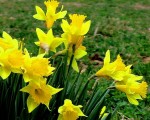
Blooming daffodils

Summer-like weather had kissed the coastal city in mid-winter. The warm sun shone brightly, not a cloud in the sky. Birds sang happily, chattering away noisily with their peers while enjoying their southern sojourn. Flowers bloomed merrily in every garden and by the wayside paths. It was the kind of day when no one should be stuck inside. But that was where she had been all day. There were dishes to wash, groceries to purchase, documents to proof-read, checkbooks to be balanced. That was all on top of caring for a small child and keeping him safe as he explored the many nooks and crannies of his world. By the time all was done and they could go outside, it was already time for her to begin dinner preparations, so someone else got to go out with him!

By late evening, as bedtime approached, dinner now having been completed, dishes done, beds ready for their occupants, the little guy decided he didn’t want to stop playing and get ready for bed. She was frustrated and tired — not at all in a mood to be patient and gentle. Fortunately, she recognized the need for a quick break and walked into another room long enough to regain a bit of peace. When she came out, the child ran towards her, his face one big smile from ear to ear. All memory of the battle waged a few moments earlier long gone from his mind. He had a story for bedtime. Could they read it?  Of course, they could, and the rest of the evening ritual proceeded pleasantly. She even got a few minutes of quiet before retiring herself.

The experience of our “heroine” is, I think, all too common for many of us today. There is so much to be done. So many expectations of how quickly we must respond, so many opportunities to be “busy about many things,” that we end up over-stressed and missing the wonders of the present moment. Yet we would be well advised to notice the child’s way of living in each moment. After all, Jesus told his followers that the Kingdom is made of child-like people — people who can be present in the moment.

God exists in the Eternal Present. Every moment is new in that Eternal Present. Nothing carries over except God’s ever outpouring love. God does not hold on to the past — all is new and everything is possible. “Your sins I remember no more.” (Isaiah 43:25)

We, on the other hand, get stuck in the upsets, angers, resentments and disappointments of the past. Our ability to see and respond to love gets paralyzed. We become separated from our loving, ever present God and the wonder of ever new life flowing out as the present moment.

Jesus comes to lead us from that separation, that paralysis of living and re-living the past (aka, our sinfulness). Once we accept that healing, we can once again rise from our mats as did  the paralyzed man in the Gospel (Mark 2:1-12), dancing in the joy of new life in God’s NOW.

Daffodils Bloom – from public-domain-image.com

Read More

Posted by on Feb 2, 2012

Celebrations and Heartbreaks – There’s Always a “Day After”

Recognizing the Light through our Daily Lives

Three Candles

Stepping carefully as she crossed the intersection, the older woman, wearing a warm coat and knitted hat despite the unseasonably warm weather and carrying a shopping bag of groceries, stopped suddenly, a look of delight on her face. She stepped back and slightly to the side, shifted her purse and bag, and bent to pick up a coin from the street. From my vantage point in the car waiting for the light to change, it appeared to be a quarter — just  twenty-five cents. Yet the delight I saw in her face could not have been greater if it had been a thousand times more valuable. She had found something of value, just laying there on the ground in plain sight, waiting for someone to notice it. She picked it up carefully and placed it into her purse. Then she continued to make her way across the intersection on her way home to her apartment down the street.

As she walked on her way and I went on mine, I reflected on what I had seen. A very ordinary item, found in the course of a very ordinary activity, brought great delight to a seemingly very ordinary person. Yet she was a person who was alert and aware of her surroundings. She noticed what was going on, despite the ordinariness of the day and its activities. She saw more than many saw who crossed that intersection on that afternoon, and when she saw, she acted on what she had seen.

Perhaps this anonymous woman has something to teach us as we celebrate the Feast of the Presentation of the Lord, a feast also known as Candlemas and/or as the Feast of the Purification of the Blessed Virgin Mary. Just as Anna and Simeon recognized Jesus when his parents brought him to the Temple to offer the traditional sacrifice required for a first born son, so we are called to be alert and aware so we will recognize Jesus when he comes into our lives. No one was expecting the Christ to come as the infant son of a normal, non-wealthy, non-royal family from Nazareth. Just a carpenter’s son!  The Christ was to be a military hero who would drive out the Roman conquerors and establish a new kingdom like that of David. Yet, Anna and Simeon recognized him and blessed God for the gift of seeing him before their deaths. Indeed, Anna went around happily telling everyone she met that the Messiah had been born and had been presented at the Temple … and she herself had seen him!

The challenge each of us faces, I believe, is to see the Christ in the people with whom we share our lives, as well as in the people who formally represent the Christian community, and to celebrate that coming  into our lives. The fellow who sits begging on the street downtown, the woman who stops joyfully to pick up a coin in the middle of the crosswalk, the guy who laughingly dances down the street, flirting with all the ladies as he goes to round up some buddies and head off to dinner before the cold night catches up with them, the frightened teen who finds she’s pregnant and is certain her parents will beat her and throw her out on the street if they find out, the doctor who cares for a child without charge when the parents don’t have insurance and can’t pay for the care, the little boy who delightedly strips off all his clothes because he’s learned how to do it and revels in the freedom of being alive and unfettered. Each of these is Christ coming to someone. How do we respond?

Image by Alice Birkin – Public domain


Read More

Posted by on Jan 4, 2012

Celebrations and Heartbreaks – There’s Always a “Day After”

The Feast of the Holy Name of Jesus

Monogram of the name of Jesus

The Feast of the Holy Name of Jesus has been celebrated on various dates in January, however, the current General Roman Calendar has set the celebration on January 3 (since 2002). The feast is celebrated close to the day on which Jesus received his name formally, on the eighth day following his birth when he was circumcised according to Jewish custom. The feast has been celebrated for centuries, popularized originally by Cistercian monks in the 12th century and later by Franciscans, Dominicans, and Jesuits.

In our day, it is not a widely remembered feast. As a child, reverence for Jesus’ name was an important part of our Catholic education. I was taught by Sisters of the Holy Names of Jesus and Mary. We were taught to put the initials, JM (for Jesus and Mary) or JMJ (for Jesus, Mary, and Joseph) at the top of each page we wrote at school. We were reminded to bow our heads slightly when the name of Jesus was spoken. We were not allowed to swear at all and particularly not to use Jesus’ name in swearing. At least some of these practices remain part of the behavior of many of the children taught by the sisters, I suspect. Since the Holy Names Sisters teach all levels of students, from kindergarten through higher education, there are many opportunities for instilling reverence along the way.

The men in our parish were encouraged to become members of the Holy Name Society. As part of membership in this group, they helped and encouraged each other to keep their language clean. They worked together to support the parish and the parish school. It was a way for men to help each other, become friends, and grow in faith. Some amazing things were accomplished by the men who worked together in the Holy Name Society.

I think about this when I hear conversations today in which “OMG” is casually used as an expression of amazement or just excitement, with or without actually saying all the words for which the initials stand. Only rarely are “goodness” or “gosh” substituted for “God” in the expression. Jesus’ name is used freely in ways the Sisters would never have approved.

I find myself wondering if those who speak this way are really aware of what they are doing. Names are powerful and using them creates a connection between the speaker and the one named. Perhaps it’s time to celebrate this feast more publicly, with reminders in church bulletins and special family meals. It certainly wouldn’t hurt to be more mindful of how we use Jesus’ name and how we call on God. At the very least, we could return to the custom of changing what we hear into a prayer, asking a blessing or giving thanks for the many blessings we receive each day.

Then again, maybe many of us already do.

Image is a contemporary example of a traditional monogram.
The letters are the first three letters of Jesus’ name in Greek.
Image in the public domain.


Read More

Posted by on Oct 29, 2011

Where is God on This Page of My Life?

For over twenty-five years I’ve been reading Richard Scarry’s Cars and Trucks and Things That Go to the children in my life. There have been periods during those years when the children were too old or too young for the story, of course, but the book remained on the shelf and visiting children also enjoyed it.

Cars and Trucks and Things That Go is the story of a family (of pigs in this case) who go for a drive to picnic at the beach and then return home by another route. Unlike many children’s books, however, the storyline is just a narrative that ties together page after detailed page of illustrations of cars, trucks and other types of transportation or work vehicles – some fanciful, others actual varieties one might see on the road. All are in use by animals dressed and living as humans would.

One of the characters is a small golden insect, with human type arms and legs, dressed all in golden clothing, whose name is Goldbug. Goldbug, in the words of the story, “shows up just about everywhere,” cleverly hidden on many pages, but always present. Looking for Goldbug is an enduring feature and part of the charm of reading the story. In the process of looking for Goldbug (“Hi there, Goldbug … wherever you are!”), the reader – whether adult or child – scans each bit of every page, looking carefully for the golden head, eyes and antennae that betray his presence. On some pages he’s easy to find – driving a car or bulldozer. But on others …

Yesterday I found him on a page where I don’t remember having seen Goldbug in all the many times I’ve read the story. He looks remarkably like a bit of gold trim on one of the vehicles, but he is definitely there.  I found myself delighted like a little girl at my discovery and I returned to some of the other pages on which he is well hidden. As a result of this exercise, I can assure all that Goldbug is indeed present in every illustration.

The adult me now asks, how many times do I not notice other things or individuals (like maybe God) in the scenes of my life? In ways not unlike little Goldbug’s creativity in finding hiding places, our God peeks out at us through a smile, a flower, a sunrise or sunset, a song, a story, a helping hand, a stranger who takes our part when we are wronged …

In the days and weeks to come, as we move into the busyness and excitement of the holidays, may we keep our eyes open, actively looking  for God’s presence in the pages of our lives. When we look, we’ll find him.


Read More

Posted by on Aug 28, 2011

Celebrations and Heartbreaks – There’s Always a “Day After”

“I’m on my own now, why should I go to Church?”

Mass aboard the USS Enterprise


A new school year is beginning in the Northern Hemisphere and many students who have always gone to Church with their families now find themselves addressing the question, “Why should I go to Church?”  Some will have been asking it for many years. Others will ask it for the first time in the next few weeks, as other activities and concerns vie for their attention and time.

For those who began questioning their family’s practice early, the answers they received as children may have ranged from “Because” to “That’s what our family does” to “No, God doesn’t need us to go to Church, but we need to go to Church,” to “When you’re grown up, you can decide, but until then, we go to Church on Sunday.” None of these answers satisfies the questioner. If truth be told, they don’t really satisfy the one answering the question either.

So really, why should anyone go to Church? Sometimes Mass is boring. In some parishes liturgy feels rushed; in others it seems to take far too long. Sometimes it seems only to be a matter of completing a ritual in the expectation that then God will have to pay attention to those who perform it. Sermons are sometimes dull and not at all related to questions children and teens face in their daily lives. The same old songs are sung every week.  Young people don’t feel welcomed in the music group – only the “old” people who’ve been singing forever decide what to sing and how to sing it. Pastors sometimes seem more interested in getting everyone to contribute to the collection than to getting everyone involved in parish activities or ministry. The idea of contributing from “Time, Talent, and Treasure” seems to undervalue the Time and Talent of teens and young adults in favor of the Treasure they are perceived to have. In short, there are lots of perfectly justifiable reasons not to go to Mass on Sunday.

As a mother, daughter, aunt, catechist, godmother, grandmother, and friend, I watch family and friends struggle with this issue. I was blessed to grow up during Vatican II and to have had wonderful experiences of liturgy and community as a child, teen, and young adult. It was never an issue for me. I loved it all. Yet many of my siblings, their spouses, and their children have had different experiences and find membership in a worshipping community less essential as part of their daily lives. So I ask myself as well, “Why should anyone go to Church?”

The answers I find range from selfishly pragmatic to possibly theologically justifiable. They are certainly not the only reasons. They are simply reasons I can suggest from my own experience and studies.

1.  Church communities are made up of good people who will generally try to help when problems arise in people’s lives. It’s a good idea to get involved with good people and form mutually supportive relationships before you need them. Things may be going well now, but that won’t last forever. When everything starts crashing down around you, it’s good to have someone who’ll try to help you hold the umbrella to deflect the debris, pick up the pieces to start over again, or simply be with you to hold your hand in support and love when nothing else can be done.

2.  Members of church communities may become lifelong friends who share a culture of belief and values. This doesn’t always happen and sometimes those same friends may break apart for a time over nuances of belief, changing values, or practical questions such as where their children will attend school. Nevertheless, with time, love, patience, and forgiveness, members of a community will find that reconciliation occurs and the bonds deepen in subtle ways. The friendship may not be the same as it was originally, but when the chips are down, the bond remains.

3.  God is Trinity – Three in One yet Undivided Unity. Without each of the members of the Trinity, God would be lacking. Together, God is complete. Jesus counted on His Father for support during His life on Earth. He must have listened to the Spirit in His healing ministry – how else to know which of the many people he met would be open to receive healing? The Father was glorified through Jesus’ teaching and life. The Holy Spirit is our advocate, cheerleader, and helper – the way God is with us in this time following the Resurrection.

If God is, in a sense, a community, who are we to turn our backs on community?

4.  Jesus developed and relied on a community of friends during his lifetime. Some were closer confidants than others, but each played an important role in his life. They worshipped together. They ate together. They traveled together. They laughed and cried together. They did all the kinds of things that Christians have done with each other through the ages. They even fought with each other sometimes and were rebuked by Jesus when they got out of line or totally missed the point of what He was trying to teach them. Some betrayed Him. Some denied him. Some ran away when He was arrested. But He never turned any of them away or refused to forgive and be reconciled with them.

It was out of this experience of community that the Church grew – many different people, from many different lands, languages, and traditions, coming together to encourage and support each other as followers of The Way.

5.  The Church is the Mystical Body of Christ. Jesus is not physically present here today in the same way He was before His death and resurrection. St. Paul explained the early understanding of the Christian community, that each person has a specific role to play within the Church, just as each part of a physical body has its own function. If any member of the body is missing, the entire body is weakened. That includes everyone who has been baptized into the community – of all ages, sexes, genders, races, interests, gifts, and talents. If anyone is missing, we are all diminished.

6.   We meet Jesus through each other. This draws from the concept of the Mystical Body. It’s not something about which we generally speak. Many times we don’t recognize this reality. However, when a group of tradesmen comes together to add rooms to the home of a member of their parish who has many children and not enough space for them, Jesus has come. When a death occurs in a family, and the ladies of the parish host a reception following the funeral, Jesus has come to that family. When a friend gives an afternoon to help build a cabinet for a family’s new bathroom, Jesus has come. When a much desired pregnancy ends unexpectedly and a child’s teacher stops to visit the grieving mother after school, Jesus has come. When a family gathers to celebrate a wedding or an anniversary and friends come from miles around to join them, Jesus has come, blessing them all.

7.  Christianity is not an easy path to follow. Christians are called to take unpopular positions. To feed the hungry. To clothe the naked. To care for the poor and strangers in the community. To visit those in prison. To care for the sick. To “speak truth to power.”  Following Jesus will inevitably lead to experiences of the cross. It’s not easy to take a stand contrary to that of people who are powerful. It’s not easy to express an opinion that is contrary to that of one’s family and friends. At home, at work, at school, in public life, times will arise when an individual will have to stand firm, refuse to go along with what everyone else is doing or saying, and experience the pain of being unpopular, ridiculed, censured, isolated, or passed over for a promotion. Some have even had to pay the ultimate price in their witness. We call them martyrs, a word that means witnesses.

8.  In gathering for liturgy (Mass or other celebrations), we share in giving thanks for God’s great gifts and we eat the food that Jesus has given to transform us and give us the strength to continue His work in our world. We meet and get to know each other through our companionship at church. Out of this gathering, all the other benefits already mentioned can and will grow, including the neat side-effect of having a community to support us when we need help too!


Read More

Posted by on Aug 15, 2011

The Assumption of Our Lady, the Human, and Creation


This reflection is based in part on a presentation by Fr. Thomas Berry (1914 – 2009) – Philosopher, Cosmologist.


The Son is the image of the invisible God, the firstborn over all creation.
For in him all things were created: things in heaven and on earth, visible and invisible,
whether thrones or powers or rulers or authorities;
all things have been created through him and for him.
He is before all things, and in him all things hold together.
And he is the head of the body, the church; he is the beginning and the firstborn from among the dead,
so that in everything he might have the supremacy.
For God was pleased to have all his fullness dwell in him,
and through him to reconcile to himself all things,
whether things on earth or things in heaven,
by making peace through his blood, shed on the cross. – Colossians 1:15-20


There is a dimension to all feasts of Our Lady that highlights God’s involvement with the physical –  the material dimension. Mary’s assumption into heaven is a very tangible sign of the new creation in Christ. In his letter to the Colossians, St. Paul is addressing those who do not believe that Jesus was truly human. In this type of Platonist thinking, the feminine is seen as being prototypically associated with the earth and the physical is far inferior to the spiritual, celestial, male principle. The celebration of Mary, Mother of God, in the apostolic churches, acclaims the feminine as the means by which God makes all things new. Mary is the model, the example of what we are supposed to become.

God’s redemption of all creation is the setting for our own restoration of our fallen nature. Caring for creation is today a key obligation for us because of our recently acquired ability to reshape ecological systems on a global basis.

For more on Thomas Berry please go to http://earth-community.org.


Read More

Posted by on Jul 30, 2011

Celebrations and Heartbreaks – There’s Always a “Day After”

Novena to St. Ignatius Loyola – Contemplation to Attain Love – Ninth Day – July 31

We shall not cease from exploration
And the end of all our exploring
Will be to arrive where we started
And know the place for the first time.

T.S. Eliot — “Little Gidding” (the last of his Four Quartets)

The Contemplation to Attain Love is the final Exercise of the Spiritual Exercises. In the Third Week of the Exercises, we focus on the passion and death of Christ. In the Fourth Week we focus on living in the Risen Christ. It is important to remember that St. Ignatius is referring to our love for God. He is also referring to something which is not sentimental or poetic but something lived in everyday life.

We began our exploration and pilgrimage with St. Ignatius with “Take Lord Receive” as an impulse of grace that moves into the life of the Holy Trinity. We now complete the cycle and move into the next. Yet we know the place for the first time.

1st Point.

This is to recall to mind the blessings of creation and redemption, and the special favours I have received.

I will ponder with great affection how much God our Lord has done for me, and how much He has given me of what He possesses, and finally, how much, as far as He can, the same Lord desires to give Himself to me according to his divine decrees.
Then I will reflect upon myself, and consider, according to all reason and justice, what I ought to offer the Divine Majesty, that is, all I possess and myself with it. Thus as one would do who is moved by great feeling, I will make this offering of myself: Take, Lord, and Receive…

2nd Point.

This is to reflect how God dwells in creatures: in the elements giving them existence, in the plants giving them life, in the animals conferring upon them sensation, in human beings, giving understanding. So He dwells in me and gives me being, life, sensation, intelligence; and makes a temple of me, since I am created in the likeness and image of the Divine Majesty.
Then I will reflect upon myself again…

3rd Point.

This is to consider how God works and labours for me in all creatures upon the face of the earth, that is, He conducts Himself as one who labours. Thus in the heavens, the elements, the plants, the fruits, the cattle, etc., He gives being, conserves them, confers life and sensation, etc.
Then I will reflect on myself…

4th Point.

This is to consider all blessings and gifts as descending from above. Thus, my limited power comes from the supreme and infinite power above, and so too, justice, goodness, mercy, etc., descend from above as the rays of light descend from the sun, and as the waters flow from their fountains, etc.
Then I will reflect on myself…

Conclude with a colloquy (The colloquy is made by speaking exactly as one friend speaks to another, or as a servant speaks to a master…) and an Our Father.

Concluding Prayer

St. Ignatius, you signed your letters “pobre de bondad,” poor in goodness, and called yourself a pilgrim. Please pray for me to be open to what God is calling me to do to announce and build up the kingdom. Transform my petitions into questions of discernment and pray for us to remember that all of our true needs and desires are already known to God. Pray that I be taken beyond my wants, beyond my fears, from death into life.

In your writings and by your example we are reminded to pray for the Church and the Holy Father, for all who dwell in darkness, and for the millions lacking food, water, and other necessities. We join our prayer with yours for true openness so that we can contemplate the Divine presence in all things and praise, reverence, and serve God Our Lord in action. Pray for us to have the courage to meet and to serve the Lord Jesus in the poor and the suffering.

Praise be to the Father, the Son, and the Holy Spirit
Now and Forever. Amen.

Read More

Posted by on Jul 29, 2011

Celebrations and Heartbreaks – There’s Always a “Day After”

Novena to St. Ignatius Loyola – Applying the Senses – Eighth Day – July 30

With Christ in Real Time

For St. Ignatius, the spiritual journey is a pilgrimage to the Holy Land and into the very life of Christ. The application of the sense is a type of prayer that is just the opposite of a “mind trip.” Here are some excerpts from Fr. Bob Gilroy, SJ, a Jesuit priest who is an artist, art therapist, hospital and jail chaplain and his beautiful site Prayer Windows.

Becoming Free for God’s Sake

In many ways, Ignatius helps retreatants paint a picture with the mind and senses. The aim of his manual was to inspire people, so that they could enflesh the Gospel of Jesus Christ and live their lives for God and others. This methodology heightened one’s awareness of personal weaknesses and strengths in order to know how best to serve others. The object is to undergo conversion in order to be free for God’s sake.

Composition of Place: An Example

For example, let us look at a selection from the second phase of the Spiritual Exercises, called “The Blind Beggar.” (Fig.15) As I prayed with Mk 10:46-52, which is the story of Bartimaeus, a blind man, I began to imagine the landscape of the setting. It was dry, hot and dusty as I found myself being Bartimaeus, sitting by the roadside. I can smell the animals as they pass by and hear people’s voices in the background. Then I realize from the conversation that Jesus is near, so I cry out to him. I hear the footsteps of someone I believe to be Jesus approach me. I become filled with eager anticipation. Jesus is so close I feel his breath on my face and I hear him say, “I trust you. If there is anything you want to tell me I will listen to you.”

At this point in my life I was wondering whether to consider other job opportunities. As I revealed my fears and hopes in prayer, I felt more freedom to continue looking for confirmation to remain in my present situation. I was asking to see how I could grow spiritually in order to help others by encountering Jesus in a deeper way. This was one example of Jesus restoring my sight in order to follow him.

The revelation of God through the stories of Jesus is made present through imaginative participation. The mind engages the heart. As Hugo Rahner comments, “… the aim of this mode of prayer is to make the events of salvation ‘present’ in the mind, and thus to attain that direct experience.” Ignatian Prayer Windows

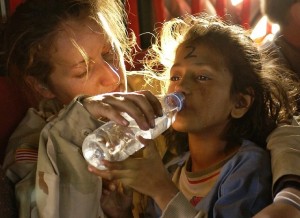
Humanitarian Aid

Exercise

What scene in the life of Christ is your favorite. Spend some time there, in the moment, with the sights, sounds, smells, and feelings of the instant. What does Christ say and do to you and for you. How do you respond?

Concluding Prayer

St. Ignatius, you signed your letters “pobre de bondad,” poor in goodness, and called yourself a pilgrim. Please pray for me to be open to what God is calling me to do to announce and build up the kingdom. Transform my petitions into questions of discernment and pray for us to remember that all of our true needs and desires are already known to God. Pray that I be taken beyond my wants, beyond my fears, from death into life.

In your writings and by your example we are reminded to pray for the Church and the Holy Father, for all who dwell in darkness, and for the millions lacking food, water, and other necessities. We join our prayer with yours for true openness so that we can contemplate the Divine presence in all things and praise, reverence, and serve God Our Lord in action.Pray for us to have the courage to meet and to serve the Lord Jesus in the poor and the suffering.

Praise be to the Father, the Son, and the Holy Spirit
Now and Forever. Amen.

Read More

Posted by on Jul 28, 2011

Celebrations and Heartbreaks – There’s Always a “Day After”

Novena to St. Ignatius Loyola – Discernment – Seventh Day – July 29th

Roland Joffe’s 1986 Movie “The Mission” traces and telescopes the Jesuit missionary efforts in Paraguay. In 1995, the Vatican Film List singled out “The Mission” as one of 15 films of special religious significance. In this scene Fr. Gabriel (Jeremy Irons) plays his oboe to make contact with the Guarani after several of his brothers had been killed in similar attempts. The song is the now famous “Gabriel’s Oboe” by Morricone. Right click on this link to open it in another tab for a symphonic and choral arrangement as a background for your own meditation on this day of the novena.

The Invitation of Christ

St. Ignatius is very clear in his distinction between the Call of Christ and that of Satan. Like Gabriel’s Oboe, the call of Christ is peaceful, inviting, encouraging. The snares of Satan are fear, anxiety, and compulsion. These are the primary ways in which we can begin to discern the source of motions and movements within our soul. The banner of Satan has been called the path of least resistance while the banner of Christ is that of consciousness.

The banner of Christ requires openness, humility, and real courage, as we see in the scene from the movie. In fact, the Jesuit missionary experience in Paraguay would follow the path of the cross as the Portuguese killed the missionaries and enslaved the Guarani. This in turn was only the prelude to the suppression of the Society of Jesus in 1767 because of its opposition to the absolute power given to kings and emperors during the Enlightenment. The Society was restored in 1814.

A Growing Sensitivity

Wholeheartedness in the service of God demands a constant effort of discernment, a growing sensitivity to the will of God. Without this, generosity can lead only to ‘the expense of spirit in a waste of shame’…

At all events, Ignatius characterizes Lucifer as a tyrant who drives and compels his subjects (he uses a vocabulary of compulsion and trickery), whereas when describing Christ his vocabulary is one of friendship, persuasion, gentleness…

What I have to see is that my personal option must be made in the light of this universal vision. My choice must integrate me into the great movement of salvation already accomplished in Christ and now being worked out on earth. My choice will be a reproduction in me of the option of Christ who chose the cross, despising its shame. We may note that this idea finds its first development with Origen but is already contained in germ in the phrase of Ignatius of Antioch – ‘Let me be an imitator of the passion of my God’. – William Yeomans (emphasis not in the original)

Mother Teresa

Exercise:

Placing myself in God’s presence, I ask these questions of myself and the Holy Spirit. What is my path of consciousness? What is my path of least resistance?

Concluding Prayer

St. Ignatius, you signed your letters “pobre de bondad,” poor in goodness, and called yourself a pilgrim. Please pray for me to be open to what God is calling me to do to announce and build up the kingdom. Transform my petitions into questions of discernment and pray for us to remember that all of our true needs and desires are already known to God. Pray that I be taken beyond my wants, beyond my fears, from death into life.

In your writings and by your example we are reminded to pray for the Church and the Holy Father, for all who dwell in darkness, and for the millions lacking food, water, and other necessities. We join our prayer with yours for true openness so that we can contemplate the Divine presence in all things and praise, reverence, and serve God Our Lord in action.Pray for us to have the courage to meet and to serve the Lord Jesus in the poor and the suffering.

Praise be to the Father, the Son, and the Holy Spirit
Now and Forever. Amen.

Read More

Posted by on Jul 28, 2011

Celebrations and Heartbreaks – There’s Always a “Day After”

Novena to St. Ignatius Loyola – The Banner of Christ – Sixth Day – July 28th

“May Christ our Lord give us his grace so that we may be always sensitive to his will and fulfill it entirely.”

This quotation is the closing salutation St. Ignatius used commonly in his letters and represents the state of openness that is the goal of the Exercises.

The Forces of Good and Evil

The Second Week of the Spiritual Exercises prepares us to make the “Election” or the choice to serve Christ the way he has served us in complete humility by the way of the cross. St. Ignatius takes us through the life of Christ from the Incarnation to the Baptism at the River Jordan.

Before we can get to this election we have to deal with the parts of ourselves that still hold on to sinful ways, attitudes, and tendencies. For St. Ignatius, there are two competing kingdoms symbolized by their own flags or standards. By accepting the banner of Christ and His Kingdom, we reject sin and evil within ourselves and move from a position of self-interest to one of complete surrender to the Divine Will.

The Banner of Christ

“The issue at stake at this stage of the Exercises is not the fact of salvation or of Christ’s victory over Lucifer. That has never been in doubt and the whole theology of the First Week presupposes it. The question is how this victory is to be made a reality for mankind here and now, through my choice. There is no doubt in Ignatius’ mind that the banner of Christ is the Vexilla Regis, the banner of the cross, and the Election is going to be a setting out on the way of the cross.” William Yeomans, “The Two Standards”

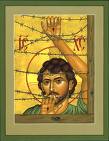
SacredHeart Fanelli 1994

Exercise:

What comes to my mind and heart when I say this prayer? What part do I play in God’s plan of salvation here and now: day in and day out?

Lord, teach me to be generous.
Teach me to serve you as you deserve;
to give and not count the cost;
to fight and not heed the wounds;
to toil and not seek for rest;
to labor and not ask for reward, except to know
that I am doing your will.

Concluding Prayer

St. Ignatius, you signed your letters “pobre de bondad,” poor in goodness, and called yourself a pilgrim. Please pray for me to be open to what God is calling me to do to announce and build up the kingdom. Transform my petitions into questions of discernment and pray for us to remember that all of our true needs and desires are already known to God. Pray that I be taken beyond my wants, beyond my fears, from death into life.

In your writings and by your example we are reminded to pray for the Church and the Holy Father, for all who dwell in darkness and for the millions lacking food, water, and other necessities. We join our prayer with yours for true openness so that we can contemplate the Divine presence in all things and praise, reverence, and serve God Our Lord in action.Pray for us to have the courage to meet and to serve the Lord Jesus in the poor and the suffering.

Praise be to the Father, the Son, and the Holy Spirit
Now and Forever. Amen.

Read More

Posted by on Jul 26, 2011

Celebrations and Heartbreaks – There’s Always a “Day After”

Novena to St. Ignatius Loyola – Reconciliation – Fifth Day – July 27 –

Testimony:

Thank God for His mercy and grace. If not for His grace and mercy, I would have been so lost in drugs and alcohol and misery. He sent His son to die for each of us. What I have now is peace that passes all understanding, and His Spirit that lives in me to give me actual joy in life. finally joy and peace that I thought was in pain killers and booze. That wasn’t joy, that was being numb. Not now! Not anymore! Thank God for His grace. – blog comment on “Your Grace Is Enough for Me” by stormyweather

Reflection:

This testimony is a beautiful example of true reconciliation. It involves a transformative healing and could have come right out of the pages of the Gospel – The Good News.

Confession, or the Sacrament of Reconciliation, is high on St. Ignatius’ list of priorities for the First Week of the Exercises. The challenge for most cradle Catholics is focusing on a long Church approved check list of sins, as opposed to focusing on the person of Christ. The things that bother us the most are obvious if we are honest with ourselves. Often we can become neurotically obsessed with our own behavior in terms of small things, without facing major issues like alcoholic parents; sexual, physical, or psychological abuse; refusing to forgive. People in lifestyles or marriages that don’t meet Church standards can feel that somehow God is not interested in them; somehow He died only for the good people.

Most of the detailed lists cover symptoms of some type of break-down in our relationship with God as codified in the Ten Commandments or the Seven Deadly Sins: pride, avarice, lust, envy, gluttony, anger, and sloth. However, this can lead to a denial of our own feelings and cause damage in other areas of our lives. If my anger is always close to the surface, it is not really helpful to keep confessing it and beating myself up over it without looking more deeply at what its cause is. My marriage can be problematic and my sex life unsatisfying. However, if I just keep focusing on the symptoms instead of these deeper issues, I am wasting time and energy and building up to something that will be very bad for everyone concerned.

Sin, guilt, and remorse can be very complicated. Returning veterans from the Middle East have not sinned when they killed people if you believe in the just war theory of morality. That doesn’t mean that they don’t carry a great burden. When they lash out in destructive ways as part of Post-Traumatic Stress Disorder, marriages are lost, children are harmed, suicide can follow. Going down a checklist doesn’t even begin to offer the healing we all need in these and most situations. Let us look at ourselves, our loved ones, and all others with honesty and compassion as we embrace the forgiving Christ. We are worth everything to God. Perhaps the greatest sin when we don’t see ourselves as worth saving. God does not make junk.

people-walking-on-street

Examination of Conscience

Place yourself in God’s presence and know that you are with a trusted friend. Put out of your mind all thoughts of an avenging father figure or some tyrannical authority figure. You are with the God who came to dwell among us and shared all things we endure except sin. Jesus was open and frank with people who came and spoke with him. He expects no less from you. If you are upset or confused, listen for the healing voice of your Friend. Open your heart and listen.

Start with a thank you for being redeemed and saved and for protection. Ask the tough questions. Why did my child die? What do I do with my alcoholic husband? My heart is broken. Can you mend it? I tampered with evidence to get innocent people convicted. I fought for tax laws that would protect me and take food, healthcare, housing, and education from the poor. I did my best to be careful, but I killed women and children in that village. I think the Church is wrong when it says we should get rid of the death penalty.

Be open to finding out the facts. Have I brought these issues to a counselor? How do I start to change things and to make amends. What is the deeper issue here?

Talk with Jesus. Accept His forgiveness. When he says “Go in peace and sin no more,” what will I do to make that a reality? If you are glum or downcast, something is wrong. You have been pardoned. Stretch, breathe, cry for happiness. Break out in song. Jump for joy. This day salvation has come to your house.

Concluding Prayer

St. Ignatius, you signed your letters “pobre de bondad,” poor in goodness, and called yourself a pilgrim. Please pray for me to be open to what God is calling me to do to announce and build up the kingdom. Transform my petitions into questions of discernment and pray for us to remember that all of our true needs and desires are already known to God. Pray that I be taken beyond my wants, beyond my fears, from death into life.

In your writings and by your example we are reminded to pray for the Church and the Holy Father, for all who dwell in darkness and for the millions lacking food, water, and other necessities. We join our prayer with yours for true openness so that we can contemplate the Divine presence in all things and praise, reverence, and serve God Our Lord in action.Pray for us to have the courage to meet and to serve the Lord Jesus in the poor and the suffering.

Praise be to the Father, the Son, and the Holy Spirit
Now and Forever. Amen.

Read More

Posted by on Jul 25, 2011

Celebrations and Heartbreaks – There’s Always a “Day After”

Novena to St. Ignatius Loyola – Soul of Christ – Day 4 – July 26


Opening Prayer

Anima Christi

Soul of Christ, sanctify me.
Body of Christ, save me.
Blood of Christ, inebriate me.
Water from the side of Christ, wash me.
Passion of Christ, strengthen me.
O Good Jesus, hear me.
Within Thy wounds hide me.

Suffer me not to be separated from thee.
From the malignant enemy defend me.
In the hour of my death call me.
And bid me come unto Thee,
That with all Thy saints,
I may praise thee
Forever and ever.
Amen.

A favorite prayer of St. Ignatius, the Anima Christi has its origins in the 13th century, but the author remains unknown. It may seem a little jarring to juxtapose the exuberant “Worthy Is the Lamb” with the ancient and more subdued Anima Christi. However, they focus on our recognition of the source of our salvation and the compelling power of God’s grace. Across 800 years, the cultural idiom may have changed but not the Holy Spirit.

Foregiveness

Reflection

St. Ignatius focuses the First Week of the Exercises on sin and conversion. The activities concentrate on becoming aware of our sinfulness, our unworthiness, and God’s willing pardon. Sometimes this awareness can be overwhelming in inappropriate ways. The purpose of these actions is to change our hearts. In this regard, St. Ignatius is something of a behaviorist. His approach is to notice particular tendencies or actual sins and to keep a scorecard of our victories and defeats. Clearly, it is not enough to know our failings; it is more important to do something about them.

For those who are newly turned from sinful and self-destructive lifestyles, the First Week is a time of awareness, repentance, and a behavioral change in our awareness of our thoughts and actions. In many ways this mirrors St. Ignatius’ own experience during his conversion and pilgrim years. As a man of his times, he lived in a time of strict and rigid codes of honor, duty, and obligation. Feudal lords could exact terrible consequences from any of their vassals or peasants who breached obligations, whether the breach was real or perceived.

For many people today, Christian conversion is experienced in the intensity of the charismatic experience. The focus is on forgiveness, the terrible price Christ paid for each one of us, and the joy of our salvation. The reformation of our lives is worked out in this broader context.

Regardless of whether we are in the 16th or the 21st centuries, our journey begins with the experience of our salvation and the changing of hearts shown in our actual behavior.

Placing Ourselves in God’s Presence

Inhale slowly and deeply. Exhale slowly and mindfully.
Relax. Be at peace. Be aware that you are in God’s loving presence wherever you are.

Reviewing Our Lives With Gratitude

When did I first become aware of my sinfulness and God’s forgiving love? Who were the people in my life who showed me their changed hearts by their example? When did I first give or receive forgiveness from someone important in my life? When did I first stop looking at a check list of sins and realize that my actions could hurt and offend God?

Reflecting on Our Feelings and Spiritual Movements

What thoughts and feelings come to my mind and heart when I let God and others down? What do I feel when I see and reflect on the suffering and death of Christ? How do I feel when my love is not returned? Why is God’s love so encompassing?

Focusing on What Comes to Us

Let your feelings and images well up within you. What strikes you the most about the course of your life? What feeling or images come to you more clearly and peacefully?

Talking With Jesus Our Friend

Converse with Jesus as He is right now, right here – your friend. Share what comes from your heart – in a look, a few words, a smile. Talk frankly about the things that you are doing wrong in your life. Talk about grudges, bitterness, your regret, your shame. Ask for his healing and make a plan to start changing things, little by little, day by day.

Jesus, your love and your grace are enough for me. Let nothing come between us.

Concluding Prayer

St. Ignatius, you signed your letters “pobre de bondad,” poor in goodness, and called yourself a pilgrim. Please pray for me to be open to what God is calling me to do to announce and build up the kingdom. Transform my petitions into questions of discernment and pray for us to remember that all of our true needs and desires are already known to God. Pray that I be taken beyond my wants, beyond my fears, from death into life.

In your writings and by your example we are reminded to pray for the Church and the Holy Father, for all who dwell in darkness and for the millions lacking food, water, and other necessities. We join our prayer with yours for true openness so that we can contemplate the Divine presence in all things and praise, reverence and serve God Our Lord in action.Pray for us to have the courage to meet and to serve the Lord Jesus in the poor and the suffering.

Praise be to the Father, the Son, and the Holy Spirit
Now and Forever. Amen.

Read More