Pages Menu
RssFacebook
Categories Menu

Posted by on Sep 3, 2008

Saint of the Day – St. Gregory the Great – Preaching the Gospel to the Ends of the Earth

Saint of the Day – St. Gregory the Great – Preaching the Gospel to the Ends of the Earth

St. Gregory the Great was born in Rome around 540 AD. This was a time when the Goths and Franks were invading Rome. The emperor was in Constantinople. The Senate had been disbanded. Italy was still one country, called Rome, and late classical Latin was the language of the people.

Gregory’s family were wealthy, owning homes and property in and around Rome and in Sicily. He was raised and educated for a career in public office. He had fresco portraits of his family painted at some point, and his biographer, John the Deacon, left a description of them 300 years later as they appeared in the portraits. Gregory’s father was tall and had a light eyes and a long face. He wore a beard. Gregory’s mother was also tall, but she had a round face and blue eyes. She appeared to be a cheerful person. A portrait of Gregory himself was done shortly after his death. Again, John the Deacon left a description of his appearance in the portrait. Gregory is described as being somewhat bald, with a tawny beard. The shape of his face was somewhere between that of his mother and his father. His remaining hair was worn long and curled carefully. He had a thin, straight, almost aquiline nose and a high forehead. His lips and chin were described as also attractive and it is said that his hands were beautiful.

St. Gregory lived in a time of great turmoil. Wars, floods, famines, political changes, and religious controversies swirled through Italy and the Empire. He left a career in public service to enter a monastery when he was around 30 years old, only to be drawn back into public life by the Pope, who sent him to Constantinople to request help from the Emperor in defending Rome. Following 6 years in Constantinople, he returned to Rome. Eventually he himself was elected Pope, an office he tried to decline.

As Pope, he is remembered for reforms of the liturgy, establishing rules of conduct for bishops, the wielding of political power in dealing with invading armies and natural disasters, his insistence on the supremacy of the papacy over the other patriarchs of the church, the notion that the Pope is the “Servant of the Servants of God,” and for establishing the papacy in the form it would take during the Middle Ages. He insisted that the Church has a responsibility to care for the poor. When famine threatened even the wealthy in Rome, he arranged for food and other supplies to be delivered from properties in southern Italy (lands that his family had given the Church) and distributed in the city. He cooked meals for the formerly wealthy himself to spare them the pain of having to ask for charity.

St. Gregory is also remembered for sending missionaries to England, the “end of the Earth” from the perspective of Rome. At that time, there was no knowledge of lands beyond the British Isles. In the rest of the Roman Empire, Christianity had been introduced. Even the Franks in Central Europe had been reached by missionaries. Given the turmoil and upheaval, it stands to reason that he might have thought, as many do today in times of natural disasters and social turmoil, that the end of the world must be near. The Gospels said that the end would not come until the Good News was preached to the ends of the Earth, however. So, perhaps with that in mind, and certainly with a fondness for the blond, blue-eyed people (the Angles) he had seen in Rome, he sent Anselm of Canterbury to preach the Good News in England.

The end of the world didn’t come in St. Gregory’s time. However, the works he did influenced the Christian community of his time and continue to play a role in even our beliefs and style of worship today.

Read More

Posted by on Aug 18, 2008

Saint of the Day – St. Gregory the Great – Preaching the Gospel to the Ends of the Earth

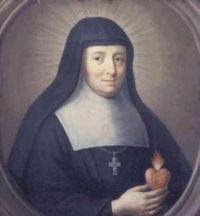
Saint of the Day – St. Jane Frances de Chantal

St. Jane Frances de Chantal was born in France in 1582, the daughter of the president of the Parliment of Burgundy. She married Baron de Chantal and had 6 children, three of whom died shortly after birth. She became a widow at the age of 28 as the result of a shooting accident. She was heart-broken and vowed never to marry again. She lived with her children in the home of her father-in-law for seven years before she was allowed to visit her father in 1604.

On that visit, she met St. Francis de Sales and he became her spiritual director. By 1610, in collaboration with Francis de Sales, she founded the Order of the Visitation of Holy Mary, for widows and lay women who were not called to such strict forms of religious life as were common at the time.

One description of the order states that its charism “combines gentleness with a valiant spirit; initiative with communal support; dedication to prayer with presence in the world; a contemplative life with an apostolic dimension. The order’s motto is “Vive Jésus” (French for “Live Jesus”).”

Visitationist sisters work with widows and women in poor health. They also have some schools. Their life includes a strong contemplative element.

One of St. Jane Frances de Chantal’s teachings to her sisters is as follows:

Fidelity toward God consists in being perfectly resigned to his holy will, in enduring everything that his goodness allows in our lives, and in carrying out all our duties, especially that of prayer, with love and for love. In prayer we must converse very familiarly with our Lord, concerning our little needs, telling him what they are, and remaining submissive to anything he may wish to do with us…

We should go to prayer with deep humility and an awareness of our nothingness. We must invoke the help of the Holy Spirit and that of our good angel, and then remain still in God’s presence, full of faith that he is more in us than we are in ourselves.

There is no danger if our prayer is without words or reflection because the good success of prayer depends neither on words nor on study. It depends upon the simple raising of our minds to God, and the more simple and stripped of feeling it is, the surer it is.

We must never dwell on our sins during prayer. Regarding our offenses, a simple humbling of our soul before God, without a thought of this offense or that, is enough…such thoughts act as distractions.

Saint Jeanne de Chantal, from Wings to the Lord

Read More

Posted by on Aug 14, 2008

Saint of the Day – St. Gregory the Great – Preaching the Gospel to the Ends of the Earth

Operation Kolbe – Continuing the Witness

The Kidnapped Colombia

– John Angée, artist


In preparation for the celebration of the feast of St. Maximilian Kolbe, Randy requested input from outside sources about Kolbe and his life. One of the responses came from a group in Colombia who offer themselves in exchange for persons kidnapped by rebels. This was their response.


El 14 de Agosto se recuerda y celebra la vida de Maximiliano KOLBE. Unidos a todos los secuestrados, Operación Kolbe, iniciativa de largo aliento, quiere renovar su ofrecimiento por la libertad.


Hemos expuesto un óleo titulado: “La Patria secuestrada” de John Angée (USA 2007) a la entrada del edificio Pedro Arrupe (Facultad de Teología) de la Pontificia Universidad Javeriana de Bogotá y seguimos alentando a Relevos, Orantes y Difusores para que se mantengan en la firme de decisión de acompañar solidariamente a tantos hombres y mujeres que siguen en cautiverio y a sus familiares y amigos.


No sabemos si algún día esta propuesta sea aceptada, pero sabemos, sí, que no descansaremos hasta ver en libertad al número desconocido de hermanos y hermanas que dramáticamente y en silencio nos piden no olvidarlos.

OPERACION KOLBE 2008
COLOMBIA

RESPONDER A:  operacionkolbe@hotmail.com

[On August 14 we remember and celebrate the life of Maximilian Kolbe. United with all those kidnapped, Operation Kolbe, a long term enterprise, wishes to renew its offer for liberty.

We have exhibited an oil painting titled: “The Kidnapped Colombia” by John Angée (USE 2007) at the entrance of the Pedro Arrupe building (Department of Theology) of the Pontificia Universidad Javeriana (Xavier Pontifical University) in Bogotá and we continue to encourage those who serve as Relief, those who Pray and Broadcasters to remain firm in their decision to accompany in solidarity the many men and women who remain in captivity and their family and friends.

We do not know if one day this offer will be accepted, but we know that, yes, we will not rest until we see the return to freedom of the unknown number of brothers and sisters who dramatically and in silence ask us not to forget them.

Operation KOLBE 2008

We can be reached at: operacionkolbe@hotmail.com

Translation by Kathy Pozos]

Thank you for your response. We will keep you and all kidnap victims and political prisoners in our prayers.

Read More

Posted by on Aug 14, 2008

Saint of the Day – St. Gregory the Great – Preaching the Gospel to the Ends of the Earth

Saint of the Day: St. Maximilian Kolbe – August 14

St. Maximilian Kolbe, a Conventual Franciscan, is widely known as the saint of the Nazi death camp Auschwitz, where he voluntered to take the place of a young husband and father who was one of ten innocent men condemned to death by starvation as a reprisal. As courageous as this was, he is also considered a martyr because of the abuse and torture he endured when he affirmed his faith in Christ.

Born Rajmund Kolbe (1894 – 1941), to a working class family in what is now Poland, he took the name of Maximilian when he entered the Conventual Franciscans. He had doctorates in philosophy and theology and founded a thriving monastery at Niepokalanow near Warsaw. St. Maximilian Kolbe was also a missionary to Japan and is remembered for his respect for Japanese culture and tradition as he created a thriving center near Nagasaki.

He lived a life of true Franciscan poverty, often living in very difficult circumstances, but always depending on God for the resources he needed for his apostolate. St. Maximilian Kolbe used publishing and radio to promote the Gospel and to defend the Church. He landed in Japan with a couple of companions and no money. They began their work sleeping on the ground in an improvised hut. Within a month he had a press and was publishing a weekly newspaper. He ventured into India where he wanted to create another foundation, but his superiors recalled him to Poland because of his ill health.

In 1939 the Nazis invaded Poland. St. Maximilian Kolbe and his fellow Franciscans sheltered 3,000 refugees at Niepokalanow including 2,000 Jews. On February 17, 1941 he was arrested by the Gestapo after publishing a defense of truth in the face of Nazi propaganda. In May he was transferred to Auschwitz, where he continued his ministry despite inhuman conditions and beatings. It was in late July that a prisoner from his cell block disappeared and he volunteered to take the place of one of the ten men selected to be executed as a reprisal for the missing prisoner. After three weeks of hunger and thirst, during which he encouraged the other men and led them in prayer, he was murdered by a lethal injection on August 14.

St. Maximilian Kolbe had a powerful effect on a young Polish man, Carol Wotyla, who as Pope John Paul II would declare him a saint.

St. Maximilian Kolbe has also inspired Operation Kolbe, a group in Colombia, to offer themselves in exchange for those who have been kidnapped by rebels. They can be reached at: operacionkolbe@hotmail.com.

Read More

Posted by on Aug 11, 2008

Saint of the Day – St. Gregory the Great – Preaching the Gospel to the Ends of the Earth

Saint of the Day – St. Clare of Assisi – August 11

St. Clare of Assisi was born in 1194. She was one of the early followers of St. Francis of Assisi and with him co-founded the Order of Saint Clare, now commonly known as the Poor Clares.

Clare was from a wealthy family and left it all to lead a life of absolute poverty in a cloistered monastery. She and her sisters passed their days working and praying. The order has continued into our times, with monasteries of sisters in communities around the world.

In celebration of the feast of St. Clare, I invited some of her sisters to share their insights and reflections. I received these responses.

From Sr. Miriam Varney, Abbess of the Monastery of St. Clare in Chesterfield, NJ,

Saint Clare had a great devotion to the Eucharist and it was shown at the time when the town of Assisi was being attacked.  Clare’s response was to go to Jesus in the Eucharist. Here is our prayer Novena for our Feast Day:

Saint Clare, radiant light, Shining in Splendor, help us all to walk, “with swift pace and light step” in the footprints of the “Poor Crucified and His Most Holy Mother.” Through Your presence in the Blessed Sacrament, Protect all life, our homes and cities from crime and violence as you once protected your sisters and the city of Assisi.
Through your powerful intercession obtain many graces for the Church, for each of us, for our Franciscan family and for the whole world. Amen

From the Poor Clare Nuns of Belleville:

13th century St. Clare stands as a 21st century witness of Gospel hope.  She is reminder that human fulfillment is not a matter of power or prestige or possessions, but of discovering the treasure that lies hidden in the field of the world (3rd Letter of St. Clare to St. Agnes of Prague).  Clare bears shining witness that the kingdom of God is within.   She shows the world that a life full of God is a life full of hope.   She confirms this telling observation of Pope Benedict XVI:  Prayer is the language of hope — not a hope which isolates or renders indifferent to the sufferings of the human family, but a hope that gives the individual a heart for the world and thus to all that makes the world truly worthy of its divine destiny.

Each Poor Clare community is called to be an “assembly of hope.”  Hidden and apart, universal and eschatological (Poor Clare Constitutions, art. 44,1), the more deeply, fervently and faithfully we live our enclosed contemplative form of life, the more do we bear witness to Christ, the Life and Hope of the world.  Ours is a life of joy and faith, surrender and self-sacrifice which enables our monasteries to continue to offer to today’s world, with its widespread need for spirituality and prayer, the demanding proposal of a complete and authentic experience of God, One and Triune, radiating His loving and saving Presence.  (Pope John Paul II)

For more information on our community, our Poor Clare vocation and for reflections on various Franciscan/Clarian themes, you are welcome to visit our website.

From Sister Jane Marie Delevan of St. Clare Monastery in Evansville.

We appreciate your efforts to make our Mother St. Clare better known and yes you are in our prayers, God Bless you, Sr. Jane Marie,O.S.C. Happy & Blessed Feast Day!!

And now, a quick trivia question. Why is St. Clare shown with a cat in the first image? The story goes that when she was confined to bed due to illness, she continued to work. One day she dropped the roll of fabric on which she was working and it rolled away out of her reach. The monastery cat brought the fabric back to her, so she could continue working.

One of the California missions, and indeed, an entire city, is named for St. Clare of Assisi. Mission Santa Clara de Asís is located near San Jose, California and was founded in 1777 by Fr. Junipero Serra. Fray Tomás de la Peña and Fray José Murguía were the first to minister at Santa Clara. Today Santa Clara University is located on the site of the mission and the restored mission church is the university chapel.


My thanks to the communities who have shared their thoughts with us and to all Sisters of Saint Clare, for your dedication to serve the Lord and the Christian community through your lives of prayer and sacrifice, as well as through the many types of work you do in service to the community. Happy Feast Day.

Read More

Posted by on Aug 9, 2008

Saint of the Day – St. Gregory the Great – Preaching the Gospel to the Ends of the Earth

Saint of the Day: St. Edith Stein – August 9

Sr. Teresa Benedicta of the Cross, a Carmelite nun, was born Edith Stein in 1891in Poland and was killed in Auschwitz on August 9, 1942. Edith and her sister Rosa, along with other Jews who had become Catholics, were arrested by the Nazis occupying the Netherlands in retaliation for the denunciation by the Dutch bishops of Nazi anti-Semitism.

There has often been criticism of the silence of the Church with regard to the Nazi extermination of the Jews. Before he became Pope Pius XII, Cardinal Eugenio Pacelli had been the papal nuncio to Germany during the 1930’s and negotiated a treaty, or concordat, between the Vatican and Nazi Germany. Gerard Noel has published a new book, Pius XII: The Hound of Hitler, which focuses on the crushing conflict the Pope experienced within himself and the deep personal toll it took on him.

Pius XII’s fears for the Church were only increased by the Nazi extermination of Jewish converts to Catholicism in the Netherlands. A broader analysis of the Pope’s situation makes it seem almost impossible. Events were beyond the ability of any one person to change or control. Mary Doria Russell, in A Thread of Grace, portrays the complexity of the Italian resistance to the Holocaust. The sheer caprice of war annihilates and spares individuals and communities at random. Most Italian Jews were saved by their neighbors and complete strangers. Unfortunately, this was not the pattern in the rest of Europe.

St. Edith Stein could not justify the horrendous evil that was to be visited on her people in any theological sense but that of the cross. In her final few days at Auschwitz, Edith and her sister Rosa made an indelible impression on some of the children. As the survivors tell it, many mothers were so traumatized that they collapsed emotionally. Edith and Rosa comforted and held the children and did what they could to meet their needs. Edith Stein’s contribution to the philosophy of experience was the notion that our identity is created not through an Ego that apprehends others. Rather, the Ego arises out of our identification with the needs, desires, and feelings of others. We come to be, as self-conscious beings, through compassion.

In her final days, St. Teresa Benedicta of the Cross showed that her philosophy of compassion was not just an intellectual construct but the framework of her life and legacy to us.

Read More

Posted by on Aug 8, 2008

Saint of the Day – St. Gregory the Great – Preaching the Gospel to the Ends of the Earth

Saint of the Day – St. Dominic – August 8

For the feast of St. Dominic, I asked several Dominicans what they would like people to know about the founder of their order, the Order of Preachers. These were responses I received in the order received.

From Timothy Radcliffe, OP, Blackfriars, Oxford: 

I would say that one of the things that struck people about St Dominic was his joy. One has the impression that he delighted in talking to people, whoever they were. He had an immediate empathy with people, with their sorrows and joys. It was said that he laughed during the day with his brethren, and wept at night with God. This joy is the beginning of all preaching. The early Dominicans all compared the gospel to new wine, which makes you drunk!

From Thomas McDermott, OP, Kenrick-Glennon Seminary, St. Louis, Missouri

Here’s something that you might be able to use:

“Two distinctive features of Dominican spirituality are study and preaching.  St. Dominic situated his religious communities not in the countryside, as in the case of monks, but in the center of university cities.  Manual labor was replaced by study and the friars could be dispensed from attending parts of the Liturgy of the Hours for purposes of study.  What were they to study?  Truth–sacred truth.  The motto of the Order is Veritas.  Study was to inform the contemplative life of the Dominican friar and preaching, in all its forms, was the overflow.  Another motto is, “To preach, and to share with others the fruits of one’s contemplation.”  The official name of Dominican order is the Order of Preachers.  Democracy has always been a hallmark of the Dominicans. Major and local superiors are elected by the friars themselves.  General chapters of the Order take place every three years to respond to current needs and keep the Order’s legislation up to date.”

Here’s a good source for biographies of St. Dominic and other OP saints, http://www.domcentral.org/trad/

From Michael Fones, OP, Co-director, Catherine of Siena Institute

I would want people to know that he was in such love with God that it was said of him that “he was always either talking to God or talking about God.”  I say this is a sign of his great love of God because we naturally want to be in conversation with our beloved, and he or she is always so much on our mind that we inevitably talk to others about them.

 From Sr. Barbara Long, OP, Holy Cross Parish, Santa Cruz

St. Dominic’s ministry is as contemporary today as it was in the 13th century. Dominic realized that we need to meet people where they are at. He didn’t wait for people to come to him, but encountered them in the every day activities of their lives and shared the Gospel message.

My thanks to these and other dedicated brothers and sisters of St. Dominic for sharing your gifts and insights.

Read More

Posted by on Aug 5, 2008

Saint of the Day – St. Gregory the Great – Preaching the Gospel to the Ends of the Earth

Saint of the Day – St. John Vianney: August 4


St. Jean Baptiste Marie Vianney (1786-1859) was the parish priest of the village of Ars and is known primarily by that title even in English, “The Cure d’Ars”. Canonized in 1925 St. John Vianney is the patron of parish priests. In many respects he is a thoroughly modern saint.

He was born into the midst of the French Revolution and into a devout rural family who worshiped in secret with outlaw priests who refused to become state functionaries. The upheaval of the revolution closed schools, hospitals, and other institutions. For the first time in human history, the state asserted itself without religion as it destroyed the old Catholic order – the Ancien Regime. The “Goddess of Reason” was enthroned in the Cathedral of Notre Dame in Paris. Priests, nuns, and the Catholic nobility were killed, forced into hiding or exiled.

After the revolution subsided, Napoleon attempted to gain complete control of the Church in France and even took control of the Papal States, removing the Pope from Rome and bringing most of the Cardinals to Paris. In 1812 Napoleon’s fall began with the disastrous retreat from Russia in winter. The Industrial Revolution would follow, ending forever the cultural matrix of European Christianity.

St. John Vianney’s 73 years of life would span the trauma of the ending of the Divine Right of Kings to the rise of the rights of the common man. He would become emblematic of a Catholicism redefining itself, as it was torn from the 1,500 years of prerogatives and burdens of its affiliation with the state dating from the reign of the Emperor Constantine.

St. John Vianney began by re-asserting the centrality of God in his own life and supporting those in the parish who still practiced the faith. It is important to note that his vocation was in itself something of a miracle. Due to the upheaval of the times, he had no formal education until he was 20 and had great difficulty with Latin. To make matters worse, he got drafted by Napoleon and ended up as a deserter in hiding. An unlikely amnesty made it possible for him to return to his studies. If there hadn’t been such a severe shortage of priests, it is possible that he would never have been ordained.

His personal example of holiness in terms of his prayer and his charity to all made a deep impression. Sunday had become just another workday. Taverns were places of dissolution and much of the social order had broken down. “Dances” were part of a wild party scene involving promiscuity and adultery. Orphans and the disabled were exploited and left to fend for themselves. Over several decades, he led a movement to remedy these problems and to encourage religious devotion, while promoting service to others.

When the bishop attempted to assign St. John Vianney to other parishes, the community protested until the bishop relented. By our standards, his personal acts of penance and mortification, his meager diet, and short hours of sleep, appear to be excessive and even harsh. Reports that he was assaulted by the Devil at night strike us as bizarre, maybe even pathological. Yet they were witnessed by men in the parish who came when they heard the commotion.

Interestingly, he was not severe with his parishoners or penitents in the confessional. In fact, he was known for having won over a prominent woman who was a Jansenist and led her from a severe and demanding conception of God.

Not all of his fellow priests agreed with his approach or pastoral style. In fact, we might say that his special gifts in his historical circumstances may have created the ideal of the parish priest as a solitary super hero, like the desert fathers or the anchorites of the early Church. This calling is something one can respond to, but it cannot be fabricated and put on like a suit. Fr. John Cihak, in “St. John Vianney’s Pastoral Plan”, helps us understand how his example can guide parish priests today.

There is one major factor that is alluded to in the wonder of St. John Vianney’s life and ministry, but it is especially important for all of us who are parishioners today. God worked extensively in the life and ministry of St. John Vianney through his family, those who sheltered him as a deserter, and the people of Ars. Whether the pastor is single or married, the position is one of the most exposed and the most lonely. In denominations with a married clergy, and in the case of Eastern Rite Catholic priests and Latin Rite Catholic deacons, the spouses and children of clergy have a special opportunity and burden that only we can support by our prayers, understanding, and kindness toward them.

Read More

Posted by on Jul 25, 2008

Saint of the Day – St. Gregory the Great – Preaching the Gospel to the Ends of the Earth

Saint James the Apostle – July 25 – Big Jim Learns About the Kingdom

James, son of Zebedee and Salome, was one of the first disciples of Jesus. He was a fisherman, son of a fisherman, and was called by Jesus, along with his brother John, from his boat on the Sea of Galilee. He followed immediately, being a man who acted decisively and sometimes brashly all his life. Jesus called James and John the “Sons of Thunder.” They were two of his closest disciples, present throughout his ministry, including private experiences such as the Transfiguration and the Agony in the Garden.

Two men named James were among the twelve Apostles. James, son of Zebedee, and James, son of Alphaeus. James, son of Zebedee, is known as James the Greater. James, son of Alphaeus, is called James the Lesser. The use of “Greater” and “Lesser” was always puzzling to me. But what I have learned is that the terms probably referred more to the relative size of the men than to any sense of being greater or lesser in zeal, holiness, intelligence, or any of the many other qualities we treasure in people. It was probably like we find today among young men. I’m thinking particularly about two friends of one of my sons. Both are named Dan. But one is taller. So he’s called “Big Dan.” I suspect that James the Greater today might be called “Big Jim.”

One of the stories told about Big Jim was the day his mother approached Jesus and asked if her sons, Jim and John, could sit at His right and left hands in the Kingdom. Jesus told her that she didn’t know what she was asking. Could they drink of the same chalice from which he would drink? They confidently assured Him that they could. He confirmed that they would indeed share in the same chalice, but that it was not His to give a place at his right or left hand. He went on to explain that unlike earthly kingdoms, where leaders were the powerful who lorded it over all the rest, among his followers, the leaders were to be the servants, those who took care of those less able to help themselves. (Mt 20:20-28)

Big Jim learned that lesson well. Following the Resurrection, he enthusiastically spread the Good News of Jesus’ life, death and resurrection. Some say he went as far as Spain, preaching the Good News, though we have no proof of that. We know that he he was one of the leaders of the community in Jerusalem and died there in 44 AD, the first of the Apostles to die as witnesses (martyrs) for the Good News.

And what of this kingdom where service to the least of the least is the hallmark of greatness? It grew and continues to grow. We look around us and see all of the pain and suffering of the poor. We get disheartened by the wars that rage and the senseless killings. But we also need to look at the good things that have developed. Think of doctors, hospitals and clinics that serve the poor as well as the rich. Think of schools for children of all social classes. Think of public funds that help provide food for mothers and children who otherwise might have none. These and many more good things have come about because followers of Jesus, sometimes one lonely person at a time, saw a need and set about to serve those who had nothing and no one who cared enough to help them. We still have a long ways to go, but the Kingdom of Jesus is growing, slowly though it may seem, and changes continue to come even in our days. The lesson Big Jim learned on that day so many years ago is one for us today. “Whoever wishes to be great among you shall be your servant; whoever wishes to be first among you shall be your slave.” (Mt 20:26-27)

Read More

Posted by on Jul 22, 2008

Saint of the Day – St. Gregory the Great – Preaching the Gospel to the Ends of the Earth

Saint of the Day: St. Mary of Magdala – July 22

Icon of St. Mary Magdalene with a red egg.

One of the most striking sayings of Jesus is perhaps His simplest. It is one word, “Mary.” He is not referring to His mother or Mary of Bethany or any of the several other Marys of the Gospels.

Mary of Magdala is utterly distraught. She has come with other women to anoint the body of Jesus. The stone has been rolled away. The tomb is empty. She sees a man whom she mistakes as a gardener or caretaker and wants to know where the body of Jesus has been taken. (John: 20). Jesus utters her name, and through her, the Apostles and all of us learn of the unthinkable. Christ is risen.

This is Mary of Magdala, a woman that many of us don’t recognize because of a movement set in motion by Pope St. Gregory the Great, making Mary into the repentant prostitute whom Jesus forgives. In fairness to Gregory the Great, he was probably voicing a earlier tradition confusing Mary of Magdala with the penitent who washed the feet of Jesus with her tears and dried them with her hair.

The restoration of the historical position of Mary of Magdala is recent. In 1969 the Vatican officially corrected the traditional misconception of her as a prostitute. This also coincided with the rise of the women’s movement. More recent scholarship on the gnostic Gospel of Mary shows that Mary of Magdala appeared to have played a more central role in the immediate circle of the Apostles. This is also part of a trend in historical scholarship of the early church indicating that women played a more prominent role in leadership and teaching and were supplanted by men as the church became established under the emperor Constantine.

Mary the Apostle? Mary the penitent prostitute? These questions are an uncomfortable reminder that male dominated societies place women on a pedestal while also exploiting them at the same time. This is not only a tragic double bind; it also contradicts what Jesus was about in His relations with women.

Read More

Posted by on Jul 18, 2008

Saint of the Day – St. Gregory the Great – Preaching the Gospel to the Ends of the Earth

St. Camillus de Lellis – July 18 – “The Original Red Cross”

St. Camillus de Lellis is one of those saints that remain quietly in the background of our Catholic lives, despite having sown seeds that continue to bear fruit into our present day. He was born in Italy in the mid-1500s and lived to the age of 64. His mother died when he was thirteen and his father was in the military, so he did not receive as much attention and loving care as he should have as an adolescent. He grew up to be an agressive, hot-headed, compulsive gambler. He worked as a mercenary soldier, selling his services to whichever ruler’s army would pay him. Between stints as a soldier, he spent time working in a hospital for the incurably ill. But his gambling and agressive behavior cut short that employment and he returned to being a soldier, serving in the war against the Turks in 1569.

Following the war, when he was working in construction on a building at Manfredonia for the Capuchins, he was touched by a talk from the guardian of the community there and at the age of 25, his life changed. His legs had been injured when he was younger and they never really healed completely. He spent time in hospitals both receiving treatment and helping with the care of other patients. Following his conversion, he dedicated the rest of his life to caring for the ill and injured. He eventually became a priest and founded a religious order, the Fathers of a Good Death, in 1584. Wearing a red cross on their black cassocks, they cared for the sick, including victims of the plague, in hospitals, in the homes of their patients and on the battlefields. The order continued to grow through the years, and today they are known as Camillians (Clerks Regular Ministers to the Sick). Camillians work all over the world.

St. Camillus de Lellis was called the “Founder of a new school of charity” when he was canonized by Pope Benedict XIV in 1726. He taught that God is present in people confined to hospitals and sick beds, reminding his followers, “The poor and the sick are the heart of God.  In serving them, we serve Jesus the Christ.”

A Camillian priest visited our parish last year, raising money for their work in the missions. He spoke compellingly about the people he had served and their stories. It was quite inspiring. When he introduced himself and his order, he told us that Camillians were the “original Red Cross” because of the color of the cross on their habits. Their work through the centuries in hospitals, battlefields and sick rooms would seem to bear that out.

Once again it seems that “God writes straight with crooked lines.” A mercenary, who is a compulsive gambler and brawler, with injured legs, becomes the founder of a group of men who spend their lives working to heal the sick and care for the dying – the patron saint of gamblers and nurses. Truly a life story to be told more widely.

Read More

Posted by on Jul 11, 2008

Saint of the Day – St. Gregory the Great – Preaching the Gospel to the Ends of the Earth

Saint Benedict – July 11 – Solitude and Community

Benedict of Nursia is called the founder of Western Monasticism. He was born at Nursia around 480 AD to a noble family. According to tradition, his had a twin sister, Scholastica, who became the founder of a similar form of monasticism for women. As the son of a noble family, he was educated well and lived a comfortable life. The world and all its opportunities were open to him. Presumably he sampled some of its treats as a young man.

Around 500 AD, he decided to leave Rome for a quieter life in the country. He took his childhood nurse along as a servant and moved to a smaller town about 40 miles away. According to St. Gregory, who wrote the first biography of Benedict, his intention was to live a life more in tune with the Gospel than that of a typical young noble in Rome. He didn’t plan to become a hermit or to organize groups of men to live in religious communities or to develop a “Rule” for monastic orders. He simply wanted to have time for prayer and work and a life with a friends who shared the goal of living a Gospel centered life.

From a distance of hundreds of years, we see choices like the one he made as signs of holiness. Up close in our own lives, we often see them as somehow irresponsible or “crazy” – a judgement generally shared by the families of those, including Benedict, who made those choices in the past.

It’s easy to forget/overlook the fact that Benedict never set out to start a religious community. The rules he eventually developed and wrote down were ones that developed out of his experiences in living with other men and by himself. They were developed for lay people. Only later did his followers become priests.

So what were these rules about? They were about how to live a holy life in the world, as a person sharing life with other people. They were written not just for those who left family and jobs to live a life of prayer, but for anyone seeking holiness. They assumed that people would work. That a life of prayer without work is not healthy. And both work and prayer need to be undertaken with the support of other people in a community. We need friends and family to keep us going and to challenge us to continue when it would be easy to cut corners or take the easy way out of a tough situation. And – surprise – there must be time for fun and play in life!

For Benedict, balance was important. Work, prayer, play — all within the framework of a community/family. 

There is a saying from Buddhist tradition, “Before Enlightenment, chop wood, carry water. After Enlightenment, chop wood, carry water.”  Benedict’s example and the rule he developed are very much in alignment with this wisdom. Prayer includes deep awareness of the presence of God in all things. So as we work, we pray if we are “present”  in what we are doing and aware of God’s presence in it. When we come together in community to pray, as monks do at regular times in the day and night, or as families do over meals or at bedtime, we pray most deeply when we are again “present” in the moment of prayer. When we have time by ourselves for personal, quiet prayer, and we find ourselves in the presence of God, we are to stay rooted in that experience too. The trick is to stay aware and present to the reality of what we are doing. “Chop wood, carry water.” And when we play, we are to play wholeheartedly as well – like happy children. Not worrying about how we look or who will win or what else we should be doing that would be “holier.”

Benedict’s life was not easy. The lessons he learned came through many twists and turns. He spent time living alone and time living in communities. He started some communities. Lived within others. Was rejected by some. One community even tried to poison him! But through it all he kept his eyes and ears open to God’s presence and call. And the witness of his life drew other people, men and women, who passed on what he learned down through the generations to us. How to find holiness in the balance of a life of work, prayer and play as individuals and as members of families and communities.

Read More

Posted by on Jul 1, 2008

Saint of the Day – St. Gregory the Great – Preaching the Gospel to the Ends of the Earth

Saint of the Day: Blessed Father Junipero Serra, the comic book and in real life

Somewhere, lost in the depths of a bookcase, my family has a comic book about Junipero Serra. It is set in the year 20something, still in the future from now, on board a space craft. The story is about a priest telling a friend of his about Serra. I first picked up the book, (actually I found it), in fourth grade, the time when all California kids study the California missions. That was the first real intro I had to Serra and the founding of the missions, because I found the book just before we started studying the missions in school. His story fascinated me, but soon I forgot about him and the book, until today when I started doing research for this post. Some might say that comic books never tell the truth, but they would be wrong about this one. The research I did showed me that the comic book is actually rather accurate at portraying his life.

Blessed Father Junipero Serra was born Miguel Jose Serra on November 24th, 1713 in Petra, Majorca, Kingdom of Spain. Later, he took the name “Junipero” in honor of Saint Juniper. He entered the Order of Friars Minor on September 14th, 1730.  Because he was so good with his studies, Serra was appointed Lector of Philosophy (some sort of professor) before he was ordained a priest. Later on he also received his doctorate from Lullian University in Palma De Mallorca.

In 1749, Serra travelled to Mexico City. On the way from Vera Cruz to Mexico City, he was bitten in the leg by an insect. The bite never got better, and that leg bothered him for the rest of his life. He never wanted any help with it though, and preferred to walk whenever he could.

From Mexico City, Serra requested transfer to the Sierra Gorda Indian Mission. He spent nine years there, learning the language of the Pame Indians, and translating the Catechism into their language. He was soon recalled to Mexico City and gained fame as being the most fervent and most effective preacher, because he would do ridiculous stuff in order to get people to repent. It is said that he used to pound his breast with rocks at the pulpit, scourge himself and hold a lit torch to his chest. Whether or not he actually did any of that is debated.

The years went by, and in 1769, Serra acompanied Govenor Gaspar de Portola to Nueva California. On July 1st, 1769, the exedition landed in San Diego, where Fr. Serra founded Mission San Diego de Alcala, the first of 21 California missions. After founding Mission San Carlos Borromeo de Carmelo in Montery, Serra relocated his head quarters to Carmel. Under his rule as “Father Presidente of Alta California”, the missions expanded to include: Mission San Antonio de Padua, Mission San Gabriel Arcangel, Mission San Luis Obispo de Tolosa, Mission San Juan Capistrano, Mission San Francisco de Asis, Mission Santa Clara de Asis and Mission San Buenaventura. Each of the California missions is located within one day’s walk of each other. He also pressed for laws to protect the Natives from the abuses of the military.

Around 1778, Serra was given dispensation to give the sacrament of Confirmation. He went around confirming people for a year until Felipe de Neve told him to stop until he could present a Papal Brief. Serra waited for two years, until the Viceroy Majorga gave instructions to the effect that Serra was within his rights. Over the next three years, Serra traveled from San Fransico to San Diego, over 600 miles, and confirmed 5,309 people. 600 miles may not seem like a lot now days, but it was a lot then, on foot, with a bad leg.

Blessed Father Junipero Serra died of a snake bite on August 28th, 1784. He was beatified by Pope John Paul II on September 25th 1988. He is buried in the Carmel Mission.

P.S This is not actually Kathy writing. I am Rosie her 15 year old daughter. Gotcha!

Read More

Posted by on Jun 30, 2008

Saint of the Day – St. Gregory the Great – Preaching the Gospel to the Ends of the Earth

The Feast of Sts. Peter and Paul – June 29

It’s the time of year when we remember and celebrate the witness of two men who played foundational roles in the community of believers that has grown to include well over 1 billion people – St. Peter and St. Paul.

Peter was a fisherman from Galilee. He was known as Simon. He was brash and decisive and protective of his friends. He didn’t hesitate to argue if he thought a request was unreasonable (but we’ve been fishing all night and haven’t caught anything!) or a plan was unwise (they want to kill you in Jerusalem!). Yet when Jesus came into his life, he was open enough to the Spirit that he left everything and followed when he was called. Jesus named him Peter, calling him the Rock on which the community would be built. (Jn 1:42)

Peter became the leader of Jesus’ followers, at least in part because he spoke his mind and looked out for the safety of them all. He was the one who answered Jesus’ question, “Who do you say that I am?” with the profession of faith, “You are the Messiah, the Son of the living God.” (Mt 16:15-16)

Peter was not perfect. He expressed his doubts about Jesus’ plans to go to Jerusalem, trying to dissuade him from that plan, and was rebuked as “Satan” for his efforts. He walked on water towards the Lord, and sank into the waves when he stopped to think about what he was doing. He promised undying support for Jesus at the Last Supper, and denied him 3 times before the sun came up.

No, Peter was not perfect. But he was a perfect leader for the new community because he knew he was imperfect and still loved, chosen, and trusted to do his best. It was a big job for a big person. Figuring out who this Jesus was and is, how to live as a community who follow His ways, how it all fit into the faith in which he was born and raised, what to do about all those non-Jews who also received the Spirit and wanted to be part of the community. A big job.

Paul was from Tarsus, a Roman city. So he was a Roman citizen. He had been trained as a tent maker, but he had also been educated. He was a Pharisee, the son of a Pharisee, and a student of the great teacher Gamaliel. He was not a follower of Jesus before the Crucifixion and Resurrection. In fact, he was one of those who saw the new Way of living as a huge threat to the larger Jewish community and to their faith. The Romans were not gentle with those who opposed them or to those who upset the day-to-day routine of life in the provinces. And certainly, the Jews had seen time after time through history what happened to the whole people if groups of them stopped worshipping according to the traditional ways of their people. War, exile, persecution by conquerors. It was not something to risk.

The first time we hear of Paul is at the trial and stoning of St. Stephen, the first martyr. He was called Saul at the time and he consented to Stephen’s death. Saul was an enthusiatic participant in the persecution of Jesus’ followers that followed. He saw that the new teachings were doctrinally quite different from those of traditional Jewish Law and worship at the temple. He was determined to crush the new movement. (Acts 8:3)

When the persecution began in Jerusalem, followers of the Way (as Christians called themselves at that time) had scattered throughout the surrounding area. So Saul got letters from the authorities and traveled north to Damascus, to arrest them there too and bring them back to Jerusalem for trial. It was on the road to Damascus that he met the Lord. A bright light flashed around him. He fell down. A voice called to him, “Saul, Saul, why are you persecuting me?” He asked who was speaking and was told, “I am Jesus, whom you are persecuting. …” Acts 9:1-30 tells the story of his conversion, his first preaching, the reactions of his fellow Christians and of his fellow Jews, and his return to Tarsus (where he would be safe from those who wanted to kill him). And then in Acts 9:31 we read, “The church throughout all Judea, Galilee and Samaria was at peace.”

Peace. A lovely thought. But peace is a state that seems never to last very long – perhaps because growth so often brings unexpected changes, stresses, and strains in its wake. Perhaps because some growth can’t happen except in times of difficulty, when new ideas and new solutions must be discovered. Perhaps because God is too unlimited, too expansive, too inclusive, TOO BIG to be kept in any of our human boxes.

And so the Fisherman baptized a Gentile, Cornelius, and his family. And the community adjusted its thinking about who could be called to the new Way. (Acts 10:1-49, 11:1-18)

Those who had been scattered from Jerusalem shared their faith in new communities in Phoenicia, Cyprus and Antioch. They spoke not just to Jews, but also to Greeks and many believed. The community in Jerusalem sent Barnabas to meet them. Barnabas was so impressed that he went down to Tarsus, collected Saul, and went back to Antioch for a year, teaching the growing community there – where followers of Jesus were first called Christians.

Saul and Barnabas were sent forth from the community at Antioch, to proclaim the word of God in Cyprus. It was the first of Saul’s many missionary trips. (From this point on, he is called Paul in the Acts of the Apostles.)

And things would never again be the same. The Fisherman and the Pharisee didn’t always see eye to eye. They argued. They tussled. They sent letters and messengers back and forth to each other. They had meetings. And through it all, they (and the community) worked things out. And the Christian community became more and more a separate community and faith from the Jewish one into which they had been born.

It was not a time of perpetual peace and smiles. But at the end of their lives, both Peter and Paul, in Rome, died as witnesses to their faith in the Lord – Peter upside down on a cross and Paul, the Roman citizen, by the sword. And the tensions and struggles within the growing community, as well as the growth in understanding of the Good News, and of who Jesus was/is, and of how we are to relate to the Father, and of many, many other things, continued.

In future posts, I’ll talk about some of those “other things” that came along, and use some of the tools of anthropology to look at them. For now, it’s enough to say that Peter and Paul can be seen as representing two essential roles within our community of faith. Their passion and courage in hearing the Lord’s call and stepping out faithfully to spread the Good News is a gift to us all.


Read More

Posted by on Jun 24, 2008

Saint of the Day – St. Gregory the Great – Preaching the Gospel to the Ends of the Earth

Saint of the Day: St. John the Baptist – June 24


St. John the Baptist is the last of the prophets and the first of those to approach the Kingdom. He occupies a place of transition. Christ acknowledges him in a strange way in Luke 7:24-28:

When the messengers of John had left, Jesus began to speak to the crowds about John. “What did you go out to the desert to see – a reed swayed by the wind?
Then what did you go out to see? Someone dressed in fine garments? Those who dress luxuriously and live sumptuously are found in royal palaces.
Then what did you go out to see? A prophet? Yes, I tell you, and more than a prophet.
This is the one about whom scripture says: ‘Behold, I am sending my messenger ahead of you, he will prepare your way before you.’
I tell you, among those born of women, no one is greater than John; yet the least in the kingdom of God is greater than he.”

Somehow the least in the Kingdom of God is greater than John. The least are greater than this courageous prophet who spoke truth to power and was beheaded for his efforts. Aren’t those of the Kingdom not born of women? Isn’t John’s courage and faithfulness a model for all Christians? Christians are born again of water and the Holy Spirit. John announces the coming of the Lord and for all of the wonder and importance of this role, it is not as privileged as the least in the Kingdom of God.

The feast of St. John the Baptist is a time to reflect on the privilege and grace of our invitation to the Kindgom. In the earlier verses of this chapter, Jesus tells the the messengers of St. John to report to him what the signs of the Kingdom are: the blind see, the lame walk, the sick are cured.

Maybe it’s time to see where we are in the Kingdom.

Read More