Pages Menu
RssFacebook
Categories Menu

Posted by on Jun 1, 2025

Our Choices – Look Back or Look Ahead

Our Choices – Look Back or Look Ahead

In times of transition, we often feel we must choose between loyalty and nostalgia for “the old ways” and dreams and hopes of “better days ahead.” This is especially true when roles, expectations, and opportunities have changed from older ways to newer ones. Change is never easy and changes that involve our ability to live in society, in our families and with our customary ways of making a living, are particularly hard to manage. All too often it seems that whenever opportunities open for one person or group, they close for others.

In point of fact, the notion that if you get something better, then I will, as a direct result, get less of the good thing or even something worse is not truly the way it works out in practice. In anthropology, we call this concept “Limited Good.” In reality, limited good doesn’t actually play out. When one group gets a better opportunity and options for a good life, others from other groups can also benefit. Their opportunities to move ahead are also enhanced. “A rising tide raises all boats” is an expression describing this phenomenon on a societal level. When workers from other nations, for example, come looking for work, those already here who need help caring for livestock, or picking crops, or building homes, or caring for children, find willing help. The newcomers fill a need not easily met by the existing resources of the communities into which they move.

We have two options in these situations. We can look back with nostalgia and seek to return to the good old days – to make something Great again. The other option is to look forward and work to make things better for everyone – to open new opportunities and help those less prepared to be able to move into them. This option lets the rising tide help everyone.

Those who have been left behind when economic opportunities collapse around them are much more likely to believe folks who promise to resolve the problem by tossing out newcomers or others who are different in appearance. It’s all too easy to point fingers and accuse. It’s much harder to offer new, attractive opportunities that are open to all.

In the world today and in the Church, we are in a time of transition once again. The gap between income/opportunities for the very wealthy and those open to the very poor and even those in the middle has been increasing dramatically. We see this around the world, both in terms of individuals and in terms of nations. It happens again and again. Sometimes very rapidly.

How do we move forward to bring opportunities for health, safety, education, housing, nutrition and hope to all? Do we look back and try to recreate some of those “good old days” that seem so attractive in the movies? Or do we recognize that those days may have been good for some of us, but were quite restrictive for others of us? Is it really the case, for example, that as women or members of minority groups have opportunities for education, men necessarily have fewer opportunities? Or is it possible, instead, that we can find ways for both men and women of many different backgrounds to bring valuable skills and insights to their jobs, communities, and families – loving, respecting, and supporting each other in the process? In the Church, how will being open to hear the voices of everyday people enhance the mission of sharing the message of the Kingdom of Love?

All of this comes to mind as I reflect on the experience of the disciples during the period after the Resurrection. For forty days, Jesus showed up among them and continued to teach them. He clearly was alive. What was not clear were the implications of his return from death. Also, at least at first, they didn’t always recognize him at first glance. He was different. He still spoke of the Kingdom, as he had before his passion, death, and resurrection, but what did that mean? He reminded them of “the promise of the Father” that they would be “baptized with the Holy Spirit.” But what did that mean? (Lk 24:46-53)

So they did what people so often do. They drew on their prior experience and expectations. “Lord, are you at this time going to restore the kingdom to Israel?” Can we go back to the good old days and Make Israel Great Again? After all, someone who can rise from the dead ought to be able to defeat the greatest power in the world – Rome! And then We could be the ones in charge – the rulers of the world…

But Jesus was not tempted by this thought. Again, he reminded the disciples that times and seasons of the Father’s plans for the world were not for humans to know in advance. What was important to know and remember was just one thing. They would receive power when the Holy Spirit came to them and they would become witnesses of what they had seen. This witness was not to be confined to their local families and communities in Galilee. They would speak in Jerusalem, and also in Judea, Samaria, and out into the rest of the world.

The first step was to stay in Jerusalem and wait for this gift. With that promise, he was taken from their sight – lifted away. Two men in white clothing suddenly were there with them and reminded them to return to Jerusalem, promising that Jesus would return one day. (Acts 1:1-11)

The disciples were not to try to recreate the good old days of traveling with Jesus from town to town and witnessing the miracles he worked. They were to go out, and through their witness, wonders would be worked. People would see new options for living  with each other as a community. The poor would receive help. The oppressed would find freedom. And most wondrously, all would have the chance to know the love of the Father through the caring of the community of Followers of the Way of Jesus.

Nine days passed, then on the feast of Pentecost, the promise of the coming of the Spirit was fulfilled.

For now, as we celebrate the Ascension and in these coming days we remember the time of waiting  between the Ascension and Pentecost, we pray. Jesus was taken into heaven, and as a result of the Father’s gift, humans would receive the Spirit of wisdom and revelation (Eph 1:17-23) – enlightenment to see the hope and riches of the glory of the Lord inherited by all through Jesus, our high priest. (Heb 9:24-28; 10:19-23)

We are called to be people of hope – people who look forward, building a world in which everyone has opportunities for lives of dignity and hope.

May we this week remember to trust the Spirit to work among us and come upon us once again, in all the power and joy and hope of the family of God. We can do great things, but only when we trust that doors will open, opportunities will arise, and the Lord will work through our simple actions of love and caring for those we meet.

Readings for the Solemnity of the Ascension of the Lord – Cycle C


Read More

Posted by on May 10, 2025

My Sheep Hear My Voice

My Sheep Hear My Voice

My grandparents lived in Idaho, about three hours away from where I grew up. We often visited them. One of their neighbors had several daughters and the two families had become close friends over the years. One of those daughters was about my age, and we spent many happy hours playing together.

As it happened, her grandparents lived in Ketchum, a town near Sun Valley, Idaho. The family had homesteaded there years before the resort became a tourist destination. When they invited us all to come visit, we loaded up our tent trailer, piled into the car, and headed off on a new exploration and adventure! (My folks loved to travel.)

We camped beside a small river and explored the area, including visiting a mine the family owned that had never really produced valuable minerals but had to be “worked” every year to maintain title to it. Dad found a beautiful big chunk of agate that he carried back down the mountain on the saddle of the horse he was riding! It still sits proudly in the garden at home.

Never ones to go back home the same way we had ventured out, we continued south through the Sawtooth Mountains into the high open plains of central Idaho. As we passed through, we saw a shepherd with his flock, traveling on foot across the dry lands. He had a wagon and his dogs and a very large flock, who moved at a very leisurely pace as they grazed happily. It was a big, open land. I’m sure there were plenty of predators who would happily have munched on his lambs and sheep. But he and the dogs were there, guiding them, keeping them from straying into danger, and helping them grow and thrive.

This experience often comes back to me as I hear the words of Scripture about sheep and shepherds and the One who is our shepherd.

The ancient Israelites, like the man we watched on that trip, were shepherds. They traveled with their flocks from Ur of the Chaldees, northwest into areas now part of Turkey (known today as Türkiye), then south into the land of Caanan, and even into Egypt and lands east of the Jordan River. Their religion and experience of the divine were shaped by their experience as shepherds who traveled with their sheep. Even as they settled into the land of Israel, built villages and cities, and had a Temple and royalty, their faith was expressed in terms of what they had experienced as traveling shepherds.

It is not surprising, then, that Jesus and his early followers would use the image of sheep and shepherds to describe the relationship of the divine with humanity. Jesus described the qualities of a good shepherd in his teachings. He spoke of himself as a shepherd. “My sheep hear my voice; I know them, and they follow me… No one can take them out of my hand.” (Jn 10:27-30)

The Psalmist sings, “Know that the Lord is God; he made us, his we are; his people, the flock he tends … his kindness endures forever, and his faithfulness, to all generations.” This hymn has passed down through the generations. Jesus would have sung it. We sing it today. (Ps 100:1-2, 3, 5)

After the Resurrection, when it had become evident that salvation was not only for the Jews, Paul and Barnabas traveled through ancient lands that are now part of western Türkiye. They always visited the local synagogue to worship with their fellow Jews. As visitors, they would have been welcomed and conversations would strike up about who they were, from where they had come, the purpose of their travels, etc. They didn’t have an Internet to use to find out what was going on the world, or to learn about other lands. They had travelers – visitors from other lands – who would tell them of the great world around them.

What a story Paul and Barnabas had to tell. The Messiah had come. He had been rejected by the authorities and even crucified by the Romans, but that was not the end of the story! He had risen from the dead and shared the Spirit of the Most High with all of his followers. We, Paul and Barnabas, are coming to visit you to share this amazing, good news.

It was an engaging story, told by men who were staking their lives on its truth, and sharing it with people who lived far from their homeland. Many people wanted to hear more. They visited with Paul and Barnabas during the week and came in large groups to the synagogue the next week to hear more.

Now, we look at the story and might be critical of the leaders of the community for their actions in arguing forcefully and passionately against Paul and Barnabas. But we must not judge them too harshly. This was not the kind of messiah anyone had expected. People can so easily be manipulated, especially in hard times or when living under foreign occupation.

Paul and Barnabas were not deterred by the angry response of the authorities. They answered boldly, sharing their experience and the truth they had come to believe and to share. Furthermore, they let all know that this good news was not just for the Jews, the historical inheritors of the promise. The Holy One welcomes all. “So the Lord has commanded us, ‘I have made you a light to the Gentiles, that you may be an instrument of salvation to the ends of the earth.’”

The message was happily received by the non-Jewish residents of these cities. It was not well-received by the leaders of the community or the city. Paul and Barnabas were expelled from the territory and moved on, “filled with joy and the Holy Spirit.” (Acts 13:14, 43-52)

Later, as the community of believers were faced with the reality of persecution by major world powers, including Roman emperors, the image of the Lamb who had been sacrificed for all became a source of hope. The lambs sacrificed in the earliest days of Jewish history, the lambs whose blood marked the homes of the Israelites at the time of the Passover, the lamb eaten every year in remembrance of that gift of life and freedom, the lambs sacrificed at the temple through the time of Jesus, and the Lamb of God who gave his body and blood to his friends the night before he died – all of these examples of lambs giving their lives for the survival of others became a great source of hope for a community in peril because of their faithfulness to the Way of the Lamb.

In the vision of John in the Book of Revelation, the great multitude of people from all peoples and lands, faithful to the word they had received, stand before the throne of God. And “the Lamb who is in the center of the throne will shepherd them and lead them to springs of life-giving water, and God will wipe away every tear from their eyes.” (Rev 7:9, 14b-17)

The image of shepherd, from ancient times, portrays the role and calling of the one who is to lead the community. Not a king. Not a prince (or princess). Not a patriarch lording it over a family or community. A shepherd – one who cares for the sheep and the lambs, through thick and thin.

We are at a turning point in the history of our Roman Catholic Christian community again. Pope Francis has returned to the Lord. He spoke of the importance of shepherds who smell like their sheep. The importance of accompanying the poor and the marginalized. The rights of migrants and the imprisoned. And so many, many more examples.

We now have a new Pope, Leo XIV. This man too has a history of working with those who are powerless, opening doors to influence in the community for women and other lay people,  reminding those in authority of their responsibility to work for the good of all people equally, and speaking of the importance of setting up structures to protect humanity from the potentially run-away power of new digital technologies, including artificial intelligence (AI).

It’s a new day, a new era for our community and our world. A new shepherd has been selected. The clothing he wears, the symbolic items he carries, the places he travels, even the foods he eats will be watched and discussed. Some will love what he says. Others will react angrily. Some will simply yawn and go about their lives.

Nevertheless, as the next days and years play out, we have a shepherd who will lead and care for the community. Some days will be hot and dusty, as were those we saw as children in that high desert land of Idaho. Others will be stormy and not always well sheltered from the elements.

This week, let’s pray for Pope Leo as he moves into this new leadership role. Let’s do our best to help by being kind and patient with each other. Let’s continue to reach out to help the poor, the immigrants, those being swept up unjustly in deportation raids, those who are in need of healthcare or specialized services, those whose lives are turned upside down by drought, floods, winds, or cold.

We are the sheep of the Lord. Do we hear his voice?

Read More

Posted by on Apr 27, 2025

Powder, Powder, Pretty Baby

Powder, Powder, Pretty Baby

In the old black and white picture, a cute little baby girl is sitting on the floor in front of an open cabinet door. She is wearing only a diaper and is covered in white powder, as are the inside of the cupboard and the floor around her. Her face, hair, and entire body are covered with the powder as she innocently smiles and says, “Powder, powder, Pretty Baby.”

The image comes to mind this week as we reflect on the early experience of the apostles after the Resurrection. The apostles all ran away or denied Jesus during his arrest and trial. Only John stood by the cross with Jesus’ mother and the other women. Yet on the first night after he rose, he came to them, appearing inside a locked room. His first words to them were, “Peace be with you.” He didn’t scold them. He didn’t stand silently waiting for an apology. He didn’t even laugh at them. He simply offered them a greeting, “Peace.” All that had happened, all they had messed up, all the disgrace they felt, all was forgiven. “Powder” all over the floor, but no condemnation, no punishment.

To their amazement, Jesus didn’t stop with forgiving all of them. He breathed forth the Spirit on them, giving them the same power to forgive.

This ability to forgive after having been forgiven is worth thinking about in more detail.

When hard things have happened, when we have made mistakes in judgement, done things that are just plain wrong or hurtful, or been unwilling to do the right thing in difficult situations, we carry a burden within ourselves. Sometimes we describe it as a heavy heart. People of other cultures might describe it differently, but it’s there and it gets in the way of being open and joyfully allowing love and mercy to flow out into our relationships with other people and the world around us.

What Jesus did for the Apostles was to remove that burden of a guilty heart, replacing it with a heart that is gifted now to forgive others. Where there was a blocked channel, there is now an open stream or gully through which mercy and healing can flow.

Thomas wasn’t there the first night. When he heard what had happened, it just made no sense at all to him. They must all be delusional! Not going to believe that nonsense about Jesus having risen and appeared to the others unless he sees it himself. They’re just overwrought!

What a surprise for him the next Sunday evening, when Jesus again showed up in the locked room with them. Downright embarrassing! Jesus knew what Thomas had said, so he called him to touch his wounds – hands and side – then told him to believe what he had been told. Thomas responded with a fervent prayer of faith – “My Lord and my God.”

We are also included in this scene. As we remember the encounter with Thomas and the other disciples, we are brought into the room with them. Jesus declares that though we have not physically seen his wounded, risen body, we are blessed because we too believe. We too have been forgiven. (Jn 20:19-31)

After the Pentecost experience, the Apostles told everyone they met about what they had seen and experienced of God’s coming in Jesus and his resurrection. They went to the Temple and spoke of Jesus there. Wondrous healings and other signs accompanied their witness. They didn’t even have to touch people to heal them. Simply passing by them on the streets, their shadows falling on people waiting by the side of the road, brought healing. (Acts 5:12-16)

When we open our hearts to receive forgiveness and healing, the power of love and healing we receive can continue to flow out into our world too. Jesus has come for all peoples at all times. His love flows through us, as we allow it to do so. If we refuse, he doesn’t blast his way through. He waits until we are willing to be healed and open the channel again. But make no mistake, he is waiting right there beside us, hoping we’ll open to allow his love to flow forth.

This Easter week we have experienced the loss of our dear Pope Francis. He has returned to the Father, a faithful servant who made mistakes in his life, learned from them, and received forgiveness. He lived and learned, coming to see the Lord’s presence among the poorest of the poor. He spoke and acted on behalf of children, immigrants, the elderly, prisoners, the frightened, and the sick. He challenged us to care for the Earth in ever more concrete ways, protecting this common home of ours as we grow in numbers and use of resources. He opened doors to leadership to those denied such opportunities for centuries. Women and lay people from around the world were given the opportunity to serve in ministry and offer their reflections on how the Spirit is calling all of us to move forward into this third millennium of Christianity. His influence will long remain in our Church and world community.

In the days and weeks to come, we will discover who will be the next Bishop of Rome and heir to the Chair of Peter, leader of the Roman Catholic community. We pray for the Lord’s guidance as our cardinals meet and make the choice, remembering that ultimately, it is Jesus who is in our midst, calling us to remember that he is the firstborn of the dead, alive now forever in triumph over death and all barriers to love. (Rev 1:9-11a, 12-13, 17-19)

That little girl, covered in powder, was picked up and loved by her mother. Her mother, grandmother and school-aged aunts and uncles laughed as they helped clean things up. The powder was washed off her. The floor was swept. The cupboard was cleaned out. And the powder found a safer place, higher up in the cabinet!

In the family picture album, the picture is proudly, fondly displayed, with the inscription in Mom’s handwriting: “Powder, Powder, Pretty Baby.” I don’t consciously remember the event, but as I grew up, I was always reassured when I saw that picture that no matter what I did, that Pretty Baby was loved and forgiven. Mercy and love were free to flow out into the world.

As we move through this next week, may we remember to be open channels for Divine mercy and love to flow into our world. There is so much anger, fear, and distrust flowing just now. The Lord needs each of us to open our hearts and let His love flow into the world too. It’s more powerful than anger or hatred. But it doesn’t force its way. It flows only when we are willing to be open and let it through.

Readings for the Second Sunday of Easter, Sunday of Divine Mercy – Cycle C


Read More

Posted by on Feb 2, 2025

A Refiner’s Fire – Purify and Prepare

A Refiner’s Fire – Purify and Prepare

Aluminum foil is one of those products that has come to be so commonly used that no one thinks much about where it comes from and how it’s made. But that wasn’t always the way it was.

Here’s a bit of background. Aluminum is the twelfth most common element in the universe. It reacts well with oxygen, and when they combine on the surface, aluminum shines like polished silver. It is soft, easy to shape, and non-magnetic. Many cooking pots used today are made of aluminum, which heats easily. (This poses a challenge for those seeking to use induction stoves! They won’t heat, because induction is based on magnetic force.)

Aluminum is found in the crust of the earth, mixed into a kind of rock known as bauxite. This mineral is lighter than iron or steel, so has historically been extensively used in aviation – for building airplanes. It has to be separated from the rock in order to be used. It must be refined.

When I grew up, most of the men in my area of town worked either for the railroad or for Kaiser Aluminum, refining aluminum from bauxite. The pot lines were located just outside the town immediately to the north of our community. Once the ore was liquid, it was trucked to another plant east of town. There it was poured and shaped into huge rolls of solid aluminum. Those rolls were then shipped to plants elsewhere, rolled increasingly thinner, and formed into the metal we use today for airplanes, cars, cooking pots, and aluminum foil!

The pot lines were extraordinarily hot places. There were sixteen buildings with potlines. If a bit of metal fell on the ground, everyone knew not to touch it. It would be burning hot. When the lines were open so families and friends of the workers could visit and see, we were all told never to touch anything shiny or metal on the ground. The potlines were heated and the metal was liquid. It was stiflingly hot inside the buildings. Over 100 million pounds of aluminum were produced there in the first year alone.

The plant has since closed, as has the railroad yard. A lot of clean-up work has been required to rid the area of toxins produced by both. Some toxins are still in the soil and protective layers have been added to keep them where they are rather than letting them get out into the waterways again. And life has gone on …

Reading from the book of the Prophet Malachi today, I was reminded of these potlines and the refiners’ fires, the fuller’s lye. (Fuller’s lye is also known as potash – potassium hydroxide. It’s very caustic. Sodium hydroxide is another very common form of lye, known as soda lye. Don’t even think of drinking it! Both are used to make soaps.) Processing of the bauxite includes use of lye to break apart its components and separate out the aluminum ore.

Malachi speaks of the messenger of the Lord who will come ahead of the messenger of the covenant. The first messenger is to prepare the way of the Lord, so the messenger of the covenant can enter. This one will come with power – like the refiner’s fire – and will patiently refine and purify the Levites, the priestly class. Why purify them? So they can offer sacrifices on behalf of the people that will be pleasing to the Lord. (Mal 3:1-4)

The words of Malachi were recorded around 500 years before the birth of Jesus. Yet they are part of a transition in the long story of reconciliation between God and humanity. The purification of which the prophet speaks will result in a renewal of the Lord’s joy in the offerings and love of the community.

And then, the long wait continued.

Jesus’ birth marked another transition in this history, as he began his life as a child of the Covenant. The Feast of the Presentation celebrates an event required by the Covenant in the life of Jewish baby boys. When the first boy was born to a family, tradition said the child belonged to God. The parents of the family offered a sacrifice of thanksgiving for the birth of the child and in return, received the right from God to keep him as their own. They didn’t have to give him to the Temple to be raised there, apart from his family.

Joseph and Mary took Jesus to the temple to offer this sacrifice on his behalf. This was not the time of his circumcision. That was a different custom and timeframe. They expected to offer the sacrifice and leave, as any other couple would expect. Additionally, it was forty days after his birth, so a sacrifice was to be offered to allow Mary to re-enter the life of the community, to “purify” her after her pregnancy. Accordingly, this day we remember as the Feast of the Purification of Mary was a doubly important day in their lives.

Joseph and Mary got a surprise that day in the Temple. An old man, Simeon, met them at the Temple. He had been promised by the Lord that he would not die before seeing the Christ of the Lord – the anointed one who was to come. When he saw Joseph and Mary, he knew this child was the one he was sent to meet. He took Jesus in his arms and gave thanks. “Now, Master, you may let your servant go in peace … for my eyes have seen your salvation.” More than just the salvation of Israel, Simeon proclaimed that this child would be “a light for revelation to the Gentiles and glory for your people, Israel.”

Wow. Not just Israel, but all the peoples of the world!

Simeon was not a fool, however. He spoke directly to Mary of the trials that would come to her personally because of the identity of her child. Her child’s life would be a source of contradiction and of conflict among peoples – those who believed in his origin and mission and those who did not. She would suffer personally as she watched this come to pass – as would any mother watching her own child go through all Jesus would.

Another woman was also in the Temple that day. Anna was a prophetess. She heard the Lord’s word and had spent most of her life serving and praying in the Temple after the death of her husband. She too recognized Jesus and gave thanks for his birth. She thanked God and told all those she met afterwards about the coming of this child at last.

Following that amazing day, St. Luke tells us that Jesus and his family returned to Nazareth. Jesus grew up there as an ordinary child in an ordinary family, becoming strong and wise. The Lord God was pleased with him and his growth. (Lk 2:22-40)

Now, you may ask, where does aluminum fit into all of this?

As an adult, Jesus’ life followed a pretty normal path until his cousin John began baptizing people in the Jordan River and speaking of the coming of the Messiah. Following Jesus’ own baptism, when the Holy Spirit came upon him and he began to understand his role in the coming of the Kingdom of God, he traveled a path that eventually led to his self-sacrifice at Calvary.

The author of the letter to the Hebrews explains that in order for God to reach out in reconciliation with all of humanity and take away the power of death, it was necessary to become one of us and experience and conquer death. Rather than sacrifice animals, as the traditional priests in the temple did, Jesus gave himself as an offering. In doing this, God himself came to experience human suffering in a very personal way. Jesus, as human and divine, is able to help those who are suffering too. He understands and is present with them. He can’t necessarily prevent them from suffering. But they will not be alone. He will be with them through the entire process of purification and refining of faith and faithfulness to the Kingdom’s call. (Heb 2:14-18)

This promise has sustained millions of people through the centuries as they have had to stand on their own two feet and say Yes or No to what is happening in their families and communities.

There continue to be times when people are called to pass through a time of refining, of becoming again faithful to their call, of speaking and acting on behalf of the Kingdom. It happens in families. It can happen in communities. It can happen in nations.

As we enter into this very difficult time in our nation’s history, with so many unknowns, so many precedents being discarded, so many vulnerable people being hurt, may we too remember and pray for the courage to speak and work for the Kingdom of love in practical ways. It’s not a theoretical, sometime-after-I-die kind of thing. It’s right here and now.

How do we support the migrants? How do we speak for children who will be left hungry without community support through the government? How do we protect travelers? How do we keep roads and bridges safe? How do we prevent wealthy thieves from stealing the funds we have all put together to support our institutions and families?

This is a time we have not seen before in our lifetimes. Pray with me that we will have the courage to speak up, to reach out, to help those who we may not even know are at risk, so that all may continue to live and work and thrive in this place that has been so rich in resources and community.

It’s not a time to give up. It’s not a time to panic. It is a time to speak and act concretely. Reach out. Offer your time and help to groups that are trying to protect the poor, the migrants, the visitors, the disabled, the minorities, the elderly, the children. Work together. We must not stop caring. We must not stop hoping. We must carry on in faith.

Aluminum gets very hot as it is separated from bauxite. But it shines when the process is over. May our lives, our traditions, our nation, our way of being be purified and sustained through this time of upheaval and danger.

Our traditions and beliefs do not point to the elevation of one race or one set of beliefs. Our outreach is to all peoples and we find God in all cultures. All are our sisters and brothers. All are to be protected and loved.

At this Feast of the Presentation of the Lord, may we remember our call to recognize and shine forth the Light for Revelation whom Simeon first recognized so long ago in the Temple: the Love and blessing of the Lord God for all, living now within each of us.

Readings for the Feast of the Presentation of the Lord – Cycle C


Read More

Posted by on Jan 12, 2025

You are my Beloved Child

You are my Beloved Child

“You are my beloved child, with you I am well pleased.” These are words I suspect every person wishes to hear from a parent. We especially hope to hear them when things are tough and we are afraid we will never be able to live up to expectations – of our parents, society, teachers, family, or more devastatingly, of ourselves! “You are my beloved child. I am well pleased with you. You are trying so hard to do what is right. I love you always.”

Christmas Season comes to a close with The Baptism of the Lord. We celebrate this event in the life of Jesus on the Sunday after the Epiphany. Between the time of the stories told about his birth and the first few months of his life – with the exception of the story of the family visit to Jerusalem when he was 12 – and the revelation he experienced at his baptism in the Jordan River at about age 30, we know very little about his life. We know that he was a carpenter from Nazareth, son of a carpenter and therefore experienced in the trade from a young age. There was not anything particularly noteworthy about his life. Those who knew him were astounded and many were dismayed at the change in him that followed that baptism. “Who is he to be passing himself off as a healer and teacher? We have known him from childhood. He’s not anybody special – just a carpenter and son of a carpenter!”

And yet, as he was praying after coming up out of the water, he experienced something very special. The heavens opened and the Holy Spirit of God came upon him “in bodily form like a dove.” He heard a voice from heaven that said, “You are my beloved Son; with you I am well pleased.” (Lk 3:15-16, 21-22)

When we experience the direct touch of the Lord God, it is life-changing. Hearing directly or sensing directly the great love that created and keeps all in existence speaking directly to us or embracing us is not quickly forgotten or written off. We know only one thing matters, to accept and return that love.

For Jesus, that happened at his baptism. His response was wise, he went off to the desert to ponder the experience and pray. When he returned, it was as a man with a mission. To share the good news of God’s love and desire to heal a wounded world – to announce the coming of God’s kingdom.

Folks around him didn’t know what to make of him. He kept on speaking anyway. Some folks came to hear what he had to say. They didn’t always understand what he meant when he spoke of God’s unrestricted love for those whose lives were difficult or didn’t meet acceptable standards – folks like tax collectors or prostitutes. Some folks came out of curiosity. What will he do this time? Others came seeking healing for themselves or friends. People blind from birth became able to see. Those paralyzed could pick up their beds and walk home. Lepers found their skin healed at a word or touch. A child who was on his way to burial was returned alive to his widowed mother. Thousands of people were able to eat one day when he gave thanks for a few fish and loaves of bread offered by a child, then began to share them out to the crowd.

We will spend the next weeks and months hearing the stories of what resulted from that day at the River Jordan and the revelation received by Jesus.

This carpenter from Nazareth turned out to be the one long anticipated by the prophets – the one about whom Isaiah spoke when he proclaimed that the glory of the Lord would be revealed. “Prepare the way of the Lord! Make straight in the wasteland a highway for our God! … The glory of the Lord shall be revealed, and all people shall see it together…” (Is 42:1-4, 6-7)  The Lord’s servant will come, the one who has received the Lord’s spirit, and bring forth justice to the nations, not shouting or crying out, but tending to the bruised reed, the smoldering wick, and healing all with a forgiving justice. (Is  40:1-5, 9-11)

Those who came to know and follow Jesus closely through the next three years of his life found their expectations and their understandings of the relationship between the Lord God and people to be much too narrow. They had to figure out who he was, the source of the authority with which he spoke, how to understand the counter-cultural things he sometimes said or did, his insistence on going into danger despite knowing full-well it could end badly for him. When he was condemned and executed, most of them took off and hid. But he came back, first revealing his resurrection to women, then to the others!

As his friends received the outpouring of the Holy Spirit, they continued to reflect on what they had experienced. They learned, when the Spirit came to the Roman authority Cornelius and his household before they were baptized, that God’s grace and salvation were not restricted to any one chosen people but were for all humans! (Acts 10:34-38) They learned the importance of living justly and devoutly in their everyday lives, trusting that God’s mercy, which had opened them to receive the outpouring of the spirit, would guide them through life and lead them to eternal life. (Ti 2:11-14; 3:4-7)

We are still learning these lessons today. Our world is experiencing raging wars, repression of peoples, threats of trade wars between countries, deportation of millions of people who have already fled for their lives from their own home nations, fires and other natural disasters, and divisions among the peoples of nations. It’s a crazy, scary, unnerving, and anxious time.

Yet we remember the words Jesus heard on that day so long ago. “You are my beloved son, in whom I am well pleased.” It was not a time of peace and ease in which he was living. The world has never really gotten to a point at which all people are living in peace, with access to all the basics needed for living. We too often think that if we take from others, things will be better for us. But that has never worked. It only breeds more conflict.

As we move from Christmas to our time of reflection on the life of Jesus in Ordinary (Counted) Time, may we remember the coming of the Holy Spirit to Jesus at his baptism. May we know deeply that the same Holy Spirit came to us at our baptisms and in the sacrament of Confirmation. He comes to us in Reconciliation, Anointing of the Sick, the sacraments of vocation, and our everyday experiences of living together through the challenges of life.

“You are my beloved child” – God speaks these words to each of us. Believe them. Live them. God doesn’t joke or lie about such things. They’re for real.

“You are my beloved child.”

Readings for The Baptism of the Lord – Cycle C


Read More

Posted by on Jan 4, 2025

The Glory of the Lord Shining Forth

The Glory of the Lord Shining Forth

A child is born and, in most cases, happy parents and grandparents joyfully share the news with family, friends, neighbors, and co-workers. Once in a while, the coming of a child is not an expected or desired event, but in general, that is rare. Family help and support of the parents and newborn child is more common and helps create a bond that will last a lifetime, a bond of trust and security, the certainty of being loved and lovable.

When the child is born to an influential family, the news spreads more quickly and farther. Think of the cases of the children of the heir to a throne for example. The world waits and watches for the birth and the first glimpse of the child, presented by proud royal parents. For better or for worse, such children grow up in a spotlight, even when their parents strive mightily to shield them from sight. Their presence and the promise they embody awaken interest and attention far and wide.

At the Feast of the Epiphany of the Lord, we celebrate the coming of a royal child whose coming was not widely recognized, though anticipated for centuries.

We hear from St. Matthew of the coming of Magi, wise ones from the east who studied the skies for messages about world affairs. They had observed signs in the stars that indicated a royal child had been born in Israel, so they had set out with gifts for him and his family.

Israel had been conquered by Rome, but there was still a king ruling in the land. Accordingly, the Magi went to the palace in the capital city first, thinking that would be the place to find a royal infant. However, no child had been born there, nor was one expected. Their visit raised quite a stir. Messages written in the stars and read by sages from other nations were not to be ignored. There must be a child somewhere near who would be a threat to the royal family’s succession!

The coming of a king to restore the kingdom of Israel had long been foretold by prophets. Isaiah wrote of the triumph of Jerusalem as “the glory of the Lord” shone upon the city. Exiles who had returned from Babylon were rebuilding the city and the Temple following their time in captivity. Isaiah proclaimed that despite darkness covering the earth and its peoples, the Lord’s glory shining on the people of Israel would lead the other nations out of darkness. Their peoples would stream to Jerusalem, bearing riches of the sea and the wealth of nations, including gifts of gold and frankincense, and praising the Lord. (Is 60:1-6)

Now here were Magi bearing gifts and coming to the city of Jerusalem in search of a newborn king. Where would such a king be born? The prophecies all pointed to the city of David, the shepherd who had been anointed second king of Israel. The Lord had promised David that the Messiah would come from among his descendants. David’s hometown was Bethlehem, in the Kingdom of Judea. The Messiah was expected to be a person who would restore the nation and physically rule the country in all its glory as a power in the world, a ruler “who is to shepherd my people Israel.”

Herod relayed this information to the Magi, asking carefully about the timing of the appearance of the star and instructing them to find the child and report back to him, so he might “go and do him homage.” Then he sent them on their way to Bethlehem.

Arriving in Bethlehem, the star stopped moving and the Magi found Jesus and his parents. They bowed down in his honor and then presented the gifts they had brought – gold, frankincense, and myrrh.

Wisely distrusting the word of Herod, the Magi returned home by another route, skipping the stop in Jerusalem. They took with them the news of the coming of this child, bearing witness to the larger world of this gift from the Lord. (Mt 2:1-12)

Epiphany is a word meaning manifestation. A breaking forth of something newly understood. We speak of unexpected insights as epiphanies, for example.

Historically, royal families were not particularly worried about the well-being of their subjects who were poor or suffering from disabilities or illness. Those who worked at low status occupations were not high on their list for attention or honor.

Yet this new king, the one foretold by the prophets, would be different. In Psalm 72, expectations of the king to come are laid out for us. “He shall govern your people with justice… Justice shall flower in his days… He will rule from sea to sea, and from the River to the ends of the earth… All kings shall pay him homage, all nations shall serve him…”

What makes this king so great? What is so different about him? The Lord has endowed him with the Lord’s own judgement. As a result, “He shall rescue the poor when he cries out, and the afflicted when he has no one to help him. He shall have pity for the lowly and the poor; the lives of the poor he shall save.” (Ps 72:1-2, 7-8, 10-11, 12-13).

This is the one who is to come. Not a mighty conqueror of the sort Herod feared. This is one who is even more powerful. He does not need to step on the poor or the afflicted to maintain power. His power includes care for those in need, for all those in need. No distinction between citizens and non-citizens for this king!

At Epiphany, we celebrate the coming and the shining forth of the one long foretold. This one, revealed by the Spirit to the apostles, to Paul, and to the prophets, has broken down the barriers that divided humanity into those who had been chosen for salvation and those who were excluded (the Gentiles). All are welcomed as coheirs of Christ’s promises, part of the same body, children of the same Father. (Eph 3:2-3a, 5-6)

A child was born. His family rejoiced. Not all welcomed him, but with God’s help (and the wisdom of the Magi to protect the secret of his whereabouts) he grew up and became the one who reconciled humanity with the Father and brought all of us into one family, his family.

In the days and weeks to come, may we remember that strength is not just a question of who is in political or economic power. Strength comes from how we treat each other. How we help and support those who are struggling to have enough to survive. How we welcome those who have been forced to flee their countries to protect their children – remember that Jesus’ parents had to do the same for him when Herod would have killed him!

We have great responsibilities in this world today. May we use our gifts wisely and share them generously. May the Glory of the Lord shine forth through our love of those we meet each day.

Happy Feast of the Epiphany, the shining forth and manifestation of the Lord!

Readings for The Epiphany of the Lord – Cycle C


Read More

Posted by on Dec 29, 2024

Growing in Wisdom, Age, and Grace

Growing in Wisdom, Age, and Grace

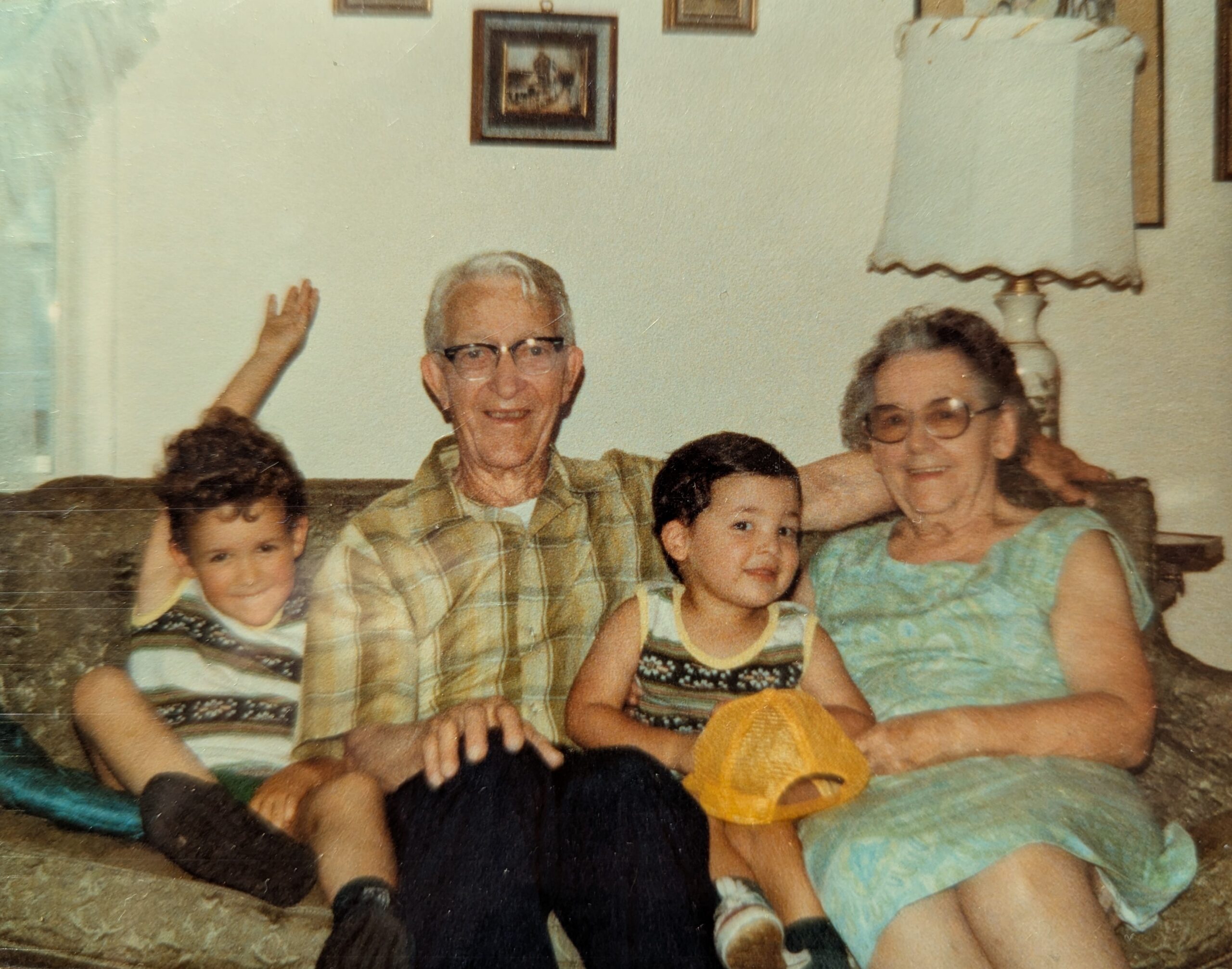
When I was a girl, I loved going to visit my maternal grandparents. They lived in a big home, with a wonderful yard and friendly neighbors, one of whom was a girl about my age. It was approximately three hours from our home to theirs, so we always stayed for at least one day, usually over a weekend, from Friday night to Sunday afternoon. My mother was the oldest child, so when I was born, there were still children at home when we went there to visit. It was always fun to be with them. I clearly remember the meals in which after everyone had had their fill, my teenage uncle would finish the rest of the potatoes and gravy – “to fill up his hollow leg,” we were told.

I’ve been thinking about this a lot over the past few weeks as I have spent time with one very young grandchild and a couple who are older. I am now a grandmother (and have been for quite some time now). But this time, when a creeping baby and a toddler grace my days again, I am remembering how my own Grammy and Grandad welcomed us, helped us feel at home, and always had a place and time for us. I’m sure we were no more aware of all they did for us than our grandchildren are of what we do today. Somehow, food was ready, clothes were there to keep us warm or cool, and a lap full of books, stories, and love was always ready to receive us or comfort us when we fell or were afraid. I suspect they smiled and laughed as they observed our innocence and eager readiness to try new things or explore whatever we could get our hands on.

This weekend we celebrate the Feast of the Holy Family. Joseph, Mary, and Jesus were ordinary folks from a small, conquered country in the Roman Empire, not far from the Sea of Galilee. Joseph was a carpenter and passed the trade on to his son. Mary became a mother at a young age, as was customary, and spent her days caring for her family and their home. They were part of an extended family; everyone was in those days. All knew their place and what was expected of them.  Aunts, Uncles, Cousins, Grandparents shared the love of the family.

We don’t know much about the lives of the Holy Family. They weren’t famous or powerful, after all. We have a few stories about Jesus’ birth and the sojourn of the family in Egypt, a land visited to protect the newborn Jesus from the jealously of the local king, Herod. We also have St. Luke’s story of the time the family visited Jerusalem when Jesus was 12 years old. It was an annual pilgrimage and lots of people went there together, traveling in caravans. Jesus was not yet old enough to be considered a man.  He was only 12 and should have remained with his family and the other boys. But he didn’t. He stayed in Jerusalem, visiting the temple on his own and speaking with the teachers there.

Mary and Joseph were terribly frightened when they realized at the end of a day’s journey that their son had not actually been with the other parent all day. They returned immediately to Jerusalem, but it still took three days for them to find Jesus. They were quite upset with him. “Son, why have you done this to us? Your father and I have been looking for you with great anxiety.” Jesus, with the innocence and confidence of a child who is approaching adulthood responded, “Why were you looking for me? Did you not know that I must be in my Father’s house?”

Jesus’ response made no sense to his parents. His father’s house was in Nazareth, after all, not the Temple in Jerusalem. Obediently, he returned to Nazareth with them and continued to learn and grow with them there. It wasn’t until he was much older that his life became dramatically different and he truly began to understand his calling. St. Luke tells us that as he grew up, “Jesus advanced in wisdom and age and favor before God and man.” Lk 2:41-52

We too are called to grow in wisdom, age, and favor (or grace) before God and the other humans with whom we share this world. We are not alone. We are part of our personal families and part of the great family of humanity. We learn as we go along how to treat each other, what our roles will be in the world, how others will expect us to behave. Each culture has its own expectations for how men and women will behave and what their interpersonal interactions will be like. As followers of Jesus, we have the great gift of knowing that we are loved by our God who is the Father who loves us dearly, allows us to learn much on our own, and is always ready to have us run back to him for a hug and a new start when we realize we didn’t make the right choices.

St. Paul reminded the Colossians to put on “heartfelt compassion, kindness, humility, gentleness, and patience” and to love and forgive others freely. Love and the peace of Christ are to control our behavior and expectations. Col 3:12-27  St. John reminds us that as we love each other, as God commanded we do, we remain in God and God in us, because he gave us his Spirit. 1 Jn 3:1-2, 21-24  Sirach, speaking from an ancient wisdom tradition, reminds us to care for each other, honor those who are older than we, share with those who have fewer riches, and be kind to those whose abilities to care for themselves are failing with the years. Sir 3:2-6, 12-14

Most of us do not share the experience of Hannah and her husband, who were unable to have children for most of their lives together. Hannah begged the Lord for a child and was given a son in her older years. She dedicated this son, Samuel, to the Lord when he was three and he grew up to be one of the last prophet/judges who led Israel before the anointing of Saul as first king of Israel. 1 Sm 1:20-22, 24-28

Those of us who have been blessed with children ordinarily watch them grow in wisdom, age, and favor with the Lord and with other people. We marvel at the adults they become and smile as we watch them teaching their little ones the same things we taught them. As their children, our grandchildren, play with some of the same toys, we smile, knowing the gifts we received from our parents, grandparents, and even great-grandparents (I knew mine), are tumbling along like a mountain creek, bringing new life and possibilities to those they will meet as they travel through life.

May we all grow in wisdom, age, and favor with the Lord today, as we close out this tumultuous calendar year and enter a new one. May we have courage to love and to speak out for those in need or for those with less influence or power. May we ponder the tidbits of wisdom that spring from the mouths of the children and young people in our lives. May we humbly share what we have learned and the hope that through all things, God is with us. Emanuel has come. Peace and joy and hope will mark our passage through life as we patiently accept each day and pour love into it.

Peace be with you.

Read More
Posted by on Nov 24, 2024

¿Qué esperamos de un rey?

¿Qué esperamos de un rey?

Desde mucho antes del nacimiento de Jesús y el comienzo de lo que ahora se llama Anno Domini (A.D.) o E.C. (la Era Común), hombres fuertes y a veces mujeres poderosas han gobernado sobre pueblos y tierras. Por lo general, estas personas obtuvieron poder a través de la violencia y luego se enriquecieron con el comercio, los bienes y los impuestos que fluían a través de sus tierras y hacia sus tesoros.

Recientemente, he estado leyendo The Silk Roads: A New History of the World (Las Rutas de la Seda: Una Nueva Historia del Mundo), por Peter Frankopan. Publicado hace casi una década, el autor se remonta a más de 4.000 años, a los reinos del Creciente Fértil y al Código de Hammurabi, rey de Babilonia. Lejos de ser Europa el centro de poder e influencia en el mundo, las tierras desde Mesopotamia hasta China y Mongolia eran ricas y poderosas. El comercio, el aprendizaje, la tecnología, la ciencia, todo prosperaba a lo largo de las Rutas de la Seda entre Asia y Europa. Los hombres fuertes lideraron a los guerreros en la conquista de las tierras vecinas una y otra vez, hasta bien entrado el presente, ya que las nuevas tierras se han convertido en las grandes potencias. Todavía no he terminado de leerlo, pero espero seguir disfrutándolo.

Todo esto nos viene a la mente al llegar al último domingo del año cristiano, la celebración de Cristo Rey del Universo.

¿Qué esperamos de un rey? Históricamente, los reyes eran los suficientemente fuertes como para conquistar y mantener tierras. Cuando sus hijos heredaron el trono, se esperaba que ellos también fueran guerreros, que defendieran sus tierras y tomaran tierras de otros siempre que fuera posible. Eran hombres a los que había que temer. Sus caprichos eran ley y su cólera mortal. Los matrimonios de los gobernantes se concertaban para crear alianzas entre los reinos. Cuando por alguna razón el matrimonio no funcionaba, o ningún heredero varón sobrevivía para hacerse cargo del reinado, el reino se tambaleaba y muchas vidas se perdían.

Hoy esperamos a alguien que lidere y gobierne con justicia. Muchas monarquías comparten el poder de gobierno con representantes elegidos por el pueblo al que gobiernan. La monarquía británica es un ejemplo de ello. El rey ya no tiene un poder ilimitado sobre la vida y la muerte de sus súbditos, pero siguen siendo llamados súbditos.

Los líderes autocráticos, a menudo elegidos por los ciudadanos de su nación, se parecen más a los reyes de la antigüedad. Su favor trae poder y riquezas a aquellos que les sirven y obedecen sus deseos. Quienes se oponen a ellos se encuentran en el exilio o en prisión, a menudo de por vida.

Entonces, si esto es lo que es un rey, ¿por qué celebraríamos a Cristo como Rey?

Cuando Jesús fue arrestado y llevado a juicio en el Sanedrín, se le preguntó si afirmaba ser el Hijo de Dios y el Mesías. Cuando se le preguntó directamente: “¿Eres tú el Mesías, el Hijo del Bienaventurado?” Jesús respondió: “Yo soy; y veréis al Hijo del Hombre sentado a la diestra del Poder y viniendo con las nubes del cielo”. (Mc 15, 61-62). Por esta declaración, fue condenado por blasfemia.

Las palabras de Jesús se hicieron eco del relato del profeta Daniel al describir las visiones que había visto durante la noche. “Vi venir a uno semejante a un Hijo del Hombre, sobre las nubes del cielo…” Este Hijo del Hombre fue presentado al Anciano y se le dio “dominio, gloria y realeza” sobre todos los pueblos del mundo, una realeza interminable e ilimitada. (Dn 7:13-14)

A pesar de haber sido condenado por blasfemia, Jesús no debía ser ejecutado por su propio pueblo. Las autoridades romanas tenían que autorizar cualquier ejecución. Sin embargo, la blasfemia no era un delito que acarreara la pena de muerte, y mucho menos la crucifixión.

Cuando las autoridades llevaron a Jesús ante el procurador, Poncio Pilato, el delito del que se le acusaba era traición, es decir, la pretensión de ser rey. Pilato interrogó a Jesús antes de emitir un juicio. —¿Eres tú el rey de los judíos? Jesús respondió preguntando si Pilato quería saberlo por sí mismo o solo establecer un punto legal. La respuesta bastante exasperada de Pilato fue que eran los sumos sacerdotes quienes lo habían entregado. —¿Qué has hecho?

Jesús no negó ser un rey, pero señaló que el reino en cuestión no era terrenal. Ninguno de sus seguidores luchaba para protegerlo o rescatarlo. —¿Entonces eres rey? —dijo Pilato—. “Tú dices que soy un rey”, respondió Jesús, una forma formal de decir “Sí”. Luego explicó que vino al mundo “para dar testimonio de la verdad”. (Juan 18:33b-37)

Jesús fue condenado. El letrero sobre su cabeza decía: “Jesús el Nazareno, el Rey de los judíos”.

Un rey cuyo reino no son las tierras y el poder, sino la verdad y la justicia. No es la justicia que castiga a los que intentan arrebatarle tierras o poder. Justicia que asegura a los pobres comida y refugio y la oportunidad de vivir su dignidad humana. Justicia que protege a los niños y a los refugiados. Justicia que abre los corazones para amar y aceptar a los que son diferentes a ellos. Justicia que acoge a todos y cuida de la tierra y de toda la creación. Justicia que dice la verdad al poder, como Jesús lo hizo a Pilato. Justicia que es un testimonio de la verdad del amor de Dios por todos.

Este es el Rey del Universo a quien celebramos. Aquel a quien las visiones del Apocalipsis aclaman. “Jesucristo es el testigo fiel, el primogénito de los muertos y el gobernante de los reyes de la tierra”. Él es el que “nos ama y nos ha liberado de nuestros pecados… nos convirtió en un reino, sacerdotes para su Dios y Padre”. (Ap 1:5-8) Él es quien nos llama a vivir las Bienaventuranzas. Aquel que sanó a los enfermos, alimentó a los hambrientos, consoló a los afligidos y se dio a sí mismo en testimonio de la verdad.

Muy lejos de lo que solemos esperar de un rey. Sin embargo, él es el Rey que nos eligió y cuyo ejemplo estamos llamados a seguir. Gracias a Dios.

Lecturas para la Solemnidad de Nuestro Señor Jesucristo, Rey del Universo – Ciclo B

En Inglés

Read More

Posted by on Nov 24, 2024

¿Qué esperamos de un rey?

What Do We Expect in a King?

Since long before the birth of Jesus and the beginning of what is now called Anno Domini (A.D.) or C.E. (the Common Era), strongmen and sometimes powerful women have ruled over peoples and lands. Typically, these people gained power through violence and then became rich from the trade goods and taxes that flowed through their lands and into their treasuries.

Recently, I have been reading The Silk Roads: A New History of the World, by Peter Frankopan. Published nearly a decade ago, the author reaches back over 4,000 years, to the kingdoms of the Fertile Crescent and the Code of Hammurabi, King of Babylon. Far from Europe being the center of power and influence in the world, the lands from Mesopotamia to China and Mongolia were rich and powerful. Trade, learning, technology, science – all were thriving along the Silk Roads between Asia and Europe. Strongmen led warriors in conquest of neighboring lands again and again, well into the present as newer lands have become the great powers. I haven’t yet finished reading it, but I look forward to continuing to enjoy it.

This all comes to mind as we arrive at the last Sunday of the Christian year, the celebration of Christ the King of the Universe.

What do we expect in a king? Historically, kings were the ones strong enough to conquer and hold lands. When their sons inherited the throne, they too were expected to be warriors, to defend their lands and take lands from others as well whenever possible. They were men to be feared. Their whims were law and their anger deadly. Marriages of rulers were arranged to create alliances between kingdoms. When for any reason the marriage did not work out, or no male heir survived to take over kingship, the kingdom was shaken and many lives were forfeit.

Today we expect someone who will lead and govern justly. Many monarchies share governing power with elected representatives of the people they govern. The British monarchy is an example of this. The king no longer has unbridled power over life and death for his subjects, but they are still called subjects.

Autocratic leaders, often elected by citizens of their nation, are more like the kings of old. Their favor brings power and riches to those who serve them and obey their wishes. Those who oppose them, find themselves in exile or in prison, often for life.

So, if this is what a king is, why would we celebrate Christ as King?

When Jesus was arrested and taken to trial in the Sanhedrin, he was questioned about whether he claimed to be the Son of God and the Messiah. When asked directly, “Are you the Messiah, the Son of the Blessed One?” Jesus answered, “I am; and you will see the Son of Man seated at the right hand of the Power and coming with the clouds of heaven.” (Mk 15:61-62). For this statement, he stood condemned for blasphemy.

Jesus’ words echoed the account of the prophet Daniel as he described the visions he had seen through the night. “I saw one like a Son of man coming, on the clouds of heaven…” This Son of man was presented to the Ancient One and given “dominion, glory, and kingship” over all peoples in the world, an unending, unlimited kingship. (Dn 7:13-14)

Despite having been convicted of blasphemy, Jesus was not to be executed by his own people. Roman authorities had to authorize any execution. However, blasphemy was not a crime that would incur the death penalty, let alone crucifixion.

When the authorities took Jesus to the Procurator, Pontius Pilate, the crime of which he was accused was treason – the claim to be a king. Pilate interrogated Jesus before passing judgement. “Are you the king of the Jews?” Jesus responded by asking whether Pilate wanted to know for himself or only to establish a legal point. Pilate’s rather exasperated response was that it was the chief priests who had handed him over. “What have you done?”

Jesus did not deny being a king, but he pointed out that the kingdom in question was not an earthly one. None of his followers were fighting to protect or rescue him. “Then you are a king?” said Pilate. “You say I am a king,” responded Jesus, a formal way of saying “Yes.” He then explained that he came into the world “to testify to the truth.” (Jn 18:33b-37)

Jesus was condemned. The sign above his head read: “Jesus the Nazorean, The King of the Jews.”

A king whose kingdom is not lands and power but truth and justice. Not justice that punishes those who try to take lands or power from him. Justice that assures the poor have food and shelter and a chance to live their human dignity. Justice that protects children and refugees. Justice that opens hearts to love and accept those who are different than themselves. Justice that welcomes all and cares for the earth and all of creation. Justice that speaks truth to power, as Jesus did to Pilate. Justice that is a testimony to the truth of God’s love for all.

This is the King of the Universe whom we celebrate. The one whom the visions of Revelation acclaim. “Jesus Christ is the faithful witness, the firstborn of the dead and ruler of the kings of the earth.” He is the one “who loves us and has freed us of our sins … made us into a kingdom, priests for his God and Father.” (Rv 1:5-8) He is the one who calls us to live the Beatitudes. The One who himself healed the sick, fed the hungry, comforted the mourning, and gave himself in witness to the truth.

A far cry from what we usually expect in a king. Yet he is the King who chose us and whose example we are called to follow. Thanks be to God.

Readings for the Solemnity of Our Lord Jesus Christ, King of the Universe – Cycle B

En Español


Read More

Posted by on Nov 22, 2024

Christ the King and the Kingdom Not of this World

Christ the King and the Kingdom Not of this World

Christ the King

Today we celebrate the end of the church year. Today is the climax of salvation history. In the Gospel we find Christ Jesus in front of Pontius Pilate affirming that his kingdom was not of this world. In the interrogation, Our Lord says to Pilate, “If I were a king of this world, my followers would have defended me.” This answer puzzled Pilate. This poor Jewish preacher did not behave like the rest of the prisoners. He was not begging for his life. He did not deny the charges. Nor did he lose his dignity. (Jn 18:33b-37)

The kingdom of heaven does not come by violence. It does not come for conquest or slaughter. The Lord’s regime comes to us in power and authority because it does not carry with it evil or vengeance. Our king is crucified as a rebel, as a terrorist. It seems that the forces of evil had finished him off. It seems that his kingdom was an illusion, a dream, something in vain. He died. The sky darkened, there was lightning, and the centurion proclaimed that he was the son of God. That is how our king died.

This feast of Christ the King has a lot of meaning for Mexicans. Viva Cristo Rey was the cry of the movement fighting against the religious oppression of the socialist government. After the Mexican Revolution which lasted from 1910 to 1917, the new government attempted to deny God and impose a social order against religion. There was a strong devotion to the Sacred Heart of Jesus. The struggle against atheism raised the banner of the Sacred Heart as Christ the King – the king of the world and of the heavens.

The persecution of the church included the killings of priests, nuns, and lay leaders. The churches were closed. The resistance did not use the traditional images of the victorious Christ the King with crown and scepter. Instead, Christ the King is represented by his flaming heart full of love and mercy. He is not king of this world. He is a king who suffers for his people to the point of giving his life for them.

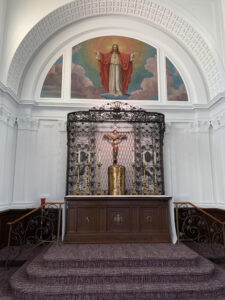
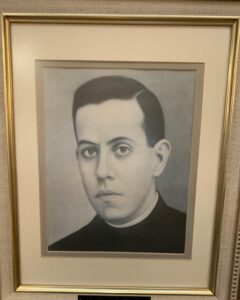
Some Mexican Jesuit seminarians took refuge here in Los Gatos in the novitiate of the Sacred Heart for a year before they obtained asylum in Spain. Before leaving, a Mexican priest who was an artist painted a mural of the Sacred Heart in the chapel above the altar. One of the young Jesuits was Miguel Pro. After his ordination he returned to Mexico and was ministering in secret when he was arrested and sentenced to death. Before he was shot, his last words were “Long live Christ the King!” A photo of the martyr is still kept in the same Jesuit house in Los Gatos where he took refuge. In it we see the deceased young priest with the bullet wound in his heart.

How is it possible to have a kingdom that is always defeated by the forces of the world? How is it possible that the divine regime is frustrated today?

Today’s first reading presents us with some fantastic images of combat in the heavens from the book of Revelation. The whole heavenly order reveals the conquest of the persecutors of the church and of Christ. God comes to judge the living and the dead. Evil and the powers of evil are vanquished. (Dn 7:13-14)

However, we see day after day the tragedies and sufferings of life. Victims of war, victims of famine, victims of epidemics. There are failures of the government and the institutions of justice. Yet inside the darkness burns a flame. It is the light of our faith advancing the kingdom of peace and humility. The terrestrial and heavenly forces of wickedness are defeated. We can say before the Roman procurator Pontius Pilate and the powers of this world that our king and our kingdom is above all and for all.

Our King does not come in violence, he does not come armed, he does not come to kill his enemies. The Sacred Heart, full of peace, mercy, and healing comes through us. It is up to us not so much to venerate the beautiful portrait of the Sacred Heart, but to encounter Christ the King – the Sacred Heart in our daily lives. We are called to proclaim the kingdom of God through peace and humility in our hearts.

Our kingdom is not of this world. Our regime is to proclaim the good news. Support the poor. Encourage the depressed. Feed the hungry. Manifest love, peace, forgiveness, healing, and hope in our difficult times, enduring serious illnesses. The kingdom comes in our homes, jobs, and social relationships. All this and more we acclaim – Your kingdom. Your will be done on earth as it is in heaven.

Long live Christ the King!

Readings for the Solemnity of Our Lord Jesus Christ, King of the Universe – Cycle B


Read More

Posted by on Jun 1, 2024

Life-Giving and Life-Sustaining Blood

Life-Giving and Life-Sustaining Blood

My father was a life-long blood donor. His dedication to this service began when he was a young man. His younger sister developed a condition in which the platelets no longer held the blood inside her veins and arteries properly. She began to bleed internally. The only treatment was to give her blood and hope her body would begin to produce the platelets she needed before she died. Unfortunately, it did not. She died at the age of 18, the year before I was born.

In memory of his sister, Dad gave blood regularly for the rest of his life. He lived to be 93 ½ years old.

For Aunt Dolores, the reality of life-sustaining and life-giving blood was very immediate and intimate. For most of us, it’s much more of a theoretical, abstract concept.

As we celebrate the Solemnity of the Most Holy Body and Blood of Christ, we have the opportunity to reflect on the importance of blood to life and to our experience of the presence of Christ in our lives.

Our ancestors in faith, the descendants of Abraham and Sarah, were pastoralists. They raised sheep and goats and traveled with them from one pasture to another until a great famine led them to move to Egypt. There they grew in numbers, but always remembered that they were a separate people, with their own God. Eventually, after they had been enslaved, God sent Moses to lead them out of Egypt and back to the land promised to Abraham, Isaac, and Jacob. It was not an easy, peaceful transition.

To this day, we remember the events of the Exodus from Egypt. Plagues, storms, disasters, and the death of firstborn children of Egypt – all were part of the signs that led Pharaoh to allow them to leave. The Angel of Death swept through Egypt one night, but skipped the homes that had the blood of a lamb smeared around the door frame. This first Passover has been celebrated annually since that time. Jesus and his followers celebrated the Passover in Jerusalem at the end of his life. Three of the evangelists place the Last Supper and the institution of the Eucharist at the end of a Passover Seder.

St. Mark tells us about the preparations for that evening’s celebration and also about Jesus’ actions in taking the bread and giving it to all, saying, “Take it; this is my body.” He passed the last cup of wine around as well, saying, “This is my blood of the covenant, which will be shed for many.” (Mk 14:12-16. 22-26)

Since that time, we have shared this bread and wine in our celebrations of thanksgiving, our Eucharist. His words are repeated each time, including the instructions to “Do this in remembrance of me” which are found in another Gospel account. (Lk 22:19)

Thousands of words have been written, hours of thought, conversation, discussion, arguments, and energy have gone into the endeavor of reaching understanding of how this can be and exactly what is it that is happening/has happened through these words and actions. I do not pretend to have better answers than those who have come before me.

Nevertheless, I do want to reflect a bit on the idea of blood as life-giving and life-sustaining. Moses carried God’s words and instructions/ordinances to the people after his encounter with God on the mountain top. He told the people what God was asking of them and they agreed to do as they were instructed. So Moses wrote it all down for them and began this new formal relationship with a ritual, a ceremony, to make it all official.

Pillars were erected to represent all twelve tribes of Israel, young bulls were sacrificed. Some were burned completely as a sacrifice and others were only partly burned and eaten by the people as peace offerings. It was a sacred, sacrificial meal. Then half the blood of the sacrificed animals, which had been collected in bowls was poured out on the altar in sacrifice as well. The rest of it was sprinkled over the people. Our contemporary minds say, “Ewww.” But they believed that in blood, God’s life force was present. The Hebrew people did not and do not consume blood. When the blood was sprinkled over the people, it was a sign of the covenant relationship between the people and God. Life-giving and life-sustaining. (Ex 24:3-8)

For Jesus and those around him, the sacrifice of animals at the temple remained a reality. Part of his anger with those who administered the markets supplying animals for sacrifice was due to the fact that all too often the ordinary people were being charged too much to purchase the animals for sacrifice. It caused greater hardship than necessary.

So when Jesus spoke of his body and blood as signs of a new covenant, his friends immediately wondered what he meant by that. They didn’t suspect that he would rise from the dead. They didn’t even know that he would die the next day! There was a lot to sort out in the days, weeks, and years after these events. But the community continued to gather, pray together, and read the Hebrew scriptures that spoke of God’s love and the promise of a redeemer. And they broke the bread and shared the cup, as we continue to do today.

The author of the Letter to the Hebrews also reflected on this great mystery of the new covenant and the new high priest in the heavenly sanctuary. This new high priest does not need the sacrifice of animals and their blood. The blood of life, the life of God, has been shed to bring life to all, a share in divine life. The everyday ordinary blood of human and animal life no longer needs to be shed for this covenant. Another has shared the blood of life. (Heb 9:11-15)

Most likely we will never know how many people lived because my father shared his blood with them. I’m sure he has been thanked many times in his new life with the Lord by those who received his gift. I too thank him tonight as I write. I was wondering how to address these readings and this feast all day. And then this evening, after the dishes were washed and it was nearly time for bed, the memory of Dad and Aunt Dolores came to me. Life-giving, life-sustaining. Blood of life. Body to nourish us on our journey to everlasting life.

May we remember this week that we are sharers in the life of God. The Body and Blood of Christ we share are those of our God, become one of us and raising us to new life. Not a riddle to solve. Not a logical puzzle. A mystery to enter into. A cause for rejoicing.

Readings for the Solemnity of the Most Holy Body and Blood of Christ – Cycle B


Read More

Posted by on May 19, 2024

Covenants Renewed and Transformed

Covenants Renewed and Transformed

The feast of Pentecost began as a harvest festival in Israel. By the time of Jesus’ life, it had become a festival celebrating the gift of the Torah at Mt. Sinai, when Moses went up the mountain to meet the Lord and returned with the tablets of the Law. It was a festival celebrating and renewing the covenant between the Lord and the Jewish people.

Fifty days after the Resurrection, and after Jesus had been taken from their sight at the Ascension, the apostles and close followers of Jesus were gathered in a room in Jerusalem to pray, as Jesus had instructed them to do. This day was the feast of Pentecost. A loud noise began in the room, like a mighty wind on a mountain top, and flames that looked like tongues of fire appeared over the heads of those gathered there. On Mt. Sinai, there had been a loud wind, flames, and a loud voice signaling the presence of the Lord. Now these were being experienced in a room in Jerusalem. The Holy Spirit swept into each person in that room and they were transformed. No longer frightened and hiding in fear for their lives, they began to praise the Lord boldly and speak of what they had seen and heard, using languages they had never before spoken.

Folks outside noticed the uproar and wondered what was happening. Jews from all over the world were there for the feast and noticed that what they were hearing was in the languages of all the surrounding countries, including Rome. More surprising, what they heard was the disciples telling of “the mighty acts of God.”

The reading from Acts of the Apostles for this feast of Pentecost stops at this point, but the actual story goes on. Peter went out and spoke to the crowd, telling them about the Resurrection and the new covenant that God was establishing with all who would believe and follow the Lord Jesus. Large numbers of people believed and the growth of the community began in earnest on that day.

This day of Pentecost was the fulfillment of a promise Jesus made before his death. St. John speaks of the promised Advocate who would come and testify to the disciples of the truth that Jesus had taught them. They in turn were to go out to the world and testify to what they had heard. Since so much of what Jesus had taught them was still hard to comprehend, the Advocate, the Spirit of truth, would come and guide them to understand it. In this, the Advocate would make clear the meaning of what Jesus had received from the Father and shared with them.

This process of understanding all they had heard was only beginning at the first Pentecost. Many controversies, many changes, many years of discussing and coming to new understandings awaited the community. When folks with one set of ideas came to town and began to teach ideas different than those initially presented by Paul or the other apostles, it became necessary for these leaders to remind members of the communities that were in turmoil what the fundamental teaching was. One major conflict revolved around how much of the ancient Jewish Law was to be required of new members of the community, particularly those who were Gentiles. Did they need to become Jews? What did it mean to live by the Spirit? Did that mean by the ancient Law or something else?

St. Paul devoted many of his letters to dealing with these questions. How do we recognize life in the Spirit?  Paul explained that living by the spirit meant denying many kinds of actions we commonly see among humans – actions that have negative effects on life in community or family. Instead, living in the Spirit would result in what he called “the fruit of the Spirit … love, joy, peace, patience, kindness, generosity, faithfulness, gentleness, self-control.” These things are all signs of the presence of the Spirit in our lives. We receive the gifts we need to serve the Lord in the ways He calls us to serve the community. And together we become one body of Christ.

All of this brings us to some important questions. What does it mean to live in the Spirit today? Has that changed from what it was in the past? Was it all set in stone nearly two thousand years ago? Or are there new understandings that can come to us today?

How does our covenant with God become renewed and transformed through the centuries. At the time of the Apostles and early Christians, there was an expectation that Jesus would return in glory within at most a hundred years or so, maybe even sooner. But that didn’t happen.

As our community of faith has continued and grown through the centuries, many men and women have pondered these questions. Many wise ones have written their thoughts, observations, insights into living in the Spirit. The teachings have been organized, categorized, shaped into traditions and ways of doing things (laws). They have grown and developed along with the growth of knowledge in science, philosophy, mathematics, astronomy, literature, and all the many areas of human inquiry.

As we today deal with new questions that arise from the realities of our lives, as well as some very old challenges dating from the dawn of human history, how do we know what the Spirit is guiding us to do? What do we bless? What do we reject? What do we seek to transform? How do we determine which is the option to which the Spirit is calling us?

We can go back to a fundamental insight from Paul – when we are under the Spirit, we are not bound by old laws that do not lead to the blossoming and development of the fruit of the Spirit. If it’s not loving, joyful, peaceful, and so forth, then it may not be of the Spirit. But if it is, and if it includes more people and opens the gates to loving patience, kindness, generosity, faithfulness, gentleness, kindness, and self-control, then we know the Spirit is present.

God’s time is not our own. The gifts of the Spirit and their fruits are ever new in our lives. The covenant is continually being renewed and transformed. We open our eyes to the insights of our contemporary world. We recognize that many things we humans believed in the past might not have been totally accurate. We admit that we don’t yet know everything. And we keep our ears and eyes open to see where the Spirit will lead us now.

It’s Pentecost. We rejoice this week that the Holy Spirit, the Advocate, is here among us – teaching, guiding, laughing, playing, and bringing joy and peace to our hearts.

Alleluia.

Readings for the Feast of Pentecost – Cycle B


Read More

Posted by on May 11, 2024

Transitions: Waiting, Praying, Growing

Transitions: Waiting, Praying, Growing

What can be done with a broken plate, or cup, or bowl? A beautiful keepsake crashes to the floor and is, as the saying goes, smashed to smithereens! An everyday cup slips out of a child’s hands and meets the same fate. Things break, both literally and figuratively. Sometimes they can be mended. Sometimes they can’t. And sometimes they can be reused rather than being sent to the trash heap.

In our own lives, we also experience times of transition. Something exciting and wonderful comes to an end and we mourn its passing. Something difficult begins to improve and we rejoice, hoping the improvement will continue. Sometimes it’s a bit of both and the something new is born slowly and quietly. Sometimes there’s a sudden change and that also requires time for adjustment.

In these times of transition, when broken pieces wait for realignment and transformation into something beautiful again, we don’t always know what to do. These are times for waiting, praying, and growing into newer, deeper, more human persons.

After the Resurrection, the disciples were visited many times by the Risen Lord. They came to believe that he had indeed risen from the dead. Many still thought he might now lead armies in battle to “restore the kingdom to Israel.”

The last time Jesus met with his friends, he instructed them to remain in Jerusalem and wait “for the promise of the Father” of which both he and his cousin John had spoken, the baptism with the Holy Spirit. (Acts 1:1-11)

Baptism is a word that means to plunge into something. Baptism with water involves having water poured over the person being baptized or their being submerged into water. Baptism with the Holy Spirit is not a physical thing. In the sacrament of Confirmation, the Bishop anoints the person with chrism and lays hands on the person’s head, while together we pray with him for the Holy Spirit to enter into their hearts in a new and deeper, transformative way. Not everyone experiences a sense of something being different in their lives after Confirmation, but there is a difference and some do notice it. Sometimes, the difference is dramatic. In the early Church and at various times in the following centuries, the coming of the Spirit has been seen in the community with signs and wonders – speaking in tongues, prophesy, healings, and other wonderful things.

At any rate, whether with dramatic signs or simply with a quiet sense of peace, Jesus promised the disciples would be baptized, plunged into, the life of the Holy Spirit. How that would happen or what it would mean was not explained before he was taken up and away from their sight. Two men, dressed in white, reminded them that they were to return to Jerusalem to wait and pray for the fulfillment of the promise. And so they did. The men also promised that Jesus would return one day. How or when this would happen was for the Father alone to know, he assured them.

St. Mark also spoke of Jesus’ final words before being taken up into heaven. He told them to “Go into the whole world and proclaim the gospel, the good news, to every creature.” Signs and wonders would accompany their preaching. We can get very literal in understanding the words in the Gospel, but I suggest it’s important to seek understanding in terms of what we have learned in two thousand years about humans and our interactions with each other. People would be healed, new words and ways of speaking would be used, dangerous things would not hurt them. All would see the goodness of God in their lives and actions. (Mk 16:15-20)

St. Paul instructed the community at Ephesus regarding the gift of living their lives as Christians, followers of the Lord. The eyes of their hearts will be opened to see and understand the great hope and power of the inheritance they have received through the Holy Spirit’s anointing. They are to live with humility, gentleness, patience, preserving the unity of the community with peace. They are one body and share in the one Spirit, received through their baptism. Some are to go out publicly and teach and preach. Others will live more quietly in their communities, doing the regular things expected of those with their calling – parents, homemakers, tradesmen, teachers, healers, software engineers, doctors, lawyers, scientists, astronauts, poets, musicians, and so many, many more vocations that have opened through the centuries. (Two reading options – Eph 1:17-23 or Eph 4:1-13)

We are all called to be preachers of the Good News. We are not all called to do it on the street corners or pulpits of our communities. We do it in the everyday way we live our lives. Forgiving when we have been hurt. Helping those to heal who have been wounded, whether physically or emotionally. Finding ways to make living as Christians fun for our families, and preparing each member to be able to hold on to the hope and joy of the Good News while dealing with the opposition they will meet outside the community.

As a community, we are like a great big mosaic that is being created by our Father. He takes each of the broken pieces of our lives, places each in a very specific place in the design he envisions, and creates something beautiful and unexpected. Meanwhile, we wait, pray, and grow, becoming the pieces he needs for the mosaic.

As we wait and pray this week for the coming of the Holy Spirit into our lives once again at Pentecost, may we have the courage to request the grace of being open to the ways the Father will shape and mold us into the pieces he needs for his mosaic. It may take a bit of sanding, nipping off a corner here or there, or being turned around or upside down several times, but eventually, we will fit into the picture just the way we need to fit.

Readings for The Ascension of the Lord – Cycle B


Read More

Posted by on Apr 21, 2024

Help in Time of Need – The Shepherd

Help in Time of Need – The Shepherd

The afternoon was bright and sunny. The ocean was quiet. The breeze was gentle. All was peaceful and calm.

Suddenly, the chickens next door began to squawk and race around their yard. The roosters began to crow at the top of their lungs. The dogs barked up a racket. Something drastic was happening and they were telling the world.

Neighbors wondered if someone had fallen or if there had been some sort of accident to provoke such an uproar. But when they checked, all seemed fine and the animals had quieted again.

Later, the owner of the chickens and dogs explained that he had seen what looked like a badger approaching the house. The animals had responded according to their nature. The chickens were panicked, not having a great number of self-defense options! The dogs had shouted a warning to their owner that a serious problem was needing attention. And with all the uproar, the threatening animal changed plans and went back to the field.

St. John tells us that Jesus spoke of himself as the Good Shepherd. In biblical times, prophets often spoke of the leaders of the people as being their shepherds. This made sense with an historically pastoralist people, who raised sheep and goats and traveled with their animals. Jesus took the idea of shepherd farther than the traditional one of God as the Shepherd of Israel and leaders who failed to obey the Law as bad shepherds. Jesus declared, “I am the Good Shepherd.” In saying this, he was using the same terminology and usage as God had used when he spoke from the burning bush to Moses, “I Am.” This was one of seven times in John’s Gospel that Jesus speaks of himself in divine terms.

Jesus speaks of the role of the Good Shepherd as watching over the sheep and protecting them. Remembering my niece’s comment about sheep being dumb as compared with goats, I find Jesus’ statement even more striking. The Good Shepherd cares about the sheep, even if, and maybe because, they are not the most intelligent animals.  The Good Shepherd will protect the sheep even at risk of his own life. Jesus will give his own life for his sheep. Those who do not own the sheep will not do this. When the wolf (or badger or hawk in the case of the chickens) comes creeping up on the sheep, the hired shepherd might well run away. Wolves are not animals that are easily defeated. They work together in packs and don’t hesitate to go after humans too, if necessary to get the sheep.

When Jesus spoke about being the Good Shepherd, it was expected that only the Hebrew people were of interest to God. God was still a deity of only one relatively small group of people. Outsiders had no place among those to be protected by the shepherd. Jesus, however, did not consider only the Jews to be the sheep loved and protected. “I have other sheep that do not belong to this fold.” His mission is big enough to include all peoples. All are to be members of one flock. And all will be included in the salvation gained for them by the good shepherd who dies rather than allowing them to be lost. (Jn 10:11-18)

This was a huge expansion of understanding of the relationship between God and humanity. Through Jesus, God’s love and call extended formally to all. Those who believe and follow him become children of God. (1 Jn 3:1-2)

Because of the close relationship between the shepherd and the sheep, miraculous healings continued after the Resurrection through the actions of the apostles, as signs of Jesus’ power and relationship with the Father in the Trinity. Humans don’t typically have the power to heal with a word or a touch. But Jesus does. (Acts 4:8-12)

Like the owner of the chickens and dogs who faced the badger this past week, Jesus and his followers step up to help those who need extra help. This includes those with little money, those who have health issues, those whose physical safety is threatened, those who must leave their homes to protect themselves and their children, those who learn new skills or do jobs that don’t take advantage of their existing education but allow them to send funds to help their families far away. Thus, many, many people follow the Good Shepherd and do what they can to help and protect the sheep. And the Good Shepherd is there among all of us, his sheep, with all the messiness of our lives, walking with us and helping us along the way.

In this next week, let’s reflect on the ways we experience the protection and love of our Shepherd. Let’s also reflect on how we can share in his mission and help protect others whom we meet in our daily lives.

Readings for the Fourth Sunday of Easter – Cycle B


Read More

Posted by on Mar 30, 2024

How Do We Remember?

How Do We Remember?

Memory is a tricky thing. As we go through life, we experience so many things that it would be overwhelming if we were aware of all of them at every second of every day. Good things, hard things, sad things, short-time things, long-term things.

When things happen that are particularly memorable or important, we think we’ll never forget them. But we do forget details. And our memories reflect what we found most important about the events. Have you ever told a story to someone else about a past event and had a partner or friend who was there and an active participant in the event tell a very different story or correct your version? The older we get, the more frequently it happens, I think.

Part of what happens is that our minds process information based on our experiences and our past history. The explanatory systems of our culture and our society, the ways we explain why things happen and how it all came to be, also shape the way our experiences are processed. Over time, memories of the everyday sort begin to be just one of so many stored in the “card catalog” of our internal mental libraries – there for the finding again, but maybe a bit aged, torn, or tattered.

I started thinking about memories this year during the Holy Thursday liturgy as we heard the story of the first Passover and St. Paul’s description of how Eucharist was celebrated in the first Christian communities. These events took place thousands of years ago! Yet we still remember and celebrate them. More amazingly, we celebrate them in a way very close to what was originally described.

Moving through the rest of the week, we hear more of the story of God’s work in bringing about reconciliation between humanity and himself. The words of prophets calling the community to care for the least capable people among us. The praise of those who are faithful to their mission despite being mistreated, abused, and even killed. The retelling of the ancient stories of creation, the covenant with Abraham, the crossing of the Red Sea. Descriptions of the Last Supper, Jesus’ agonized prayer in the garden before his arrest, his trial, execution, and burial. The wonder of the Resurrection, first discovered by women from the community who were his followers. The reflections of that community on what happened in the life of Jesus and the tremendous surprise of the Resurrection. Nobody expected such an outcome! There were no precedents on which to draw for explanation.

How would it all be passed on to a wider group of people? It was too important to be kept a secret, though in the first weeks no one spoke publicly about it. That would have been too dangerous. With the coming of the Holy Spirit at Pentecost, they were emboldened to speak publicly and so the world has come to know the wonders they witnessed.

The memories written down in the Gospels and Passion narratives are very similar, but they too were written by different people in different places and for different audiences. So, some of the details differ. The basics remain the same, however. The event happened and in more or less the same way described in each account.

Then how do these differ from other ancient stories such as the Odyssey, the Epic of Gilgamesh, the Iliad, and others? Why are they still remembered and actively celebrated in a way similar to the ancient ways?

Perhaps there are a few things that have made it possible. The first that comes to mind is the fact that these events happened in a community which had a history of remembering and reenacting ancient events. The Lord told the people that first Passover that the date on which it happened originally was to be the first day of the new year for them. It was to be celebrated the same way each year. And so it happened. Even to our day, at Passover, families and friends gather to celebrate this saving act of the Most High. Out of this celebration, the Christian community drew their remembrance, because Jesus gave the same kind of instructions to his friends when they gathered for the dinner. “Do this in remembrance of me.” This line is repeated each time we gather for Eucharist. Because the Resurrection took place on the first day of the week, Sunday on our calendar, it was seen as the beginning of a new reality in creation.

Another factor that has played into the continuation of this wonder is the fact that it involves more than just words. We pray actively – sitting, listening, standing, moving around the room, singing, eating, and drinking. We bring all of our senses into the experience, so we learn it deeply in our very being. The tastes, the smells, the sights and sounds – all are incorporated into our memories of the experience. Do we remember each specific time we have celebrated Eucharist? No. But we remember it as part of the rhythm of our lives and remember at least some details of the times that were out of the ordinary.

Perhaps one of the most important factors is that there is no time in Eternity. God’s time is totally separate from ours. God’s time is all Now, the present. From this comes the ancient Hebrew understanding that “Our ancestors crossed the Red Sea and our feet are wet.” When we celebrate Eucharist, the same thing happens. We are present with the apostles at that table with Jesus. We receive the same gift from him that was given to his closest friends. We are part of that community of “closest friends.”

And so, in the words of a lovely hymn, “We remember how you loved us to your death and still we celebrate for you are with us here. And we believe that we will see you, when you come in your glory, Lord. We remember, we celebrate, we believe.”

Happy Easter!

Readings for Holy Thursday – Evening Mass of the Lord’s Supper – Cycle B

Readings for Good Friday of the Lord’s Passion – Cycle B

Readings for Easter Vigil – Cycle B

Readings for Easter Sunday – Cycle B

Read More