Pages Menu
RssFacebook
Categories Menu

Posted by on Jan 4, 2012

The Feast of the Holy Name of Jesus

The Feast of the Holy Name of Jesus

Monogram of the name of Jesus

The Feast of the Holy Name of Jesus has been celebrated on various dates in January, however, the current General Roman Calendar has set the celebration on January 3 (since 2002). The feast is celebrated close to the day on which Jesus received his name formally, on the eighth day following his birth when he was circumcised according to Jewish custom. The feast has been celebrated for centuries, popularized originally by Cistercian monks in the 12th century and later by Franciscans, Dominicans, and Jesuits.

In our day, it is not a widely remembered feast. As a child, reverence for Jesus’ name was an important part of our Catholic education. I was taught by Sisters of the Holy Names of Jesus and Mary. We were taught to put the initials, JM (for Jesus and Mary) or JMJ (for Jesus, Mary, and Joseph) at the top of each page we wrote at school. We were reminded to bow our heads slightly when the name of Jesus was spoken. We were not allowed to swear at all and particularly not to use Jesus’ name in swearing. At least some of these practices remain part of the behavior of many of the children taught by the sisters, I suspect. Since the Holy Names Sisters teach all levels of students, from kindergarten through higher education, there are many opportunities for instilling reverence along the way.

The men in our parish were encouraged to become members of the Holy Name Society. As part of membership in this group, they helped and encouraged each other to keep their language clean. They worked together to support the parish and the parish school. It was a way for men to help each other, become friends, and grow in faith. Some amazing things were accomplished by the men who worked together in the Holy Name Society.

I think about this when I hear conversations today in which “OMG” is casually used as an expression of amazement or just excitement, with or without actually saying all the words for which the initials stand. Only rarely are “goodness” or “gosh” substituted for “God” in the expression. Jesus’ name is used freely in ways the Sisters would never have approved.

I find myself wondering if those who speak this way are really aware of what they are doing. Names are powerful and using them creates a connection between the speaker and the one named. Perhaps it’s time to celebrate this feast more publicly, with reminders in church bulletins and special family meals. It certainly wouldn’t hurt to be more mindful of how we use Jesus’ name and how we call on God. At the very least, we could return to the custom of changing what we hear into a prayer, asking a blessing or giving thanks for the many blessings we receive each day.

Then again, maybe many of us already do.

Image is a contemporary example of a traditional monogram.
The letters are the first three letters of Jesus’ name in Greek.
Image in the public domain.


Read More

Posted by on Dec 26, 2011

The Feast of the Holy Name of Jesus

A Christmas-tide Reflection

CHRISTMAS STAR

Across the world once again, a star is in our sky,
a gift is in our hearts: It’s Christmas.

Right here at home: our highway is our backbone, our rivers,
our arms and legs.
The forest is our clothing.
The ocean is our blood.

As a people, we have known: Struggle, Isolation,
Darkness, and Bitterness.

But more importantly, we have also found: Success,
Security, Happiness, and One another.

It’s Christmas once again: time to focus on what makes light overcome
darkness and love overcome emptiness.

It’s time to believe once more that no matter how battered our lives are,
no matter how well off we are materially, there is still someone who knows
our darkness and lights it,
who knows our hurt and heals it.

It’s a moment for healing, and we really need it this time.

Healing is the medicine that can close the wounds
between parent and child, brother and sister,
government and people.

Healing comes from God – directly or indirectly.

We must do what we can do; God does the rest.

Merry Christmas

Received from Fr. Ron Shirley,
who received it from someone else.
Used with Fr. Ron’s approval.

Image from NASA – NGC 5584

Read More

Posted by on Sep 14, 2011

The Feast of the Holy Name of Jesus

The Exaltation of the Holy Cross – An Ancient Feast Still Relevant

Feast of the Cross - Russion Icon, 1680

The Feast of the Exaltation of the Holy Cross dates from the fourth century, when according to tradition St. Helena discovered the True Cross on a pilgrimage to Jerusalem. The Church of the Holy Sepulchre was dedicated in 335 AD and the cross was kept inside the church. The dedication of the church was celebrated on September 13 and the cross was carried outside the church for veneration by the faithful on September 14. As part of the celebration, the cross was lifted up so all could see it. This was the reason the feast came to be called the “Exaltation” or “Raising Aloft” of the Holy Cross or the Precious Cross (depending on whether one spoke Latin or Greek). Another,  more recent, translation of the term Exaltatio is “triumph.”

Beyond the physical practice of raising the cross up so that people could see it and venerate it, the triumph of Jesus over death on the cross has been a source of hope for people through the ages. In fact, Jesus told his disciples, “If I am lifted up high I will draw everything to myself.” (Jn 12:32)

In The Dialogue, 26, St. Catherine of Siena describes God’s explanation to her of Jesus’ role as bridge between the divine and the human.

“… Do you know when it [this bridge] was raised up? When my Son was lifted up on the wood of the most holy cross he did not cut off his divinity from the lowly earth of your humanity. So though he was raised so high he was not raised off the earth. In fact, his divinity is kneaded into the clay of your humanity like one bread. …

When my goodness saw that you could be drawn in no other way, I sent him to be lifted onto the wood of the cross. I made of that cross an anvil where this child of humankind could be hammered into an instrument to release humankind from death and restore it to the life of grace. In this way he drew everything to himself: for he proved his unspeakable love, and the human heart is always drawn by love. He could not have shown you greater love than by giving his life for you. …

I said that, having been raised up, he would draw everything to himself. This is true in two ways: First, the human heart is drawn by love, as I said, and with all its powers: memory, understanding, and will. If these three powers are harmoniously united in my name, everything else you do, in fact or in intention, will be drawn to union with me in peace through the movement of my love, because all will be lifted up in the pursuit of crucified love. … For everything you do will be drawn to him when he draws your heart and its powers.”

“His divinity is kneaded into the clay of your humanity” and then all raised up, drawn into the life of the Trinity. What a great gift we have received. We no longer gather in Jerusalem expecting to see Jesus’ cross carried out for our veneration. We celebrate the raising aloft of our lives in union with His gift of life on the cross, drawn by love to that union.

(Image is in the public domain in the United States because its copyright has expired.)

Read More

Posted by on Sep 9, 2011

The Feast of the Holy Name of Jesus

The Feast of the Nativity of the Mary – September 8


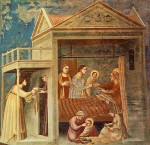
The Birth of the Virgin by Giotto, ca 1305

Since the fifth century AD, beginning in Jerusalem, the feast of the Nativity of Mary has been celebrated in Christian Churches. It is celebrated exactly nine months after the Feast of the Immaculate Conception. This feast and others like it are a reminder that those remembered as holy ones in our community got their start the same way all humans do. They were born of a woman, into a family and a larger community of fallible, imperfect humans, who nevertheless managed to help them grow to adulthood and eventually to sainthood.  This should be a source of great hope to all of us.

Mary was no exception. Her parents, Joachim and Anna, had long awaited the birth of a child. Her coming to them was a great gift from God. According to tradition, she lived with them only three years before they took her to the temple to be dedicated to service there. They visited her regularly at the temple as she was growing up until they passed away when she was about 10 years old.

Most of us will never have children following prophecies or angelic announcements of their coming. Most will not take our children to be raised in the temple or our local church. Most of us will live to see our children as grown adults with families of their own. But we will share in the task of parents such as Joachim and Anna, or Zacharia and Elizabeth, or Joseph and Mary: we will do our best to raise the children who have been entrusted to us, to help other parents to raise their own children, and to love and care for children of those we don’t know in other communities around the world. The love, acceptance, patience, gentleness, and consistency we show them in our day to day contact and care will be the qualities that help shape and mold their view of the world and of God.

On this Feast of the Nativity of Mary, may we be open to see the wonder of God’s love shining through the world’s children today and celebrate the continuation of the great chain of birth and love that unites us all in the Lord, leading us to holiness through the adventure of life as it is here and now.

Read More

Posted by on Aug 15, 2011

The Assumption of Our Lady, the Human, and Creation


This reflection is based in part on a presentation by Fr. Thomas Berry (1914 – 2009) – Philosopher, Cosmologist.


The Son is the image of the invisible God, the firstborn over all creation.
For in him all things were created: things in heaven and on earth, visible and invisible,
whether thrones or powers or rulers or authorities;
all things have been created through him and for him.
He is before all things, and in him all things hold together.
And he is the head of the body, the church; he is the beginning and the firstborn from among the dead,
so that in everything he might have the supremacy.
For God was pleased to have all his fullness dwell in him,
and through him to reconcile to himself all things,
whether things on earth or things in heaven,
by making peace through his blood, shed on the cross. – Colossians 1:15-20


There is a dimension to all feasts of Our Lady that highlights God’s involvement with the physical –  the material dimension. Mary’s assumption into heaven is a very tangible sign of the new creation in Christ. In his letter to the Colossians, St. Paul is addressing those who do not believe that Jesus was truly human. In this type of Platonist thinking, the feminine is seen as being prototypically associated with the earth and the physical is far inferior to the spiritual, celestial, male principle. The celebration of Mary, Mother of God, in the apostolic churches, acclaims the feminine as the means by which God makes all things new. Mary is the model, the example of what we are supposed to become.

God’s redemption of all creation is the setting for our own restoration of our fallen nature. Caring for creation is today a key obligation for us because of our recently acquired ability to reshape ecological systems on a global basis.

For more on Thomas Berry please go to http://earth-community.org.


Read More

Posted by on Jul 21, 2011

Mary Magdalene: Apostle to the Apostles – Then and Now

Mary Magdalene: Apostle to the Apostles – Then and Now

Mary Magdalene as Myrrh Bearer
Carrying spices to anoint Jesus body
in the tomb. – Eastern Orthodox icon.

The first witness to the Resurrection, according to all four evangelists, was a woman named Mary Magdalene. From the time of Pope St. Gregory the Great to 1969, her place in the story of the Roman Catholic community was confused with that of another woman, the repentant prostitute who washed Jesus’ feet with her tears. This woman was not Mary Magdalene.

In the earliest of the Gospels, St. Mark names Mary Magdalene as one of the women present at the crucifixion of Jesus (Mk 15:40). She is the first woman Mark names in the list of those who went to the tomb early on Sunday morning (Mk 16:1). The angel told the women that Jesus had been raised from the dead and instructed them to go to the Apostles with the news. They were to tell the men to go to Galilee. Jesus would meet them there. The women were frightened, according to Mark, and they didn’t tell anyone. (Mk 16:8)

Mark’s Gospel has two endings: one is short and says that the women reported to Peter and through them the message went out to the entire world. The second ending is longer and features Mary Magdalene. In this version, Jesus appeared to Mary Magdalene first. She is described as the one “out of whom he had cast seven demons.” (Mk 16:9). Mary told Peter and the others of having seen Jesus and the message of the angel. They did not believe her testimony. Then two men to whom Jesus had spoken on the road returned to testify that he was risen. Peter and the others still did not believe. Finally, Jesus appeared to Peter and company at supper. He scolded them for not believing the first witnesses he had sent to them. (Mk 16:9-14)

The other Evangelists tell essentially the same story. In Matthew’s Gospel she is named as among the women at the crucifixion, at the tomb that evening, and present on Sunday morning before the angel rolled the stone away from the tomb. The angel gave Mary and the other women with her the message to carry to Peter and the others that Jesus was risen and to meet him in Galilee. On their way to tell Peter, Jesus appeared to all of them, saying, “Peace! Do not be afraid. Go and carry the news to my brothers that they are to go to Galilee where they will see me.” (Mt 28:9-10). In this account, the men believed the women and went to Galilee. (Mt 28:16)

Luke names “Mary the Magdalene, from whom seven devils had gone out” early in his account. (Lk 8:2) She was one of a group of women who traveled with Jesus and helped fund his ministry. He does not specifically name any women present at the crucifixion, but he says the friends and women who had come with Jesus from Galilee were there, standing at a distance from the cross. (Lk 23:49) They followed Joseph of Arimathea to the tomb and then went home to prepare the burial spices and perfumes. (Lk 23:55-56)

Sunday morning, Luke says, Mary Magdalene and the others were the first at the tomb, heard the angel’s message and relayed it to Peter and the others. The men did not believe their account until they had come and seen with their own eyes that the tomb was empty. (Lk 24:1-12) They still did not know what to think until Jesus came to them personally at suppertime. (Lk 24:36-45).

In John’s Gospel, Mary Magdalene is named as one of the women at the cross with the beloved disciple and Mary the mother of Jesus. (Jn 19:25) She is the first person at the tomb on Sunday morning and saw the stone moved away. She went and told Peter and John, who came to see for themselves. Meanwhile, she was alone in the garden, mourning Jesus’ death, when she saw a man she thought must be the gardener. She asked where Jesus’ body had been taken, not recognizing her Lord. Jesus spoke her name, “Mary,” and her eyes were opened to recognize him. She spoke with him, then returned to the Apostles with this testimony, “I have seen the Lord!” (Jn 20:18)

The gospel accounts are clear. Mary Magdalene was one of the women who had traveled with Jesus from a time early in his ministry. She had been healed by Jesus, probably of a severe mental illness, described in that time as having seven devils. She stayed with him to the bitter end, and then stayed to anoint his body after his death. When she met him in the garden, she boldly took the news to the men who were recognized as leaders of the group. As a woman, her testimony was considered worthless. Nevertheless, she testified boldly. And Jesus backed her up, scolding those who doubted her word!

In one of the terrible ironies of history, Mary Magdalene was tagged as a great sinner who was forgiven much, rather than being remembered as a very brave woman who carried an impossible story to a group of men who would not accept testimony from any woman, much less such a fantastic story from a woman with a history of mental instability. Her story became one of forgiveness of a woman’s sinful nature rather than the rightful story of a woman’s faithfulness, courage and openness to hear of the impossible abundance of divine life and love that overcomes even death.

As we move forward in history, the time has come to correct the telling of Mary Magdalene’s story and to ask ourselves if we would be more open to receive her testimony today than Peter and the others were on that first Easter Sunday.

How do we measure up today? Do we value the witness of women? Do we recognize the importance of their role in nurturing the next generation? Do we value their intelligence and give them opportunities to reach their fullest potential? Do we give women a voice and a role as teachers and preachers within our community of faith? Do we look out for women: working to end violence and abuse against them? Do we hear the voices of women who are overwhelmed with work, worried about how they will care for the families they have, unable to muster the resources to bear more children and raise them well? Do we hear the voices of women who are in danger from those who should be their loving supporters? Do we hear their voices telling of the kingdom as it is coming to birth in our world today, through their struggles for freedom, equality, education, and opportunity?

I pray that we, as individuals and as a community of faith, will not find ourselves being scolded by our Lord for not listening to the ones he has sent as witnesses to each of us, telling of his Resurrection and the coming of the kingdom into our world today. At least half of the witnesses any of us will meet will be women. May we be open to hear through their many voices and stories the voice of the Lord, calling us to share in the freedom and abundance of life in God’s love.

St. Mary Magdalene, pray for us.


Read More

Posted by on Jun 25, 2011

Realities and Wonders Beyond Our Comprehension – The Feasts of The Holy Trinity and Corpus Christi

The mystery of the Holy Trinity is at the core of our faith as Christians. God is one undivided unity. Yet God is also Father (Mother/Parent), the incarnate Son (Jesus) and the Holy Spirit – all united as one in being and each separate in identity.

Early Church writers spoke of the Trinity in terms of perichoresis, a mutual indwelling and interpenetration of being shared by the members of the Trinity. The word itself comes from Greek roots meaning around and to contain. In some ways it’s akin to a dance in which the dancers and the dance are one. None can be separated from each other because their essence is one, yet each has an individual role and part in the whole.

We experience God as Trinity in our lives. God as parent brings all things into being through love overflowing and keeps us safely in existence – never forgetting us. God our brother Jesus who has shared the joys and sorrows, hopes and fears of human life is truly one of us – 100% human. God the Holy Spirit of love gives us courage to live in love and words to speak of what we have experienced of divine life and love. God as Father, Son and Holy Spirit is the greatest fan each of us will ever have – always hopeful and encouraging us as we forge ahead through life’s challenges.

Following Trinity Sunday, we celebrate the Feast of Corpus Christi – the Body and Blood of Christ. One mystery following on another. How can simple bread and wine be the body and blood of the Lord? Yet that is what Jesus told us he was giving us – his own flesh and blood to eat, as divine food to strengthen us on our journey as we travel back to union with the Trinity. One of our prayers tells us that we become what we eat. As we share in the divine meal, we share in the life of the Trinity and are drawn ever closer into it.

What a gift!

The wonder of all this struck me as I reflected on an experience I had with my young grandson last week. We were at Disneyland on the last day of a trip with my Girl Scout troop. The girls graduated from high school this year and this was our last major outing.

The park was closing early in preparation for a “Grad Night” for local high school seniors, so despite having a young child along, we were there for the fireworks and final show. It was a show with light, water and music telling of a dream Mikey Mouse was having, complete with ominous music and threatening villains. Could Mickey triumph over the evil that threatened by using the power of imagination? Of course he could and did. The show ended with great joy and happy, triumphant music.

What fascinated me was watching our little boy. He quickly lost interest in watching the story and we moved off into a nearby area where there was a short wrought iron fence (about 36 inches tall). As the music, lights and story blared around us, he quite happily climbed up on the bottom cross-piece of the fence and made his way sideways, holding on to the top rail, from one end of the fence to the other. Then he jumped down, clapped his hands, climbed back up onto the fence and went back to his original starting place. He did this through the entire performance – at least four or five trips back and forth along the fence. He’d have continued doing it all night had we allowed it!

I had been concerned that the ominous, scary music, the tone of voice of the villains, the colors of the threatening sections of the show would frighten him. Had he been a few years older, they would have. However, at his young age, he had no negative associations with any of those cues. What we considered scary music was the same to him as the triumphal music or a sweet ballad. The lights that flickered and changed from peaceful pastels to discordant, multi-colored, dark or flaring reddish-orange bursts of color meant nothing to him.  It was all just background to what he was exploring. He was having a wonderful time on the fence.

In thinking about his reaction, I find myself wondering how much we are like this young child – totally enthralled with our own activities in our own little worlds and totally missing the wonder of the dance going on all around us. We live and move and have our being within the loving presence and reality of God, yet we don’t notice most of the time.

I pray that as the coming weeks unfold, I will be ever more aware of the divine presence – Father, Son and Holy Spirit – enveloping me and all of us in the great dance of being. In the words of Jesse Manibusan’s song, “Open my eyes, Lord. Help me to see your face … Help me to hear your voice … Help me to love like you… Help me to love.”

I send the same wish to all who read these words. May the blessings of God who is Father, Son and Holy Spirit descend on you and remain with you forever. Amen.


Read More

Posted by on Jun 8, 2011

The Feast of the Holy Name of Jesus

Waiting in Anticipation for the Holy Spirit

Fresco from St. Charles Church, Vienna

Easter Season is drawing to a close this week. The season itself lasts fifty days. It begins with Jesus’ Resurrection and concludes with the arrival of the Holy Spirit at Pentecost. The last nine days, from the Feast of the Ascension until Pentecost, are a special time of prayer to invite the Holy Spirit to come into our lives ever more deeply as well.

Jesus promised his followers that when he returned to his Father, he would send a Paraclete to them. Some translations use the term Advocate for Paraclete. The choice of word, as is generally the case in translating, gives a slightly different sense to the promise and its implications.

Advocate is a term used to describe lawyers who plead the case of persons accused of wrongdoing. Advocates are also people who argue on behalf of people who are at a disadvantage in a social setting or a negotiation. Advocates are people everyone needs at one or another point in life. Having an Advocate sent from Heaven on our behalf is not a bad thing. It can be quite encouraging. Yet the term carries with it a sense of our unworthiness and sinfulness. We need someone to represent us in dealing with the Father.

A couple of weeks ago, our pastor suggested that the word Paraclete might actually be better translated as Cheerleader. In this sense, the Holy Spirit is the one who encourages us, seeing the good we do, how hard we try, how we keep falling and yet encouraging us to get up and try again. Fr. Ron explained that God – Father, Son and Holy Spirit – is our cheerleader, our biggest fan. God got excited enough about humans to become a human (Jesus). And Jesus returns to the Father, fully God and fully human, promising to share that spark of Love, the Holy Spirit, with all of us too.

What a wonderful promise! Not only do we have an advocate who’ll plead for us when we mess up; we also have a cheerleader who’ll be there to cheer us on as we keep trying and keep believing that we really are lovable.

In these final days before Pentecost, lets hold on to this promise, waiting for the gift of an even deeper relationship with our God. A relationship that doesn’t depend on how well we manage to live our lives, but rather on how crazy God is about each of us and how much God wants us to respond in love to that gift of love.

Come, Holy Spirit, come!

Read More

Posted by on May 7, 2011

Sharing in Divine Mercy

The second Sunday of Easter is known as Divine Mercy Sunday. The Gospel reading (Jn 20:19-31) tells of Jesus’ appearance to His disciples in the Upper Room on Easter Sunday evening. He appeared among them, wished them Peace, showed them His wounds and asked for something to eat. Then He breathed on them, the breath of the Holy Spirit,  and told them to forgive sins. He told them to continue the work He had begun, taking the Good News of God’s love out to all the world.

When I was growing up, the message of this Gospel’s story of the granting of power to forgive sin was generally presented in terms of the power of priest to forgive sins in the sacrament of Penance (now more often known as Reconciliation). However, as I listened to the Gospel proclamation last Sunday, the Good News I heard was of the gift given to all of us as followers and disciples of Jesus – the power to forgive those who hurt us in some way.

Forgiveness does not come easily to anyone. When hurts come along, it’s often much more satisfying to plot revenge, or bask in a stew of martyred pouting or otherwise hold on to the hurt. But Jesus knew something we often miss. The one most hurt, the one most diminished, the one who suffers most from such behavior is the one who engages in it! Perhaps that is why He was so quick to forgive those who had abandoned and denied Him just a few days earlier.

As we live our calling as followers of Jesus, we share the task of bringing forgiveness, reconciliation and peace to our families, communities, nations and world. Anything that stands in the way of this mission is to be suspect. We can’t forgive through our own power. Some wounds are just too deep for our human ability to heal. But Jesus is with us and He can heal them if we are willing to open them to His touch. And as we receive healing, we are called to pass it on, so that the waves of forgiveness and healing at last embrace all the people of the world. It’s truly a noble calling.

Peace be with you.

Read More

Posted by on Apr 28, 2011

Easter Week Daze

I tried to blog during Holy Week. I would like to say that I was too caught up in ecstasy to touch the keyboard, but I was really silenced. It wasn’t really writer’s block. It was more a sense of something I am learning in my old age – to keep my mouth shut. As an extrovert this is an occurrence of note, since I don’t often know what I am thinking until I am expressing it.

Per usual, after the stress of the event, I can begin talking or writing about my experiences of Lent and Holy Week now that we are in Easter Tide.

Easter Triduum, from Holy Thursday to Easter Vigil, is a montage of one highly charged event ebbing and flowing over many others. The breaking of the bread at the Last Supper; Judas sent off on his errand; Jesus looking for support and finding us asleep. The darkness at noon covers all creation. Nicodemus asks for the body of Jesus. Mary of Magdala weeping as she asked the Gardener, “Where have you laid him?” followed by the overpoweringly personal entreaty of a close Friend, “Mary.” The disillusioned disciples heading back home and being consoled by a stranger Whom they invited in for the evening. The guest only reveals Himself in the moment of the breaking of the bread. After all of the betrayals, the abandonment, with the marks of the crucifixion on His body, His first words to the men who “threw Him under the bus” was “Peace.” In all of previous salvation history, God’s messengers manifest with the same greeting of peace, but now God does it directly, for the first time.

I understand that the traditional teaching is that the sacrifice of Jesus satisfied the Father’s need for atonement, but somehow, it is hard for me to imagine that God, in Jesus, would not take offense at the rejection of his goodness. Yet, Jesus doesn’t take offense even as the disciples and all of us cower in hiding.

The only thing that I can compare this daze to is to singing the last note of Hadyn’s Creation Mass as a member of the Loyola Men’s Chorus. The director had told us that we would know if we had succeeded if there was a deafening silence before the audience responded. The last note hung in the air. The director brought his thumb and forefinger together; the note evaporated high in the nave. The silence was profound and seemed to last forever. The temperature dropped and then there was thunderous applause.

I am still in the coolness of the silence after that last note. It is not a bad place to be. I hope you are too. Peace.

Read More

Posted by on Apr 26, 2011

The Feast of the Holy Name of Jesus

Violence and Atonement: A Necessary Link?

Fireweed by Joseph N. Hall

The relationship between violence and atonement is closely woven in scripture and theology but it seems inimical to me. As a life long Catholic, anthropologist, and amateur theologian, I grew up with the notion of the Mass as the unbloody sacrifice of Calvary. Things changed after Vatican II to a focus on the Paschal mystery. Despite all of the language we have about the Father requiring satisfaction, it does seem contrary to Jesus’ own teaching about the fact that human fathers, “evil as you are,” would not give your son a stone when he asks for bread. (Matt 7:11)

Clearly, there is patriarchal and tribal language in the concept of satisfaction. This is still prevalent, as seen in a recent gang rape case in Pakistan. A young woman was brutally gang raped by men of another sub-tribe because her 13 year old brother had apparently flirted with a young girl of the other group. To settle the conflict and avoid greater reprisals, the elders of the young woman’s group offered her as a settlement. http://articles.latimes.com/2011/apr/22/world/la-fg-pakistan-rape-20110422

This is not only revolting to our current sensibilities, but it challenges the notion of sacrifice in the tribal sense. My own existentialist take on redemption has to do with authenticity. God took upon Himself our human condition and brought mercy, healing, and peace. For this he was publicly tortured to death.

My own post-modern sense is that the Father is not so much offended by our sin as appalled by it, as an act of vandalism or destruction of works of great beauty conceived in boundless love. The freedom that is required for the reciprocation of love can also be used to reject it. I personally cannot conceive of an infinite God who is somehow diminished or “offended.” To continue to anthropomorphize the Father as a post-modern, post-Freudian human father leads us to a Father, Son, and Spirit caught up in the continuing ongoing creation of bonum diffusivum sibi – good diffusive of itself. The Incarnation and Christ event are the result of an unlimited and unconditional love.

Clearly, this post-modern language flies in the face of Old Testament pastoral society and the cult of Temple sacrifice in the New Testament. Early Christians had to find a way to explain the Christ event in their own cultural and historical context. However, there is no denying that a post-modern Father is less monstrous to the secular humanist ethics and sensibilities that derive from the Christian tradition of the West.

As terrible as the death of Jesus was, it was completely overshadowed by the fact that no evil can come between us and the Love of God in Christ Jesus. (Romans 8:39)

The great peril of a tribal metaphor is not its irrelevance nor its systemic violence, but rather the chasm it creates between God and us that continues to be the original and fundamental blasphemy alienating us from God and ourselves. The preface to the Eucharistic prayer at the Mass of the Easter Vigil and Easter Sunday begins in astonishment “Father, you love us still and sent us the Christ.” Yes, what amazement there is, that in spite of our rejection, God never stopped loving us.

The demand for violence attributed to the Father elevates evil to the level of the divine. The unrelenting intrusion of the divine in the human train wreck, of necessity, requires God to confront violence; which he does with non-violence – even to death on a cross. (Philippians 2:8)

Read More

Posted by on Mar 25, 2011

The Feast of the Holy Name of Jesus

The Annunciation – Celebrating Incarnation and a Young Woman’s “Yes” to God

The Annunciation - Dante Gabriel Rossetti, 1850

March 25 is the feast of the Annunciation, the celebration of the visit by the angel Gabriel to a young woman in Nazareth to ask a great favor of her. The Lord of Hosts, Creator of all that is, was and ever will be, requested her consent to becoming the Mother of God (Theotokos or God-bearer), Mother of the Incarnate Word of God, Mother of His Son. The story of this visit is recounted in Christian scriptures (Lk 1:26-38, Mt 1:18-21)  and also in the Qu’ran (Sura 3: 45-51).

With Mary’s courageous decision to consent to the Lord’s request, a new era in the history of human relations with the Lord opened. In a time and place where women were little valued or respected and had fewer rights than men, the consent of a woman who was little beyond childhood and was still unmarried was solicited and respected by the greatest power of all – her creator and ours.

This feast has been celebrated since the earliest days of the Christian community, probably even predating the celebration of Christmas. Celebration of the Annunciation (and therefore of the Incarnation) coincides with the general time frame of the celebration of the Passover and Exodus, events that formed the Jewish community into a nation, beginning their history as a people. With the Annunciation and the Incarnation, the life of a new community began and the history of salvation took a new turn that eventually led to inclusion of all peoples on Earth.

Selection of the date for the celebration was not random. It coincided with the timing of the birth of John the Baptist, conceived following the time of his father’s service within the Holy of Holies on the Feast of Atonement in the fall. The Annunciation took place six months later, putting it in early spring. Based on those dates, John the Baptist’s birth was celebrated in June and Jesus’ birth date came to be set as December 25.

Setting the date of the Annunciation in spring also followed the Jewish tradition of celebrating beginnings and endings on or around the same date. It was known that Jesus’ death and resurrection occurred at Passover time. Setting the beginning of his life, his conception, at the same general time made sense to the early community. The big innovation was that for Christians, his conception marked the beginning of life, rather than his actual physical birth. (The “womb to tomb” tradition thus has ancient roots as well.)

Moving forward a few hundred years, in 525 when the new calendar was introduced by Dionysius Exiguus, the Anno Domini calendar, March 25 was set as the first day of the year. The Christian community considered it to be the beginning of a new era of grace.

May we, as we continue to live out our lives as sharers in the mystery of incarnation, rejoice with the angels and saints, and with Our Lord as well, the great blessing of a young woman’s willingness to trust that her Lord would never ask too much of her.

Let us join with our sisters and brothers in the Eastern Christian churches in rejoicing on this day.

Today is the beginning of our salvation,
And the revelation of the eternal mystery!
The Son of God becomes the Son of the Virgin
As Gabriel announces the coming of Grace.
Together with him let us cry to the Theotokos:
“Rejoice, O Full of Grace, the Lord is with you!”
Read More

Posted by on Mar 9, 2011

The Feast of the Holy Name of Jesus

Ash Wednesday: Spiritual R & R – Reconciliation and Renewal

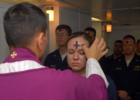
Receiving the Ashes in the Sign of the Cross


Ash Wednesday begins the season of Lent. It tends to be a day when people think about what they are going to give up in preparation for Easter. Fasting can be seen as a convenient type of dieting. Almsgiving can be reduced to cleaning out the closets.

However, prayer, fasting, and almsgiving are ancient practices in societies and religions all across the world. They are ways to produce altered states of consciousness and encounters with the divine. In the Christian tradition they are part of the “via negativa” or negative way. Generally, we tend to see this type of deprivation against the historical backdrop of hermits in the desert rejecting the “flesh” of worldly temptation and indulgence. Of course this conflicts with our consumer culture of comfort and instant gratification. It also conflicts with a more positive psychological model in which the focus on human weakness is replaced with a focus on human self-fulfillment and actualization.

In the secular model of well being, human and social limitations can be overcome by refocusing our attention and modifying our behavior. Hammering down our feeling and emotions – especially sexual ones – is sometimes seen as harming mental health. By denying our interior tensions and conflicts, we can fail to confront the real challenges we should be facing in our psychological development.

Lent itself is an old word for Spring – that time when the world comes to life again. The “via negativa,” the more traditional model of asceticism (an interesting Greek word for athletic training), and the contemporary model of self affirmation are not really opposed. They can actually be healthy correctives. If we focus exclusively on restraining ourselves we not only ignore opportunities for growth, we can also ignore what God is calling us to do. Focusing only on my needs and self-fulfillment can also lead to such an inward narcissistic self-absorbed focus that we cut ourselves off from true happiness.

In subsequent posts, as we journey through Lent, I will share with you some more reflections on being happy, holy, and healthy. This is a wonderful season for reconciliation with ourselves and others and a time of renewal for our call to serve and to engage in the coming of the Kingdom – the age of justice.

So.. what am I going to get for Lent?

Read More

Posted by on Nov 5, 2010

The Feast of the Holy Name of Jesus

Celebrating the Saints

Fra Angelico - Christ Glorified in the Court of Heaven

This week we have celebrated the Feast of All Saints and the Feast of All Souls. We’ve also celebrated the feasts of specific saints each day of the week, as we do throughout the year.

We tend to think of saints as people who were solemn, high-minded, never doubting, always choosing the right path, (insert your own superlative praise here) types of people. In fact, they were and are ordinary people just like you and me. We are all called to be saints. In the community of Christians in the early days, people spoke of each other as saints.

What is a saint? A saint is a person who lives a good and holy life. Saints sometimes do the right thing. Sometimes they do the wrong thing. Sometimes they are confident that God is with them and loves them. Other times they feel totally abandoned by God.

Father Ron Shirley spoke about saints this past Sunday. He made the point that none of us is called to be a saint in exactly the same way someone else was called. Each of us has his or her own job to do here during our lives on Earth. In doing the  particular job that God created us to do, with the help of our families, friends and community, we become holy – we become saints.

We pray for each other during our lives. We pray for each other after we have passed through the door of death into the next stage of our lives. The Feast of All Souls is a time for officially remembering and praying for those who have gone ahead of us.

We are a community of saints – people called to holiness and saved through the loving gift of God’s Son. People living today. People who have lived through all of human history. We are children of the Most High. Let us rejoice!

Read More

Posted by on Jul 4, 2010

The Feast of the Holy Name of Jesus

July 4, 2010 – Parades, Celebrations and Prayers

Fog near Monterey Bay

The Fourth of July dawned foggy and cold this morning in Santa Cruz. Not too surprising. It is, after all, “fog season.” Usually the fog lifts by early afternoon, but it’s after 3 now and except for it being a touch ligher, there’s no blue sky near the ocean.

It’s been an unusual Sunday for us. The celebration of the Mass we usually attend can’t take place when the 4th falls on a Sunday because the Aptos 4th of July Parade starts in the street beside the church (Resurrection Parish). Our pastor offered a “Park, Pray & Parade” special to all who wanted to attend the 8:15 Mass, but that’s a bit early for my family. So we chose to visit another parish community this week.

We arrived just on time for Mass at Holy Cross Church in Santa Cruz, after having been diverted by a detour due to closure of the road that passes the church. We came in the back way and parked behind the old school building. Arriving at the front of the church, the reason for the road closure was apparent. A brass band was playing, people were milling around, dressed in their “Sunday best,” (not a common sight in Santa Cruz on a holiday weekend) and lots of young girls were dressed in long white gowns, with capes and trains and wearing glittering crowns. We’ve lived here a long time, but this was the first time we’d arrived for this celebration.

We went into the church and discovered that the Portuguese community was having their annual celebration of the Feast of St. Elizabeth of Portugal. St. Elizabeth (1271 – 1336) was Queen of Portugal and noted for her devotion to the Holy Spirit and her care for the poor. Married at the age of 12, she was none-the-less a strong spirited woman who was not afraid to think for herself and even defy her husband. It is said that when he forbade her to take food to the poor, she continued to do so anyway. One day he caught her and asked what she had hidden under her cloak. She replied, “Roses.” He scoffed at that response because it was January and roses are not blooming in January in Portugal. He tore her cloak open and found, to his amazement, that she was indeed carrying roses.

St. Elizabeth of Portugal

Elizabeth (Isabel) was also known to be a peacemaker. When her husband and son, leading armies against each other, met on the battlefield, she marched out between them and made them come to terms of peace. Later, in her old age, she did the same when her son prepared to fight the king of Castile.

In Santa Cruz and around the world, where Portuguese communities live, the feast of St. Elizabeth is celebrated with special prayers to the Holy Spirit and blessings for the girls. This celebration occurs every year. I’d seen the procession after Mass – everyone walks from the church, up over the freeway and down to the Portuguese Hall in the park nearby for an afternoon of feasting and fun. It was a blessing to share Eucharist with them this year.

After the final hymn, in Portuguese, the choir led those who had not yet processed out of the building in the song, America the Beautiful. It seemed fitting. Here we all were. People literally from all over the world. Old folks and children. Parishioners and visitors to the community. People from all different walks of life. Social liberals and social conservatives. Gathered together to hear the word of God, celebrate Eucharist together and pray with thanksgiving for the gift of a wise and generous queen centuries ago, the gift of a nation with “freedom and justice for all” that we have received from our forebears in this country and to ask for the gift of wisdom for ourselves and our leaders now, in this time, with the challenges we face today.

The  original words of the hymn, and it is indeed a hymn, are worth pondering as we celebrate the freedoms we enjoy in this country today.

America the Beautiful

O beautiful for spacious skies,
For amber waves of grain,
For purple mountain majesties
Above the fruited plain!
America! America!
God shed his grace on thee,
And crown thy good with brotherhood
From sea to shining sea.

O beautiful for pilgrim feet,
Whose stern, impassioned stress
A thoroughfare for freedom beat
Across the wilderness!
America! America!
God mend thine every flaw,
Confirm thy soul in self control,
Thy liberty in law.

O beautiful for heroes proved
In liberating strife,
Who more than self their country loved,
And mercy more than life!
America! America!
May God thy gold refine,
Till all success be nobleness,
And every gain divine.

O beautiful for patriot dream
That sees beyond the years
Thine alabaster cities gleam,
Undimmed by human tears!
America! America!
God shed his grace on thee,
And crown thy good with brotherhood
From sea to shining sea.

Amen! May it be so.

Happy 4th of July!

(Words of America the Beautiful by Katherine L. Bates. Music by Samuel A. Ward.)
Read More