Pages Menu
RssFacebook
Categories Menu

Posted by on Sep 7, 2025

Finding the Way – Got a Map?

Finding the Way – Got a Map?

Assorted Map piecesSpatial orientation and keeping track of landmarks, finding the way, while moving from one place to another do not always come naturally, especially when an individual has always been with someone else who has led the way for them. I discovered this to my surprise one day when I went with three guys from my high school class to take part in a program for students from all over town at one of the local colleges. None of us had ever visited that particular campus, so no one knew where we were going.

We managed to find our way to the classroom where the event was to occur and had a good time with the other students. Then it was time to go back to our own campus and return home from there. When we left the building, I assumed all of the others would know the way back to the car in which we had come, but as it turned out, none of the guys remembered which way to go! I was amazed. My father had made sure all of us learned at an early age to pay attention to landmarks and which way we had turned when hiking in the countryside or walking in town. But apparently, the guys had not been so lucky.  I led the way back to the car and we made it home safely. (They were all taken aback that a girl could find the way home, by the way. It was a different time!)

The question of finding the way, however, is not always something as simple as finding one’s way across a small college campus in a city. It’s not even merely a physical feat of geolocation – where am I physically? Finding the way may be a factor in achieving a personal goal – I will learn how to knit this scarf! It might also be something life-changing – what am I called to do with my life? What is my vocation to be? How will I know what God is calling me to do? Got a map?

In each of the readings this Twenty-third Sunday in Ordinary Time, the question of searching for and finding the way or of reaching a goal is part of the story.

Jesus spoke to great crowds of people who followed him through the countryside from village to village and city to city. His words sound harsh to us today. “If anyone comes to me without hating his father and mother, and even his own life, he cannot be my disciple.” How can hating anyone be a goal for the follower of Jesus. Aren’t we supposed to love everyone?

This is a situation in which words in one language do not necessarily mean the same thing as in another. In some languages, there are no words to express concepts found and expressed in another. This is the case with the use of the word “hate” here. There was not a word in Jesus’ language to express preference corresponding to the word “like.” Our usage of “like” as in “prefer” was not a possibility in his language. To say that something is not to be preferred, the word translated as hate in English was used.

So, Jesus is telling his followers that if family traditions or claims on their allegiance from their family would stop them from following the way of living to which he calls his followers, their choice would need to be to prefer Jesus’ way and leave behind the claims of others – to “hate” those claims.

He gives examples of situations in which people make choices in their lives. Do I have the resources to build a tower (add on a room to my house)? Should I settle with an adversary or press my claim legally or on a battlefield? What am I willing to give up to follow this new way of love that Jesus teaches? (Lk 14:25-33)

Where is the map? How will I find the way?

Paul wrote to his friend Philemon from jail near the end of his life. One of Philemon’s slaves had come to stay with Paul and become a Christian. Paul was not required to return Onesimus to Philemon. In fact, Jewish law prohibited the return of a slave to a master. (Deut 23:16) Nevertheless, Paul sent Onesimus back to Philemon with a letter and request – receive him back into your home as a beloved brother in Christ rather than as a slave. “If you regard me as a partner, welcome him as you would me.” (Phil 9-10, 12-17)

This is definitely not the normal map! There’s a new one coming into focus.

How do we find the new map? How will we know where to go, which way to turn as we journey through life?

The author of the book of Wisdom rightly asks, “Who can know God’s counsel, or who can conceive what the Lord intends?” Humans can’t really know. Our bodies are weak, our dreams are limited, our plans are uncertain. Knowledge of how things work and what is right or good in earthly terms is not easy to achieve. We try again and again to understand the physical world and still seem only to glimpse a small part of the bigger picture.

How can humans, with such limited ability to see and understand reality, ever hope to understand the ways of the Lord and the heavenly realm? The answer is clearly stated: “…who ever knew your counsel, except you had given wisdom and sent your holy spirit from on high? And thus were the paths of those on earth made straight.” (Wis 9:13-18b)

Here is the map. The Holy Spirit instructs those who seek wisdom and understanding of the Lord’s ways. The Spirit is our hope, our refuge, our guide.

We too must rely on the Holy Spirit to guide us through each day, keeping our eyes open to see the landmarks as we move along the twists and turns of daily life. Who will we meet on the way to work? What will a fellow student need to hear as reassurance or friendship from us? Is there someone at the grocery store who could use a smile or a bit of patience from the rest of the people in line? What child walking along the sidewalk with parents will be delighted to discover that you too have pockets in your coat?

Most of us don’t have the power to reach out and fix the injustices of national or international policy around us today. But we do have the power to work for justice in our own communities. We can make a difference for the people among whom we live and work. We can help protect our neighbors and co-workers who may be in danger from those who have been led to fear them.  We can share our resources and knowledge of the ways our laws and traditions work with those who have relatively newly arrived. We can be kind to all we meet.

The law of the Lord is love. This week may we use Love as our primary map as we find our way through our daily activities on the way to the blossoming of the kingdom of Love, the kingdom of God.

Readings for the Twenty-third Sunday in Ordinary Time – Cycle C


Read More

Posted by on Jun 15, 2025

The Lord Possessed Me – Wisdom Speaks!

The Lord Possessed Me – Wisdom Speaks!

There is something uniquely satisfying about creating something new, something unique, something for which there may not be a pattern already handy. A vision pops into mind of what might be, generally not already fully formed, but an inkling that “Gee, this would be fun to try – let’s see where it goes!”

Sometimes the idea doesn’t work out – too complicated, too expensive, too…  Other times, with a bit of time, the idea develops and something beautiful comes into being.

When I was teaching religious education many years ago, I always had the children work on a cross-stitch project before class started or when they finished drawing the picture and writing a short paragraph about the lesson into their books. At that time, I had a combined 3rd and 4th grade class. One project had a series of symbols of common prayers, but with children from two grades, and knowing half of them had already completed the symbols project, I decided to do something different the next year.

We were learning about sacraments that year, so I thought, “Why not make something for the parish that could be used at Mass?” Just a simple little thing, right? RIGHT!

I designed a pattern for the children – a grapevine, with clusters of grapes. Half would do the pattern one direction and the other half would do it the opposite direction.They set out to do it with a will. Some understood quickly how to do cross-stitch. Others needed more help. But all worked diligently on their panel. By the end of the year, only one had finished – he was already doing cross-stitch at school, so it was easier for him.

The next year I was expecting a baby in January, so I passed the class on to another teacher. I set to work finishing the panels. A couple of years later, after sewing a chasuble, combining the panels, and sewing it onto the garment, it was finished. Some of the children proudly presented it to the pastor at Sunday Mass.

It is such a delight to see it used. Doesn’t happen very often, but still, beautiful.

The many adventures in creating something from scratch came to mind as I read the passage from the book of Proverbs today. It speaks of the joy and delight of the creation of something new and beautiful.

Thus says the wisdom of God:
“The Lord possessed me, the beginning of his ways,
the forerunner of his prodigies of long ago;
from of old I was poured forth,
at the first, before the earth.

Wisdom was there before creation – part of the Creator’s very being, pouring forth into all that was created. Wisdom was the craftsman, in Spanish – the architect, the delight of the Creator working to bring all that had been envisioned into being.

“I was beside him as his craftsman,
and I was his delight day by day,
playing before him all the while,
playing on the surface of his earth;
and I found delight in the human race.”

Such a wonderful image – our Creator, possessor of Wisdom from before all time, delights in wisdom, playing through of creation and delighting in it, including in all human beings. (Prv 8:22-31)

The love of God is poured forth into the world through Jesus as we believe and accept it. God can give nothing but love, because God is Love. God’s Spirit, the Holy Breath of God, breathes out that love to all – into the very depths of our being. As we open our hearts to receive it, we share in the delight of wisdom dancing and playing through creation. As we care for the environment and our fellow people, the spirit of truth speaks to us, helping us understand the message of Jesus, sharing all that comes from the Father. As he reminds us, “Everything that the Father has is mine” and the Spirit “will take from what is mine and declare it to you.” (Jn 16:12-15)

We celebrate this wonder of one God – Father, Son, and Holy Spirit. We don’t really understand it. We think in terms of our human experience of separate identities and characteristics. But whenever the Father is present, so are the Son and the Holy Spirit. Wisdom dances in delight, poured forth from God into all of creation and our very lives. We don’t always notice, but when we do, it’s like seeing a magnificent sunrise or sunset, or crafting something truly beautiful, or hearing a delightful birdsong, or watching the love and trust of a child with a loving parent.

This week, as we go through our days, may we be open to hear the whisper of wisdom still pouring through our world and our lives, creating something new and beautiful each day that we may not yet perceive. May we trust that we are loved even when things are hard. God is present there too, with us, sharing our experience, holding and carrying us through it all. (Rom 5:1-5)

Share a smile. Give a hand to someone who needs it. Encourage someone who is struggling. Welcome a stranger. Speak up for someone who is being silenced.

The Lord is present in our lives and days. Wisdom isn’t pushy or loud. May we watch for her in the quiet moments, opening our hearts to her working in our lives and in the world around us.

Readings for the Solemnity of the Most Holy Trinity (aka, Trinity Sunday) – Cycle C


Read More

Posted by on Jun 8, 2025

Lord Send Out Your Spirit

Lord Send Out Your Spirit

Living beside the ocean, one becomes intimately aware of seasonal changes in its mood and the shifting weather patterns that accompany those moods. In late spring and summertime, the ocean is mostly rather calm. Sometimes there’s better surf than others and people come from other areas to go surfing, happily riding the waves, but the ocean is quiet. We don’t hear the waves crashing on the shore or the winds raging across the water and over the land. As fall approaches, we hear the sea lions and birds returning from their summer journeys chatting away happily, but the ocean is still mostly quiet.

But in the winter, it’s a different story. The waves begin to crash on the shore with little warning. We hear them a block or more away. The crashing can continue for a day or two before the storm arrives at the shore, its raging far out in the ocean awakening the waves. When we hear the waves begin crashing onto the rocks and cliffs along the shore, we know it’s time to be sure things that can blow away in a storm are put away or safely secured outside. The strong winds will follow and rain will pelt down until the storm has raced on to the east, bringing water to the land once again.

The winter storms have passed now and spring has brought flowers and drying fields. (It’s coastal California here and grass is green in the winter and dry in summer.) Easter season has reached its end and Pentecost has arrived.

Pentecost is a festival with ancient roots. It was a day of celebration long before Jesus’ time. Fifty days after the Sabbath of Passover, the gift of the Law to Israel, handed to Moses by the Lord, is celebrated. The official name of the festival is Shavuot, the Feast of Weeks.  It is traditionally the wheat harvest festival. The name Pentecost simply means fifty.

Like Easter, Pentecost has a Vigil celebration. In the vigil, the readings trace salvation history from very early times. Beginning when all people spoke the same language, the story of the Tower of Babel is told, explaining how it came to be that we no longer understand each other’s words. Then comes the story of the gift of the Law, given by God to Moses, accompanied by thunder, lightning, clouds, smoke, earthquakes and the sound of the trumpet. The readings that follow recount the promises and examples of results of the Lord’s sharing of the Spirit, bringing life to dry bones, promising that the people would see visions and prophesy when the Lord poured forth his Spirit on the world.

Wind, fire, clouds, smoke – the coming of the Lord is a big deal. Like the waves crashing on the shore before the winter storms arrive.

Fifty days after the sabbath following Passover, the disciples were still a group of very frightened people. They remained in hiding in the Upper Room, fearing for their lives if it were known they were followers of Jesus. They had seen the Risen Lord, but who would ever believe it! And the Roman authorities and the leaders of their own people would not be happy to hear that the problem of Jesus had not gone away with his execution…

But Jesus had promised more than once to send the Spirit, the Advocate, who would remind them of all he had taught them. This Spirit would take them even farther forward in their understanding of the Father and his love for all people and all of creation. It was too much for them to understand before the Resurrection.

On the morning of Pentecost, the promise was fulfilled. “Suddenly there came from the sky a noise like a strong driving wind, and it filled the entire house… There appeared to them tongues as of fire, which parted and came to rest on each one of them. And they were all filled with the Holy Spirit and began to speak in different tongues, as the Spirit enabled them to proclaim.”

Wind, fire, power from on high. And the ancient division from Babel was overturned. Their words could be understood by all who heard them. “We hear them speaking in our own tongues of the mighty acts of God.” (Acts 2:1-11)

We all share in this life, this anointing with the Spirit of God. Through our baptism, we enter into the community of the children of God. In Confirmation, we receive the grace to begin speaking more clearly the Lord’s presence and word through our lives and our words.

As a community, we share the Good News with our world. God loves each and every person, totally and without reservation. Creation is good and worthy of our loving care. Those with special needs are to be loved and receive the extra care they may need. Strangers must be welcomed, because they too are our sisters and brothers, children of God.

Through the Spirit, the Holy Breath of God, the barriers among peoples are broken down. Barriers of language are vanquished. Differences among our cultures or our physical appearance no longer matter. Our infinitely creative Father likes diversity! We are all equal in God’s sight and love. We are all included in the great big hug God offers to his children.

As Pentecost comes this year, may our ears be opened to hear the Lord’s voice calling us to welcome all we meet, all who come seeking opportunity, all who are ready to offer their own gifts from God. Those gifts take many shapes and forms. The child who will never mature to adulthood may offer a simple, beautiful appreciation of the present moment that the rest of us miss in our hurry to do the next thing on our list. The older person who depends on others for help has stories to tell that remind us of other times and places filled with love. The delight of the newcomer who finds safety and acceptance and opportunity in a new land is to be treasured and appreciated.

We never know where or when we will meet the Lord. So, this week, let’s be open to meeting him in each person we meet. Let’s reach out with a smile or a kind word. Let’s offer patience and humor when delays arise. Let’s live as if God really loves us and we know it. Because, tell you a secret, he does! Just as the waves on the shore carry news of what’s going on farther out to sea, the smiles and little kindnesses tell the story of the love of God.

Lord, send out your Spirit. Fill the hearts of your faithful and renew the face of the earth!

Readings for Pentecost – Cycle C


Read More

Posted by on May 25, 2025

No Unnecessary Burdens

No Unnecessary Burdens

Those who have children may well have discovered that when a child wants to play on an organized sports team, there’s far more to the deal than simply showing up for games. Beyond the cost of the program itself, there’s the need for a uniform, special shoes, special equipment that’s the right size for the child, transportation, and regular required practice times (regardless of other previously scheduled aspects of family life). All that must be handled before a single game is played.

Yet despite the inconvenience of it all, parents continue to sign their children up to play sports, take dance classes, join Scouts, and be part of other activities that encourage the children to learn new skills, test their limits, and learn to work, play with, and lead others.

In the early years of the Christian community, as those who were part of the original group of disciples went out to share the good news with people outside Jerusalem, they also found some unexpected complications, especially as they moved out into non-Jewish lands.

Paul and Barnabas, as they began teaching in Asia Minor, found the message of the coming of the kingdom to be much more easily accepted by the Gentiles with whom they spoke than by the Jewish communities there. When others came out from Judea and met the Gentile Christians, some began to insist that Gentiles needed to become Jewish in order to be followers of Jesus. That would involve circumcision and obedience to Jewish Law and traditions. The idea caused a great deal of consternation among the Gentile converts, as well as Paul and Barnabas. “There arose no little dissension and debate…” about the issue, so Paul, Barnabas, and some others went to Jerusalem to consult with the apostles and other leaders there.

In what was the first council of the Church, the Council of Jerusalem, the apostles and elders met to discuss the question. Should new members of the community be required to live by Jewish law (the Torah) or not? The decision was made that obedience to traditional Jewish laws, including circumcision of males, was not necessary for new Christians. Only four conditions were set as requirements. Christians were not to eat the meat of animals sacrificed to idols. Christians were not to eat blood. They were not to eat the meat of animals that had been strangled. And they must not engage in “unlawful marriage” (a.k.a. intimate relations outside of marriage).

In a letter sent to the Christian communities of Antioch, Syria, and Cilicia, the apostles and elders wrote, “It is the decision of the Holy Spirit and of us not to place on you any burden beyond these necessities…” Keeping free of those four prohibited activities was all that was needed for “doing what is right.” The highly complex system of laws that governed every aspect of faithful Jewish life was not required anymore, based on the guidance of the Holy Spirit. (Acts 15:1-2, 22-29)

Jesus himself told his disciples before he died that there was far more they would need to know as they moved forward as his followers. He promised that those who loved him and kept his word would be loved in return by the Father. “We will come to him and make our dwelling with him.” Then he gave them a word of encouragement, “The Advocate, the Holy Spirit, whom the Father will send in my name, will teach you everything and remind you of all that I told you.”

Jesus knew that most of what he was telling his friends was beyond their ability even to imagine. Who would ever have imagined that he would rise from the dead? Who could comprehend what he was saying about being one with the Father? But here he was, telling them not to worry. “Peace I leave with you; my peace I give to you.”

So much more than they expected or could understand until the whole thing played out was now suddenly upon them as he spoke that night before his passion began. “I have told you this before it happens, so that when it happens you may believe.” (Jn 14:23-29)

At the Council of Jerusalem, the Holy Spirit did indeed teach the community something new. No unnecessary burdens need to be laid on those who come to follow the Lord.

In the Book of Revelation, we see something similar. The holy city of Jerusalem, coming down from heaven shone with God’s splendor, like a precious stone. It had high walls (for protection) and twelve gates. Twelve always stands for the tribes of Israel. The fact that Jesus had twelve apostles was related to this as well. They were seen as the stones on which the walls of the new city rested, “the twelve apostles of the Lamb.”

Jerusalem historically was the city in which God dwelt in the temple. Yet in Revelation, there is no temple in the city coming down from heaven. We are told, “its temple is the Lord God almighty and the Lamb.” The glory of God provided light “and its light was the Lamb.” (Rev 21:10-14, 22-23)

Again, no burdens of having to offer animal sacrifices in the temple in the new Jerusalem, the new community of the Lord.

As we live our lives in Christian communities today, we are also called not to put unnecessary burdens on others. People from many backgrounds, many traditions, many lands, many languages all come together as believers. We bring the riches of faith to share with each other. As we join together to serve the Lord in the community around us and throughout the world, we too need to remember that others don’t have to live exactly as we do in order to be loved by God. In those who can’t work or those who don’t have money for food for themselves and their children even though they are working, or those who arrive with nothing but hope as they flee for their lives from their native countries, in all of these, we meet the Lord. He is there, lifting the burdens of his sisters and brothers through our hands and willing hearts.

We don’t serve the Lord by imposing our religious beliefs or traditions on others. We serve by meeting others where they are and sharing the love of God by listening, sharing what we have, and enjoying the precious time we have to spend here and now.

We are a community that stretches around the world today. We are not first and foremost members of a powerful nation that imposes its will on others. We share something much deeper and more powerful – the love of the Lord, the gifts of the Holy Spirit and the fruits of their flowering in our lives of service, with our sisters and brothers in every land.

May we this week be aware of the burdens we might be imposing on others and try to lighten our expectations of them, so that the love of God will shine through us and out into our world.

Readings for the Sixth Sunday of Easter, Cycle C


Read More

Posted by on Oct 13, 2024

Wisdom’s Surprising Abundance

Wisdom’s Surprising Abundance

I love reading the comics each morning with breakfast. Sometimes I laugh (there’s a reason they’re called “the funnies”) and sometimes I nod my head in agreement. I share them with family and friends and sometimes cut them out and put them on the refrigerator, so I don’t forget the wisdom or the chuckle they embody.

This morning, Pearls Before Swine, by Stephen Pastis, offered a beautiful perspective on wisdom.

There is a character, a donkey who has a grey beard, wears glasses, and stands upright on the top of a hill waiting for folks to come with questions about life. This character is known as the “Wise Ass on the Hill.”

In today’s strip, he comes down off the hill and walks along a sidewalk, entering a café where two of the other characters are having tea and coffee. They ask why he is not up on the hill and his response is prophetic. “There is no past. There is no future. There is only the present moment… Hug your loved ones… celebrate the moment that you’re in.”  (To read the entire strip and the rest of its wisdom, visit the site.)

The message of this character today speaks deeply to me and is consistent with the messages in the readings for this Twenty-eighth Sunday in Ordinary Time.

The book of Wisdom was written about 100 years before the birth of Jesus. It was written in Greek by a member of the Jewish community in Alexandria, Egypt. The words are attributed to King Solomon, known as “The Wise.”

Solomon tells us, “I prayed, and prudence was given me; I pleaded, and the spirit of Wisdom came to me.”  Wisdom was more important to Solomon than power or honors, better than gold or silver, health or beauty. Her splendor outshone everything. Yet, he assures us, “all good things together came to me in her company.” She is, in fact, the mother of all of them. (Wis 7:7-11)

The rest of chapters 7 through 10 speak of Wisdom, Solomon’s request for her guidance, and her role in protecting her followers. Wisdom is one of the gifts of the Holy Spirit, shared with all who seek her help and presence in life. “She is an aura of the might of God and a pure effusion of the glory of the Almighty… And she, who is one, can do all things, and renews everything while herself perduring…” (Wis 7:25-27)

To hear Solomon speak, as is believed in many traditions, the good things of life come as gifts from God for those who are faithful. Follow the rules and you will be blessed, you will be rewarded in a positive way. Break the rules, and you will suffer, either now or in the future.

But there’s more to it than that.

Bad things do happen to good people. Why?

Silver and gold, wealth and influence, somewhere safe to live, health, friends … all can be positive in their own way. Yet all can be barriers to wisdom as well. If I never have to worry about where the money will come from to pay a bill, I might think it was because I have been judged worthy to have no need for help. If I live in a safe community, with good housing, schools, public services, and access to health care, I might think it’s only because I have worked hard and now deserve these blessings, all on my own. I might even begin to worry that someone else will work harder than I do and take it all from me. Or someone might receive what I have as a gift, rather than working hard themselves.

When wealth, respect, following the laws, and doing all that has been required of us don’t protect us from bad things, we question the reason. When all is going well, we assume it’s because we are being rewarded for being good people.

The young man who approached Jesus, asking what he would need to do to inherit eternal life most likely shared this understanding. Jesus reminded him of the commandments of the Law. The man responded that he had followed them since childhood. Jesus loved him and his commitment in obedience to the Law. Then he added one more thing. ”Go, sell what you have, and give to the poor and you will have treasure in heaven; then come, follow me.”

This was a bridge too far. To give up what he had, what he had worked for, what his family status gave him, that was too much. “His face fell, and he went away sad, for he had many possessions.”

There was a gate in the wall that surrounded the city of Jerusalem. It was very small, mainly for people and perhaps a donkey or horse. It was too small for a camel to pass through easily. People called it the eye of a needle.

Jesus turned to his friends and spoke words that ring true today, “It is easier for a camel to pass through the eye of a needle than for one who is rich to enter the kingdom of God.” Startling words – “who can be saved?” blurted out the disciples. Jesus’ response? “For human beings it is impossible, but not for God.” Those who give up everything for Jesus and the gospel (the good news) will receive all they need in this life and eternal life in the next. (Mk 10:17-30)

Will it be easy? No. Will there be misunderstandings and opposition? Yes. Does wisdom preclude a comfortable life? Sometimes. Do riches take many forms, sometime in disguise? Yes. Does God keep promises? Yes, absolutely.

The word of God, living and effective, can discern all that people are thinking. Nothing is hidden from the word. This word brings the gift of wisdom to us and looks for its fruit in our lives. Whether faithful or not to that word, all will be known in the end. (Heb 4:12-23)

Wisdom is a gift that lives deep within a person. It serves as a guide in decision-making and a source of comfort when things move in unexpected directions.

This week, let’s resolve to live in wisdom, in the present moment, hugging those we love, celebrating the blessings we have received, and sharing them with those we meet. Wisdom is freely offered to each of us. May we have the grace to accept the gift and live in wisdom’s freedom.

Readings for the Twenty-eighth Sunday in Ordinary Time – Cycle B


Read More
Posted by on Aug 18, 2024

The Living Bread from Heaven

The Living Bread from Heaven

One morning, a very hungry toddler sat down to eat her breakfast. One of her favorite foods was applesauce, home-made from wonderfully sweet apples. She was proud of her growing skill with a spoon and ate most of the applesauce using her spoon. But then the bottom of the bowl appeared. It became more and more difficult to scoop out the applesauce with her spoon, but there was more left to enjoy. Not one to waste a bite of something as wonderful as that applesauce, she held her spoon in one hand and lifted the bowl to her mouth with the other, happily slurping down the remainder of her applesauce.

We humans eat lots of different kinds of food. Some are special treats. Others are things we have been told are “good for us,” though we may not particularly like them. Most things we don’t really think much about at all. They are simply part of our everyday lives. We eat because we are hungry. We eat because we enjoy the food. We eat because those around us are eating and we enjoy the social nature of the experience. We eat because if we didn’t, we would not survive. For most of us, the latter is not our primary reason for eating.

The foods we eat are transformed by our bodies into the elements needed for us to grow and to live our lives. We must have the basic building blocks in order to continue. Energy needed for life comes from the food we eat. Without it, we would die. Even with food, the time comes in each person’s life in which we die. Food as we know it is not sufficient to maintain life forever. And after we die, our bodies return to the earth and recycle back to basic elements that can be reused by another organism.

Our toddler is part of a long-standing cycle of food and its uses.

Given the centrality of food in human life, and its social nature as well, it’s not surprising that when folks think about an afterlife, or a supernatural (or transnatural) world, they often include imagery of eating. Banquets are part of the mythologies of peoples around the world. The ancient Hebrews and Christians were no exceptions.

Wisdom’s banquet

Wisdom, a highly valued quality and indicator of maturity, is personified in the Hebrew scriptures. Wisdom was with God from the beginning, present at the creation of the world. Wisdom continues to act in the world and in our lives to the present day. Wisdom is perceived as feminine. For Christians, the Holy Spirit is identified as the Spirit of Wisdom, an integral aspect of the ever-dancing, swirling Trinity of Love, our God.

In the book of Proverbs, we find Wisdom hosting a banquet at the home she has built. Proverbs presents many sayings and examples of what is required of those preparing for service in government – those who will serve in the King’s court. Manners, codes of behavior, rules of civility – all are spelled out in this book. By the ninth chapter, those ready to serve, those who have matured sufficiently, are invited to Wisdom’s banquet. However, not only those who have met the expectations of their society are invited. She invites those who lack understanding, those who might not be seen as clever: “Come, eat of my food, and drink of the wine I have mixed!” Those who accept the invitation, will live and grow in understanding. This food is not physical food. It has a different purpose and leads to a different conclusion. It leads to maturity in thought and action. (Prv 9:1-6)

Physical food for a Spiritual outcome

The crowds around Jesus after he had fed so many in the wilderness were totally uncomprehending when he explained that he had not come into the world to provide miraculous quantities of fish and bread for them. On the contrary, he himself was actually living bread from heaven. His own flesh would be the food that would bring life to the world.

The claim was not well-received. “How can this man give us his flesh to eat?”

But Jesus didn’t back down. “Unless you eat the flesh of the Son of Man and drink his blood, you do not have life within you.”

Then Jesus shifted the conversation quite dramatically. He linked the eating of his body and blood to eternal life. “My flesh is true food, and my blood is true drink.”

How?   Why?   What?

“Just as the living Father sent me and I have life because of the Father, so also the one who feeds on me will have life because of me.”

We have moved into an entirely new realm. This is not normal food. The life about which he is speaking is not the normal human life here on Earth that we all experience. This is something totally different. Because the life of the Father flows through Jesus, a share in his body and blood is a sharing in the life of the Father. The body and blood of which he speaks are not the human, physical body we typically recognize as we interact with each other, rub the sleep out of our eyes in the morning, and enjoy our morning applesauce!

It was not until Jesus’ final supper with his friends before his death that it became clear what form that food and drink which are his body and blood actually would take. When he blessed and shared the final loaf of unleavened bread at his last Seder and the cup of wine after the meal has been eaten, the Cup of Thanksgiving, then gave them to his disciples, and explained that these were the food of the New Covenant, his body the bread broken and shared and the wine his blood, that of the sacrificial lamb, that his earlier words began to make sense. Until then, few who heard his words believed him anything more than a madman.

Because the life of the Father is shared with the Son, and we are invited to share in that life as we eat the bread and drink the wine that have been blessed and changed – his body and blood – we can share in their eternal life. This food leads and strengthens us for the journey of transformation and growth in maturity to the eternal table of the Lord. (Jn 6:51-58)

A New Way of Living

Living as children of God, sisters and brothers of Jesus and of each other, Followers of the Way, proved to be challenging, especially as the Good News broke down the barriers between the Jewish people and the Gentiles (all the rest of us). How does one live as a wise person rather than a foolish one? How does one know what the will of the Lord is? What traditions are to be followed? What new ways will enter our everyday activities?

St. Paul cautioned the people of Ephesus that there are many ways in which people can stray from the will of the Lord, many ways to act foolishly. The behavior which is not foolish is that which is filled with the Spirit. Lady Wisdom’s banquet hall, though not mentioned by St. Paul, welcomes those who seek her, with prayer, hymns, singing to the Lord, and giving thanks at all times.

The giving of thanks is not to be limited to times when things are going well. Paul says, “giving thanks always and for everything in the name of our Lord Jesus Christ to God the Father.” Things don’t always go well, in terms of our human evaluation of them, but God brings good out of all things. Our sharing in divine life did not and does not exclude all suffering.  We share in the whole life of Jesus in our communities and our everyday activities.

As we go through our days this week, enjoying our applesauce eaten by spoon or slurped out of our bowls, spending time at work and school, finding companionship with our families and friends, and sharing in the Bread of Life, the Body and Blood of our Lord, may we give thanks for all we have received and for the Spirit of Wisdom who shares in and rejoices in our lives.

Readings for the Twentieth Sunday in Ordinary Time – Cycle B


Read More

Posted by on Jun 30, 2024

Justice is Undying

Justice is Undying

We hear a lot about the notion of justice, especially when someone innocent is hurt or killed. Voices are rightly raised demanding that those who harmed the victim be punished for having done so. In this idea of justice, punishment for the wrong-doing balances out the injury to the victim and the scales are balanced once again. So, in this mode of reasoning, if a person is killed, then the killer should be killed or at the very least imprisoned for life. If other members of the community see the punishment, they will be less likely to commit the same offense.

Of course, it’s not quite as simple as all that. Identification of the guilty party is not always simple or accurate. An entire genre of literature, for example, is based on the idea that it’s not easy to identify the culprit when someone in a community turns up dead! If the penalty is death, then innocent people will die when they are falsely accused and convicted. Even life imprisonment for those who are actually innocent is a terrible injustice. And taking away a second life doesn’t bring back the original victim…

What then does it mean when we hear in the Book of Wisdom, “Justice is undying?” Does this mean that God is a judge who is always watching and ready to punish every mistake or smallest failing? That is certainly the image some folks have had of God. But is it really an accurate picture? Who would want a God like that?

When reading scripture, it’s important to remember that the writings were originally composed in a different language, in a far-past era, by members of a different culture than ours. Many of the same issues we face in terms of interpersonal relationships are similar, but many aspects of our lives and our understanding of reality, including cause and effect, are different. Even the meaning of a word as seemingly obvious as justice can be different.

The Book of Wisdom was written in Greek by an anonymous Jewish scholar in Alexandria, Egypt, sometime between 200 BCE and 100 CE. Its purpose was to encourage fellow Jews who were living outside Palestine to be faithful to the Covenant. It is written in verse, following the patterns of Hebrew poetry, and includes references to the Exodus, the wisdom of King Solomon, God’s mercy, and the foolishness of worshipping idols.

In the very first chapter, our narrator calls all to justice because justice is the key to life. Justice is the characteristic of living in right relationship with God. “God did not make death,” our narrator proclaims, “he fashioned all things that they might have being.” It is only through the envy of the deceiver, the devil, that death came into our world. (Wis 1:13-15, 2:23-24)

What does it mean to live in right relationship with God? Does it mean to walk around with our hands raised in prayer, looking down on those who don’t share our beliefs exactly? Does it mean hoping to be part of some small “faithful” remnant of God’s chosen ones when the last day of judgement comes? Does it mean hiding away in the mountains or in the desert, so we won’t be tempted by worldly pleasures?

For most of us, these are not ideal options, nor are they the way God wants us to live in justice. We are called to care for each other. To be kind to those who are treated as inferior. To reach out and share what we have with our neighbors. To speak a word of support for those whose rights are being trampled. To welcome those who flee violence in other areas and help them begin a new life in safety in our communities. To help the child who struggles with reading or arithmetic, reassuring them that they are not stupid, just that they learn in different ways. To forgive the person who has hurt us. To ask forgiveness from the person we have hurt. So many, many ways we are called to life in justice, in right relationship with the God who created all of us for imperishable life.

Jesus healed the sick, including when he wasn’t aware that healing was needed. When a woman in a crowd recognized him and touched his cloak as he passed by, she was healed of a condition that had made her an outcast for twelve years. Jesus did not consciously heal her. He noticed her touch in the crowd because he felt the healing power go through himself to her.  But he did not react with anger at being touched by a woman, by someone who was ritually impure, whose very touch defiled him as well. He spoke kindly and reassured her, “Daughter, your faith has saved you. Go in peace and be cured of your affliction.”

At the home of Jairus, he prayed over a twelve-year-old girl who had been ill and just died. Her father had come to Jesus to ask him to visit their home and heal his daughter. Jairus was an official of the local synagogue. Yet he reached out to this traveling preacher and asked for help. Jesus sent all out of the room except for the child’s parents and family. He took her hand and called her back, “Little girl, I say to you arise!” And she got up and walked around. (Mk 5:21-43)

Did Jesus do these kinds of things so people would say good things about him or follow him around praising him? No. He typically told the people he healed not to tell others about it. Did they keep quiet? Some might have, but I think mostly they didn’t. Can you imagine having a great source of suffering healed and it not be noticed by family and friends? Then how could one not tell of the wonder and the healer who had given that great gift?

The Christian community in Jerusalem had many hard years of struggle. They were outcasts in their own city and country because they followed The Way of Jesus. Often members of Christian communities outside of Israel sent gifts of money and supplies to Jerusalem to help the members of that first community. St. Paul urges the community in Corinth to send gifts from their abundance to help supply the needs of those in Jerusalem. He cites the example of Jesus, who became a human in order to share our lives and bring us to the richness of divine life in the Kingdom. He reminds them that God provides for all, as long as we share, just as during the Exodus, manna fell in the wilderness and was enough for all to share. We too share as we walk in justice with our God. (2 Cor 8:7, 9, 13-15)

As we move through this week, may we be alert to the needs of others and offer a smile, a hand, a word of encouragement, forgiveness, and even a share in the riches we have, however great or small. Together we are on a journey with the Lord, whose justice is undying, a journey of solidarity and right-relationship with each other and our God.

Readings for the Thirteenth Sunday in Ordinary Time – Cycle B


Read More

Posted by on May 19, 2024

Covenants Renewed and Transformed

Covenants Renewed and Transformed

The feast of Pentecost began as a harvest festival in Israel. By the time of Jesus’ life, it had become a festival celebrating the gift of the Torah at Mt. Sinai, when Moses went up the mountain to meet the Lord and returned with the tablets of the Law. It was a festival celebrating and renewing the covenant between the Lord and the Jewish people.

Fifty days after the Resurrection, and after Jesus had been taken from their sight at the Ascension, the apostles and close followers of Jesus were gathered in a room in Jerusalem to pray, as Jesus had instructed them to do. This day was the feast of Pentecost. A loud noise began in the room, like a mighty wind on a mountain top, and flames that looked like tongues of fire appeared over the heads of those gathered there. On Mt. Sinai, there had been a loud wind, flames, and a loud voice signaling the presence of the Lord. Now these were being experienced in a room in Jerusalem. The Holy Spirit swept into each person in that room and they were transformed. No longer frightened and hiding in fear for their lives, they began to praise the Lord boldly and speak of what they had seen and heard, using languages they had never before spoken.

Folks outside noticed the uproar and wondered what was happening. Jews from all over the world were there for the feast and noticed that what they were hearing was in the languages of all the surrounding countries, including Rome. More surprising, what they heard was the disciples telling of “the mighty acts of God.”

The reading from Acts of the Apostles for this feast of Pentecost stops at this point, but the actual story goes on. Peter went out and spoke to the crowd, telling them about the Resurrection and the new covenant that God was establishing with all who would believe and follow the Lord Jesus. Large numbers of people believed and the growth of the community began in earnest on that day.

This day of Pentecost was the fulfillment of a promise Jesus made before his death. St. John speaks of the promised Advocate who would come and testify to the disciples of the truth that Jesus had taught them. They in turn were to go out to the world and testify to what they had heard. Since so much of what Jesus had taught them was still hard to comprehend, the Advocate, the Spirit of truth, would come and guide them to understand it. In this, the Advocate would make clear the meaning of what Jesus had received from the Father and shared with them.

This process of understanding all they had heard was only beginning at the first Pentecost. Many controversies, many changes, many years of discussing and coming to new understandings awaited the community. When folks with one set of ideas came to town and began to teach ideas different than those initially presented by Paul or the other apostles, it became necessary for these leaders to remind members of the communities that were in turmoil what the fundamental teaching was. One major conflict revolved around how much of the ancient Jewish Law was to be required of new members of the community, particularly those who were Gentiles. Did they need to become Jews? What did it mean to live by the Spirit? Did that mean by the ancient Law or something else?

St. Paul devoted many of his letters to dealing with these questions. How do we recognize life in the Spirit?  Paul explained that living by the spirit meant denying many kinds of actions we commonly see among humans – actions that have negative effects on life in community or family. Instead, living in the Spirit would result in what he called “the fruit of the Spirit … love, joy, peace, patience, kindness, generosity, faithfulness, gentleness, self-control.” These things are all signs of the presence of the Spirit in our lives. We receive the gifts we need to serve the Lord in the ways He calls us to serve the community. And together we become one body of Christ.

All of this brings us to some important questions. What does it mean to live in the Spirit today? Has that changed from what it was in the past? Was it all set in stone nearly two thousand years ago? Or are there new understandings that can come to us today?

How does our covenant with God become renewed and transformed through the centuries. At the time of the Apostles and early Christians, there was an expectation that Jesus would return in glory within at most a hundred years or so, maybe even sooner. But that didn’t happen.

As our community of faith has continued and grown through the centuries, many men and women have pondered these questions. Many wise ones have written their thoughts, observations, insights into living in the Spirit. The teachings have been organized, categorized, shaped into traditions and ways of doing things (laws). They have grown and developed along with the growth of knowledge in science, philosophy, mathematics, astronomy, literature, and all the many areas of human inquiry.

As we today deal with new questions that arise from the realities of our lives, as well as some very old challenges dating from the dawn of human history, how do we know what the Spirit is guiding us to do? What do we bless? What do we reject? What do we seek to transform? How do we determine which is the option to which the Spirit is calling us?

We can go back to a fundamental insight from Paul – when we are under the Spirit, we are not bound by old laws that do not lead to the blossoming and development of the fruit of the Spirit. If it’s not loving, joyful, peaceful, and so forth, then it may not be of the Spirit. But if it is, and if it includes more people and opens the gates to loving patience, kindness, generosity, faithfulness, gentleness, kindness, and self-control, then we know the Spirit is present.

God’s time is not our own. The gifts of the Spirit and their fruits are ever new in our lives. The covenant is continually being renewed and transformed. We open our eyes to the insights of our contemporary world. We recognize that many things we humans believed in the past might not have been totally accurate. We admit that we don’t yet know everything. And we keep our ears and eyes open to see where the Spirit will lead us now.

It’s Pentecost. We rejoice this week that the Holy Spirit, the Advocate, is here among us – teaching, guiding, laughing, playing, and bringing joy and peace to our hearts.

Alleluia.

Readings for the Feast of Pentecost – Cycle B


Read More

Posted by on Nov 12, 2023

The Lady Wisdom at the Gate

The Lady Wisdom at the Gate

Come with me for a little walk today. It’s a walk through our daily life. We’re going to visit some old friends and some new ones too. Along the way, we’ll see some people we don’t know. One person in particular whom we hope to see will be a model and guide for our journey, the Lady Wisdom.

This Lady whom we hope to see is described in the Book of Wisdom. She is “resplendent and unfading … readily perceived by those who seek her.” This gives us hope for our journey. If we are seeking her, we will see her.

So where do we look for her? And when are we likely to see her? Will she be found in gatherings of teachers and students who are seeking the mysteries of the universe? Will she be present at fine restaurants and banquets where leaders of industry and government meet and share a meal? Will she be at department stores, among the fine clothing and perfumes? How about in the kitchen as we sit and visit after dinner and then clean up the dishes?

Wisdom herself tells us that she will help us find her. (Wis 6:12-16) She will sit outside our door in the early morning, waiting for us to get up and venture out into the world. We might not see her though. We must be looking for her if we hope to see her, keeping our eyes open. What will we see as we go on our way? The homes of our neighbors. The trees and flowers in the gardens. The people getting ready to go to work and school. Those coming home after working through the night. Will we see their joys and sorrows too? Will we notice their hopes and the places they are in need of encouragement and healing?

This Lady Wisdom meets all who seek her as they travel through the day. She makes her rounds and visits all, bringing love and hope and joy with her as her gift. In the process, she opens our eyes to see the needs of others and their joy and gifts as well.

We don’t generally think of wisdom as being masculine or feminine in our daily lives. We think of wise people as those who know many things and make good choices that lead to happy, successful lives. But in scripture, particularly in the Books of Wisdom and Proverbs, Wisdom is more than that. Wisdom is feminine and intimate. There are at least three words that are translated as Wisdom in the Scriptures, but the one in question here is characterized by a sense of intimacy with God. Wisdom is connected with the divine. She is radiant, reflecting the Lord’s light. Wisdom leads us to union with God through our connection with all of creation and all of God’s people.

Wisdom helps us see hope in difficult times. When people we love become ill or die, Wisdom helps us trust that they will rise through the gift of the Lord. (1 Thes 4:13-18) When we meet others who are having hard times financially or personally, Wisdom helps us walk with them, sharing their burden and helping to make it easier. We won’t always be able to resolve the problem or make it go away, but being present can be the most important gift we can give. Moral support in hard times cannot be purchased.

Wisdom also helps keep us on our toes, ready to meet the Lord when he comes. When we have met him in our daily lives, in our contacts with folks who may need a help to support their families, with those who are seeking a safe place to live and raise their children, with those who hope to go to school and enter a career, with those who are sick or dying, and so many, many more, we will be more like the wise virgins of Jesus’ story, who had the oil they needed to keep their lamps burning late into the night. (Mt 25:1-13)

Many years ago, a group called the Medical Missionary Sisters produced an album called “Joy is Like the Rain.” One of the songs was titled, “It’s a Long Road to Freedom.” It is ringing in my head this day. “It’s a long road to freedom, a winding steep and high, but when you walk in love with the wind on your wings, and cover the earth with the songs you sing, the miles fly by.”

When we walk with Wisdom on our journey, we walk in love and the miles do fly by. The Lady Wisdom sits at the gate waiting for each of us to notice her and journey with her through our days. May we be blessed with open eyes to recognize her.

Readings for the Thirty-Second Sunday in Ordinary Time – Cycle A


Read More

Posted by on Jul 30, 2023

Wisdom – Thinking with the Heart

Wisdom – Thinking with the Heart

“Use your head!” “Don’t be a fool!” “Don’t waste what you’ve got, use it carefully!” “They wouldn’t be in this position if they’d just been more sensible!”

How many times have we all heard these kinds of statements, sometimes addressed directly to us? It’s a common understanding in Western culture that decision making is best done with the mind, a.k.a. the head. We think of the heart as the center of emotions, and emotions are not regarded as the best sources of good decisions.

In ancient Israel, the heart was seen as both the center for emotions and the center for decision-making. When the Lord came to King Solomon in a dream at night and asked what gift Solomon would like to receive, Solomon gave an unusual answer. He had become king at a young age and had to defeat many enemies, including one of his brothers, to establish control over the kingdom. Once that was settled, still a young man, he began to build his own palace and a Temple for worship of the Lord. Up to that point, the tablets of the Law had been kept in the Ark of the Covenant. Now it was time for a permanent home for them and a center for worship and sacrificial offerings.

Solomon recognized his inexperience and the challenges ahead of him in governing a large group of people. So, he asked for “an understanding heart to judge your people and to distinguish right from wrong.” (1 Kings 3:5, 7-12)

This pleased the Lord, who had expected a request for the usual kinds of things people wanted – long life, riches, conquest of enemies and so forth. But Solomon had asked for an understanding heart. The Lord’s response was heartfelt: “I give you a heart so wise and understanding that there has never been anyone like you up to now…”

Solomon is known to this day as Solomon the Wise. His reputation for wisdom spread throughout the ancient world and people traveled long distances to meet with him. As long as his decisions were based on the wisdom that came from thinking and listening with his heart, they bore good fruit. Later in life, when he forgot some of his earlier experience with the Lord and good decision-making, things didn’t always go so well. But the reputation from his earlier years remains. Solomon the Wise.

St. Paul spoke of something similar in his letter to the Romans. (Rom 8: 28-30) “All things work for good for those who love God.” Paul used a term in his letter that is often misunderstood today. Predestined.

We tend to think the word predestined means that everything is set up firmly and unchangeably ahead of time. Nothing anyone can do will change it. Some will succeed. Some will fail. It’s like a sports activity in which the winner is determined before the match begins and the competitor who may be better will deliberately compete more poorly, to meet the predetermined setup. On the big picture, spiritual side of things, some will go to a heavenly reward and some will go to eternal damnation. This can lead to a belief that we can tell who is going to be rewarded in heaven by how monetarily successful they are here on earth! Entire cultural systems have been set up based on this premise. We do our best and if we are pleasing to God, we will prosper. If we aren’t pleasing, then nothing we can do will help and no matter how hard we are working, we will be eternally punished.

What a terrible way to go through life! Who would want a God who would treat people that way? And yet, if that’s all we’ve ever heard, that’s likely to underlie much of our understanding of life.

Fortunately for all of us, predestined in the sense used by Paul doesn’t mean the same as what we expect. Predestined in this context means that God has decided to call us and help us become like Christ, ready to be in a positive, loving relationship with God both now and into eternity. Paul assures us all that God has chosen us from all eternity to become like his Son, the one firstborn of the many humans who will join together as sisters and brothers in the family of God. This is something worth celebrating and allowing to be a foundation of our lives.

So, what is this family of God, the Kingdom of God to be like? Jesus spent a lot of time trying to explain what the kingdom is. (Mt 13:44-52) “The kingdom of heaven is like a treasure buried in a field.” The kingdom of heaven is like “a pearl of great price.” Those who find the treasure or the pearl put it back where they found it in Jesus’ parables. Then they go and sell everything they have in order to buy the field (and the treasure) or the pearl. They don’t set up a spreadsheet and compare their assets and liabilities and determine whether this new asset will be more beneficial than sticking with their existing plans. No, they simply drop everything and choose the greater prize, the one they have marvelously come upon.

Jesus tells stories of wheat growing alongside weeds and fish, good and bad, swimming in the sea. Life is not set up with only good things happening to the good people and bad things happening to the bad people. There’s a share of good and bad for all. The trick is, how do we respond? And how do we respond to others whose situation may be more difficult than the one in which we find ourselves? Do we use our heads and try to protect what we already have at all cost? Or do we sometimes go out on a limb and saw madly behind us, hoping to help someone who is struggling or in need of a hand?

Wisdom is thinking with our hearts. As our hearts are soft, or softened, they become more pliable, more ready to love as our Lord has loved.

As we move through this week, let’s pray that areas of our hearts that are hardened will be softened, so that we can hear and think with the freedom and abundance of our God.

Readings for the Seventeenth Sunday in Ordinary Time – Cycle A


Read More

Posted by on May 28, 2023

Like Wind and Fire – The Holy Spirit Comes

Like Wind and Fire – The Holy Spirit Comes

Images we often see of the Holy Spirit show a dove, wings outstretched and preparing to settle gently. The descriptions of Jesus’ baptism at the Jordan tell us that the Spirit hovered over or rested on him like a dove. All very gentle and peaceful. Yet the coming of the Spirit upended his life completely. He left his life as a village carpenter and went from the Jordan into the desert to pray. He emerged from the desert as a teacher, healer, prophet, Messiah.

Fifty days after the Resurrection, the Spirit came again. (Acts 2:1-11) This time, it wasn’t a quiet, gently-settling-like-a-dove event, though how gently a dove settles as it lands is another question. There was a sound “like a strong driving wind” and “tongues of fire” that rested on each of Jesus’ followers who were still gathered together in Jerusalem, praying. The disciples were “filled with the Holy Spirit and began to speak in tongues” that were heard and understood by visitors from all over the world. And of what were they speaking in these tongues, these languages? “The mighty acts of God.”

It’s quite a contrast.

Winds, fire, earthquakes, floods, and other natural events that are destructive have consistently been interpreted by peoples around the world as having been caused by divine beings. We see again and again the myths/stories of gods sending fires, thunderbolts, mighty winds, and other terrifying forces when they are angry with each other or the people who worship them. This includes stories we see in the Bible as well. Our ancestors in faith also used stories to explain the powerful and mysterious movements of nature and of human experience. As we have grown in understanding of the forces of nature, the rules of physics, the workings of human psychology, and more, we have developed other ways of explaining what we experience. However, the power of nature when it is raging still brings us to silence.

Over the past few years, we have seen up close and personal the power of fire and the power of wind here on the Central Coast of California. When the fires consumed the forests on the hills and mountains of our region a few years ago, the skies were blackened all day and the sun shining through was the color of a blood orange. Blessedly, the fog returned before too many days and cleaned the air, but it was an enduring experience. Folks who don’t live beside the ocean don’t get such a blessing as fog when they are going through this kind of fire experience. It lasts a lot longer.

When the ocean stormed and the cliffs collapsed into the sea last winter, we saw the power of water. When the winds howled and trees fell over or went “surfing” down hillsides, we saw the power of wind and flood. The landscape was changed. We were also changed. Now when I hear an electric bus climbing up a hill during the night in a big city, I find myself waking and wondering if it’s the wind blowing again and if everyone is OK.

The coming of God into the world is a powerful thing. From the beginning of creation, when our creation story says a mighty wind swept over the waters before there was even light, God has acted with power. (Gn 1:1-3) One of the words used in the original language to describe the movement of the Spirit over the waters in creation conveys the image of a bird flapping its wings and beating its feet against the water to take off in flight or of a bird flying so close to the water that the water itself is stirred up. A word of God brings light to a world that waits in darkness for the divine breath/power to awaken all of creation.

The coming of the God, the Spirit, awakens change. Sometimes God’s presence is revealed quietly, as when Elijah encountered God on the mountainside, not in wind or fire but in a quiet breeze. (1Kgs 19:9-13) Sometimes it’s like a mighty wind and tongues of fire as at Pentecost. But whether through a quiet breeze or a mighty wind, God’s coming into our lives brings powerful change.

The disciples were empowered to tell of all they had seen after the Spirit came upon them. They spoke in tongues, they began to heal people, they preached fearlessly, and eventually, they took the message of God’s love and presence out into the ancient world. It has come to us through the ages.

Did it all end then? Did the Spirit never do anything more for the community? Would God be like a clock-maker who set all going and then simply sat back to watch it work? Not by a long shot.

God has continued to be present in the world. This is the time of the Holy Spirit, a time of action and witness. We continue to receive the Spirit’s gifts: Wisdom, Understanding, Counsel/Knowing right from wrong, Fortitude/Courage, Knowledge, Piety/Reverence, Fear/Awe of the wonder of God. These gifts are given to help us, to give us the power to speak of what we have seen and experienced of God’s love and care for us and our world.

We each receive specific callings as well. Some are to preach. Others are to teach. Some are to care for God’s little ones. Others are to lead in service. Many gifts, many works. All, as St. Paul reminds us, are part of the Body of Christ here today. (1 Cor 12:3b-7,12-13) We all share of the same Spirit, breathed out long ago (Jn 20:19-23) and upon each member of the community even today.

We celebrate today. We look forward to seeing where the Spirit will take us in this coming year. A holy year is coming soon – 2025 will be here before we know it. The Synod process is continuing. Our leaders are listening to what members of the community have shared of their hopes and dreams for the church and its future direction in service. We continue to gather together at Eucharist to give thanks for all the gifts we have received and to be strengthened to continue in service to the world.

Power has come upon us. Quietly or dramatically, lives are changed and hope renewed.

“Come Holy Spirit, come!” Renew the face of the Earth!

Readings for the Feast of Pentecost

Read More
Posted by on May 21, 2023

Transition Times – Ascension

Transition Times – Ascension

A consistent rule in life and time is the reality that things change. Transitions invariably occur. People are born. People grow up. People die. Even mountains, valleys, continents, planets, and solar systems change over time.

As humans, we typically use words to describe the variety of stages in which each part of creation is found at any given moment. The development of awareness of self and other is a huge part of growth for infants. When the first smiles come, when the first smile at the baby in the mirror appears, when awareness of strangers pops up, when the first “Mama” or “Dada” is voiced – all are moments of joy for parents and family to witness. Each milestone is a transition on the way to full sharing in the human experience. Each of us has passed through these transitions and more. We rejoice in witnessing and celebrating them.

For Jesus and the disciples, transitions were also characteristic events in life. Jesus went a step farther in the transitions of his life. He rose from death to new life. And he came back to bring the news to his friends… Death is not the end of life. Death is a transition. The Son has returned to the Father. His sisters and brothers will share in this transition too, returning to the Father.

But did the story end there? The Savior has come, died, risen, and appears among us once in a while and that is the end of the story? No, not by a long shot. God had other plans.

Jesus’ passion, death, and resurrection were just the beginning. Now it was time to share this Good News of reconciliation between humanity and Creator. Time to let even more people know how loved they are and how gifted they are to share in God’s life (a.k.a. grace). God had not yet finished the project. And God needed/wanted more folks to share in it.
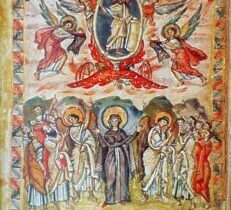
This is what we celebrate with the Feast of the Ascension. Jesus has come, shared the Good News with his friends, died, and risen. He has met with them again and explained more of what has happened. They are beginning to get a sense of the wonder and reality of it. But they are still afraid to say much about it. Who would ever believe it? They know what happens to prophets.

Forty days after the resurrection, Jesus met his friends again on a mountain top – the traditional place of encounter with God. He told them to remain in Jerusalem and wait for the promise of the Spirit who would come from the Father. They would be baptized with the Holy Spirit. (To be baptized means to be plunged into something and emerge transformed.) Through this baptism, they would receive power to become witnesses, first in Jerusalem, then branching out to Judea and Samaria and ultimately “to the ends of the earth.” (Acts 1:1-11)

A transition. No longer silent, fearful witnesses. Now they are to become bold witnesses, filled with the Spirit of wisdom and revelation who know God personally. The eyes of their hearts will be enlightened and hope based on being part of those called to new life will fill their lives. They will share what they have seen. (Eph 1:17-23)

But on this day, Jesus had been taken from their sight. Two men dressed in white appeared and reassured them that he would return in the same way one day. That’s all they knew.

They returned to Jerusalem as instructed, to wait for his return. Down through the centuries even to our days, Jesus has not yet returned in glory on the clouds in judgement over all the earth. (God’s time is very different than human time.)  Nevertheless, in Jerusalem those many years ago, something very important was about to happen. The Holy Spirit was coming. It was time to wait and pray. Whenever the Spirit comes upon humans, amazing things happen. But the disciples didn’t know that yet.

This week we wait with them. We pray for the coming of the Spirit in our lives and times as well.

Sometimes folks have been told that the Spirit doesn’t come upon people today in the same way. “Don’t expect anything special to happen in your life with God today.” But that is not actually true. The Spirit is still active. The Spirit still guides the Church, the People of God. The Spirit still is teaching us better ways to love and serve each other as faithful children of God, sisters and brothers of the Lord. Keep your eyes, ears, and heart open. Transition times are here once more. Wondrous things are afoot!

Readings for The Ascension of the Lord – Cycle A

Image is from the Rabbula Gospels, a Syriac manuscript completed in 586 at Monastery of St. John of Zagba.

Read More

Posted by on May 14, 2023

Good News Travels Far

Good News Travels Far

We have become accustomed in our contemporary world to the fact that events great and small around the world are quickly reported in our news sources. A lot of what we hear is about unfortunate events, but we hear about some of the happy ones too. Coronations and elections are broadcast around the world for anyone to see. The aftermath of earthquakes, floods, wars, and shootings are also seen by millions. News travels far and fast.

In the months after Jesus’ resurrection and the coming of the Holy Spirit, events also moved quickly. Large numbers of people were baptized and entered the community of Followers of the Way. They weren’t yet called Christians. That came later. The community’s life was centered in Jerusalem and included people who were native to Palestine and those who came from Greece and other areas. All were living as one big community. They worshipped in the Temple, and broke bread in their homes.

As the community grew, a few people were selected as deacons to attend to the mundane details of managing such a large and diverse community. The most famous of them was probably Stephen, who was the first to die as a martyr. A fierce persecution of the community began shortly afterwards and many folks moved out of Jerusalem.

One of the deacons, Philip, went to Samaria. He told everyone he met about Jesus and the Resurrection. He performed miracles as he went through the countryside, healing many and teaching. Many people asked for baptism and joined the community of believers. When the apostles in Jerusalem heard of Philip’s work and of the conversion of the people in Samaria, Peter and John went to join him. They prayed over the new believers and asked that the Holy Spirit be poured out over them too. They laid hands on them as they prayed, and the Spirit came upon them. (Acts 8:5-8, 14-17)

In this description of the conversion of the Samaritans, we see the historic roots of the sacraments of Baptism and Confirmation. Baptism is typically the entry point into the life of the Christian community. But there was and is more to Christian initiation. The Holy Spirit comes in a special way to Christians, bringing gifts that strengthen their faith and help them bear fruit as followers and companions of Jesus. When the apostles and their successors, our bishops, lay hands on the baptized and anoint them with Chrism (the holy oil), the Spirit flows into their lives in a special and deeply powerful way. Philip, the deacon, baptized. Peter and John, the apostles, confirmed the newly baptized. All shared in the breaking of the bread, a prayer that has characterized the Christian community from the very beginning. Together these three practices, Baptism, Confirmation, and Eucharist, bring Christians into their new life and sustain their faith in their daily activities.

Jesus had promised his disciples that he would not leave them orphans when he returned to the Father. Rather, he would ask the Father to send another one, another Advocate, to remain with the community and its members forever. This Advocate would be the Spirit of truth, unrecognized by the world at large, but remaining always with believers; guiding and strengthening them in their journey of faith. (Jn 14:15-21)

It is the Spirit who continues to guide us today. The Spirit helps us live in hope, with gentleness and reverence, doing good things for others and caring for our world and those with whom we share it. The Spirit gives us strength to carry on when we face opposition or disbelief and helps us to bring about positive change in our world. In choosing the path of goodness, we live our witness to our life in Christ. (1 Pt 3:15-18) When that witness is challenged but remains faithful, powerful change is planted in soil that hungers for goodness. As time passes, the fruit of the Spirit, the holy breath of God, blossoms into the world.

Are we there yet? Has heaven come to Earth yet? No. Not yet. But is it coming? Yes. Slowly but surely, the Good News of our Lord travels into our worlds of home, work, and play.

We are still in Easter Season. Still learning with the disciples of the gifts that Jesus wants to share with us. In just a couple of weeks we will celebrate Pentecost and the coming of the Spirit. Until then, let us rejoice in the wonder of the Resurrection and the promise of Jesus not to abandon us or run off to some distant Heaven and forget us.

Jesus is alive and well and present among us. Look around and see him. See the good works that spring from his life in us. Watch as good news touches the lost and those who are forgotten in our world. Celebrate the small victories. Hope for the longer-term ones and do what you can to move forward toward them.

Good News travels far. It has come to us over many centuries and thousands of miles. May we continue to pass it forward through our lives and words.

Readings for the Sixth Sunday of Easter – Cycle A

Read More

Posted by on Dec 4, 2022

“A Shoot Shall Sprout from the Stump of Jesse”

“A Shoot Shall Sprout from the Stump of Jesse”

Redwood trees in California grow to tremendous heights and can live for thousands of years. Their bark is highly fire resistant. Even when fires come, the trees historically have lived on, scorched, but still standing. They have very tiny cones for such large trees. Folks who visit redwood forests sometimes assume that these giant trees must have very deep roots in order to continue to stand tall through the centuries, sometimes supporting other trees and plants that grow high in their crowns. They wonder how such small cones can lead to the sprouting of such massive trees.

In actual fact, redwood trees have shallow roots. Their roots intertwine with those of the surrounding trees and together, they hold each other up. Their cones and tiny seeds are not essential to the continuation of the forest either. Though some trees can grow from seed, most do not. More commonly, new shoots sprout up from trees that have reached the end of their days and fallen to the ground. These new baby trees grow to new heights of their own. The fallen trees are sometimes called nurse trees.

Redwoods came to mind when I read the words of Isaiah (11:1-10) about the coming of the one who will restore peace among all creatures and with the Lord who made them. “On that day, a shoot shall sprout from the stump of Jesse, and from his roots a bud shall blossom.”

Jesse was the father of David, the shepherd who was secretly anointed to become the second King of Israel. Many years had passed and the kings of Israel were not always faithful to the Lord in their role as leaders of the nation. It was as if the tree of Jesse had been cut down or had fallen and died. Nothing remained but the stump – descendants of Jesse and the promise that the messiah would come from his line.

Isaiah reminded the people that the promise still remains. A new leader will arise from Jesse’s line. This new person will not be a corrupt king. No, the spirit of the Lord will rest on this one, bringing gifts that will set him apart from others. Wisdom, understanding, counsel, strength, knowledge, awe in the face of the wonder of the Lord. This person will judge justly, care for the poor, strike down the ruthless, do away with the wicked, and bring peace to the world. Even the world of the animals will become a place of peace in this vision. When this time comes, the Gentiles will see the signal set up from the root of Jesse and seek out the dwelling of the Lord.

It’s a wonderful picture, one which is still in the process of development. Like the growth of a redwood tree sprouting from the root of a fallen mother tree, it takes time and patience. Fortunately for us, the Lord has all the time in the world!

St. Matthew describes the mission of Jesus’ cousin John. (Mt 3:1-12) John was born about six months before Jesus. As an adult, he spent time in the desert. When he emerged from that sojourn, he began to call the people to repent and turn back to God. “The kingdom of heaven is at hand.” He spoke of himself as a voice “crying out in the desert, Prepare the way of the Lord.” People came from far and wide to the Jordan River to hear his message. He baptized people there, symbolically washing away their sins by plunging them into the water of the river.

Religious leaders came out from Jerusalem to see what he was doing, and probably to tell him to stop. But he spoke out against their assumption that because Abraham was the father of the nation, God would not hold them to account for the wrongs they had done. “God can raise up children to Abraham from these stones.” What was really needed was repentance for wrong-doing and a choice to live justly.

John spoke of the coming of his cousin, the one who actually was the promised messiah. “The one who is coming after me is mightier than I … He will baptize with the Holy Spirit and fire.” A new day is coming. A new presence of the divine is coming into the world. Be ready. The shoot has sprouted and the Spirit of the Lord is upon him.

Many years later, St. Paul encouraged the Romans to endure in hope and in harmony as they live as a community of faith. There is to be no distinction between those who are Jewish and those who are Gentiles. Christ welcomes all. He came first to the Jews, in fulfillment of the prophecies and promises made over two thousand years of their history. But that doesn’t make the descendants of the first Israelites better than those who were not the children of Abraham, Isaac and his line. It simply means that the ultimate goal has now been reached. Gentiles are drawn to “glorify God for his mercy.” God’s actions among the Jewish people have borne the long-promised fruit. Humans are unified as one people again and all sing praise to God.

We are in the second week of Advent now. The coming of the Lord among us is both a remembered historical event that we will celebrate at Christmas and a daily event in our lives, as we meet him in the people with whom we interact each day. One day, we will also meet him when the angels lead us into the eternal kingdom.

How are we preparing? Are we taking time to notice the Lord’s presence? Are we rejoicing in the little things? Can we trust that everything that truly needs to be done in the next days and weeks will get done and what doesn’t get done is maybe not all that important?

Let’s promise each other that we will try to stop for a few minutes each day to reflect on the ways in which goodness sprouts from roots hidden deep in the ground, high in the trees, or within each person. May we be blessed with a recognition of the presence of the Lord in each day of our lives.

Readings for the Second Sunday of Advent – Cycle A

Here’s a good article on Redwood trees.

Read More

Posted by on Sep 4, 2022

As Easy as Falling Off a Log?

As Easy as Falling Off a Log?

When we were children, my siblings and I used to enjoy walking along the top edge of logs in the forests and parks we visited. Some logs were small and near the ground. Others were very thick and we might find our heads were as high as our parents’ heads as we walked along, holding tightly to their hands. There was always the very real fact that we might at any moment miss a step and fall off the log. Mom or Dad would help us when we tottered and nearly fell.

As we got older, we got more certain of our footing and walked by ourselves across the logs, arms outstretched to maintain balance. Sometimes we made it across safely. Other times we found ourselves jumping as we fell off. Once in a while, an ankle got twisted or we landed ungracefully on the ground. Most of the time, we simply got up and tried it again.

Even as an adult, it’s fun to walk on a log sometimes. I’ve now been in the position of holding the hands of younger siblings, cousins, my own children, and even my grandchildren as they learned to walk on a log. There’s always the unspoken question, can you do it? Can I still do it? Will we fall off this time?

Falling off the log is much easier than balancing and walking along the top of the log. If the log is a bridge across running water or across a ravine, the stakes are even higher. Falling off can still be easier than getting across.

When the Lord asked Solomon what gift he would like as he began his reign as King of Israel, Solomon asked for the gift of wisdom. He explained, “Who can know God’s counsel, or who can conceive what the Lord intends?” (Wis 9:13-18b) It’s hard enough for humans to figure out their own plans. What to do when troubles come? What career to pursue? Where to find food and shelter? Whose respect is worth courting? Solomon rightly notes that the things of heaven are even more important than the concerns of daily life, but they can be even harder to figure out. What is it that God would want us to do in this particular situation? Is it always the same? What might be different this time around?

Yet Solomon trusts that the Lord will send his ”holy spirit from on high” to help those who ask for help in finding the straight path through life. With the help of the spirit of the Holy One, humans can walk across the log of life securely. Finding the ways of heaven is not as easy as falling off a log. But the spirit’s gift of wisdom helps us walk securely across the top of the log – finding the ways of heaven in our lives each day.

Even before Solomon became king, the Hebrew people recognized the hand of the Lord in their daily lives. The psalmist notes, “In every age, O Lord, you have been our refuge.” (Ps 90) Our lives are short, yet through them we grow in wisdom of heart. We wish for the kindness of the Lord and receive it, as the work of our hands is aided by the Lord. That steadying hand of the Lord helps keep us balanced atop the log we walk!

As Jesus walked along on his way to Jerusalem, great crowds followed him. He was a celebrity and folks wanted to be associated with him. Would there be a miracle worked? Would he notice me and perhaps praise me? Isn’t this exciting?

St. Luke tells us that Jesus wanted folks to understand clearly that simply walking along with him in the midst of a great crowd of excited people was not what it meant to be one of his followers. (Lk 14:25-33) So Jesus turned to the crowd and spoke to them. The words he used sound quite harsh to us today. “If anyone comes to me without hating his father and mother, wife and children, brothers and sisters, and even his own life, he cannot be my disciple.”

Hating? Just a minute now, you say. Isn’t this supposed to be about loving each other?

When we today speak of hating someone or something, it’s a very negative notion of extreme revulsion, distaste, antipathy, or hostility that may stem from anger or fear, or a sense of having been injured by another person. But in the context of Jesus’ time, it meant something different. Hate is part of a pair of words that describes behavior. It is the opposite of love, which also refers to a specific type of behavior. It’s not a question of emotions. To “hate” a ruler, for example, means to rebel against that ruler. To “love” the ruler means to obey that person. Jesus wanted those following him to know that there would be times in their lives as his disciples in which the choices they would be called to make, the actions they would need to take, would be contrary to those expected of them by their families and friends.

In Jesus’ culture and time, one’s only security came from being part of a large extended family. No one could get along without the support and help of the family. Yet the call to follow as a disciple of Jesus was and is something that is individual. Typically, families did not all pack up everything and follow him. Families were not the individual, nuclear family of a married couple and their children that we experience in the Western world. Families included parents, grandparents, aunts, uncles, cousins, siblings, in-laws, nieces and nephews, and the servants of the family. The preferences of the individual did not matter. The well-being of the family was what mattered. If one person wished to follow Jesus, there could be no certainty that all in the family would do so. Much more commonly, those who followed Jesus’ teaching would be acting on their own, against the wishes of the family. In doing this, they would be perceived as “hating” the family members who did not agree with their decision to live differently. They would be rebelling.

Jesus described the reality of social isolation from the family as carrying one’s own cross. It is very difficult to go against one’s family, friends, and community. It is painful to follow a different path and to experience the hard words and rejection that can entail.

He warned those who were traveling with him in the crowd to weigh carefully what they were doing, just as a builder of a tower or a king going out against an enemy with superior forces must do. Everything is on the line. Can you leave behind the security of family, friends, and property to follow? That’s what is demanded of Jesus’ disciple.

Not at all as easy as falling off a log. It’s much harder to stay on the log …

St. Paul gives us an excellent example of the kind of situation a follower of Jesus might encounter that would be totally contrary to normal social expectations. (Phil 9-10, 12-17) An escaped slave named Onesimus has become a friend and convert to Christianity in Rome when Paul is imprisoned there, awaiting trial before Caesar. Slavery is an accepted reality in society at the time. Complicating matters, Onesimus stole from his former master, so not only is he guilty of running away, he’s also guilty of theft. Both carry heavy penalties.

As if that were not enough, the man from whose household Onesimus has escaped is a friend of Paul who lives in Colossae and is one of the leaders of the Christian community there. Philemon is one of Paul’s converts too.

In a very short private letter to Philemon, Paul asks him as a friend to accept Onesimus as a returning brother in Christ, welcoming and treating him as if he were Paul himself coming to visit. Paul notes that he would like to have Onesimus remain with him, but that would not be right, since legally he belongs to Philemon and the latter has not given permission to his slave to serve Paul instead. Paul suggests that perhaps the underlying reason for Onesimus’ having escaped from slavery to Philemon was so that he could learn of the Lord and become a follower and partner in spreading the Good News. He asks Philemon to welcome his slave as a man who is a brother in the Lord.

In our time, with our understanding of the evils of slavery, it’s easy to say that of course, Philemon should receive Onesimus and give him freedom. In fact, we’d say all the slaves should be freed. But that wasn’t the way things were at the time. Paul’s letter is suggesting a very new approach to human relations, in a specific and very limited situation. The community had not yet realized that Jesus’ second coming would not be in their lifetimes. And there weren’t enough of them to have any significant influence on the laws of the Roman Empire! But they could decide to go against the prevailing custom and forgive a thief and runaway slave.

For Philemon, accepting Onesimus would not have been as easy as falling off a log. It would have taken a major decision to grant the request of his friend and mentor, Paul. The fact that this short letter, of only 25 verses, has come down to us today indicates that it was a beginning of something remarkable within the Christian movement. Slaves could be equals of their masters when they were part of this new family, the Body of Christ, the Church.

Two thousand years later, we too sometimes find ourselves having to make tough decisions. We are still called as individuals to make life-changing choices. The people we serve, the occupations we enter, the friends with whom we interact, the communities with whom we pray – all reflect the relationship we have with our Lord. When our beliefs and experiences differ from those of our family and friends, it can be hard to remain on good terms with them. Families can be split apart so easily. It takes a conscious decision and lots of patience to get past differences of opinion and keep the love alive.

We each have our own calling and our own part in the Lord’s mission here on earth. How can we help each other to stay up on the log? It’s so easy to fall off.

Jesus knows that it’s much easier to fall off the log than to follow him. That’s why we have each other as a family larger than our own biological family and even our own community. He has given us himself and all the members of his family of followers. We help each other along the way.

So then, here we go. Off to the park. Who’ll get across the log this time without falling off? I’ll help you and I hope you’ll help me too.

Readings for the Twenty-third Sunday in Ordinary Time, Cycle C

Read More