Pages Menu
RssFacebook
Categories Menu

Posted by on Oct 15, 2023

On this Mountain

On this Mountain

On this mountain, the mountain of the Lord, all will share in rich food and choice drinks, death will be destroyed, tears will be wiped away from every face, and the reproach of his people will be removed from the whole earth. All will rejoice in the salvation that comes from the Lord, on this mountain.

What beautiful hopes and dreams are expressed in this reading from the prophet Isaiah. (Is 25:6-10a) It was a time of impending conflict in Israel. Defeat and exile awaited the people. Destruction of the temple on the mountain in Jerusalem was coming. All seemed hopeless. Yet, Isaiah promised that all would end well, because “the hand of the Lord will rest on this mountain.”

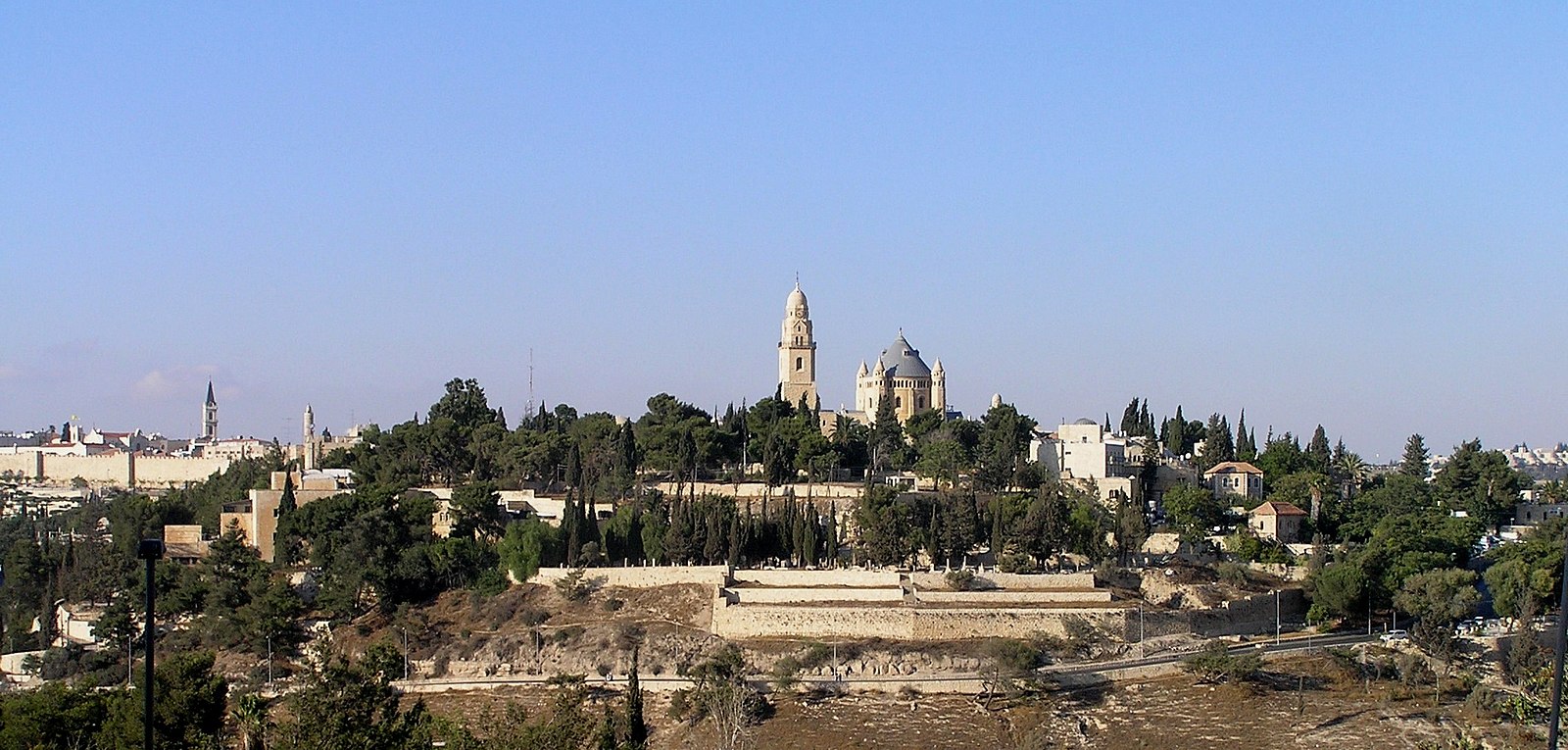
The Mountain of the Lord, the Temple Mount, in the city known as Jerusalem, is described in this passage from Isaiah. It is named often in the scriptures of Jews, Christians, and Muslims and is revered as a holy place of encounter with the Most High. When the nation of Israel was again established following the Second World War, Jerusalem was to belong to no nation. It was to be a place open to the faithful of all faiths. The name of the city itself identifies it as a place of completeness and holiness, because the Lord dwells there.

An ancient land

Today we witness once again war in the land of Israel/Palestine. The same geographic area has been known by many names throughout history. The father of both Jews and Arabs came to this land from Ur of the Chaldees over 4,000 years ago. The land belonged to others when he arrived. He and his family were foreigners, shepherds, whose God had promised them he would be with them. Against all odds, it turned out to be the case that this God was not one local to Mesopotamia. This God was present everywhere they traveled, including for a time into Egypt.

Abraham settled in the land. He and his wife did not have children and it seemed they never would. But they welcomed visitors one day and the visitors promised that they would have a child. Abraham had despaired of receiving an heir through his wife, so he had a child with her servant. This child, who was named Ishmael, Abraham believed would be his heir. However, the visitors’ promise was kept and a year later, Sarah bore a son for her husband Abraham. This was the child of the promise and he was named Isaac. Ishmael and his mother were sent away.

Thus were sown the seeds of the conflict we see continuing today.

When the descendants of Abraham moved to Egypt during a time of famine, others remained in the land they left behind. Many generations later, these descendants had grown to be a large nation. They left slavery in Egypt, with the help of their God, traveled through the Sinai Peninsula for 40 years and eventually re-entered the land of Abraham and their ancestors. Once again, the land was filled with people. It was not open for a large new group of people to move in without conflict. The newly arrived battled the existing residents and took for themselves most of the land, including the mountain on which the temple was built in Jerusalem.

As we have been hearing in the readings from Isaiah and Ezekiel, conflict continued with surrounding countries, Babylon (Iraq), Persia (Iran), Greece, and others. Sometimes the children of Israel (another name for Jacob, one of the sons of Isaac) won these conflicts. Sometimes they were defeated and the people taken into exile. Always they returned, until the Romans destroyed the temple in the year 70 CE. At that time, most of the people were killed or driven into exile.

Again, non-Jewish people, including the descendants of Ishmael, many of whom had never completely left, moved back into the area and prospered.

It was an on-going cycle of hope and disappointment, building and destruction. This cycle was not unique to this land. It was a cycle we have seen throughout history and in many areas around the world. Peoples come into a new area. Those who were living there previously are defeated. New nations rise, others come later and again war ensues. People are killed. Revenge is taken. Wars continue and hatreds grow ever more deeply rooted.

Is there any cause for hope? Will the cycle never end?

Another perspective

Jesus told a story that sheds a bit of light on this issue. (Mt 22:1-14) It seems there was a king whose son was getting married. The marriage of a royal prince is always a big deal. Invitations to the ceremony and the festivities are generally highly desired. But in this case, when the wedding feast began, none of the guests arrived. The food was ready. The tables were set. Everyone was all dressed up. And no one came.

Well, this would never do. The King sent out his servants to remind those who had been invited. But the guests refused to come to the party. There must have been some mistake, perhaps they didn’t get the date right? So he sent out the servants again with an urgent message. “I have prepared my banquet, my calves and fattened cattle are killed, and everything is ready; come to the feast.” The food is going to spoil. We can’t just put it into the freezer for another day! This is the day…

But the guests still didn’t come. Instead, they mistreated and killed the king’s servants.

The king was furious. He sent out his soldiers and killed those who had refused his invitation and killed his servants. He burned their city to the ground.

Still, the food was waiting and there were no guests.

This did not stop the king. He had the servants go out to the main roads and invite anyone they met there to come to the feast. Fine clothes were provided for everyone. It would still be a party worthy of the son of a king.

When the king arrived at the party, one guest stood out. This person had refused the offer of new clothes to wear for the party. He was still in his everyday traveling or work clothes.

This puzzled the king. Why haven’t you put on the wedding clothes that were provided for you? The man had nothing to say for himself. So the king ordered that he be tied up and thrown out of the banquet hall. Jesus finished his story with the words, “Many are invited, but few are chosen.”

Wedding Garments and War?

What does this have to do with the current war between Israel and Hamas?

It seems to me that the critical piece that is missing is something like that wedding garment. What does the wedding garment in the story represent? What does refusing to wear one that has been provided for the guest mean?

We are continually offered gifts by the Holy Spirit, including wisdom, understanding, and courage. These gifts allow us to bear fruit. The fruit we are to bear might be likened to the wedding garments of Jesus’ story. These garments are made of characteristics such as patience, kindness, goodness, joy, gentleness, faithfulness, peace, self-control, and love.

When we are invited to the wedding feast for the King’s son, we wear those characteristics as part of our identity and history. If we appear before the King refusing to wear these lovely garments, we won’t fit in. We will have chosen exclusion.

A change of heart is essential for inclusion at the king’s banquet. Similarly it is essential to the creation of peace in the Middle East and around the world. As long as the children of Israel and the children of Ishmael see each other as enemies who are taking each other’s land, there can never be peace. As long as revenge for injuries and massive destruction of life is the response in difficult relationships, the pogroms, massacres, and the Holocaust that were inflicted on the children of Isaac for so many centuries, and the never-ending cycles of violence over which of his descendants will own and control the land originally settled by Abraham will beset the world.

When the agendas of surrounding countries and peoples also enter into the equation, things get even more complicated. Just as in the past, other nations also played a role in whether there was peace or war in the area, larger forces complicate the realities of today and don’t help bring a peaceful resolution to modern conflicts.

Hopeful prayer

Is there hope? I believe there is always hope. I don’t know what it will take, but somehow, when the original guests don’t come to the wedding feast, there will be a way for the feast to happen anyway. Some will put on the wedding garments and lead the way. The prophet tells us that on the mountain of the Lord there will be peace and abundance. People from all nations will come together to share in the blessings and joy of God’s saving work, the defeat of evil and death. People will learn to forgive. Not necessarily to forget. But to forgive and decide to work together for the common good – that would be a critical place to start. And to trust that together they could all live and prosper. Not an easy step by any stretch of the imagination after so much hurt and anger. But essential.

In the meanwhile, we join together in prayer for peace and reconciliation. Violence does not result in peace. It only leads to more violence.

May the God of Abraham, Isaac, Jacob, and Ishmael be with their descendants around the world and especially in Israel and Gaza today. May peace and justice begin to sprout and bear fruit in the land that is their common inheritance.

Readings for the Twenty-eighth Sunday in Ordinary Time – Cycle A

Special thanks to Deacon Patrick Conway of Resurrection Catholic Community in Aptos for his insight into the meaning of the wedding garment in today’s parable.

Read More

Posted by on Oct 8, 2023

Not All Grapes are Grapes

Not All Grapes are Grapes

In one corner of our back yard when I was growing up there was a plant whose leaves were sharp like those of holly. The bush had small flowers in the spring and blue berries in summer and fall. We were used to picking and eating huckleberries in the fall. They looked a lot like the fruit on this plant, though the leaves were different. But this plant was called Oregon Grape, and we never ate the “grapes” that grew on it. We might have tried the berries, but my mother cautioned us that they really didn’t taste good, despite being called grapes and looking like grapes. The bushes just grew in the corner of the garden as a part of the unchanging shrubbery. Not grapes at all, it seems.

The grapes we hear Isaiah describe in his story of the vineyard remind me of the Oregon Grapes in our back yard. However, in Isaiah’s story, the owner of the vineyard was expecting real grapes, ones that could be eaten or made into wine. (Is 5:-7) He cleared the land, planted high quality vines, took good care of the plants. He even prepared a wine press – all with the expectation that a good harvest would follow in the fall.

Imagine the disappointment of the owner of the vineyard when the fruit appeared on the vines. Instead of plump, sweet grapes, he found small wild grapes that could never be made into wine or other good foods for the family or community. It was like finding Oregon Grapes growing on his vines. This fruit was unusable. The vineyard was a total failure. A waste of time and money. What a terrible disappointment.

The owner of the vineyard responded by breaking down the protective walls of the vineyard and letting it be returned to an untended state. The vines were useless, except as food for wild animals.

Isaiah here reminds the people of his time that the Lord’s vineyard is the people of Judah, the house of Israel. If this vineyard of the Lord is not producing good fruit, it will suffer the same fate as the vineyard which produced wild grapes rather than the rich, plump, domestic grapes that the owner had expected. The Lord will stop protecting the nation from their foes. Their land will be destroyed and they will be scattered.

The image of the Lord’s people as a vineyard is ancient. We see it in the psalms, including Psalm 80. “A vine from Egypt you transplanted; you drove away the nations and planted it. It put forth its foliage to the Sea, its shoots as far as the River.” In other words, the people have increased in numbers and filled the new land into which they moved after their time in Egypt and wandering in the desert. Yet they have not always remained faithful and at times it’s as if the walls of the vineyard have been broken down and passersby have taken its fruits. Wild animals have eaten the plants. Nevertheless, the psalmist calls on the Lord to rescue and protect the vineyard and the vines planted there once again. When the vineyard has been restored, the people will remain faithful, the Lord’s face will shine on them, and all will be saved.

Jesus also described a vineyard. (Mt 21:33-43) In this case, the landowner leased out the vineyard he had planted to tenants. The tenants would receive a part of the harvest as payment for their labor. The rest would go to the landowner, as a return on the investment in the land and the vineyard.

When the time came for the harvest, the landowner was away. He sent his servants to collect his share of the harvest. The tenants beat and killed the servants rather than give them the grapes for which they had come. The landowner sent more servants, but the tenants killed them too. Finally, the landowner’s own son was sent to collect the harvest from the tenants. The greedy tenants killed the landlord’s son rather than send the harvest to him.

Jesus asked those with whom he was speaking what the landlord would do in such a situation. (Always good to include your listeners in figuring out what comes next in a story or lesson.) They answered quickly that the tenants would be killed and new ones entrusted with the vineyard.

Then Jesus reminded them that just as the stone the builders had rejected became the cornerstone of the Lord’s building, the kingdom of God would be passed to other people if the people to whom it had originally been entrusted did not care for it and produce good fruit.

So what kind of grapes (or behavior) is the Lord hoping will be harvested? What are the good grapes?

St. Paul tells us that whatever we need, we can ask of God. (Phil 4:6-9) The peace of God will fill our hearts and minds, guarding and guiding them. The grapes we will see in such situations are truth, honorable behavior, justice, purity, beauty, graciousness, excellence, and actions worthy of praise. These are the kinds of grapes our landlord, the owner of the vineyard of the Lord, is hoping to receive. As long as our lives are producing these good fruits, these true “grapes,” the God of peace will be with us.

It’s still harvest time in the Northern Hemisphere. In the Southern, spring is bringing the hope and promise of a rich harvest. But for us, the harvest is on. The race to finish all that needs to be done before winter storms begin is in full swing. Grapes are being harvested. Will we and our lives be seen as sweet, rich grapes, filled with love and kindness? The Oregon Grapes are ripe too, but once again this year, they will remain on the shrub in the back yard for the birds and other animals to eat. Not all grapes are grapes!

May we bear rich fruit this week, reflecting the loving work of our Father, the vineyard owner.

Readings for the Twenty-Seventh Sunday in Ordinary Time – Cycle A

Read More
Posted by on Oct 1, 2023

Not too late to change

Not too late to change

I attended a play recently in which the world and all within it was beautiful and peaceful until spirits of anger, fear, doubt, distrust, and other negative emotions began to surround and disable the healthy functioning of the people. Eventually a wise old man went into the forest alone to seek wisdom and a solution for this terrible problem. He was advised to seek the solution through the air, the water, the earth, and fire. The wise ones of the mountain told him the people would need to pass through trials involving these forces and elements in order for life to return to the peaceful state that had existed before the coming of those evil forces. The people passed through these challenges and emerged into a community, singing of the wonders of life.

This play took the place of the more traditional ones for the festival in which it was performed. In those traditional plays, there is a dragon (from one or another of the world’s traditions) that somehow is threatening the people. With the help and guidance of angelic or spiritual forces, specifically Michael the archangel in some stories, brave people are able to tame the dragon. The dragon then provides power and help to the community to support life for all.

I have been reflecting on the difference in these stories. The first left me and many others with a sense of incompleteness. The forces that had upset the lives of the people had not really been addressed. They had not been transformed in any meaningful way. There was no reason to assume they would not return at a future date to cause even more harm. Anger was not transformed into forgiveness. Fear did not give way to courage. Doubt did not grow into a readiness to explore deeply and find inner, hidden truths. Distrust didn’t grow into a willingness to take a chance on reconciliation and healing. There was no redemption or transformation of the deep, and often fearful powers that can cause such pain and suffering in human life and damage to our ecosystem. The dragon-powers within each of us that can cause such hurt and suffering in human life did not receive the gift of transforming grace. In the traditional stories, the dragon-forces are brought under control and improve life for all. A much more satisfying result.

These thoughts fit into my reflection on the readings this week. The prophet Ezekiel spoke to the Jewish people in exile in Babylon. Prior to his time, the assumption had been that God’s judgement and any punishments for wrongdoing were communal. If others in a family or a community had broken the law, everyone would have to suffer the punishment. God was seen as a judge whose decisions affected all, whether guilty or not. So the sins of the parents were punished in the lives of their children too. If a child was born blind, for example, the question might be asked, as it was yet in Jesus’ time, “Whose sin was it that caused this”– the child’s or the parents’?

Through Ezekiel the Lord asks, “Is it my way that is unfair, or rather, are not your ways unfair?” The Lord reminds them that if a good person turns from doing good things and chooses evil, that person will bear the guilt. But if a person who has been doing evil things turns away from evil and begins to do the right thing, that person will live rather than die. It’s never too late to turn away from evil. It’s a question of individual decisions and actions. God will always give life to the one who chooses to do the right thing. (Ez 18:25-28)

And what is the right thing? St. Paul reminds the Philippians that humble, loving service to each other in the community and beyond is the calling of Christians. We are to be humble as Christ was humble. To make his point even more clear, he quoted an early hymn in which we are reminded that “though he was in the form of God … he emptied himself … coming in human likeness…” Jesus even accepted death on a cross – a shameful, humiliating death. (Phil 2:1-11)

In his teaching, Jesus made the same point about our choices as individuals, by telling a story. “A man had two sons…” He asked each of them to do some work in the family vineyard. One son refused, but later changed his mind and went to work in the vineyard. The other son said, “Sure, Dad.” But he never quite got around to going into the vineyard and doing what his father had asked him to do. Jesus posed the question to the religious leaders who were questioning him, “Which of the two did his father’s will?” Of course, the answer was clear. The one who initially refused, but then changed his mind and did what had been requested.

Jesus made it clear that the ones whose actions, professions, or status in society made them the least likely to be counted among those pleasing to God, would be welcomed into the kingdom because they heard and believed his message. Those whose positions seemed to make them more likely to be pleasing would find themselves excluded because of their failure to believe it and change their lives. (Mt 21:28-32)

We each must decide, again and again it seems. How do we live out our calling to service? Where are our talents needed? Where is a kind word, or a smile, or a simple act of forgiveness going to be the key that helps another person to hope and continue onward on their journey? How do we help to bring reconciliation and transformation of the dragons within ourselves and in our society to build a better world?

As we enter into a new month and a new season, may we be ready to listen and to allow ourselves to be transformed into sources of healing and reconciliation in our families, our workplaces, our communities, our nation, and our world. It’s a beautiful world, just waiting for us to wake up and grow together in love.

Readings for the Twenty-sixth Sunday in Ordinary Time – Cycle A


Read More

Posted by on Sep 24, 2023

My Thoughts are not Your Thoughts

My Thoughts are not Your Thoughts

“My thoughts are not your thoughts, nor are your ways my ways, says the Lord.” (Is 55:8)

Each of us enters life like a bit of a blank slate. It’s not a totally blank slate, however. There are pre-existing conditions for each of us, such as our basic physical characteristics and the physical realities resulting from the genetics of the bodies with which we have been blessed. Nevertheless, for the most part, we are set to learn and develop into adults through the example and support of the family and community into which we are born.

Once we get here, we begin to experience the expectations and knowledge of our families and communities. How are babies expected to behave? How do we expect them to eat and sleep and learn to sit up, crawl, walk, and eventually run? How do we teach them to carry out their expected roles? Will the boys learn to be fathers? Will the girls learn to be mothers? What else will they learn to be? Are roles strictly divided by physical sex? Where does gender fit into it all?

Once we get all of that figured out, then we deal with our cultures. The culture into which we are born plays a huge part in the experience we have of life. What is the creation story of our people? What do we need to do to fit into the larger society in which we live? Are the deities of our people ones who care about us, or do we need to try to please their every selfish whim as they battle for power among themselves?

The people of Israel were used to worshiping and encountering God at the temple in Jerusalem before the invasion of the Babylonians and destruction of the temple. Large numbers of the people were carried into exile – and to their surprise, God was present with them there too. As the end of the exile appeared and they returned to their own land, they took this awareness with them. Yet there was still a sense that it would be important and even necessary to return to temple sacrifice as a major form of prayer and encounter with God.

The Prophet Isaiah reminds them, “Seek the Lord while he may be found, call him while he is near.” He is not far away. He is near. He is ready to listen. He doesn’t follow our ways of thinking or interacting with each other. It’s never too late to turn back to the Lord. Scoundrels should forsake their ways. The wicked turn from evil thoughts and plans. Turn to God for mercy. Why? Won’t God just punish and destroy the evildoers? That’s what would happen in human justice. Isaiah describes God as the one “who is generous and forgiving.” Our God is not one who will take out his spite or anger on his people and break off relationships forever. Our God sticks around and hopes for reconciliation, always ready to respond in love and forgiveness. (Is 55:6-9)

Jesus told a story to his disciples: “The kingdom of heaven is like a landowner…” (Mt 20:1-16a) Landowners held a great advantage in their society. They had a resource on which they could count for supporting themselves and their families. They were not dependent on the whims of an employer or the fluctuations of the “job market” – harvest time, planting time, time between seasonal jobs, and so forth.

This landowner needed harvesters. The vines were full of ripe grapes. The harvest was ready. The year’s income was at stake. Time to hire day laborers.

Everyone knew what the regular wages would be for a day of work. It may not have been expressed as an hourly wage, but folks knew what their labor was worth. There was no question of surprises at the end of the day.

A few hours later, the landowner went out and saw more people in need of work, so he sent them into his vineyard too, with the promise to pay them “what is just.” They did not expect full wages. That would not have entered their minds. They expected a reduced wage and would have been completely happy to receive that. Much better than having nothing to take to the market for buying food on the way home.

Around noon, the same thing happened again. The next group went willingly into the vineyard, expecting about a half day’s pay.

Three o’clock, same story. Five o’clock, more idle workers in the market. Off to the vineyard with them too. Same promise – “I will give you what is just.”

Finally, the sun was setting and it was time to stop work for the day. Some of the laborers had worked from dawn to dusk. Others for three, six, nine, or eleven hours less. It was time to receive their pay and head home.

The landlord instructed his foreman, “Summon the laborers and give them their pay, beginning with the last and ending with the first.” Now, one would think this would be very satisfying to the ones who had been working all day. They would see the “slackers” hired at the end of the day get just a few coins in payment. The next group a few more, and so forth. Eventually, they themselves, who had been up and ready to work first thing in the morning, would get their full day’s pay and go home with their heads held high and bragging rights about what great providers they were.

That’s the way the story should end. It would demonstrate the value of hard work and responsibility. The whole pull-yourself-up-by-your-sandal-straps ideal. Those who work hard will prosper and the rest will just fall by the wayside. It’s their own darn fault for being lazy…

But no, that’s not the way the story goes. Those hired last received a full day’s pay, not a penny more. The same for those hired at 3, those hired at noon, and those hired at 9 in the morning. All received a full day’s pay. Well, that boded well for those who had spent all day working, right? Surely, such a generous landowner would have a bonus for the hardest-working among them. Yet no such thing happened. Those hired first received the same day’s wages as those hired at 5 in the evening.

Does that sound fair? Not to most of us.  Certainly not to those hired first.  But suppose you were one of those hired late in the day? It would be an amazing blessing, to be forgiven for not having worked all day, for having come late to the market, or simply not have been lucky enough to be offered work earlier.

The landowner in the story asks, “What if I wish to give this last one the same as you? Or am I not free to do as I wish with my own money?”

Most of us live in relative comfort. We have our concerns and struggles. But most of us don’t have to deal with loss of home due to loss of income, or the inability to feed our children, or criminals taking over our farms, or severe, disabling health conditions, or a need to care for others who cannot care for themselves. Most of us have friends on whom we can count and a future to enjoy.

It’s not easy to remember that the Lord’s ways are not our ways. When someone hurts us, we want justice in return. We don’t want to share what we have, especially with the one whom we believe hurt us. We are not ready to forgive quickly. We hold on to the hurt and resentment and anger. It builds and sours in our hearts and interferes with our openness to love and forgiveness. If and when the time comes that we speak about the incident with the person who harmed us, we may discover that they also felt wronged and misunderstood.

But the Lord doesn’t work in this punitive, restrictive way with us. The Lord doesn’t get angry and cut us off. The Lord is as ready to forgive as a parent whose small child has lashed out in anger and screamed at them while running out of the room. As would a loving parent, the Lord gives us a moment to calm down, then begins a game of peek-a-boo, hoping to coax us back into a laughing, loving interaction.

“My thoughts are not your thoughts, nor are your ways my ways, says the Lord … As high as the heavens are above the earth, so high are my ways above your ways and my thoughts above your thoughts.” (Is 55:8)

May we be open to see the Lord’s hand in our lives this week, and glimpse him peeking around a doorway playing peek-a-boo with each of us, coaxing us back home.

Readings for the Twenty-fifth Sunday in Ordinary Time – Cycle A


Read More
Posted by on Sep 17, 2023

Set Enmity Aside – An Ancient Wisdom

Set Enmity Aside – An Ancient Wisdom

In the olden days when I was a girl, I knew a woman who told me of a time when some of her classmates were teasing her. She had an older brother and he gave her a piece of advice that she carried with her into her old age: “Don’t get mad, get even!” Unfortunately, she took the advice to heart and it caused difficulties in interpersonal relationships for as long as she lived.

We often hear a version of this advice even today. We are encouraged to take revenge, sometimes phrased in the guise of obtaining justice or “evening out” the balance. Perhaps the most chilling version of it is the statement, “Revenge is a dish best served cold.” The very words send a chill. Where does it end? As Mahatma Gandhi remarked, “An eye for an eye will only make the whole world blind.”

An ancient Hebrew scribe, Ben Sira, collected a variety of ethical instructions, organized by theme, into a book which survives to this day. “Wrath and anger are hateful things, yet the sinner hugs them tight.” “Could anyone nourish anger against another and expect healing from the Lord?” He advises us all to remember that in the end, all will die. Better than seeking vengeance, “set enmity aside … cease from sin.” Sounding much like Jesus, he advises all, “Think of the commandments, hate not your neighbor; remember the Most High’s covenant, and overlook faults.” (Sir 27:30-28:7)

Great advice, but it’s not easy to live this way. Our feelings are hurt, we are embarrassed, we get angry. Yes, we get angry. Anger is an emotion that we all feel from time to time. But what do we do with the angry energy? If we harbor and feed it, it grows stronger. It takes energy we could be using to move on or to build something worthwhile in its place. The anger we are building can even take on a life of its own, prodding us forward with ever greater plans for getting even, that only result in more angry energy flooding back over us.

Ben Sira’s advice is solid. Set enmity aside, let it go! What happened was not right? OK. Recognize that. State that. Then let it go. Don’t let it begin to control or define you.

I totally admit, as a person with a temper that can flare, that letting go of anger is not easy. However, when I find myself beginning to go over in my mind the offenses that have happened to provoke the anger, and feel the anger building, I have learned most times to tell it, “Go away! I don’t need you right now! You are not helping!” And much to my surprise, it typically goes away. Sometimes I have to insist and say it more than once, but it will go away and I will have the energy to do the next thing that I need to do.

Jesus made the same point about forgiveness of injuries to Peter. The number seven is symbolic in Scripture. It’s the number that represents perfection. All was created in six days and on the seventh day, the day of perfection, God rested. When Peter asked Jesus if it was necessary to forgive an offender seven times, he was essentially asking about how far it is necessary to go. Is there any limit to the requirement to forgive? Surely, there must be a time when we can just turn away from an offender, cut the person out of our lives, and move on? But Jesus doesn’t allow that. Not just seven times. Seventy times! There’s no end to the requirement to forgive. (Mt 18:21-35)

This plays out in daily life in practical ways, as the parable of the servant who owed a master a great deal of money demonstrates. The master forgave the debt, until the servant refused to forgive a smaller debt owed by another servant. When the master discovered that unwillingness to forgive, then the first servant lost the debt forgiveness he had already received.

The lesson Jesus and Ben Sira want us all to remember is that if we don’t offer forgiveness to others, we cannot receive it ourselves. It’s just plain impossible. Our hearts are sealed off in a cold room, with not a sliver of light able to enter and bring warmth and healing. We can’t receive forgiveness, so the Lord can’t give it to us. The Lord respects our free will and will not force us to open. That would be a violence against us and the Lord loves us too much to do that.

We can only heal when we are willing to let go of anger and accept healing.

We are the Lord’s. We live and die for the Lord. And as we set enmity aside, we share in the life of Christ. (Rom 14:7-9)

As we move through this week, seeing the high points and low points of our human interactions and our responses to the natural disasters that come along around the world, let’s try to remember to set anger and enmity aside in our own personal worlds. We can’t resolve the issues of the larger world by ourselves. However, we can become an island of peace and forgiveness in our own families and communities. We can help to heal old wounds as we offer forgiveness and acceptance. We can refrain from passing on the wounds that we have been dealt in the past. We can make a better world – one day and one person at a time.

“Set enmity aside.”

Readings for the Twenty-fourth Sunday in Ordinary Time


Read More

Posted by on Sep 10, 2023

Love is the Fulfillment of the Law

Love is the Fulfillment of the Law

Imagine with me a world in which there are no mutually agreed-upon rules for behavior between individuals. Each day, the members of such a society would awaken without any pre-set guidelines or pathways for how they will treat others they meet or how they will themselves be treated. Will I get a chance to eat a good meal today, without having to prove I am stronger or more deserving of food than someone else is?  Will my parents protect me and help me to learn what I need to know to support myself and a family when I am grown? Will my children help care for me when I am old and need help getting out of bed in the morning? If my friends and I want to play a game, will there be rules for all to follow as part of the game?

Life in this type of world would be very stressful. As social beings, we humans depend on each other for lots of things. We begin as infants, totally unable to care for ourselves, totally dependent on others. We learn what to expect by watching others and by the way we ourselves are treated. Yet a child as young as six months recognizes its own mother and may object strenuously to seeing mother hold another child, even if the “child” is a nearly life-size doll. “Mama should be holding me, not that other child!”

In order to live together in harmony, humans set up social agreements. In larger societies, some of those agreements become laws, rules that everyone agrees are for the best. We may have laws that are decreed from on high (as in the Hebrew Law given to Moses on Mt. Sinai). We may have laws laid down by a king or queen. We may have laws passed by our representatives in a body established to govern and protect our mutual interests.

Laws don’t always resolve all possible issues between and among people(s). Some laws are unfair to those who have less power than others. Some laws are disliked because they protect the rights of those who have less power! Regardless of how much we like or dislike a law, we need to have them in order for life to move along smoothly each day.

During the years of the Babylonian exile, Ezekiel heard the Lord’s order to speak out when he witnessed wrongdoing, the breaking of the rules for life set down centuries earlier. (Ez 33:7-9) Those who heard the warning and continued to break the law, would be punished by death. But those who stopped their evil ways would live. The twist on this whole prophecy was that if Ezekiel did not speak out and warn those doing evil, then he would also be punished for the evil they did because he would be partially responsible for it. It’s not a question of everyone being responsible only for their own actions. Those who hear the Lord’s voice and know what is right, must also look out for those who are not living justly. We have a responsibility to each other.

Jesus told his followers something similar. (Mt 18:15-20) If someone harms an individual, the injured one is to take it up with the one who has caused the harm. They are to come to terms and become reconciled with each other. If they can’t find a way to do that, then the injured party is to call others of the community as witnesses to the attempt to become reconciled. Eventually, if the entire community can’t find a way to lead the offender back into compliance with the rules of the community, that person can be excluded from the life of the community.

This reading has been interpreted very harshly historically and even sometimes today. People have been tossed out of their homes or communities or shunned because they are unable or unwilling to conform exactly to the teaching of the tradition. And yet, we know that rules and traditions change with time. What was seen as worthy of death in the past may now be seen as part of the normal range of human behavior. We have learned much about human development and psychology. We understand the role of trauma and neglect in the lives of people. We know that illness is not caused by evil spirits or winds but rather by bacteria, viruses, or imbalances in chemical systems in the body. Responsibility for physical conditions cannot always be laid at the foot of the person who experiences them.

And yet, Jesus tells the disciples, “If two or more of you agree on earth about anything for which they are to pray, it shall be granted by my heavenly Father.” Does this mean that everything a couple of us decide should be done will be done by the Father? That could be a problem, right? It’s far too easy to mess things up when we are angry or upset. Better to leave some things for God to decide.

The other very important lesson here is that Jesus is present in the community. We need to talk with each other and pray together. That’s part of the reason we are having the Synodal process right now in the Church. Pope Francis has asked all of us to share our insights into the challenges facing our community and what we need to do to address them. It has been fascinating to see that many of the same issues are being raised by people around the world. Soon the results of the listening will be presented to a group of leaders of the Church for their consideration and reflection. “Where two or more are gathered together in my name….”

The bottom line in all of this is summed up by St. Paul in his letter to the Romans. (Rm 13:8-10) So many laws, both human and religious, are based on rules about what must not be done by one person to another. Don’t do this. Don’t do that. But deep below the requirement not to injure others is a positive command, “You shall love your neighbor as yourself.” Those who truly love do not do evil to another person or community.  Because love is the underlying foundation, it also becomes the fulfillment of The Law, the way our Father hopes and wishes all to live.

As we move through this coming week, may we listen deeply for the voice of the Lord, particularly as related to a loving response to the challenges we face in dealing with each other and the problems we share as members of the human community in this world. May we keep our eyes and ears open to the many ways the Lord speaks to us, especially the most subtle ones. “Love does no evil to the neighbor … love is the fulfillment of the law.”

Readings for the Twenty-third Sunday in Ordinary Time – Cycle A

Read More
Posted by on Sep 3, 2023

You Duped Me, O Lord

You Duped Me, O Lord

“You duped me, O Lord, and I let myself be duped!” With these words, the prophet Jeremiah expresses a feeling and frustration felt by many at some point in their journey of faith. The word we translate as duped also conveys a sense of seduction, of being betrayed by the one who has coaxed us to love him. A call has been heard. A fire lit within the heart. Words spoken foretelling danger or destruction. And rejection by those who refuse to hear or believe the truth of the call and the warning that burst forth.

In the long-ago times when I was a high school student, there was a war going on in Vietnam. It was one of those proxy wars that pitted great powers against each other, but on the surface had nothing to do with their rivalry and was carried out in a small country far from both. Our country was divided between those who supported the war and those who opposed it. The flag and the Pledge of Allegiance had taken on a meaning far beyond that of commitment to the ideals of freedom and democracy. They had come to symbolize for many a complete acceptance of and commitment to the battle against Communism, regardless of the reasons a conflict had originally begun.

In the midst of this discord, my senior class was preparing for graduation. We were taking our last classes, preparing for further education, or for getting a job, or getting married, or for military service. The young men who were not going on to college were quite likely to find themselves drafted into the army and sent to the war. Those who refused to enter the military might find their options limited to leaving the country or going to jail if they couldn’t claim conscientious objector status or arrange alternative service options. It was not an easy, carefree time.

One of my homeroom classmates took a stand against the war. He refused to stand and recite the Pledge of Allegiance to the flag at the beginning of a Student Council meeting. This might not have been a big deal, except he was our representative to the Student Council. Our homeroom teacher explained to all of us what had happened. Our classmate was given a chance to explain why he had refused. Then we were to decide whether to keep him as our representative.

The vote was taken with heads down on the desk, so no one would know who had voted for him to remain and who had voted against him. Only the teacher and the classroom president, yours truly, were to see and count the votes. I don’t remember whether anyone actually voted against his remaining as our representative. I don’t think so. I just remember how proud I was of our class as we voted to support his right to express his beliefs. Not all agreed with him, but we were not willing to deny him that right.

I don’t know what ever happened to him after graduation. I know that the day we graduated, up on the stage, in front of the entire school community, including parents, grandparents, families, and friends, he did not stand up to pledge allegiance to the flag. He was a person of great integrity and I was proud to be his classmate.

The journey of faith is filled with surprise moments. When we first experience the unbounded love of our Father, we swim in the sea of love that envelopes and enfolds us. A love which we breathe in and out as freely as we breathe the air around us. We may notice that some people look askance at us as we speak of God’s love and the wonder of it. But that doesn’t deter us, at least not at first. It’s all so new and amazing and fantastically wonderful.

When the time comes that we find we must make choices that are not popular, we begin to experience the cost of faithfulness to the one who has claimed us and invited us to be his own. Sometimes we can’t have things both ways. We have to make a choice.

Jeremiah had to speak the words of warning to the leaders of his nation and his faith. They were angry with him and repeatedly threatened and punished him. Yet, in his own words, “it becomes like a fire burning in my heart, imprisoned in my bones; I grow weary holding it in, I cannot endure it.” And then he speaks the word of the Lord again. (Jer 20:7-9)

St. Paul advised the Christians of Rome to consider themselves to be “a living sacrifice, holy and pleasing to God.” (Rom 12:1-2) They were not to change themselves to match what was popular in the city at the time. They were to be focused on God’s will and seek to find “what is good and pleasing and perfect.” Life is never perfect. Growth in faith takes place over time.  The life of a Christian is to be one of patient, persistent seeking of the good and the will of God.

Jesus also recognized that teaching about God’s mercy and love for all, along with the coming of the kingdom, would not always be accepted or welcomed by the authorities. He explained to his disciples that he needed to go to Jerusalem, not stay out in the countryside preaching and healing folks there. He also warned them that in Jerusalem he would suffer, die, and be raised “on the third day.”

Peter, who just a bit earlier had proclaimed his belief that Jesus was the Christ, took Jesus aside to urge him not to go, not to let such a terrible fate befall him. But Jesus strongly rejected Peter’s advice. “You are thinking not as God does, but as human beings do.”

Jesus went on to explain that those who follow the way he would lead must not think first of their own safety. The most important thing is to accept suffering (the cross) and follow faithfully. “What profit would there be for one to gain the whole world and forfeit his life?” The life in question here is not physical life. It is the deeper life that continues, the life that matters when the Son of Man comes “with his angels in his Father’s glory” to repay all according to the way they lived. (Mt 16:21-17)

“You duped me, O Lord, and I let myself be duped!”

My friend stood up for his beliefs by remaining seated and risked losing his leadership position and the respect of his classmates. Other brave people have taken unpopular stands and paid a high price for it. Paul was beheaded. Peter was crucified. Martin Luther King, Jr. was assassinated. Dorothy Day went to jail. Archbishop Romero was shot as he celebrated Eucharist.

Most of us will never be asked to pay such a price for faithfulness to the Gospel. But each of us will experience times when it’s not comfortable to witness to the truth that we have experienced: the love and mercy of God for all and at all times. We pray that in those moments, we too will speak the word we hear burning in our hearts, boldly and with a courage that admits our fear but speaks and acts in faith.

May we always have the courage to let ourselves be duped and seduced by the love of our God.

Readings for the Twenty-Second Sunday in Ordinary Time – Cycle A

Read More

Posted by on Aug 27, 2023

What’s in a Name?

What’s in a Name?

In our contemporary Western culture, names are given to us at birth and we typically keep them in one form or another for the rest of our lives. One of the first questions we ask when a child is born is, “What is the baby’s name?” Then we wonder how the parents happened to select that particular name. Was it a name belonging to someone else in the family? Was it the name of a friend or respected author, teacher, sports figure? Where did the name come from and what would it tell us about the child?

As we grow up, people ask us our names and we give the name by which we want to be known or by which we are legally known, depending on the circumstance in which the question is asked.

Sometimes people change their names as they grow older. It may be that the name simply doesn’t work well in their profession. A lovely woman I knew was a teacher whose last name was the same as that of a type of fish. She changed the name by which she was called to Sister Grace (her middle name) rather than Sister Iona in the early 1970s when religious women returned to their birth names rather using than their religious names. Her given name would have been too distracting to the children she taught. Others change their names to match their gender identities. Some change their names because they simply never liked the original one. Some change because their cultures expect married women to take their husband’s last name.

This is not the pattern in all cultures. In many cultures, names are not assigned until a child reaches a certain age. Names can be changed as circumstances change. In some cultures, a person’s name is what the other person wants to call them. “What would you like to call me?” is an acceptable response to a question about one’s name. The new name describes a new relationship, a new reality. Our own practice of having special names/titles for parents or other relatives is similar in this regard.

Jesus had a human name, given to him at birth. His family and friends knew him by this name. He was the son of Joseph, a native of Nazareth. His followers also had names given them by their families.

Yet as Jesus moved through the time of his public life, questions arose about who he was. In Nazareth they asked, “How can he be anybody special? We know his parents. He grew up here among us.” In other cities, folks began to wonder if he might be one of the prophets, maybe a new one or maybe Elijah, the one who was to return before the Messiah, the Anointed One, would come to restore the kingdom of Israel.

One day, when traveling with his disciples in northern Israel, Jesus asked them what they were hearing among the people. “Who do the people say that the Son of Man is?” Son of Man was a term used in Hebrew scriptures to name the savior who was to come. The savior was to be one like a Son of Man. It wasn’t a name one typically used to describe oneself, so this was in itself important. The disciples mentioned John the Baptist (Jesus’ recently executed cousin), Elijah, Jeremiah, or one of the prophets as identities that people were speculating might apply to Jesus. There was a tradition that Elijah would return before the Messiah came.

Jesus then asked the disciples, “Who do you say that I am?” Talk about putting them on the spot!

Simon, always the impulsive one, responded, “You are the Christ, the Son of the living God.” This was quite a statement. The Christ, the Anointed One, is much more than an ordinary man. We may speak of Jesus as if Christ were his last name, but Christ is much more than that. The Christ is the Messiah, one sent by God to reconcile the human and the divine. It was not a title to be used lightly. People who claimed that title could be executed as heretics.

Jesus praised Simon for his insight. Then he conferred a new name on his friend, one that was not in common use at that time. “Blessed are you, Simon son of Jonah, for flesh and blood have not revealed this to you, but my heavenly Father. And so I say to you, you are Peter and upon this Rock I will build my church…” (Mt 16:13-20)

Peter  (Petros) is a masculine form of the Greek word for rock, petra. This type of rock was not a rock like a huge boulder. It was more like a small section of a massive ledge. This new name recognized his strength and leadership position among the disciples, as well perhaps as his tendency to go out on a ledge from time to time! It was not a man’s name in use at that time, but it became common in subsequent years because of the faithful life he lived.

Names have meaning. Peter, the rock, was not a perfect follower of Jesus. He made many mistakes. He sank into the waves as he tried to walk across them to Jesus on the stormy lake. He tried to convince Jesus not to go to Jerusalem. He allowed Jesus to wash his feet, rather than refuse and be excluded from the community. He denied his master in the high priest’s courtyard when Jesus was on trial. He was not there as a witness of the crucifixion. But he was still a leader of this small group of men and women whose witness would lead to the spread of the Good News of the resurrection and of God’s great love for all of us. He saw the empty tomb. He met the Lord after the resurrection in the upper room where they had celebrated the last meal together with Jesus. And this imperfect man, this man who kept returning to ask forgiveness, was selected to be the rock-strong leader. The one whose leadership would help ensure the continuation of the mission, he learned from his mistakes and continued to follow his Lord.

What does your name mean? How does it reflect who you are? What would others call you if they could give you a new name? How would you like to be known?

This is a good time to find out a bit more about the meaning of your name. Do you have a patron saint? How about a confirmation saint? Who were they? Why did you choose them?

We grow in faith as we learn about those who came before us. We also grow as we look at our lives and dreams today. Names matter. Names are powerful. May we always use them to support each other and build a community of love and respect.

Readings for the Twenty-first Sunday of Ordinary Time – Cycle A


Read More
Posted by on Aug 20, 2023

Mercy that Excludes No One

Mercy that Excludes No One

Did you ever think about whether Jesus knew that his mission was not limited to the Jewish people? I had not really thought much about it, having grown up as a member of the Church. Then one day, I read the story of what happened when Jesus went across the border into an area which was not historically nor actually at that time a part of the kingdom of Israel. The area in question was around the cities of Tyre and Sidon, on the Mediterranean Sea north of Israel.

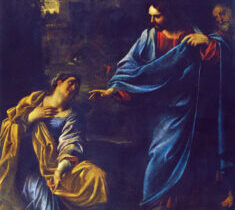
Jesus’ reputation as a healer preceded him. A woman from that area came to where he was. She was a Canaanite, one of the traditional enemies of the Israelites. She came to ask him to heal her daughter, who was being tormented by a demon. Today we would say she had a mental illness.

Jesus simply ignored her. He did not even respond negatively. Just silence. As if she didn’t even exist. She was a woman and a foreigner. No concern of his.

His disciples were irritated with her. She kept calling after them, requesting healing for her child. They asked him to send her away. “I was sent only to the lost sheep of the house of Israel,” was his response.

But she was persistent. She bowed before him and begged, “Lord, help me.”

We often think of Jesus as a kind, patient, polite man, but this time he was just plain rude. “It is not right to take the food of the children and throw it to the dogs!” Pretty clear who was being compared to a dog.

This mother did not let that insult stop her. She was desperate for healing for her child. “Please, Lord, for even the dogs eat the scraps that fall from the table of their masters.”

This brought an insight to Jesus. Healing could be for those who had faith. It is not limited to any religious or ethnic group. “O, woman, great is your faith! Let it be done for you as you wish.” The child was healed and Jesus learned an important lesson about God’s mercy and his mission. No one is to be excluded who comes in faith. (Mt 15:21-28)

This was not actually a new idea in Judaism. Isaiah spoke of a similar idea to the folks who had returned from exile in Babylon. Their temple had been rebuilt and now it was possible to offer sacrifice there again. But what about all the time away and the time before the temple was rebuilt? How had it been possible to keep the sabbath holy and to maintain the covenant with the Lord if temple sacrifice could not be offered?

The Lord, through his prophet, told them to take notice of what is right and just. Watch and see how the Lord’s justice is revealed. It is revealed as foreigners join themselves to the Lord and become his servants. All who keep the sabbath and hold on to the covenant will be welcomed to the holy mountain of the Lord. Their sacrifices offered on the altar will be as valid as those of the original community. The Lord’s house is “a house of prayer for all peoples.” No one will be excluded from his mercy. (Is 56:1, 6-7)

St. Paul expresses the community’s understanding of the Lord’s call in his letter to the Romans. He speaks of himself as “the apostle to the Gentiles.” He has been sent to spread the message of God’s love and mercy beyond the Jewish community into the entire world. If the people of Israel had welcomed Jesus with open arms and become his followers, it’s quite possible that the faith would not have expanded out to include everyone. Paul says that in their refusal to believe, their disobedience, his own people had made it possible for Gentiles, all the other peoples of the world, to receive the Lord’s mercy and love. No one is to be excluded. (Rom 11:13-15, 29-32)

As our communities divide into camps with opposing ideas these days, I believe we are again called to ask ourselves if we are truly willing to accept each other and wish each other well. Are we sisters and brothers in the Lord? Are we sisters and brothers, children of one creator. Are we equally loved and forgiven for our small mindedness and smug self-confidence. Too often we say, “I know what is right and you are totally wrong!”

In religious circles, it is especially important to be patient and loving with each other. We may not agree on all topics. Some will be more open to changes in social standards and structures than others. Some may interpret Scripture more literally than others. Some will distrust the findings of social or physical sciences. However, all are children of the same Father, who calls all to mercy and mutual forgiveness.

How do we keep from being a community that turns in on itself when confronted with others who have different experiences of God’s presence and love? How do we remain open and welcoming? Is it by condemning those whose ways are different from ours? Or by setting up rules and regulations to restrict access to the Eucharist and sacraments? Or do we recognize that God is bigger than all of our rules and categories. God loves all of creation and especially all people. He did, after all, according to our very ancient tradition, create us in his own image and likeness,. If that is truly the case, then we are called, like Jesus himself, to be open to those whose ways are different from our own. We are called to offer healing and reconciliation in and between communities. We are called to let the power and unrestricted love of our Father flow out through us to heal those who are suffering, physically, socially, mentally, spiritually.

God’s mercy excludes no one. So we must not exclude others either. Instead, we come together in prayer and Eucharistic thanksgiving to remember and be nourished. Then we go forth into our world and share the graces and blessings received as we allow the love of God to flow out in healing mercy through us.

This week, let’s focus on seeing the goodness and mercy of God in our families, our neighbors, our communities, and our world. All are welcomed in the Kingdom of God and all receive the merciful love of our Father.

Readings for the Twentieth Sunday in Ordinary Time – Cycle A

Read More

Posted by on Aug 13, 2023

Why Did You Doubt?

Why Did You Doubt?

As humans, we like to have things in our lives happen in predictable ways. Babies learn to expect certain patterns of behavior from the people around them. I cry, someone picks me up and feeds me, or changes my diaper, or helps me burp. I can count on getting reassurance and help when I need it. If I don’t, something is terribly wrong and I will tell the world about it at the top of my lungs!

With older children and adults, life is easier if we know what to expect. What time do I need to get up? When do we eat? What do we eat? Where do I have to be at noon? And so on.

When natural disasters hit, or wars, or even unexpected heat or rain that upsets planned or ordinary activities, we want to know why that happened. Historically, people have blamed the natural disasters on divine activity. The gods are angry, with each other or with us. Think of the stories of Zeus or Thor, who used thunderbolts or a great hammer to fight when displeased.

Middle Eastern peoples also interpreted such happenings as being the result of the displeasure of their gods. This form of explanation was simply part of their everyday experience.

The prophet Elijah ran into trouble with the king when he defeated and killed the priests of Baal. Jezebel, wife of King Ahab, was not amused. In fact, she tried to wipe out all of the priests and prophets of the Lord. Elijah escaped into the wilderness, where an angel gave him food and drink, then sent him on his way to the mountain of the Lord, Mount Horeb/Mount Sinai. On the mountain top, there was a cave. Elijah was nervous about being on the Lord’s mountain. It was dangerous. If you saw the Lord, you would die.

But the Lord told him, “Go outside and stand on the mountain before the Lord…” Before Elijah could do as he was told there was an uproar outside. The wind roared around the mountain. Rocks were crushed. There was an earthquake, then a fire. To the ancients, all of these were signs of the presence of the divine.

But God wasn’t in these physical events. After all the uproar, there was a tiny, whispering sound. That was the presence of the Lord and Elijah hid his face in his cloak, then went out to meet the Lord. (1 Kgs 19:9a, 11-13a)

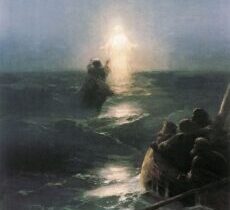
Jesus’ disciples also had a frightening experience. They had just seen Jesus feed a huge crowd of people with just a few loaves of bread and a few small fish – the lunch of a child who offered to help feed the rest. Jesus had sent the disciples to return home with the boat across the Sea of Galilee, a large inland lake. He sent the people home and went up on the mountain by himself for a little while to pray. (Taking time out to pray by himself was a common practice for him.)

From the mountain he noticed that a great storm had arisen on the lake and the boat was struggling to stay afloat. So he went down from the mountain. Just before dawn, the disciples noticed something coming across the water. They most likely believed there were monsters deep in the lake who caused storms. Ghosts were also easily believable in the middle of a storm. So, when they saw a figure coming across the top of the water, they were terrified.

Jesus called out to them, “Take courage, it is I; do not be afraid.” Well, could that be true? Might that be the kind of thing a ghost would say to lure them into a false sense of security? Peter responded, “Lord, if it is you, command me to come to you on the water.” Jesus said simply, “Come.” And Peter went over the side of the boat and walked towards Jesus.

All was well until Peter stopped to think about what he had just done. He had stepped over the side of the boat, in the middle of a storm, on a deep lake and was now walking towards what was either a ghost or his friend Jesus. Since people don’t walk on water, it might have just been a terrible mistake on his part. As such thoughts entered his mind, he began to sink into the water. He called out, “Lord, save me!” and Jesus reached out a hand and saved him, saying “O you of little faith, why did you doubt?” The waters calmed and they got safely to the boat again.

The use of the term Lord was significant. That was a term used for God. The disciples recognized who their friend was and bowed down to honor him. “Truly, you are the Son of God.”

Once again, the storms raged, the winds blew, disaster was upon ordinary people, and the Lord was there, quietly reassuring them. Elijah on the mountain, and the Lord was in the quiet whisper outside the cave. Peter sinking in the waters of the lake. “Why did you doubt?” I am here in the midst of it all. (Mt 14:22-33)

We can think we’ve got everything under control. We want to share our faith and our experiences with others. We have a good job, or at least a steady one. Our children are healthy. And then something unexpected happens. We lose a job. A friend gets cancer. A pandemic shuts down the world. Forest fires darken the skies with smoke. Hurricanes and tornadoes destroy communities. And we wonder what we did wrong. Why did God let these terrible things happen to us? Did God do all of this to punish us? Are these indicators that the end of time is upon us?

I think it’s important to remember Jesus’ question, “Why did you doubt?”

What is it that you doubt? What do I doubt? Which promise of the Lord do I need to trust more deeply.

In this week, let’s try to remember to trust that we are loved deeply and unconditionally by our Lord. Whatever happens, it’s not that God is angry and out to get me. It may be that there are unexpected consequences to choices we have made, but God doesn’t set out to punish us. We are free to make our choices and they don’t always work out as we had expected.

Sometimes, the hard or unexpected things that happen are the result of the actions of others. In those times, the Lord is with us too, sharing in our pain and offering loving support to help us get through the troubles. He has been through hard times too. He knows our pain and suffering. He wants to help and offer a hand to lift us out of the waters of doubt and despair.

With Peter, we reach out to his offered hand. We return to the boat, having recognized our Lord.

Readings for the Nineteenth Sunday of Ordinary Time – Cycle A

Read More

Posted by on Jul 30, 2023

Wisdom – Thinking with the Heart

Wisdom – Thinking with the Heart

“Use your head!” “Don’t be a fool!” “Don’t waste what you’ve got, use it carefully!” “They wouldn’t be in this position if they’d just been more sensible!”

How many times have we all heard these kinds of statements, sometimes addressed directly to us? It’s a common understanding in Western culture that decision making is best done with the mind, a.k.a. the head. We think of the heart as the center of emotions, and emotions are not regarded as the best sources of good decisions.

In ancient Israel, the heart was seen as both the center for emotions and the center for decision-making. When the Lord came to King Solomon in a dream at night and asked what gift Solomon would like to receive, Solomon gave an unusual answer. He had become king at a young age and had to defeat many enemies, including one of his brothers, to establish control over the kingdom. Once that was settled, still a young man, he began to build his own palace and a Temple for worship of the Lord. Up to that point, the tablets of the Law had been kept in the Ark of the Covenant. Now it was time for a permanent home for them and a center for worship and sacrificial offerings.

Solomon recognized his inexperience and the challenges ahead of him in governing a large group of people. So, he asked for “an understanding heart to judge your people and to distinguish right from wrong.” (1 Kings 3:5, 7-12)

This pleased the Lord, who had expected a request for the usual kinds of things people wanted – long life, riches, conquest of enemies and so forth. But Solomon had asked for an understanding heart. The Lord’s response was heartfelt: “I give you a heart so wise and understanding that there has never been anyone like you up to now…”

Solomon is known to this day as Solomon the Wise. His reputation for wisdom spread throughout the ancient world and people traveled long distances to meet with him. As long as his decisions were based on the wisdom that came from thinking and listening with his heart, they bore good fruit. Later in life, when he forgot some of his earlier experience with the Lord and good decision-making, things didn’t always go so well. But the reputation from his earlier years remains. Solomon the Wise.

St. Paul spoke of something similar in his letter to the Romans. (Rom 8: 28-30) “All things work for good for those who love God.” Paul used a term in his letter that is often misunderstood today. Predestined.

We tend to think the word predestined means that everything is set up firmly and unchangeably ahead of time. Nothing anyone can do will change it. Some will succeed. Some will fail. It’s like a sports activity in which the winner is determined before the match begins and the competitor who may be better will deliberately compete more poorly, to meet the predetermined setup. On the big picture, spiritual side of things, some will go to a heavenly reward and some will go to eternal damnation. This can lead to a belief that we can tell who is going to be rewarded in heaven by how monetarily successful they are here on earth! Entire cultural systems have been set up based on this premise. We do our best and if we are pleasing to God, we will prosper. If we aren’t pleasing, then nothing we can do will help and no matter how hard we are working, we will be eternally punished.

What a terrible way to go through life! Who would want a God who would treat people that way? And yet, if that’s all we’ve ever heard, that’s likely to underlie much of our understanding of life.

Fortunately for all of us, predestined in the sense used by Paul doesn’t mean the same as what we expect. Predestined in this context means that God has decided to call us and help us become like Christ, ready to be in a positive, loving relationship with God both now and into eternity. Paul assures us all that God has chosen us from all eternity to become like his Son, the one firstborn of the many humans who will join together as sisters and brothers in the family of God. This is something worth celebrating and allowing to be a foundation of our lives.

So, what is this family of God, the Kingdom of God to be like? Jesus spent a lot of time trying to explain what the kingdom is. (Mt 13:44-52) “The kingdom of heaven is like a treasure buried in a field.” The kingdom of heaven is like “a pearl of great price.” Those who find the treasure or the pearl put it back where they found it in Jesus’ parables. Then they go and sell everything they have in order to buy the field (and the treasure) or the pearl. They don’t set up a spreadsheet and compare their assets and liabilities and determine whether this new asset will be more beneficial than sticking with their existing plans. No, they simply drop everything and choose the greater prize, the one they have marvelously come upon.

Jesus tells stories of wheat growing alongside weeds and fish, good and bad, swimming in the sea. Life is not set up with only good things happening to the good people and bad things happening to the bad people. There’s a share of good and bad for all. The trick is, how do we respond? And how do we respond to others whose situation may be more difficult than the one in which we find ourselves? Do we use our heads and try to protect what we already have at all cost? Or do we sometimes go out on a limb and saw madly behind us, hoping to help someone who is struggling or in need of a hand?

Wisdom is thinking with our hearts. As our hearts are soft, or softened, they become more pliable, more ready to love as our Lord has loved.

As we move through this week, let’s pray that areas of our hearts that are hardened will be softened, so that we can hear and think with the freedom and abundance of our God.

Readings for the Seventeenth Sunday in Ordinary Time – Cycle A


Read More
Posted by on Jul 23, 2023

To Weed or Not to Weed

To Weed or Not to Weed

When I was a girl, we had a big vegetable garden. The largest crop by far was the green beans. We all liked to eat them and we were a good-size family. Mom liked one particular variety of bush beans. She didn’t like pole beans, so we never grew them. The challenge with growing the beans was that there was a fungus in the soil that killed the beans if it got on the leaves. So, every year, when the soil was ready, we planted the seeds and watched the beans grow. As the beans sprouted, so did the weeds. Every year, just the same. As the bushes grew bigger and the beans began to grow, the weeds kept pace with them. That part of the garden looked a fright! But we never pulled the weeds as the beans were growing.

When the beans got big enough to harvest, we picked the first batch. It filled several washtubs and we all sat around the tubs of them on hot summer afternoons, cutting them to put into the jars for canning. We would eat those beans for the entire next year. A week or so later, a second picking would be ready and we again filled the washtubs with them for canning.  The difference was that after the second picking, we pulled out both the weeds and the bean bushes. There would not be another picking. By that time of the summer, the bushes were becoming infected and were going to die anyway.

I thought of this when I read the story Jesus told about the farmer who planted good wheat seed in his field and went home to a well-deserved rest. During the night, an enemy came and scattered weed seed in the field too. The scenario was not seen as outrageously improbable to Jesus’ audience. Family feuds were a part of life and such things would and could happen. With a grain crop, it can take a while before it becomes obvious that not everything growing in the field is the grain that was planted. An enemy who can ruin the crop would dishonor the farmer in the eyes of his peers. “How could he have planted weeds along with his wheat? Didn’t he know better? He must not be as good as we thought he was!”

When the treachery was discovered, the stalks of wheat and the stalks of the weeds were completely intermixed. The farmer would have had every right to take action against his enemy and the family of his enemy. At the very least, those who worked his fields expected that he would want them to pull the weeds out, so no one would see that they were growing among the good plants.

But the farmer took a different approach. Like Mom with the beans, he let the weeds continue to grow. Pulling them would have damaged the crop, because the stalks of the wheat would be trampled in the process of getting all the weeds out. Instead, he waited until the grain was ripe. Then the weeds could be pulled and destroyed. The wheat could be gathered and stored in the barn for use during the year.

Jesus explained to his disciples later that he himself, the Son of Man, was the farmer. The field is the world and the good seed represents the children of the kingdom. Those children of the kingdom can be led astray by others who are not of the kingdom, who deceive them and lead them to do evil. At the end of time, the children of the kingdom who have remained faithful “will shine like the sun in the kingdom of their Father.” The others will be like the weeds, destroyed as worthless instruments of hatred as were the weed seeds sowed by the farmer’s enemy.

This can be a rather frightening teaching. Would God really judge people so harshly and condemn the wrongdoer? What hope is there for any of us if that’s the way it is?

We get a hint of the answer in the book of Wisdom. This book was written sometime during the last hundred years before Christ. The author was probably Jewish, but Greek-speaking and possibly from Alexandria, Egypt. Alexandria was a great center of power and learning in the ancient world.

The author points out that God does not have to justify to anyone else actions He takes, because there are no other, or superior, gods. God’s own power is the source of justice. But that justice is not harsh. God’s mastery over everything leads to lenience to all. God teaches His people through mercy that they are to be kind and merciful themselves. “You taught your people, by these deeds, that those who are just must be kind…”

Those who choose to turn away from God and refuse to turn back and accept forgiveness, will remain separated, because God has given freedom to each person to choose how to respond. But God is merciful, and at the slightest turn toward the good, God will be waiting with open arms to welcome the one returning.

God is willing to wait, like the farmer with a field full of weeds, until each person, aided by the Spirit, turns to the Father of all, becoming part of the good harvest.

There’s a lesson for each of us here as well. When we are hurt or disappointed or embarrassed by someone else, we too have to decide whether to pull the weeds or patiently wait and hope that the situation will improve with time. Sometimes, things get better on their own. Sometimes they don’t. Sometimes, for our own safety, we have to pull the weeds – moving out of dangerous relationships or situations. But other times, we simply need to wait for someone to grow up or to realize that a change is needed. At that point, it’s better not to pull the weed and cut off the possibility of reconciliation.

Let’s pray this week for wisdom to know when to weed and when to wait as we deal with the good times and the challenging times of our lives.

Readings for the Sixteenth Sunday in Ordinary Time – Cycle A


Read More
Posted by on Jul 16, 2023

Rain, Seed, Harvest – the Word of God

Rain, Seed, Harvest – the Word of God

“My word shall not return to me void.”

One of the great mysteries of life is the way everything grows from a tiny beginning. Even single cell creatures must start somehow. Division of a single cell into two is a common mode of birth for such beings. But they are not fully grown at the time they pop into being. Both the old and new cells are smaller than the original one had become at the time of the division.

For larger creatures, dividing and forming an exact copy of an older one is not an option. The pattern we see is of a very small cell with genetic material that somehow guides it as it grows and changes into increasingly more complex states. Eventually, the organism gets large enough and developed enough to survive on its own and even reproduce.

The prophet Isaiah reminds the people of his time (and all of us) that the rain and snow which fall on the earth are essential for the growth of the plants on which we all depend. They come from the heavens and return only after fulfilling their role on earth. The Lord, through his prophet, says that his word is the same in this regard. The Lord’s word goes forth from heaven and does not return until its purpose has been attained.

Jesus speaks of this same reality and the conditions that affect the way the process unfolds. “A sower went out to sow.” Those who are not close to the land may never have experienced the scenario Jesus presents. Seeds are very small. Traditionally, they were scattered by hand out onto the fields. Later, machines were invented to throw the seeds out in a pattern onto the fields. Today, there are even more precise machines that poke the seeds into the soil one-by-one and add a bit of fertilizer to help the seed grow. There is much more accuracy to today’s planting methods, and presumably, better yields at harvest time. The newer method also allows farmers to care for the soil more effectively, not having to plow under the remaining short stalks and roots of the prior year’s crop and risk having the soil blown away in a windstorm or washed away in the rain.

But when Jesus was speaking, and even today for farmers around the world, seeds were tossed out across the land by the farmers. Fields are not typically surrounded by solid walls. They are bordered by roads or paths. The soil on the path or road is hard. Seeds may sprout, but only with difficulty. Lots of them become food for the birds or other small animals. Then there are the areas where there are lots of rocks. Not a lot of soil to cuddle around the roots of the plants there either. Again, they don’t survive in large numbers. They are easy to pull and dry out quickly. And then the thorns. Have you ever tried to grow a lawn or garden beside a berry patch? The berry plants send out roots far into the area around them. Anything growing inside the berry patch is not going to produce well. The berries pull the nutrients for their own fruit. It’s a continual battle to beat back the berries and let the grass grow. The same goes for wheat and other grain crops growing beside thorny plants.

Fortunately, there are large expanses of land which are not filled with rocks or thorns onto which the seeds also can fall. In a good year, with adequate rain and dry weather as the grain matures and harvest time nears, a good crop will be harvested.

I grew up in a family in which some members were and still are farmers. In Eastern Washington, farmers often grow winter wheat. It is planted in the fall and sprouts before everything gets too cold. Then the snow comes and covers the land. Growth stops, but the plants are protected from the extreme cold that would kill them if they weren’t small and insulated. As the snow melts, the ground is watered and growth resumes. By June, the crop is growing beautifully, forming heads of seeds for the next season. The plants don’t know it, but they are also growing to be food for humans and animals. As the season moves on to August, we all hold our breath. Will the weather hold until the grain can be harvested? Will the storms that inevitably come through go around the family farms?

Lives can be and have been changed dramatically by the luck of the weather. Two harvests-hailed-out in a row sent my grandparents from Montana to Spokane, Washington, where Grandpa worked as a brake mechanic for the city bus lines for the rest of his career. Other relatives had better luck. The harvests were good enough to keep going another year. It’s not surprising that farmers take pictures of their fields as the grain is growing. It’s so beautiful. And then they take pictures of the harvest too!

For Jesus, there was a lesson to be learned from the sowing and harvesting. The word comes forth from the Father. It lands in different ways among the people who hear it. Some simply don’t understand what they are hearing and are easily convinced that it means nothing for them. Some receive it happily, but when opposition arises, they don’t hold on to it. Some hear it and want to grow, but they get worried about the future and how they’ll get along, and they can’t keep going. But there are some who hear the word and it takes deep root within them. These are the ones whose faith sustains them, allows them to share with others, and carries the Father’s word forward in the world. The community grows as the word is shared and lived.

Sometimes we can get to thinking in very abstract ways about questions of faith. How does God do this or that? Who or what is God? Why does God let bad things happen? Why can’t God do bad things? Or can he? Many, many questions and concerns. But the very basic reality is that God is both practical and optimistic. God sends out a word to bring forth all of creation. God’s word is like a tiny seed, that grows and bears fruit, including seeds to continue the cycle. Each time, more are created.

St. Paul tells us that creation itself is waiting, groaning in labor pains, for the triumph of the harvest of the freedom of the children of God. The word of the sower grows in all of creation and in human society, as we learn to care for each other and this home we have in common, our Earth. When we accept the love and forgiveness of God, and become God’s children, the word is fulfilled and returns to the Father.

As we move through this coming week, may we be alert to the ways in which the word has been sown in our lives. Are we open to growing in love? Are we sharing a smile? Are we patiently helping a family member or friend who simply needs a hand now and again? Where are the seeds sown in our lives taking us? Are we ready and willing to go?

Readings for the 15th Sunday in Ordinary Time – Cycle A


Many thanks for this photo to my “cousin” Scott whose uncle and my aunt were married. Scott took this photo of one of his fields a few years ago.

Read More

Posted by on Jul 9, 2023

Easy Yokes and Light Burdens

Easy Yokes and Light Burdens

What do you expect of a ruler? Someone strong and decisive? Someone confident and willing to make decisions? Or someone who asks questions and listens carefully to the answers that come even from the lowest social and economic tier of workers?

Zechariah speaks in prophetic form of the ruler who will come to Jerusalem. “Thus says the Lord …” lets all know that these are not the thoughts or dreams of the one who speaks. They are words received in prophecy, oracles that shed light on the thoughts and plans of the divine.

And what does the oracle foretell? “Rejoice heartily, O daughter Zion, shout for joy, O daughter Jerusalem!” Why should Zion shout for joy? Because a king is coming who will not be a warrior. A ruler who is just and humble, so humble, in fact, that he will ride a young donkey into town. Kings typically arrived with a great retinue of folks – trumpeters, chariots, archers, foot soldiers, and finally, the carriage in which the ruler rode. Servants and courtiers also traveled with the ruler, to make a luxurious camp or set up housekeeping in the home of a local noble. Rulers didn’t ride donkeys, especially not very young donkeys. They rode majestic horses or in fabulous chariots or carriages.

But this ruler foreseen by Zecharia is to come proclaiming peace to the nations. This one will rule over all the land, not just the land of Israel. All the ends of the earth. When Jesus chose to enter the city of Jerusalem riding on a donkey, he was absolutely aware of this oracle and what it would mean to the people of his community. This was a claim to being the one who was to come, the king who would rule the entire world. The people who witnessed his arrival understood clearly what he was saying. So did the rulers of Jerusalem.

What kind of ruler would he be and who would recognize and accept him? Jesus had thought about who would be open to recognizing this long-awaited king. It would not be the wise and learned, the teachers and priests of the temple or the most educated people in each little town. It would be the ordinary folks, the “little ones” who must depend totally on God’s care and help to get by in their lives. These would recognize the Father’s presence in the Son’s love and teaching.

What kind of ruler? That’s the big question. Would this one who knows the Father personally throw his weight around and demand great works of daring and costly sacrifice to elevate his stature?

Jesus answers clearly. “Come to me all you who labor and are burdened, and I will give you rest.” I’m not going to demand that you keep working so hard before I love you. I don’t expect you to give me rich gifts and build up my ego. “I will give you rest.” I am humble and will serve gently those who come to me. “My yoke is easy, and my burden light.” I don’t ask for costly sacrifices, or long, unhappy, pressured hours of work. I will be there helping to make our time together pleasant and to share the carrying of life’s burdens.

As we move through this coming week, let us remember and rejoice with Daughter Zion that the Lord has come. The yoke of servitude has been replaced with a shared journey through life. No one is alone. The Lord is always with us, our partner in the yoke, helping us handle the challenges life throws our way and reminding us to reach out to each other in love and trust, so no one is left with an unbearable burden.

“My yoke is easy and my burden light.”

Readings for the Fourteenth Sunday in Ordinary Time – Cycle A

Read More

Posted by on Jul 2, 2023

What Goes Around Comes Around?

What Goes Around Comes Around?

A very human urge is to try to understand why something happens. If that something was something negative, we want even more to know why and then we ask what the consequences of that something might be. Think of children in the school yard. Some are very good at sports. Others are not. If those who are good at sports begin to pick on those who are not, there is every expectation that the teachers or other adults in charge will step in and stop the bullying. There is an expectation, or at the very least, a hope, that justice will prevail. In the eyes of those on the receiving end of the bullying, the hope may well be that the guilty ones will be punished. That doesn’t always happen. Sometimes, the guilty ones overstep and pick on someone who is stronger. In such instances, the originally bullied ones may take glee in the notion that “what goes around comes around” and the former bullies have gotten their comeuppance!

Now this is not necessarily the way we want to approach the world. If we all keep cheering for bad things to happen to the “bad guys,” things aren’t going to get a lot better. In fact, they will just keep getting worse. We might even discover to our dismay that we are starting to be seen as “bad guys.”

So, what to do?

The Scriptures point to another option. What if we assume that love is a stream of energy that flows continuously through all of creation and through each of us? That love doesn’t try to get even with those who behave badly and hurt others. Instead, that love aims to bring out the best in all it touches.

Elisha experienced that gift of love through the generous hospitality of a woman in Shunem who first invited him to dinner one day. As time went on, she and her husband hosted him often. Eventually, she arranged for a room to be prepared for him to use whenever he was in the area. Elisha was grateful for her hospitality and asked what gift might be given her in thanksgiving. His servant suggested that a son would be the best gift for her, because she had never had a son and so the gift was promised. The story continues beyond the short bit in today’s reading to tell of the birth of a son to her. It’s worth reading, especially remembering that women typically had no say in such matters as to who would be invited to dinner or to stay in a family home. Men made all such decisions. But this woman’s generosity was rewarded abundantly. The gift of loving welcome and hospitality was returned and amplified with the gift of a son. (2 Kings 4:8-11, 14 – 16a)

St. Paul speaks of baptism as an entry into the death and resurrection of Jesus. In entering into the water, a person enters into death. Upon rising out of the water, new life springs forth. The love of God flows like a stream of life, deeper than our physical world would lead us to imagine. With Jesus’ death, the power of sin was broken and the cycle of tit-for-tat was broken. Followers of Jesus live for God in Christ Jesus. (Rom 6:3-4, 8-11)

Jesus spoke strongly about what living in accordance with his teaching would require. The words are as jarring today as they were when he first uttered them. “Whoever loves father or mother more than me is not worthy of me…” Aren’t we supposed to love our families? Yes, but there’s more to what Jesus said than just the literal meaning of the sentence.

Jesus lived in a culture very different from our Western industrial culture of nuclear families with the expectation each will make their own way in life. In Jesus’ culture, the extended, corporate family was the basic unit of society. One was known in terms of the larger family. The head of the family was the oldest man, from whom the rest were descended. Women left their own family upon marriage and became part of their husband’s family. If they did not produce male heirs, they were considered worthless and might even be returned to their original extended family.

In this type of culture, the honor of the family is everything. One’s responsibility is to behave in a way that will not embarrass or otherwise harm the reputation of the family. If one’s family has a dispute with another family, there is no expectation that individuals will step outside their own family and do anything good for a person of the other family. Think of family feuds like that of the Hatfields and McCoys. Or the families of Romeo and Juliet, for that matter. When Jesus speaks of loving father or mother more than loving him, this is what he means. Loyalty to one’s family over loyalty to Jesus and the way he taught is not acceptable for his followers.

Do families take that kind of independent thinking and acting happily? Not usually. Even in our own nuclear families, it’s hard to take a stand that is contrary to the beliefs of parents or even siblings. Yet this is what Jesus expects of his followers – a willingness to take the risk of being misunderstood and even condemned for the refusal to conform to the expectations or the decisions of family or social group. This is taking up the cross, accepting the disapproval, the scolding, the mocking, even the rejection by those one has held dear, rather than conform to expectations that are contrary to the teachings of Jesus.

So what is expected of Jesus’ followers? What will come to them along the way? How will the stream of love show up? “Whoever receives you receives me, and whoever receives me receives the one who sent me.” The rewards for passing love along will correspond to those received by others. If one is receiving a righteous person because that person is righteous, then the reward will be the same as the one received by the righteous person. (Mt 10:37-42)

The actions that flow along in this stream of love may be grand and noteworthy. They may also be small and commonplace. A cup of cold water given to one of God’s little ones will be rewarded abundantly.

We are called to be channels of love and peace in our world. What goes around in a channel of peace may also come around, but it comes around in an ongoing, ever-increasing stream of loving action that will remake our world in God’s image. We don’t have to be perfect. We don’t have to do it all by ourselves. We just need to be open and generous in sharing the gift of love we have received. As we share in love, both the love and the basic requirements of life, we are carried along in the stream ourselves.

May we notice this week the times and ways in which the stream of divine love touches us. May we then open our hearts and hands to let it pour forward to others as well.

Readings for the Thirteenth Sunday in Ordinary Time – Cycle A

Read More