Pages Menu
RssFacebook
Categories Menu

Posted by on Apr 8, 2023

What a beautiful night – Resurrection!

What a beautiful night – Resurrection!

What a beautiful night!

¡La noche de la resurrección!

It is a night that burns brighter than day. The darkness is banished by the light of love. Death is vanquished by the light of joy. Our fears have been taken away. Our crucified Lord is dead no more. The blinding light of the angel and the earthquake rolling away the stone stuns all of us.

En la madrugada las tinieblas moradas se rompen por el terremoto y el relámpago del ángel. Conmovidos, nos asustamos cuanto más al oír la consolación del ángel, “No temas.” Dios llega con su poder y gracia para rescatarnos. No temas.

Yet, the blinding light of the Angel’s voice tells us not to be afraid. We are shaken and our legs are trembling. But is this true? Yes! Our fear gives way to excitement. Go tell the others. You wept for him and anointed his body, torn and broken on the cross. You stayed with him until the end and now you have come to mourn him, but he is not here!

Al amanecer, la resurrección, se evanescen nuestros miedos, nuestras angustias, nuestra tristeza. Hemos visto el sufrimiento de los inocentes, hemos encontrado desconsolados la matanza de niños escolares. Hemos visto y tocado la fiebre del temor del COVID. No temas. Están sueltos de los lasos de la muerte como El Señor. Todo el sufrimiento de las cruces de la humanidad ha sido vencido por la cruz y resurrección del Salvador Victorioso.

Christ is victorious! Death has no power over him. Joined to him we have the promise of everlasting life. Heaven and earth are reconciled. With Him and in Him all glory, honor, and praise are given to the Almighty Father.

The forces of evil, despair, and distrust fell on Him and He vanquished them with compassion. “Father, they know not what they do.” In this priceless witness, the forces of derangement became only more furious. But He conquered them not by force but by coming forth from the sealed tomb.

Cristo en su triunfo ha vencido las fuerzas del pecado y furia por su humilde fe en la voluntad de su Padre. Lo captaron y crucificaron por su miedo, por su temor de que El los derribara de sus tronos y elevara a los humildes y mansos. Una luz resplandeciente que hace mover la tierra en sí misma nos ha amanecido en esa noche de nuestras velas de esperanza como estrellas en el domo del cielo.

Through the sin of Adam, a promise is made and fulfilled. God comes to pitch his tent with us. Light from light, True God from True God, begotten not made.

El cirio de la luz eterna rompe las cadenas de la oscuridad. La llama vacilante abofeteada por los vientos de nuestros tiempos, impulsados por la indiferencia, el enojo, y la desesperanza, la luz del cirio brilla aún más. Nos guía a través de las brisas de nuestra peregrinación, a través del Mar Rojo a pesar de nuestra duda. Anda en frente de nosotros por noche en el desierto desconocido y mostrándonos el camino al Padre.

“Go to Galilee.” “Go tell the others.”  You will see him there. He is not here. But surely, He is here. We go to tell the others. Leaving our jars of spices and unguents to perfume the dead; leaving our wine and spices to wash the dead. We find him! We fall at his feet. He smiles and lifts us up. Go tell the others.

Mary of Magdala, relieved of seven devils by the Lord’s touch, weeps at the open tomb. His body has been stolen. Where have they taken him? The gardener must know. He must know. “Tell me sir, tell me where have they laid him?” So quietly, so gently, kindness meets my ears. “Mary!” He calls through my tears. The gardener tends a new paradise where sin cannot enter, nor ugliness, but only the sweetness of blossoms. “Mary!” I look up. “Rabboni, it is you!”

Nos da nueva vida el jardinero del paraíso. Su voz suave seca nuestras lágrimas. Con precaución levantamos nuestros corazones. ¿Puede ser? La tumba fue vacía. Ni sabemos por donde lo llevaron. Señor Jardinero, ¿sabe usted a dónde lo llevaron? y nos llama por nuestro propio nombre. ¡Cómo queremos quedarnos en este jardín de dulce alegría!

¿Sólo era en el pasado la tumba vacía?

The Angel tells tourists today, “He is not here.” We come with our phones and cameras, in our sandals and shorts. We are here to see the empty tomb. “Have you listened to the women and gone to Galilee?” the lightening voice asks. This is not history. This is your story. What are you going to do with this second chance? How will your sorrow be turned into joy? How will your smile conquer the frown in your heart? Is it enough to marvel at the paschal candle, the singing, the flowers and the lights? This holy night is only the beginning. On your way, as you leave the garden, pay heed to the Gardener to find your name and yourself.

Ya amanece el sol, Víctor de la madrugada. La estrella de la mañana surge en nuestros corazones. Cristo Rey victorioso, crucificado y muerto por las fuerzas de la maldad, triunfador resucitado desde la muerte llevando a nosotros consigo a la derecha del Padre.

Cristos Anesthe, Alethos Aneste, Christ is Risen, Truly Risen.

¡Viva Cristo Victorioso!

Readings for Easter Vigil– Lecturas para la Vigilia Pascual

Readings for Easter Sunday – Lecturas para Domingo de Pascuas


Read More

Posted by on Apr 7, 2023

Why did Jesus have to Die?

Why did Jesus have to Die?

“Why did Jesus have to die?” “What kind of a God would require a blood sacrifice, of a human being no less, before forgiving the disobedience of the first humans?” “What kind of parent would demand the death of a son?” “Who is ultimately responsible for the death of innocent people?”

All of these questions and more have been raised throughout history, following the death of Jesus. Believers and unbelievers alike have wrestled with the problem of evil and the painful finality of death. Answers are complex and, many times, unhelpful. At best, they provide some logical foundation, based on human values and cultural expectations. At worst, they are downright illogical and unsatisfactory.

I have no good answers either, but I have some thoughts. One of the most important things I have learned in my lifetime is that without difficult times, I don’t appreciate the good times as well. I also have much less appreciation for the challenges faced by others.

If there had always been enough money to be sure of where the next groceries were going to come from, I would not appreciate what it is to go through year after year of food insecurity. If I had always been able to purchase health insurance, I would not be as ready and able to encourage and rejoice with folks who can now get health care and insurance because of the Affordable Care Act (aka, Obamacare) in the United States. I would also be less able to encourage those who have always been part of the middle class and now find their income has fallen so much that they are qualified for Medicaid (Medi-Cal in California). If I had never spent late nights with a crying baby, I would not be able to sympathize with and offer nonjudgmental help to another parent whose child just will not go to sleep!

So many times in my life, there have been difficult moments. Each time, as I come through them, I appreciate more deeply the pain and suffering that are part of life for others as well. I become, I hope, a more compassionate person.

I wonder to what extent Jesus also had to go through hard times as part of growing in compassion and determination to help make life better for others. He had an intense experience of God’s love at his baptism in the Jordan. He grew in wisdom and faith during his time of fasting in the desert. He shared the experience of God’s love with those he met during his public life. He would have been encouraged by its reception among so many ordinary people. He must have been surprised at times that the message he brought was doubted and opposed by so many who were leaders of the community.

In the end, he realized the danger he faced in continuing to proclaim the coming of the kingdom. After all, he lived in a conquered nation where those who led revolutions or opposed the power of Rome were routinely executed publicly. Yet he chose to remain faithful to the call he had received. His cousin had paid the ultimate price for his proclamation of the coming of the Messiah. Now Jesus was facing the same powers and penalties.

He chose freely to continue forward. He could have run away. He saw the soldiers coming out from Jerusalem, down through the valley and up the mountainside to the Garden where he and his friends were spending the night. He could have slipped away before they arrived.

But he didn’t run away. He chose to go and testify to what he had come to understand. When asked if he was the Messiah, he did not deny it. In fact, in St. John’s account, Jesus used the name of God, I AM, three times during his arrest in the garden. When Pilate tried to release him, his accusers retorted, “We have a law, and according to that law he ought to die, because he made himself the Son of God.” This frightened Pilate, but when push came to shove, Pilate did not resist their demands. Anyone who called himself a king or a god was too dangerous to keep around. (Jn 18:1-19:42)

Jesus went to his death freely. He chose fidelity to what he had come to know and understand about God, about humanity, and about his place in the grand scheme of things.

Did he know he would rise? I don’t know. In the Gospels, there are statements about rising, but they were usually phrased in terms of “on the third day,” which was a code phrase for “God will come to the rescue and make things right.” But literally, who knows when or how?

Jesus died. Of that there is no doubt. To make doubly sure, his heart was pierced by a soldier’s lance. He was buried in a borrowed tomb. His friends and family went home to mourn his passing. A guard was posted outside the tomb to be sure there would be no false claims of resurrection.

Jesus was a human being in all senses. If he had not gone through all the suffering he endured, would we who follow his teachings and believe what he came to proclaim about God’s love for all of us be deeply convinced of the truth of God’s unwavering love and forgiveness? I’m not sure we would be.

Jesus died not to appease a vengeful God. Jesus died not because of the “sins of Adam” that made humanity unfit for Heaven. Statements about his sacrifice as payment for Adam’s sins are found in the Scriptures and tradition, but those are from a specific cultural context in which animal sacrifice was a given. They may not be the way we would speak of the same reality today, though all of us are guilty of adding to the pain and suffering of those around us in big and little ways as we go through life.

Maybe Jesus died because he was so totally committed to what he had come to understand and experience of his relationship with the Father that there was no other option but to trust and go forward. In the process, he showed us too the way to move ahead through the sorrows and pain that come to each of us in our daily lives. He showed us that we grow in compassion through suffering and hard times. He showed us that the Father loves us through it all. And he is there with us as we go through it too. We just need to trust that he is there and open our hearts to receive his love and support.

There is no celebration of Eucharist on Good Friday. But we gather to remember the great love of Jesus and his willingness to go through all of the hardest things ever asked of humans: betrayal, unjust trial, condemnation, mocking, physical abuse, and death. He was there. He will be there always with those who suffer the same. And he’s even there for those of us who pass through less dramatic but deeply painful times.

We gather this day in prayer and silence to be with him in the mystery of timeless eternity. We continue in quiet through the day to come.

Peace be with you.

Readings for Good Friday of the Lord’s Passion


Read More

Posted by on Apr 6, 2023

Meals Shared and Rituals Born

Meals Shared and Rituals Born

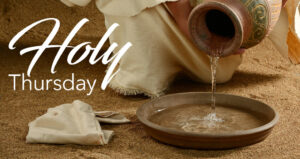
Holy Thursday – the first of three days that mark the culmination of Jesus’ life and ministry. The Triduum, a three day liturgy. We gather together to remember ancient traditions, as well as the events that gave birth to them and led to their continuation into our times.

Passover was and is a fundamental feature of Jewish faith and history. The children of Jacob/Israel and their families, had found sanctuary in Egypt during a great famine. They and their descendants had grown to be a large group in the many years that followed the famine. Eventually, leadership of Egypt changed enough that they came to be seen as a potential threat and restrictions were applied that led to their enslavement.

Hearing their cries, God called Moses to intercede for them with Pharoah. When Pharoah refused to free them, a series of plagues came upon Egypt. Each was more severe than the previous one. Finally, the Lord sent the Angel of Death to slay the firstborn of all in Egypt, except those who were his own. These he had ordered to sacrifice a lamb, put some of its blood on the doorpost and lintels, and eat a communal meal of the sacrificed lamb. That night, the Angel of Death carried out its work. Pharoah ordered the Israelites to leave the land. (Ex 12:1-8, 11-14)

The Passover meal has been celebrated since that time in recognition of the great power of the Lord God and his care for his people, Israel.

Jesus and his followers were descendants of the people who escaped from Egypt. They came to Jerusalem to celebrate the Passover that year. In three of the Gospels, his last meal was a Passover celebration, but in the Gospel of John, it’s a couple of days before Passover. This is the Gospel that is featured on Holy Thursday, and the focus of this reading is Jesus washing of the feet of his disciples. (Jn 13:1-15)

Washing the feet of guests was a common thing done by hosts of any gathering. People didn’t wear closed shoes like we have today. Their feet got dirty as they walked from place to place. Servants would wash the feet of guests at banquets or other formal gatherings. But the host or the master of the household never washed anyone’s feet.

Jesus got up from the meal, took off his robe, tied a towel around himself, and began to go from one person to the next, washing their feet. Peter objected, but when told he must accept the service or not be one of the group, he accepted Jesus’ service too. When he had finished, Jesus explained to his friends that as his followers, they would be expected to follow his example. They were to become each other’s servants. More than that, they were to be servants to all, including those of lower social status.

John doesn’t tell us about the institution of the Eucharist. His focus is on the service and on the love of God.

St. Paul, however, describes the custom of the early church in his letter to the Corinthians. He tells of taking the bread, blessing it, breaking it, and sharing it as the Body of Christ, in obedience to Jesus’ command at the Last Supper when he did the same thing. Paul tells too of the sharing of the cup, transformed into Jesus’ Blood, shed for all of us, to reunite humanity with the Father. Paul’s writings predate the Gospels. This is the earliest description we have of the communal celebrations of our Thanksgiving banquet, the Eucharist. (1 Cor 11:23-26)

When I was a young girl, we were told that Holy Thursday was the day we celebrated both the beginning of the Mass and the institution of the priesthood. This was because only the priest could say the words of consecration that turned the bread and wine into the Body and Blood of Jesus.

Our understanding of Eucharist has grown and developed greatly since those early days of my life. With the inspiration of the Holy Spirit and the work of many theologians, the Church’s understanding of Eucharist has expanded. We have come to understand that through our baptism, we all share in the priestly ministry. We together offer the sacrifice of the Mass. The priest is the one who speaks the words of the Eucharistic prayer aloud, but those words include statements of our own participation in their offering. We pray with our priest, “We offer you …” The words of consecration are not the high point of the Mass. The final offering, before the Lord’s Prayer, is the high point. “Through Him, with Him and in Him…”

Yes, priesthood can be traced to the Last Supper, but so can diaconate, our ministry of service, and our very own priesthood of the non-ordained, the laity. We are all called to be part of offering Eucharist (Thanksgiving) to God. We offer our praise, our thanksgiving, and our service as a people called out of slavery. With our Jewish sisters and brothers, we can say, “Our ancestors crossed the Red Sea and our feet are wet.” We could add, “Our ancestors sat at table with Jesus, and our feet have been washed.”

As we celebrate our liturgy this day, let us remember that call to service. We transition at the end of our celebration to the quiet of the Garden of Gethsemane and the beginning of Jesus’ passion – his arrest, trial, execution, and burial. On Good Friday we will hear of those events. But for today, we give thanks and rejoice in the gift of Eucharist – our sharing in the very life of Christ.

See you at Eucharist!

Readings for Holy Thursday Mass of the Lord’s Supper

Holy Thursday Liturgy – live-stream from Resurrection Catholic Community in Aptos, CA


Read More

Posted by on Apr 2, 2023

A Destination is Reached

A Destination is Reached

We have arrived at the end of Lent. Today we enter, with Jesus, into Holy Week. We have traveled with him from Galilee, through Samaria, to Judea and Bethany. We have heard that he brings living water, sight to the blind, and life to the dead. Today we see him enter Jerusalem, riding on a donkey. Kings and conquering heroes entered cities on horseback, with great fanfare, welcomed by throngs of people. Jesus entered on a donkey, as had been foretold in ancient scriptures (Zec 9:9). This is not a conquering hero. This is a man of peace.

On Palm Sunday, as we enter into Holy Week, we hear of Jesus’ triumphal entry into Jerusalem. Immediately afterwards, we hear Matthew’s account of his Last Supper, the agony in the Garden, his trial, and his execution as an enemy of Rome. It’s a week of powerful readings, profound emotions, and great mystery.  We travel with him from the heights of praise to the ignomy of death on a cross, outside the walls of the city, by the city dump.

God did not choose to come among us as a conquering hero. He did not choose an easy life, filled with praise and luxury. He didn’t worry that the powerful might not like to hear the news that the poorest among them were cherished by their maker. He chose to experience all of the ups and downs of human life. Security in family life and career. Excitement in working with people. Wonder in seeing the growing faith and hope of the community. Joy in being able to help relieve suffering. Courage in speaking truth to power. Fear in knowing that great suffering would soon be unavoidable, especially if he did not back down from the truth he had been called to proclaim. Betrayal at the hand of a trusted friend. Terrible pain in the end, as he suffered a death reserved for those who had committed great crimes, including rebellion against Rome. Burial in a borrowed tomb.

Yet through it all, Jesus did not back down. The Son of God, the Word made flesh, who pitched his tent among us, held on to the reality he had come to understand and proclaim. A new day had dawned. Creation was new again. The relationship between God and humans was healed.

As he was dying, Jesus prayed one of the most powerful psalms ever written. “My God, my God, why have you abandoned me?” It sounds like the words of a man who is despairing. They are certainly the words of a person in great distress, and Jesus had to have been in great distress. But more than that, it is also a song/prayer of great faith and hope. Psalm 22 describes the agony of a man who has been betrayed, abandoned, and mocked by all. “He relied on the Lord; let him deliver him, let him rescue him, if he loves him,” say his tormentors. The prayer continues, with more description of the agony being endured, until finally a great song of praise and hope bursts forth, “I will proclaim your name to my brethren; in the midst of the assembly I will praise you…”

As we travel with our Lord through this week, may we too know the love and consolation of our God, who didn’t hesitate to enter into human life and share it all, especially the hard times, when hope seems far away. He will be there to meet us in those hard times, because he experienced them himself.

Blessed Holy Week to all.

Readings for Palm Sunday of the Lord’s Passion

Palm Sunday liturgy – Resurrection Catholic Community – Aptos, California

Read More

Posted by on Mar 26, 2023

Opened Graves and the Breath of God

Opened Graves and the Breath of God

“I will open your graves and have you rise from them.” These words were spoken to the Hebrew people through the prophet Ezekiel during the time when the Babylonian Empire controlled the land of Judah, the temple in Jerusalem had been destroyed, and many of the people had been taken into exile in Babylon. The Lord continued, “Then you shall know that I am the Lord, when I open your graves and have you rise from them.” (Ez 37:12-14)

Once the dead have been raised from their graves, the Lord promises to bring them to life by putting his spirit in them. The Hebrew word for spirit is important here. It is the same word that is used for breath and wind. The spirit of God in this passage is God’s breath. In the Garden of Eden, God breathed life into Adam. In the desert, when the dry bones came back together into people in the vision granted to Ezekiel, the Lord breathed life and regeneration into the bones, which became covered once again with muscles, skin, and all that is needed for human life.

When the people see this return from death (and exile), according to the prophecy, they will recognize that the one who has done this is the Lord, the One who keeps his promises.

Jesus confronted the death of his friend Lazarus. St. John tells us the story of how it happened. (Jn 11:1-45) This is the seventh miracle or sign of the divinity of Christ that John describes. Jesus and his friends had left Judea before they received word that Lazarus was very ill. They didn’t go to him right away, but a couple of days later, Jesus told his disciples, “Let us go back to Judea.” This seemed crazy to the disciples, because the authorities there had just tried to kill him. But Jesus had decided to go, so the disciples went along with him.

Lazarus had already died and been buried for four days when they arrived. Decomposition of the body would have already begun by that point. The sister of Lazarus met Jesus on the road and they talked. Jesus promised her that her brother would rise. She professed faith in the resurrection of the dead.

Now resurrection was a theory being debated by different schools of thought in the Jewish community at the time. Jesus assured her, “I am the resurrection and the life.” Jesus was claiming that belief in him would assure life that would never end, even if a person died. What a wild concept! His use of the two simple words, I am, was significant. “I am” is the name of the Lord God, the Holy One of Israel. People did not say this or use these words to describe themselves. Martha expressed her faith that he was the Christ, the Son of God.

Martha’s sister Mary also came and spoke with Jesus, expressing her belief that her brother would not have died if Jesus had only come earlier.

Jesus approached the tomb and ordered that it be opened. With great reluctance, the order was obeyed. Then Jesus prayed before calling, “Lazarus, come out!” Lazarus, bound in the burial cloths, emerged from the tomb – alive again. Jesus ordered, “Untie him and let him go.”

The breath of God had once again entered into his body. Life had returned, at the word of Jesus. Just as in the time of Ezekiel, the grave had been opened and the dead raised. And once again, the people who witnessed it, believed. They had seen the Lord at work.

St. John is the only one of the evangelists to tell of this incident. His words were composed a long time after the events described, colored by years of reflection and the faith of the community for whom they were written. They are intended to share with us what they as a community had come to understand. In this interaction and gift of new life to Lazarus, God was revealing himself in Jesus.

Years after the raising of Lazarus, St. Paul wrote about the Spirit to the community in Rome. (Rm 8:8-11) He spoke of flesh and spirit. Flesh is the word he used to describe worldly concerns and actions, not all of which were life-giving or good. Spirit is the word used to identify the good actions and loving style of living of followers of Jesus. Flesh is characterized by the concept of sin. Spirit is about life.

Paul says, “If the Spirit of the one who raised Jesus from the dead dwells in you, the One who raised Christ from the dead will give life to your mortal bodies also, through his Spirit dwelling in you.” Once again, the breath of God gives life – a life that is stronger than death and continues after the body dies.

So, does this breath of God bring life only when up against physical death? I don’t think so. The holy breath of God is much more than a life preserver ring that is thrown to a drowning person. Besides, there are many situations in which we face danger or metaphorical death. Do I tell that secret that will discredit my former friend? Do I try to get more than my share of the common resources of my community? How can I look like a great person without taking any risks or actually helping anyone? So many ways to put ourselves at the center…

Each of these kinds of situations are dangerous to our fundamental well-being, the spiritual level of our lives. The decisions we make in our interpersonal relations, in our families and professional lives, all of these are areas that can lead us into tombs, tombs into which the Spirit of God is ready to blow life. The Spirit waits to blow renewed life into our interactions and our interior being. As we open to receive God’s breath in our daily interactions, we become more able to pass that life on to those with whom we live and work.

The Spirit blows through all of creation, through each of us and out into our circles. As we receive this breath of love, let us rejoice in the One who loves us and pass it on.

Lent is nearing an end this year. Let us open our hearts to receive the healing breath of God, to emerge with Lazarus from our tombs, as we prepare to celebrate the Passion, Death, and Resurrection of Jesus.

Readings for the Fifth Sunday of Lent – Cycle A


Read More

Posted by on Mar 19, 2023

Not as Humans See

Not as Humans See

Sight is an amazing gift. A new baby’s eyes open and immediately floods of new sensations pour into existence for the child. It would all be overwhelmingly overpowering if the baby could see everything going on around it. Fortunately, at first babies don’t see things far away clearly.

The face of mother or father are among the first to be seen – that’s a good distance for starters. Baby studies them carefully and begins to associate experiences with what is being perceived visually. Gradually, the distance increases and more wonders come into view. Experiences begin to be associated with what the eyes are reporting.

Baby reflects:
I cry and the tall folks around me pick me up and give me something to eat! I’m sitting in my car seat and I’m feeling pretty peaceful, but there’s one of those tall beings who pick me up when I cry. Oh boy, I’ll just cry and get picked up! No? Well then, I’ll complain some more. Oh. Now I can’t see them. Oh well, I guess I’ll just sit here quietly and see what comes next…

For the man born blind, the story of whose encounter with Jesus we hear in John’s Gospel, these experiences didn’t happen. He had to figure out the world in different ways. With much help from family and friends, he grew up, but the only way he had to support himself as an adult was to beg for alms from passers-by. A far cry from the experience of those who are blind in developed societies. (Jn 9:1-41)

In Jesus’ time, people believed that the light residing within people was what made it possible for them to see. If a person was born unable to see, there must not be any light within them. If there’s no light, then it’s only reasonable to assume that only darkness is there. Darkness is the realm of evil, so someone must have sinned in order for the child to be filled with darkness. For this reason, people asked Jesus, who had been the sinner whose actions resulted in the birth of a blind child: the parents or the child before birth? Jesus responded firmly, “Neither he nor his parents sinned; it is so that the works of God might be made visible through him.”

Jesus didn’t wait around to see what would happen to the man as life continued. He acted. “While I am in the world, I am the light of the world.” Then he spat on the clay ground and made some mud, which he smeared on the man’s eyes. He then told the man to go to a pool called Siloam (Sent) and wash off the mud. This pool was known to be a place where people were sometimes healed, so the man went. He washed off the mud and he gained the gift of sight, not the gradually expanding sight of an infant, but the sight of a person who could function in society.

The rest of the story tells of the consequences of this new experience in the man’s life. People were astonished. He was led to testify before the religious authorities about what had happened. (It was on a Sabbath that Jesus acted – how could he be from God if he broke the Sabbath by working?) Who was this Jesus after all? What did the man think of him? The man didn’t change his evaluation of the experience: the man who healed me must be from God because he “opened my eyes.”

Jesus went to find the man after he had been tossed out of his religious community by the authorities. He asked the man if he believed in the Son of Man, a title for the savior who was to come from God. The man became a follower of Jesus when he learned that Jesus was the one who had transformed his life.

This theme of sight and of light runs through the readings from the book of Samuel (16:1b, 6-7, 10-13a) and the letter to the Ephesians (5:8-14) as well.

When the Hebrew people decided they needed to have a king rather than be led by strong, wise men and women in times of danger or attack. God acquiesced to their request and Saul was anointed king. However, Saul didn’t turn out to be entirely faithful to God’s instructional leadership. God had someone else in mind to be the next king. The challenge was that kingship so commonly passes from father to son. Saul’s sons were not the ones God had in mind either!

The Lord sent the prophet Samuel to the village of Bethlehem, to a man named Jesse. One of Jesse’s sons would be the one he should anoint the one to be the next king. Jesse had eight sons. Any one of them might be the one, so one by one they were presented to Samuel. Each time Samuel thought, surely this would be the one. But none of the seven older sons was the one. Finally, they called David in from tending the sheep. David was still quite young. No one would have expected him to be the choice, yet this young man was the one chosen. Samuel anointed him in the presence of his family and the elders of the community. The spirit of the Lord, the holy breath of God, rushed upon him and remained with him.

As the Lord told Samuel, “Not as man (humankind) sees does God see, because man sees the appearance but the Lord looks into the heart.”

As members of the Followers of the Way, the early Christians in Ephesus were learning new ways to live. Many things that were acceptable behavior in their society were not “pleasing to the Lord.” Paul encouraged them: “You were once in darkness, but now you are light in the Lord. Live as children of light…” He advised them to act always with the assumption that what they were doing must be worthy of being seen – done in the light. Everything done in the light can be seen and everything that can be seen is light. He concludes, “Awake, O sleeper, and arise from the dead, and Christ will give you light.”

Light and sight are the keys. God sees in different ways than we do. Our human vision and understanding can go only just so far. Like the new baby, as we grow, we see more deeply and more clearly. As we grow in the experience of God’s love and life, our ability increases to perceive how far and deeply love extends and actually forms the substance of all life.

As we continue the journey to Holy Week and Easter, let’s ask the Lord to open our eyes too. To help us to see the face of Love all around us – in the people, the plants and animals, the environment, and the universe. To help us to value the unseen goodness of all of creation and treat it with reverence. To trust that all will be well, as long as we keep our eyes open in trust to the Lord, our God. And finally, to let that light be reflected into the world around us, letting the Light of Christ pour through us into our world.

Readings for the Fourth Sunday of Lent – Cycle A

Open My Eyes – Jesse Manibusan

 Liturgy – Resurrection Catholic Community


Read More

Posted by on Mar 12, 2023

Water: Cool, Clear, Water

Water: Cool, Clear, Water

My father loved the music of a group called Sons of the Pioneers. The refrain of one of their songs, Cool Water, included the phrase, “Water, water – cool, clear water.” The song told the story of at least two people traveling in a desert, presumably in the American West. One of them was hallucinating due to dehydration, seeing “big green trees and the water running free and it’s waiting there for me and you.” The other assured him that what he was seeing was not really there.

The song has been running through my head today as I think of the readings from Exodus, John’s Gospel, and Paul’s letter to the Romans. Water and God’s care for us run through them as a theme.

The Hebrew people had escaped from slavery in Egypt. They had crossed through the Red/Reed Sea. They had experienced the cleansing of bitter water at one place in the desert so they were able to drink it. Another time, when there was no food, God sent manna and quail each day for them to eat. Then they arrived at a place that came to be known as Massah and Meribah. (Ex 17: 3-7)

There was no water for this large group of people to drink. People can’t last long without water. Why had Moses led them out from Egypt to die of thirst in the desert? Moses appealed to God for help and was told to take the same staff with which he had struck the river and parted the sea and to use that staff to strike the rock in Horeb. The Lord promised to be there in front of him as he struck the  rock. Water would flow from the rock for the people to drink.

In the presence of the elders of the people, Moses struck the rock and water flowed forth, demonstrating once again that God was with them on their journey.

Many years later, Jesus and his friends were traveling through Samaria, another dry land. They stopped in the town of Sychar, the location of Jacob’s well. (Jn 4:5-42) This town had been given to Joseph by his father, Jacob, in ancient times.

Jesus waited beside the well while the rest went into town to buy food. A woman came to the well to draw water for the day. It was the wrong time of the day for a respectable woman to come to the well. Respectable women came early in the day. She was not a respectable woman, as her conversation with Jesus later demonstrated. As it turns out, she had had five husbands and was now living with a man to whom she was not married.

Jesus asked her for a drink of water from the well. This was shocking. Men didn’t speak to women in public. Men didn’t ask strange women for water. Jews didn’t speak to Samaritans. But she didn’t run away. She challenged him, asking why he was asking her for water. Jesus answered that rather than question him, she would ask him for living water if she knew who he was.

Two things pop out here to be noted. First, living water in those days meant running water, not that from a well. Secondly, John’s gospel assumes that Jesus knew what he was doing at critical points in his ministry. His actions were signs to let the world know that he, the Word of God, had come into the world and spoke with authority.

When Jesus spoke of living water, she assumed he meant running water. But there was none there, only well water. So, she challenged him. “Are you greater than our father Jacob who gave us this cistern…?” But Jesus didn’t back off. “Everyone who drinks this water will be thirsty again…” He told her that the water he would give would quench thirst forever and continue to grow within the person who drank it. It would lead to eternal life.

The conversation went on for quite a while. It ranged from her marital history to where people were supposed to worship and the dawning realization on the woman’s part that this man might be the anointed one of God, the Christ. She called the rest of the town to meet him. Jesus and his friends stayed in that town for several days. As Jesus told his friends, God’s harvest of people for eternal life was ready. It was time to spread the word, to reap the harvest sown for centuries in the hearts of the people.

It all started with a request for a drink of water. Cool, clear water in the middle of a hot day of walking.

By the time Paul came on the scene, Jesus had died and risen again. The community was growing and spreading outside Palestine. He had been part of spreading the word well beyond the original lands and was now writing to the community at the heart of the Roman Empire. The Church of Rome.  (Rom 5:1-2, 5-8) And what was his message?

Paul wanted all to know that God is still loving and protecting each of us. Through God’s actions, the Holy Spirit of love has been poured into our hearts. Through Jesus’ death, we received the gift of reconciliation with God. We can live in right-relationship with God, the Most High. We can experience peace, harmony, tranquility in our relationship with God and with each other. All because God is present among us and pouring out the grace, the share in divine life, that makes our restored relationship possible.

Water comes and goes in everyday life. Some years we have plenty of it. Some years it is scarce. In some parts of the world, rain is a daily reality. In other areas, an inch or less a year is all that is normally expected. This year in California, we’ve had massive amounts of rain in just a few months. We have a Mediterranean climate, which in part means we have a rainy season and a dry season. Most years, rainy season is relatively mild. This year, when there’s only an inch and a half of rain in 24 hours, it seems like a small amount! Why, one day there were three inches!

But through it all, we need water to drink. We thirst for water.  We thirst for other things too. Power, prestige, security, friendship, respect, love… The list can go on and on. What do you thirst for? What do I thirst for? Do we thirst for the cool, clear water of eternal life?

Lent is a time to ask ourselves these questions.

And when the Lord appears in our lives, in his many disguises, will we be ready to receive living water from him?

Readings for the Third Sunday in Lent – Cycle A


Read More

Posted by on Mar 5, 2023

Light Shining Forth

Light Shining Forth

Abram was a shepherd, from Ur of the Chaldees (in contemporary Iraq). Jesus was a carpenter from Nazareth in the Galilee. Paul was a tent maker from Tarsus, a city in Cilicia to the north of Syria who had become a student and teacher of the Law in Jerusalem. Each heard God’s call and responded in faith.

Abram had already left his homeland with his flocks and family and was living in Haran, an area that is now part of Türkiye. He heard the Lord’s call to move south to Shechem in the land of Canaan. (Gn 12:1-4a) This was a big deal. Gods were believed to be local to a geographic area. Yet his God was telling him to go to a new area, where the people worshiped other gods. God promised that a great nation would grow from this man who had no children at the time. Abram took God at his word and moved his family south. Much to his relief, I imagine, God was present in the new land too.

Just as God had promised, Abram became the father of not one but two great peoples, the Arabs and the Jews. And through his obedience to the call, blessings have come to all the communities of the earth.

Jesus too listened to God’s voice calling him at his baptism in the Jordan River. When he returned from his forty-day retreat in the desert, he began proclaiming the good news that the kingdom of God was at hand. The time had come in which the people’s relationship with God would be mended. The signs of this new kingdom would include the poor hearing good news, the blind seeing, the deaf hearing, those who were crippled being healed. It was a different kind of kingdom than the one expected by his contemporaries. But many people followed him. It wasn’t every day that one could see a healer at work or hear new teachings.

Jesus had some very close friends with whom he shared the last three years of his life. He took three of them up on a mountain one day. (Mt 17:1-9) Mountains in Scripture are often places where God meets people. This was no exception. On this day, both Moses (representing the Law) and Elijah (representing the Prophets) appeared and spoke with Jesus about what was coming. His friends were astounded. Jesus’ face was shining like the sun and his clothing was blazing white. They rightly understood that God was present in that moment, his light shining through Jesus. Peter suggested that three tents could be set up, so Moses, Elijah, and Jesus would have a comfortable place to stay. Then they heard God’s voice telling them that this was his beloved son, to whom they should listen. This confirmed God’s presence there and they were afraid. They fell to the ground in worship.

The moment passed. Jesus touched them. Instructed them to get up. And as they went back down the mountain, he told them not to tell anyone what they had seen until after he had risen from the dead. Of course, they had no idea what that meant, but we’ve all been told about it now – after the Resurrection.

Paul too had an encounter with the Risen Jesus. Another brilliant light experience. He was blinded for a few days afterwards. Then he got busy and devoted the rest of his life to telling what he had learned and experienced of God’s love and presence. He traveled through much of the ancient world between Jerusalem and Greece, all the way to Rome. His letters tell us today what he learned of God’s call and support for each of us in living the new way of love and service. (2 Tim 1:8b-10) He reminds us that God is the one who called us and will support us through any and all hardships that come our way as a result of following Jesus.

When I was in grade school, some of my teachers told us that we shouldn’t expect great or outstanding things to happen to us as followers of Christ. The miracles pretty much had all happened long ago.

For the most part, we do go through our lives with few surprise interventions from the divine world. At least, we don’t notice them most days. The sun rising, the moon and stars at night, the smiles of those we love, the people with whom we interact – all seem very normal. Nothing special there, folks.

Yet I believe we sell ourselves and our lives short when we say it’s all just ordinary. Amazing things still happen. God touches people directly and indirectly even today. We don’t talk about it much, but it happens.

There is a light shining just below the surface of the world around us. We don’t see it most of the time. But there are moments when it breaks through. A child races down the sidewalk to give us a hug. A friend calls just to say hello. The clouds pick up the sun’s rays at just the right moment to paint the sky with shades of rose. A bird greets us when we walk out the door in the morning, then picks up the treat it has just found and hides it in a neighbor’s gutter, planning to come back and enjoy more of it later. (No kidding. I watched a crow do just that a couple of weeks ago!)

Remember the words of the song, “You light up my life…” Remember the times you have seen someone’s face light up with delight. We speak of lighted faces. God is shining through those faces, smiling at each of us. May we each day be open and transparent enough in our interactions with others that God’s smile shines through us as well.

Abram, Jesus, and Paul were not the only ones whom God has called to go forth and bring blessing to the world through our lives. He calls ordinary people in all ages, including each of us too. The light continues to shine forth. Not as brightly as it did through Jesus at the Transfiguration, but enough that it can be noticed as a calming, reassuring, and powerful sign of love.

Here’s to the light!

Readings for the Second Sunday of Lent – Cycle A


Read More

Posted by on Feb 26, 2023

The Trickster in the Garden

The Trickster in the Garden

A common feature in stories told in culture after culture around the world is the presence of a trickster. The trickster is a character who is always up to some mischief. All is well in the world. People or animals are getting along well with each other. Things are happy and peaceful. Then the trickster appears (Coyote, Fox, Hare, Spider, Raven, Hermes, Loki, and many others) and begins whispering things into the ears of the characters in the story. These things may or may not be true. Often they are not strictly true, but they raise questions in the minds of those who hear them. Sometimes they might even be what the listener wishes were true, so they become easier to believe.

In our Judeo-Christian religious tradition, we also find a trickster. Two creation stories are found in the book of Genesis, the first collection of stories telling of the relationship between God and humans. The first tells the story in terms of seven days of God’s creative activity, which culminate in a day of rest, as God sees all of creation and pronounces it good. It’s a lovely story. Humans are created in the divine image. Males and females are equally created in God’s image and are placed in a position of responsibility to care for the rest of creation.

A lovely story, but somehow, it didn’t quite answer some fundamental questions. Why don’t people all get along? Why do bad things happen to people? Why is life hard?

In the second story of creation (Gen 2:7-9; 3:1-7), God creates a human being from the clay of the earth. Then God creates a beautiful garden and animals and all the rest, to live in the garden. Finally, because the human is lonely, God takes a bone from his side and forms it into a companion for him. This companion is his equal, because she was formed from his rib. They live happily together in the garden, until the trickster arrives.

In this story, the trickster is a serpent, a cunning animal. The serpent begins whispering into the ear of the woman that God has forbidden them to eat the fruit of the Tree of the Knowledge of Good and Evil because they will become like God if they do. But what would be the matter with knowing the difference between good and evil? So the woman tastes the fruit and convinces the man, the Adam, to do so as well. And they begin to understand and experience the entire range of possibilities between the absolute good and its opposite. They begin to experience shame and fear. They make clothing for themselves and hide from God. They are separated from the absolute trust and comfort of their former relationship with each other and with God. They come to understand and experience separation from absolute love. It is a form of death, death of the former relationship.

Sadly, to protect them, God escorts them out of the garden and into the world that is no longer perfect. They cannot return to the childlike innocence of that garden any more than we who are older than about nine years of age can return to the innocence of our younger years as long as we are healthy people. But God does not abandon them. God gives them the gifts and tools they will need to grow in wisdom in their lives together.

Jesus too met a trickster. After his baptism in the Jordan River, he went into the desert to fast and pray. His baptismal experience had been a deep and transformative moment. The Holy Spirit of the Most High had settled on him and he had heard the Lord’s voice proclaim that he was the Lord’s beloved son. One doesn’t just go home to the carpenter shop after such an event.

In the desert, he was approached by a stranger, a trickster, a deceiver. ( Mt 4:1-11) This tempter suggested, “If you are the Son of God…”  Jesus could provide for his own comfort by turning stones into bread. Or Jesus could gain great fame by throwing himself down from the top of the temple and trusting that angels would catch him. The trickster quoted scripture to make his case. Each time, Jesus responded with another scriptural reference that overruled the one given by the opponent. Finally, the tempter offered Jesus power over all the world if he would just bow down and worship him. Jesus firmly rejected that option, sending the tempter away with a reminder that only the Lord is to be worshiped. At that the trickster left him and angels came to comfort and minister to Jesus. And thus began his public life.

Jesus didn’t fall for the lies of the trickster. And because he didn’t fall for the lies of the trickster, a new beginning came to the world and its people. Just as with the first humans, pain, suffering, anger, hatred, and all of the negative, unloving things came into human life, when Jesus turned away the lies of the trickster, a new beginning opened to all of us. We as humans could be reunited with our loving creator, the Lord, the Most High.

St. Paul (Rm 5:12-19) speaks of the actions of Adam and Eve as sin and notes that even before humans received the Law through Moses, people were sinning. But it’s important to note that the word he used and that we translate as sin means to take an arrow from a quiver, aim at a target, and miss the mark. Humans are prone to miss the target. Jesus didn’t miss it. And because he didn’t miss, the gift of life was returned to us all.

As we travel through Lent this year, let’s agree to keep our eyes and hearts open so that we notice when the trickster is trying to trip us up. Let us join Jesus in sending away any voices that coax us to make wrong choices and instead focus on seeing God’s presence in the lives of those around us. Let us become people of peace and joy who actively reach out in love as we go through our days. On the way to work. In the line at the grocery store. When a child interrupts our rest or relaxation. And in all the many ups and downs of our days.

We may still meet the Lord God in a garden: the garden of our daily lives.

Readings for the First Sunday of Lent – Cycle A


Read More

Posted by on Feb 19, 2023

Be Holy

Be Holy

Be Holy.

Two simple words, but what a challenge to obey them! The Lord instructed Moses to speak to the community of Israelites and tell them, “Be holy, for I, the Lord, your God, am holy.”

What does it mean to be holy? The book of Leviticus is the third book of the Hebrew scriptures. In this book, the many rules and regulations for how the people are to live are laid out. In this particular chapter (19:1-2, 17-18), there is a listing of things (in verses 3 -16) that many of us would recognize as part of the Ten Commandments. We don’t hear that whole list in the selection for our reading today, however, only the command to love our fellow humans as we love ourselves. Hatred, anger, revenge, grudges – all are prohibited because they are not the way of love.

Jesus in the Sermon on the Mount also refers to the law as set forth in the books of Exodus and Leviticus when presenting the instructions for his followers. (Mt 5:38-48) He mentions the injunction that allows taking “an eye for an eye and a tooth for a tooth” from those who harm others. We hear that and are appalled at the thought of such punishment. Nevertheless, this statement from the ancient Law was actually a huge step forward in its time. It limited revenge for injuries inflicted on others to no more than what the one who was guilty had done to another. No more killing an entire village because one member had injured someone from another village or insulted someone more powerful!

Jesus takes it a step further. “Offer no resistance to the one who is evil,” and gives concrete examples from life as experienced in his community and by those to whom he spoke. For example, Roman soldiers were allowed to require people to help transport things for a mile, whether it was convenient for them or not. Jesus says, give them two miles rather than one mile. Some have suggested that in this, he was actually giving people a way to protest the law that required one mile. It put the soldiers into a difficult position, because they were left to explain why the person had carried the burden for two miles! Had they broken the rule themselves and forced the extra service? Whether that was it or not, the idea of giving extra service to the soldiers of a hated conquering nation was quite unheard of.

Then there’s that little bit about loving enemies… What a crazy idea. But Jesus insists. Anyone can love people who are friendly and treat them well. It’s much harder to behave lovingly to those who treat us badly. Still, Jesus points out, God doesn’t treat those who do evil badly. God treats all with the same gifts of sunshine and rain – the things they need to live.

If we love only those who love us, we are like everyone else. But to go that extra step (or mile) and be good and kind and loving to those who hurt us – well that is beyond the norm. That enters into the realm of the divine, the realm to which we are called. The realm of the Holy One.

St. Paul reminds the people of Corinth and the people of the world today that we are the new temple of God, because the Spirit of God lives within us and within our community. (1Cor 3:16-23) As part of that temple, we ourselves are holy too. But how to be holy? It’s not through the ordinary wisdom for getting ahead in life. In the eyes of God, that is foolishness. We are called to embrace God’s foolishness – that of caring for others, loving enemies, helping those in need. Every member of the community has a responsibility to every other member. Each person belongs to us as family, we belong to Christ as family, and Christ to God. Here we find ourselves again, called to be holy, because God is holy and we belong to God.

So as we pass our days this week and enter into the holy season of Lent on Wednesday, let’s remember to look for the ways in which we get to practice the holiness of God by being loving and forgiving, patient and kind to all those we meet each day.

Readings for the Seventh Sunday in Ordinary Time – Cycle A

Read More

Posted by on Feb 12, 2023

Going Deeper with The Law

Going Deeper with The Law

In the Sermon on the Mount in St Matthew’s Gospel, Jesus says several times, “You have heard that it was said … But I say to you…” (Mt 5:17-37) Each of the things Jesus says takes the requirement farther than the original teaching from Mosaic Law seemed to go. It’s not enough to refrain from murdering someone, even getting angry and holding on to the anger is too much. It’s not enough not to be unfaithful to a spouse. Even harboring unfaithful thoughts is too much. It’s not enough not to swear a false oath. Don’t swear oaths at all. You really have no way to back it up.

We so often are tempted to split hairs. Well, she didn’t really say I couldn’t stop for ice cream on the way home, she just said to come home! Well, it’s only a little untruthful, what difference will that make? What right does he have to tell me what to do anyway? It won’t hurt anything to do it my way instead! And so we justify what we want to do, regardless of what is asked of us.

But Jesus wants us to look at the underlying meaning of the commandments. How do we live out the spirit of the law rather than the letter of the law. It’s in the spirit of the law that we learn the wisdom of God and choose life. He was very clear on this. He didn’t come to overturn the Law. He came to fulfill it.

Does that mean that we have to take everything we hear in scripture at face value, even if our culture is very different from Jesus’ culture? No. But we need to understand what the reasoning was for his teachings. For example, when he speaks of divorce, it is about a different social reality than we know today in our Western culture. In his time and culture, a man could divorce a woman, but a woman could not divorce a man. Beyond that, once a woman was married, she was the responsibility of her husband’s family. Her family was no longer responsible to support her in any way. If her husband divorced her, there was no one to look out for her. She had no income, no home, no support. That’s why Jesus spoke of such women as having to commit adultery. It was the only way a lot of them could survive, but their survival method put them in violation of the letter and spirit of the law.

How about that business of gouging out an eye or cutting off a hand that causes us to sin? Not to be taken literally at all. But we need to act definitively sometimes to cut out the things from our lives that lead us to make the wrong choice or to go down the wrong road. If watching TV in the evening leads me to get angry with the baby who interrupts my watching, it’s not the baby’s fault. I need to cut out the TV watching. If having the computer in my bedroom leads me to watch YouTube rather than do my homework, maybe I need to keep and use the computer only in a public area of my home. If being around people who are smoking or drinking makes me want to do it too, or if I can’t resist their offers to join in, maybe I need to hang out with other people.

Sirach (15:15-20), long ago, presented a series of choices the Lord offers that ring true today. Fire or water? Life or death? Hang on to anger and revenge – you’ve chosen a fire that will eat at you and eventually destroy you. Choose water and you can be washed clean of the anger and other negative emotions – you are choosing life. Wisdom comes as we choose the path of life again and again over time. And sometimes, it comes as a result of having to turn from the wrong choices and the messes that have resulted when we made them. Turning from death to life.

God doesn’t force us to do anything we don’t want to do. That is a key reality of love. Freedom to choose. But God also doesn’t shield us from the consequences of our choices. God is simply there to help us pick up the pieces when we realize our mistake and make better choices the next time around. Then God gives us a big hug to let us know how much we are loved, even when we mess things up royally.

So, as we listen to the readings from Sirach, St. Paul (1 Cor 2:6-10), and the Gospel today, with all of these more demanding instructions, let’s remember that we are called to hear a deeper meaning to the rules. We’re to hear the meaning that seeks to call us to be our best selves and choose the path of life and love rather than sinking more deeply into the morass of anger, selfishness, deceit, and all that goes with them, all the while thinking we are keeping the rules as they are literally formulated. We are called to go deeper.

Readings for the Sixth Sunday in Ordinary Time – Cycle A


Read More

Posted by on Feb 5, 2023

Light and Salt – Justice for the Poor

Light and Salt – Justice for the Poor

Salt of the earth, light for the world – the essential calling of the disciple is to live a life that shines with the goodness of the Lord, a light that shines in the darkness, so those who see it understand the glory of the Father in heaven. (Mt 5:13-16) Jesus is very clear on this point. It’s useless to live in a way that hides the light of love from others or that does not season interactions with love and care for others, because then God’s glory can’t shine forth into the world of human social life.

This insight of Jesus was not unique to him. We often think that Jesus thought up most of what he taught, but actually, there is a long tradition in Judeo-Christian thinking that focuses on the interaction between those who have the necessities of life and the power that goes with it and those who do not.

The prophet Isaiah spoke very clearly of this (58:7-10), in words that many of us first heard spoken by Jesus about the final judgement in which the “sheep” would be separated from the “goats.” “Share your bread with the hungry, shelter the oppressed and the homeless, clothe the naked when you see them…” These words of Isaiah were spoken to a people returning from exile in Babylon. To the extent that they created a new society in which justice and care for the poor and oppressed were foundational, the light of that society and its people would break forth like the dawn into the world. The Lord would be present among them and be a source of protection and healing for them. “Light shall rise for you in the darkness…”

This kind of life is not to be a source of pride for Jesus’ followers. It’s certainly not a message that is easily accepted in a world in which those with power don’t easily share resources with those who have nothing to give them in return. But as St. Paul points out (1 Cor 2L1-5), the persuasiveness of the message of the Gospel is the result of the demonstration of Spirit and power that flow from the positive change that the foolishness of the message and lifestyle produces. Doing hurtful things leads to anger and revenge – an intensification of the evil that provokes them. Doing good things for others leads to more goodness being shared.

How does this play out for us today? We have a lot of social safety nets that are intended to help protect and support those who for one reason or another are unable to earn the money needed for food, clothing, shelter, healthcare, and education for themselves and their families. These programs provide essential support to a lot of people that we might not ordinarily realize are struggling.

As an insurance professional specializing in health insurance, I hear a lot of stories from people struggling to keep food on the table and a roof overhead for themselves and their children. I often work with middle-class people who suddenly find their income crashing and discover that what they always took for granted is not guaranteed for all in this country. I explain how the social safety net works, based on my own experience with it, and encourage them that it’s not the end of the world if they need to move to Medicaid (known as Medi-Cal in California) for a period of time. I encourage them to look at the supplemental nutrition programs for their families (aka, food stamps) and to take advantage of the help, so that they have a chance of getting back on their feet. Sometimes I work with people who will never be able to support themselves, due to illness or injury, including mental illness or addiction. It is a great joy to me to be able to offer help to those who are despairing of ever living a “normal life” again. On more than one occasion, I have had people react with tears of joy to know that their prayers have been answered and help is available. Not a common experience in the insurance field.

And yet, there are still folks who have even less and don’t qualify for this governmental help. We think of refugees and asylum seekers in this category. It’s not easy for them to get along and figure out how the very different legal and socio-economic systems here work. Lots of people are involved in helping and offering a welcoming hand to these new arrivals.

Once they have been here for a while, there are still obstacles. I worked with a young person the other day who is a DACA recipient. They can’t get a policy through the Affordable Care Act marketplace because we as a nation have not yet come to terms with the fact that these young people are ours just as surely as if they had been born here. We have raised them and educated them and shared our dreams, visions, and expectations with them. They have jobs and businesses and are giving back to the country which raised them. And yet some of us still want to throw them out because their parents brought them here so they could be safe from the violence or oppression in their native communities. Fortunately, my young client was able to afford insurance outside of the subsidized plans. Not all are so fortunate.

How do we react to the discrepancies in income and opportunity in our country. Do we work to make sure the hungry have enough healthful food to live a decent life? Do we complain that a homeless person has been given a cell phone so they can get medical care and other essential services? Have you tried to find a pay-phone in a telephone booth lately? Without a cell phone, it’s next to impossible to access basic services if one does not have a home.

As you may have guessed by now, these are questions and issues about which I am rather passionate! I see too many folks on a daily basis who are struggling and I know the great blessing that having folks who are willing to share their bread with the hungry, to clothe the naked, and find homes for the homeless can be.

If you ever wonder about the wisdom of the Gospels and of efforts to help those who struggle, I encourage you to volunteer with others from your Church community or other social service programs. Get to know some of the folks who serve and some who are served. There’s a tremendous richness in the encounter and a deep, deep faith among those who have nothing but faith to hold onto.

“Light shall rise for you in the darkness, and the gloom shall become for you like midday,” says Isaiah. “Your light must shine before others, that they may see your good deeds and glorify your heavenly Father,” says Jesus.

Here we go on the journey together.

Readings for the Fifth Sunday in Ordinary Time – Cycle A

Sunday Mass at Resurrection Catholic Community, Aptos, CA

Read More

Posted by on Jan 29, 2023

He Went up the Mountain

He Went up the Mountain

The Beatitudes are front and center in the liturgy today.  Jesus goes up the mountain – just as Moses went up the mountain to receive the original Law, a short part of which are the 10 Commandments. Matthew’s positioning of this teaching as taking place on the mountain makes it clear that this is the new law which Jesus is bringing to all right from the beginning. (Mt 5:1-12a) It’s not given to him by God, as the Law was given to Moses. He is the one teaching them.

Yet what Jesus is teaching is not entirely new. The prophets long before the time of Jesus called the ordinary people, the humble of the earth, to follow God’s law, seeking justice and humility, speaking the truth, living in peace, and taking refuge in the name, the power, of the Lord. Jesus too speaks of the humble, ordinary folks of the earth. It’s not the rich and powerful who will make up the kingdom of heaven or make it a reality on Earth. It’s those who are not ambitious for power and fame but who are hungry for righteousness, for doing what is right and good rather than what might be more profitable. It’s those who are merciful and look at the world with pure hearts, those who work for peace and who mourn the losses caused by greed or ambition.

This is the new law Jesus brings to us, laid out right near the beginning of his public life, shortly after the call of his first disciples. Yet it’s not a law that will be easy to accept or to live by. He speaks clearly of persecution, insults, and evil worked against those who will follow this law. Still, the reward for faithfulness is the kingdom of heaven, a kingdom in which their hunger for justice will be satisfied, they will experience mercy and be comforted. They will be known as children of God. Not a bad outcome, all in all.

Easy to live this way? No. Not at all. Does it make sense in everyday life? No, not really. Yet it’s the foolish who live as he teaches who will show the way to life. It’s only through the grace, the help of God, that we can live this new way.

We have been called and have received an amazing gift, to live in the Lord and by the wisdom he brought to that mountainside. The kingdom begins as we live as he has called us to live, following the instructions he gave so long ago.

The Beatitudes are not the entire teaching from Jesus on that day on the mountain. As was the case with the original Law given on Mt. Sinai, there is much more that Jesus taught his disciples that day. We’ll be hearing more of this right into the beginning of Lent on Ash Wednesday. Here we go on the journey. Much to see and learn as we travel along the way with Jesus.

Readings for the Fourth Sunday in Ordinary Time – Cycle A

Read More

Posted by on Jan 22, 2023

A Voice Calls to You – Do you hear?

A Voice Calls to You – Do you hear?

Have you ever received a phone call, a text, or a letter inviting you to an event or an activity that you would never have considered attending? It might even be an invitation to something that you didn’t know existed, something so totally out of character for you that you are surprised anyone would ever associate you with that!

My initial reaction in these moments is to decline. “No, I can’t possibly do that.” “I don’t have time.” Usually I don’t say, “Are you crazy? Why would you think I would ever be associated with something like that?” I may be thinking that, but I try to be polite as my mother taught me.

Nevertheless, there have been times when I didn’t say no to the invitation. Invariably, I have learned something important in the process.

I was never into rock and much of the contemporary music of my day as a teen and young adult. As a result, the thought of attending a Grateful Dead concert never entered my mind. Yet as an adult in the late 70s and early 80s, I was working with a group, the Seva Foundation, that was trying to combat preventable blindness in Nepal. (I discovered I was not good at fundraising in the process, but that’s another story.)

One of the folks with whom I was working knew someone from the Grateful Dead and was able to instigate the planning of a benefit concert that included some members of the Dead, along with many other folk and rock artists who were well-known musicians and activists. We were invited to attend as well.

That night, as we stood in line at the will-call ticket booth, a young woman ahead of us, clearly rather “spaced-out,” approached the booth. She went up to the window and warmly greeted Jahanara, who was handing out the tickets. Jahanara smiled and greeted her in return. It was clear the young woman was not there to pick up tickets, but it didn’t matter to Jahanara. There was a warm smile and a wish for a happy evening. Then the young woman walked away peacefully.

I have often reflected on that encounter. I don’t know that I would have had the grace that Jahanara exhibited that night. I might instead have been irritated that the young woman had wasted my time and that of the folks in line. But I think Jahanara’s response was the way Jesus would have responded. I have never forgotten that moment of grace.

Liturgically, we are in a time of hearing about the events in Jesus’ life that led to its climax with his passion, death, and resurrection. We have heard about John the Baptist’s testimony. Today we hear about what happened after John had been arrested by Herod but before his execution. (Mt 4:12-23) Jesus moved from Nazareth to Capernaum and began his journey of preaching: “Repent, the kingdom of God is at hand.”

Capernaum is on the shore of the Sea of Galilee. It’s a very big lake and many folks made their living as fishermen. As he walked along the lake, he saw Andrew and Simon throwing their nets into the lake. He called to them, “Come after me, and I will make you fishers of men.” That seems a crazy thing to say and they responded in an even crazier way. They left their nets right there and walked on with him. Then they saw two other brothers, James and John, in the boat with their father Zebedee. Jesus called them as well. They left their father and went off with him.

These were absolutely outrageous things to do. Totally irresponsible and unheard of. Yet because they heard the invitation and responded, they became witnesses to the greatest event of salvation history – the reconciliation of humanity with God.

Most of the time our own encounters with strangers don’t seem to have cosmic implications. Most of the people we meet on the street or in the grocery store are pretty ordinary folks, with ordinary lives and hopes. But I think we make a great mistake if we assume that because they seem ordinary, there is nothing special about them. Each of us is here for a reason. We mostly have no clue what that reason is, but God has a reason for each of us to be here. There is someone we are to greet. Someone with whom we are to share a smile. Someone who just needs to be seen by another person and treasured as one of God’s special ones.

When Jesus comes into our lives, it’s not generally going to be with trumpet blasts and fanfare. Very likely it will come in the form of an invitation to do or try something that we would not ordinarily do. Who would ever have thought the I would go to a concert and enjoy the music of the Grateful Dead? But I did and it was a wonderful experience. And in the process, I saw the Lord reaching out in kindness to a young woman who needed to hear a gentle word that night.

Jesus continues to walk among us, mostly unseen. He is present in each one of us and wants us to reach out to each other and to those we meet, sharing the great love the Father has for each of his children. We too are called to leave our ordinary “nets” and follow along with him. He will make us fishers of men, women, and children too.

A voice is calling. Do you hear him?

Readings for the Third Sunday in Ordinary Time

Read More

Posted by on Jan 15, 2023

I did not know him …

I did not know him …

John the Baptist spoke these words about Jesus, “I did not know him, but the reason why I came baptizing with water was that he might be made known to Israel.”

The context for these words is not crystal clear when we hear them read at Mass. We are used to the stories in the first three Gospels, the Synoptics, that tell of John baptizing Jesus. We also have heard that the mothers of Jesus and John are cousins, so we expect that the boys would have known each other while they were growing up. But these assumptions aren’t necessarily correct. They come from our perspective as people from a culture in which kinship is established through the lines of both our fathers and our mothers. This was not the case in Jesus’ culture. One’s mother had to be Jewish for a child to be born a Jew, but kinship was established through the father’s line. Also, one child grew up near Jerusalem while the other grew up in Nazareth, several days’ journey to the north.

John the Evangelist, in his Gospel, also tells us about Jesus and John the Baptist, but this story has a different focus. (Jn 1:29-34) In the section of the Gospel that comes just before John identifies Jesus to his own disciples as the Lamb of God, John has been speaking with those who came out from Jerusalem to find out what the heck he was doing and to ask who was he to be doing it! That is one of the readings we typically hear in Advent liturgies. As we enter into Ordinary Time (that is to say, Counted Time), we hear the rest of the story.

John breaks his account of Jesus’ life into two books: The Book of Signs and The Book of Glory. Just before the Book of Signs, we find the Prologue, with its famous line, “In the beginning was the Word.” This is a new beginning of the history of the relationship between God and creation.  Just as in Genesis, “In the beginning …” The Prologue summarizes the themes of the entire Gospel and notes that John came ahead to testify to the light so that others might believe when his identity became known.

The Book of Signs presents key events in the life of Jesus that point to his divine origin. Thus, the Book of Signs picks up the story with John’s testimony to those from Jerusalem: “There is one among you whom you do not recognize – the one who is to come after me..” The very next day, as Jesus came towards him, John suddenly exclaimed to those around him: “Look! There is the Lamb of God who takes away the sin of the world! … I did not know him …”

In the Synoptic Gospels, written by Matthew, Mark, and Luke, we are told that John baptized Jesus. In Matthew’s account, John demurs, but Jesus insists that they do it that way. Immediately afterwards, the Holy Spirit descends on Jesus like a dove and the words, “This is my beloved son” are heard coming from the heavens. John the Evangelist also speaks of this event, but with a different focus and in more detail. In his account, John the Baptist declares a second time, “I did not know him.” It was only when “the one who sent me to baptize with water told me” that the descent of the Spirit like a dove from heaven would be the sign of the chosen Servant or Son of God that he was able to recognize Jesus as the one.

John the Baptist immediately testified to what he had seen, telling his disciples that this man was the one, the long-awaited Lamb of God.

Isaiah also spoke of one or ones who would be Servants (or Sons) of God. (Is 49:3, 5-6) The terms were used interchangeably. These were ones called by God from among the people to be faithful to the covenant and lead their nation back to a right relationship with God as their nation was rebuilt. The rulers were not necessarily going to be the ones who would do it right. Yet God would call people from among the community and through them Jerusalem and her people would become a light to the nations and salvation would reach to the ends of the earth.

Paul too makes it clear in his greeting to the people of Corinth (1 Cor 1:1-3) among whom he had lived for over a year, that all of them, Jews and Gentiles alike, had been called to holiness in Jesus. To them and to us comes his greeting: “Grace to you and peace from God our Father and the Lord Jesus Christ.”

Today, I invite you to pray with me for the grace to see God’s servants among those I meet each day. In seeing ordinary folks who are living witnesses to love and grace and forgiveness in their lives, we begin to see the face of the Son of God among us as well. We don’t always recognize him. It’s way too easy to get focused on our tasks and responsibilities, our concerns and our worries. Yet he is there among us, day to day, in the middle of it all. At the grocery store. At school. At the office. Walking along the beach. Playing in a puddle. Helping someone shovel water out of a flooded home.  All the many activities of our lives.

“I did not know him…” With God’s help and prompting, may we say with John, “Now I have seen and testified …” The Son of God is here with us now.

Readings for the Second Sunday in Ordinary Time – Cycle A


Read More