Pages Menu
RssFacebook
Categories Menu

Posted by on Nov 17, 2008

Paul Tillich on Grace – Quote of the Day

Paul Tillich on Grace – Quote of the Day

Autumn leaf color - Image from wikimedia
Autumn leaf color – Image from wikimedia

This reflection comes courtesy of Theologika trustee Terry Hershey, quoting theologian Paul Tillich.

“Grace strikes us when we are in great pain and restlessness.
It strikes us when we walk through the dark valley of a meaningless and empty life.
It strikes us when, year after year, the longed-for perfection does not appear, when the old compulsions reign within us as they have for decades, when despair destroys all joy and courage.
Sometime at that moment a wave of light breaks into our darkness, and it is as though a voice were saying, “You are accepted. You are accepted, accepted by that which is greater than you, and the name of which you do not know.
Do not ask for the name now; perhaps you will find it later.
Do not try to do anything now; perhaps later you will do much.
Do not seek for anything, do not perform anything, do not intend anything.
Simply accept the fact that you are accepted.
If that happens to us, we experience grace.”

Paul Tillich

May grace reach into your life and surpise you today and always. Amen.

Read More

Posted by on Oct 20, 2008

Paul Tillich on Grace – Quote of the Day

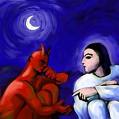
Fidelius and Diabolus: The Not So Gay Marriage Dialog

Image taken from oneyearbibleimages.com

Image taken from oneyearbibleimages.com

Diabolus: How’s it going?

Fidelius: You know we can’t talk – why do you persist?

Diabolus: That might be true if I were the Devil, but what if I’m your conscience?

Fidelius: There are no views but those of the Church.

Diabolus: True, but what about Church teaching, which acknowledges the “Sensus Fidelium” or Sense of the Faithful?

Fidelius: Stop bugging me Diabolus.

Diabolus: How do you know that’s my name?

Fidelius: You’re tempting me to think for myself. You’re torturing me.

Diabolus: No one can control your mind and heart. What’s bothering you?

Fidelius: I will take my counsel from my confessor, not from a post-Pepperoni heartburn!

Diabolus: “Pepperoni.” What a great name! Why don’t you call me that?

Fidelius: You are what you are.

Diabolus: And what is that?

Fidelius: The Tempter, the Evil One.

Diabolus: Have I ever suggested that you do anything wrong? Did I set your eye to wandering or encourage you to blow up when the Angels didn’t make the pennant?

Fidelius: Good people are tempted under the guise of good.

Diabolus: So, you’re a good person?

Fidelius: Yes. Generally, that is.

Diabolus: So then, why are you thinking about “it” again.

Fidelius: What “it”?

Diabolus: You know. Your conflict about gays.

Fidelius: They’re disgusting, you know that.

Diabolus: That’s not an uncommon opinion.

Fidelius: They make me squirm – and now they want to get married!

Diabolus: So, you think that it would be better to encourage them to stay with promiscuity as opposed to having a life of fidelity?

Fidelius: There can be nothing good in an act that is “intrinsically evil”.

Diabolus: So, you mean that you and Cynthia have never done anything “kinky”?

Fidelius: Shut up. We’re married.

Diabolus: My point exactly. You know, pleasure in marriage used to be called concupiscence.

Fidelius: What’s that?

Diabolus: You know – messed up like everything else after the fall of Adam and Eve.

Fidelius: So now you presume to teach me moral theology!

Diabolus: No. You learned it at that expensive Catholic college. Remember – the one you drank your way through?

Fidelius: Yeah, but it was after Vatican II. They weren’t Catholic anyway.

Diabolus: You mean like old Father Sullivan, who came to class in his cassock with the old yellowed pages on St. Thomas Aquinas?

Fidelius: He was different.

Diabolus: Yeah – he made you sweat to get a “C”. Not like the easy liberal that you gave you a “B+” for some beer can “sculpture” you threw together at the last minute.

Fidelius: Yeah, he was real.

Diabolus: Wasn’t he the guy that told you to have a happy sex life when you got married?

Fidelius: How do you know that? That was in confession!

Diabolus: Remember? I was there.

Fidelius: All I felt was so dirty.

Diabolus: You thought that he was going to throw the book at you.

Fidelius: Yeah, but he didn’t.

Diabolus: But there was a sin you didn’t confess.

Fidelius: What do you mean?

Diabolus: You remember. The time you stopped your fraternity brothers from beating up David Farnsworth, the fag?

Fidelius: He wasn’t gay – besides, “fag” isn’t politically correct.

Diabolus: Yeah. That’s why you found him dying in the AIDS ward a few years later at St. Mary’s, when you were helping the administration get their finances in order! A young guy out of business school and you go through the wrong door!

Fidelius: He never had a chance.

Diabolus: What do you mean? We all have free will. We all make choices.

Fidelius: His only moral choice was not to have sex.

Diabolus: He could have had a partner. You know – spend their lives together and all that? Maybe adopt a kid?

Fidelius: It would have been one mortal sin piled on another. He’d be deeper in Hell than he is now.

Diabolus: You don’t believe that.

Fidelius: Well, I heard Fr. Sullivan got to him before it was too late. But Purgatory’s no picnic.

Diabolus: So why did you pay for the Plenary Indulgence for him?

Fidelius: I didn’t pay for it. I just made an offering.

Diabolus: Strange. All this good will. Did you have a thing for this guy?

Fidelius: He was a guy. Got it? Like anybody. He deserved some decency, some respect.

Diabolus: But not a home.

Fidelius: He wasn’t homeless. He was making good money as an attorney.

Diabolus: No one to come home to; just work, parties, the bars …

Fidelius: He knew marriage was for straights. He was a good Catholic.

Diabolus: Yeah right. A gay can be a good Catholic; as likely as the Good Samaritan.

Fidelius: The Samaritan was real.

Diabolus: Maybe – or was he just a way for Jesus to show up the “good” people who had no compassion?

Fidelius: We can’t encourage gay culture. We’d be undermining the family; the basis of society.

Diabolus: Right. We can’t encourage a culture of life and fidelity.

Fidelius: It’s wrong. Remember, God made Adam and Eve – not Adam and Steve.

Diabolus: An interesting piece of demagoguery, but it doesn’t seem very compassionate.

Fidelius: The kids’ll get the wrong idea. They’ll think it’s okay.

Diabolus: Is that why so many gay people hate themselves?

Fidelius: It’s not my problem.

Diabolus: David became your problem when you saved him from that pack of apes.

Fidelius: I would have done it for anybody. Nobody deserves that kind of hate.

Diabolus: So where do you stop on this slippery slope?

Fidelius: It’s easy. The Church says, don’t beat ’em up but don’t let ’em get married.

Diabolus: That’s why you and Cynthia have only 3 kids – after 20 years?

Fidelius: We couldn’t have afforded more kids. You know that. With Cynthia’s problems it probably would have killed her.

Diabolus: So you love your wife more than God?

Fidelius: There’s a difference between God and the Church.

Diabolus: So who’s being the Devil now?

Fidelius: It’s in the Apostles Creed… “I believe in God, the Father Almighty.” Toward the end it says “I believe in one, holy, catholic, and apostolic church.”

Diabolus: Conscience. That weasel thing you picked up from those liberal priests!

Fidelius: It was a Vatican II thing. I had to write a paper on it.

Diabolus: So you did learn something!

Fidelius: Only because Fr. Sullivan made me re-write it 3 times.

Diablolus: I can’t imagine St. Thomas being on the side of conscience. He was a real theologian – and a saint.

Fidelius: Yeah. It’s a big thing for him – like it was for those Moslems philosophers he studied.

Diabolus: They only blow up stuff.

Fidelius: Conscience. You know – “formed according to the teaching of the Church.”

Diabolus: So why did Aquinas end up on the list of forbidden books so long?

Fidelius: He was accused of subjecting God to human reason.

Diabolus: Well I gotta go. Time “to prowl about seeking the ruin of souls”.

Fidelius: What about me?

Diabolus: You’re hopeless!

Fidelius: Hopeless?

Diabolus: Just the opposite, I’m afraid. No sale here today.

Fidelius: What about gay marriage?

Diabolus: Deciding that by a crowd? I like lynchings. Remember? But you know, it’s not my thing. You should look at that WMD “weapons of mass destruction” bracelet you wear.

Fidelius: It’s WWJD! What would Jesus do?

Diabolus: Yeah. I wonder. Later dude.. out’a here..

Read More

Posted by on Apr 10, 2008

Paul Tillich on Grace – Quote of the Day

Memory, Identity, and Resurrection

sky-computer-generated.jpg

This Easter Season, I have been puzzling over why the people who lived with Jesus and shared the intimacies and hardships of his travels didn’t recognize him when they encountered the Risen Christ.

I have been reading Oliver Sacks’, Musicophilia: Tales of Music and the Brain, and came across the notion of emotional memory. Sacks relates the very tragic case of a brilliant music scholar and choral director who suffers an almost total amnesia as the result of encephalitis. He had no episodic memory, which meant that everything kept popping into existence all of the time. However, his ability to sight read and play music from memory was quite intact. He also “recognized” his wife and clung to her. Apparently, according to Sacks, our physical and emotional memory is somehow distinct from our memory of events past and present. It is something much deeper. He also states that our development of episodic memory comes to the fore after the age of two. In those first two pivotal years we develop deep emotional bonds. Learning music, riding a bike, and other types of motor learning have their own place outside of episodic memory. The bonds of deep love even transcend the loss of memory of specific events.

The scene in the garden with the Risen Christ and Mary of Magdala has always resonated deeply within me. Mary is still in a serious state of shock on top of her tremendous grief. Her disorientation seems almost complete when she hears her name in the music of a voice that transcends the memory of events.

So many oceans of ink and uncounted forests have been lost to the question of how we can find the Jesus of history. The disciples left us stories and experiences that are far beyond episodic memory. Their invitation is catechetical – an invitation into the mystery of a love and relationship so intense it is beyond time and memory.

Read More

Posted by on Mar 31, 2008

Paul Tillich on Grace – Quote of the Day

Easter Communion or Condemnation?

holy-communion.jpg

To receive communion during the Easter season has been a long established precept of the Catholic Church. It is a practice that we should examine more closely. To receive Christ in the Holy Eucharist requires one to be in the state of grace – free of serious or mortal sin. We are advised – wisely – to put our souls in order. We are to turn away from sin and return to the community through the grace of absolution. There must be peace and love in our hearts and a definite change in our lives.

Fr. Burke, a Discalced Carmelite from Australia, expands on the notion of communion in terms of our living out the Sacrament of the Holy Eucharist in our shared lives as Catholics and Christians. In his article, “St. Teresa and Two Spiritualities in the Church Today,” at http://www.carmelite.com/, Fr. Burke explains St. Teresa of Avila’s views on legalism as opposed to true and complete union with God and each other. It is well worth reading.

Fr. Burke has put into words what I have been feeling ever since I read selections from the popular blog, Cafeteria Closed, by Gerald Naus, who writes as Gerald Augustinus. Naus came to the United States from Austria in 1997. A former Jehovah Witness, he became a Catholic in 2005. His views are decidedly Restorationist. Unfortunately, they are generally stated in tones of arrogance, condescension, or condemnation. His posts on culture, politics, and religion are inflammatory and provocative, akin to those of Rush Limbaugh and Ann Coulter, except that Catholicism is now the justification for neo-fascism. Naus’s recent post, On the Status of Palestinian Education, uses photos and a few inflammatory lines to libel all young Palestinian men. One might argue that many of Naus’s views are Catholic in the officially regressive sense, but there seems to be little of Christian charity or communion about them. From this narrow point of view anyone who does not agree with him is wrong and should be attacked. As a major blogger, Naus has a large following in which to sow his seeds of dissension.

You will know them by their fruits. (Mt 7:20)

Read More

Posted by on Mar 30, 2008

Paul Tillich on Grace – Quote of the Day

Easter Tide: The Age of Faith

christ-carmelite-icon.jpg

It’s all so obvious – right? Jesus is Risen. The women and men closest to Him have all seen Him, touched Him.

Yet they only recognized Him with difficulty. St. Mary of Magdala’s grief was not broken until Jesus called her by name. The Apostles recognize Him with difficulty and Jesus takes the initiative to introduce Himself. There is an air of surprise – an awkwardness that Jesus breaks with the greeting used by Angels and other heavenly visitors, “Peace be with You”. It is easy enough to see this as a blessing, but not as the gesture of reassurance that it is. The Risen Christ is not the historical Jesus that He was. Beyond time and space, the Divine Word – God Eternal – is now and ever was.

We can all now live in the Risen Christ and He in us.

“Without seeing you, We love you;

Without touching you, We embrace;

Without knowing you, We follow;

Without seeing you, We believe.”

– David Haas, “Without Seeing You”, from the album “Glory Day”.

Read More

Posted by on Mar 24, 2008

Paul Tillich on Grace – Quote of the Day

Dance: The Easter Sacrament

dancing-children-nolde-1913.jpg

Yesterday on Easter Sunday, we sang a second communion hymn in Spanish and English “Resucitó” (He Is Risen). The latin beat, punctuated by conga drums and a driving bass line, turned most of us cradle Catholics into momentary Baptists, as our middle class “cool” gave way to clapping, toe tapping and widespread joyous singing. We were too well brought up to be too demonstrative, but this did not stop the smaller children from launching into a marvelously free dance of joy, aided by their older siblings. It was all in keeping with our name – Resurrection. Granted, we are not the most conventional group, which is saying something in Santa Cruz County. The concluding bars were punctuated by “gritos,” those characteristically Mexican musical shouts of joy, from the smaller children, whether Mexican or not. Things got more animated when we ended Mass with the spiritual, “O They Rolled The Stone Away”.

Terry Hershey, in the March 24, 2008 issue of his newsletter, Sabbath Moments, is also carried away by dance. Yes, Easter Week is a time to stop pursuing happiness and to just be happy.

Read More

Posted by on Mar 24, 2008

Paul Tillich on Grace – Quote of the Day

Easter: Not Recognizing the Risen Christ

mary-magdalene.jpg

The very core of Christianity is the amazing tenacity of the believers to assert the impossible – a man publicly tortured to death rose from the dead. What is even more surprising is that they did not recognize Him.

Seeing loved ones after they are dead is not that uncommon among those stricken with grief. According to psychologists, this delusion always produces an immediately recognizable image of the dead person.

One of the most affecting scenes in the Gospel is the encounter between that most faithful of disciples, Mary of Magdala, and the Gardener in the Gospel According to St. John, Chapter 20: 10-18.

Then the disciples went back to their homes, but Mary stood outside the tomb crying. As she wept, she bent over to look into the tomb and saw two angels in white, seated where Jesus’ body had been, one at the head and the other at the foot.

They asked her, “Woman, why are you crying?”

“They have taken my Lord away,” she said, “and I don’t know where they have put him.” At this, she turned around and saw Jesus standing there, but she did not realize that it was Jesus.

“Woman,” he said, “why are you crying? Who is it you are looking for?”
Thinking he was the gardener, she said, “Sir, if you have carried him away, tell me where you have put him, and I will get him.”

Jesus said to her, “Mary.”
She turned toward him and cried out in Aramaic, “Rabboni!” (which means Teacher).

Jesus said, “Do not hold on to me, for I have not yet returned to the Father. Go instead to my brothers and tell them, ‘I am returning to my Father and your Father, to my God and your God.’ “

Mary Magdalene went to the disciples with the news: “I have seen the Lord!” And she told them that he had said these things to her.

In the the other encounters of the disciples with the Risen Christ, there is a similar pattern. The very people who lived with Him on a daily basis, shared His travels, and even argued with Him, didn’t recognize Him. The reality was so much beyond a delusion of grieving friends and followers, so much beyond irrational expectation, that we only get a glimpse of how preposterous it was in the expressed doubts of Thomas. (John, chapter 20)

More than any other event in the Gospels, the stories of the empty tomb, the encounters, the general chaos that occurred is hard for us to fathom, let alone appreciate, since we have heard the story so many times. The story of the suffering and death of Christ is always muted for us because we know how the story ends. The men and women who followed Jesus were more bewildered and confused on that first Easter because what they heard was so outlandish.

The term for Easter in Romance languages drives from Passover – “Pascua” in Spanish and Italian, and “Paques” in French. Since the English term doesn’t bear this heavy direct reference to Passover – the Passover of the Lord – we can miss a key fact of experiencing the Resurrection – being led out of bondage is a tumultuous, confusing, and fearful process. We can cope with grief, disillusionment, and grinding oppression, finding comfort in cynicism, skepticism, or addiction. Resurrection for us is only a painful beginning, an inconvenient surprise, getting stretched on a rack of hope.

Having seen the worst, Mary of Madgala, like us, could conceive of only the worst when she saw the empty tomb. These glorious “men” in white must have taken the only memento left of the Teacher whom she so desperately loved. Where was his body? She had come to do the courageous and loving act allowed to women of her time. But there was no body.

Everything shattered when she heard her name, in a voice that no other could have uttered. Her love would only cause more problems. Are we ready for that?

Read More

Posted by on Mar 20, 2008

Paul Tillich on Grace – Quote of the Day

Holy Thursday on the California Coast

cal-coast-spring.jpg

Holy Week on the California coast, from Pt. Mendocino above San Francisco to the Mexican border, is a place of spring time sun, deep blue skies, and blossoming flowers. At the Equinox, the ocean loses its grayness and picks up more yellows, subtle greens and muted turquoise. The salt air becomes more pungent, as the kelp forests put on new growth to accommodate the explosion of trillions upon trillions of sea plants and animals. The succulents and coastal chaparral burst out in purples, roses, and pinks, peppered with the bright yellow of sour grass blossoms. The Santa Cruz redwoods seem to stretch, fresh washed from the winter storms, looking forward to the morning and evening fog that gives them sustenance and flourishes their layered ecosystems that change every 20 feet upward, dancing in the dappled ray filled sunlight of the forest canopy.

It is a time of happiness and rejoicing. Sunglasses come out, flip flops slap the pavement, and shorts replace the winter denim, even though the day time temperatures are barely in the mid-60s. It is the coming of First Summer, before the Fog Season that begins on Memorial Day in late May and ends on Labor Day in early September. On the Central Coast, we host our first guests during Spring Break and settle in to enjoy the peaceful days before our June to August onslaught of shivering, fog-bitten visitors and their much welcome tourist dollars.

Aren’t we supposed to be down or at least subdued during Holy Week? How can we rejoice Saturday evening and Easter if we have somehow not rationed that joy? We should at least lament our unfaithful adherence to our Lenten resolutions – right? Christ’s terrible torture and death stayed the arm of a rightfully vengeful Father, so shouldn’t we show at least some token of fear for not being swept out into hellfire? If God’s Spring and Passover are any indication, maybe Cotton Mather had it wrong. Maybe we are a lot more than “Sinners in the Hand of an Angry God.”

If we, and all creation, are the overflowing love of the Trinity, are we the products of a God who can somehow demand the death of the the Eternal Word Made Flesh, God’s very immediate recognition and instantaneous self-acceptance, who shares the eternal dance of the Three in the joy of the Holy Spirit? Yes, much of the language that shapes our souls is a reflection of the fallen world where the Word “pitched his tent” – the actual Greek expression we use in the Creed. Yes, Jesus died and saved us in his rising from the dead. Yes, Jesus is the Lamb of God. Yes, we are the reason, we are his motivation for sharing our lives and submitting to the capital punishment of being tortured to death by an occupying superpower. Perhaps, the gravest sin of pride is to even think that we were the cause. Yes, God as Love couldn’t bear to leave us to the fate of hatred, despair, and alienation.

Why should people celebrating their rescue be glum, depressed, lost in narcissistic guilt? Why is this night different from any other night? It is the Passover of the Lord. If we are not washed in joyful Spring, can we share the Passover meal? Can we have any part in Him?

Read More

Posted by on Feb 14, 2008

Paul Tillich on Grace – Quote of the Day

Valentine’s Day Reflections 2008

 love.bmp

February 14 is Valentine’s Day, a day focused on love. Marketers have been promoting their products for several weeks now – trying to convince us that their particular product is the best possible way to say “I love you” to that special someone in our lives. And lots of us will buy something to express our love for those special people with whom we share our lives.

I remember one year when I received a waffle iron for Valentine’s Day. The women at the shop where my husband was getting his hair cut were horrified that he would get a small kitchen appliance for me. But he was right – I was thrilled. I love waffles and the old waffle iron I’d gotten 10 years earlier at a garage sale had finally broken – metal fatigue. It was a wonderful gift. We had waffles for dinner that night!

Valentine’s Day is a feast whose origins are found in legends about holy men who lived long ago. We don’t know much about St. Valentine, or even which man he actually was – there were several Valentines who were martyred in ancient days. The name means worthy and was popular in Roman times.

Many of the traditions related to Valentine’s day had their origins in the Middle Ages. It was believed then that birds began to choose their mates in mid-February, so the day seemed appropriate for celebrating romantic love. Fr. James McSweeney, on his website, www.todayismygifttoyou.com has a couple of lovely pieces about St. Valentine and love today.

Another essay I found this morning is by Timothy Chambers, a philosophy teacher at the University of Hartford in Connecticut. He talks about love potions mentioned in old legends and about what is really necessary for love – the stuff that can’t come out of a bottle. Of course, physical attraction is important in human love (and it might conceivably be produced by a “love potion”), but even more important are memories of happy times together, trust and faith in the beloved and the free choice to love in bad times as well as in the good times.

My wish for you today is that you know love. A love deeper than the sea and higher than the sky. The love that fills your being with the unshakeable certainty that nothing can ever come between you and the Lover, between you and your Creator. You are loved and loveable because you were loved into existence and are held in existence by that same love. Just as you are. With all your gifts and faults. You are loved.

Peace be with you. Now and always. Happy Valentine’s Day.

Read More

Posted by on Feb 8, 2008

Paul Tillich on Grace – Quote of the Day

Saint of the Day: St. Josephine Bahkita – February 8

st-josephine-bakhita.jpg

St. Josephine Bahkita (1869-1947) was born in Olgossa in the province of Darfur, Sudan. She was kidnapped and sold into slavery at the age of 7 and was sold 5 times in the markets of El Obeid and Khartoum. Her suffering and abuse were immense. Her fourth owner, an Ottoman army officer, had her and his other slaves tatooed and scarred to mark them as his property. Once the sons of her owner beat her so severely that she could not move from her straw pallet for a month. Her fifth buyer was the Italian consul ,who treated her more humanely, but nevertheless gave the 16 year old to one of his friends, who made her a nanny to his daughter. St. Josephine and the girl she cared for were sent to the Canossian Daughters of Charity in Venice while the parents returned to Africa.

Upon their return, St. Josephine refused to leave with them. In the ensuing court case, the Canossian Sisters and the Patriarch of Venice intervened on her behalf. The court upheld her freedom and she returned to the Canossian Sisters. She spent the rest of her life happily as the door keeper in the convent in Schio and was in frequent contact with the community. St. Josephine was known for her cheerfulness and holiness. In her later years, her order asked her to write her memoirs and to give talks about her life story. Efforts to declare her a saint began soon after her death in 1947 and she was canonized (declared a saint) in 2000.

As terrible as her story of slavery is, it might be more bearable if we could relegate it to the horrors of 19th century Africa. Unfortunately, turmoil in Darfur and human trafficking are even more prominent today. There might be some solace in St. Josephine’s designation as the patron saint of Sudan, except that genocide in Darfur is directed at Christians and animists by a hostile government in Sudan which is protected from international sanction by its commercial ties with China. The persecution of Christians has spread to other African countries in recent years as well.

St. Josephine is remarkable not only because she was able to survive such a cruel childhood and adolescence, but because she rose from it in a spirit full of happiness. Bitterness, depression, anxiety, even hostility, and self-destruction are the more likely outcomes of such an horrendous youth. Credit also has to go to the Canossian Sisters who could have turned a blind eye to the plight of an African and not opposed a prominent family. St. Josephine could have taken a certain morose refuge with the Sisters, but instead she became an unassuming beacon of holiness.

I don’t think that she would want us to forget about Darfur and the resurgence of slavery in our globalized economy. What will we say when we meet her one day? Make a donation to help out.

Image of St. Josephine Bahkita from the website of the Canossian Daughters of Charity.

Read More

Posted by on Feb 7, 2008

Paul Tillich on Grace – Quote of the Day

Christ in the Desert and the County Jail

christ-of-maryknoll.jpg

On Shrove Tuesday, while much of the world was at Mardi Gras, I was praying and sharing scripture with a small group of inmates at the county jail. Our scripture was the Temptation of Christ (Luke 4:1-19). One thing that emerged in our prayer and reflection was Christ’s acceptance of the Father’s way of rejecting power and advantage in the announcement of the Kingdom.

Why take the hard way? God could have redeemed us in many different ways. Why such a horrible death? Why did the Spirit drive Jesus into the wilderness after his baptism by John? Why was the Son of God fasting and praying for 40 days?

One of our group restated a common view that the offenses of humanity had become so severe that God demanded the most severe appeasement. I suggested that maybe the answer was in the persistence of evil in our lives. For so many of the men I was praying with, their lives had been damaged by forces beyond their control – poverty, addiction, and mental illness. (Hardened criminals generally don’t come to a prayer meeting in our jail. The faith of those who do come is something, I am sure that Jesus did not find in Israel and does not find in most respectable Christians.)

Christ, who was like us in all things but sin, chose to identify with the powerless and to put his faith in the Father through non-violence. Utter foolishness – according to St. Paul. In our suffering and defeat how could we be one with a God who was not defeated – a God who was not an utter failure? Did the Father exact this humiliation out of a some perverse pleasure unworthy of a human father?

That community of Divine love – Father, Son, Holy Spirit – Creator, Redeemer, Breath of Life come to the heart as love. Love can never be forced. True love can never come through power, glamour, or glitz. As we reflected and prayed it became more obvious to us that God can only come to us in compassion and that is how we come to him. Yet compassion is not compatible with power, wealth, and success – like a camel passing through the eye of the needle.

God with us. God like us. Powerless in love.

Read More

Posted by on Jan 22, 2008

Paul Tillich on Grace – Quote of the Day

Saint of the Day? – Martin Luther King, Jr.

martin-luther-king-jr.jpg

Martin Luther King Jr. (January 15, 1929 – April 4, 1968) achieved a moral stature and Christian witness that continues to inspire people of all faiths across the world. His life and work is commemorated not as a feast of the Roman Calendar but of the United States, on the third Monday of January each year. The human rights leader and Nobel Peace Prize laureate was 35 at the time of his assassination in Memphis, Tennessee.

Most people are familiar with his “I Have A Dream Speech” on the National Mall in Washington, D.C. However his final speech, delivered on April 3, 1968, “I Have Been to the Mountain Top,” not only presaged his death, but summarized his great vision for us all. You can hear by clicking on this link. It is well worth hearing in its entirety, not only because Dr. King was one of the great masters of English rhetoric, but the actual spoken message in its wonderful cadences, rich inflections, and profound rhythms stirs the soul with their inspiration.

Is Dr. King a saint? It is ironic to pose this question in regard to a Baptist minister, whose denomination – among others – has criticized the “worship” of the saints by Catholics. Like Dorothy Day, we can probably assume that Dr. King would dissuade us from giving him the title and remind us to return to the work of serving the least among us.

What is most remarkable about Dr. King’s legacy was the Christian witness of non-violence. Very easily, Dr. King could have kept the oppression of black people in the United States on a political level and built a base of power for himself. He also could have kept it on a “spiritual” level by focusing on the “next” life. Dr. King did neither. As a result, he elevated the whole movement to one of social justice and human rights for the children of God – of the “I” encountering the “thou” of the other person.

Let us develop a kind of dangerous unselfishness. One day a man came to Jesus, and he wanted to raise some questions about some vital matters of life. At points he wanted to trick Jesus, and show him that he knew a little more than Jesus knew and throw him off base….

Now that question could have easily ended up in a philosophical and theological debate. But Jesus immediately pulled that question from mid-air, and placed it on a dangerous curve between Jerusalem and Jericho. And he talked about a certain man, who fell among thieves. You remember that a Levite and a priest passed by on the other side. They didn’t stop to help him. And finally a man of another race came by. He got down from his beast, decided not to be compassionate by proxy. But he got down with him, administered first aid, and helped the man in need. Jesus ended up saying, this was the good man, this was the great man, because he had the capacity to project the “I” into the “thou,” and to be concerned about his brother.

Go and do likewise. (Luke 10:37)

Like anybody, I would like to live a long life. Longevity has its place. But I’m not concerned about that now. I just want to do God’s will. And He’s allowed me to go up to the mountain. And I’ve looked over. And I’ve seen the Promised Land. I may not get there with you. But I want you to know tonight, that we, as a people, will get to the promised land!

And so I’m happy, tonight.

I’m not worried about anything.

I’m not fearing any man!

Mine eyes have seen the glory of the coming of the Lord!!

Read More

Posted by on Jan 1, 2008

Paul Tillich on Grace – Quote of the Day

A New Year – 2008

sunrise.jpg

A new year begins today. Opportunities, challenges, joys, sorrows, laughter, tears – all the ups and downs of life await us anew.

May your new year be one filled with peace, joy and the assurance that you are loved by the One Who is Love – just as you are, with no need to try to be someone else or to change yourself into someone lovable. You are already lovable. You are loved.

Happy New Year!

Read More

Posted by on Dec 23, 2007

Paul Tillich on Grace – Quote of the Day

Holiday Grace Means Reducing Stress

star.jpg

Christmas and New Years are times for that bane of all good people – temptation in the guise of Good. St. Ignatius Loyola is well known for this insight into the primary way good people fall from grace. One of the fool proof temptations is to get people so wound up in getting everything right, that they get it all wrong.

Here are some ideas:

Budget your time, money, and calories. Becoming exhausted, financially stressed, and sending your blood sugar into outer space are all great ways to make you feel down, miserable, and ready for a fight.

Prioritize you activities. Turn off the Christmas machine! It’s a time for celebration. Select activities you and your family really want to do. Get help. Delegate tasks. Indulge in just relaxing, breathing, praying.

Don’t try and solve family issues over the holidays. It can happen, but usually it only happens in greeting cards and holiday movies. Be peaceful and prayerful. Take care of yourself and avoid toxic people and situations. You have a much better chance of being successful in handling difficult relationships during less stressful times and occasions.

Decorations and “house beautiful” have nothing to do with a manger in Bethlehem. You and your loved ones will remember and cherish the warmth and the love that come from imperfect decor, meals, and people. The greatest gift you can give yourself and your loved ones is relaxation. Banish the junk food devil. Holiness is in simple slow food – nothing elaborate – just healthy and good.

Your daily examination of conscience should include rest, wholesome food, plenty of water, and exercise. Remember it’s supposed to be a holiday, not two weeks on a forced march. Make sacred time for yourself – alone with God or at least a good book.

Remember, the truest sign of grace and holiness is laughter. It is a time to have fun. Laughter brings us closer to our family and friends, boosts the immune system, and relieves stress.

Watch out for impulse anything — eating, spending, drinking, or decision making.

If you feel out of sorts, it is time to watch out for the four horseman of the holiday apocalypse: Hunger, Anger, Loneliness, Fatigue. Be peacefully aware of your moods and feelings. You determine how you will respond to people, situations, moods, and feelings. Live in God’s grace and so will the others around you.

Read More

Posted by on Dec 23, 2007

Paul Tillich on Grace – Quote of the Day

Quote of the Day – Blessed Teresa of Calcutta

mother-child.jpg

I came across this quotation today from Blessed Teresa of Calcutta. As we prepare to celebrate God’s love for us, in becoming one of us, this is a reminder of how we are to accept that love and pass it on.

“Love cannot remain by itself – it has no meaning. Love has to be put into action and that action is service. How do we put the love for God into action? By being faithful to our family, to the duties that God has entrusted to us.”

As we enter into the final couple of days before Christmas, let’s try to remember to cherish each other, to take the time to smile and laugh together, to give a hug to someone we love and to take the time to be together. Those are the things that will make Christmas truly memorable. They are the gifts that really matter when all is said and done. And in giving these gifts of love and time, we give the only things that will remain with our families and our children forever.

Read More