Pages Menu
RssFacebook
Categories Menu

Posted by on Dec 14, 2007

Saint of the Day – St. John of the Cross

Saint of the Day – St. John of the Cross

st-john-of-the-cross.jpg

December 14 is the feast day of St. John of the Cross (1542-1591), a mystic, reformer, and one of the greatest poets of Spanish literature’s Golden Age. He was born Juan de Yepes y Alvarez into a “converso” or converted Jewish family. His father died when he was young and he and his two older brothers, along with their mother, moved from village to village in Castilla, suffering from poverty and rejection by both Jews and Christians. At Medina del Campo, from 1559 to 1563, he studied humanities at the Jesuit school. In 1563, he entered the Carmelite Order and in 1564, he studied philosophy at the Colegio San Andres at the University of Salamanca. In 1567, he was ordained a priest and wanted to join the Carthusians, since he felt called to a life of silent contemplation. St. Theresa of Avila convinced him to help her reform the Carmelites instead.

In 1568, he co-founded the Discalced Carmelites ,with St. Teresa of Avila. (The were called discalced because they returned to the custom of walking bare foot.) St. Teresa had a vision for restoring the Carmelite order to its original austerity and seclusion from the world. St. John founded the first Discalced Carmelite monastery at Duruelo in 1569. There was great opposition to the reform within the Carmelite Order. He was imprisoned in Toledo by his superiors for 9 months, from December 1577 to August 1578, when he managed to escape after brutal treatment and privation. His tormentors tried to sway him from his leadership of the reform movement, which had been legitimately authorized. Nevertheless, St. John of the Cross went on with the reform and produced wonderful poetry and treatises on the spiritual life.

It may seem incomprehensible to us today that there could be opposition to such a reform that would return an order to its original vision. However, many of the men and women in convents and monasteries at the time were placed there by their families, especially if they were younger sons and daughters. A position in the Church strengthened the family’s position and avoided the costs and alliances that came with marriages. Making the best of a bad situation, many of these men and women with “enforced” vocations tried to live as comfortable a life as possible. They weren’t called to live lives of austere, silent contemplation and fought the reform.

Just as he had suffered from those opposed to the reform, St. John’s latter years would be marked by suffering from those who embraced the reform but went too far in their austerity. When he opposed and corrected their excesses, they did their best to neutralize his influence. St. John of the Cross died in 1591 after he had been denied adequate medical attention and endured isolation. It seems that much of his maltreatment by both sides was not due entirely to his authorized reform activities. He was a “converso” and considered a renegade and certainly beneath the standing of so-called “pure bloods,” who resented and were shamed by his holiness and learning.

el-greco-toledo.jpg El Greco’s “View of Toledo”

St. John of the Cross was a man of great courage, without bitterness, because his suffering never conquered him. Thomas Merton reflects on the imprisonment of St. John of the Cross in Toledo as an example of the holiness of a saint coming from grappling with the problem of evil. Why do good people suffer? Why do I suffer? His response during his inhuman imprisonment was to write a major part of one of his greatest poems on union with Christ, The Spiritual Canticle. Out of great darkness and suffering came great light and peace.

Stanzas Of The Soul

One dark night,
fired with love’s urgent longings
—ah, the sheer grace!—
I went out unseen,
my house being now all stilled.

In darkness, and secure,
by the secret ladder, disguised,
—ah, the sheer grace!—
in darkness and concealment,
my house being now all stilled.

On that glad night,
in secret, for no one saw me,
nor did I look at anything,
with no other light or guide
than the one that burned in my heart.

This guided me
more surely than the light of noon
to where he was awaiting me
—him I knew so well—
there in a place where no one appeared.

O guiding night!
O night more lovely than the dawn!
O night that has united
the Lover with his beloved,
transforming the beloved in her Lover.

Upon my flowering breast
which I kept wholly for him alone,
there he lay sleeping,
and I caressing him
there in a breeze from the fanning cedars.

When the breeze blew from the turret,
as I parted his hair,
it wounded my neck
with its gentle hand,
suspending all my senses.

I abandoned and forgot myself,
laying my face on my Beloved;
all things ceased; I went out from myself,
leaving my cares
forgotten among the lilies.

Read More

Posted by on Dec 8, 2007

Saint of the Day – St. John of the Cross

Feast of the Day: The Immaculate Conception of the Blessed Virgin Mary

immaculate-conception.jpg

December 8 is the feast day of the Immaculate Conception, a solemnity celebrating the conception of the Virgin Mary. According to apocryphal writings, Mary’s parents were Joachim and Anna. Mary’s conception, which occurred in the natural way, was special in that Mary was spared the “stain” of original sin.

There has been a long tradition of celebrating the feast of the Virgin’s conception by her mother. There has also been a long tradition that Mary was redeemed in anticipation of the redemption of all humanity by her son Jesus. St. Thomas Aquinas and others taught that Mary’s redemption occurred sometime after her conception, to conform with the scripture that all men and women have sinned except Christ. The issue has to do with the fact that God’s becoming fully human in the mystery of the Incarnation, when Mary conceived Jesus, could only have occurred in one who was sinless and not subject to the pain and weakness of a fallen human nature. When the angel Gabriel saluted Mary, he addressed her as Full of Grace. This greeting would not have made sense – according to the long tradition of theology – if Mary were tainted by the fallen state that afflicts every other human until Baptism.

Devotion to Mary, the mother of Jesus, was recorded in early feasts emphasizing her role in salvation history. Mary’s “yes” to the angel Gabriel set everything in motion when she was overshadowed by the power of the Most High. During the controversies about the nature of Christ in the early centuries, titles given to Mary became very important. If Jesus was truly human and divine, Mary became Theotokos – Mother of God. If Jesus was not truly God, Mary was called Christotokos – Mother of Christ.

Exactly how and when Mary was delivered from the sinful state all humans share was not formally defined by the Catholic Church until 1854 by Pius IX. Contrary to the theology of several prominent saints, Mary, from the first moment of her existence, was spared the blockage of grace we call original sin.

An Episcopalian priest, Fr. Matthew Moret, has produced a very short You-Tube video, “Making Sense of Sin,” which succinctly reviews previous conceptions of sin and what these conceptions say about our conception of God. The common concept of sin as a transgression sets God up as the cosmic Judge. Our relationship is not personal but juridical. God’s love becomes conditional on our surrendering our will to His. This concept can be one of a vindictive or manipulative God. Our concept of sin can alienate us from God, contrary to His Divine mercy, love, and grace, which never leave us. Fr. Moret’s short but excellent video presents Kathryn Tanner’s concept of sin as blockage. God continues to heal us, to provide for us in all ways, but we have a diminished capacity to accept or even recognize God’s continual outflowing of good and love to us. Sin is far from trivial, as demonstrated by the brief slide of an entrance to a Nazi death camp.

Mary, Full of Grace and Mother of God. There must have been no blockage. How did that happen?

Read More

Posted by on Dec 5, 2007

Saint of the Day – St. John of the Cross

Polarization in the Church – The Kingdom Rent Assunder?

brontosaurus-apatosaurus.jpg

“A kingdom divided against itself cannot stand.” (Mt 12:25) Many of the sayings of Jesus are hard to understand or accept. This one seems only obvious.

It is often said that the lack of Christian unity is a major hazard or stumbling block – scandolos or “scandal” in Greek – for those trying to enter the Kingdom or the Reign of God. The good news is that various groups have begun to treat each other as Christians and not as minions of the anti-Christ. The bad news is that major denominations are split over the existence of the brontosaurus in the sanctuary.

Some people say the beast is an elephant because people experience it differently – like the blind men in the fable. For some it is a rope, for others tree stumps, for a few it feels like a snake. The “elephant” school says that issues like same sex marriage, women’s issues, and diversity are actually the result of a single problem – the need to update Christian ethics and not to take the Bible literally. Christian behavioral norms, according to this school, should be influenced by more enlightened cultural norms and follow the primary mandate of compassionate love.

Others say that the beast is the “Beast” of the Book of Revelation and these challenges to traditional Christian behavioral norms are the beginning of the test of the faithful. According to the “Armageddon” school, the Beast will consume the compromisers like so much buttered popcorn. Those who have not “compromised” will be caught up in the rapture and spared the thousand year reign of the anti-Christ.

Between these two extremes there is a complete spectrum of different intellectual and emotional responses to these issues. Many people are inclined to think that all of this started in the 1960s, when the world got turned upside down. For many Catholics, the secular cultural upheaval of the 1960s was nothing compared to the tsunami of the Second Vatican Council. A few think that Pope Paul VI, in ratifying the declaration on religious liberty and changes to the liturgy, committed apostasy and left the Chair of Peter vacant – Sede Vacante. According to the sedevacantists, the bishops appointed by Paul VI and the popes elected by those bishops have no legitimate authority.

At the other end of the Catholic spectrum, there are those who see Vatican II as limiting and redefining the centrality of rule from Rome. Local churches, governed by lay people, with lay presiders at the Eucharist, are seen as an authentic restoration of the Church. In response, Restorationists – including many young people – think that all these problems will go away if we return to the Golden Age of the Catholic Mass in Latin, with everyone praying their rosaries while the sacred mysteries are performed.

The beast in question is actually a “brontosaurus”(or Apatosaurus), because it is a much older and more intractable species than the elephant. It is not the Beast of the Book of Revelation because it is all too confused and political – and it doesn’t have the gaping maw. The “brontosaurus” is the challenge of living the Christian life and being church in a rapidly changing and unstable world. This challenge actually dates back to the Enlightenment in the 1700’s. However, the major denominations could contain it until the industrial revolution. The urbanization of rural agrarian populations, the revolution in transportation and communication, as well as the emergence of history and the social sciences as academic fields of study, raised major questions that divided church thinkers – the theologians and philosophers. One of the most unsettling discoveries was that Christian philosophy and theology – like all human endeavors – have changed over the centuries.

The Catholic church responded by not only condemning the modern world, but also by rehabilitating the logical approach of Aquinas and Aristotle (See Arraj Chapter 2) as a means of presenting and logically defending the faith against any thought or political action that challenged it. Instead of the medieval spirit of inquiry, students got summaries of pre-digested questions and answers. Not all thinkers went along with this, but they were marginalized or condemned. This gave the appearance of well-being, but like a person with emphysema, the overuse of steroids provides comfort while it destroys the bones. On the positive side, Pope Leo XIII and other Christian leaders, led a social gospel movement to protect the interests of industrial workers. This movement continues today, with the “preferential option for the poor.”

When Pope John XXIII called the Second Vatican Council, the Curia had prepared draft agendas and documents for the bishops. No one foresaw that the octogenerian pope, who had been elected as a caretaker, would encourage the bishops to take matters into their own hands in his opening address, Gaudet Mater Ecclesia.

Having chafed under the control of the Curia, the bishops set their own course. Theologians and philosophers who had been silenced or put to the side were chosen to fill the intellectual vacuum. One of the young superstars was Joseph Ratzinger, who is now Pope Benedict XVI. The major problem was that this new school of thinking had never been tested in the open forum of discussion and debate. Conservatives did what they could to stem the tide, but the winds of Aggiornamento (updating) filled the sails of the bishops, the clergy, and more importantly, the people in the pews who now became the “laity.”

In the United States today there are approximately 3,300 men in seminary programs studying for the priesthood. There are also 33,000 men and women in graduate ministry and theological programs who are not studying for the priesthood. The vast majority of them share the same classrooms with the students for the priesthood. However, the newly ordained priests tend be in their 30’s and 50’s and are already formed as people. Many of them are more conservative and many bring with them an entrenched clericalism from their Philippine and Vietnamese cultures.

The growth of the Anglican Communion, the Catholic Church, and other denominations in Africa and Asia – the global south – has already created substantial tensions due to the immense cultural and economic differences which support more traditional behavioral codes and religious perspectives.

So the brontosaurus is alive and well – or at least it will be until we deal with these tensions so that others once again can come to know us as Jesus’ disciples by our love (Jn 13:34-35).

Read More

Posted by on Nov 21, 2007

Saint of the Day – St. John of the Cross

Feast of the Day – Presentation of the Blessed Virgin Mary

presentation-bvm-icon.jpg

November 21 is the feast of the Presentation of the Blessed Virgin Mary. This feast is based on material from the Proto-Gospel of James – an apocryphal gospel that did not make it into the canon of scripture. Mary is presented in the temple at age 3 by her aging parents in fulfillment of a vow that they made.

This is an archetypal pattern of a very special child born to aged parents who is destined for great things by God. The birth of Isaac to Abraham and Sara is the first example. The birth of the prophet Samuel to Elkanah and Hannah comes about after the barren Hannah is told by Eli, the priest at Shiloh, that her prayer would be heard. In the New Testament, John the Baptist is born to Zachary and Elizabeth according to the promise of the angel. The feast of the Presentation appears to have come from Syria in the 6th century and became prominent in the West in the 11th century. However, the Presentation did not become a universal feast until the 15th century.

Although the four canonical gospels do not mention the Presentation, the devotion of the early Church to Mary as the Mother of God makes it easier to understand why there would be such a tradition. St. John the Baptist’s prominence is emphasized by the nature of his birth. Certainly, one might suspect that the apocryphal account would resonate with Christians as giving prominence to Mary and the importance of her role. While one could argue that the Annunciation is more than ample in terms of underscoring Mary’s importance, the Presentation can be seen as a reasonable corollary.

The Second Vatican Council (1961-1965), in its Dogmatic Constitution on the Church in the Modern World – Lumen Gentium – restated the ancient belief in Mary as our mother in the order of grace.

Predestined from eternity by that decree of divine providence which determined the incarnation of the Word to be the Mother of God, the Blessed Virgin was in this earth the virgin Mother of the Redeemer, and above all others and in a singular way the generous associate and humble handmaid of the Lord. She conceived, brought forth and nourished Christ. She presented Him to the Father in the temple, and was united with Him by compassion as He died on the Cross. In this singular way she cooperated by her obedience, faith, hope and burning charity in the work of the Savior in giving back supernatural life to souls. Wherefore she is our mother in the order of grace. (Lumen Gentium The Light of Nations chap 8, III,61)

Although we might have some reservations about the feast of the Presentation as a speculative notion by early Christians, there is a modern psychological explanation that underscores its development. Mary came from a devoted family who rejoiced at her birth because she was truly God’s answer to prayer for her parents. Such love, even in secular psychological terms, is always grace filled and grace giving.

Read More

Posted by on Nov 8, 2007

Saint of the Day – St. John of the Cross

Fire, Love and God

candle.jpg

Kevin Drabinski, editor of our local diocesan newspaper, The Observer, has a wonderful reflection on fire, love and God in this month’s edition.

Drabinski begins by looking at the themes of fire, judgement, and the end of history in the liturgical readings for the end of November, and reflecting on the destructive power of wild, uncontrolled fire as we have recently seen it in southern California. The Church year is coming to a close and the readings shift to thoughts of endings. (The last Sunday of this liturgical year will be November 25, the celebration of the Feast of Christ the King.)

Drabinski then writes of the blessings of fire in its controlled state. Fire in this context is warming, comforting, light giving. He says, “One candle, quietly burning, spells hope and warmth. Many a candle, held by the hands of a crowd, is faith itself. And like faith, a candle’s light is never diminished by its being shared.”

Fire is also an expression of love – human or divine. Images are presented of the use of controlled fire in lanterns, processions, and worship. The coming of the Holy Spirit at Pentecost was accompanied by “tongues as of fire … [which] came to rest on each of them.” (Acts 2:3) The fire of God’s love, however, cannot be managed or controlled by humans. The author of the Song of Songs describes love, both human and divine, as “flashes of fire” and “a very flame of the Lord,” noting, “Many waters cannot quench love, neither can the floods drown it.”

This article is worth taking a few moments to read and ponder as we approach the end of another year. When fire and judgement and the end of history are seen through the lens of the Love of God, we can all have hope.

Read More

Posted by on Oct 10, 2007

Saint of the Day – St. John of the Cross

Quote of the Day – Thomas Merton on Gratitude

“Every breath we draw is a gift of God’s love,

every moment of existence is a grace, for it brings

with it immense graces from God. Gratitude

therefore takes nothing for granted, is never

unresponsive, is constantly awakening to new wonder

and to praise of the goodness of God. For the grateful

person knows that God is good, not by hearsay but by

experience. And that is what makes all the difference.”

                       Thomas Merton in Thoughts in Solitude

Read More

Posted by on Oct 5, 2007

Saint of the Day – St. John of the Cross

Saint of the Day – St. Faustina Kowalska and The Divine Mercy

October 5 is the feast day of St. Maria Faustina Kowalska (1905 – 1938) whose brief life and spiritual journal inspired The Divine Mercy Movement in the Catholic Church. She was baptized Helen Kowalska and came from a small village Glogowiecz near Lodz, Poland. She was the third of ten children and had only 3 years of formal education. At 14 she began working in well to do house holds as a governess. (Given her limited education she was probably more of a domestic servant.) Helen Kowalska was known as a pleasant, cheerful, and talkative young woman. When she was almost 20 she entered the Congregation of the Sisters of Mercy in Cracow as a lay sister on August 1, 1925. She worked mainly in the kitchen and the garden. She pronounced her first vows on April 30, 1926 and became Sr. Mary Faustina of the Most Blessed Sacrament.

In the convent she was pleasant, cheerful, and obedient according to her fellow sisters. She was pleasantly unremarkable until the evening of February 22, 1931 when she had her first vision of Christ, as the King of Mercy. In the years that followed she received her call to be an apostle and secretary of Christ in promoting an awareness of the Divine Mercy and living a life a life of mercy. It was not smooth sailing by any means. She was honest with her spiritual directors and confessors but no one could reassure her that the visions were really legitimate. Her fellow sisters generally viewed her experience with a high degree of skepticism. St. Faustina kept her pleasant disposition and continued to carry out all of her tasks with industry. Nevertheless, she became a social outcast and her life became miserable. Understandably, she identified with Christ in His Passion.

Relief came in 1933 after St. Faustina professed her perpetual vows. Her spiritual advisors helped her to have confidence in the visions and her relationship with Christ. When the first painting of her vision was completed she was disappointed that it conveyed very little of the great beauty of her vision. The painting was first publicly displayed in 1935 in Vilnius which was in Poland at the time and is now the capital of Lithuania. The devotion really took off with outbreak of World War II in 1939 a year after St. Faustina’s death and grew steadily for the next 20 years. The Holy See banned the devotion in 1959 due to wording in translations of devotional material. Carol Wojtyla the Archbishop of Cracow worked unceasingly for 20 years to get the ban lifted. He succeeded six months before he was elected Pope John Paul II.

In a way it not surprising that Pope John Paul II the first Polish pope, would have been inspired by her as young man. In fact John Paul II canonized (declared her a saint) St. Faustina in 2000 as the first saint of the new millenium and as a model for Christians in the third millenium. The pope also designated the second Sunday after Easter as Divine Mercy Sunday for the entire church. The day the Pope made these pronouncements, he said that it was the happiest day of his life. John Paul II would later die on the eve of Divine Mercy Sunday in 2005.

What is surprising is that such a devotion, which focuses on helping others in physical and spiritual need, would become so strong in Poland at a time when it was about to be ripped asunder by Hitler and Stalin and would reappear in a different shape and location behind the Iron Curtain as a Communist country.

Unlike many devotional movements in the Catholic Church which focus on the individual’s relationship with Christ, the Divine Mercy movement emphasizes a ministry of service to others and society. Christians are called to be the compassion of God here and now. The movement focuses on the spiritual and corporal works of mercy as outlined in Matthew 25: 35-46. ( For a list of the Works of Mercy, please scroll down to the bottom of this link in American Catholic.)

Like many Catholic devotional movements, there is an emphasis on a particular image of Christ, there is a chaplet of prayers, and a novena. Divine Mercy Sunday is now becoming a day of special devotional observance in churches which enshrine the image. The challenge for Catholic culture will be to meet the discomfort and privation of the following of Christ as promoted and lived by St. Faustina Kowalska and Pope John Paul II. If the Divine Mercy becomes yet another icon of personal comfort we will have found yet another way to say no to Christ politely.

Read More

Posted by on Oct 2, 2007

Saint of the Day – St. John of the Cross

Guardian Angels –

October 2 is the feast of the Guardian Angels. Spirit messengers and agents of the Divine are found in many world religions that predate Christianity. Angels are also a big part of New Age spirituality.

Spirithome.com’s article on Why Angels? does a good job of reviewing traditional Christian views of angels and their place in the lives of Christians. (The site is an excellent information and inspiration resource. Be sure to check it out.)

If you want to review the traditional Catholic teaching on angels, take a look at Catholic Online. It can be a little technical but is also an excellent example of a highly rational post-Enlightenment type of theology.

Angels-Online is a site devoted to contemporary stories about people’s experiences of Angels. Some stories are better than others. However, they attest to the current fascination with Angels as a sign of God’s providence or as benevolent spirits in a world of “spirituality” without religion.

The persistence of Angels in people who adhere to religion or who embrace its early earth related forms is a sign of something deeper. People perceive activity in a realm beyond immediate physical reality. If we take a closer look at non-industrialized “primitive” people, as studied by anthropologists, we see that most everything in everyday life is explained in terms of spirits. This notion that the spiritual realm is the true realm is widespread throughout world religions, including Christianity.

The belief in Guardian Angels is a belief in God’s individual care and concern for all of us. For all of us post-moderns stuck in the here and now, Angels offer us a reminder. Angels fly because they take themselves lightly.

Read More

Posted by on Oct 1, 2007

Saint of the Day – St. John of the Cross

St. Thérèse of Lisieux, Saint of the Day

Today, October 1, is the feast of St. Thérèse of Lisieux, the Little Flower. This is a picture of her as a child.

As faithful readers will recall, St. Thérèse is one of my favorite saints. I have already written about her (see my post for September 4, 2007, Triumph of the Lowly) and will not go into great detail here. Suffice it to say that in her short 24 years, she gave to the church a great gift, the Little Way. She delighted in the small things of life and determined that her calling was to love God in all His creatures and in all of creation. Although she entered a convent at the age of 15 and died there at 24, her writings have reached beyond the convent walls and touched people great and small since her death from tuberculosis in 1897.

Her Little Way to holiness is one to which all of us are called. It consists of doing the everyday things in “mindful” ways, paying attention and acting in love as we go about our everyday routines.

As she said, “I am a very little soul, who can offer only very little things to the Lord.”

In another place she wrote,”Love proves itself by deeds, so how am I to show my love? Great deeds are forbidden me. The only way I can prove my love is by scattering flowers and these flowers are every little sacrifice, every glance and word, and the doing of the least actions for love.”

As she neared her death, in the midst of a great time of personal spiritual darkness, she assured her sisters, “I will spend my Heaven doing good on earth,” and, “After my death I will let fall a shower of roses.”

When she overheard two of the other nuns wondering what would ever be said about her at her funeral, since she was so young and had really not done anything of note in her life, she was delighted. She had never wanted to be noticed as any different than the other sisters with whom she lived. Yet within just a few years of her death, her autobiography and other writings were being translated into all the major languages of the world. Her Little Way influenced theologians, popes, bishops, priests, and thousands of others both inside and outside the Church. In recognition of the depth of her contribution to the Church, Pope John Paul II, named her a Doctor of the Church in 1997.

For a more complete biographies, see:

http://therese.kashalinka.com

http://www.catholic.org/saints/saint.php?saint_id=105

http://www.thereseoflisieux.org/

Read More

Posted by on Sep 25, 2007

Saint of the Day – St. John of the Cross

Saint of the Day: St. Elzear & Bl. Delphina – The Happy Couple

Today, an unconsummated marriage would probably not be considered advisable by the Church and mental health experts. St. Elzear and Blessed Delphina were a couple who were married and lived together chastely. They are saints because of their care of the poor and the suffering. This couple is also known for their conscientious exercise of their duties as members of the nobility. Interestingly, they were known and remembered as a happy couple.

Personally, I don’t think that I would have responded by taking a vow of chastity on my wedding night the way St. Elzear did when he found out the Delphina had already made one. We have a contemporary theology of marriage that stresses and endows love making and sex within marriage as sacramental.

Certainly the late Middle Ages (St. Elzear 1286 -1323, Bl. Delphina 1283- 1358) was not a “puritanical” time. In fact, Puritanism would not happen for another 200 years and would never take root in the Mediterranean.

St. Elzear was born at the family castle in Ansouis, Provence, in the south of France. At 23, he became lord of Ansouis and Count of Ariano in the Kingdom of Naples. The Count and Contessa became influential in the court of King Robert of Naples and Elzear was the tutor to the King’s son Charles. He was also the “justiciar” or head of law enforcement and justice for southern Abruzzi under King Robert. St. Elzear died on September 27, 1323 while on a diplomatic mission to Paris to arrange the marriage of Charles to Mary of Valois. Blessed Delphina would survive him for another 35 years and spend the time in continued acts of charity.

As nobles, producing children was a serious responsibility. Even when having children was precluded due to medical reasons, noblemen usually had some illegitimate sons at hand. William the Conqueror was one such son. Since the marriage of the Count and Contessa of Ariano (St. Elzear and Blessed Delphina) was so atypical by the standards of their day and ours, how do we relate to it?

Perhaps it was a marriage of convenience, in the sense that due to their social station they were obliged to marry but would have really preferred monastic vocations. Since their state in life was determined when they were young children of a noble family, they simply found a way around it.

Young children at the ages of 5 -7 were sent as oblates to monasteries and convents. Hildegard of Bingen and St. Thomas Aquinas are two examples. We also know, of course, that many people who found themselves in “enforced” monastic vocations would do their best to bend or break the rules.

Then as now, marriages – especially those among the rich and powerful -were not happy affairs. Eleanor of Aquitaine (1122-1204) and her Church sanctioned marriages to King Louis VII of France and King Henry II of England demonstrates the far from Romantic character of such marriages. In fact, Eleanor of Aquitaine was a major promoter of the troubadour movement. The origins of what we today experience as romantic love originally began as songs of chaste love for the unattainable woman. As we know, the reality of courtly love was far from chaste, but it seemed to provide some fluidity in a tight social structure. That doesn’t mean that it didn’t cause feelings of betrayal and rejection resulting in duels, beatings, and death. The case of King Henry VIII in the early modern period (1491 -1547) provides a window onto the complexity of marriage in Europe in previous centuries.

The Count and Contessa feeding the poor, living as lay Franciscans, and in the case of St. Elzear healing lepers were definitely unusual for the time. What was probably most striking about them is that they were known as a happy couple. Their marriage – even if its lack of consummation might not adhere to the Church’s definition of one – was a partnership for a radical living of the Gospel.

In our own culture and time, can we say as much about our marriages and the joy, happiness and moral guidance they bring to others?

There are two slightly different accounts of these saints, with some inconsistencies. Please see Saint of the Day at AmericanCatholic.org and Catholic Online.

Read More

Posted by on Sep 20, 2007

Saint of the Day – St. John of the Cross

Jews and The Passion of Sister Rose

Sister Rose Thering (1920-2006) did her doctoral research on the image of Jews in Catholic textbooks. She received her degree in 1961 from St. Louis University, but her writing would be the catalyst for a significant change. Jews would no longer be labeled the “Christ killers.” The Second Vatican Council would adopt Nostra Aetate (In Our Time), a ground breaking document on non-Christians, including Jews.

Sr. Rose Thering’s research came to the attention of Cardinal Augustin Bea at the beginning of Council in 1962. Cardinal Bea was a major force in ecumenical relations. According to Fr. Eugene Fisher, the issue of anti-semitism came up early in the deliberations of the Council and was one of the last to be resolved. Anti-semitic tracts were submitted to the bishops (the Council fathers) and debunked. Diplomatic pressure came from Arab governments. Finally the issue was addressed in 15 sentences comprising section 4 of Nostra Aetate (In Our Time).

These two sentences strike down any biblical notion of the culpability of the Jewish people:

Even though the Jewish authorities and those who followed their lead pressed for the death of Christ (see Jn 19:6), neither all Jews indiscriminately at that time, nor Jews today, can be charged with the crimes committed during his passion. It is true that the church is the new people of God, yet the Jews should not be spoken of as rejected or accursed as if this followed from holy scripture. Consequently, all must take care, lest in catechizing or in preaching the word of God, they teach anything which is not in accord with the truth of the Gospel message or the spirit of Christ.

It is telling that this passage refers to the Gospel of St. John 19:6, since this Gospel casts Jews in a very negative light ,as do many other parts of the New Testament. This acrimony toward the Jews is part of a larger conflict between the two groups in the emergence of Rabbinic Judaism and Christianity after the destruction of the Temple in 70 A.D. In fact, the tension with the Christian movement regarding observance of Mosaic law and Jewish practice was also intense. Over time, the Hellenistic segment prevailed by sheer force of numbers and their ability to assimilate into the broader Graeco-Roman culture.

The persistence of anti-semitism can be seen in Mel Gibson’s film, The Passion of the Christ. The blockbuster movie followed the basic story line but contained a lot of materials that were the private revelations of a 19th century German nun. Somehow, Jesus, his family, and followers are no longer Jews but Aryans in the hands of alien hostile Jews. This reinforces something worse than a stereotype. It becomes an archetype of the Christian unconscious that structures dreams, perceptions, and ultimately – genocide.

The Jewish feast, Yom Kippur, the Day of Atonement, comes every year as Summer gives way to Fall. As Yom Kippur approaches, Sr. Rose Thering provides an excellent example of going beyond guilt. She opens the door to a new and better day for everyone.

“She was a one-woman wrecking crew,” said Rabbi James Rudin, senior inter-religious adviser for the American Jewish Committee, and a friend of Thering’s for 36 years. “What she helped wreck was 2,000 years of the teaching of contempt which was built into so much of Christian teaching.”

For an in-depth report, see the section in the Anti-Defamation League site on the 40th anniversary of Nostra Aetate (In Our Time) in October 2005.

Sister Rose’s Passion, a short documentary of Sr. Rose’s life and work, was nominated for an Academy Award in 2005. It is well worth seeing.


Read More

Posted by on Sep 14, 2007

Saint of the Day – St. John of the Cross

Feast of the Day: The Exaltation of the Holy Cross

Exhaltation of the Holy Cross

In the name of the Father, and of the Son, and of the Holy Spirit.

It is almost impossible for Catholics, Orthodox, Anglicans, and many other liturgical Christians to say these words without performing the gesture of blessing – the Sign of the Cross.

I have always liked the stories I first heard in childhood about Constantine’s vision of the Holy Cross –in hoc signo vinces, you will conquer by this sign – and the discovery of the True Cross by his mother, St. Helen.

The images are still fresh in my mind. It is also reassuring to see that there is some historical support for these stories from early church sources. We definitely know that St. Helen (Helena) dedicated the Church of the Holy Sepulcher on September 14, 335 on the site of the Tomb of the Resurrection. The location has the support of many archaeologists as the actual site.

The use of the cross as a central symbol by Christians began early in the life of the church. Early accounts from the first and second century indicate that Christians marked their homes with this sign and blessed themselves and others with it.

For millions of us, this symbolic gesture, like the prayer itself, marks beginnings and endings of liturgy, life, and rites of passage. When we went away on a trip or off to college or on those last steps to our weddings – the parental words still echo – “Here let me bless you” – followed by the sign, the words, a prayer, and a kiss.

My favorite form of the blessing for others came from a Spanish Jesuit. He said that it was used by St. Ignatius’ first companions at times of parting. “May the Holy Trinity bless you, In the name of the Father, and of the Son, and of the Holy Spirit – And as far as I am able, I bless you.”

Sites of Interest:

How the feast continues to be celebrated: Antiochian.org

Early uses of the Sign of the Cross: Justus.anglican.org

Catholic Encyclopedia: Newadvent.org

Read More

Posted by on Sep 10, 2007

Saint of the Day – St. John of the Cross

William Countryman – Homosexuality and the Bible

Scripture scholar William Countryman is part of a movement that threatens to split the Anglican Communion. Throughout its history, Christianity has held that homosexuality is an immoral act. Over the last 20 years, Papal pronouncements have referred to the sexuality of gays and lesbians as “disordered” and the act itself as “intrinsically” evil, while at the same time deploring acts of malice and violence toward homosexuals. The movement to give homosexuals full standing in the Episcopal Church has reached the point of severe strain with the confirmation of the election of the first openly gay bishop, the Rev. Gene Robinson, as Bishop of New Hampshire in August 2003.

I had always wondered how Gay Liberation in Christianity was going to deal with St. Paul’s condemnation of it in his letter to the Romans, Chapter 1. (Jesus makes no reference to homosexuality in the Gospels.) When I came across Countryman’s Dirt, Greed, and Sex. I thought that it was probably the most provocative titled book by a scripture scholar that I had ever seen.

Countryman’s thesis is simple. Romans has been misread. According to Countryman, Paul was addressing a church (congregation) which he had not visited. The group in Rome was having what today we call a cross cultural conflict. Jewish Christians objected to unclean items and practices that were part of the culture of Gentile Christians. In the first part of Romans, Countryman says that Paul was playing up to the Jewish Christians and their moral sense of superiority in order to reprimand them later. The upshot is that the Jewish Christians are not supposed to require the same observance of ritual purity by the Gentile Christians.

However, Gentile Christians are to avoid certain acts such as meat sacrificed to idols in order not to trip up (scandalize) others in their faith. In fact, Paul doesn’t see division because of the Jewish ritual purity code as the big problem. The bigger divisive issue is greed.

Countryman’s book is a very carefully crafted and detailed piece of scholarship. My description of it in the previous paragraph is a great oversimplification. The key point though, is that is possible to see the scriptural basis against homosexuality in both the Old and New Testaments in a different light based on a careful study of the language and culture of the time.

This approach is giving many Christians more than heartburn. Anglicans in Africa whose culture opposes homosexuality make up a great part of the opposition. Interestingly, polygamy is socially acceptable among many African Christians. If one can take such a linguistic and cultural approach to scripture and even tradition, should the Episcopal Church accept polygamy?

The question was part of a April 24, 2005 podcast interview with Countryman at Grace Cathedral in San Francisco. As a Roman Catholic, I have to confess some culture shock. The openness and frankness of the discussion, while refreshing, is very different from an environment in which the boundaries of belief and practice are more strictly defined. Even in everyday matters, Catholics – of a certain age – recall parents or teachers indicating that there was to be no more discussion when they heard in Latin or English “Roma locuta, causa finita.” “Rome has spoken, the matter is closed.”

This came up in the podcast regarding Anglican rejection of both Rome’s direct control of discussion by bishops and theologians and Geneva’s (read Calvin’s) objection to inquiry. “Rome cannot err. Geneva will not err.” Although dialog and collegiality among bishops may be a significant part of the culture of the Episcopal Church, what do you do when the other side doesn’t want to talk?

On the other hand what do you do when your personal experience tells you that there are good people out there who are involved – even in love with – a person of the same sex?

Stay tuned.

Read More

Posted by on Sep 5, 2007

Saint of the Day – St. John of the Cross

Mother Teresa – “Love is Left Alone”

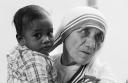
Mother Teresa 1979

Jesus has a very special love for you. As for me, the silence and the emptiness is so great that I look and do not see, listen and do not hear.
— Mother Teresa to the Rev. Michael Van Der Peet, September 1979

The Time cover story was not really news to me. I had read about Mother Teresa’s time of spiritual dryness in My Life With the Saints, by Fr. James Martin, S.J. Like most people, I never suspected that Mother Teresa’s spiritual silence and emptiness had lasted so long.

In the secular science of the soul – psychology – the current ideal of human development is one of balance. There is supposed to be an apportioning of time and energy for your internal, personal, and professional life. We are supposed to pay attention to our own personal space, our spouses, families, colleagues, communities, and the environment.

Like most ideals, it is unattainable. If we could achieve a balance in all of these relationships, we would implode under the disappearance of our own uniquely unbalanced personalities. If personal fulfillment and psychological health is not balance, it would seem that some portion of our efforts should be focused on many of these areas. What happens if your life is comprised only of ministry?

Mother Teresa of Kolkata (Calcutta) led a life beyond balance. She had no secular career, no family, no apparent hobbies. She had an all consuming ministry to those completely abandoned by society. Founding and leading a religious order and expanding the work of the Missionaries of Charity, left little time for sleep, let alone rest and relaxation.

Mother Teresa’s hyper-focus and zeal appears to go against most of the consensus about the development of the spiritual life. Spiritual directors and teachers prescribe adequate sleep, relaxation, and attention to personal and community relationships. The Rule of St. Benedict of Nursia (c. 530) comes to mind, since it has been the de facto standard in monastic living. There is a large body of Christian literature, from the earliest times, advising prudence and temperance in the spiritual life.

St. Ignatius Loyola referred to dark periods, when there is little feeling of the presence of God, as periods of desolation or aridity. Early hermits in the Egyptian desert referred to this state as the “noonday devil.

My first thought was that Mother Teresa’s lack of prudence and temperance had gotten the better of her. Yet, how could I make such an observation without knowing Mother Teresa? So, I decided to talk with someone whose home in Madras Mother Teresa had visited several times. Paul D’Souza is an old friend of ours who met her when he was 3 years old. What struck Paul was that, although the house was full, she always first sought him out and the other small children, before paying attention to any one else. Paul has had his own thoughts on harmony and balance for some time. As a management consultant and healer, Paul has his own theory of Beyond Balance.

When I asked him what he thought might have been the cause of Mother Teresa’s very long dark night of the soul, the reply was unusually sharp for someone with a master’s degree in social work. Paul remembered that Mother Teresa continually reminded her Missionaries that the face of Christ was to be found in every child, in every human person. The arduous work of caring for disabled orphans is a direct service to Christ. “What about balance?” I asked. In tones of not so patient exasperation, Paul said that in his study of leaders, “No one whoever accomplished anything was balanced.” When I pressed him on Mother Teresa as a person, he told me to talk with his mother who had met Mother Teresa several times.

I had a pleasant talk with Christine D’Souza, who is also an old friend. (Our children call her Grandma Christine.) She and her late husband, John, met Mother Teresa in 1968 in Madras, now known as Chenai. As many have recounted elsewhere, Mother Teresa was not demanding or seemingly driven. According to Mrs. D’Souza, she normally sat quietly and spoke in a soft voice while looking at her hands. Mother Teresa “put her cards on the table,” according to Mrs. D’Souza, and allowed her listeners “to pick up what ones they would,” without asking them to make any choice. Mrs. D’Souza recalls, “She had such humility, but with a strength and dignity. She reminded me of the beatitude, ‘Blessed are the meek.'” The only time Mrs. D’Souza recalls her making a request was when they first met and Mother Teresa asked her directly if she and the lay co-workers could meet at the D’Souza’s home.

When I asked Mrs. D’Souza what she thought about Mother Teresa’s decades of spiritual dryness, she responded with the wisdom of age and grace. Mrs. D’Souza said that she couldn’t speak for anyone else. She recounted that in her youth she experienced a closeness to Christ but that this emotional awareness and feeling waned over time. This absence did not keep her from raising a family, being a music educator, and engaging in many other activities in a spirit of faith.

Mrs. D’Souza recalled a few lines of a poem in a pamphlet her husband had given her:

God gives us love.

Something to love He lends to us.

Love reaches ripeness,

and of that on which it throve,

Love is left alone.

Read More