A Time for Mercy, A Time for Love…
Carly Paoli, a rising English talent sings her signature hymn for the Year of Mercy.
Read More


Carly Paoli, a rising English talent sings her signature hymn for the Year of Mercy.
Read More
 Holy Saturday can become one of the busiest days of the year, especially for those preparing for church services or hosting Easter dinner. Finding a moment to stop and pray is not easy. There are rehearsals for those playing a part at Easter Vigil or other Easter services. There are last minute Easter basket details to handle. The floors need sweeping. The furniture is dusty. The windows have splotches that testify to recent rains. Shirts to iron, shoes to shine, etc., etc., etc.
Yet Holy Saturday is really a time that is supposed to be holy: a time to stop, reflect on what we have just experienced with Christ and his early family and friends, and wonder how it all applies to our lives here and now. A time to step out of time and space and enter into (or remain within) the realm of the Sacred, the Holy, the Other.
We Christians are not always conscious of the reality that God and God’s presence/activity exist outside the confines of time and space. We mistakenly think that what we celebrate took place two thousand years ago and we simply remember in historical, or maybe collective, terms the events and the people to whom these things happened. In reality, for God everything is NOW. There is no past, present, or future. When we enter into the mysteries of the life, passion, death, and resurrection of Jesus, the Pascal Mystery, those mysteries are not history. They are happening in our lives as well. Our Jewish sisters and brothers will say, “Our ancesters walked through the Red Sea and our feet are wet.” They understand that the events they remember in story and ritual are truly real today as well. This reality is equally true for us.
Today we remember that day when all seemed lost for Jesus’ mother Mary, for his friends Peter, James, John and the other disciples, for Mary of Magdala and the other women who traveled with Jesus. Jesus had been publicly tortured to death as a traitor to the Empire, a political enemy of the state. His death was that reserved for the worst of criminals, those seen as fomenting revolution. It was meant as a warning to any who would attempt to change the status quo, the way things are/were. His family and friends recognized the warning and were crushed with sadness and fear, on top of the emptiness we all feel when someone we love has died. It was the Sabbath. They couldn’t even go to the tomb to care for his body properly. They simply had to wait and pray, try to make some sense of the past three years of their lives with him, and console each other as best they could.
We know the rest of the story — the events of the next morning changed history. God intervened, raising Jesus up on the third day, the day on which God came to the rescue of the faithful one. As a result, it’s easy for us to forget what this day, the day in-between, is about, easy to get busy rushing around to prepare to celebrate. They didn’t have a clue what was coming.
But we have entered into the mystery. We have celebratedPalm Sunday with cries of Hosanna and waving of palm branches. We rejoiced on Holy Thursday, celebrating the institution of the Eucharist. We have heard the passion narrative, prayed for all the peoples of the world, and venerated the cross on Good Friday. We are still in the midst of the mystery. It is not over yet. This is a time of quiet hope and awe in the face of loss and the unknown. It’s a time to experience our solidarity with those who suffer today because they are disciples of this Jesus, the crucified one. Time for quiet and prayer.
It’s a beautiful day here on California’s Central Coast. I’m going to leave the floors unswept, the furniture undusted, the weeds growing happily in all the flower beds, and go for a walk with my Lord alongside the ocean.
Holy Saturday blessings to all.
Read More

Today God our Father brings us to the beginning of Lent.
We pray that in this time of salvation he will fill us with the Holy Spirit, purify our hearts, and strengthen us in love. Let us humbly ask him:
Lord, give us your Holy Spirit.
May we be filled and satisfied,
— by the word which you give us.
Teach us to be loving not only in great and exceptional moments,
— but above all in the ordinary events of daily life.
May we abstain from what we do not really need,
— and help our brothers and sisters in distress.
May we bear the wounds of your Son in our bodies,
— for through his body he gave us life.
Intercessions, from Morning Prayer for Ash Wednesday,
Liturgy of the Hours

Almighty God and Father of light,
a child is born for us and a son is given to us.
Your eternal Word leaped down from heaven
in the silent watches of the night,
and now your Church is filled with wonder
at the nearness of her God.
Open our hearts to receive his life
and increase ouf vision with the rising of dawn,
that our lives may be filled with his glory and his peace,
who lives and reigns for ever and ever.
From Liturgy of the Hours, Morning Prayer
Christmas
 Families today are struggling with the challenge to fit in a day all the things they need to do. School, childcare, meals, commute, work, marriage, parenting, pets, athletics, extended family, finances, church, house, local and broader civic issues, friends, medical needs, and recreation all require thought and planning. Everyone wants their children to be happy and, for parents with faith, this includes wanting their children to be close to God, part of a community of believers, and to have a faith-filled life.
Usually families adopt some form of three parenting styles: Authoritarian, Permissive or Dialogue. The style used may vary based on situation and/or age of the child.
Some rules, such as “No running into the street,” start out as authoritarian with a very young child but with older children there can be a dialogue about the reasons. Brushing a two-year-old’s teeth is a decision from the top down (authoritarian). Later on there can be conversations about it. Permissive parenting, in which the children run the house and are allowed to break the rules or to not do the chores is usually never helpful. At times, when a child has exams, she can skip her chores or go to bed late, but that can be decided in a negotiation about the special situation. Going to church for parents with faith will be at the top of the hierarchy of choices about the family schedule. Hopefully the parents know that they need to be there — to hear the Scriptures, the preaching, or to receive the Eucharist. There may be exceptions, but being consistent will make the liturgy a natural and essential part of the rhythm of life. Church can also be a place for other involvements for children, such as religious education, roles in the liturgy, youth group, outreach, or choir. Making the liturgy more meaningful for children by providing a book to read or color can also help them engage in the Mass and enjoy it more.
But all of this will not necessarily help children to have a relationship with God or stay in the Church. A big help in this direction is if the parents have a living relationship with God, can naturally talk about it, and enjoy spending time with their children. The best approach is both organic to the parents’ entire orientation and planned strategies. Parents who know and experience God and the saints in their lives think, feel and do everything out of a spiritual orientation and discernment. In their adult relationships, home/family, work, and the world, everything hopefully is referred to God and what God is loving for them to love (even learning to trust him in little things like losing your keys). Feelings and actions that come from fear can be recognized and given to God (Discernment). If a parent grows in discernment and asks for wisdom and courage, God will give it and everything goes much better. Planning, conversations, and family problems — all are more productive. Everyone in the family can grow in peace, understanding, generosity and trust in God.
Stress and worry are a part of family life. Painful things will happen. Feeling loved by God will not prevent or remove all suffering. It will reduce anxiety and even anger. For the faith-filled family, unavoidable forms of suffering can be understood as a sharing in Jesus’ redemptive work in the world. (Mk. 10:44 ff.) We also know that he never leaves us. He asks us to lean on him and ask him for the grace to bear the heavier loads. Daily prayer — both talking to God and listening to God — can help parents to keep perspective and not take personally the problems that will come. (For work and faith ideas, see: Heroic Leadership by Chris Lowney, Loyola Press: Chicago, 2005. Excellent, well written.)
One of the biggest issues that comes up in child-raising is that of control. Parents are responsible for working through the process of protecting their children and then letting go of them. Parents pour love, energy, resources, and sacrifices into family life but do not “own” their children, who in fact are gifts from God. At some point, offspring will start making their own decisions and these may not reflect the values of the parents. They may have abilities and desires that are foreign to the parents. There will be a period of time when children are learning who they are and trying out many experiences available to them. If the child has been exposed to a healthy and holy way of dealing with decisions (e.g. trust in God and discernment) in the family from infancy, they have a very good chance of seeking what God wants for them.
Adults and children can develop an interior life with God in which they recognize when they are doing actions from fear, insecurity, laziness, and/or to impress others. Children encounter many negative things in their lives both in themselves and others. Bullying, cheating, and lying are all around them. There is no harm is letting them know about the influence of the Evil Spirit too when they are older. In middle school they will encounter many forms of social climbing and meanness right next to kindness and generosity. Parents can spend time by both listening to the child and talking about the fact that God will be with them as they make the choice to be friendly to an outcast or to own up to a bad choice.
Understanding the developmental stage of your child is important for both their moral understanding and experience of faith. The work of the religious psychologist Dr. James Fowler is very helpful. His work is summarized in an article entitled “How God Invites Us to Grow: the Six Stages of Faith Development” by Richard J. Sweeney, Franciscan Media, Catholic Update, No. CU1087.
God dwells within us and will help us sort out destructive feelings from those of courage, strength, hope, and self-worth. If parents are doing this themselves day after day and sharing this at times with their family, the children will share their successes in being strong and discerning too. Listening to our kids, wanting to know their interests and worries, will help them to feel understood. The goal is not control. The goal is that we surrender to God our desires, worries, and problems and let him tell us how best to work with them. The prayer of St. Ignatius of Loyola called The Examen is very helpful in going over each day what is working and not working in my thoughts and behaviors and what I can ask God to help me with. There are many modern versions of this prayer available. Children can be taught to do this little review without dwelling on the mistakes but simply asking Jesus to be there when I am feeling pressure.
It is not by accident that our present Pope Francis speaks constantly of dialogue and seeking understanding. According to Francis, we should never be frightened of being open to understanding those who disagreed with us. (Pope Francis, homily October 4 in the Mass opening the Synod on the family, St. Peter’s Basilica) To the pope that does not mean that we cannot condemn certain philosophies and behaviors, but it does mean that we must understand and love others no matter what. Once we surrender our lives and our children’s lives to God, we can expect and ask God to help us. (E.g. blind Bartimaeus, Mk. 10:46-52) In his encyclical, Laudato Si, Pope Francis points out that in creating a new human ecology in which we all nurture the Earth, marriage and family are a natural base for this kind of universal solidarity. The self-giving of marriage can be taught to children, who can learn to care for the Earth and share its resources with others. Parents and children can forge a strong bond while living these values together. Parents can communicate the ways in which God reveals his love in the beauty, mystery and rhythms of Creation.
Some practical suggestions for family life are to selectively sprinkle in your talk how you react to problems or make decisions out of your relationship with God, find times for family prayer, and ask your kids individually how things are going. One time for prayer is before dinner. Take a little time to ask people at the table if there is someone or something they would like everyone to prayer for. This can also be a bedtime ritual. It is great if parents purchase appropriate lives of the saints and read parts to younger children each night, etc. Acknowledging to a child that you know they have a concern: an exam, tryouts for a sport, a difficult subject at school, a dance coming up and saying, “I’ll pray for you,” is a good thing if it is not constant. Children are very perceptive. If you are sincere and are seeking God, they will be too. But, if God is abstract for you, children will sense this. You might consider seeing if there is a spiritual director in your parish to talk to or a retreat center in the area where you can go on a retreat, spend a few hours, or see a spiritual director. There are also wonderful websites to visit regularly, even for just 10 minutes, that have articles, mini-retreats and music. A wonderful article on prayer, “Never Lose Heart” by Robert P. Maloney, CM, for example, is found on the America Magazine website.
1. Have I experienced God or the saints ? In what ways?
2. Do I pray? What kinds of prayer am I familiar with? Speaking and listening?
3. Can I share my faith or thoughts about spiritual things in a natural way or is this difficult?
Image: “Woman and Child” – Renoir – public domain
Read More
In Catholic culture, devotion to the Sacred Heart of Jesus has become so widespread that the image has become an icon of Catholicism. Sometimes, the various forms of the image can strike us as a little bizarre, with Jesus pointing to a physical heart on His chest. Others which are more contemporary move us with the more abstract heart on fire with love. Why is this image so central to the modern or post 1500s Catholic imagination? We don’t really find it in ancient icons.
In the 1500s and 1600s, Calvin and other protestant reformers focused on the fall of humanity from grace or the breakup of people from their loving relationship with God when Adam and Eve sinned. The only way that this divorce could be fixed was by God reaching out in love according to St Augustine (in the 300s) because humanity was too broken and too easily fell into sin. This sinful impulse is called concupiscence. The brokenness of humanity is called depravity which comes from the Latin word for crooked. The Catholic Church has always taught that the passion, death and resurrection of Christ has restored humanity and that we are not basically at our core wicked, corrupt, or crooked. Calvin and others taught that human nature is basically corrupt and is covered over by God’s love. Only a few will be saved and God has made up His mind ahead of time who they will be. Those few are predestined by God since there is really nothing anyone can do to enter into this loving relationship with God.
These ideas found their way into a Catholic movement led by Bishop Cornelius Jansen (1585 – 1635) of Ypres in the Belgian Province of West Flanders. In part, this was a reaction to the pre-reformation Catholic notion that you could win your way back into God’s favor by doing good works. Some people had the mistaken idea that God could be “bought.” This was a distortion of the fact that we are supposed to live our faith and show our reunion with God by doing good things for other people. Basically, love is more than words. Love is shown in how we live.
The Jansenist movement took St. Augustine’s view of a fallen human nature and moved toward Calvin’s position that we are so fundamentally damaged and crooked that there is nothing we can do. According to Calvin, we are incapable of reaching out to God’s love but God’s love or grace is so powerful that it can sweep us up and we have no choice in the matter. That’s the only way that we can be saved. While not throwing aside Catholic teaching the way that Calvin and other reformers had done, the Jansenist movement changed the tone and the attitude of how we are supposed to relate to God. We are so damaged and unworthy that we should receive communion only rarely. We should engage in a lot of prayer and penance because God still sees our sinfulness and brokenness and is always “ticked off” or at least supremely disappointed. There was no way that you could be human — loving, caring, and inconsistent — and make God happy, because we are all hopeless “screw ups.” Jesus may have suffered and died for us, but all we do is repay him with sin. The Jansenist attitude causes the loving Jesus to be off in the distance and our relationship with him to become formal and focused on certain types of religious practices that make no allowance for human frailty, weakness, or growth.
The Jansenist attitude became a prominent part of the Catholic Church in the United States since it was brought by Irish and French immigrants and the priests and nuns who accompanied them. One could not receive communion without going to confession first. Many types of minor human mistakes, even the gestures the priest used at Mass could be gravely serious mortal sins that cut us off from the love of God completely. Eating meat on Friday was a mortal sin; owning slaves was not. Not observing certain days of fasting and not eating meat (abstinence) were mortal sins; beating one’s wife or children was not. The tragic legacy of Jansenism and the Calvinism that is a big part of Anglo American culture is that we are seen as beyond real healing and redemption. We are so messed up that God’s healing love, forgiveness, and happiness are not within reach. This has become a major reason for people to give up on God and religion altogether. Such a distorted “god” is inhuman, abusive, and unloving.
In the 1600s, at the same time that Catholic and Protestant movements were focusing on the brokenness and crookedness of humanity and how far we are from God, St. Margaret Mary Alacoque and St. Claude de la Colombière promoted a renewed focus on the love and forgiveness of Christ. This devotion came to be known as devotion to the Sacred Heart of Jesus. Since Christ is truly human and truly divine, this vision brings us an understanding of Jesus as loving us in a completely human way but with unlimited Divine love. This is the Divine love that continuously overflows in creation, redemption, and resurrection in our lives.
The devotion to the Sacred Heart has had its own excesses. There was a tendency to actually worship the heart of Jesus itself as opposed to rejoicing and reveling in God’s love. This is called an error of logical typing, an error which would lead to eating the menu instead of the food. Another problem was to humanize the love of Christ to the point of believing that our rejection of God’s love could somehow “hurt” him in the way that we suffer rejection when others do not respond to the love we offer them. God cannot be other than God, which is love. (1 John 4:16) God cannot help Godself. The divine love is what God is. If we love imperfectly it is because we are human and we love with all of those human limitations. This is the only way we can respond to that divine love that is always creating, redeeming, and bringing new life out of death. But it is not the way God loves.
This understandably human mistaken notion that God can be “hurt” led to a number of practices such as special prayers, fasting, and mortification of the “deadening” impulses related to hunger, thirst, and sex, as well as the deadly sins of pride, anger, lust, envy, gluttony, avarice (greed), and sloth or laziness. While these are important parts of spiritual training or getting “in shape” (called asceticism), they were often done to somehow make up for all of the bad stuff everyone else was doing to “hurt” God. These are called acts of reparation. In this mode we focused on the transcendence of God — the loftiness of the Almighty as separated from everyday creation and living.
The Second Vatican Council (1961 – 1965) focused more on the immanence of God — the presence of God in our daily lives. The Church’s concept of itself was no longer that of a “perfect society” that was complete and sufficient within itself like a strong kingdom or empire. The Church became the People of God on pilgrimage, living in and following the living Christ of the Resurrection. This changed the expression of our devotion to the loving presence of God. Images of the Divine Word Incarnate in Jesus became more human. Jesus became more Jewish looking, more middle-eastern, and more like a young virile man. Many earlier images of a pale, wan, almost effete white man no longer matched the Catholic imagination of the post-modern period that emerged after World War II.
Not all Catholics welcomed this development. Such a generous, understanding, and lovable Jesus who is the image of the Living God seemed to downplay the seriousness and widespread nature of sin. Getting in shape spiritually (asceticism) now focused on changing structures of sin and oppression — human rights, civil rights, freedom, and equality. This was quite a shock to the Catholic imagination which had focused so heavily on the interior and heavenly direction of our relationship with God. By retreating from the world to our “perfect” society we had security due to the certainty we enjoyed. Insecurity returned when we realized that faith is the opposite of certainty. Suddenly, the life of Christ was a not a noble walk of the white Aryan with fair hair through Palestine. The life of Christ as the model for our lives became a struggle to proclaim the Kingdom of Heaven that ends in apparent failure, torture, and death. Yes, the resurrection transforms us all. The death and resurrection of Christ which we live out in our lives is God’s definitive “no” to evil and to death.
Michael Rubbelke in his post “Devotion to the Sacred Heart Today: The Heart of the Poor, Creation, and Mercy” offers an emerging vision of the Sacred Heart Devotion. The images of the Sacred Heart in his post offer a stark contrast. The first is a traditional image of the white serene Jesus. The second is a contemporary icon by Robert Lentz. This image of Jesus is a brown man with tightly curled African hair. He is portrayed in a more South Asian Hindu style, jutting forth from the icon with arms extended and stylized flames bursting from his hands. Perhaps this is the post-modern icon of the Sacred Heart. It gives expression to Pope Francis’ vision of a church of the poor for the poor, a call to be responsible stewards of creation, and a profound call to announce and to become the Divine Mercy.
This is a more challenging and less comforting Sacred Heart. It also brings more of the challenges of a direct, open, and honest love relationship with the Living God.
Image: Sacred Heart of Jesus, Joseph Fanelli,
used with permission
 On May 16, 2015 the Holy Sacrifice of the Mass was celebrated at St. Peter’s Basilica according to the Hispanic-Mozarabic Rite for the 4th time in history. The first time was in 1963 during the Vatican II Council. In 1992 it was celebrated by Saint John Paul II when the revised Mozarabic Missal and Lectionary were promulgated. And most recently, on December 16, 2000 the Feast of the Annunciation was commemorated according the Hispanic-Mozarabic Calendar.
The Hispanic-Mozarabic Rite, sometimes called either the Gothic or Visigothic Rite, is the ancient liturgy of Spain. (The term Hispanic in this case refers to its origin and reference to Spain itself.) The rite was formed and codified over the centuries by many great Saints, most notably St. Isidore (San Isidoro) of Seville and his brother and predecessor, St. Leander (San Leandro). Later, the councils and saintly bishops of Toledo took an active role in its standardization. Since the 11th century, the city of Toledo has been its primary home, with the city’s archbishop as its custodian and protector. Today Toledo’s archbishop is Braulio Rodríguez Plaza, who celebrated the venerable liturgy at St. Peter’s during a pilgrimage to the Eternal City.
The liturgy he celebrates is as ancient as the memory of Christianity in Spain. There are elements of the liturgy that remind people of the great liturgies of the East, such as the chanting of the closing words of the Holy, Holy in Greek and the standardized prayers of the faithful called The Diptych. There are elements that remind people of the Roman Rite, with its opening prayer after the Gloria and the structure of the Eucharistic Prayer. Then there are things that are familiar but seem to be out of place for a Roman Catholic, for example the Creed is prayed after the Eucharistic prayer, before the Our Father, and the “Final Blessing” is given right before Communion. People who are fond of dialogue at Mass will like that there is more interactive participation by the people. The same people might be turned off by the priest praying the Our Father for the whole assembly. But, then again, they might be excited by the fact that to each of the seven petitions of the Our Father the people sing “Amen”.
As a celebrant, I particularly like that the Mozarabic rite has ten proper (thematic) prayers for each Mass. This makes for a celebration of Mass that is unified in theme from beginning to end. In the Roman Rite we have only three proper prayers per Mass, plus a few proper Prefaces and Final Blessings. Whereas in the Roman Rite the introductions to the Our Father and the Sign of Peace are standardized and unchanging, in the Mozarabic Mass they are proper for each Mass and unique for each Sunday and thus contain the themes of the Mass.
The prayers of the Mozarabic Mass in general are longer than a Roman Rite Catholic would be used to, but they are very rich. A Roman Rite Opening Prayer (the Collect) is typically one sentence. By contrast, the Opening Prayer (Post-Gloria) in the Mozarabic Rite might be as long as a page or so. A Roman Preface is about a page while a Mozarabic Preface (Illatio) can range from a half of a page to three or four pages. Roman prayers are said to have a noble simplicity; Mozarabic prayers tend to be poetic and full of scriptural stories and teachings. Sometimes a Mozarabic prayer will even be a poem with rhyme and meter. One year I returned to Mt. Angel Seminary for a little R&R after Christmas and brought my Mozarabic Missal with me. As my old Latin teacher read through the Preface (Illatio) for Christmas he audibly gasped three or four times. As he finished, he looked up and said, “This is really beautiful Latin.” Then with a smile and love in his voice he added, “It’s about the Blessed Virgin.” I responded, “Who knows, maybe the great St. Isidore wrote that one himself.”
As the kings of northern Spain fought their way south during the Reconquista (Reconquest), they brought with them the liturgical books of the Roman Rite. When they arrived in Toledo, they found Catholics who had maintained their faith and liturgy during the 400 years of Islamic rule. While living under Islamic rule these Catholics had learned Arabic and adopted new fashions of clothing, but never lost their identity. They were dubbed, “Mixto-Arabs” or Mozarabes and the rich faith and liturgy that sustained them against persecutions and trials then, still nourishes and inspires them and many others today.
During this season of the Resurrection, let us close with the Prayer for Peace (Ad Pacem) for the Sixth Sunday of Easter from the Hispanic-Mozarabic Mass.
Conserve in your peace, Lord, those whom you redeemed with the abundant out-pouring of your blood; free from scandal those for whom you hung upon the wood. Make worthy, through works of charity, those who, being guided by your grace, you adopted as sons and daughters. So that we who celebrate the victory of your resurrection, rising at the time of the Last Judgment, will be placed crowned at your right with the sheep. R/. Amen
Grant this, Oh God, through the author of peace and love, our Lord Jesus Christ, with whom you are one lone and co-equal essence in the unity of the Holy Spirit, God, reigning for ever and ever. R/. Amen.
Image: 11th Century Mozarabic Antifonary Folio from the Cathedral of León, Spain
Public Domain
 In his blog, Deacons Today: Servants in a Servant Church, Deacon William Ditewig, PhD reflects on the role of the Deacon in singing the Easter Proclamation, the Exsultet: “Exult, Let them exult, the hosts of heaven.”
Deacon Ditewig traces the history of the Easter Vigil liturgy and the important role of the deacon in the lighting of the Paschal candle, as well as his proclamation of the Light of Christ in “Christ, Cross, Candle, and Gospel: An Early Lenten Reflection on the Deacon and the Exsultet.”
From the earliest times of the Church, according to Deacon Ditewig, the bishop was likened to God the Father, the presbyters (elders, priests) were viewed as the apostles, and the deacon was the Alter Christus (Another Christ). In fulfilling this calling, the deacon proclaimed the Gospel — the Kingdom of Heaven — and provided for the sick and needy in mind, body, and spirit.
The blessing and lighting of the Easter Candle and the proclamation of God’s saving power symbolize the deacon as Christ carrying the cross which is now transformed into the glorious light of salvation, dispelling the gloom and bringing new life and vision into the world.
Listen to the Exsultet sung here:
 Terry Hershey defines sanctuary as “a place where your soul can catch up with your body.” We all need these places, yet we don’t often give ourselves permission to go there. Nevertheless, a healthy physical and spiritual life requires taking time to rest and simply be at peace.
Terry offers the image of “two dogs” that live within each person. The first dog is the list-maker, the one who gets things done. The second dog is the one who does nothing. This dog just rests and enjoys sanctuary. Which dog do we feed, and when do we feed it? Can we take a chance and feed the second dog?
Sanctuary is not simply an ideal, far-off place that can only be experienced by hermits or others who leave the modern world behind. Sanctuary is a place here and now that can be entered by any one of us. We simply have to decide to do it and recognize what it is for us personally.
1) A portal exists through which we must pass to enter into our sanctuary. There’s something we do, somewhere we go, or a mental image we invoke that opens a different “space” to us.
2) A sanctuary has boundaries. It’s a type of container/space in which we can be ourselves unreservedly.
3) Sanctuary is a place to slow down. As a wise grandfather once said, “Sometimes it’s not the fish we’re after, it’s the fishing.”
4) A place of sanctuary engages all the senses. When we enter into the “holy ground” of sanctuary, we take our shoes off, figuratively if not literally. Like Moses, we need to feel the holy ground, savor it with all our senses, and enjoy our time there.
5) Finally, entering into sanctuary is an intentional action. We need to set a time and enter regularly. We do it for ourselves, not for anyone else. To the extent we fail to enter our sanctuary, we have less to offer to others. We must enter sanctuary in order to be re-charged and ready to carry out our own calling and mission in life.
Terry is an engaging speaker and an inspirational author. His most recent book, Sanctuary: Creating a Space for Grace in Your Life, is available now. For a taste of his wit and engaging style, take a look at this video of his presentation at “Congress”.
Read More
“Be transformed by the renewal of your mind, so that you may judge what is God’s will, what is good, acceptable and perfect.” (Rom 12:2)
Many of us have a desire for closeness to God and the realization of all that we can be. Those goals inevitably call us to change. But, change is hard. And often we feel that we cannot make it happen. In fact, we cannot and do not make it happen. As Christians we realize that God makes it happen. We can let desire in. We can say “yes” to change even if it feels like an unknown path. We can push back fear and see the new possibilities as freedom from the past or as an adventure. But even these are with God’s support. Left on our own, we humans fall into fear, laziness, and even anger that there is work involved in finding true happiness.
Why is growth toward happiness so much work? Is there a point to work? Why doesn’t God just give us feelings of happiness or all the material goods that would meet normal needs?
In his love, God has created us to transcend our natural selves. He has built into his creation a sense of beauty and love that goes far beyond the need to survive. As humans evolved from an un-self-reflective consciousness to an ability to be self-reflective, they developed the ability to choose consciously and to know if an act is harmful to self or others. This is a good and basic moral accomplishment, but the bigger task for humans has been to distinguish accomplishments from our fundamental orientation. Many of us work very hard at doing important and helpful things. We build our legacy goal by goal.
In the middle of all of this striving we inevitably hit such things as disappointment, tragedy, loneliness, thoughtlessness, health problems, and set-backs. We ask ourselves if all the effort is worth it. Do I matter? Does my life matter?
I can react with anger or ego and wrap myself up in accomplishments, money, or an attractive body. I often yell at God about why I have to work so hard to get things done. I always get back the same reply, “Because I love you.” God loves me enough to invite me to work with my fear and my feelings of inadequacy and to let him help me through all the moments of planning and work. No one is going to hand me good relationships. But, my prayerful reflection on my relationships can improve them. I can let God calm me down. I can hear an inner voice suggesting a better way to talk or listen.
All of this hope and growth can happen if my fundamental orientation is to God. The desire to depend on God happens because I surrender to God and to God’s ways. The Bible speaks of the turn in fundamental orientation as “metanoia.”
The term “metanoia” appears 58 times in the New Testament. It is usually translated as “repentance.” But, the translation as “repentance” is controversial. It can be traced back to a choice that had to be made when the text was translated for early Latin Christianity. There was no equivalent in Latin to the earlier Classical Greek meaning. Classical Greek understood it as a change of mind. Even if one narrows the word to repentance, it never in Greek usage had a sense of sorrow or regret. “Meta” means beyond or after and “noia” means mind. Why is this search for precision important?
It is important because “metanoia,” even if translated as repentance, is in the broader context of Jesus’ intention to announce the coming of the kingdom of God. There is a process in the Gospels by which people come to the Kingdom and salvation. It is a process of evangelism, encounter with God, enlightenment, conversion, repentance, decision, and a new self-identity which includes a change of belief and social structure. Sorrow for sins is important and good, but the encounter with God and commitment to him is the only enduring basis for belief, change and perseverance. We see examples of this in the story of St. Peter’s responses to Jesus after the Resurrection (Jn 21:15-21) or the call of the disciples (Jn. 1:35-39).
 A lasting “metanoia” or change happens because of an experience of God.
No one can define the nature of that experience. It is different for each person. It can be a sense of closeness such as that experienced by Mary, Martha and Lazarus (Lk. 10:38-42, Jn. 11:1-44) or an answer to prayer or the knowledge that one has been saved from a threat or entanglement as in the experience of Zacchaeus the tax collector (Lk. 19:1-10). Some people have visions, others experience healings. For some a particular passage in Scripture sets their hearts on fire or they experience a feeling of consolation after receiving communion.
Some Christian groups make a distinction between the metanoia and pursuant faith commitment of someone raised in the faith and the startling experience St. Paul had on the road to Damascus. There is no difference. People raised in a faith tradition can grow from learned traditions and rules to an experience of God. It can be quite eye-opening. Many are not counting on knowing Christ. The practice of prayer can provide strength and guidance, but experience of God is the possible and expected point of prayer. This is not just for the canonized saints. God can re-frame our accustomed ways. This is metanoia. It is a turning or conversion which takes our consent, but it is a gift.
Give God some time to meet you in prayer. Read the Gospels and put yourself in the stories. Consider giving your life to God and let him lead you to your experience of him, to your metanoia.
Read More
 One of the biggest changes that Vatican II made in the liturgy was replacing the sermon with the homily. Sometimes the words are used interchangeably, but they are very different. The sermon in the Tridentine or Pre-Vatican II liturgy was a time for teaching and making announcements. It was a presentation of some element of faith that may have tied in with the theme of the Sunday. The homily, on the other hand, is a more conversational approach to this pivotal part of the Mass that bridges the Liturgy of the Word and the Liturgy of the Eucharist. Our response to the scripture and the homily should fill us with praise and thanksgiving for what God is doing in our lives. This leads us to enter into the mystery of praise and thanksgiving that is the Eucharist.
A Renewed focus on preaching
Over the last 30 years there has been a lot of emphasis on preaching. Most recently, Pope Francis has focused on the importance of the homily in his apostolic exhortation The Joy of the Gospel. The Pope has made it clear that good preaching is critically important to the life of the church. He writes, “the homily cannot be a form of entertainment like those presented by the media, yet it does need to give life and meaning to the celebration. It is a distinctive genre, since it is preaching situated within the framework of a liturgical celebration” (n. 138).
The disciples on the way to Emmaus were talking or conversing. They were engaging in homilia, as was the Stranger who accompanied them. The homilist, who can be a priest, a deacon, or an authorized lay person, listens to the needs and concerns of the assembly and discerns God’s message for the assembly. This role is similar to that of the prophets and the Ultimate Prophet, Christ. Although we tend to think of a prophet as someone who foretells the future, prophecy is much more about proclaiming, announcing, and forth-telling. That is why we refer to the scripture passages and the gospel as something that we proclaim.
The homilist may share something about his or her life if it is relevant to the message, but the homily is not about the homilist. The homily must follow the conventions of good public speaking, but it is more than public speaking. For the homily to shed light, the preacher cannot just re-tell the story in the gospel for that Mass.
Pope Francis notes that “the homily has special importance due to its eucharistic context: it surpasses all forms of catechesis as the supreme moment in the dialogue between God and his people, which leads up to sacramental Communion” (EG, n. 137). Given this context, the homily cannot be improvised or done extemporaneously. Preparing a homily takes many hours of prayerful reading of the text, reflection, study, drafting, and practicing. Being a good preacher is something that comes out of a broader lifestyle of prayer, reflection, and reading the signs of the times. Good homilists are very familiar with the lives of the people in their congregations. They are aware of all of the cultural influences, the centrality of mass media, and economic and social conditions.
Cardinal Agostino Vallini, vicar of Rome, expressed the challenge of preaching a good homily well when he said, “We want our words to set people’s hearts on fire” and want the faithful “to be enlightened and encouraged to live a new life and never be forced to suffer through our homilies.”
Shed light and set hearts on fire — the two-fold challenge of good preaching!
Image of Fr. Lee Acevo preaching – public domain
Read More Catholics & Cultures is a new program developed by the Rev. Michael C. McFarland, S.J. Center for Religion, Ethics and Culture of the College of the Holy Cross. Its goal is to encourage comparative study of Catholic life as it is being lived around the world today. In addition to comparative studies of Catholic culture, this site aims to provide resources for teaching about the richness and uniqueness of Catholic life in our world. How do ordinary Catholics live their faith through their daily lives? How is a Catholic life different in Ireland, or Indonesia, or Brazil, or China, or India? What local customs, foods, and activities are enjoyed by Catholics in cultures around the world?
We often think that Catholicism as we experience it in our own community is the way it is everywhere and from all times. Any Catholic who has married another Catholic from a different cultural community, however, will have noticed that sometimes it seems as if the two of them are divided rather than united by the bonds of a common religion. Part of the adventure of such marriages is learning to enjoy the differences and enter into the experience of the divine from another direction or perspective.
As part of Catholics & Culture, a new journal will be produced, the Journal of Global Catholicism. The primary focus of the journal will be “lived Catholicism,” whether examined as comparative studies or specific case studies.
The site already offers wonderful resources. I’m looking forward to checking it out often and hope you will too. We’re a great big community with much to celebrate and share together!
Image by Wesisnay of a Catholic festival sand painting in Tenerife
– GNU Free Documentation License
Read More
 The arrival of Lent always seems too fast. Christmas season is so short yet so intense following the four weeks of Advent. We get a brief few weeks of Ordinary Time to ponder the baptismal experience of Jesus and his response, and then, BOOM, here we are in Lent again! It sometimes feels like maybe we should just postpone it for a few more weeks. Maybe Easter wouldn’t really have to be the first Sunday after the first full moon of spring. Would that be such a big deal? But then I think a bit further and decide that maybe 2000 years of tradition have something to tell me/us today as well.
February begins with the celebration of Candlemas on February 2. This day recognizes events in the life of Jesus and his parents when they visited the temple both for the ritual purification of Mary 40 days after childbirth and the presentation of Jesus, as her firstborn son, to God. It is also known as Candlemas because the prophet Simeon recognized Jesus as the Promised One and foretold that he would be a light to all the nations. Candles have been the primary source of light for most of the history of Christianity, so they became associated with these feasts.
As we listen to the Gospel accounts of the ministry of Jesus, we see him discovering the special relationship he has with God as Father and the mission for which he has been sent. He accepts that mission, to gather the people of Israel and bring them back with him to the Father, beginning with the poor and marginalized of his land. It’s not without reason that he calls fishermen and tax collectors to be his special friends or that he uses images of farming, tending flocks, baking bread, keeping house, and fishing to explain God’s love for the people. These are realities deeply understood by his audience.
Jesus had three years in which to grow into the man who would stand before the religious and political leaders of his country and testify to the truth of who he was/is. During that time he preached and healed many of those who were brought to him. He also retreated regularly into the hills or off onto the Sea of Galilee to pray. We are told more than once that he slipped away to pray early in the morning and his disciples had to go looking for him. To their insistent reminders that people were waiting for him, Jesus responded that time to be with his Father was even more important. That time away with his Father was what made it possible for him ultimately to face and accept his death and the apparent failure of his mission.
We are called to live in the light of the Resurrection, but we are also called to live as Jesus did. That means we must deal with many of the same realities faced by the people of his time. Poverty, injustice, hardship, the unfairness of life — these things are not unique to the ancient world nor to our world. It is through prayer, fasting, and other activities of Lent that we grow in strength to follow the Lord. When Easter arrives, we rejoice with the newly baptized as we once again rise with the Lord in our daily lives. All is renewed and hope springs forth eternally. From the Light come into the world, through the time of deepening prayer and growth in faith, to the joy of the Resurrection.
It’s time to celebrate Lent!
Read More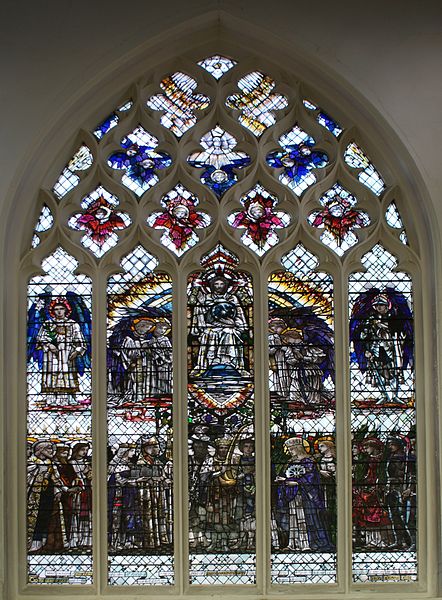
Te Deum Laudamus — We Praise You O God — is a traditional song of thanksgiving in the Church that is used on special occasions outside of the liturgy or in formal worship.
The videos below are of the ancient chant version dating from the fifth century, followed by Mozart’s version 12 centuries later.
The Te Deum window by Christopher Whall, from the church of St Mary the Virgin in Ware, England is an example of a physical structure depicting the church community joining with the heavenly realms in praise and thanksgiving.
Text and translation of the Te Deum.
| TE DEUM laudamus: te Dominum confitemur. | O GOD, we praise Thee: we acknowledge Thee to be the Lord. |
| Te aeternum Patrem omnis terra veneratur. | Everlasting Father, all the earth doth worship Thee. |
| Tibi omnes Angeli; tibi Caeli et universae Potestates; | To Thee all the Angels, the Heavens and all the Powers, |
| Tibi Cherubim et Seraphim incessabili voce proclamant: | all the Cherubim and Seraphim, unceasingly proclaim: |
| Sanctus, Sanctus, Sanctus, Dominus Deus Sabaoth. | Holy, Holy, Holy, Lord God of Hosts! |
| Pleni sunt caeli et terra maiestatis gloriae tuae. | Heaven and earth are full of the Majesty of Thy glory. |
| Te gloriosus Apostolorum chorus, | The glorious choir of the Apostles, |
| Te Prophetarum laudabilis numerus, | the wonderful company of Prophets, |
| Te Martyrum candidatus laudat exercitus. | the white-robed army of Martyrs, praise Thee. |
| Te per orbem terrarum sancta confitetur Ecclesia, | Holy Church throughout the world doth acknowledge Thee: |
| Patrem immensae maiestatis: | the Father of infinite Majesty; |
| Venerandum tuum verum et unicum Filium; | Thy adorable, true and only Son; |
| Sanctum quoque Paraclitum Spiritum. | and the Holy Spirit, the Comforter. |
| Tu Rex gloriae, Christe. | O Christ, Thou art the King of glory! |
| Tu Patris sempiternus es Filius. | Thou art the everlasting Son of the Father. |
| Tu ad liberandum suscepturus hominem, non horruisti Virginis uterum. | Thou, having taken it upon Thyself to deliver man, didst not disdain the Virgin’s womb. |
| Tu, devicto mortis aculeo, aperuisti credentibus regna caelorum. | Thou overcame the sting of death and hast opened to believers the Kingdom of Heaven. |
| Tu ad dexteram Dei sedes, in gloria Patris. | Thou sitest at the right hand of God, in the glory of the Father. |
| Iudex crederis esse venturus. | We believe that Thou shalt come to be our Judge. |
| Te ergo quaesumus, tuis famulis subveni: quos pretioso sanguine redemisti. | We beseech Thee, therefore, to help Thy servants whom Thou hast redeemed with Thy Precious Blood. |
| Aeterna fac cum sanctis tuis in gloria numerari. | Make them to be numbered with Thy Saints in everlasting glory. |
| V. Salvum fac populum tuum, Domine, et benedic hereditati tuae. | V. Save Thy people, O Lord, and bless Thine inheritance! |
| R. Et rege eos, et extolle illos usque in aeternum. | R. Govern them, and raise them up forever. |
| V. Per singulos dies benedicimus te. | V. Every day we thank Thee. |
| R. Et laudamus nomen tuum in saeculum, et in saeculum saeculi. | R. And we praise Thy Name forever, yea, forever and ever. |
| V. Dignare, Domine, die isto sine peccato nos custodire. | V. O Lord, deign to keep us from sin this day. |
| R. Miserere nostri, Domine, miserere nostri. | R. Have mercy on us, O Lord, have mercy on us. |
| V. Fiat misericordia tua, Domine, super nos, quemadmodum speravimus in te. | V. Let Thy mercy, O Lord, be upon us, for we have hoped in Thee. |
| R. In te, Domine, speravi: non confundar in aeternum. | R. O Lord, in Thee I have hoped; let me never be put to shame. |
Read More
Your subscription gift helps make this ministry possible. Thank you!


The Synod has ended. Bishops, priests, nuns, and lay persons from around the world have again gathered in Rome to pray, listen, and reflect on where the Holy Spirit is leading us as a community in this new era. As their reflections and recommendations are offered to us, we are invited to join them in prayer as we move forward, always open to the guidance and inspiration of the Spirit.