Pages Menu
RssFacebook
Categories Menu

Posted by on Dec 12, 2008

Our Lady of Guadalupe – December 12

Our Lady of Guadalupe – December 12

Once again, today we celebrate the feast of Our Lady of Guadalupe.

When I was a girl, this feast was not a major focus of my life. Growing up in Eastern Washington, in a community with relatively few Mexican Americans, we simply didn’t celebrate this feast.

Then I married into a Mexican American family and all that changed. I learned much more about Our Lady of Guadalupe. I discovered the traditions associated with her feast day. I got up early one morning to join the community in Oakland in singing the mañanitas at 5:30 a.m. We celebrated together in the liturgy and then had a wonderful breakfast of posole, champurrado and pan dulce (soup, chocolate/cocoa, and sweet Mexican bread) with the Mexican immigrants who were our English language students and friends.

When I was pregnant with our first child and nervous about the course of the pregnancy, my mother-in-law advised, “Just put it in Our Lady of Guadalupe’s hands. It’ll all be OK.” She was right. More than once since then Our Lady has gotten a problem dumped into her hands. It always turns out OK – not always the way I expected, but always OK.

Tonight we’ll again celebrate the feast of Our Lady of Guadalupe. We don’t get up for mañanitas these days, but we do celebrate. We’ll get out the nice dishes, have a tasty dinner, and eat pan dulce with champurrado for dessert. And once again, we’ll celebrate the special relationship with Our Lady we enjoy as a Mexican American family.

Read More

Posted by on Dec 4, 2008

Our Lady of Guadalupe – December 12

Saint of the Day: St. John of Damascus – December 4

St. John of Damascus (676 – 794), a monk and priest, was a native of Damascus and was also Chief Councilor to the Caliph. As a Christian, he held an hereditary position of great importance under the Ummayid dynasty of Syria.  The Caliph was the chief religious and political leader of the Islamic world.

David Levering Lewis’s book, God’s Crucible: Islam and the Making of Europe, 570 – 1215, provides an interesting insight into this transitional world in which Christianity gives way to Islam. (God’s Crucible also deals with the ways in which Islam stopped at the Pyrenees and the reconquest of Spain.) There were roles for Christians and Jews as subordinate groups.

The Sassanid dynasty of the second Persian Empire (which included Syria) had been defeated a generation earlier by the Caliphate in 651. St. John of Damascus became a key religious and Christian cultural figure at a time of great transition. St. John of Damascus is often called the last of the Greek Fathers and signals the end of the great Patristic period in theological and philosophical reflection. The little that we know about his life is fragmentary and subject to historical criticism. What we do have and know are his writings.

In the various theological controversies of the Patristic period, in both the East and the West, the political and cultural context provides a fascinating dimension for appreciating the wider meaning and importance of these seemingly abstract issues and their very real importance not only to the faith but also to the wider culture.

Despite his contributions to law, philosophy, theology, and music, St. John of Damascus is best known for his role in the Iconoclastic controversy. The Byzantine court endorsed a movement that rejected the veneration of religious images. St. John of Damascus, a high official in the Islamic Caliphate in Damascus opposed the Emperor, Leo III, and supported the Patriarch of Constantinople in support of the veneration of icons and their public display. Ironically, the making and admiration of images of either a secular or sacred nature were not tolerated by Islam. Although Islam provides a place for Jesus as a prophet and accords a special place to Mary, St. John of Damascus exhalted her status in his writings on the Assumption of Mary into heaven. At a time of the repression of Christian culture, St. John of Damascus composed hymns that became the core of the Eastern liturgy and are sung even today.

It is perhaps only fitting that St. John of Damascus has become the subject of venerated icons. The one above is an Arabic icon from the the 19th century attributed to the iconographer Ne’meh Nasr Homsi and is now in the public domain.

Read More

Posted by on Nov 11, 2008

Our Lady of Guadalupe – December 12

Martinmas and Veterans Day

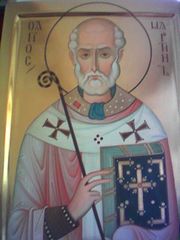
St. Martin as a bishop: modern icon in the chapel of the Eastern Orthodox Monastery of the Theotokos and St Martin, Cantauque, Provence.

St. Martin as a bishop: modern icon in the chapel of the Eastern Orthodox Monastery of the Theotokos and St Martin, Cantauque, Provence.

The feast of St. Martin of Tours, sometimes known as Martinmas, falls on November 11. In the United States, we celebrate November 11 as Veterans Day – a day we honor those who have served in the military of the country. It is a national holiday, though many businesses are open and retailers offer sales in the hope of luring people who are enjoing a day off!

As a child, I remember hearing people from my grandparents’ generation speak of the day as Armistice Day. This was the day, in 1918, on which World War I stopped. The Armistice was declared and hostilities were set to end at the 11th hour of the 11th day of the 11th month – and so they did. That was a war called “The War to End All Wars,” but unfortunately, it didn’t. So, when World War II followed all too soon afterwards, the name of the day was changed to Veterans Day, in honor of all veterans.

It seems appropriate that the feast of St. Martin of Tours coincides with this day of honoring those who have served their countries militarily, as he too served in the army. His life and contributions to the Christian community are discussed in greater detail in an earlier post, and they were impressive. Nevertheless, he is most commonly known for the legend told about him, in which he is approached by a begger and asked for help. Martin is said to have cut his military cape in half and given half of it to the beggar. Later, in a dream, he saw Christ in the form of the beggar, wearing the cape.

Martin was not a Christian at the time he served in the Roman cavalry, but had entered the Catechumenate before entering the military. Before he left the army, he had been baptized. As his faith grew and deepened, he became convinced that as a Christian, he could not kill, even as a member of the military. He accepted arrest and imprisonment rather than fight. He volunteered to go to the front of the troops, unarmed, but a peaceful solution was reached before the battle, so he did not have to prove his courage and commitment to non-violence in that way.

It seems to me that Martin’s insight that killing is not the calling of Christians is one that has been shared by many men and women who have served or refused to serve in military forces through the centuries. Certainly, there have been times when Christians have turned their backs on this belief, even claiming that killing was done on behalf of God. For those times we must beg God’s forgiveness and that of those harmed. However, the veterans I have known generally will say that war is never the best answer to human disputes. Terrible things happen in war. It does not really resolve the problem between nations. Sometimes it seems to be the only way to stop a terrible evil, but it’s never the best option. (Stopping the Holocaust is often given as an example of a good reason to go to war, but it must be acknowledged that even World War II was fought not to stop the Holocaust – of which there was very little awareness outside of Europe – but rather to stop the military aggression of certain nations.) Martin of Tours would agree that war is never to be the first response of nations or their people to conflicts with others.

But what, you ask, is Martinmas? Martinmas is the name of the celebration of Martin’s feast in Europe. I first experienced the celebration of Martinmas when my sons were little and attending Waldorf school. (Waldorf schools celebrate many European Christian holidays.) It is a harvest festival. It is a festival that marks the end of Autumn weather and the beginning of Winter weather in many nations. The thing that was most fun about the feast was the custom of making lanterns and going out after dark to walk with the lanterns.

For a week or more before the feast, the children would make lanterns of paper. Some were simply construction paper colored by the children and rolled into a cylinder with a bottom and a wire handle. Others were more elaborate. Sometimes a balloon was inflated as a base and tissue paper layers glued over the balloon to form the lantern. Once a wooden frame was built in the form of a star. Then layers of tissue paper were applied to form the walls. Leaves and glitter were included on that lantern. That one hangs in our living room to this day, a beautiful reminder of a school festival and a saint’s feast day.

(In some schools, glass jars are decorated for lanterns. They are also beautiful, but tripping in the dark can result in dangerously broken glass. Plastic peanut butter jars might be a reasonable solution to that problem!)

Once completed, the lanterns are hung by wire from a stick, a candle placed in the bottom, and children and parents sally forth in a procession around the school or neighborhood. In some countries, children visit neighbors and receive candy or other treats – much like Halloween in the US.

Martinmas Lantern Walk - From Today in Faerie School

Martinmas Lantern Walk – From Today in Faerie School

If you decide to celebrate Martinmas with a lantern walk, be very careful with lighted candles. There are now battery-operated “candles” that you might consider using, especially for very young children. We never had any serious accidents, but I’m sure Martin wouldn’t mind opting for safety on his feast.

After you go out for a little lantern walk, follow up with a warm dinner and/or dessert, lots of laughter and fellowship and a happy night’s sleep.

Happy Martinmas! Happy Veterans Day! And may the Lord help us all to find better ways to resolve our differences.

Read More

Posted by on Oct 15, 2008

Our Lady of Guadalupe – December 12

Saint of the Day – St. Teresa of Avila – October 15

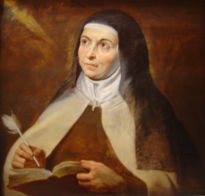
St. Teresa of Avila - by Peter Paul Rubens

St. Teresa of Avila - by Peter Paul Rubens

St. Teresa of Avila, also known as St. Teresa of Jesus, was a Carmelite nun, reformer of her order, mystic, and writer.  She is one of only three women who have been named “Doctor of the Church.” She had a lively intellect and loved people and parties. She wasn’t afraid to argue with the Lord or to oppose those of her time who believed her reforms unnecessary and even dangerous. She experienced many years of illness, including three of paralysis. She found prayer difficult for many years and even refused to try. It wasn’t until she was middle-aged that she began her great work of prayer, reform and teaching.

Many books and articles have been written about St. Teresa of Avila. I refer you to them and to her own writings for details about her life and contributions.

I also invited Mother Marija of Holy Annunciation Monastery in Sugarloaf, Pennsylvania to share a thought with us about St. Teresa. Her response:

The invitation: “What is one thing you would like people to know about St. Teresa of Avila?”  To be true to Teresa one must be faithful to Teresa’s own thought, at least as well as another can understand and convey it. Our Holy Mother St. Teresa, is a Doctor of the Church, so she needs no other “recommendation” in her teaching capacity. Her own mystical life is self-described in her writings: Life, The Way of Perfection (written for her daughters the Carmelite nuns), and the Interior Castle,  which book describes – even maps out – the journey of a soul through seven stages of the inner life to union with God. Again, Teresa had the Carmelite nuns in mind when writing this book, as the epilog expressly tells us. So what would I like people to know about Teresa? Simply that she is a true guide for a life of prayer – a “life”, meaning that prayer for Teresa is the WAY to God. Our Lord is, of course, the WAY and Teresa’s way of prayer is friendship with Jesus. The Way of Perfection, a life of Prayer and finding Jesus as the Way for each of us seems for Teresa  to be identical. After all, she is Teresa of Jesus.

Thank you, Mother, for your contribution. May God bless you and all who seek to serve Him through a life of prayer and friendship with Jesus.

The books of St. Teresa of Avila are still in print today. You can find them listed in our discovery engine at http://www.theologika.net/search. Just enter her name and you’ll get links to her works.

Read More

Posted by on Oct 6, 2008

Our Lady of Guadalupe – December 12

Saint of the Day – Blessed Marie-Rose Durocher – October 6

Eulalie Durocher was born on October 6, 1811, in San Antoine sur Richelieu near Montreal. Her life can be summarized very briefly. She was the tenth of eleven children and one of her older brothers was a priest.  When she was 18, her mother passed away and Eulalie and her father went to live with her brother, Theophile, at his parish in Boleil. The young Eulalie took charge of the priest’s home as housekeeper, hostess, and parish assistant. Although she was reputed to be lively and something of a tomboy, her health was never really robust.

At the request of Bishop Ignace Bourget, Eulalie, at 32, in 1842 became the reluctant co-founder, with the bishop, of the Sisters of the Holy Names of Jesus and Mary. (Bishop Bourget also founded 3 other religious orders to help meet the needs of his diocese, which was the vastness of Canada.) At her profession of vows, she took the name Sr. Marie-Rose. Two of her friends joined her in this new work, focusing on the religious education of children, especially girls.  Blessed Marie Rose led her group for 6 difficult years until she died on her birthday October 6, 1849.

We know that her spiritual formation under Fr. Telmon was strict and that she set a very high standard for the members of her community. However, her service to the poor and her efforts to deal with the social ills of her time set the order on a trajectory of education, nursing, social work, and spiritual direction.

The Sisters of the Holy Names have been leaders in the education of women and pastoral care and service of the most disadvantaged. Kathy and I are both indebted to the Sisters of the Holy Names. Kathy was educated by Holy Names Sisters for 10 years, first in her parish grammar school and later at Holy Names Academy in Spokane, WA. My first full time teaching position was in the Education Department of Holy Names University in Oakland, CA some 30 years ago. We send our greetings, thanks and prayers to the Sisters of the Holy Names on this the feast of their foundress.

Read More

Posted by on Oct 4, 2008

Our Lady of Guadalupe – December 12

Saint of the Day – St. Francis of Assisi – October 4


St. Francis of Assisi window – St. Joseph’s Monastery in Aptos, CA – Artist: Susan Wagner

October 4 is the feast of St. Francis of Assisi. Francis was born in Assisi, Italy in about 1182 and died at the Porziuncola, a chapel outside Assisi’s walls, in 1226. He is one of the best known saints, founder of the Order of Friars Minor or Franciscans, the Poor Ladies or Order of St. Clare  (Poor Clares – founded with St. Clare of Assisi) and the Third Order Franciscans, including lay men and women who also wanted to live in accordance with the Gospels in a Franciscan manner. There are many sub-groups of Franciscans.

Brother Bill Short, OFM  of the Franciscan School of Theology, Berkeley, CA has developed an excellent series of lectures on the life and times of St. Francis. I listened to it recently and was fascinated with the richness of detail he included about the culture and history of the times, as well as the people who each played a part in the story of St. Francis.

I asked Brother Bill and a few others for reflections on St. Francis for his feast – one thing they would like people to know about him. I received these responses.

From Brother Bill:

Something (one thing) I would like people to know about St. Francis – hmmmm, there’s an embarrassment of riches.  Let me try this:
 
Francis was rather alarmed by the notion that people might think he was some kind of saint.  In a fairly reliable account from companions who travelled with him, recounted some fifteen years after his death, they remember that on travelling through a town in Tuscany, a man pleaded with Francis to pray that his wife would be freed from an evil spirit that was making her cry out, disturbing the neighbors.  Francis seemed pretty skeptical, but finally agreed to go to the house, along with three companions.  He stationed them in three corners of the room where the woman was ranting, while he took one corner for himself.  They all prayed, and the woman stopped shrieking, apparently healed.  The husband thanked Francis profusely, but Francis seemed in a hurry to move along.  Some time later he passed through the same town with Brother Elias (his vicar) and the woman came rushing out to thank him.  He still seemed reluctant to accept her story, but finally agreed that she had been freed from her problem – but he was very clear that four brothers had prayed for her (including him) and who knew which prayer God had answered?  That’s good, practical humility, I think.
 
I like the story because it shows Francis as someone with a pretty shrewd sense of “phonies,” and a cautious approach to anyone (including himself!) being considered a saint during their own lifetime.

From Sr. Krista Aitkin of St. Joseph’s Monastery in Aptos, CA

St. Francis of Assisi is a spirit and a way of life.  His spirit and his way of living are reality lived,  not an idea or ideal, or even a formula.  Everything about St. Francis is an invitation to practice.  He is not locked into “a system.”  He lives reality through devotion toward others,  respect for the poor and for all of God’s creation.  In short,  St. Francis lives in and through the Word of God.  His charism is not linked to a particular apostolate,  but is focused on “becoming” rather than “producing,”  on one spirituality – putting on Christ,  who called himself the way,  the truth,  and our life.

Thank you to Brother Bill and Sr. Krista for your responses to my question and for sharing your love of St. Francis with me. May the Lord continue to bless you richly.

Read More

Posted by on Oct 1, 2008

Our Lady of Guadalupe – December 12

Saint of the Day – St. Therese of Lisieux – October 1

St. Therese 

St. Therese of Lisieux is known as “The Little Flower” because before she died she promised that after her death she would send down a shower of roses on the earth. She is known for her “little way” to God – a way that everyone can follow, doing the smallest everyday things in love as a way to God.

I asked the sisters at several Carmelite monasteries to share their reflections on St. Therese for her feast day and received these gracious responses.

Mother Marija, 0cd of Holy Annunciation Monastery , a Byzantine Carmelite monastery, in Sugarloaf, PA, sent this note:

The invitation: “What is one thing you would like people to know about St. Therese?”  This in turn, led me to ask: “what did Therese want us to know about her life and spirituality?  What did she say?” Before she died Therese spoke  of her desire  to make known to all “little souls” (everyone)  her way of confidence and love.  Therese wanted us to know how much, how very much, we are loved by God and have nothing to fear from Him.  This being true, we might also say that God gave Therese to the Church and world as a “new” expression of the Gospel message: God is Love.

When praying the Novena of Grace in 1897, the very year of her death, Therese asked God to grant her unique request: That her mission to save souls would last until the end of time” So as we honor Therese,  we should  recognize that God wants our love and has sent Therese to us, raised her up in the Church, as a new “invitation” to know Him as Love.

The Sisters at Carmel of Reno were unable to offer a reflection on St. Therese or Carmelite spirituality at this time, but they graciously gave permission to use the icon of St. Therese doing the laundry created by the late Sr. Marie-Celeste, as illustration for this post. They also offered their best wishes and this comment.

We deeply appreciate your interest in Carmelite spirituality and  sharing the riches of theology and religious experience with the broad community on line.

St. Therese is one of my personal favorite saints, as I’ve mentioned in earlier posts. For more about her life and influence, here are some options:

Maurice and Therese: The Story of a Love by Patrick Ahern

Saint Therese and the Roses by Helen Walker Homan

St. Therese of Lisieux – Saint of the Day

The Triumph of the Lowly – St. Therese of Lisieux and the Little Way

 Original icon by Sr. Marie-Celeste Fadden, Carmel of Reno – Used with permission

Read More

Posted by on Sep 30, 2008

Our Lady of Guadalupe – December 12

Saint of the Day – St. Jerome: September 30

St. Jerome (340 – 420) is one of the most interesting personalities among the fathers of the early Church. We generally envision saints as fairly moderate and gentle persons. It is safe to say that St. Jerome never believed in moderation. He was one of the most brilliant and well educated men of his time, a man who lived and wrote with incredible energy and passion. St. Jerome’s Latin translation of the scriptures, which is a literary and scholarly tour de force even by today’s standards, would become the intellectual standard for western civilization.

In many respects, St. Jerome embodies very basic conflicts and contradictions among Christian scholars and educated clergy.  St. Jerome’s knowledge and love of secular – in his case – pagan literature gives him a great appreciation of literature and skill in communication. However, the moral conflict of this literature with the Christian ideal and the values portrayed in scripture create a real tension. As one of the founders of western literary criticism and biblical archaeology, St. Jerome establishes a secular “scientific” standard for deciding which texts are inspired and whether to consider the Greek translation of the Jewish scriptures, the Septuagint, as less authoritative than the Hebrew original.

In addition, virginity and celibacy were very important to St. Jerome. He and other fathers of the Church would establish sexual abstinence as the ideal Christian lifestyle, in keeping with the pre-eminence celibacy enjoyed in certain non-Christian religions of the day. Temptations of the “flesh” became the work of the devil. Such impulses, which we today consider in a more measured and moderate way as the product of genetics, socialization, and choice, were for St. Jerome forces to be conquered through prayer, fasting, and physical punishment of the body. Today we would call it “aversion” therapy.

This tradition of seeing the natural as the lesser part of our being is not in keeping with our being made in the image and likeness of God. The fear of our erotic and sexually creative dimension, as part of our fallen and corrupted nature, appears to challenge the appropriateness of the Word becoming flesh and the redemption of humanity in the death and resurrection of Christ.

Clearly, when we look at the excesses and exploitation of people in the Graeco-Roman world, the corrective action of St. Jerome in a lifestyle that witnessed to a coming of the kingdom of justice, peace, and dignity – the sober controlled Christian life – is an understandable ideal.

Perhaps, a great deal of our problem as citizens of the era of psychology and human potential is grappling with such an outsized cauldron of talent and passion. In many respects, although he did his best to stay within certain boundaries, the combination of the terms “Saint” and “Jerome” in reference to the same person should encourage the outlandish and the fire of divine genius in us all.

Read More

Posted by on Sep 29, 2008

Our Lady of Guadalupe – December 12

Celebrating the Feast of the Archangels, Michael, Gabriel and Raphael

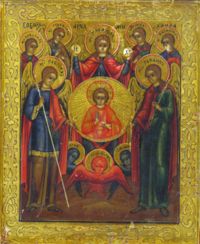
Angelic Council – an Orthodox icon from the Wikipedia entry on Archangels

The Feast of the Archangels – Michael, Gabriel and Raphael – brings a day for fun and celebration at our house. My father’s name is Michael, so even as a child, this was a day to note. We didn’t particularly celebrate it, but I knew it was his feast day. Each of these archangels had their special day, but the feasts have since been combined into one. So today many men in my family celebrate feast days, including my father, brother, cousin, nephew, husband and sons. We don’t have a Gabriel, but Michael and Raphael (Rafael) are common.

When my children started Waldorf school (known as Steiner schools outside the United States), we were introduced to the celebration of Michaelmas. In Northern Hemisphere Waldorf schools, Michaelmas is the first festival of the year. It is seen as a time to remember that, as days grow shorter and darkness seems to grow stronger, we depend on the forces of light and strength to bring us safely through our lives. Many stories of Michael include mention of dragons – drawing on the story from the Book of Revelations describing a battle in the heavens between the dragon and Michael (Rev. 12:7-9). So confrontations between Michael and dragons are often portrayed theatrically by children as part of the celebration. The stories I’ve enjoyed the most have the dragons being “tamed,” in the sense that their great stores of energy are turned to building up the community. That’s a lesson that speaks even to adults – who among us doesn’t sometimes need to channel great energies that surge from deep within us and that can be destructive or constructive?

At the elementary schools our children attended, following the play, the community joined together around a great loaf of bread baked in the shape of a dragon by the third graders. A blessing was sung, the bread was cut and the community shared in eating it. (Always reminded me of certain liturgical activities with which many of us are very familiar!) Lunch, followed by a great pot luck of desserts came next. Then making apple juice in the orchard and other fun activities completed the day.

After the Michaelmas celebration (generally celebrated on a Saturday so entire families could come), we were always tired when we got home. When it came time for dinner, nobody was up to cooking a big meal. So we developed a fun little custom of making and eating dragon cakes.

So here’s the Pozos family method of celebrating Michaelmas. We make dragon cakes (pancakes shaped in the form of dragons). Add dragon eggs (fried potatoes cut in circles), dragon nests (grated apples with cinnamon for spicing) and dragon food (scrambled eggs with spicy sausage – we like Mexican chorizo). Light a candle. Use special dishes if you want. Share some sparkling cider. And, most importantly, work together to make the meal and then sit around afterward and enjoy each other’s company.

I’m looking forward to the celebration tonight! Hope you have fun too.

Read More

Posted by on Sep 27, 2008

Our Lady of Guadalupe – December 12

St. Vincent de Paul – September 27

St. Vincent de Paulimage by Monastery Icons

St.Vincent de Paul is one of those saints whose mark on society has been so great that we often take their contributions for granted. Men and women through the centuries have been moved to serve the poor because of his example, as priests, nuns, and lay persons. Through the society which bears his name, the St. Vincent de Paul Society, members work across the United States and around the world, providing help both for those who face long term challenges and those who are “down on their luck” for a short time. 

Last year, Randy wrote a biographical post for the feast of St. Vincent de Paul. Lots of good information is there, along with links to other sites. This year, I asked members of orders founded by St. Vincent de Paul and his associates for one thing they’d like the world to know about him. These were responses I received, in order received.

From Sr. Mary Frates, DC – Vocation Director, Daughters of Charity, DePaul Provincial House

Thank you for this opportunity.  St. Vincent De Paul is well known for making an impact on the society of his day through organizing service to the very poorest.  What I would like people to know about Vincent is that he paid attention to everything that was happening around him and it was this attention to the present moment that drew him to take action to help those in need.

From Fr. Ray Van Dorpe, C.M.  Assistant Provincial, Midwest Province of the Congregation of the Mission

I would like people to know that St. Vincent de Paul was a man far ahead of his time.  He was one of the first to organize the laity for charitable works of mercy that were not dependent on the support of the local pastor.  These “Confraternities of Charity” later became the Ladies of Charity, an international organization and part of the larger Vincentian Family, along with the Congregation of the Mission, the Daughters of Charity, and the Society of St. Vincent de Paul, to name but a few.  St. Vincent was also ahead of his time in putting women to work outside the structures of cloistered life (the Daughters of Charity).  He also was one of those who revolutionized the formation of the clergy in France and other countries and developed a sophisticated ministry of preaching missions in poor rural parishes (the Congregation of the Mission).  But more important than all these accomplishments was his love for the poor and his deep desire to bring the Good News to the poorest of God’s people.

Thank you for sharing your insights. May the Lord continue to bless your ministry and that of Vincentians around the world.

Read More

Posted by on Sep 17, 2008

Our Lady of Guadalupe – December 12

St. Robert Bellarmine – September 17

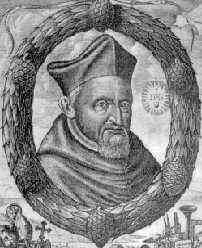
Once again, the feast of St. Robert Bellarmine is upon us. Last year, Randy wrote a post about Bellarmine’s life and contributions. This year, I thought it would be interesting to hear what a few Jesuits might have to say about him. I wrote to several schools and other institutions named after Robert Bellarmine and to the Jesuit communities at several Jesuit universities. I received responses from people at many of them. Not all had comments they wanted to share, but these men did.  I offer their responses in order received, with my thanks to all those who took the time to respond.

From Alan Yost, SJ – Formerly of Bellarmine Preparatory School in Tacoma, now working in a parish in Yakima, WA.

I don’t necessarily WANT people to know this about Roberto Belarmino, but since it’s true, and in a spirit of transparency, he was one of the main protagonists in the whole Galileo affair, arguing for the Church and against Galileo regarding the earth-centered vs. sun-centered model of the universe. In retrospect, it’s a little embarrassing, but we have to remember that he was a man of his time and that he was ardent in defending his beliefs and the beliefs of the Church at the time. Recall that Pope John Paul II offered a public apology to Galileo about 400 years after the fact.

From Rev. Clyde F. Crews – University Historian, Bellarmine University

We have had as our university motto, from the very beginning of this institution, the words taken from the introit of the Feast of St. Robert Bellarmine:  In Veritatis Amore.  To be truly engaged “in the love of truth” in all its dimensions, joys, tasks, and responsibilities remains a central part of our mission.  We are also struck by the fact that St. Robert was widely known – in the context of his times – for his tolerance, fairness, kindness, and generosity – especially to those in need.

From Fred Mayovsky, SJ – Math teacher at Bellarmine Preparatory School in Tacoma

St. Robert Bellarmine defended Galileo.  OK, Bellarmine was the Pope’s man, but he handled GG with love and gentleness, guiding him (GG) as he (SRB) was telling him what he (GG) could and could NOT state.  SRB was a dove and not a hawk in bringing the Pope’s directives.  In that same vein, when I teach math and demand neatness and organized thought, I will explain HOW to do the homework and not merely expect my students to do what I “expect” but as I “direct”, so that they assimilate knowledge.

Yes, my reflections on Bellarmine, I teach at a school named after him, I teach in a spirit of which I think he would approve.  Sorry I do not have the time to ground and defend my reflections.  But they are MY reflections on a great man, and I have been trying to live by his spirit in HIS school.

From James Flaherty, SJ  Rector of the Jesuit Community at Marquette University

Bellarmine was probably the most important theologian of the Counter-Reformation era. You might check out the website of the Singapore Jesuits for further info. Just google them and look for their hagiographies on Jesuit saints.

My thanks to each of you for the insights you’ve shared. May the Lord richly bless your ministries.


Read More

Posted by on Sep 15, 2008

Our Lady of Guadalupe – December 12

Feast of the Day – Our Lady of Sorrows – September 15

Mothers of the Plaza de Mayo

The Feast of Our Lady of Sorrows follows the Feast of the Exaltation of the Holy Cross by one day. On this day we remember the prophecy of Simeon when Mary and Joseph took Jesus to the temple for the first time. Simeon blessed them and said to Mary, “Behold, this child is destined for the fall and rise of many in Israel, and to be a sign that will be contradicted; and you yourself a sword will pierce, so that the thoughts of many hearts may be revealed.” (Lk 2:33-35)

This feast was not part of the official liturgical cycle of the Church until the mid-1600s, though it was celebrated in some locations as early as the 13th century. Sometimes it is known as the feast of the Seven Sorrows of Mary and includes mention of seven events from Jesus’ childhood and passion.

Our Lady of Sorrows is a title of Mary with which many women and men can identify. Bearing and raising a child is not an easy task, though it can be an extremely rewarding adventure. There are countless joys and sorrows along the way. And make no mistake about it – the commitment of parent to child is one that does not stop when the child reaches adulthood! It is a commitment for life and beyond. In our belief in the Communion of Saints and life after death, we recognize that those who went before us still care about us and look out for us. Parents who are with the Lord do not cease to be parents of those who still remain here. The relationship is just transformed.

In thinking about this feast, it came to me that surely Our Lady of Sorrows is especially close to mothers, fathers and family of those who are killed prematurely. I’m thinking of those who “disappeared” in Central and South America in recent years – victims of political violence and/or persecution for their actions in living and teaching the Gospel. I’m thinking of victims of terrorism in the Middle East – including those on both sides of the Israeli-Palestinian question and those dying almost daily in Iraq. I’m thinking of those whose children were killed in wars – Iraq, Iran, Afghanistan, India, Pakistan, Bangladesh, Sudan, Ruwanda, Brundi and so many, many others. We see the pictures year after year and our hearts become numb. Yet for all of them, and with all of them, Our Lady of Sorrows weeps. And so should we all.

And then … we must commit ourselves to work for peace. So that those who have given their lives will not have died in vain. So that those who believe that “might makes right” will learn that only love makes right. So that we truly become a community where we live our belief that what we do to the least of Jesus’ sisters and brothers, we do to Him.   

May it be so.

Read More

Posted by on Sep 9, 2008

Our Lady of Guadalupe – December 12

St. Peter Claver – September 9 – Patron Saint of Slaves

Peter Claver was born in Catalonia in 1581. He attended the University of Barcelona before entering the Jesuits at the age of 20. During his study of philosophy in Majorca, he was encouraged by the porter, Br. Alphonsus Rodriguez, to travel as a missionary to the Americas. In 1610, Peter Claver arrived in Cartagena, in present day Colombia.

Cartagena was the center of the slave trade in the Americas at that time.

Slavery has had a long history in human relations. To this very day there are people enslaved in our world. Even within Christianity for most of its history, slavery was seen as one of those realities of life that are simply unquestioned until relatively recently. St. Paul, for example, wrote instructions on the proper behavior of slaves and sent an escaped slave who had become a Christian home to his master, with instructions to his Christian master to treat the slave well (Philemon). But there were no instructions to free him.

The West African slave trade that brought so many people to the Americas in chains had its roots in the Crusades. Pope Nicholas V, in a papal bull titled Dum Diversas (June 18, 1452), allowed the perpetual enslavement  of Saracens and pagans captured during the Crusades, because they were seen as enemies of God and Christianity. It seems ludicrous today, but that’s what people believed at the time. Later, on January 8, 1455, in Romanus Pontifex, he also authorized European dominion over newly discovered lands and the enslavement of non-Christian peoples living there. At that time, the Americas had not yet been “discovered” by Europeans, at least not by a Europe in any way ready or able to begin to colonize them.

Once Columbus and his crew brought word back of their findings, both Spain and Portugal, the foremost seafaring European peoples of the time, wanted to claim lands in America. Pope Alexander VI, on May 4, 1493, in Inter Caetera, divided the Americas between Spain and Portugal. He commanded Spain “to instruct the aforesaid inhabitants and residents and dwellers therein in the Catholic faith, and train them in good morals.” 

Despite the instructions of Alexander VI, military leaders and economic developers (colonists) had begun to enslave the native peoples whom they encountered in the Americas. Many had died of European diseases, against which they had no immunity. By May 29, 1537, Pope Paul III issued another papal bull dealing with the question of enslavement of peoples, Sublimus Dei. In this one, he specifically forbade the enslavement of the indigenous peoples of the Americas, based on the fact that they are rational beings with souls. He further extended this prohibition to the enslavement of all other previously unknown peoples. Unfortunately, the peoples of West Africa did not count as “previously unknown peoples” – at least it had been know there were people living there – so enslaving them was not strictly forbidden.

Into this context, Peter Claver entered as a young man, not yet a priest. There he met Fr. Alfonso de Sandoval, another Spanish Jesuit who had earlier dedicated his life to the care of African slaves. Working with Fr. Alfonso, Peter Claver dedicated his life as well to this ministry, declaring himself “the slave of the negroes forever.” For the next 44 years, he served the slaves of Cartagena, from the time the ships arrived bringing them chained in the holds through their time of bondage on the plantations and in the mines.

The work of caring for the slaves was not easy. It was not unopposed. It was not welcomed by “the powers that be” of Cartagena. It was not even always welcomed by his superiors or by members of local parishes.

Each month, as the slave bearing ships arrived, Peter Claver went out to meet them, taking food, medicines, and other supplies with him. He went into the holds of the ships and began to care for those who were nearest death, caring for people with diseases such as smallpox and leprosy (Hansen’s Disease). He organized a group of helpers who spoke the various languages of the peoples arriving. They went with him to the slave pens, speaking to the newly arrived and helping to care for them. As the new slaves recovered their health and strength, Peter, Alfonso, and their helpers began to teach them about Jesus and to baptize those who accepted the faith. Despite official Church instructions, many people still questioned the humanity of these captives and opposed teaching them the faith or accepting them into the Church. This opposition did not stop Peter Claver and those who worked with him. They simply worked and prayed harder.

Care for the slaves did not stop at the slave pens. As men, women and children were purchased and set to work in the mines and on plantations, Peter Claver continued to be their advocate. He visited them, celebrated the sacraments with them, admonished their owners to treat them justly, and continued to teach and care for them. He refused to stay with the owners of the plantations and mines. When he visited slaves, he stayed with them in their homes.

Over time, he gained some respect in Cartagena, if for no other reason than that he was consistent and persistent in following his calling. People began to believe that it was because of his work and his presence that they had escaped many potential disasters (think hurricanes, pirates, etc.).  The slave markets were not closed during his lifetime. But somewhere around 300,000 people received care, love, instruction in the faith and baptism through the ministry of St. Peter Claver. Not a bad record!

Read More

Posted by on Sep 5, 2008

Our Lady of Guadalupe – December 12

Blessed Teresa of Kolcata – September 5

Mother Teresa was born in Albania in 1910. She went to India in 1929 to become a Sister of Loreto, an order of teaching nuns. She took her first vows in 1931 and began working as a teacher, work she deeply enjoyed. She chose the name Teresa in honor of St. Therese of Lisieux, patroness of the missions.

As the years passed, Mother Teresa became increasingly aware of the poverty and despair that were the lot of so many people in India, including around the school in Kolkata. On September 10, 1946, she received a “call” from the Lord to leave the work she was doing and go out to live among and serve the poorest of the poor. Her response to this call and the positive results of her service and witness are well documented.

From the streets of Kolkata, men and women who joined her in service as the Missionaries of Charity have moved throughout India and into the broader world. Today, as sisters, priests and brothers, they have schools, clinics and shelters in 120 countries, including the United States. My home parish, St. Patrick’s, in Spokane, WA is even blessed to have a group of sisters working in the community. They are quietly witnessing and bringing the Good News to the larger neighborhood and diocesan community through their service and I am grateful for their presence there.

Many words have been written about Mother Teresa, including a post in this blog last year. Some praise her. Some criticize her. Some mock her. Some don’t know what to think about her. None of this would come as a surprise to her. It was like that from the beginning of her work. In the decades of her “dark night of the soul,” many of these things may have been thoughts she had herself. 

But she was faithful to the calling she received and Pope John Paul II declared her Blessed. We’d do well to keep that in mind as we try to be faithful to the calls each of us have received. There are no guarantees of success or popularity. Most of us will never be praised by Kings, Queens and Presidents. Few will receive Nobel prizes. But we all can aspire to be faithful to the work set before us by our Lord.

If you’d like to send an e-card with words, prayers, and/or blessings from Mother Teresa, check out this link. http://www.catholicgreetings.org/Saints/motherteresa.asp

Blessed Teresa, pray for us.

Read More

Posted by on Sep 3, 2008

Our Lady of Guadalupe – December 12

Saint of the Day – St. Gregory the Great – Preaching the Gospel to the Ends of the Earth

St. Gregory the Great was born in Rome around 540 AD. This was a time when the Goths and Franks were invading Rome. The emperor was in Constantinople. The Senate had been disbanded. Italy was still one country, called Rome, and late classical Latin was the language of the people.

Gregory’s family were wealthy, owning homes and property in and around Rome and in Sicily. He was raised and educated for a career in public office. He had fresco portraits of his family painted at some point, and his biographer, John the Deacon, left a description of them 300 years later as they appeared in the portraits. Gregory’s father was tall and had a light eyes and a long face. He wore a beard. Gregory’s mother was also tall, but she had a round face and blue eyes. She appeared to be a cheerful person. A portrait of Gregory himself was done shortly after his death. Again, John the Deacon left a description of his appearance in the portrait. Gregory is described as being somewhat bald, with a tawny beard. The shape of his face was somewhere between that of his mother and his father. His remaining hair was worn long and curled carefully. He had a thin, straight, almost aquiline nose and a high forehead. His lips and chin were described as also attractive and it is said that his hands were beautiful.

St. Gregory lived in a time of great turmoil. Wars, floods, famines, political changes, and religious controversies swirled through Italy and the Empire. He left a career in public service to enter a monastery when he was around 30 years old, only to be drawn back into public life by the Pope, who sent him to Constantinople to request help from the Emperor in defending Rome. Following 6 years in Constantinople, he returned to Rome. Eventually he himself was elected Pope, an office he tried to decline.

As Pope, he is remembered for reforms of the liturgy, establishing rules of conduct for bishops, the wielding of political power in dealing with invading armies and natural disasters, his insistence on the supremacy of the papacy over the other patriarchs of the church, the notion that the Pope is the “Servant of the Servants of God,” and for establishing the papacy in the form it would take during the Middle Ages. He insisted that the Church has a responsibility to care for the poor. When famine threatened even the wealthy in Rome, he arranged for food and other supplies to be delivered from properties in southern Italy (lands that his family had given the Church) and distributed in the city. He cooked meals for the formerly wealthy himself to spare them the pain of having to ask for charity.

St. Gregory is also remembered for sending missionaries to England, the “end of the Earth” from the perspective of Rome. At that time, there was no knowledge of lands beyond the British Isles. In the rest of the Roman Empire, Christianity had been introduced. Even the Franks in Central Europe had been reached by missionaries. Given the turmoil and upheaval, it stands to reason that he might have thought, as many do today in times of natural disasters and social turmoil, that the end of the world must be near. The Gospels said that the end would not come until the Good News was preached to the ends of the Earth, however. So, perhaps with that in mind, and certainly with a fondness for the blond, blue-eyed people (the Angles) he had seen in Rome, he sent Anselm of Canterbury to preach the Good News in England.

The end of the world didn’t come in St. Gregory’s time. However, the works he did influenced the Christian community of his time and continue to play a role in even our beliefs and style of worship today.

Read More