Pages Menu
RssFacebook
Categories Menu

Posted by on Dec 8, 2007

Feast of the Day: The Immaculate Conception of the Blessed Virgin Mary

Feast of the Day: The Immaculate Conception of the Blessed Virgin Mary

immaculate-conception.jpg

December 8 is the feast day of the Immaculate Conception, a solemnity celebrating the conception of the Virgin Mary. According to apocryphal writings, Mary’s parents were Joachim and Anna. Mary’s conception, which occurred in the natural way, was special in that Mary was spared the “stain” of original sin.

There has been a long tradition of celebrating the feast of the Virgin’s conception by her mother. There has also been a long tradition that Mary was redeemed in anticipation of the redemption of all humanity by her son Jesus. St. Thomas Aquinas and others taught that Mary’s redemption occurred sometime after her conception, to conform with the scripture that all men and women have sinned except Christ. The issue has to do with the fact that God’s becoming fully human in the mystery of the Incarnation, when Mary conceived Jesus, could only have occurred in one who was sinless and not subject to the pain and weakness of a fallen human nature. When the angel Gabriel saluted Mary, he addressed her as Full of Grace. This greeting would not have made sense – according to the long tradition of theology – if Mary were tainted by the fallen state that afflicts every other human until Baptism.

Devotion to Mary, the mother of Jesus, was recorded in early feasts emphasizing her role in salvation history. Mary’s “yes” to the angel Gabriel set everything in motion when she was overshadowed by the power of the Most High. During the controversies about the nature of Christ in the early centuries, titles given to Mary became very important. If Jesus was truly human and divine, Mary became Theotokos – Mother of God. If Jesus was not truly God, Mary was called Christotokos – Mother of Christ.

Exactly how and when Mary was delivered from the sinful state all humans share was not formally defined by the Catholic Church until 1854 by Pius IX. Contrary to the theology of several prominent saints, Mary, from the first moment of her existence, was spared the blockage of grace we call original sin.

An Episcopalian priest, Fr. Matthew Moret, has produced a very short You-Tube video, “Making Sense of Sin,” which succinctly reviews previous conceptions of sin and what these conceptions say about our conception of God. The common concept of sin as a transgression sets God up as the cosmic Judge. Our relationship is not personal but juridical. God’s love becomes conditional on our surrendering our will to His. This concept can be one of a vindictive or manipulative God. Our concept of sin can alienate us from God, contrary to His Divine mercy, love, and grace, which never leave us. Fr. Moret’s short but excellent video presents Kathryn Tanner’s concept of sin as blockage. God continues to heal us, to provide for us in all ways, but we have a diminished capacity to accept or even recognize God’s continual outflowing of good and love to us. Sin is far from trivial, as demonstrated by the brief slide of an entrance to a Nazi death camp.

Mary, Full of Grace and Mother of God. There must have been no blockage. How did that happen?

Read More

Posted by on Dec 5, 2007

Feast of the Day: The Immaculate Conception of the Blessed Virgin Mary

Polarization in the Church – The Kingdom Rent Assunder?

brontosaurus-apatosaurus.jpg

“A kingdom divided against itself cannot stand.” (Mt 12:25) Many of the sayings of Jesus are hard to understand or accept. This one seems only obvious.

It is often said that the lack of Christian unity is a major hazard or stumbling block – scandolos or “scandal” in Greek – for those trying to enter the Kingdom or the Reign of God. The good news is that various groups have begun to treat each other as Christians and not as minions of the anti-Christ. The bad news is that major denominations are split over the existence of the brontosaurus in the sanctuary.

Some people say the beast is an elephant because people experience it differently – like the blind men in the fable. For some it is a rope, for others tree stumps, for a few it feels like a snake. The “elephant” school says that issues like same sex marriage, women’s issues, and diversity are actually the result of a single problem – the need to update Christian ethics and not to take the Bible literally. Christian behavioral norms, according to this school, should be influenced by more enlightened cultural norms and follow the primary mandate of compassionate love.

Others say that the beast is the “Beast” of the Book of Revelation and these challenges to traditional Christian behavioral norms are the beginning of the test of the faithful. According to the “Armageddon” school, the Beast will consume the compromisers like so much buttered popcorn. Those who have not “compromised” will be caught up in the rapture and spared the thousand year reign of the anti-Christ.

Between these two extremes there is a complete spectrum of different intellectual and emotional responses to these issues. Many people are inclined to think that all of this started in the 1960s, when the world got turned upside down. For many Catholics, the secular cultural upheaval of the 1960s was nothing compared to the tsunami of the Second Vatican Council. A few think that Pope Paul VI, in ratifying the declaration on religious liberty and changes to the liturgy, committed apostasy and left the Chair of Peter vacant – Sede Vacante. According to the sedevacantists, the bishops appointed by Paul VI and the popes elected by those bishops have no legitimate authority.

At the other end of the Catholic spectrum, there are those who see Vatican II as limiting and redefining the centrality of rule from Rome. Local churches, governed by lay people, with lay presiders at the Eucharist, are seen as an authentic restoration of the Church. In response, Restorationists – including many young people – think that all these problems will go away if we return to the Golden Age of the Catholic Mass in Latin, with everyone praying their rosaries while the sacred mysteries are performed.

The beast in question is actually a “brontosaurus”(or Apatosaurus), because it is a much older and more intractable species than the elephant. It is not the Beast of the Book of Revelation because it is all too confused and political – and it doesn’t have the gaping maw. The “brontosaurus” is the challenge of living the Christian life and being church in a rapidly changing and unstable world. This challenge actually dates back to the Enlightenment in the 1700’s. However, the major denominations could contain it until the industrial revolution. The urbanization of rural agrarian populations, the revolution in transportation and communication, as well as the emergence of history and the social sciences as academic fields of study, raised major questions that divided church thinkers – the theologians and philosophers. One of the most unsettling discoveries was that Christian philosophy and theology – like all human endeavors – have changed over the centuries.

The Catholic church responded by not only condemning the modern world, but also by rehabilitating the logical approach of Aquinas and Aristotle (See Arraj Chapter 2) as a means of presenting and logically defending the faith against any thought or political action that challenged it. Instead of the medieval spirit of inquiry, students got summaries of pre-digested questions and answers. Not all thinkers went along with this, but they were marginalized or condemned. This gave the appearance of well-being, but like a person with emphysema, the overuse of steroids provides comfort while it destroys the bones. On the positive side, Pope Leo XIII and other Christian leaders, led a social gospel movement to protect the interests of industrial workers. This movement continues today, with the “preferential option for the poor.”

When Pope John XXIII called the Second Vatican Council, the Curia had prepared draft agendas and documents for the bishops. No one foresaw that the octogenerian pope, who had been elected as a caretaker, would encourage the bishops to take matters into their own hands in his opening address, Gaudet Mater Ecclesia.

Having chafed under the control of the Curia, the bishops set their own course. Theologians and philosophers who had been silenced or put to the side were chosen to fill the intellectual vacuum. One of the young superstars was Joseph Ratzinger, who is now Pope Benedict XVI. The major problem was that this new school of thinking had never been tested in the open forum of discussion and debate. Conservatives did what they could to stem the tide, but the winds of Aggiornamento (updating) filled the sails of the bishops, the clergy, and more importantly, the people in the pews who now became the “laity.”

In the United States today there are approximately 3,300 men in seminary programs studying for the priesthood. There are also 33,000 men and women in graduate ministry and theological programs who are not studying for the priesthood. The vast majority of them share the same classrooms with the students for the priesthood. However, the newly ordained priests tend be in their 30’s and 50’s and are already formed as people. Many of them are more conservative and many bring with them an entrenched clericalism from their Philippine and Vietnamese cultures.

The growth of the Anglican Communion, the Catholic Church, and other denominations in Africa and Asia – the global south – has already created substantial tensions due to the immense cultural and economic differences which support more traditional behavioral codes and religious perspectives.

So the brontosaurus is alive and well – or at least it will be until we deal with these tensions so that others once again can come to know us as Jesus’ disciples by our love (Jn 13:34-35).

Read More

Posted by on Dec 3, 2007

Feast of the Day: The Immaculate Conception of the Blessed Virgin Mary

St. Francis Xavier and Me

francis-xavier.jpg

December 3 is the feast of St. Francis Xavier, “Apostle to the East.” Francis Xavier was born in Navarre, Spain in 1506, to a wealthy and influential family. However, his family lost their lands in 1512 when Navarre was conquered by troops from Castille and Aragon. His father died in 1515.

Francis went to study in Paris when he was 19 and met Iñigo (Ignatius) Loyola there. To make a long story short, Francis eventually joined with Loyola as one of the founding members of the Society of Jesus, the Jesuits.

Francis is best known for his missionary work in India, Malacca, Sri Lanka, Indonesia, and Japan. From 1540, until his death on an island off the coast of China in 1552, he traveled and preached throughout the East, frequently returning to Goa in India. He left behind communities of Christians in each place he visited and pioneered the missionary style of the Jesuit order through the compromises he worked out with the existing Christian community, founded by St. Thomas the Apostle, in India.

There are many biographies and studies written about St. Francis Xavier’s life, teachings, influence in the Church, and miracles.

My family has had a close relationship with St. Francis for several generations in the Pacific Northwest. Jesuits were among the first to arrive in eastern Washington and brought with them a devotion to St. Francis. Growing up in parishes staffed by Jesuits, we shared in the tradition of the “Novena of Grace” each year in March. In fact, my parents’ first date ocurred when my father picked up my mother from her teaching assignment in northern Idaho and escorted her to the Novena in Spokane!

As a child, many of my early memories are related to the family tradition of attending Mass and the Novena from March 4-12. Each year we went, with our own prayer requests, and gathered with hundreds of other people from Spokane and the surrounding areas to praise God and ask St. Francis to intercede for us. There were people we only saw once a year – at the Novena.

Some years  the prayer intentions were very practical – a job for a relative out of work, health for a sick relative, help with school work, etc. Other years the intentions were more “spiritual” – help in overcoming a bad habit, help in discerning a life path, greater understanding of the Holy Spirit – little things like that!

Important things happened during or after the Novena. Two cousins who were born during the Novena were adopted into the family – we had been praying for a child for each family that year. Other children have been born into or adopted into the family in the year following the Novena. One of my brothers survived a difficult birth on March 4 and was given an extra middle name, Francis, in thanksgiving. Relatives got jobs. People got well. An uncle returned to the Church as he lay dying during the Novena. My Great Grandmother and my Grandmother both died on First Friday during the Novena. 

Sometimes funny things happened, like the year my youngest brother dropped a “steely” marble at the back of the church and it rolled all the way to the front, causing a stir as it went all the way! Mom was not amused, but we’re all still laughing about it.

The relationship with St. Francis is not limited to those nine days in March. At harvest time, when a storm threatens to ruin a crop before the field is harvested, prayers go up to “St. Frank” to protect it. When a relationship needs a boost from the Holy Spirit, prayers go to St. Francis. And when something goes really well, prayers of thanks go up too. It’s good to have a powerful big brother (saint) to help out.

A little over ten years ago, a young man from a Goan family knocked on our front door, hoping to sell a medical software program to a medical group we managed. The software was not what our group needed, but he became a close friend. We found many common threads in our educations, life experience and shared bond as Catholics. He in turn has introduced us to his family and many of his friends, including those who are the founders of Suggestica.com and who have opened this world of internet blogs and vertical discovery engines such as theologika.net to us.

It seems St. Francis Xavier is still looking out for us in this increasingly small, small world and doing his part to continue spreading the Good News.

Read More

Posted by on Nov 29, 2007

Feast of the Day: The Immaculate Conception of the Blessed Virgin Mary

Don’t Feed the Bears or the Deceiving Spirits

bear-cubs.jpg

When I was growing up, Yogi Bear was a popular cartoon. Yogi lived in “Jellystone Park” and, with his sidekick, Boo-Boo, took it as his mission to defeat the park ranger and get picnic baskets from the tourists. It was all very silly and funny to watch.

In the actual world, “Don’t Feed the Bears” was and is a serious statement. Bears are wild animals and play an important role in the environment. However, bears that get used to eating human food or bears that come close to humans can be dangerous. Cute little cubs have fiercely protective mothers who do not hestitate to defend them.

As an adult, I have come to observe that there are other beings who should not be fed. This is the story of one person’s encounter with one of those beings.

It had been a difficult day. The children were out of sorts. She was short of sleep. Her husband was worried about problems at work. Nothing seemed to be going right. To top it all off, like the proverbial cherry on the banana split, he had criticized her housekeeping or some such thing. (Later she couldn’t even remember what it had been.) She got the children to bed, the dog to the kennel and went to bed herself.

Usually, when she’d had a day like that, a good night’s sleep took care of the problem and the next day went better. But that night she couldn’t sleep. She was too angry. She kept going over and over in her mind what had happened and how unfair and unjust it all had been. The time dragged on and she couldn’t calm down. She tried praying the rosary, because often that helped her go to sleep when she was upset or worried, but that didn’t help either.

Finally, it occured to her to ask God to take away the anger and resentment so she could get some sleep. No sooner said than done! Her eyes were closed and she was lying on her side. She had the sensation of the blankets being flung back off of her – and at that instant, there was a cold, bright, bluish flash of light which stung her leg and then was gone. She no longer felt angry or resentful, but rather peaceful and ready to sleep. Thanking God, she drifted off to a restful night of sleep.

A couple of weeks later, she was talking with a friend about what had happened. The friend has the gift of healing, so she knew he wouldn’t think she was making it up. She described what had happened and he said that he could see, looking with his mind’s eye at the scene, what she had not seen. Behind her as she lay on the bed, a golden light appeared. (Golden light is often associated with the divine or the holy – as in halos around the heads in pictures of saints.) The golden light moved over her and exposed the deceiving spirit, forcing it to flee. The spirit had stung her as it left, in anger at being exposed. Then the golden light had covered her and let her rest.

I have often reflected on this woman’s experience. I had never really thought of anger, resentment, jealousy and the other negative emotions as spirits or as having any real “being” outside of the individual person. It would seem that I was mistaken.

I am now very careful about what emotional states I nurture. When I am angry, I try to remember not to feed that “spirit” by dwelling on how I have been wronged. Feeding these deceiving spirits only strengthens them and allows them to reach out and hurt others through me. They tell me I am the one who was hurt, but in my heart of hearts I know that “it takes two to tango” and despite what they might have me believe, I am rarely a totally innocent victim.

In these days of the ending of one liturgical year and beginning of the next, when the readings speak of the last days and of judgements to come, maybe we would all do well to make a sign and post it in our hearts, “Don’t Feed the Deceiving Spirits!”

Read More

Posted by on Nov 9, 2007

Feast of the Day: The Immaculate Conception of the Blessed Virgin Mary

Marriage and Divorce – A Reconsideration by Evangelicals?

wedding-band.jpg

For all of us who have ever felt guilty about stressing the importance of grammar, the absence of quotation marks in the Greek New Testament shows that we have not been overly obsessive. David Instone-Brewer, a British evangelical scripture scholar, in the October 5, 2007 cover article of Christianity Today, says that if we place quotation marks in Jesus’ answer regarding divorce (Matthew 19: 13-15), there are more justifications than adultery alone. In “When to Separate What God Has Joined: What Does the Bible Really Teach About Divorce?” Instone-Brewer makes the case that in Matthew’s Gospel, Jesus is being asked if he supports an “any-cause” approach to divorce. According to Instone-Brewer, Jesus’ response is to quote Moses and reaffirm the limited justifications for divorce. Instone-Brewer is a specialist in Jewish thought during the time of Christ and he concludes that there are four reasons for permissible divorce in the Old and New Testaments: adultery, abuse, sexual or emotional abandonment, and neglect.

David Van Biema, in Time (November 6, 2007), reports on Instone-Brewer’s article and also cites the fact that divorce rates are the same or higher for Evangelicals in the United States compared to the national average, this according to the Barna Research Group poll taken in 2001. Van Biema speculates that the reason for publishing Instone-Brewer’s article was to provide Evangelicals with some way to deal with the conflict between the literal words of Jesus and St. Paul in the New Testament and their everyday experience.

This is an interesting example of how the way one approaches scripture affects the understandings gained from its study. A strictly literal approach, without a broader understanding of the culture and thinking of the time, can create unnecessary tensions with our everyday experience. There is an interesting commentary, “Grounds for Divorce in God’s Law,” at BibleGateway.com on Matthew 19: 13-15. Jesus’ teaching on marital commitment should be seen in its relationship to forgiveness – our ability to live in proper relationships with others. According to this commentary, Jesus’ teaching follows his teaching on forgiveness. One who refuses to forgive will tend to look down on weaker people – women and children. This approach is refreshing because it challenges us to see marriage in the context of proper or just relationships with others. What is often seen as an issue of “private” morality occurs in a much broader social matrix of justice.

In many respects, Evangelicals, who are often seen as focusing too narrowly on scripture, may help all of us go beyond the question of whether divorce is permissible for Christians. The broader challenge Jesus puts to us is whether we can live the deeper meaning of marriage as a living witness of peace, justice, and love.

Read More

Posted by on Nov 5, 2007

Feast of the Day: The Immaculate Conception of the Blessed Virgin Mary

Spirituality and Social Justice – Quote of the day

jim-wallis-2.jpg 

The connection the world’s waiting for is to connect the hunger for spirituality with passion for social change. Because spirituality, when it isn’t disciplined by social justice, in an affluent society, becomes narcissistic. We buy the books, we buy the tapes. We hear the guru speaker. Barnes & Noble has a whole wall of how to be spiritual, balanced, healed, whole. Spirituality becomes a commodity to be bought and sold. So spirituality has to be disciplined by social justice.”

Jim Wallis, in an interview with  Michal Lumsden, March 10, 2005

Challenging words – and perhaps a reminder that Thanksgiving and Christmas generosity and concern for the poor need to be extended to a year round concern. Our spirituality must be grounded in the realities of daily life and the common good to take deep root and bear fruit through our lives.

Keep reminding us, Mr. Wallis.

Read More

Posted by on Oct 24, 2007

An I-Thou Moment

She walked down the street with a somewhat shuffling gait, shoulders hunched with the weight of life’s challenges, and holding a cigarette by her side, from which she took an occasional puff. Her hair hung long, a bit below her shoulder blades. She wore a jumper made of a predominantly orange/pink fabric – stripes with a floral pattern in them – over a pink floral print blouse whose pattern clashed with the jumper fabric. She looked about 50 years old and as if life had not been good to her.

It was a hot day in October, in the 80s, and she was walking towards her town’s downtown stores, perhaps in search of a bit of cool in an air conditioned building. Most people on seeing her would have walked right by, averting their eyes to avoid a request for “spare change.” She looked like a resident of a cheap apartment or a local half-way house.

At the corner, a younger woman was waiting to cross the street. She wore tan shorts and a white tank top over a purple cami. Her hair was also long, but well brushed and pulled into a pony tail for comfort in the heat. She had a canvas shoulder bag and had obviously been shopping for groceries that day.

As the older woman approached the corner, the younger woman smiled at her and greeted her. The older woman’s reaction was subtle but stunning. Her shoulders straightened. She raised her head. The smile that was on her face was not visible from behind, but it was obvious that her whole body was smiling in return. She had been recognized and honored as a person. It made all the difference.

Observing this encounter from the confines of my car, I was reminded of Martin Buber’s insight that there are two ways of interacting with the “other.” We can interact in the realm of I-It or I-Thou. The I-It interaction does not recognize the other as an equal or even as human. The I-Thou recognizes the other individual as another human being, a child of God, worthy of respect and love. This kind of encounter (I-Thou) makes the difference between a satisfying, life-giving interchange and the kind of sterile, unfulfilling, relationship in which people mistreat or even exploit the other.

As Christians, we are called to meet people, the world and the eternal in I-Thou mode. It is in these encounters that the good news of our Lord will be preached wordlessly but most effectively.

Read More

Posted by on Sep 25, 2007

Feast of the Day: The Immaculate Conception of the Blessed Virgin Mary

Saint of the Day: St. Elzear & Bl. Delphina – The Happy Couple

Today, an unconsummated marriage would probably not be considered advisable by the Church and mental health experts. St. Elzear and Blessed Delphina were a couple who were married and lived together chastely. They are saints because of their care of the poor and the suffering. This couple is also known for their conscientious exercise of their duties as members of the nobility. Interestingly, they were known and remembered as a happy couple.

Personally, I don’t think that I would have responded by taking a vow of chastity on my wedding night the way St. Elzear did when he found out the Delphina had already made one. We have a contemporary theology of marriage that stresses and endows love making and sex within marriage as sacramental.

Certainly the late Middle Ages (St. Elzear 1286 -1323, Bl. Delphina 1283- 1358) was not a “puritanical” time. In fact, Puritanism would not happen for another 200 years and would never take root in the Mediterranean.

St. Elzear was born at the family castle in Ansouis, Provence, in the south of France. At 23, he became lord of Ansouis and Count of Ariano in the Kingdom of Naples. The Count and Contessa became influential in the court of King Robert of Naples and Elzear was the tutor to the King’s son Charles. He was also the “justiciar” or head of law enforcement and justice for southern Abruzzi under King Robert. St. Elzear died on September 27, 1323 while on a diplomatic mission to Paris to arrange the marriage of Charles to Mary of Valois. Blessed Delphina would survive him for another 35 years and spend the time in continued acts of charity.

As nobles, producing children was a serious responsibility. Even when having children was precluded due to medical reasons, noblemen usually had some illegitimate sons at hand. William the Conqueror was one such son. Since the marriage of the Count and Contessa of Ariano (St. Elzear and Blessed Delphina) was so atypical by the standards of their day and ours, how do we relate to it?

Perhaps it was a marriage of convenience, in the sense that due to their social station they were obliged to marry but would have really preferred monastic vocations. Since their state in life was determined when they were young children of a noble family, they simply found a way around it.

Young children at the ages of 5 -7 were sent as oblates to monasteries and convents. Hildegard of Bingen and St. Thomas Aquinas are two examples. We also know, of course, that many people who found themselves in “enforced” monastic vocations would do their best to bend or break the rules.

Then as now, marriages – especially those among the rich and powerful -were not happy affairs. Eleanor of Aquitaine (1122-1204) and her Church sanctioned marriages to King Louis VII of France and King Henry II of England demonstrates the far from Romantic character of such marriages. In fact, Eleanor of Aquitaine was a major promoter of the troubadour movement. The origins of what we today experience as romantic love originally began as songs of chaste love for the unattainable woman. As we know, the reality of courtly love was far from chaste, but it seemed to provide some fluidity in a tight social structure. That doesn’t mean that it didn’t cause feelings of betrayal and rejection resulting in duels, beatings, and death. The case of King Henry VIII in the early modern period (1491 -1547) provides a window onto the complexity of marriage in Europe in previous centuries.

The Count and Contessa feeding the poor, living as lay Franciscans, and in the case of St. Elzear healing lepers were definitely unusual for the time. What was probably most striking about them is that they were known as a happy couple. Their marriage – even if its lack of consummation might not adhere to the Church’s definition of one – was a partnership for a radical living of the Gospel.

In our own culture and time, can we say as much about our marriages and the joy, happiness and moral guidance they bring to others?

There are two slightly different accounts of these saints, with some inconsistencies. Please see Saint of the Day at AmericanCatholic.org and Catholic Online.

Read More

Posted by on Sep 24, 2007

Feast of the Day: The Immaculate Conception of the Blessed Virgin Mary

Spiritual Machines?

Ray Kurzweil’s 2005 The Singularity is Near: When Humans Transcend Biology is an update of his 1999 book, The Age of Spiritual Machines.

Kurzweil has excellent credentials in information technology. He invented the first flat bed scanner, initiated speech and voice recognition technologies, pioneered music synthesizers. Kurzweil was the first to develop technology that could read text and speak it out loud.

Based on this record of achievement and innovation on matters relating to artificial intelligence, Kurzweil estimates that we are approaching a point at which machine intelligence will surpass human intelligence. The point of intelligence surpassing human biology is called the singularity. The point from which everything begins.

Contemporary physics, as elaborated by Stephen Hawking in his updated A Briefer History of Time, refers to the emergence of the universe from an initial singularity.

Kurzweil uses the singularity concept to describe a tipping at which machines surpass human intelligence. It also implies that when the intelligence of machines surpasses (or even approaches) human intelligence, a sense of self – an experience of soul – will occur in these mechanical systems.

Basically, intelligence and the sense of self is reduced to a critical mass of neurons firing, whether they are carbon based neurons in humans or silicon based neurons in machines. The next assumption is that spirituality derives from this sense of self awareness.

Physician and scientist, Antonio Damasio in his book, Descartes’ Error: Emotion Reason and the Human Brain (1994), presents the case that our perception and intelligence is linked – literally – with our nervous system’s extension outside the skull and throughout the body. According to Damasio, it is not possible have a functioning nervous system floating in a medium separate and apart from the human body.

Since our body influences and literally shapes our sense of self awareness and identity, what will happen to silicon based intelligence developing without an analagous body is not clear. Even carbon based “organic” computer systems floating in a liquid medium would not have the human sense of body.

The other issue is that the sheer volume of firing neurons does not necessarily create consciousness in humans. If we reduce consciousness, self identity, and soul to the direct or indirect product of physical functions, how can there be a spirit on which to have a spirituality? By definition, the spirit cannot be reduced to the physical.

If we reduce the soul to the product of physics and chemistry, isn’t our sense of spirit and spirituality merely a cognitive error of some type? If there is no objective or actual realm that transcends the physical, won’t machines in their cognitive excellence avoid this delusion?

Stay tuned for a post on Bernard Lonergan, S.J. author of Insight: A Study of Human Understanding.

Read More

Posted by on Sep 21, 2007

Feast of the Day: The Immaculate Conception of the Blessed Virgin Mary

Yom Kippur – The Day of Atonement 2007

Sunset September 21, to Sunset September 22, 2007 is the Jewish Day of Atonement.

This is the day set aside for asking for forgiveness of God and those against whom we have sinned. The “virtual” Talmud – an adaptation of the Jewish tradition of teaching and commentary has an excellent post for today. A key point is that one’s individual wrongdoings are more than a personal matter. They have consequences for our loved ones, communities, and society overall.

Confession of sins, repentance, and turning around appear to the theme of the day not only for Jews.  They also appear to be making a comeback among Catholics, Protestants and Evangelicals. The Wall Street Journal today has an interesting feature on the return of repentance – specifically confessing one’s sins. “Confession Makes a Comeback” (page W1).

Even some Lutherans, whose founder Martin Luther opposed the sale of indulgences (the ability to get one’s time in Purgatory reduced or eliminated), are restoring a sacrament that they say they neglected for too long.

Take some time, tune up your conscience, make that phone call, send that card, forgive and ask to be forgiven. You might get a dose of your own medicine – we all do. Get straight with God and your neighbor. Find peace.

Read More

Posted by on Sep 14, 2007

Feast of the Day: The Immaculate Conception of the Blessed Virgin Mary

Feast of the Day: The Exaltation of the Holy Cross

Exhaltation of the Holy Cross

In the name of the Father, and of the Son, and of the Holy Spirit.

It is almost impossible for Catholics, Orthodox, Anglicans, and many other liturgical Christians to say these words without performing the gesture of blessing – the Sign of the Cross.

I have always liked the stories I first heard in childhood about Constantine’s vision of the Holy Cross –in hoc signo vinces, you will conquer by this sign – and the discovery of the True Cross by his mother, St. Helen.

The images are still fresh in my mind. It is also reassuring to see that there is some historical support for these stories from early church sources. We definitely know that St. Helen (Helena) dedicated the Church of the Holy Sepulcher on September 14, 335 on the site of the Tomb of the Resurrection. The location has the support of many archaeologists as the actual site.

The use of the cross as a central symbol by Christians began early in the life of the church. Early accounts from the first and second century indicate that Christians marked their homes with this sign and blessed themselves and others with it.

For millions of us, this symbolic gesture, like the prayer itself, marks beginnings and endings of liturgy, life, and rites of passage. When we went away on a trip or off to college or on those last steps to our weddings – the parental words still echo – “Here let me bless you” – followed by the sign, the words, a prayer, and a kiss.

My favorite form of the blessing for others came from a Spanish Jesuit. He said that it was used by St. Ignatius’ first companions at times of parting. “May the Holy Trinity bless you, In the name of the Father, and of the Son, and of the Holy Spirit – And as far as I am able, I bless you.”

Sites of Interest:

How the feast continues to be celebrated: Antiochian.org

Early uses of the Sign of the Cross: Justus.anglican.org

Catholic Encyclopedia: Newadvent.org

Read More

Posted by on Sep 5, 2007

Feast of the Day: The Immaculate Conception of the Blessed Virgin Mary

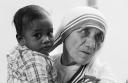
Mother Teresa – “Love is Left Alone”

Mother Teresa 1979

Jesus has a very special love for you. As for me, the silence and the emptiness is so great that I look and do not see, listen and do not hear.
— Mother Teresa to the Rev. Michael Van Der Peet, September 1979

The Time cover story was not really news to me. I had read about Mother Teresa’s time of spiritual dryness in My Life With the Saints, by Fr. James Martin, S.J. Like most people, I never suspected that Mother Teresa’s spiritual silence and emptiness had lasted so long.

In the secular science of the soul – psychology – the current ideal of human development is one of balance. There is supposed to be an apportioning of time and energy for your internal, personal, and professional life. We are supposed to pay attention to our own personal space, our spouses, families, colleagues, communities, and the environment.

Like most ideals, it is unattainable. If we could achieve a balance in all of these relationships, we would implode under the disappearance of our own uniquely unbalanced personalities. If personal fulfillment and psychological health is not balance, it would seem that some portion of our efforts should be focused on many of these areas. What happens if your life is comprised only of ministry?

Mother Teresa of Kolkata (Calcutta) led a life beyond balance. She had no secular career, no family, no apparent hobbies. She had an all consuming ministry to those completely abandoned by society. Founding and leading a religious order and expanding the work of the Missionaries of Charity, left little time for sleep, let alone rest and relaxation.

Mother Teresa’s hyper-focus and zeal appears to go against most of the consensus about the development of the spiritual life. Spiritual directors and teachers prescribe adequate sleep, relaxation, and attention to personal and community relationships. The Rule of St. Benedict of Nursia (c. 530) comes to mind, since it has been the de facto standard in monastic living. There is a large body of Christian literature, from the earliest times, advising prudence and temperance in the spiritual life.

St. Ignatius Loyola referred to dark periods, when there is little feeling of the presence of God, as periods of desolation or aridity. Early hermits in the Egyptian desert referred to this state as the “noonday devil.

My first thought was that Mother Teresa’s lack of prudence and temperance had gotten the better of her. Yet, how could I make such an observation without knowing Mother Teresa? So, I decided to talk with someone whose home in Madras Mother Teresa had visited several times. Paul D’Souza is an old friend of ours who met her when he was 3 years old. What struck Paul was that, although the house was full, she always first sought him out and the other small children, before paying attention to any one else. Paul has had his own thoughts on harmony and balance for some time. As a management consultant and healer, Paul has his own theory of Beyond Balance.

When I asked him what he thought might have been the cause of Mother Teresa’s very long dark night of the soul, the reply was unusually sharp for someone with a master’s degree in social work. Paul remembered that Mother Teresa continually reminded her Missionaries that the face of Christ was to be found in every child, in every human person. The arduous work of caring for disabled orphans is a direct service to Christ. “What about balance?” I asked. In tones of not so patient exasperation, Paul said that in his study of leaders, “No one whoever accomplished anything was balanced.” When I pressed him on Mother Teresa as a person, he told me to talk with his mother who had met Mother Teresa several times.

I had a pleasant talk with Christine D’Souza, who is also an old friend. (Our children call her Grandma Christine.) She and her late husband, John, met Mother Teresa in 1968 in Madras, now known as Chenai. As many have recounted elsewhere, Mother Teresa was not demanding or seemingly driven. According to Mrs. D’Souza, she normally sat quietly and spoke in a soft voice while looking at her hands. Mother Teresa “put her cards on the table,” according to Mrs. D’Souza, and allowed her listeners “to pick up what ones they would,” without asking them to make any choice. Mrs. D’Souza recalls, “She had such humility, but with a strength and dignity. She reminded me of the beatitude, ‘Blessed are the meek.'” The only time Mrs. D’Souza recalls her making a request was when they first met and Mother Teresa asked her directly if she and the lay co-workers could meet at the D’Souza’s home.

When I asked Mrs. D’Souza what she thought about Mother Teresa’s decades of spiritual dryness, she responded with the wisdom of age and grace. Mrs. D’Souza said that she couldn’t speak for anyone else. She recounted that in her youth she experienced a closeness to Christ but that this emotional awareness and feeling waned over time. This absence did not keep her from raising a family, being a music educator, and engaging in many other activities in a spirit of faith.

Mrs. D’Souza recalled a few lines of a poem in a pamphlet her husband had given her:

God gives us love.

Something to love He lends to us.

Love reaches ripeness,

and of that on which it throve,

Love is left alone.

Read More

Posted by on Sep 4, 2007

Feast of the Day: The Immaculate Conception of the Blessed Virgin Mary

The Triumph of the Lowly – St. Thérèse of Lisieux and The Little Way

Not too long after Pope John Paul II named St. Thérèse of Lisieux a Doctor of the Church in 1997, I overheard someone commenting to one of her friends that a specialist in the spirituality of St. Teresa of Avila, was upset by his action. This specialist was very clear about the reasons that Teresa of Avila had received that honor, based on her years of spiritual growth, her reformation of the Carmelite order, and her writings. By contrast, Thérèse of Lisieux, in her short 24 years, had really not contributed anything of substance, certainly not enough to merit such a grand title as Doctor of the Church, a status shared by only 32 other people. Only two other women, Teresa of Avila (1515-1582) and Catherine of Siena (1347-1380) were Doctors of the Church. They had only received this recognition in 1970. (The New Catholic Encyclopedia, in 1967, ventured that women were unlikely to receive this honor because it is linked to the teaching office of the church,”which is limited to males.”)

Marie Françoise Thérèse Martin (1873-1897) became Sr. Thérèse of the Child Jesus and the Holy Face when she took her vows at the Carmelite convent in Lisieux in Normandy, France in 1888. I have been a fan of hers since I was in second grade. I read a children’s biography, Saint Thérèse and the Roses. It was really too hard for me to read easily, but I plowed my way through it and fell in love with her. I returned to the story many times as I grew up and continued to find her attractive. In fact, I chose her as my Confirmation patroness at age 13, long before she was so grand.

When Randy and I were newly-weds, we went to Guadalajara, Mexico to meet his cousins on his father’s side of the family. Randy’s aunt, Tía Dorotea, gave me a copy of Thérèse’s autobiography, The Story of a Soul, in Spanish. Thérèse was also Tía Dorotea’s favorite saint and I learned that in Mexico she is sometimes known as Santa Teresita (St. Little Teresa). I have thought of her as Teresita since that time.

However, I was in graduate school and then had young children and a business to operate with Randy, and I never found time to read my precious gift.

I’d like to say that I have now found and read it, but that would not be true. I know it is in our house somewhere, but like the beads for repairing my favorite moccasins, it is hiding in our resident Black Hole. I’m confident that it will someday escape and I plan to read it with a smile when it does, as I remember Tía Dorotea fondly.

So, I found myself wondering, what was it that made her as important in the life and history of the Church as Teresa of Avila and Catherine of Siena? I found the answer recently while shopping for a birthday gift at my favorite bookstore. On the shelf was a small book by Patrick Ahern, Auxiliary Bishop of New York, Maurice and Thérèse: The Story of a Love.

In this little book, Bishop Ahern offers a brief biography of Thérèse of Lisieux and an explanation of the general spiritual ambience of the late 19th Century. He then presents a series of letters written by Maurice Bellière to Thérèse of Lisieux and her responses. Maurice Bellière was a seminarian who had written to the Prioress of Carmel in Lisieux requesting that a Sister be chosen to pray especially for his vocation and with whom he could correspond. Thérèse’s sister Pauline was prioress at the time and she chose Thérèse to be the one who would respond to him.

Thérèse was passing through the last 18 months of her life, dying of tuberculosis. She was holding on by sheer force of will to her belief in God and her trust that her life of faith had not been that of a fool. It was a time of deep spiritual darkness for her, yet she offered sound advice, great encouragement and deep love to Maurice in her letters.

I couldn’t send the book to its new owner until I read it all myself! And through this book, I came to understand the great gift my Teresita gave to the Church, a path out of the darkness of Jansenism back into the light of trust in a loving God.

During the late 19th Century, an heretical approach to spirituality called Jansenism was still widely influential in popular spirituality, especially in France. The fundamental idea of Jansenism, which began in the mid-1600s, was that humans are not able to resisting any deep longing of the soul or any pleasure, whether towards good or evil. The only hope of salvation rested on God’s intervention in a person’s life, steering the person directly to choose the good. This understanding denied the existence and role of free will as a foundation of the relationship between God and humans. It was a system of predestination in which no one could have any certainty that he or she had been chosen (predestined) for salvation.

As a result, it tended to be a spirituality leading to uncompromising firmness or rigidity regarding beliefs and stern, strict religious practices. There was no role allowed for the heart or for feelings in worship. The infallibility of Church teachings was denied. Humans were seen as inherently bad and unworthy of God’s love or forgiveness. Frequent reception of Communion was discouraged because people are so unworthy to receive such a great gift.

Jansenism persisted for the next several centuries, especially in France. It was formally outlawed in 1712, but many Jansenist ideas and practices continued. St. Pius X, who had read Thérèse’s autobiography, was elected Pope in 1903. He tried to counter Jansenism by lowering the age for First Communion to 7 and by encouraging frequent Communion. Yet even into the mid-20th century when I was a girl, the remnants of Jansenism popped up in popular spirituality and even in the pulpit.

The “Little Way” of Thérèse of Lisieux, again opened the door to the Good News of Jesus, that God is a loving Father (a Parent) to us. While it is true that we are weak and we sin all too easily and frequently, God’s Love still reaches out to us and forgives.

The essence of the Little Way is the idea that most of us are not called to heroic degrees of self giving and sacrifice in our lives. Most of us are not called to leadership roles in the community. Few are called to celibacy. Even fewer are called to the heroic witness of martyrdom. But all of us are called to holiness (sainthood).

In her own words, “Love proves itself by deeds, so how am I to show my love? Great deeds are forbidden me. The only way I can prove my love is by scattering flowers and these flowers are every little sacrifice, every glance and word, and the doing of the least actions for love.”

Teresita understood, as did the great St. Teresa of Avila, that God is found even in the cooking pots of the kitchen — in the daily routines of cooking, cleaning, sewing, gardening and praying of her community.

Bishop Ahern notes that her greatest fear in facing death was that death might truly be the end of everything. That her life might go out like an extinguished candle and all have been in vain. Her second greatest fear was the death by suffocation that tuberculosis often causes. However, when the time came, she simply stopped breathing, with a smile of peaceful delight on her face, and moved into her new life, all fear and doubt obviously left behind her. Her final words were, “My God, I love you.”

John Paul II, in Divini Amoris Scientia (The Science of Divine Love), the decree that gave Marie Françoise Thérèse Martin the title, Doctor of the Church, noted that she gave us a foundation for spirituality that was innocent, open, hopeful, and trusting. Church authorities also noted that Thérèse was ahead of her time. Thérèse stressed the importance of reading Scripture and using it as a basis for prayer and meditation. She promoted the importance of studying the Scriptures in their original languages. These views would set theology and spirituality on a whole new course when they were advocated in 1943 by Pope Pius XII, in Divino Afflante Spiritu (Inspired by the Divine Spirit).

Thérèse Martin’s little book and her Little Way also influenced Pope John XXIII who convened the Second Vatican Council. Her autobiography influenced most of the movers and shakers of the early 20th Century in the Church and those insights shine through the Council documents and reforms.

Thank you, Bishop Ahern for your wonderful little book.

Read More

Posted by on Aug 23, 2007

Harden Not Your Heart

Many years ago I was teaching a 5th and 6th grade religious education class (otherwise known as CCD in Catholic circles). It was a lively group of children, many of whom were quite outspoken. We gathered weekly in a church hall after their regular school day. I always let them move around a bit, talk with each other and work on a cross stitch project while I was getting the space ready for our class. It helped them transition into the time we would spend together. It also helped them get to know each other, because they came from four or five different schools.

One particular day, a very lively, expressive girl, I’ll call her Marcie, decided that she didn’t like something I had said in greeting or in calling the group together. I don’t remember now what it was, but none of the other children thought anything of it.

When I called the children to gather in a circle for our opening prayer verse and song, Marcie joined the circle but faced away from the rest of us, towards the outside, saying she wasn’t going to be part of the group because she didn’t like what I had said.

It’s not often that a teacher gets such a perfect example handed her on a platter, so I shamelessly moved ahead and used it! We were, after all, studying the sacraments, including Reconciliation, that year. I asked the other children to look at Marcie and notice what she was doing. She had chosen not to be part of the group and had turned away from us. We had not turned from her. None of us had rejected her in any way. It was her choice to turn away and would be her choice to turn back to join the group. That is the way it is between us and God. God never turns away from us. We may choose to turn from God — and we are the ones who can choose to turn back at any time. God will never force us to act in either direction. It’s entirely up to each of us.

And what did Marcie do while I was speaking? Before I finished the first sentence, she had turned back to the group and was apologizing to all of them for giving me the chance to make a “religion” lesson out of what she had done. They were quick to make her feel at ease again.

I remembered Marcie and that day today as we prayed the Psalm at Mass. “If today you hear God’s voice, harden not your heart.” (Ps 95:7-8) God’s voice calls us. I hope we can respond as quickly as Marcie and the other children did to join the circle listening to His voice.

Read More