Pages Menu
RssFacebook
Categories Menu

Posted by on Jan 1, 2011

World Peace and Freedom of Religion

World Peace and Freedom of Religion

(Credit: Hiking Artist Cartoons – Used with permission)

This New Year’s post and my resolution comes from Fr. Cyprian Consiglio’s homily today at Holy Cross Church in Santa Cruz, California. Fr. Cyprian is a Camaldolese monk, musician, and student of world religions.

A liturgy with Fr. Cyprian is always a wonderful experience. His homily was based on the theme for today’s observance of World Peace Day.

Pope Benedict XVI focused on Freedom of Religion as the theme for this New Year’s Day of Peace 2011.

Religious freedom is not the exclusive patrimony of believers, but of the whole family of the earth’s peoples. It is an essential element of a constitutional state; it cannot be denied without at the same time encroaching on all fundamental rights and freedoms, since it is their synthesis and keystone. It is “the litmus test for the respect of all the other human rights”.[8] While it favours the exercise of our most specifically human faculties, it creates the necessary premises for the attainment of an integral development which concerns the whole of the person in every single dimension.

In his homily, Fr. Cyprian reflected on the number of groups which observed peace vigils New Year’s Eve and that the growing number showed, perhaps, an increase in consciousness and enlightenment. He went to some pains to point out that many of the groups from diverse traditions did not agree on everything and probably never would. However, it is only through the free exercise of religion and the building of bridges of good will that these tensions can be recognized, managed, and appreciated.

In fact Fr. Cyprian’s life as a troubadour of peace has bridged many of these divides through the dialog of contemplation and world music. (For wonderful and challenging reflections, subscribe to Fr. Cyprian’s blog.)

The unspoken lesson: Become the Peace You Want.

YouTube – CyprianConsiglio’s Channel.

For a brief but deep meditation on peace, tune into the chants Benedictus, Namo Janitre, and Awakening performed by Fr. Cyprian and Dr. John Pennington for a truly happy entry into this New Year.

Fr. Cyprian Consiglio and Dr. John Pennington

I highly recommend Fr. Cyprian’s blog and Dr. John Pennington’s website.

Read More

Posted by on Dec 17, 2010

Advent – A Time to Be At Peace

We’re now approaching the fourth Sunday of Advent and the number days until Christmas grows shorter. We’ve heard readings of Hope/Expectation for the Coming of Christ in our days and at the end of days. We’ve heard readings of Peace, with images of children playing safely beside the adder’s lair and lambs being safe with lions. Readings of Joy were proclaimed last week, with the promise of the Lord coming to set things right and signs of the coming of the Kingdom of God already present in the life and work of Jesus. Next Sunday we’ll hear of the Lord’s promise and reassurance to St. Joseph that Mary’s pregnancy was divinely blessed and of Joseph’s acceptance of that gift.

As I’ve moved through these days and weeks, I’ve been reflecting on what peace means in daily life. It seems to me that peace is more than the absence of armed conflict between nations. Peace is a way of living. It springs from a place of openness and gratitude.

Peace means being gracious when another person fails to notice, even in passing, that you have gone out of your way to do something just for him or her. Peace means accepting an apology without needing to shame the one offering it. Peace means choosing to be kind rather than insisting on being right. Peace means looking beyond the gift one has received to see the love with which it was given.

Peace flows out of a place of gratitude for gifts received and shared. It giggles with a small child discovering the joys of a puddle. It smiles with the fond memories of a grandparent who is watching another’s child. It holds hands and spends quiet time with the person nearing the end of this life.

Advent is about hope, peace, joy and the coming of the light of the world. May each of us remember this truth as we hear the enticements of the mall and feel the pressure to “make Christmas memorable” by doing many things and buying lots of merchandise. Advent is a time for hope, peace, joy, and sharing with Christ the wonder of being a bringer of hope, peace and joy to others.

Come, Lord Jesus, Come!

Read More

Posted by on Oct 31, 2010

Who is Zacchaeus in Our Lives Today?

The Gospel reading for today, the 31st Sunday of Ordinary time, Cycle C, is the story of the tax collector, Zacchaeus.

Zacchaeus lived in Jericho. He was despised by the people of the community because he was a tax collector. Being a tax collector in those days meant that he was free to extort as much as he could get from the people and had only to send a portion of it to the authorities at higher levels of government (ie, Jerusalem and Rome). He was the chief tax collector, taking money from all the tax collectors under his supervision and from his own work as well. The gospel notes that he was a wealthy man.

Now Zacchaeus was curious about Jesus and when he heard that Jesus would be passing through town, he went out with the crowd to see him. We do the same today when celebrities come through our own towns. However, Zacchaeus had a problem. He was a short man and there were lots of people in front of him. So he climbed a tree to get a better view.

Jesus saw him in the tree, stopped and called him by name to come down, saying that he (Jesus) would dine at the home of Zacchaeus that night. The people were horrified and scandalized. They asked if Jesus really could know who Zacchaeus was, that he was a terrible sinner? But Zacchaeus was touched by the healing love of Jesus in that moment and volunteered that he would return fourfold all that he had stolen and give half of his possessions to the poor. Jesus told all “Today salvation has come to this house because this man too is a descendant of Abraham. For the Son of Man has come to seek and to save what was lost.” (Lk 19:1-10)

This story got me to thinking. Who is Zacchaeus in our lives today?

It’s easy to point the finger of blame at celebrities who are promiscuous or who drink too much or who use illicit drugs. It’s easy to look at politicians who misuse their power. It’s easy to say that those who provide or seek abortions are great sinners. It’s easy to scapegoat people whose sexual orientation does not match our own.  It’s easy to gloat when a minister is caught in some sin he or she has denounced from the pulpit.

But I don’t think that’s the lesson we need to draw from this account. We need to look at ourselves and see the areas in which we fail. We need to ask ourselves who we cheat, from whom do we steal, whose hearts do we break? To some extent each of us is Zacchaeus.

Then I suggest we go a step further. Who are the people in our lives whom we blame for what is wrong in society? Who are the people we would choose to block from access to the goods of life? To whom would we deny education, health care, food, clothing, shelter?

Do we blame undocumented immigrants and seek to exclude them and their children from the goods and services they need to live full, healthy lives? Do we suggest that the children of the undocumented who are born here should not be citizens by birth, thereby denying them the protection of the 14th Amendment of the Constitution? Do we look down on the laid off teacher, the unwed mother,  or the disabled worker who receive unemployment, food stamps and Medicaid? Do we insist that people who can’t afford health insurance should just not get sick and/or need preventive care services? Do we say that only the well-to-do should be able to stay home with their young children and that mothers in poorer families should have to put their children in day care for long periods of time and work at minimum wage or less trying to earn enough to cover rent, food and childcare? Do we assume that all children of minority groups are probably gang members? Do we expect that the poor are somehow less intelligent and deserve to live in poverty?

I suggest that perhaps Zacchaeus takes many forms in the United States today. Some people we treat as if they were public sinners (Zacchaeus) because they are less fortunate or have made poor decisions in their lives. Somehow we are inclined to believe that those for whom all is going well are holy and specially rewarded by God for their good lives and that the opposite is true for those in difficult circumstances. Some of us are Zacchaeus in our world because of choices we have made that hurt others.

The good news is that Jesus came to bring salvation to us all, in whatever way we may personally be Zacchaeus and to whomever we treat with scorn or exclude as if he or she were Zacchaeus.  And why does Jesus come to bring this salvation? Because “the Son of Man has come to seek and to save what was lost” and because the Lord will “overlook people’s sins that they may repent.” (Wis 11:23)

Good news indeed. May we be open to receive that salvation ourselves and to support others whom we might otherwise push aside as unworthy of the grace and blessings of the Lord.

Read More

Posted by on Oct 15, 2010

World Peace and Freedom of Religion

St. Teresa of Avila – On Prayer


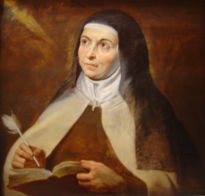
St. Teresa of Avila by Peter Paul Rubens

“Contemplative prayer [oración mental] in my opinion is nothing else than a close sharing between friends; it means taking time frequently to be alone with him who we know loves us.”

St. Teresa of Avila is considered an expert on prayer. In her many writings, she describes a four step  process of growth in prayer, beginning with mental prayer and culminating in deep mystical experiences. Her writings are based on her personal experience and are deeply insightful.

Most of us pray on the first level, that of mental prayer. This is the type of prayer described in the above quotation. In this stage, prayer is a question of consciously choosing to pay attention and spend time with God, remembering and meditating on the love of God as seen through the life of Christ and His passion.  This level of the journey of prayer requires our choice and active participation. God is there waiting for us to come calling, but God will not force us to stop and spend time in the divine company.

The good news is that prayer in this sense does not require hours of preparation nor does it remove the one who prays from the surrounding world. It’s wonderful when it’s possible to retreat to a place of solitude and spend time with the Lord, but when responsiblities of life and work don’t permit more than a few minutes of alone time, one can still speak with the Lord quietly in thanks or to ask for help. That’s one of the things I’ve always loved about St. Teresa of Avila, she was very practical about prayer opportunities. As I stand with my hands in the dish water every evening, I remember her advice to one of her sisters: “God can be found even among the stew pots of the kitchen.”

Today as we celebrate her feast, may we remember to give thanks for the gifts God gave her and the insights she shared with us about God’s love. Let’s especially be grateful that our relationship with God is to be that of a close friend with whom we look forward to spending a few minutes of our time.

Read More

Posted by on Apr 9, 2010

World Peace and Freedom of Religion

Great Love or Great Suffering – Two Paths to Non-duality

Richard Rohr, OFM

Recently I’ve been listening to Fr. Richard Rohr’s three CD set, Exploring and Experiencing The Naked Now, a recording of two webcasts in which he talks about his work on non-dual thinking and the insights of the contemplative/mystic tradition of Christianity. Rohr’s work provides a fine background for the last couple of weeks of Lent and moving into Easter.

A central insight of Rohr’s work is that non-dualistic thinking is central to experiencing the mystery of Christ and the Trinity. God is One, yet we know God as Father, Son and Holy Spirit. The contrast boggles the mind when we try to explain, define or otherwise pin down the mystery. Our minds, trained to make logical distinctions and put all we experience into categories of “this/not that,” find it hard to deal with the “yes/and”  of combining such seemingly irreconcilable statements. Nevertheless, Jesus calls us into the mystery and teaches through example, images and stories that seem to contradict each other. In one place, for example, he says that his followers are to turn the other cheek when someone strikes them. In another, he counsels that it’s time to take swords along to the place where he and is friends planned to spend the night. At yet another, he turns over the tables of the money-changers in the temple and drives them out. Then when the chips are down, he heals the ear of the servant of the High Priest in the Garden of Gethsemane and goes to his death without offering resistance. So which is it? Non-violent always or Violent sometimes? Do we simply choose one meaning – the one that suits what we want to do – or are we supposed to try to make some logical sense of the contrasting statements/actions or must we somehow live in the mystery, without needing to explain it logically. And if we do that, won’t we be seen as somehow immature and childish?

Rohr suggests that a return to the contemplative mindset is essential in the long-run. It is the ultimate goal of the spiritual life. Union with God, a return to the non-duality of the Garden of Eden, is the final goal of our lives and quest. We start non-dualistically as infants and small children. We move away from non-dualism around the age of reason and begin to be able to separate from God, make wrong choices, and, dare I say it, to sin. We learn what is right and what is wrong. We learn to make distinctions. Then we think we’ve got it all set for the rest of our lives. But we’re right smack dab in the middle of a dualistic world and mindset. So everything gets phrased in terms of win/lose or “limited good” (a concept from anthropology) — what is good for you will take something from me. We forget, or perhaps haven’t consciously experienced, that God’s love comes to us like water flowing through a pipeline or electricity flowing down a wire. As long as there’s no blockage, it just keeps coming. The critical thing is to keep the pipe open, the transmission line unbroken. But that gets scary. The “what ifs” start raising their ugly heads. And we fight against anyone or anything that seems to threaten the way things are now, even if it’s not ideal. And so we block the flow, partially or totally.

Rohr argues that the only way we can move beyond dualism in our thinking and again enter non-dualistic reality is through the path of great love or the path of great suffering.  In both situations, the normal ways of coping or experiencing reality fall away.  We don’t have the energy to block the flow. We’re too deeply in the joy or sorrow. “Everything’s coming up roses …” as the song says. Or, alternatively, we cry out, “My God, my God, why have you abandoned me?” Where are you when I need you God? In either condition, we are open to experience the wonder of God’s love and compassion without trying to (or even being capable of) splitting it into dualistic compartments or categories. The experiences are too overwhelming, too all encompasing, too intense to allow for separation and dualism. And then we can grow in wisdom. And we experience redemption – a return to union with our God – set free from the normal ties that hold us bound in worry of losing our “secure” duality.

Meanwhile, “back at the farm,” the troubles and tragedies of world events continue through Holy Week.  A small group of people are arrested for plotting to kill a police officer and then kill more officers at his funeral, all in the name of Christ. What madness is this? Bombs explode in crowded places around the world, in the name of God. What madness is that? How can religious people believe that the creator of all of us and of all of the wonders of the universe could want us to be killing each other? And how could we dare to think we do it in his name, by his authorization? How can Christians be terrorists, as Leonard Pitts notes in a recent column? Is our God really so helpless or so impotent that he could condone such action, such dualistic us/them action?

Jesus went to the cross rather than try to force God’s hand to free his nation from the Romans by inciting a rebellion, as some would have liked. He went to the cross rather than deny the truth that God is more interested in the way we treat each other than in the sacrifices we bring to the altar. He went to the cross rather than run away and deny that he had experienced a very special relationship with his Father, one that the Father wants to share with the rest of us too. And redemption came out of that great passionate love and suffering. Easter came to all the world and our separation from God came to a resounding end.

May each of us move forward in this Easter season in joy and trust, building on the faith of our younger years and beginning to enter into the world of contemplation, of not dividing the “real” from the “ideal,” of really believing the Good News, that love is all that really matters, and love will make all the suffering lead to the peace and deep, deep joy of the children of God.

Read More

Posted by on Mar 4, 2010

World Peace and Freedom of Religion

Divided by the Bonds of a Common Religion

When I was growing up, one of the questions always asked when two people began dating  was, “Is she/he Catholic?” It was quite rightly assumed that differences in religion within a marriage could be a major source of stress and potentially lead to break-up of the marriage. In those days, we were just barely past the time that “mixed marriages” took place at the rectory or in the vestibule, and the non-Catholic partner had to promise to raise the children Catholic before a marriage could be blessed. Presumably, sharing the bonds of a common religion would serve to strengthen the marriage.

Imagine my surprise, then, when I married a Catholic man of Mexican ancestry and discovered that we were divided by the bonds of a common religion. Many aspects of his cultural experience of Catholicism were different from the Irish-German Catholic experience of my childhood. (And no, the German Catholic side were not converts.  They had been Catholic for centuries.)

Things we found that differed ranged from the relative importance of certain feast days (those of Our Lady were never to be missed) to questions as “serious” as Friday abstinence (could one eat gravy served on potatoes at a restaurant on a Lenten Friday?).

Fortunately, we were both graduate students in Anthropology and had a vocabulary with which to discuss and appreciate the cultural differences over which we were tripping. Feasts of Our Lady are extremely important in Hispanic culture and, as Our Lady of Guadalupe, she is trusted to handle any and all problems that arise. Friday abstinence from meat has been somewhat optional within Spanish speaking culture since the time of the Crusades. The male head of household had the prerogative to excuse the family from following the rule of abstinence. So the question of gravy on potatoes was moot! Simply a minor cultural difference in the experience of faith and definitely not something requiring confession. (Further research done in the course of writing this post indicates that meat based gravy was never actually prohibited, but general understanding of the rules within my culture of origin excluded it.)

This all came to mind again in the past couple of weeks. One of our daughter’s classmates is also Catholic, from a somewhat more traditional family than ours. On Ash Wednesday, the friend ruefully confessed that she had already forgotten and had a piece of candy that day. She had intended to give up candy for Lent. As it turned out, she had also forgotten (or perhaps never realized) that Ash Wednesday is a day of abstinence. She had packed a wonderful turkey sandwich for lunch that day. When apprised of the fact, she looked at the sandwich, declared, “Well, it would be a shame to waste it,” and ate her entire lunch.

When I was their age, the poor sandwich would have been returned to its wrapper and taken home for another day, or perhaps even thrown away. Some might have chastised the young woman for breaking a Church rule and eating the sandwich. She probably would have felt the need to confess her sin. Blessedly, she does not seem to have such worries today.

So a few questions arise.  How do rules fit into our experience of faith? Why even have rules of fast and abstinence if they aren’t going to be taken extremely seriously? How can religious rules be applied to one group of people and not another? That’s not fair! Aren’t there more important things to worry about than what people eat and when? Should religions have rules at all?

In looking at religion and behaviors associated with religion, Clifford Geertz‘ insight, in “Religion as a Cultural System,” that religion serves both as a model of society and a model for society provides a useful platform for analysis. Religions all around the world have codes of behavior — expectations of how people will act and for what reasons they will act as they do. These codes are normally posited to be the will of the deity. Generally, they uphold the social structure of the society and provide the rationale for the way social interactions occur. The song, “Tradition,” from the musical, Fiddler on the Roof, is an excellent example of the structuring of such social expectations and the recourse to God as their source.

This works pretty well when the religion in question is a small, localized one with a limited number of adherents. With groups that are larger and spread out over a larger geographic area, modifications begin to be seen. As Christianity spread out through the Roman Empire, accomodations were made to make it more understandable to peoples with different geographical, economic and cultural realities. If evergreen boughs are a symbol of everlasting life in a culture, for example, it’s a short jump to include them as symbols in Christian settings as well. But if evergreens mean nothing in a culture, they will often mean nothing in liturgical settings either. For this reason we are careful what we include in liturgy that must of its nature be open to be experienced cross-culturally.

The underlying reason for a practice is also important in analysis of how that practice plays out in the lived experience of a people. If the underlying reason is that there must be atonement for one’s failings, a penitential reason, then denying oneself something good but not necessary for life is often valued. If growth in self discipline is an underlying reason, again, denying oneself something makes sense. If one’s salvation from a nearly eternal cycle of birth and rebirth requires attaining perfection or enlightenment in this life, such practices again make sense. If the reason is that we choose to enter into a time and process of transformation of who we are so that we can be more open to meet our God when He comes, then it again makes sense.

Most religions and “spiritual” movements or quests require their adherents to make sacrifices during certain seasons or as part of their daily life. There is a recognition that we are not perfect and we do not live in a perfect world. It takes work to make things better and to become better persons. We only grow through difficult experiences, not when all is easy. So times of prayer and fasting and  giving alms are commonly found.

The trick in all of this is to keep things in perspective. What is a more serious offense, eating meat on Friday, for example, or betraying a friend? Is it more offensive to God and the community to miss Mass on Sunday because guests arrived unexpectedly or to turn away the guests because one has to get to church? Should we look to larger issues of how we use resources locally and globally in planning the forms our fasting and almsgiving will take? How do our religious beliefs lead us to act in our communities and countries? How do we weigh the relative importance of the wide variety of issues that must be addressed by our representatives when we decide who will represent us in government? Can people of good will take different positions and still be part of our community?

It seems to me that all of these questions and more are reflected in the simple decisions we make about things like abstaining from meat on Friday or wasting the food that has been prepared for us. Some things are simply matters of traditional practice and can vary from place to place or family to family. Others are fundamental issues that go to the heart of our relationship with God and creation. Nevertheless, we must be gentle with each other in addressing them. God does not go around bashing people over the head and we must not either. If our religious beliefs and practices do act as models of the societies in which we live and models for what those societies should be like, and in my experience they do, then let’s be careful to use them to shape a society in which God’s “little ones” are protected and supported, people are free to ask questions, think for themselves, and grow in wisdom, age and grace,  and the resources we have been given can be used wisely to benefit all of God’s creatures, human as well as non-human.

Just as my husband and I found we were divided by the bonds of a common religion, humans are divided by the bonds of our common human habit of designing social systems to meet the environment in which we find ourselves and the perception of reality that goes with and shapes those systems that we design. Only by accepting each other in love, giving up the attempt to change the other into our own image and culture, and laughing a lot as we go along can we be transformed so we are ready to meet the Lord who comes to us telling stories and trusting in His Father’s bounty and love to sustain Him.

Read More

Posted by on Feb 16, 2010

World Peace and Freedom of Religion

And Once Again, The Seasons Turn

Mardi Gras beads

It’s Tuesday afternoon, the day before Ash Wednesday, a day called Mardi Gras  or Carnival in many places. The sun is shining yet again here in Santa Cruz, as it did all weekend, with warm breezes, bird song, blooming fruit trees, sour grass, wild radish, camelias and daffodils to celebrate the wonder and promise of Spring. A far cry from the winter so many people are still experiencing here in the Northern Hemisphere. It should be noted, that this beautiful weather will not last for long. Already storms are lining up out on the ocean for the end of the week. But today it is beautiful.

I’m sitting here thinking about the interesting confluence of themes that have met this week. Sunday was Valentine’s Day, a day of hearts and flowers, a day of many marriages, the birthday of a friend from graduate school whom I remember fondly, a day of gifts and remembrances for those we love. For some it’s a day of disappointment or sadness, when a loved one is not thrilled, or when no one is there to say “I love you,” or when a relationship has ended and the hurt has not begun to heal.  

Sunday was also the day many people in the world celebrate the beginning of a new year, a day we call Chinese New Year, though it isn’t only the Chinese who celebrate this day. Parades, parties, special foods, gifts, and good wishes abound.  It’s a day of hope for the future.

This particular Sunday, the readings of Cycle C from Jeremiah, Paul and Luke challenged us to keep our focus on the Lord and not put our fundamental trust in the things of this world. Calling the poor, the hungry, the weeping and the excluded ones among us blessed, Jesus warns that those who find life easy and who never challenge the status quo for fear of arousing the enmity of those in power are not close to the kingdom of God. It’s a message that is far from our American cultural concept, drawn from the earliest colonial days, that those who are economically secure and respected by their fellows are those blessed by God, while those who are poor, sick, injured, or otherwise disadvantaged are somehow not pleasing to God and are being punished.

Father Ron Shirley, our pastor, in his homily told the story of a wedding toast. The best man offered a toast wishing only the best for the bride and groom, with never a moment of pain or sadness. Then a stranger stepped up and offered a toast. He was dressed simply and seemed out of place. He assured the couple that he loved them deeply then offered a series of strange wishes for them – that poverty, sorrow, pain, and controversy would be part of their lives.

Today we celebrate Mardi Gras – with rich foods, parties, celebrations of abundance and the promise of good things to come.  And tomorrow we enter into a time of reflection, of conversion, and of returning our attention and our intentions to God and the works of God. Are they opposites or mutually exclusive? I don’t think so. Jesus and his followers certainly didn’t go around in sack cloth and ashes, continually fasting. They were criticized for their love of good times and celebrations. But there is a time and a place for abstaining from some of the good things of live in order to be open to the deeper fundamentals of God’s life and love for us. Jesus and his followers quietly entered into those times as well.

And so we follow them into these weeks of reflection and self-control, as we break our addictions to the excesses of the world around us and try to be more open to the quiet wonders of God’s love in people and in nature. The season is turning. New hope is in the air. Easter is coming soon.

May these days of Lenten preparation be full of the awareness of the Lord’s presence in your life and of the abundance of His love and support in all of life’s challenges.

Read More

Posted by on Dec 31, 2009

World Peace and Freedom of Religion

New Year’s Greetings and Wishes

New Year's Eve in Rio

New Year's Eve in Rio

It’s New Year’s Eve in Santa Cruz. A year has nearly ended and a new one is fast upon us. On top of that, the first decade of the new century is coming to a close. So much has happened in the past 10 years – for all of us. Some has been good. Some has been bad. Some has been just normal. That’s the way life goes.

Still, as Christians, we live with the belief and hope that God is in it all and brings good out of even the terrible times of our lives. The God who couldn’t bear to sit back in isolation from all of creation and from the human beings He created entered into our lives and history, to bring us all back into union again. It’s not up to us to become perfect and worthy of God. God became one of us and in doing so, made that re-union possible. We just have to let go of anger, jealously, hatred, fear, and all the other negative energies which we so easily hold onto and nurture. God will even help us let go of them.  It’s all a free gift!

So, at this time of a New Year and a New Decade, may the Love and Peace and Joy of God fill each of our hearts, so that no room remains for harboring the negative, life-draining spirits that lurk among us. May we look at each other and at ourselves and see the Face of God looking back at us. May we rejoice in the beauty of creation and of each person. May we trust that when the hard times come, as they certainly will, God will be with us personally, holding our hand and helping us through them. And may we move forward with confidence that we are loved and lovable, just as we are. Of course, there’s room for growth in love, patience, faithfulness, joy, and so forth, but we are each loved NOW, by our God who is absolutely crazy about us and just wants to hold us close in a huge, big hug.

What great good news that is!

Happy New Year.

Read More

Posted by on Aug 30, 2009

World Peace and Freedom of Religion

Act on God’s Word – August 30, 2009

Fr. Ron Shirley

Fr. Ron Shirley

The following is today’s homily from Fr. Ron Shirley, pastor of Resurrection Parish in Aptos, CA. Today’s readings are for the 22 Sunday of Ordinary Time, Cycle B. (DT 4:1-2,6-8, JAS 1:17-18,21b-22,27, MK 7:1-8, 14-15, 21-23)

Fr. Ron’s homilies are available every week at www.FatherRon.com.

An elderly priest made a retreat. In the course of it he was struck deeply by three things that he’d always been aware of but never had really taken to heart.

First, there are millions of people in the world who are hungry and homeless. Second, he had spent his entire priestly life preaching comfortable sermons to comfortable people. Third, he had bent over backwards to avoid disturbing or alienating people.

In other words, the priest found himself to be much like the priest played by Jack Lemmon in the film “Mass Appeal.” He preached only about those things that didn’t disturb his parishioners and made them feel good.

And now, like the priest in “Mass Appeal,” the old priest suddenly realized that he had been more worried about pleasing his people than about preaching the Gospel. He had been more worried about rocking the boat than about challenging his parishioners to look into their hearts to see if they were satisfied with what they saw there.

The week following his eye-opening retreat, the old priest looked up the Scripture readings to prepare his Sunday homily.

As he read the Gospel, these words of Jesus leaped right off the page: “These people honor me with their lips, but their hearts are far from me.”

The priest resolved, then and there, that he was going to share his soul-searching with his parishioners. So he began his homily by saying:

“My homily this morning will be exactly 30 seconds long. That’s the shortest homily that I’ve ever preached in my life, but it’s also the most important homily I’ve ever preached.”

With that attention-grabbing introduction, the priest gave his 30-second homily. He said:

“I want to make just three points. First, millions of people in the world are hungry and homeless. Second, most people in the world don’t give a damn about that. Third, many of you are more disturbed by the fact that I just said damn in the pulpit than by the fact that I said there are millions of hungry and homeless people in the world.”

With that the elderly priest made the sign of the cross and sat down.

That homily did three things that many homilies don’t do.

First, it caught the attention of the people.
Second, it caught the spirit of Jesus’ words in the gospel.
Third, hopefully it made the people look into their hearts.

The story of this priest and the gospel reading make the same point.

Religion is not something we do on Sunday. It’s not primarily, observing certain laws, saying certain prayers, or performing certain rituals.

That’s what many people in Jesus’ time had turned religion into. To observe these rituals was to please God. Not to observe them was to sin. In short, observing rituals became identified with being religious.

To illustrate the hypocrisy of such legalism, William Barclay tells this story – about a Muslim pursing an enemy to kill him. In the midst of the chase, the Azan, or public call to prayer sounded. Instantly the Muslim got off his horse, unrolled his prayer mat, knelt down, and prayed the required prayers as fast as he could. Then he leaped back on his horse to pursue his enemy in order to kill him.

It was precisely this kind of legalism that Jesus opposed so vigorously in his time.

Jesus made it clear that religion isn’t something you do at certain times on certain days. It’s not saying certain prayers or performing certain rituals. It’s a thing of the heart. It’s a thing of the heart called love – love of God and love of neighbor. Love in action.

Today’s Scripture reading invites us to look into our hearts and to ask ourselves to what extent the words of Jesus in today’s gospel reading apply to us: “This people honor me with their lips, but their hearts are far from me.”

The Scriptures also invite us to look into our own hearts and ask ourselves to what extent the words of James in today’s second reading apply to us:

Act on (God’s) word.
If all you do is listen to it, you are deceiving yourselves.”

I hope this homily today did 3 things:

First – it caught your attention.
Second – it caught the spirit of Jesus’ words in the Gospel.
Third – it makes all of us look into our hearts!

Read More

Posted by on Dec 8, 2008

World Peace and Freedom of Religion

Celebrating Sabbath and the Sacred Present – Terry Hershey

Fountain of flowing water - from Terry's website

Fountain of flowing water - from Terry's website

It’s the second week of December. Christmas carols are sounding on the radio, in the grocery stores, elevators, and malls. Television is filled with uplifting Christmas programming. Gala fundraisers are filling evenings and weekends. Church youth groups, Scouts, Campfire Girls, Boys and Girls Clubs, etc. are selling wreaths, candles, centerpieces. Bake sales pop up all over the place to tempt us with holiday goodies. Countdowns to Christmas appear on family bulletin boards. Everywhere people are asking, “Are you ready for Christmas [or other holiday] yet?”

And in the midst of all this activity, school assignments must still be completed. Our daily work moves ever forward with its demands, whether in the office, on an assembly line, in a store, at home or any other of the myriad worksites of our lives. The amount of daylight gets shorter (in the Northern Hemisphere where I live), so it seems the amount of time to accomplish anything is shorter too.

Pressure builds for all of us and can easily spill out into our relationships with others.

So how do we reconcile all of this activity with the quiet season of hope and expectation that is Advent? How do we find the space for a few moments of quite reconnection with life, hope, love, peace, joy? Where do our relationships with family and friends find space to be nourished?

These are challenges we all face.

One of Theologika’s Trusted Authorities is Terry Hershey, a nationally known speaker and writer. Terry lives and works on Vashon Island in Washington state. He has worked as a minister and more recently has shifted his focus to the nurture of personal relationships and gardening. You can find a short description of his life journey at http://www.terryhershey.com/about.htm.

Terry’s website and the focus of his work these days is “Embracing the Sacred Present” and finding Sabbath Moments in life. He has a regular weekly newsletter and column to which you can subscribe online through the website. I highly recommend his work. I look forward to spending a few minutes each week reading his thoughts. There’s always a good story and a reflection that helps me remember to slow down, notice the presence of God in the people and places of my life, and enjoy the love that surrounds me.

Thank you Terry. Happy Birthday. And may you ever be open to life in the sacred present!

Read More

Posted by on Nov 17, 2008

World Peace and Freedom of Religion

Paul Tillich on Grace – Quote of the Day

Autumn leaf color - Image from wikimedia
Autumn leaf color – Image from wikimedia

This reflection comes courtesy of Theologika trustee Terry Hershey, quoting theologian Paul Tillich.

“Grace strikes us when we are in great pain and restlessness.
It strikes us when we walk through the dark valley of a meaningless and empty life.
It strikes us when, year after year, the longed-for perfection does not appear, when the old compulsions reign within us as they have for decades, when despair destroys all joy and courage.
Sometime at that moment a wave of light breaks into our darkness, and it is as though a voice were saying, “You are accepted. You are accepted, accepted by that which is greater than you, and the name of which you do not know.
Do not ask for the name now; perhaps you will find it later.
Do not try to do anything now; perhaps later you will do much.
Do not seek for anything, do not perform anything, do not intend anything.
Simply accept the fact that you are accepted.
If that happens to us, we experience grace.”

Paul Tillich

May grace reach into your life and surpise you today and always. Amen.

Read More

Posted by on Oct 15, 2008

World Peace and Freedom of Religion

Saint of the Day – St. Teresa of Avila – October 15

St. Teresa of Avila - by Peter Paul Rubens

St. Teresa of Avila - by Peter Paul Rubens

St. Teresa of Avila, also known as St. Teresa of Jesus, was a Carmelite nun, reformer of her order, mystic, and writer.  She is one of only three women who have been named “Doctor of the Church.” She had a lively intellect and loved people and parties. She wasn’t afraid to argue with the Lord or to oppose those of her time who believed her reforms unnecessary and even dangerous. She experienced many years of illness, including three of paralysis. She found prayer difficult for many years and even refused to try. It wasn’t until she was middle-aged that she began her great work of prayer, reform and teaching.

Many books and articles have been written about St. Teresa of Avila. I refer you to them and to her own writings for details about her life and contributions.

I also invited Mother Marija of Holy Annunciation Monastery in Sugarloaf, Pennsylvania to share a thought with us about St. Teresa. Her response:

The invitation: “What is one thing you would like people to know about St. Teresa of Avila?”  To be true to Teresa one must be faithful to Teresa’s own thought, at least as well as another can understand and convey it. Our Holy Mother St. Teresa, is a Doctor of the Church, so she needs no other “recommendation” in her teaching capacity. Her own mystical life is self-described in her writings: Life, The Way of Perfection (written for her daughters the Carmelite nuns), and the Interior Castle,  which book describes – even maps out – the journey of a soul through seven stages of the inner life to union with God. Again, Teresa had the Carmelite nuns in mind when writing this book, as the epilog expressly tells us. So what would I like people to know about Teresa? Simply that she is a true guide for a life of prayer – a “life”, meaning that prayer for Teresa is the WAY to God. Our Lord is, of course, the WAY and Teresa’s way of prayer is friendship with Jesus. The Way of Perfection, a life of Prayer and finding Jesus as the Way for each of us seems for Teresa  to be identical. After all, she is Teresa of Jesus.

Thank you, Mother, for your contribution. May God bless you and all who seek to serve Him through a life of prayer and friendship with Jesus.

The books of St. Teresa of Avila are still in print today. You can find them listed in our discovery engine at http://www.theologika.net/search. Just enter her name and you’ll get links to her works.

Read More

Posted by on Oct 1, 2008

World Peace and Freedom of Religion

Saint of the Day – St. Therese of Lisieux – October 1

St. Therese 

St. Therese of Lisieux is known as “The Little Flower” because before she died she promised that after her death she would send down a shower of roses on the earth. She is known for her “little way” to God – a way that everyone can follow, doing the smallest everyday things in love as a way to God.

I asked the sisters at several Carmelite monasteries to share their reflections on St. Therese for her feast day and received these gracious responses.

Mother Marija, 0cd of Holy Annunciation Monastery , a Byzantine Carmelite monastery, in Sugarloaf, PA, sent this note:

The invitation: “What is one thing you would like people to know about St. Therese?”  This in turn, led me to ask: “what did Therese want us to know about her life and spirituality?  What did she say?” Before she died Therese spoke  of her desire  to make known to all “little souls” (everyone)  her way of confidence and love.  Therese wanted us to know how much, how very much, we are loved by God and have nothing to fear from Him.  This being true, we might also say that God gave Therese to the Church and world as a “new” expression of the Gospel message: God is Love.

When praying the Novena of Grace in 1897, the very year of her death, Therese asked God to grant her unique request: That her mission to save souls would last until the end of time” So as we honor Therese,  we should  recognize that God wants our love and has sent Therese to us, raised her up in the Church, as a new “invitation” to know Him as Love.

The Sisters at Carmel of Reno were unable to offer a reflection on St. Therese or Carmelite spirituality at this time, but they graciously gave permission to use the icon of St. Therese doing the laundry created by the late Sr. Marie-Celeste, as illustration for this post. They also offered their best wishes and this comment.

We deeply appreciate your interest in Carmelite spirituality and  sharing the riches of theology and religious experience with the broad community on line.

St. Therese is one of my personal favorite saints, as I’ve mentioned in earlier posts. For more about her life and influence, here are some options:

Maurice and Therese: The Story of a Love by Patrick Ahern

Saint Therese and the Roses by Helen Walker Homan

St. Therese of Lisieux – Saint of the Day

The Triumph of the Lowly – St. Therese of Lisieux and the Little Way

 Original icon by Sr. Marie-Celeste Fadden, Carmel of Reno – Used with permission

Read More

Posted by on Aug 11, 2008

World Peace and Freedom of Religion

Saint of the Day – St. Clare of Assisi – August 11

St. Clare of Assisi was born in 1194. She was one of the early followers of St. Francis of Assisi and with him co-founded the Order of Saint Clare, now commonly known as the Poor Clares.

Clare was from a wealthy family and left it all to lead a life of absolute poverty in a cloistered monastery. She and her sisters passed their days working and praying. The order has continued into our times, with monasteries of sisters in communities around the world.

In celebration of the feast of St. Clare, I invited some of her sisters to share their insights and reflections. I received these responses.

From Sr. Miriam Varney, Abbess of the Monastery of St. Clare in Chesterfield, NJ,

Saint Clare had a great devotion to the Eucharist and it was shown at the time when the town of Assisi was being attacked.  Clare’s response was to go to Jesus in the Eucharist. Here is our prayer Novena for our Feast Day:

Saint Clare, radiant light, Shining in Splendor, help us all to walk, “with swift pace and light step” in the footprints of the “Poor Crucified and His Most Holy Mother.” Through Your presence in the Blessed Sacrament, Protect all life, our homes and cities from crime and violence as you once protected your sisters and the city of Assisi.
Through your powerful intercession obtain many graces for the Church, for each of us, for our Franciscan family and for the whole world. Amen

From the Poor Clare Nuns of Belleville:

13th century St. Clare stands as a 21st century witness of Gospel hope.  She is reminder that human fulfillment is not a matter of power or prestige or possessions, but of discovering the treasure that lies hidden in the field of the world (3rd Letter of St. Clare to St. Agnes of Prague).  Clare bears shining witness that the kingdom of God is within.   She shows the world that a life full of God is a life full of hope.   She confirms this telling observation of Pope Benedict XVI:  Prayer is the language of hope — not a hope which isolates or renders indifferent to the sufferings of the human family, but a hope that gives the individual a heart for the world and thus to all that makes the world truly worthy of its divine destiny.

Each Poor Clare community is called to be an “assembly of hope.”  Hidden and apart, universal and eschatological (Poor Clare Constitutions, art. 44,1), the more deeply, fervently and faithfully we live our enclosed contemplative form of life, the more do we bear witness to Christ, the Life and Hope of the world.  Ours is a life of joy and faith, surrender and self-sacrifice which enables our monasteries to continue to offer to today’s world, with its widespread need for spirituality and prayer, the demanding proposal of a complete and authentic experience of God, One and Triune, radiating His loving and saving Presence.  (Pope John Paul II)

For more information on our community, our Poor Clare vocation and for reflections on various Franciscan/Clarian themes, you are welcome to visit our website.

From Sister Jane Marie Delevan of St. Clare Monastery in Evansville.

We appreciate your efforts to make our Mother St. Clare better known and yes you are in our prayers, God Bless you, Sr. Jane Marie,O.S.C. Happy & Blessed Feast Day!!

And now, a quick trivia question. Why is St. Clare shown with a cat in the first image? The story goes that when she was confined to bed due to illness, she continued to work. One day she dropped the roll of fabric on which she was working and it rolled away out of her reach. The monastery cat brought the fabric back to her, so she could continue working.

One of the California missions, and indeed, an entire city, is named for St. Clare of Assisi. Mission Santa Clara de Asís is located near San Jose, California and was founded in 1777 by Fr. Junipero Serra. Fray Tomás de la Peña and Fray José Murguía were the first to minister at Santa Clara. Today Santa Clara University is located on the site of the mission and the restored mission church is the university chapel.


My thanks to the communities who have shared their thoughts with us and to all Sisters of Saint Clare, for your dedication to serve the Lord and the Christian community through your lives of prayer and sacrifice, as well as through the many types of work you do in service to the community. Happy Feast Day.

Read More

Posted by on Aug 6, 2008

World Peace and Freedom of Religion

The Feast of the Transfiguration of Jesus – August 6

The Transfiguration of Jesus was reported in the Gospels of Matthew, Mark and Luke, as well as in the second letter of Peter. Jesus and three disciples, Peter, James and John, went up a high mountain (traditionally identified as Mt. Tabor) and “He was transfigured before them; his face shone like the sun and his clothes became white as light.” Two men joined Jesus on the mountain top and spoke with Him there, Moses and Elijah – representing the Law and the Prophets. Peter, ever ready to act, offered to put up three tents for Jesus, Moses and Elijah. But just then a cloud overshadowed them all and a voice from the cloud proclaimed, “This is my beloved Son, with whom I am well pleased; listen to him.” The disciples fell down and were terrified when they heard the voice, but Jesus touched them and told them not to be afraid. He also told them not to tell anyone else about what they had seen “until the Son of Man has been raised from the dead.” (Mt 17:1-9)

Following the Transfiguration, Jesus continued on his way to Jerusalem and his eventual death and resurrection. Only following the Resurrection did the experience on the mountain top make sense to Peter, James and John.

While most of us don’t have such dramatic “mountain top experiences,” in the course of our lives as believers we do have special times. It may be our Baptism or First Communion. It may be Confirmation. It may be an experience of healing through Reconciliation or Anointing of the Sick. It may be a homily that particularly spoke to a trouble or concern and gave the hope needed to continue moving forward in faith. Sometimes the mountain top comes during private personal prayer. Sometimes it comes during a group activity.

Mountain top experiences are to be treasured. They don’t happen often. And they are always followed by a return to the ordinary activities of life – activities that seem dull, boring, unimportant, even worthless, in comparison with where we have been and what we have experienced. Yet both are part of life and both move us forward on the path to our ultimate goal, union with the Lord.

When you’ve had a mountain top experience, be patient with yourself and with your family and friends who may or may not have shared it with you. It’s not easy to jump back into the hustle and bustle of daily life. Do what has to be done to keep soul and body together (i.e. prepare meals, get some rest, go to work, “chop wood, carry water”), but do these activities with an awareness that there’s a transcendent reality just beyond your ability to perceive it normally, that gives meaning to all of the day to day activities of life.

As time goes on, you’ll undoubtably have cause to remember the mountain top and draw on the strength and consolation you experienced there. Jesus went from the mountain top to the cross. His followers rarely have to crash quite so dramatically into disgrace and apparent failure as He did, but the hard times will come – no need to go looking for them. And when they come, try to remember the love you experienced on the mountain top. Our God loves you – just as you are – and will be with you in the hard times as well as the good times. Jesus went before us, and He stands with us. On the mountain top and in all the other times as well.

Read More