Ten Were Cleansed, Were They Not?
 Our first lesson in morality is the one we hear as infants. “Say thank you.”
We say thank you or thanks all the time to recognize someone’s effort to help us, to do us a favor, or to give us a gift. The favor, the gift, or the patient explanation is something that is the personal expression of the giver. This is called reciprocity. It is an exchange. I will give you something and in return you will give me something. It is something that we learn as infants. It is a commonplace experience, and we are reminded to do it as children. If we forget to do it, we hear. “Say thank you.” Even in old age, we can mimic the tone and voice of the speaker of those exact words.
Those two simple words mean that we acknowledge not only what the person has done for us, but we acknowledge who they are as people. We acknowledge that even though they may be serving us as part of their job, they are extending themselves. If clerks or online businesses treat us rudely our finger immediately hovers over the one-star rating. If we are especially irate, we hit the nuclear launch button and write a flaming review and send it out to the universe via the internet
We turn a tube of lipstick into a ballistic missile because not only has the other party not fulfilled their part of the social contract – they have not given us what we wanted, they have not acknowledged our dignity and worth as people. At a minimum they don’t even see us as paying customers.
When I got my first paper route at age 12 – Yes, there was a time before digital media – my father gave me some important advice. The customer is always right. It struck me as strange because I knew that people could not be right all the time. My Mexican Catholic father never explained this Buddhist koan. When I looked up to question him, I got that look of “Don’t ask.” As a novice paper boy, I had the additional pressure of wearing my Catholic school uniform and being evaluated by the all-seeing eyes of my mother’s large extended network of family and friends.
The life lesson I learned from this is that people want to be seen. They want to be heard. They want to be validated. People would sometimes complain if I left the paper on the top step as opposed to putting it on the welcome mat. Tossing it without the right aim and not enough force could land it on the steps, or God forbid, in the flowers. Too much force and a little too high would slam it against the screen door. With wooden screen doors the sound was muffled. But aluminum screen doors like the one at the convent made quite a crash – like pots and pans battling each other. I discovered this one day when the paper sailed into the door while the sisters were at afternoon prayers. The consensus was that I would grow up to be a nice young man if they didn’t choke me to death first. Needless to say, it only happened once.
Even though I was never good at math, I did learn the other side of the equation. People said thank you. I was surprised to get cards and candy on holidays. I even got cakes on my birthday. One lady paid me in advance every month since she had a very serious heart condition and she knew that she could die suddenly. One day the house was all closed up and there was dust on the porch. A neighbor came up to me with an envelope. It was a final thank you.
Most of us observe these social niceties because we know what our mothers would say. More importantly if our mothers have gone to their eternal rest, we can expect a lightning bolt from upstairs if we are rude.
Even though most of us are not trolls under a bridge, we can often commit serious levels of rudeness and invalidating the other person in our personal lives. We routinely say thank you to our spouses, our children, and our parents as part of social courtesy. Do we really recognize them with a deep appreciation? Do we see them as gifts in our lives or are they just an irritation, an inconvenience? Are they people we take for granted like comfortable recliners? Do we appreciate a clean house or a nice lawn. Do we really think that Harry Potter house elves take care of our most essential needs?
On the Road with Jesus
Often, we think of Our Lord Jesus gliding along the roads of Samaria and Galilee. His halo is bright; his clothes have just come back from the dry cleaners. His disciples are gathered around him in glowing adoration. We get this notion from the beautiful art that is a great part of our legacy over 2,000 years. We see the life of Christ from the standpoint of his resurrection. We are shielded from the horror, the gore, and the blood of the crucifixion when His glory is eclipsed but also revealed. Despite the comfort of the resurrection, we would do well to get a sense of the life of the Jesus of history without the halo and with pushing and shoving followers who weren’t sure of exactly what He was or who He was. We then see followers who later denied Him and deserted Him. They had a profound lack of appreciation and gratitude.
St. Ignatius tells us to put ourselves in the scene of Jesus healing the lepers. Israel at the time of Jesus was a lot like the East Bay hills. It was dusty and dry. If you have gone hiking you know about the dust, the sun, and being thirsty. They walked with callused feet and sandals and had no boots or gear from REI or Patagonia. Unlike us Jesus and his disciples could not retreat to air-conditioned RV’s and energy drinks. Who are we in this scene? Are we skeptical disciples looking for the next miracle? Lepers? Are we one of the women looking after Him? The women who won’t deny or desert him. Are we, his mother? Do we feel the danger and apprehension of going through Samaria a place hostile to Jews because the Jews had destroyed their temple? Bandits frequent this place.
As we approach the safety of Galilee near a village a greater danger comes out of the brush. Burned by sun, with suppurating pustules, driven out of their homes are ten lepers – 9 Jews and one Samaritan. They had to keep their distance and cover their faces. Everyone pulls back and covers their noses from the stench They leave Jesus in front. Occasionally, when people recovered from leprosy, psoriasis, or severe rashes, they could present themselves to the priests who could declare them cleansed and they could re-enter society. We wonder how strange this is. He doesn’t cure them but tells them to do the impossible – because the priests would not receive them unless they were cleansed. They certainly would not receive a Samaritan. From our standpoint in the scene, how do we feel? What do we see?
We continue our journey and a short time later one of the lepers comes running back. He is barely recognizable. He is healthy and whole and throws himself at the feet of Jesus in profound gratitude. The others never show up. We often think that Jesus was irritated or disgusted, or at least above it all. We never consider that he might have been hurt. He extended himself to his own people and to one outsider. He sacrificed himself. We know that he often was exhausted after a day of healing and that he slept on the ground.
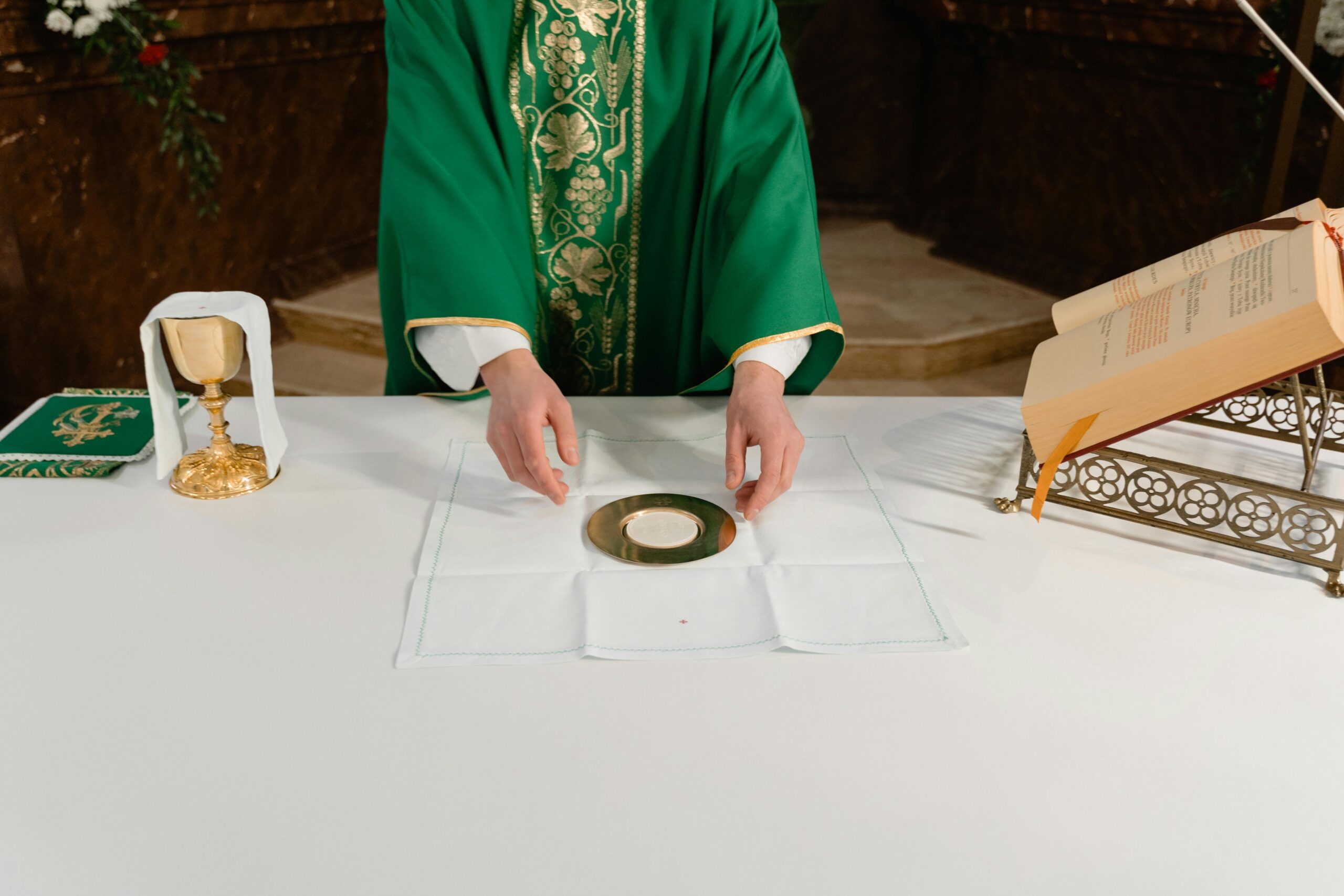
The scene ends and we resume our daily routines. Do we take this time with Jesus and lepers with us? Do we give thanks for our blessings? Do we begin our prayers with praise and thanksgiving? In the Eucharist, which means thanksgiving, we offer profound thanks in, with, and through Christ. We are the Samaritan who came back.
Gospel for the Twenty-eighth Sunday in Ordinary Time – Cycle C
Read More