Pages Menu
RssFacebook
Categories Menu

Posted by on Jun 5, 2009

The Feast of Pentecost and the Age of the Holy Spirit
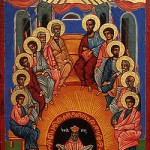
The Feast of Pentecost and the Age of the Holy Spirit

Eastern Orthodox Icon of Pentecost

Eastern Orthodox Icon of Pentecost

The Feast of Pentecost falls 50 days after Easter. Pentecost was originally a celebration of the first harvest and people came to Jerusalem from all over the known world to celebrate the feast.

For people in northern climes, the thought of a first harvest celebration in Spring may sound strange. After all, the snow has barely melted and crops are nowhere near ready to harvest. Even early crops like strawberries and lettuce aren’t ready yet. Nevertheless, in the Middle East, and by extension in that general latitude around the globe, many crops have already been harvested. Just go to a grocery store and you’ll see the fruits of our fields waiting for your table!

Within the Church, we celebrate the outpouring of the Holy Spirit on the disciples – men and women who had been friends, family and followers of Jesus. This outpouring of the Spirit of God, the God Who is Love, gave birth to the Christian community that endures to this day. Jesus’ friends and followers were transformed from frightened “mice” into fearless “lions” who proclaimed boldly that Jesus had been raised from the dead, that He is the long awaited Christ, that God has made Him both Lord and Savior, that a new age has dawned and the Kingdom of God has begun.

These early disciples wasted no time in putting their beliefs into action. They shared what they had. They cared for and healed the sick. They took care of widows and orphans – the powerless ones of their society. They recognized the gifts of women who were leaders in their communities. They spread the Good News of the Lord to all who would listen. And they struggled to understand the implications for themselves and their society of the Good News and the freedom of God’s children. Who were God’s chosen ones? Who could be followers of the Way? What parts of the Law were non-Jews required to obey? How can the pastoral needs of the community be met? Who will look out for the powerless ones in our own communities? How do we choose leaders for our communities? How should Christian family members behave with each other?

For nearly 2000 years we have dealt with these issues as a community. Today we still face many of them, though in a much wider context, as a global, international community that includes peoples of all cultures. More than ever we must count on the continued outpouring of the Spirit to guide us and make us bold witnesses to the Good News.

Much of what we take for granted today is the result of the work of Christians who actively put their beliefs into practice and stepped out to make their part of the world a better place. Institutions such as hospitals, schools for poor and even middle-class children, education for girls, social safety nets, and many others have resulted from the Christian insight that God cares about all humans, even those who traditionally have been excluded.

The Christian belief that all receive the gifts of the Holy Spirit in Baptism and Confirmation also leads to the understanding that all are responsible to share the gifts they have received and bear fruit in their lives. Together we listen to the Spirit and share in the development and shaping of both our Church community and the world.

As we move through these days following Pentecost, we face many challenges. It’s a time of global financial challenges. Governments are moving quickly to try to minimize the harmful effects of the banking crisis on their people. Social service agencies and churches are struggling to offer aid to the increasing numbers of people coming to their doors. Here in California there’s talk of dismantling all state funded social services, including health care programs for children of low income families and the welfare to work programs that helped so many families keep roofs over their heads and food on their tables.

What will we as children of God, brothers and sisters, do to address these challenges in our communities, states and countries? Will we say, as so many do, “It’s not my responsiblity to care for the children of the poor. Why don’t their parents just go get jobs?” Will we say, “Don’t ask me to pay more taxes. I shouldn’t have to cut back my lifestyle to pay for other people’s mistakes.” Will we sit in judgement of people who are losing their homes because they lost their jobs? Will we smugly assume that we’ve saved enough money to keep us safe if we get ill or lose a job? Will we criticize the people who lost their savings to the stock market when the money should have been somewhere safer? I hope not.

This year the time from Pentecost onward can be a time in which we truly listen to the Holy Spirit’s call to build up the Kingdom by caring for the poor, the powerless, those who are ill and who are losing their security (whether as a result of their own errors or those of others). It’s a time to trust that if we give of what we have, share from our abundance or our need, God will make sure that our needs are met. Our ethic of life must include not only the unborn but also those who are here and in need. Womb to tomb includes all those days in-between as well. Let’s not forget that as a Church community.

Read More
Posted by on May 21, 2009

The Feast of Pentecost and the Age of the Holy Spirit

The Feast of the Ascension

Ascension

Ascension

The Feast of the Ascension traditionally occurs 40 days after Easter. Since it falls on a Thursday, it’s often called Ascension Thursday.

Recently, with the transition of our work lives from an older, more flexible agrarian routine to modern industrialization’s insistance on time clocks, 24/7 availability of services, and the challenges of two income households, child care, school schedules and after school activities, taking time as a community of faith to stop and celebrate this feast has become a luxury available only to the fortunate few. Recognizing this reality in the lives of the faithful, bishops in many dioceses have allowed celebration of the feast to be moved to the Sunday before Pentecost. To the extent that this allows more people to be consciously aware of and celebrate the feast, I see this as a good step. Nevertheless, it is important to note that the feast actually falls today.

The feast of the Ascension marks the day on which Jesus was taken up to heaven (Lk 24:50-53). After the Resurrection, Jesus appeared on many occasions to his followers. He continued to teach them and explain all that had happened through His passion and why it had to happen as it did. At the end of both the Gospels of Mark and of Luke, as well as the beginning of the Acts of the Apostles, we are told that Jesus instructed His followers to go out as witnesses of all they had seen and heard, calling all peoples to turn from sin and accept baptism and the forgiving love of God. Then Jesus told His followers just before He was taken from their sight, to go back to Jerusalem and pray, waiting to receive the “promise of the Father” (Acts 1:4), the Holy Spirit who would give them power from on high to become His witnesses.

These events happened nine days before the Jewish feast of Pentecost. The apostles, Mary and other followers of Jesus did indeed return to Jerusalem. They gathered in the upper room where they had been staying after the Resurrection and devoted themselves to prayer. (They also took care of some administrative details – including selecting another person to take the place of Judas Iscariot. But that’s another part of the story not critical to today’s feast!)

On the feast of Pentecost, the Holy Spirit was poured out on them and the Church was born as Peter and the others fearlessly stepped out and witnessed to the world regarding all they had seen and experienced. The time of the Holy Spirit had begun.

A particularly important thing to remember regarding the Ascension, is that it is the beginning of a period of prayer for the outpouring of the Holy Spirit – a period of prayer mandated by Jesus Himself.

Since those early times in the church, we have developed a tradition of novenas, nine days of prayer with a particular focus or request. Typically the novena is addressed to a specific saint, requesting the saint’s intercession with God – much like asking a big brother or sister for help with a problem.

In the case of this first novena, the focus was much more direct. The novena from the Ascension to Pentecost is addressed directly to the Holy Spirit. With the early followers of Jesus, we too can pray for the outpouring of the Holy Spirit into our lives and world.

Imagine what could happen if we truly believe that we are to go out and be His witnesses — speaking His words of challenge and comfort, feeding the hungry, clothing the naked, housing the homeless, caring for the sick, acting as if a better world could really exist and all could really love and care for each other! This can only happen if we are filled with the Holy Spirit, clothed in power from on high. It is a daunting calling, but one that is implicit in our baptism and confirmation. We sing the ancient hymn, “Come Holy Ghost, Creator blest, and in our hearts take up thy rest…” It’s a beautiful prayer and truly dangerous if we take it to heart, meaing and believing what we are asking.

A younger hymn, from Zimbabwe, is also particularly appropriate for our novena to the Holy Spirit in these coming nine days. “If you believe and I believe and we together pray, the Holy Spirit must come down and set God’s people free. And set God’s people free, and set God’s people free; The Holy Spirit must come down and set God’s people free.” Free to be His witnesses — His hands, feet, voice and heart in our world.

Let’s again join together in these coming days to ask the Holy Spirit for a new outpouring of power into our lives and times. Pray with me with hope and confidence, trusting that with God’s help everything is possible, because “If you believe and I believe and we together pray, the Holy Spirit must (will) come down and set God’s people free.”

Read More

Posted by on Feb 2, 2009

The Feast of Pentecost and the Age of the Holy Spirit

February 2 – A Day to Celebrate Three Feasts and a Blessing

The Meeting of the Lord - Orthodox Icon from Belarus (1731)

The Meeting of the Lord - Orthodox Icon from Belarus (1731)


February 2, a day falling 40 days after Christmas in the western Christian calendar, is a day when we celebrate 3 feasts and a blessing – The Presentation of Jesus at the Temple, The Purification of the Virgin, The Meeting of the Lord and Candlemas.

There’s a sort of game going around Facebook these days in which people are asked to give 25 random bits of information about themselves to their friends and ask 25 others to do the same. It’s been fun to see what people have to say about themselves and who they ask for information.

In the spirit of the game, I’d like to give 25 bits of information about today’s feasts and blessing.

1. The Presentation of Jesus has been celebrated since at least the 4th Century AD.

2. First-born sons belong to God in Jewish tradition – originally to serve as leaders of worship/sacrifice. Fathers of the boys were required to offer a sacrifice to “redeem” them from the obligation to serve at the temple rather than remain with their families. This tradition continues in modified form today.

3. Today’s feasts are not the same as the Feast of the Naming of Jesus or the Circumcision – celebrated 8 days after Christmas.

4. When Joseph and Mary offered the sacrifice to “redeem” Jesus, they were allowed to choose between offering a lamb and a dove or simply two doves or two pigeons. They offered the birds, the gift of those who were not wealthy.

5. Childbirth rendered a woman ritually “unclean.” A purification ceremony was required to restore her freedom to interact socially with family, friends and community, including her worship community.

6. Periods of time for this unclean status varied by sex of the child born. A woman was unclean for 80 days following the birth of a girl. For a boy she was only unclean for 40 days. In both cases, a ritual was required to purify her.

7. Mary went to the temple in Jerusalem for her purification ceremony.

8. Simeon was an old man who had been promised by God that he would see the Messiah before he died. He recognized Jesus as the fulfillment of that promise when Jesus was presented for the sacrifice of his redemption at the temple and Mary for her purification.

9. Simeon told Joseph and Mary that their son was “destined for the fall and rise of many in Israel.” (Luke 2:34)

10. Simeon told Mary that she would be pierced with a sword. Our understanding is that this was the sword of sorrow as she watched her son’s life and mission unfold.

11. Anna was an old woman who spent her days and nights at the temple. She too recognized Jesus and his family, blessed God for the gift of seeing him and told all she met about him.

12. The Feast of the Purification has been celebrated since at least the 7th century.

13. The Feast is known as The Meeting of the Lord in some Eastern Christian churches.

14. Candlemas is a celebration of the blessing of candles (traditionally beeswax ones) for use in homes and churches in the coming year.

15. First evidence of the celebration of Candlemas dates from the 4th century in Rome, but it spread to the rest of Europe more slowly. It had reached England by the 10th or 11th century.

16. Candlemas is probably a feast whose focus was changed to a Christian one from older non-Christian ones that included fire, candles, ash and purification in a variety of European cultures.

17. Before the Second Vatican Council, the Christmas/Epiphany season lasted until Candlemas. It was considered bad luck to have Christmas decorations (including holly, ivy and bay leaves) still in the house on Candlemas.

18. Some cultures had celebrations in which young women carried candles in a procession at this time of year or in which young men and women had to jump over fires for purification before they could be married.

19. These are the last feast days whose date is set based on the date of Christmas.

20. Many traditions link Candlemas to the actions of animals as predictors of future weather – including bears, wolves and groundhogs!

21. Candlemas was one of the days certain taxes had to be paid in Scotland until 1991.

22. The French celebration of Candlemas includes eating crepes for dinner after 8 pm.

23. Mexican tradition includes tamales on the menu for Candlemas.

24. Some believe Candlemas was a “Christianization” of the feast of  Brigid the Goddess – an oracle and predictor of the success of the growing season – but little historical evidence exists for this claim. The feast of St. Brigid, an Irish abbess, is February 1. 

25. These feasts are celebrated in both Eastern and Western Christianity, but on different dates. In all traditions, however, they are celebrated 40 days after Christmas.

Whew!  So … there you have it. More than you probably ever wanted to know about Christian celebrations for February 2!

I think we’ll put the last of the Christmas decorations away, light some candles, and have tamales for dinner!

Read More

Posted by on Jan 6, 2009

The Feast of Pentecost and the Age of the Holy Spirit

Epiphany

Hieronymus Bosch - The Adoration of the Magi

Hieronymus Bosch - The Adoration of the Magi

The Feast of Epiphany is traditionally celebrated January 6 in the Western Church. Recently, we have begun to celebrate it as a community on the first Sunday of January after the Feast of Mary, Mother of God (January 1st).

Epiphany, from the Greek “to manifest” or “to show forth,” is a celebration of God’s presence bursting forth and becoming visible in human lives. For Western Christians, the focus has been on the visit of the Magi, the wise ones, who followed a star from the East to find the newborn king. In this story, we see God’s presence being revealed to non-Jews, to Gentiles. For Eastern Christians, the focus is on the Baptism of Jesus, when Jesus became identified as the Son of God. The feast is sometimes known as Theophany in the East. (In the Western Church, we too celebrate the feast of the Baptism of Jesus, but on the Sunday after we celebrate Epiphany.)

In many Christian countries, especially those bordering the Mediterranean and in former colonies of those countries, gifts are exchanged at the Feast of Epiphany. This is because the Magi brought gifts to the child Jesus – gold, incense (frankincense) and myrrh. The gifts named in Matthew’s gospel can be seen as symbolic of the roles Jesus would play in salvation history – as king, deity, and human victim/sacrifice – as a result of the incarnation. Songs such as “The First Nowell” and “We Three Kings” remind us of the story and tell it again to our children.

During this season of Epiphany, may our eyes be open to see God’s presence in the people around us – the children, the babies, the old ones, the ones on the street, the ones at our work or in our homes. God is forever peeking around corners, knocking on doors in our hearts, smiling out of flowers, singing through the voices of birds and trying in every way possible to shine forth into our lives. May we be gifted to see and to smile in return.

Read More

Posted by on Sep 15, 2008

The Feast of Pentecost and the Age of the Holy Spirit

Feast of the Day – Our Lady of Sorrows – September 15

Mothers of the Plaza de Mayo

The Feast of Our Lady of Sorrows follows the Feast of the Exaltation of the Holy Cross by one day. On this day we remember the prophecy of Simeon when Mary and Joseph took Jesus to the temple for the first time. Simeon blessed them and said to Mary, “Behold, this child is destined for the fall and rise of many in Israel, and to be a sign that will be contradicted; and you yourself a sword will pierce, so that the thoughts of many hearts may be revealed.” (Lk 2:33-35)

This feast was not part of the official liturgical cycle of the Church until the mid-1600s, though it was celebrated in some locations as early as the 13th century. Sometimes it is known as the feast of the Seven Sorrows of Mary and includes mention of seven events from Jesus’ childhood and passion.

Our Lady of Sorrows is a title of Mary with which many women and men can identify. Bearing and raising a child is not an easy task, though it can be an extremely rewarding adventure. There are countless joys and sorrows along the way. And make no mistake about it – the commitment of parent to child is one that does not stop when the child reaches adulthood! It is a commitment for life and beyond. In our belief in the Communion of Saints and life after death, we recognize that those who went before us still care about us and look out for us. Parents who are with the Lord do not cease to be parents of those who still remain here. The relationship is just transformed.

In thinking about this feast, it came to me that surely Our Lady of Sorrows is especially close to mothers, fathers and family of those who are killed prematurely. I’m thinking of those who “disappeared” in Central and South America in recent years – victims of political violence and/or persecution for their actions in living and teaching the Gospel. I’m thinking of victims of terrorism in the Middle East – including those on both sides of the Israeli-Palestinian question and those dying almost daily in Iraq. I’m thinking of those whose children were killed in wars – Iraq, Iran, Afghanistan, India, Pakistan, Bangladesh, Sudan, Ruwanda, Brundi and so many, many others. We see the pictures year after year and our hearts become numb. Yet for all of them, and with all of them, Our Lady of Sorrows weeps. And so should we all.

And then … we must commit ourselves to work for peace. So that those who have given their lives will not have died in vain. So that those who believe that “might makes right” will learn that only love makes right. So that we truly become a community where we live our belief that what we do to the least of Jesus’ sisters and brothers, we do to Him.   

May it be so.

Read More

Posted by on Aug 6, 2008

The Feast of Pentecost and the Age of the Holy Spirit

The Feast of the Transfiguration of Jesus – August 6

The Transfiguration of Jesus was reported in the Gospels of Matthew, Mark and Luke, as well as in the second letter of Peter. Jesus and three disciples, Peter, James and John, went up a high mountain (traditionally identified as Mt. Tabor) and “He was transfigured before them; his face shone like the sun and his clothes became white as light.” Two men joined Jesus on the mountain top and spoke with Him there, Moses and Elijah – representing the Law and the Prophets. Peter, ever ready to act, offered to put up three tents for Jesus, Moses and Elijah. But just then a cloud overshadowed them all and a voice from the cloud proclaimed, “This is my beloved Son, with whom I am well pleased; listen to him.” The disciples fell down and were terrified when they heard the voice, but Jesus touched them and told them not to be afraid. He also told them not to tell anyone else about what they had seen “until the Son of Man has been raised from the dead.” (Mt 17:1-9)

Following the Transfiguration, Jesus continued on his way to Jerusalem and his eventual death and resurrection. Only following the Resurrection did the experience on the mountain top make sense to Peter, James and John.

While most of us don’t have such dramatic “mountain top experiences,” in the course of our lives as believers we do have special times. It may be our Baptism or First Communion. It may be Confirmation. It may be an experience of healing through Reconciliation or Anointing of the Sick. It may be a homily that particularly spoke to a trouble or concern and gave the hope needed to continue moving forward in faith. Sometimes the mountain top comes during private personal prayer. Sometimes it comes during a group activity.

Mountain top experiences are to be treasured. They don’t happen often. And they are always followed by a return to the ordinary activities of life – activities that seem dull, boring, unimportant, even worthless, in comparison with where we have been and what we have experienced. Yet both are part of life and both move us forward on the path to our ultimate goal, union with the Lord.

When you’ve had a mountain top experience, be patient with yourself and with your family and friends who may or may not have shared it with you. It’s not easy to jump back into the hustle and bustle of daily life. Do what has to be done to keep soul and body together (i.e. prepare meals, get some rest, go to work, “chop wood, carry water”), but do these activities with an awareness that there’s a transcendent reality just beyond your ability to perceive it normally, that gives meaning to all of the day to day activities of life.

As time goes on, you’ll undoubtably have cause to remember the mountain top and draw on the strength and consolation you experienced there. Jesus went from the mountain top to the cross. His followers rarely have to crash quite so dramatically into disgrace and apparent failure as He did, but the hard times will come – no need to go looking for them. And when they come, try to remember the love you experienced on the mountain top. Our God loves you – just as you are – and will be with you in the hard times as well as the good times. Jesus went before us, and He stands with us. On the mountain top and in all the other times as well.

Read More

Posted by on Dec 31, 2007

The Feast of Pentecost and the Age of the Holy Spirit

The Feast of the Holy Family

flight-to-egypt.jpg

The Feast of the Holy Family falls on the Sunday between Christmas and the Feast of Mary, Mother of God, January 1. The readings for the day focus on qualities that make for happy relationships between people, including members of families.

Sometimes when we focus on the Holy Family as the model for family life, we get bogged down with the perfection of Jesus and Mary, the holiness of St. Joseph, and the impossibility of actually living a perfect life ourselves. Then we write off their example as just another bit of pious nonsense that has nothing to do with the reality of crying babies, mortgage payments, difficult bosses, and all the other stresses that come with marriage and family. For those who are not married and/or don’t have children, the feast can seem irrelevant or even be a painful reminder of unfulfilled hopes.

So, I find myself wondering, what is it that makes a family, any family, “holy?” It seems to me that if the Holy Family is to be a model for the rest of us, that must mean that we are also to be “holy.” What made them holy?

Being holy does not mean having no problems or challenges in life. Holiness, it seems to me, lies in how we handle those difficulties that come in every life. After all, without the problems, difficulties, challenges, “crashes,” struggles, “hitting bottom,” or whatever we call it, we would never need to turn to God for help. We could just continue blithely on our way, assuming everything is fine, and in the best American cultural sense, be “rugged individuals” who can make it on our own.

But that isn’t what the spiritual life and journey are all about. Our spiritual lives are about learning from our mistakes, growing in wisdom, reaching out for help and community, being purified in God’s love, so that we can run joyfully to the Lord at the end of our days.

When we look at the lives of Mary, Joseph and Jesus, we find that they were filled from the beginning with many of the same challenges faced by other families. An unexpected, unplanned pregnancy, one outside the marriage; governmental demands that upset a family’s plans; taxes; inconvenient timing of a birth; the necessity to leave home and become refugees in another land; a child who feels grown up enough to go off on his own at the age of 12 without telling anyone where he’ll be; the death of a spouse or parent; a child whose life choices and career don’t meet the expectations of the family or community; the untimely death of a child. All these things were part of the lives of the Holy Family, as they can be part of our own lives. What made Joseph, Mary and Jesus holy as a family was their response to these challenges and their loving support of each other through them.

Joseph’s first recorded response to Mary’s pregnancy was compassion. He did not want to expose her to the penalties of the Law. He loved her and wanted her to be safe. When the angel told him in a dream that Mary had not been unfaithful, he accepted her as his wife. He made a home with her and supported her through the pregnancy and birth. He took her and Jesus to safety in Egypt, again following the instructions received in a dream. When it was safe, he took them back to their home in Nazareth cared for them and made a home for them.

Both Mary and Joseph must have “pondered” many things along the way. Many things did not make sense at the time. They really didn’t know what God had in mind. Jesus was a normal child. He had to learn how to be a man and how to respect and love the people around him. Mary and Joseph taught him by their actions as well as their words, just as we teach our children more by the way we act than by our words. It’s no surprise that people in families tend to share many gestures, facial expressions, attitudes and beliefs. The Holy Family would not have been different in this. The characteristics we seen recorded about Jesus were probably in great part those he learned from his parents.

In this week following the Feast of the Holy Family, as we enter a new calendar year, I hope we can take their lives as ones that exemplify the kind of relationships that result from heartfelt compassion, kindness, humility, gentleness, patience, forgiveness, and love (Col 3:12-17). These qualities are not ones that stem primarily from feelings, but rather they are attitudes and behavioral choices to which we are all called.

Read More