Pages Menu
RssFacebook
Categories Menu

Posted by on Jan 22, 2008

Getting Robbed for Christian Unity – Sam Clear, Pilgrim

Getting Robbed for Christian Unity – Sam Clear, Pilgrim

walk4one.jpg 

Thanks to a comment from Ed, I learned about Sam Clear’s pilgrimage around the world from Australia for Christian Unity.

Sam’s dangerous mishap in Costa Rica appears to be a tale from long ago, except that it’s all too modern. Here is an excerpt.

May 13, 2007

Aussie Pilgrim Mugged in Highway Robbery

At 2pm today Samuel Clear, a 28 year old Australian walking the globe to promote the unity of Christians, was attacked at knife point and robbed by a band of 4 thieves in Costa Rica. Sam was walking and praying with friend, Damian Burgur, and a Costa Rican World Youth Day Group, when they were set upon by the four assailants.

The robbers thrust long-blade knives at the group of 11, threatening them as they lined them up along the railing of the bridge as heavy traffic flowed past. The thieves then stripped the Christian prayer group of everything valuable, including 4 backpacks, cameras, mobile phones, wallets, watches and sunglasses.

Within minutes around 10 police vehicles took chase and opened fire on the robbers as they tried to escape off the end of the bridge and down through a canyon. 3 were successful, but the fourth, was apprehended and is now facing court in Costa Rica. Sam, Damian and the group were shaken and stunned by the surprise attack, but amazingly not injured.

Despite having a knife thrust at his stomach and losing around $2,000 worth of gear, Sam had this to say, after he met the young thief, who had been apprehended.

“He was just 16 years old. He was incredibly ashamed & very quiet as he stood there looking at the floor. We introduced ourselves & I explained why we had been walking.

I gave him a World Youth Day postcard/invitation & Damian popped some rosary beads into his hand. He looked up, smiled & said thankyou, before tentatively extending his hand. We each shook hands & he once again bowed his head & returned to his cell.

Two hours later I saw him entering the court house still holding his postcard and beads – the kid wasn’t the ring leader. “His name is Danny if you’d like to offer a few prayers for him,” said Sam.


The article goes on to tell about Sam, his pilgrimage for Christian Unity, and his dream of a “24 hour a day worldwide prayer session in the name of Christian unity.” You can get the whole story at walk4one.

Read More
Posted by on Jan 22, 2008

Getting Robbed for Christian Unity – Sam Clear, Pilgrim

Saint of the Day? – Martin Luther King, Jr.

martin-luther-king-jr.jpg

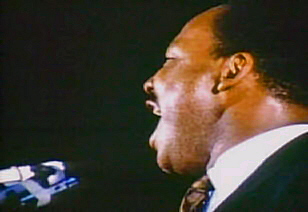
Martin Luther King Jr. (January 15, 1929 – April 4, 1968) achieved a moral stature and Christian witness that continues to inspire people of all faiths across the world. His life and work is commemorated not as a feast of the Roman Calendar but of the United States, on the third Monday of January each year. The human rights leader and Nobel Peace Prize laureate was 35 at the time of his assassination in Memphis, Tennessee.

Most people are familiar with his “I Have A Dream Speech” on the National Mall in Washington, D.C. However his final speech, delivered on April 3, 1968, “I Have Been to the Mountain Top,” not only presaged his death, but summarized his great vision for us all. You can hear by clicking on this link. It is well worth hearing in its entirety, not only because Dr. King was one of the great masters of English rhetoric, but the actual spoken message in its wonderful cadences, rich inflections, and profound rhythms stirs the soul with their inspiration.

Is Dr. King a saint? It is ironic to pose this question in regard to a Baptist minister, whose denomination – among others – has criticized the “worship” of the saints by Catholics. Like Dorothy Day, we can probably assume that Dr. King would dissuade us from giving him the title and remind us to return to the work of serving the least among us.

What is most remarkable about Dr. King’s legacy was the Christian witness of non-violence. Very easily, Dr. King could have kept the oppression of black people in the United States on a political level and built a base of power for himself. He also could have kept it on a “spiritual” level by focusing on the “next” life. Dr. King did neither. As a result, he elevated the whole movement to one of social justice and human rights for the children of God – of the “I” encountering the “thou” of the other person.

Let us develop a kind of dangerous unselfishness. One day a man came to Jesus, and he wanted to raise some questions about some vital matters of life. At points he wanted to trick Jesus, and show him that he knew a little more than Jesus knew and throw him off base….

Now that question could have easily ended up in a philosophical and theological debate. But Jesus immediately pulled that question from mid-air, and placed it on a dangerous curve between Jerusalem and Jericho. And he talked about a certain man, who fell among thieves. You remember that a Levite and a priest passed by on the other side. They didn’t stop to help him. And finally a man of another race came by. He got down from his beast, decided not to be compassionate by proxy. But he got down with him, administered first aid, and helped the man in need. Jesus ended up saying, this was the good man, this was the great man, because he had the capacity to project the “I” into the “thou,” and to be concerned about his brother.

Go and do likewise. (Luke 10:37)

Like anybody, I would like to live a long life. Longevity has its place. But I’m not concerned about that now. I just want to do God’s will. And He’s allowed me to go up to the mountain. And I’ve looked over. And I’ve seen the Promised Land. I may not get there with you. But I want you to know tonight, that we, as a people, will get to the promised land!

And so I’m happy, tonight.

I’m not worried about anything.

I’m not fearing any man!

Mine eyes have seen the glory of the coming of the Lord!!

Read More

Posted by on Jan 21, 2008

Getting Robbed for Christian Unity – Sam Clear, Pilgrim

Saint of the Day: St. Agnes of Rome – January 21

st-agnes-gauld.jpg

St. Agnes (291-304) was a twelve year old Roman girl who was killed on January 21, 304 because she refused to marry the son of the Prefect Sempronius. Agnes was killed because she was a Christian virgin and wished to remain so. She is an early heroine of the church at Rome and is mentioned in the Eucharistic Prayer – the Great Thanksgiving – of the Mass.

There is very little we know about her except that she was a real historical person. Her faith and her strength at such a young age were seen as remarkable by Christian and non-Christian alike. In and of itself, it was considered a miracle. Agnes’s defiance of authority was not only rare, it was also foolhardy, particularly for a woman, let alone a girl, in her time and culture. In a culture which was licentious and in which the slaves and less powerful had no control of their own futures, let alone of their own bodies, Christianity would set a new standard which we take for granted today in a post-Christian world.

St. Agnes was martyred in the last great wave of persecution under the Emperor Diocletian. Within 20 years of her death, Christianity would become legalized in the Empire and the love of Christ for which she died would spread beyond her time and place throughout history. Human rights: dignity, autonomy, opportunity – the right to be whole, free, in love, caught up in the divine – were announced by the faith of a young girl of faith a long time ago.

Read More

Posted by on Jan 18, 2008

Getting Robbed for Christian Unity – Sam Clear, Pilgrim

Christian Unity: A Week of Prayer – Chair of Unity Octave

chair-of-unity-poster-2008.jpg

One hundred years ago, a group of Episcopalians – the Franciscan Friars and Sisters of the Atonement – led by Fr. Paul Thomas Wattson and Sr. Mary Lurana White in Garrison, New York at Graymoors, started the observance of a week of prayer for Christian unity. The whole story is fascinating and encouraging since it traces the emergence of ecumenism in the 20th century. Fr. Wattson and the Franciscan Order of Atonement, which he co-founded, entered the Catholic Church in 1909 but continued to promote Christian Unity.

During the 1920s and 30s there was a growing movement for Christians to observe a week of prayer for Christian unity. During the Second Vatican Council (1962-1965), interfaith dialogue and prayer received a new emphasis with the 1964 issue of the Decree on Ecumenism, which called prayer the core of the ecumenical effort and encouraged Catholics to observe a week of prayer. In 1966, the Faith and Order Commission of the World Council of Churches and the Vatican Secretariat for Christian Unity began working on a common set of prayers for the Octave. Since 1968, The Graymoor Ecumenical and Interreligious Institute has facilitated and published the international texts for use in the United States. In 1991, a Sunday was incorporated into the week of prayer. Each year’s theme is developed by an ecumenical group whose members are appointed by the World Council of Churches and the Pontifical (Catholic) Council on Ecumenism. The 2008 theme is “Pray without ceasing” (1 Thes. 5-17).

Read More

Posted by on Jan 17, 2008

Getting Robbed for Christian Unity – Sam Clear, Pilgrim

Saint of the Day: St. Anthony the Great – January 17

stanthony-abbot.jpg

The feast of St. Anthony the Great (251-356) is January 17. In the Egyptian or Coptic Orthodox and Coptic Catholic Churches, the feast day is January 30. He is also known as St. Anthony the Abbot and is an early example of the Christian monk. What we know of his life comes from a biography written by St. Athanasius, the patriarch of Alexandria in Egypt. The account was written in Latin and had a major impact on the development of monasticism in the West. Devotion to St. Anthony is less prominent in the East.

St. Anthony is best known for his literal following of the Gospel. According to St. Athanasius, St. Anthony’s parents died when he was a young man. Hearing the call of Christ in St. Matthew’s Gospel to sell everything he had and come follow Christ, St. Anthony, who had inherited a substantial estate from his parents, did just that. He spent his life in the desert, primarily alone, although toward the end of his life he did supervise some other monks who had joined him. They lived with the fundamental rule to work and pray, which would later be echoed by St. Benedict of Nursia.

What is noticeable in the account of St. Athanasius is the theme of spiritual warfare with the devil. St. Anthony overcame many temptations through prayer and faith. His life in the desert brought him the same temptations that Christ encountered during His soujourn in the desert. What is even more notable is that St. Anthony emerged from his time of testing as someone enlightened who could comfort and heal, someone people sought out not for his wisdom or knowledge, but for his goodness and genuine holiness.

As postmodern people, we have a highly developed notion of individual psychology and it can be difficult to relate to someone like St. Anthony. Our notion of self-actualization appears to get in the way of such an extreme life style of self renunciation. However, it is hard to see how such enlightenment is not the highest form of self-actualization. Today our spiritual heroes, such as Mother Teresa, have chosen a very challenging path not unlike that of St. Anthony. What desert are we being called to?

Read More

Posted by on Jan 7, 2008

Getting Robbed for Christian Unity – Sam Clear, Pilgrim

Astronomy and the Star of Bethlehem

star-of-bethlehem.jpg

As we approach the end of the Christmas season in this week after the Epiphany, I wanted to share two interesting astronomical sites about the Star of Bethlehem.

Astronomynotes.com blends historical, scriptural, and astronomical sources to take us back to the birth of Christ.

BethlehemStar.net is a well done site blending scientific and excellent historical information to arrive at dates and times for the Christmas Star and also for the Crucifixion. This site is more devotional and more evangelical in that is desires to elicit a faith response.

Both sites are excellent blends of faith and reason. However BethlehemStar.net makes a definite but discrete appeal to conversion.

Read More

Posted by on Jan 6, 2008

Getting Robbed for Christian Unity – Sam Clear, Pilgrim

The Feast of the Epiphany – The Three Kings

magi.jpg

Epiphany – literally the shining forth – was traditionally celebrated on January 6 but is now observed on the second Sunday after Christmas. St. Matthew’s Gospel (2:1-12) is the only one to recount the story. This feast is of singular importance because it is the first manifestation of Christ to non-Jews. It is also remarkable in that the importance of Jesus is reflected in the stars and attracts the attention of Zoroastrian priest-astrologers in Persia who come to pay homage to the newborn king.

St. Matthew’s account does not tell us the number of Magi -literally magoi or “Great Ones” – and certainly they were not kings. For those familiar with current contemporary science fantasy books, the term in Greek for the visitors is Mages – magicians or sorcerers. The term is generally translated as Wise Men, softening the sense of black or destructive magic. The three gifts of gold, frankincense, and myrrh were seen as offerings for a god, according to St. John Chrysostom in the second century. Some scholars characterize this story as a non-historical account which has symbolic importance for the very special divine status of the Christ child.

Was there a star? Well yes and no. According to Ball State University astronomer, Ron Kaitchuck, contemporary astronomical research – which has its origins in this same priestly Zoroastrian caste – indicates that there were unusual conjunctions of key planets in significant constellations. The story is somewhat complicated because we are not sure of the actual month or year of the birth of Christ. (When the Christian calendar was being established, an error in arithmetic changed the count by 3 years. Christ was actually born in 3 B.C. – we think.) Astrophysicist Grant Matthews, at Notre Dame University, has found supernovae which he suggests as potential candidates.
Creationists who are also well credentialed scientists have come up with some interesting scenarios to explain the Christmas “Aster”. The Greek term we translate as star can be just about any light in the heavens. (You want to watch out for bad “asters” or “dys-asters”.)

Lambert Dolphin, an accomplished physicist, has published an updated account of the Christmas Star by Barry Setterfield, an Austrailian astronomer who has tried to reconcile literal biblical accounts of the young age of the earth with a novel approach to scientific dating that assumes the duration of atomic processes does vary over time. Needless to say, Setterfield’s ideas are not considered to be in the scientific mainstream. However, his account of the ancient night sky and the dating of Christ’s birth follow a rigorous logic. His approach is also shared by another noted astronomer, Craig Chester of the Monterey Institute for Research in Astronomy.

While Setterfield and Craig issue the traditional warning against the practice of astrology and the occult, it is hard to see anything else in their analysis of the ancient star patterns other than ancient astrology. It is a curious contradiction that we are supposed to watch for signs and portents in the heavens and assign some religious predictive meaning to them by interpreting the scriptures but we are to avoid astrology. Clearly, the admonitions are meant to avoid pre-Christian and other earth based religions that attempt to manipulate the transnatural or “buy off” disasters with various types of animal sacrifice.

When the ancient night sky can be traced to certain historical events, such as the Roman census and the rise and fall of various rulers, it has a certain grounding. If we look at Setterfield’s and Chester’s analysis of sky charts to reveal the creation of the world or the coming of the apocalypse, there is really nothing to ground these speculations except for a string of assumptions that don’t seem to be supported by outside verifiable evidence.

Whether we believe it happened or see it only as a shining metaphor of the favor of Heaven, the Star and the Magi are portents of the coming of all people to faith.

Read More

Posted by on Jan 4, 2008

Getting Robbed for Christian Unity – Sam Clear, Pilgrim

God and Evolution – Divine Design?

tortoises-galapagos.jpgDarwin’s Tortoises on the Galapagos Islands

On January 3, 2008, The National Academy of Sciences issued a new publication Science, Evolution and Creationism advocating the teaching of evolution as the primary scientific understanding underlying contemporary biology. Many religious conservatives advocate the teaching of Creation Science in the public schools as an alternative to evolution. The core of the controversy for those who interpret the Bible literally is the fact that the theory of evolution contradicts the creation account in Genesis, which states that God made all of creation in six days and rested on the seventh.

Many want Creationism, or at least the theory of intelligent design, to be presented to students along with evolution.

Unfortunately, it is a false controversy. If we look at the issue from the standpoint of epistemology – the philosophical study of knowledge and truth – faith and science are looking at entirely different things. Science attempts to explain things in terms of matter and energy, based on experiments which can be repeated to produce the same results. The uses we make of science are called technology. The same methods that cause the light to turn on when we use the wall switch are the methods that indicate a very long history of planetary and biological development.

Holy Scripture is the inspired writing of believers for believers about the meaning and significance of God in our lives. Archaeologists and scripture scholars use the same methods of science that we depend on to design and operate cars, airplanes, and space ships. They use these methods to tell us how people lived at the times these documents were written and when they were probably written. These same scientific methods helps us understand the ancient languages and cultures of the time. Consequently we – as believers – understand the scriptures differently.

Much of the problem, as I see it, is the focus of Calvinism and the Anabaptist movement on “sola scriptura,” using the Scriptures as the sole authority for matters of faith and Christian living. This approach – barely 500 years old – is fairly new and radical in the history of Christianity. In order to re-create a church free of bishops, popes, and patriarchs, and to jettison many of the teachings contained in tradition, the reformers adopted a reformed version of the Bible.

It is interesting to note that from the very beginning, the fathers of the Church had two books: the collection of writings which the church assembled and approved in the fourth century and the book of nature.

I’ve had a radical thought. Why not teach philosophy in the public schools? We could teach the history and philosophy of science. Unfortunately, I give my bright idea slim odds, because many religious conservatives are wary of the liberal arts, including philosophy and theology, for the same reason many scientists are. From the standpoint of the liberal arts, the world is less certain and more open to questioning both scientific and biblical teaching.

Read More

Posted by on Jan 3, 2008

Getting Robbed for Christian Unity – Sam Clear, Pilgrim

Feast of the Day January 3 – The Holy Name of Jesus

christus_ravenna_mosaic.jpgihs-monogram-name-jesussvg.png

Currently, January 3 is the feast of the Holy Name of Jesus. The feast has a long history and has been celebrated on different dates – most of which have been after the 8th day of Christmas and related to the naming of Jesus at his circumcision or bris. According to scripture (Mt. 1:25), St. Joseph was told to give him the name Yeshua -“YHWY (the Lord) saves,” because the child would save His people. (YHWY -Yahwey – God’s name is not pronounced by devout Jews and the term “Adonai “- the Lord – is used instead.) Joshua was actually the more common version of the name and was probably the name to which Jesus responded. To make a long story short, Yoshua got transliterated into Greek as Ioshua and Yeshua got transliterated as Iesus. Interestingly, if you reverse the order of the two elements you come up with Isaiah.

All of this was neatly summarized by a neon sign on a church in Ventura, CA where I grew up. The sign was made in the form of a cross. Running vertically downward was “God Saves,” interrupted by the cross bar emblazoned with “Jesus.” I used to attend Holy Name Society Masses, followed by breakfast in the parish hall with my father. (The pancakes and the hot cocoa were good and more than welcome in the days when we fasted from midnight, or at least three hours before Mass.) It was actually a fairly nice father-son affair, and although the focus was on devotion to Christ, there was a very clear focus on using clean language and carefully using the Holy Name.

Although my father was an oil field welder and we lived in a blue collar world, in which the Holy Name was just another throw away swear word, I noticed that men took note of my father’s language. It gave him a dignity without being sanctimonious or judgmental. Tony Pozos didn’t swear, was a man of his word, and his welding crews did not get injured on the job. What impressed me most was my father’s fidelity to the Holy Name pledge which we recited at the meetings. Like me, he was far from perfect. However, my Dad held himself to certain standards, which he passed on to me by example.

Later, as the result of my parents’ hard work and sacrifice, when I moved into the white collar world, I was surprised that gifted and talented men and women could be so coarse in language and cavalier with the name of Jesus. What struck me most is the lack of respect people showed for themselves and others. If we can take the wonder of “God Saves” and make it a curse, it reflects a profound despair and anger. To do this casually out of habit reflects a coarsening of the the soul and our relationships. It bespeaks a deep pessimism, far from hope. “What goes into a man’s mouth does not make him ‘unclean,’ but what comes out of his mouth, that is what makes him ‘unclean.’ ” (Mt. 15:11)

Read More

Posted by on Dec 28, 2007

Getting Robbed for Christian Unity – Sam Clear, Pilgrim

Feast of the Day – 12/28 – The Holy Innocents

holy-innocents-rubens.jpg

December 28 is the Feast of the Holy Innocents. This feast dates from the 6th century and commemorates the the slaughter of the boys under two years of age in Bethlehem as recounted in the Gospel of Matthew (2:16). The murders were occasioned by the visit of the Thee Wise Men to Herod, the Roman client king. When the Wise Men did not return to tell Herod of the boy shown to them by the Star, Herod estimated that the New King foretold by the Star would be two years old or less. As a result he ordered their wholesale murder.

Some scholars say that this event never really happened. The story in Matthew and the infancy narrative itself were attempts to show the importance of Jesus and the prophecies and wondrous events that happened at his birth.  However, since Herod’s cruelty was legendary, scholars have not been able to rule it out.

The Coventry Carol brings to life the pathos of this remembrance. The first time I heard the Coventry Carol it was sung on a Christmas recording by Joan Baez as the Vietnam War was escalating. The commemoration and the carol are a timeless recollection of the victims of war, famine, and plague. People in the wrong place at the wrong time.

Fr. Raymond Brown, the scripture scholar, suggested that the narrative was written to recall the exile and return of Israel and Christ. Rachel mourning for her children recalls Jeremiah’s assurance that they would return from their capitivity in Babylon. The flight of Joseph, Mary and Jesus into Egypt to escape Herod parallels Israel’s own sojourn on the Nile. The slaughter of the children recalls the 10th plague which killed all of the first born human and animal males in Egypt and which resulted in the release of the Israelites, God’s people.

The message of hope in this time of darkness is echoed in the Prologue of St. John’s Gospel.

“The light shines in the darkness, and the darkness has not overcome it.” (John1:5)

Read More