Pages Menu
RssFacebook
Categories Menu

Posted by on Sep 27, 2007

Saint of the Day – St. Vincent de Paul

Saint of the Day – St. Vincent de Paul


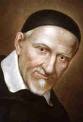
St. Vincent de Paul (1576? 1580? – 1660) is justifiably remembered as a great model of charity. However, his charity addressed not only the immediate needs of people but also focused on longer term solutions.

Born to poor parents at Pouy, Gascony in France, St. Vincent de Paul’s life was an amazing adventure. Working his way through school he was ordained a priest. He spent two years as a slave in Tunisia after having been captured aboard ship by Turks. He managed to escape and made his way home via Italy and Rome. He preached to the rural poor, ministered to galley slaves, and rose to the Royal Court while becoming the hero of the poor of Paris.

St. Vincent de Paul organized groups of men and women, priests and nuns to expand his mission of preaching, feeding, housing, nursing, and teaching the most abject members of society. He had influence with some of history’s most powerful men – Cardinal Richelieu and Cardinal Mazarin who, as first ministers to the King, made France the dominant power in Europe. King Louis XIII asked for St. Vincent de Paul’s assistance on his deathbed. After the king’s death, he managed to prevent a violent crackdown on the people of Paris, who had protested the interim rule of Louis XIII’s widow, Ann of Austria, as Regent.

St. Vincent de Paul organized massive relief efforts for areas of France devastated by the 30 Years War. He raised incredible amounts of money from nobles and the merchant class by letters and publications. He built hospitals, old age homes, and orphanages that also had endowments to fund their continued service. Certainly, these achievements alone would have make him one of the greatest figures of the early Modern period.

However, St. Vincent de Paul’s lasting legacy is his sense of creating organizations and institutions to meet longer term needs. The organizations include the Daughters of Charity, founded by St. Louise de Marillac, The Congregations of the Mission (Vincentian Fathers and Brothers) and various lay groups, such as the Ladies of Charity, which now operate in 40 countries.

St. Vincent shaped the emergence of the Catholic Church in the Modern period by his establishment of training programs for priests and his efforts to stem the gloominess of Jansenism.

The Council of Trent (1545 -1563) mandated several major reforms. One of these was the establishment of special schools or seminaries for the training of priests. Previously, priests might have been educated in monasteries and universities or received very little formal education. Of the 20 seminaries established after the Council of Trent, only 10 had survived by the early 1600’s due to the wars of religion.

Theologically, St. Vincent made a lasting impact by his opposition to Jansenism. He used his influence to make sure that priests who subscribed to this heresy did not receive funded positions (benefices). St. Vincent de Paul was especially active in securing the censure of the Jansenist heresy. He got the support of 85 bishops to condemn the teaching, which obliterated free will and left people predestined to heaven or hell by a grim and capricious God. St. Vincent de Paul was instrumental in securing the censure of Jansenism by Pope Innocent X in 1655 and Pope Alexander VII in 1656.

Although much of his wonderful work was swept away by the French Revolution, the institutions he founded now operate in 40 countries. St. Vincent de Paul’s spirituality – the love of God for all – is the gift that keeps giving.

St. John’s University presents an excellent portrait of St. Vincent de Paul’s spiritual journey on its website.

In the interests of transparency, I must disclose my debt to St. Vincent de Paul as well, since I received my high school education from a mixed faculty of diocesan priests and Vincentian Fathers (the Congregation of the Mission) at Our Lady Queen of the Angels Seminary in San Fernando, CA. How do you say thank you to those who not only taught you to write but to think critically and live compassionately? All I can hope to do is to pay it forward.

Read More

Posted by on Sep 26, 2007

Neuropsychology – Beyond the Soul: The Secular Sense of Self

Neuropsychology – Beyond the Soul: The Secular Sense of Self

Picasso Self-Portrait

Picasso: Self-Portrait

WNYC’s Radio Lab pod cast, “Who Am I?” aptly summarizes current scientific understanding of the neurology of self-perception. Traditionally, the sense of the self, along with intellectual capabilities, are thought to be contained in the soul. Apparently, our perception of self awareness appears to come from the right hemisphere.

There is a compelling story about a 46 year old woman who suffered an aneurysm and recovered as a person with a completely different self who happens to share the same history and memories of her previous self. The emergence of this new person was startling to her only child, her daughter. From being very proper and aware of social conventions, her mother became much less of perfectionist, someone who loves to sing, and is much more interested in sex. Her mother does not worry about death, although she doesn’t have a memory of a near death experience.

A neuropsychologist, Dr. Paul Broks, author of Into the Silent Land: Travels in Neuropsychology, said that we are all just a car crash away from being a completely different person. Our self is nothing but the story the brain tells itself.

Dr. V.S. Ramachandran says that what is unique about us is our ability to tell stories. He believes that introspective consciousness began some time between 200,000 and 500,000 years ago. For example, a monkey can make associations with a color such as red but it cannot imagine something called a purple striped canary. Only humans can take images from the real world and make abstractions. Humans can conjure imagination. This allows us to manipulate ideas to the extent that we can imagine ourselves. The idea of ourself is a story that we can change from day to day, according to this perspective.

What happens when we sleep? Our brain produces our dreams as well as producing ourselves. There is a fascinating story, told by Robert Louis Stevenson, of training little people in his head to tell him a story in a dream that he could later write down to meet his need to produce stories to make a living.

There is also a very interesting story about the loss of a father and the son’s grief reaction which blurred the boundaries of identity between the two.

With all of this neurology, what happens to the concept of a spiritual soul that is our fundamental principle of identity? What about all of the intellectual faculties that are supposed to inhere in the soul? If what we call the soul is the result of neurological activity, what survives when we die?

Clearly this is another contrast between scientific modes of explanation and religious and philosophical modes of explanation. However, it is fair to say that just as geology and paleontology changed our notion of the nature and meaning of creation, neuroscience is about to take us and our notions of philosophy and theology on a roller coaster.

Read More

Posted by on Sep 25, 2007

Neuropsychology – Beyond the Soul: The Secular Sense of Self

Saint of the Day: St. Elzear & Bl. Delphina – The Happy Couple

Today, an unconsummated marriage would probably not be considered advisable by the Church and mental health experts. St. Elzear and Blessed Delphina were a couple who were married and lived together chastely. They are saints because of their care of the poor and the suffering. This couple is also known for their conscientious exercise of their duties as members of the nobility. Interestingly, they were known and remembered as a happy couple.

Personally, I don’t think that I would have responded by taking a vow of chastity on my wedding night the way St. Elzear did when he found out the Delphina had already made one. We have a contemporary theology of marriage that stresses and endows love making and sex within marriage as sacramental.

Certainly the late Middle Ages (St. Elzear 1286 -1323, Bl. Delphina 1283- 1358) was not a “puritanical” time. In fact, Puritanism would not happen for another 200 years and would never take root in the Mediterranean.

St. Elzear was born at the family castle in Ansouis, Provence, in the south of France. At 23, he became lord of Ansouis and Count of Ariano in the Kingdom of Naples. The Count and Contessa became influential in the court of King Robert of Naples and Elzear was the tutor to the King’s son Charles. He was also the “justiciar” or head of law enforcement and justice for southern Abruzzi under King Robert. St. Elzear died on September 27, 1323 while on a diplomatic mission to Paris to arrange the marriage of Charles to Mary of Valois. Blessed Delphina would survive him for another 35 years and spend the time in continued acts of charity.

As nobles, producing children was a serious responsibility. Even when having children was precluded due to medical reasons, noblemen usually had some illegitimate sons at hand. William the Conqueror was one such son. Since the marriage of the Count and Contessa of Ariano (St. Elzear and Blessed Delphina) was so atypical by the standards of their day and ours, how do we relate to it?

Perhaps it was a marriage of convenience, in the sense that due to their social station they were obliged to marry but would have really preferred monastic vocations. Since their state in life was determined when they were young children of a noble family, they simply found a way around it.

Young children at the ages of 5 -7 were sent as oblates to monasteries and convents. Hildegard of Bingen and St. Thomas Aquinas are two examples. We also know, of course, that many people who found themselves in “enforced” monastic vocations would do their best to bend or break the rules.

Then as now, marriages – especially those among the rich and powerful -were not happy affairs. Eleanor of Aquitaine (1122-1204) and her Church sanctioned marriages to King Louis VII of France and King Henry II of England demonstrates the far from Romantic character of such marriages. In fact, Eleanor of Aquitaine was a major promoter of the troubadour movement. The origins of what we today experience as romantic love originally began as songs of chaste love for the unattainable woman. As we know, the reality of courtly love was far from chaste, but it seemed to provide some fluidity in a tight social structure. That doesn’t mean that it didn’t cause feelings of betrayal and rejection resulting in duels, beatings, and death. The case of King Henry VIII in the early modern period (1491 -1547) provides a window onto the complexity of marriage in Europe in previous centuries.

The Count and Contessa feeding the poor, living as lay Franciscans, and in the case of St. Elzear healing lepers were definitely unusual for the time. What was probably most striking about them is that they were known as a happy couple. Their marriage – even if its lack of consummation might not adhere to the Church’s definition of one – was a partnership for a radical living of the Gospel.

In our own culture and time, can we say as much about our marriages and the joy, happiness and moral guidance they bring to others?

There are two slightly different accounts of these saints, with some inconsistencies. Please see Saint of the Day at AmericanCatholic.org and Catholic Online.

Read More

Posted by on Sep 24, 2007

Neuropsychology – Beyond the Soul: The Secular Sense of Self

Spiritual Machines?

Ray Kurzweil’s 2005 The Singularity is Near: When Humans Transcend Biology is an update of his 1999 book, The Age of Spiritual Machines.

Kurzweil has excellent credentials in information technology. He invented the first flat bed scanner, initiated speech and voice recognition technologies, pioneered music synthesizers. Kurzweil was the first to develop technology that could read text and speak it out loud.

Based on this record of achievement and innovation on matters relating to artificial intelligence, Kurzweil estimates that we are approaching a point at which machine intelligence will surpass human intelligence. The point of intelligence surpassing human biology is called the singularity. The point from which everything begins.

Contemporary physics, as elaborated by Stephen Hawking in his updated A Briefer History of Time, refers to the emergence of the universe from an initial singularity.

Kurzweil uses the singularity concept to describe a tipping at which machines surpass human intelligence. It also implies that when the intelligence of machines surpasses (or even approaches) human intelligence, a sense of self – an experience of soul – will occur in these mechanical systems.

Basically, intelligence and the sense of self is reduced to a critical mass of neurons firing, whether they are carbon based neurons in humans or silicon based neurons in machines. The next assumption is that spirituality derives from this sense of self awareness.

Physician and scientist, Antonio Damasio in his book, Descartes’ Error: Emotion Reason and the Human Brain (1994), presents the case that our perception and intelligence is linked – literally – with our nervous system’s extension outside the skull and throughout the body. According to Damasio, it is not possible have a functioning nervous system floating in a medium separate and apart from the human body.

Since our body influences and literally shapes our sense of self awareness and identity, what will happen to silicon based intelligence developing without an analagous body is not clear. Even carbon based “organic” computer systems floating in a liquid medium would not have the human sense of body.

The other issue is that the sheer volume of firing neurons does not necessarily create consciousness in humans. If we reduce consciousness, self identity, and soul to the direct or indirect product of physical functions, how can there be a spirit on which to have a spirituality? By definition, the spirit cannot be reduced to the physical.

If we reduce the soul to the product of physics and chemistry, isn’t our sense of spirit and spirituality merely a cognitive error of some type? If there is no objective or actual realm that transcends the physical, won’t machines in their cognitive excellence avoid this delusion?

Stay tuned for a post on Bernard Lonergan, S.J. author of Insight: A Study of Human Understanding.

Read More

Posted by on Sep 21, 2007

Neuropsychology – Beyond the Soul: The Secular Sense of Self

Yom Kippur – The Day of Atonement 2007

Sunset September 21, to Sunset September 22, 2007 is the Jewish Day of Atonement.

This is the day set aside for asking for forgiveness of God and those against whom we have sinned. The “virtual” Talmud – an adaptation of the Jewish tradition of teaching and commentary has an excellent post for today. A key point is that one’s individual wrongdoings are more than a personal matter. They have consequences for our loved ones, communities, and society overall.

Confession of sins, repentance, and turning around appear to the theme of the day not only for Jews.  They also appear to be making a comeback among Catholics, Protestants and Evangelicals. The Wall Street Journal today has an interesting feature on the return of repentance – specifically confessing one’s sins. “Confession Makes a Comeback” (page W1).

Even some Lutherans, whose founder Martin Luther opposed the sale of indulgences (the ability to get one’s time in Purgatory reduced or eliminated), are restoring a sacrament that they say they neglected for too long.

Take some time, tune up your conscience, make that phone call, send that card, forgive and ask to be forgiven. You might get a dose of your own medicine – we all do. Get straight with God and your neighbor. Find peace.

Read More

Posted by on Sep 21, 2007

Neuropsychology – Beyond the Soul: The Secular Sense of Self

St. Matthew the Apostle

St. Matthew by Caravaggio

According to tradition and some internal evidence, St. Matthew was the author of the Gospel that bears his name. He was also the tax collector referred to in the Gospels who turned to follow Christ. Tax collectors of the time were the most reviled of all sinners.

According to Philo of Alexandria, a Jewish writer (30 BC – 45 AD), as cited by Maureen B. Cavanaugh in her article, “Private Tax Collectors: A Roman, Christian, and Jewish Perspective”

“They [Romans] deliberately choose as tax collectors men who are absolutely ruthless and savage, and give them the means of satisfying their greed. These people who are mischief-makers by nature, gain added immunity because of their “superior orders,” obsequious in everything where their masters are concerned, leave undone no cruelty of any kind and recognize no equity or gentleness . . . as they collect the taxes they spread confusion and chaos everywhere. They exact money not only from people’s property but also from their bodies by means of personal injuries, assault and completely unheard of forms of torture.”

Tax collectors were independent contractors who frequently got out of control, since there were few safeguards to protect the local populace in ancient society. Interestingly, Ms. Cavanaugh’s article is a cautionary history lesson in the context of plans by the United States government to outsource tax collection to independent contractors.

Jesus’ association with tax collectors was even more scandalous than his association with prostitutes and members of terrorist organizations such as Simon the Zealot. Tax collectors were so despicable that their ritual “dirtiness” defiled everything in a house that they entered. In contrast, a thief only defiled those things that he touched in the house.

After his conversion, Matthew was not free from controversy. His Gospel established a hostile attitude toward Jews that persisted for almost 2,000 years. Since the Gospel According to Matthew refers to the temple and city of Jerusalem in their state before their obliteration in 70 A.D., some scholars conclude that the Gospel was written prior to that year. St. Matthew’s stance toward Jews can be understood in the context of a struggle between Jews regarding adherence to their traditional faith or conversion to Christianity. St. Paul lists himself as a persecutor of early Christians. In fact, his conversion occured while he was on a mission to track down believers.

Douglas R. A. Hare’s monograph “The Theme of Jewish Persecution in the Gospel According to St. Matthew,” asks whether St. Matthew exaggerated the persecution and what effect it had on his theology. Using Christian and Rabbinic sources, Hare concludes that the persecution was directed at Christian missionaries, as opposed to Christians in general.

We see this continuing contest after the destruction of 70 AD in the efforts of St. John Chrysostom to stem Jewish influence in the Christian community in Antioch in the fourth century. It was not until 1965 that the Second Vatican Council, in its decree on relations with non-Christians, “Nostra Aetate” (“In Our Time”), that the Church told her members to adopt a posture of respect and dialog with Jews.

The Gospel of St. Matthew, in its beauty, is a central document in Christianity. The emphasis on Christ as the Messiah and the passing away of Judaism are central themes. Pharisees, those staunch guardians of Judaism from the rampant Hellenistic paganism of the time, won’t make it into the Kingdom before repentant tax collectors and prostitutes.

If we substitute  the words “Faithful Christians” for “Pharisees” we get some idea of how incendiary the message still is today.

Read More

Posted by on Sep 20, 2007

Neuropsychology – Beyond the Soul: The Secular Sense of Self

Saints of the Day – Korean Martyrs

Kim Dae Geon (1822 - 1846) Priest & Martyr

If you ever wonder about the power of books, the church in Korea owes its start to them. It is probably unique in this regard. Korea was closed to outside trade and influences at the time. Unfortunately, this is still the case in Communist North Korea, the Democratic People’s Republic of Korea. The Christian books were obtained by Korean scholars from the Korean embassy in China. The first convert Ni-seoung-houn was baptized in 1784 in Beijing, where he had gone to study Catholicism. He returned to Korea and converted many others. Most of these first Christians were later killed in 1791. However in 1794, when a Chinese priest, Fr. James Tsiou, arrived, he found 4,000 Catholics. Subsequent waves of persecution and martyrdom followed in 1836, 1846, and 1867. The martyrdom of French missionaries, in part, led to to a war called the French Campaign Against Korea.

Their stories are compelling. It is especially interesting to see how a sacramental and liturgical church can grow without any ordained clergy. It is even more interesting how they adapted with relative ease to a foreign clergy and developed their own.

Pope John Paul II canonized (designated as saints) the martyrs of 1836, 1846, and 1867 in Seoul on May 6, 1984. The Pope began his homily with Luke 24:26 from the story of the disciples on the way to Emmaus after the death of Christ. “Was it not necessary that the Christ should suffer these things and enter into His glory?” He went on to relate the rest of this story of encouragement and also incorporated a history of the church in Korea. and the testimony of the martyrs.

The faith demonstrated by these Christians, and their statements prior to their deaths, are very reminiscent of the early Church. They should also be a reminder that in many parts of the world today, Christians are still being persecuted. In China, Sudan, and even Latin America, the faith remains something to die for.

Read More

Posted by on Sep 20, 2007

Neuropsychology – Beyond the Soul: The Secular Sense of Self

Jews and The Passion of Sister Rose

Sister Rose Thering (1920-2006) did her doctoral research on the image of Jews in Catholic textbooks. She received her degree in 1961 from St. Louis University, but her writing would be the catalyst for a significant change. Jews would no longer be labeled the “Christ killers.” The Second Vatican Council would adopt Nostra Aetate (In Our Time), a ground breaking document on non-Christians, including Jews.

Sr. Rose Thering’s research came to the attention of Cardinal Augustin Bea at the beginning of Council in 1962. Cardinal Bea was a major force in ecumenical relations. According to Fr. Eugene Fisher, the issue of anti-semitism came up early in the deliberations of the Council and was one of the last to be resolved. Anti-semitic tracts were submitted to the bishops (the Council fathers) and debunked. Diplomatic pressure came from Arab governments. Finally the issue was addressed in 15 sentences comprising section 4 of Nostra Aetate (In Our Time).

These two sentences strike down any biblical notion of the culpability of the Jewish people:

Even though the Jewish authorities and those who followed their lead pressed for the death of Christ (see Jn 19:6), neither all Jews indiscriminately at that time, nor Jews today, can be charged with the crimes committed during his passion. It is true that the church is the new people of God, yet the Jews should not be spoken of as rejected or accursed as if this followed from holy scripture. Consequently, all must take care, lest in catechizing or in preaching the word of God, they teach anything which is not in accord with the truth of the Gospel message or the spirit of Christ.

It is telling that this passage refers to the Gospel of St. John 19:6, since this Gospel casts Jews in a very negative light ,as do many other parts of the New Testament. This acrimony toward the Jews is part of a larger conflict between the two groups in the emergence of Rabbinic Judaism and Christianity after the destruction of the Temple in 70 A.D. In fact, the tension with the Christian movement regarding observance of Mosaic law and Jewish practice was also intense. Over time, the Hellenistic segment prevailed by sheer force of numbers and their ability to assimilate into the broader Graeco-Roman culture.

The persistence of anti-semitism can be seen in Mel Gibson’s film, The Passion of the Christ. The blockbuster movie followed the basic story line but contained a lot of materials that were the private revelations of a 19th century German nun. Somehow, Jesus, his family, and followers are no longer Jews but Aryans in the hands of alien hostile Jews. This reinforces something worse than a stereotype. It becomes an archetype of the Christian unconscious that structures dreams, perceptions, and ultimately – genocide.

The Jewish feast, Yom Kippur, the Day of Atonement, comes every year as Summer gives way to Fall. As Yom Kippur approaches, Sr. Rose Thering provides an excellent example of going beyond guilt. She opens the door to a new and better day for everyone.

“She was a one-woman wrecking crew,” said Rabbi James Rudin, senior inter-religious adviser for the American Jewish Committee, and a friend of Thering’s for 36 years. “What she helped wreck was 2,000 years of the teaching of contempt which was built into so much of Christian teaching.”

For an in-depth report, see the section in the Anti-Defamation League site on the 40th anniversary of Nostra Aetate (In Our Time) in October 2005.

Sister Rose’s Passion, a short documentary of Sr. Rose’s life and work, was nominated for an Academy Award in 2005. It is well worth seeing.


Read More

Posted by on Sep 19, 2007

Neuropsychology – Beyond the Soul: The Secular Sense of Self

A Thread of Grace – Resisting The Italian Holocaust

Grace is a heavy topic in systematic and historical theology. It has been the center of a longstanding dispute between Catholics and Protestants. In many respects, this dispute that dates to the Reformation is about how much credit we can take for the good we do or whether we have to credit everything to God.

I must say that when I picked up Mary Doria Russell’s, A Thread of Grace, I thought that the title was more of a poetic touch than a solid theological theme. I was attracted to the subject of the Holocaust in Italy. Since we are now between Rosh Hashanah, the Jewish New Year, and Yom Kippur, the Day of Atonement, the timing of this post seems appropriate.

When I picked up A Thread of Grace this summer for some “light” reading on vacation, I was unaware of Mary Doria Russell’s previous books, The Sparrow and Children of God, which are both works of science fiction with theological and philosophical themes. The Sparrow is the story of a Jesuit mission to an alien planet told by the sole survivor, Fr. Emilio Sandoz. In Children of God, Fr. Sandoz is called upon to return to Alpha Centauri.

Even though it is a work of historical fiction, A Thread of Grace reads like a thriller. Italy withdraws from World War II. Nazis come pouring in, along with refugee Jews from areas of southern France that had been controlled by Italy. Italians resist the Nazi extension of the Holocaust and 85% of resident and refugee Jews in Italy survive the 20 months of German occupation. The story takes place in northwestern Italy and presents the complexity and richness of the stories of the major characters. Who lives and who dies and how they die appears to be largely a matter of chance or fate.

The desperate situation of the region, caught between the collapse of their government and military, the German invasion, the relentless Allied bombing, and various partisan factions, provides a relentless cauldron in which the Jews are offered refuge and protection. The plot is very complicated but the characters reveal a great deal about simple truths. Werner Schramm, a Nazi doctor guilty of horrendous crimes, finds a measure of redemption after he is given a place and help to recover from tuberculosis. The man responsible for this help is the main character, Renzo Leoni, a Jewish aviator and veteran of the Abyssinian War, who has his own guilt about war crimes. Fr. Osvaldo Tomitz, who refuses to give absolution to Dr. Schramm, later receives his final Communion and last blessings from the Nazi doctor who is too late to rescue him. Iacopo Soncini, the local rabbi, comforts Fr. Tomitz when the priest comes to warn him and the Jewish community. People act to help others at an unbelievable cost – torture, the loss of their family, friends, and communities.

While this is certainly not a “feel good” book about the Holocaust, it is a resounding testament to people doing the right things in moments of grace. Are they responsible for these heroic actions or is God? The lives of these believers and unbelievers, these saints and sinners all wrapped up in the same complex person, render the academic quarrel over grace moot. God does not overpower free will and free will snatches hope from despair.

“There is a saying in Hebrew… No matter how dark the tapestry God weaves for us, there is always a thread of grace.”

Read More

Posted by on Sep 18, 2007

Neuropsychology – Beyond the Soul: The Secular Sense of Self

Saint of the Day: St. Joseph of Cupertino

Joseph Desa (1603-1663) was born in Cupertino, near Brindisi in the Kingdom of Naples.

St. Joseph of Cupertino is a challenge to anyone of an intellectual bent. His life is the prototypic story of an uneducated child, beset by poverty, who has ecstatic experiences beginning at age 8 which leave his mouth agape. His school mates called him “voca aperta.” The young child had quite a temper, which his mother tried to moderate, and he was later apprenticed to a shoemaker. At 17 he was turned away from the Friars Minor Conventual because of his ignorance. The Capuchins at first accepted him as a lay brother but his continued ecstasies made it impossible for him to do his work, so he found himself out on the street again. His mother and his uncles had given up on him and abused him as a good for nothing. Finally, after repeated prayers and a lot of tears he was allowed to work in the stable at the Franciscan convent of La Grotella near Cupertino. He was basically a lay servant. His humility, obedience, and love of penance must have impressed the friars because he was not only allowed to became a cleric but he was also ordained a priest over a period of years. Despite his lack of education, he demonstrated an amazing knowledge which appeared to be infused as a mystical gift. He was able to solve intricate problems.

His life was one long series of episodes of ecstasy, vision, and levitation. His superiors had to keep sending him from convent to convent to escape the curious.

John Coulson in his brief biography relates an incident that was all too typical.

“In 1645 the Spanish ambassador to the Holy See, the High Admiral of Castile, having spoken for some time with him in his cell at Assisi, said that his wife too would like to meet him. The Father Guardian told him to go down to the church: Joseph said he would obey but did not know whether he would be able to speak to her. He entered the church, saw a statue of our Lady over the altar and straightway flew some twelve paces above the onlookers to its feet, and after a while, ‘uttering his customary shrill cry’, returned to the floor and then his cell, having said nothing to the Admiral, his wife and their large retinue. Instances could be multiplied up to the last month of Joseph’s life.”

Through it all St. Joseph of Cupertino kept his sense of peace and humility. It almost seems as if his life was written as an object lesson about the need for men in religious orders to temper and even validate their spirituality through obedience. This is not an uncommon theme of the time. How much of this is history, legend, and myth?

The art of writing about the lives of saints – hagiography – has undergone extensive criticism in the last 100 years. St. Christopher, the patron saint of travelers, was removed from the Church calendar by the Vatican in 1969 because there wasn’t enough historical evidence that he had existed or had lived a life of holiness. Many lives of saints had become embellished over the centuries. For example, St. Nicholas was said to have stood up in the bathtub as an infant and preached a sermon.

In the 17th century, a group of Jesuit scholars, the Bollandists, were commissioned by the Pope to prepare a definitive collection of the Acta Sanctorum, The Lives of the Saints – or literally, the Deeds of the Saints. In a bow to the Enlightenment and rationalism, the resulting investigations cleared away a lot of misinformation and also validated significant historical information.

We might expect that the flying Franciscan would have been relegated to the dustbin of history. However, the historical testimony of Pope Urban VIII, who saw St. Joseph of Cupertino in ecstasy, the accounts of powerful nobles and officials who saw his miracles, and the records of the Inquisition, bear historical witness to a saint who baffled his contemporaries as much as he baffles us today.

St. Joseph of Cupertino defies our psychological categories. We could use the terms: hysteria, seizure disorders, aphasia, schizophrenia. Yet he certainly did not fit the social norm of insanity. Against the odds, his superiors judged him worthy of ordination to the priesthood, although his paranormal behavior prevented him from saying Mass in church and participating in processions. In 35 years he could not eat in the common dining room (refectory) or participate in the “choir” or singing of the Liturgy of the Hours (The Divine Office). His creativity in solving problems seems to remove him from the idiot savant category.

If we can’t explain away his behavior as a mental illness, then perhaps we are getting a glimpse of what it means to have a lifestyle of intense religious experience. If we leave science behind, we enter into the language of faith itself, or at a minimum, we enter the language of theoretical physics by talking about additional dimensions beyond the space-time continuum or the notion of parallel universes.

As I wrestle for some type of explanation, I feel that at any moment people will come rushing forward to tell me that I have made a fool of myself in front of some hidden camera. On the other hand, maybe that is what St. Joseph of Cupertino is all about.

1 Corinthians 1:26-31
Brothers, think of what you were when you were called. Not many of you were wise by human standards; not many were influential; not many were of noble birth. But God chose the foolish things of the world to shame the wise; God chose the weak things of the world to shame the strong. He chose the lowly things of this world and the despised things—and the things that are not—to nullify the things that are, so that no one may boast before him. It is because of him that you are in Christ Jesus, who has become for us wisdom from God—that is, our righteousness, holiness and redemption. Therefore, as it is written: “Let him who boasts boast in the Lord.”

Read More