Pages Menu
RssFacebook
Categories Menu

Posted by on Oct 23, 2008

Happy Birthday to our Trusted Authority, Jesse Manibusan!

Happy Birthday to our Trusted Authority, Jesse Manibusan!

Jesse Manibusan

Jesse Manibusan

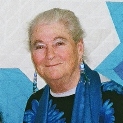
Jesse Manibusan is a singer, songwriter, comedian, and guerilla evangelist who works primarily with youth and young adults, but is also loved by many of us “older” folks as well. We first met when my oldest son was 5 years old. (He’s 29 now – you can do the math!)

Jesse includes a wide variety of styles of music in his work, from the sweetly lyric poetry and tone of Have you seen my God? or Until I Return to the rapper style MC God and I’m Coming Home‘s cha-cha rhythm. I’ll never forget the day he sang for the first commencement ceremony of The National Hispanic University. He didn’t speak Spanish, but he had listened to tapes of traditional songs and played them for about 15 minutes before the ceremony started, to the delight of the assembled families and friends of the graduates. When he led us in The Star Spangled Banner to begin the ceremony, his voice filled the auditorium. He later took this great talent for music and language and wrote his Misa del Mundo, liturgical music with phrases and refrains from languages and cultures all over the world – uniting all into the one prayer we all share, our liturgy.

Early in his career, Jesse wrote a song that I’ve always thought was a good reminder of what’s important – God is Bigger. In these days leading up to the election in the US, when financial markets are on a roller coaster, jobs are in flux, the housing market continues to fall and everything is uncertain, it’s important that we remember that truly, God is Bigger than all that stuff. As Jesse says, “God is good … all the time and All the time … God is good.”

Jesse is probably best known for another of his early songs, Open My Eyes. The words of the song include, “Open my eyes, Lord, help me to see your face …. Open my ears, Lord, help me to hear your voice … Open my heart, Lord, help me to love like you…” A wonderful prayer for beginning each day.

Jesse has a website, http://jessemanibusan.com. Go there and check it out. His blog tells of his travels, adventures and reflections. His CDs and Videos are available for purchase, along with songbooks for those who’d like to have the music to play themselves. And you can find out where his next performance will be, so you can be there! You won’t regret it.

I’ll close with wishes for Jesse of a very Happy Birthday, many more years of joy with your wonderful family, and continued faithfulness to your calling which has enriched all of us and brought such delight to so many.

Read More

Posted by on Oct 15, 2008

Happy Birthday to our Trusted Authority, Jesse Manibusan!

Saint of the Day – St. Teresa of Avila – October 15

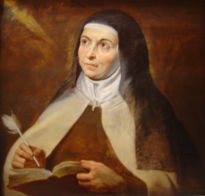
St. Teresa of Avila - by Peter Paul Rubens

St. Teresa of Avila - by Peter Paul Rubens

St. Teresa of Avila, also known as St. Teresa of Jesus, was a Carmelite nun, reformer of her order, mystic, and writer.  She is one of only three women who have been named “Doctor of the Church.” She had a lively intellect and loved people and parties. She wasn’t afraid to argue with the Lord or to oppose those of her time who believed her reforms unnecessary and even dangerous. She experienced many years of illness, including three of paralysis. She found prayer difficult for many years and even refused to try. It wasn’t until she was middle-aged that she began her great work of prayer, reform and teaching.

Many books and articles have been written about St. Teresa of Avila. I refer you to them and to her own writings for details about her life and contributions.

I also invited Mother Marija of Holy Annunciation Monastery in Sugarloaf, Pennsylvania to share a thought with us about St. Teresa. Her response:

The invitation: “What is one thing you would like people to know about St. Teresa of Avila?”  To be true to Teresa one must be faithful to Teresa’s own thought, at least as well as another can understand and convey it. Our Holy Mother St. Teresa, is a Doctor of the Church, so she needs no other “recommendation” in her teaching capacity. Her own mystical life is self-described in her writings: Life, The Way of Perfection (written for her daughters the Carmelite nuns), and the Interior Castle,  which book describes – even maps out – the journey of a soul through seven stages of the inner life to union with God. Again, Teresa had the Carmelite nuns in mind when writing this book, as the epilog expressly tells us. So what would I like people to know about Teresa? Simply that she is a true guide for a life of prayer – a “life”, meaning that prayer for Teresa is the WAY to God. Our Lord is, of course, the WAY and Teresa’s way of prayer is friendship with Jesus. The Way of Perfection, a life of Prayer and finding Jesus as the Way for each of us seems for Teresa  to be identical. After all, she is Teresa of Jesus.

Thank you, Mother, for your contribution. May God bless you and all who seek to serve Him through a life of prayer and friendship with Jesus.

The books of St. Teresa of Avila are still in print today. You can find them listed in our discovery engine at http://www.theologika.net/search. Just enter her name and you’ll get links to her works.

Read More

Posted by on Oct 13, 2008

Happy Birthday to our Trusted Authority, Jesse Manibusan!

Choosing our Leaders – Decisions based on Fear or on Issues

Photo by Chuck Welch of Lakeland, FL

Over the past 12-18 months I’ve received a number of emails forwarded from friends and family that were related to the current Presidential election in the US. The majority of the emails purported to be sincere efforts to raise questions about the ability of a candidate to serve as leader of this country. However, in general, they were filled with statements that were phrased to sound alarm bells in the minds of “Middle America” about the candidacy of Senator Barak Obama.  Many make a big deal of Senator Obama’s name. Others raise questions about the validity of his decision to become a Christian as an adult. One, featuring a cute picture of a bear seated at a picnic table, raised again the old Republican campaign claim that the Democratic party would give money to people who didn’t really need it or were too lazy to work for it – a “socialist state” type of idea, with all the negative baggage such terms carry in this country.

I haven’t received emails of this nature from the other side. I did hear of a You-Tube video featuring a formal Navy officer who was also a POW during the Vietnam War. In that one the speaker explained his concerns about Senator McCain. But that’s the only one I’ve seen. There may be others, but my “liberal” friends tend not to send that kind of stuff to me.

I write about this because as we come into the final weeks of the campaign, the tenor of the rallies and the statements being made are becoming more worrisome. Some of the rhetoric is deliberately arousing negative reactions from the crowds. Use of Senator Obama’s middle name in speaking of him is leading crowds to “boo” and shout out threats against him. While the presidential candidates themselves do not endorse this kind of activity, at least one of their running mates has not stopped it at campaign rallies when it occurred. This is dangerous and un-American. It is also un-Christian. So I believe it is something that must be addressed in Theologika’s forum.

Accordingly, I offer reflections I sent to a friend who had forwarded one of those “hate” emails to me. It should be noted that my friend was sincerely asking for my input on the content of the email. (He sent my reply back to his correspondent with his statement that he agreed with what I had said.)

The piece in question asked specifically if Muslims could be good Americans and would go to fight for America if the need arose. The implication of the article was that they could not and by extension that Senator Obama, because of his name and family of origin, would not be a safe choice for President. My response was as follows:

How to begin!?!
 
I guess the place I begin is remembering when Kennedy ran for President when I was a child. The big question on many people’s minds was whether electing him meant accepting the Pope as leader of the US. Catholics were not trusted in the US for the most part up until that time. I remember having someone spit on me as I walked home from school for lunch, wearing my Catholic school uniform. I was about 7-8 years old. I’d hate to think that now that it’s become understood that we are not ruled by the Pope, we’d become bigots ourselves about those of another of the great faiths ‘of the Book.’
 
A second thought is of my Muslim ‘sons,’ two now middle aged men who lived with us as our children in 1978 and early 1979. They and their family are honest people, whose religious beliefs guide them to be caring, respectful, thoughtful members of the communities in which they live. One of them told me one day, that the Christian teaching to forgive one’s enemies was something that Islam also taught, as a quality of the holiest of people. I would not hesitate to see them in public service in this country. They are very grateful for the US and for the refuge, welcome, education and opportunities they received as teenagers from an ‘enemy country’ (Iran) when they were young.
 
A third thought – Obama is Christian. This nonsense of saying that his Muslim name means he’s Muslim is just that – nonsense.  It’s like saying that any woman named Mary or man named Joseph is Jewish because those were names of Jews in the Bible! He’s named after his father. So’s my son. So what! Names are not destiny and do not equal religious faith, unless chosen as a religious name by someone entering religious community life.
 
Fourth – As Catholic Christians, we are members of a universal community, with first allegiance to the Kingdom of Heaven. The Pope and bishops continually remind us that we are not first and foremost Americans. Our decisions must be made in the light of broader, more universal concerns. What will this policy do to the least among us? The ‘preferential option for the poor’ that is rarely mentioned in American political discourse is the fundamental principle for us. Does that make us unfit for American office or citizenship? Some would argue that it would. I argue that as Christians, our call is to work for change within our society, not legislating it or criminalizing actions that are contrary to my beliefs, but to create support systems and encourage development of values on a broader scale that align American society and values with Kingdom values. We must keep this as a secular society, refusing to allow people of any faith to impose their own religious rules. A theocracy (society governed by religious law and leaders) is dangerous for all of us. As Christians, we’ve accomplished the most in bettering life for ‘the least among us’ when we began working as individuals and small groups to take care of the poor, the women and children, the disabled, etc. Those beginnings grew into larger movements and institutions, like the proverbial yeast of the Gospels. (Think St. Vincent de Paul, Mother Teresa, St. Camillus de Lellis, and many, many more. See https://blog.theologika.net for more examples.)

Fifth – I was raised in a family that more often than not votes Republican. I was always proud of the Republican belief that individuals can solve problems much more effectively in their own local communities than some ‘politician’ in the “East” could solve it for them. (We were from a western state.) But I’ve learned through the years that there are some things that can’t be handled or resolved effectively on a local level. And people who don’t have even flip flops can’t pull themselves up by their bootstraps. We’re in this together, as the melt-down on Wall Street has made abundantly clear recently. If a party can’t present its ideas and win the hearts of voters by presenting the issues and their best ideas about how to solve the problems of our nation without resorting to lies, fear-mongering and innuendo, then I’m not at all sure that party is worth supporting. I’m ashamed to see people of good will passing this garbage around and giving it credibility in the process.
 
As you can see, I’m a bit passionate about all of this. We’ve come so far. We can go so much farther. But we keep diving back down into bigotry and hatred. The saints and angels, as well as the one God and Father of us all, must be in tears.

I offer these thoughts to you, my readers, as well. In choosing our leaders, we must move beyond the politics of fear and of creating barriers where they don’t really exist. We must look at the issues before us, evaluate them based on our values and understanding of our faith, and then make our decisions responsibly and prayerfully, remembering that God has given us the gift of our minds so that we can use them to make this a more compassionate, just, and secure world for all who share it.

For more on the idea of secular societies vs theocracies, see https://blog.theologika.net/2008/09/11/theocracy-or-secular-society-reflections/.

For information on Islam, a classic from the field of anthropology is Islam Observed, by Clifford Geertz. There are also good pieces in Wikipedia on Islam and the many forms it takes.

The following are works I cited in another blog post, but in case you missed them, they’re well worth reading, so here they are again!

God’s Crucible: Islam and the Making of Europe, 570-1215, by David Levering Lewis 

The Voice, The Word, The Books: The Sacred Scripture of the Jews, Christians, and Muslims, by F.E. Peters

A Peace to End All Peace: The Fall of the Ottoman Empire and the Creation of the Modern Middle East, by David Fromkin

Secularity and the Gospel: Being Missionaries to our Children, by Ronald Rolheiser, OMI

Three Cups of Tea: One Man’s Mission to Promote Peace … One School at a Time, by Greg Mortensen

Read More

Posted by on Oct 6, 2008

Happy Birthday to our Trusted Authority, Jesse Manibusan!

Saint of the Day – Blessed Marie-Rose Durocher – October 6

Eulalie Durocher was born on October 6, 1811, in San Antoine sur Richelieu near Montreal. Her life can be summarized very briefly. She was the tenth of eleven children and one of her older brothers was a priest.  When she was 18, her mother passed away and Eulalie and her father went to live with her brother, Theophile, at his parish in Boleil. The young Eulalie took charge of the priest’s home as housekeeper, hostess, and parish assistant. Although she was reputed to be lively and something of a tomboy, her health was never really robust.

At the request of Bishop Ignace Bourget, Eulalie, at 32, in 1842 became the reluctant co-founder, with the bishop, of the Sisters of the Holy Names of Jesus and Mary. (Bishop Bourget also founded 3 other religious orders to help meet the needs of his diocese, which was the vastness of Canada.) At her profession of vows, she took the name Sr. Marie-Rose. Two of her friends joined her in this new work, focusing on the religious education of children, especially girls.  Blessed Marie Rose led her group for 6 difficult years until she died on her birthday October 6, 1849.

We know that her spiritual formation under Fr. Telmon was strict and that she set a very high standard for the members of her community. However, her service to the poor and her efforts to deal with the social ills of her time set the order on a trajectory of education, nursing, social work, and spiritual direction.

The Sisters of the Holy Names have been leaders in the education of women and pastoral care and service of the most disadvantaged. Kathy and I are both indebted to the Sisters of the Holy Names. Kathy was educated by Holy Names Sisters for 10 years, first in her parish grammar school and later at Holy Names Academy in Spokane, WA. My first full time teaching position was in the Education Department of Holy Names University in Oakland, CA some 30 years ago. We send our greetings, thanks and prayers to the Sisters of the Holy Names on this the feast of their foundress.

Read More

Posted by on Oct 4, 2008

Happy Birthday to our Trusted Authority, Jesse Manibusan!

Saint of the Day – St. Francis of Assisi – October 4


St. Francis of Assisi window – St. Joseph’s Monastery in Aptos, CA – Artist: Susan Wagner

October 4 is the feast of St. Francis of Assisi. Francis was born in Assisi, Italy in about 1182 and died at the Porziuncola, a chapel outside Assisi’s walls, in 1226. He is one of the best known saints, founder of the Order of Friars Minor or Franciscans, the Poor Ladies or Order of St. Clare  (Poor Clares – founded with St. Clare of Assisi) and the Third Order Franciscans, including lay men and women who also wanted to live in accordance with the Gospels in a Franciscan manner. There are many sub-groups of Franciscans.

Brother Bill Short, OFM  of the Franciscan School of Theology, Berkeley, CA has developed an excellent series of lectures on the life and times of St. Francis. I listened to it recently and was fascinated with the richness of detail he included about the culture and history of the times, as well as the people who each played a part in the story of St. Francis.

I asked Brother Bill and a few others for reflections on St. Francis for his feast – one thing they would like people to know about him. I received these responses.

From Brother Bill:

Something (one thing) I would like people to know about St. Francis – hmmmm, there’s an embarrassment of riches.  Let me try this:
 
Francis was rather alarmed by the notion that people might think he was some kind of saint.  In a fairly reliable account from companions who travelled with him, recounted some fifteen years after his death, they remember that on travelling through a town in Tuscany, a man pleaded with Francis to pray that his wife would be freed from an evil spirit that was making her cry out, disturbing the neighbors.  Francis seemed pretty skeptical, but finally agreed to go to the house, along with three companions.  He stationed them in three corners of the room where the woman was ranting, while he took one corner for himself.  They all prayed, and the woman stopped shrieking, apparently healed.  The husband thanked Francis profusely, but Francis seemed in a hurry to move along.  Some time later he passed through the same town with Brother Elias (his vicar) and the woman came rushing out to thank him.  He still seemed reluctant to accept her story, but finally agreed that she had been freed from her problem – but he was very clear that four brothers had prayed for her (including him) and who knew which prayer God had answered?  That’s good, practical humility, I think.
 
I like the story because it shows Francis as someone with a pretty shrewd sense of “phonies,” and a cautious approach to anyone (including himself!) being considered a saint during their own lifetime.

From Sr. Krista Aitkin of St. Joseph’s Monastery in Aptos, CA

St. Francis of Assisi is a spirit and a way of life.  His spirit and his way of living are reality lived,  not an idea or ideal, or even a formula.  Everything about St. Francis is an invitation to practice.  He is not locked into “a system.”  He lives reality through devotion toward others,  respect for the poor and for all of God’s creation.  In short,  St. Francis lives in and through the Word of God.  His charism is not linked to a particular apostolate,  but is focused on “becoming” rather than “producing,”  on one spirituality – putting on Christ,  who called himself the way,  the truth,  and our life.

Thank you to Brother Bill and Sr. Krista for your responses to my question and for sharing your love of St. Francis with me. May the Lord continue to bless you richly.

Read More

Posted by on Oct 1, 2008

Happy Birthday to our Trusted Authority, Jesse Manibusan!

Saint of the Day – St. Therese of Lisieux – October 1

St. Therese 

St. Therese of Lisieux is known as “The Little Flower” because before she died she promised that after her death she would send down a shower of roses on the earth. She is known for her “little way” to God – a way that everyone can follow, doing the smallest everyday things in love as a way to God.

I asked the sisters at several Carmelite monasteries to share their reflections on St. Therese for her feast day and received these gracious responses.

Mother Marija, 0cd of Holy Annunciation Monastery , a Byzantine Carmelite monastery, in Sugarloaf, PA, sent this note:

The invitation: “What is one thing you would like people to know about St. Therese?”  This in turn, led me to ask: “what did Therese want us to know about her life and spirituality?  What did she say?” Before she died Therese spoke  of her desire  to make known to all “little souls” (everyone)  her way of confidence and love.  Therese wanted us to know how much, how very much, we are loved by God and have nothing to fear from Him.  This being true, we might also say that God gave Therese to the Church and world as a “new” expression of the Gospel message: God is Love.

When praying the Novena of Grace in 1897, the very year of her death, Therese asked God to grant her unique request: That her mission to save souls would last until the end of time” So as we honor Therese,  we should  recognize that God wants our love and has sent Therese to us, raised her up in the Church, as a new “invitation” to know Him as Love.

The Sisters at Carmel of Reno were unable to offer a reflection on St. Therese or Carmelite spirituality at this time, but they graciously gave permission to use the icon of St. Therese doing the laundry created by the late Sr. Marie-Celeste, as illustration for this post. They also offered their best wishes and this comment.

We deeply appreciate your interest in Carmelite spirituality and  sharing the riches of theology and religious experience with the broad community on line.

St. Therese is one of my personal favorite saints, as I’ve mentioned in earlier posts. For more about her life and influence, here are some options:

Maurice and Therese: The Story of a Love by Patrick Ahern

Saint Therese and the Roses by Helen Walker Homan

St. Therese of Lisieux – Saint of the Day

The Triumph of the Lowly – St. Therese of Lisieux and the Little Way

 Original icon by Sr. Marie-Celeste Fadden, Carmel of Reno – Used with permission

Read More

Posted by on Sep 27, 2008

Happy Birthday to our Trusted Authority, Jesse Manibusan!

St. Vincent de Paul – September 27

St. Vincent de Paulimage by Monastery Icons

St.Vincent de Paul is one of those saints whose mark on society has been so great that we often take their contributions for granted. Men and women through the centuries have been moved to serve the poor because of his example, as priests, nuns, and lay persons. Through the society which bears his name, the St. Vincent de Paul Society, members work across the United States and around the world, providing help both for those who face long term challenges and those who are “down on their luck” for a short time. 

Last year, Randy wrote a biographical post for the feast of St. Vincent de Paul. Lots of good information is there, along with links to other sites. This year, I asked members of orders founded by St. Vincent de Paul and his associates for one thing they’d like the world to know about him. These were responses I received, in order received.

From Sr. Mary Frates, DC – Vocation Director, Daughters of Charity, DePaul Provincial House

Thank you for this opportunity.  St. Vincent De Paul is well known for making an impact on the society of his day through organizing service to the very poorest.  What I would like people to know about Vincent is that he paid attention to everything that was happening around him and it was this attention to the present moment that drew him to take action to help those in need.

From Fr. Ray Van Dorpe, C.M.  Assistant Provincial, Midwest Province of the Congregation of the Mission

I would like people to know that St. Vincent de Paul was a man far ahead of his time.  He was one of the first to organize the laity for charitable works of mercy that were not dependent on the support of the local pastor.  These “Confraternities of Charity” later became the Ladies of Charity, an international organization and part of the larger Vincentian Family, along with the Congregation of the Mission, the Daughters of Charity, and the Society of St. Vincent de Paul, to name but a few.  St. Vincent was also ahead of his time in putting women to work outside the structures of cloistered life (the Daughters of Charity).  He also was one of those who revolutionized the formation of the clergy in France and other countries and developed a sophisticated ministry of preaching missions in poor rural parishes (the Congregation of the Mission).  But more important than all these accomplishments was his love for the poor and his deep desire to bring the Good News to the poorest of God’s people.

Thank you for sharing your insights. May the Lord continue to bless your ministry and that of Vincentians around the world.

Read More

Posted by on Sep 15, 2008

Happy Birthday to our Trusted Authority, Jesse Manibusan!

Feast of the Day – Our Lady of Sorrows – September 15

Mothers of the Plaza de Mayo

The Feast of Our Lady of Sorrows follows the Feast of the Exaltation of the Holy Cross by one day. On this day we remember the prophecy of Simeon when Mary and Joseph took Jesus to the temple for the first time. Simeon blessed them and said to Mary, “Behold, this child is destined for the fall and rise of many in Israel, and to be a sign that will be contradicted; and you yourself a sword will pierce, so that the thoughts of many hearts may be revealed.” (Lk 2:33-35)

This feast was not part of the official liturgical cycle of the Church until the mid-1600s, though it was celebrated in some locations as early as the 13th century. Sometimes it is known as the feast of the Seven Sorrows of Mary and includes mention of seven events from Jesus’ childhood and passion.

Our Lady of Sorrows is a title of Mary with which many women and men can identify. Bearing and raising a child is not an easy task, though it can be an extremely rewarding adventure. There are countless joys and sorrows along the way. And make no mistake about it – the commitment of parent to child is one that does not stop when the child reaches adulthood! It is a commitment for life and beyond. In our belief in the Communion of Saints and life after death, we recognize that those who went before us still care about us and look out for us. Parents who are with the Lord do not cease to be parents of those who still remain here. The relationship is just transformed.

In thinking about this feast, it came to me that surely Our Lady of Sorrows is especially close to mothers, fathers and family of those who are killed prematurely. I’m thinking of those who “disappeared” in Central and South America in recent years – victims of political violence and/or persecution for their actions in living and teaching the Gospel. I’m thinking of victims of terrorism in the Middle East – including those on both sides of the Israeli-Palestinian question and those dying almost daily in Iraq. I’m thinking of those whose children were killed in wars – Iraq, Iran, Afghanistan, India, Pakistan, Bangladesh, Sudan, Ruwanda, Brundi and so many, many others. We see the pictures year after year and our hearts become numb. Yet for all of them, and with all of them, Our Lady of Sorrows weeps. And so should we all.

And then … we must commit ourselves to work for peace. So that those who have given their lives will not have died in vain. So that those who believe that “might makes right” will learn that only love makes right. So that we truly become a community where we live our belief that what we do to the least of Jesus’ sisters and brothers, we do to Him.   

May it be so.

Read More

Posted by on Sep 11, 2008

Happy Birthday to our Trusted Authority, Jesse Manibusan!

Theocracy or Secular Society – Reflections

September 11 used to be just another day in the ninth month of the year. But the acts of terrorism which were committed on this date in 2001 in the United States changed that reality. Now, in most countries of the world, September 11 is a day to remember and mark with speeches, prayers, visits to “sacred sites” and news reports. For some few, it is a day remembered as a great victory against the most powerful representative of secular society in the world. For most, it is seen as a great tragedy, in which lives of innocent people were lost, personal freedoms were threatened, and excuses provided for nations to go to war.

Believing with George Santayana that “Those who do cannot remember the past are condemned to repeat it,” I add that those who do not understand the fundamental concepts underlying social systems are also condemned to repeat history. Accordingly, I offer some reflections as an anthropologist on structures and realities that shape societies and social interaction.

In a Nutshell

For those with only a few moments to spare, here are my thoughts in a nutshell.

We’re dealing with a clash of cultures, specifically in terms of family structures and political systems. The “corporate family” and “theocratic” political system that was the norm for most cultures throughout most of human history has been challenged by an upstart system. In this new system, it’s the “nuclear family,” with its focus on the individual and personal choice, as well as its “secular” political structure, that are the ideal.

Some of the first cracks in the old system began to appear around 2000 years ago, with the teachings of Jesus and His early followers. More followed as Christians began caring for the sick and teaching children (including girls) and insisting that women had rights in marriage. Still more appeared towards the end of the religious wars that followed the Reformation, as religious dissidents began to move to the New World. With the ratification of the Bill of Rights as part of the American Constitution, the secular society as a political system was born.

Today we’re dealing with a side-effect of that event. Secular societies offer the opportunity for people of all faiths to work together to their fullest potential, to make this world a better place for all. Unfortunately, not all human choices are made for the common good, under any social or political system, so we also see people doing things that are very wrong. Sometimes religious people get frightened by that and think we should just go back to religious law – theirs, of course. Splinter groups of them may turn to violence and terror, killing innocent people in an attempt to change a political system. That’s what the events of September 11 and other terrorist activities of the past century have been about – political systems and family structure. Often disguised as defense of religious beliefs – but at base a question of political systems and family structure.

A violent response cannot stop violence of this type. In dealing with the problems that breed discontent and lead to social upheaval (unemployment, hunger, lack of safety, etc.), economic solutions are more often effective. Education, employment opportunities, health care, housing – all contribute to social stability and take the wind out of the sails of the terrorists. That’s the response we should be offering to the world!

Now, for those who have a little more time.

Definitions and More Details

Begining at the begining – a few definitions and clarifications are in order.

Nuclear Family – The nuclear family is one that includes adults – generally but not exclusively a man and a woman – and their children, whether naturally born or adopted. It does not include grandparents, aunts, uncles, cousins, godparents or other friends.

In the nuclear family, the individual tends to be seen as having intrinsic value. Having an individual opinion and making personal choices is valued. Individuals are allowed to decide and act for themselves and it is expected that at a certain age and maturity, the individual will leave the nuclear family and live his or her own life. Many will enter into committed relationships, legally recognized by the society, and start new nuclear families of their own. The family in which they were raised is called the “family of origin” and is distinct from the family created upon reaching adulthood and entering into their own newly formed nuclear families. In American society, the nuclear family is the type of family structure that is the norm.

Corporate Family – A corporate family is like a business. It includes many more people than a nuclear family. It is multi-generational. It has an identity and existence of its own, apart from that of any individual member of the family. The continuation of the family takes precedence over the desires or even the sheer survival of the individual. Issues of honor are seen in terms of the larger family and individual lives may be sacrificed to maintain family honor. Marriage is a matter of alliances between corporate families – not something for two individuals to choose for themselves. One’s sexuality belongs to the family and one’s duty is to provide children for the continuance of the family. Individual opinions and preferences are not of deciding importance. In fact, the mere possibility of having an individual opinion may not enter the mind of a member of a culture in which the corporate family is (or has been) the rule.

Corporate families can take a variety of forms, depending on rules of inheritance and identification. In some, identity and property are passed through the male line (patrilineal) and in others through the female line (matrilineal). Somewhat more rarely, identity and inheritance can come from both lines. (This is more common in nuclear families, however.)

The vast majority of world societies take the corporate family model as the preferred model. It is only relatively recently that the nuclear family has arisen on the social scene of the world – and that in relatively few cultures. Nevertheless, with the spread of Western culture through the media, exposure to the nuclear family and the type of culture that accompanies it is increasing.

Theocracy – A form of political organization in which the legal foundations of the society are the laws of the dominant, governing religion or religious body. Theocracies have a long history in the world. Any culture, ancient or modern, in which religious rules are the ones by which disputes are resolved and individual or group actions judged as a matter of law is a theocracy.

Secular Society – A form of political organization in which the legal foundations of the society are distinct from the laws of religious organizations or groups of believers. The laws of secular societies may be, and generally are, based on certain principles drawn from the religious beliefs of their members, but religious law is distinct and carefully separate from the law governing the wider society. Secular societies have emerged relatively recently in the history of the world.

Freedom – The concept of freedom I will use is that which states that an individual can act or behave according to his or her conscience, to the mutual benefit of both the individual and other persons who will be affected by the action. In cases in which what benefits one does not benefit others, the one may not have the right to act or behave in the manner he or she desires. Sometimes the greater good or the rights of other people take precedence. Freedom does not mean license to behave however I choose and the rest be damned! Freedom entails a great responsibility to act for the common good, trusting that the larger good will also benefit the individual in the long run. In this, the concept of freedom draws much from the corporate family tradition, but it recognizes the rights of the individual to choose, apart from the interests of the corporate family, and to look at his or her own interests and those of the larger community.

So what does all this have to do with us today?

Corporate family structure and theocracy as a basis for political organization have been the dominant forms of organization during much of the history of human culture. Some of the first cracks in the system that we see historically resulted from the teachings of Jesus. When Jesus told the rich young man to sell everything he had, give the money to the poor, and come follow him, (Mt 19:21) that was demanding a major break from the corporate family. When Jesus told another young man to let the dead bury the dead, in response to his request for permission to bury his father before becoming a disciple, (Mt 8:22) that was an even greater break. 

The early church continued the process of separation. In the Acts of the Apostles, ( Acts 2:42-47) we see a community of believers who have sold all, combined their resources, and share all things in common. They have left their ancestral corporate families and joined into a new form of family – family still being needed for mutual support and protection. We know that not all went smoothly. There were disputes between Jews and Greeks, concerns over whether all resources had been contributed or not, complaints about fair distribution of resources, etc. The first persecution of the church in Jerusalem broke up the communal experiment and the Followers of the Way were dispersed, taking the Good News of the freedom of God’s children with them into the Roman Empire.( Acts 4-8)

In each community where the Gospel took root, communities formed. Christian community became a new social unit and each person’s gifts were seen as contributing to build up “the Body of Christ.” (Eph 4: 1-16) Individuals became important because the gifts they received built up the whole community. We’re still not to a nuclear family model yet in this understanding, but birth families were not primary in this scheme of things.

When religions become State sponsored or mandated, when religious law becomes the law of the land and all are required to become members of that religion (or at least live by its rules), some common patterns emerge. We see forced conversions, wars over definitions of points of belief, torture of those who do not believe “correctly,” and State sponsored executions of non-believers or heretics (those with beliefs deemed to be untrue). This pattern held true with the legalization of Christianity and its establishment as the religion of the Roman Empire. 

On large scale, we see destabilization of entire societies resulting from the persecution of non-conforming religious communities. In Spain, for example, both during the time of the Visigoths and the time of the reunification of the kingdoms under Ferdinand and Isabella, there was an attempt to enforce unity in religion, political governance, and military might. In both cases, the society was ultimately destabilized by the creation of persecuted minorities. During the Visigothic period, those minorities welcomed the invading Muslim forces which overthrew the Visigothic kings. (Ironically, Muslim rule itself was undermined in Spain by the 12th century as the result of a turn towards fundamentalism.) During the 15th and 16th centuries, the expulsion of Jews and Muslims from Spain resulted in the loss of large numbers of people with valuable skills and professions – banking, medicine, science – not fields a successful nation can manage without. The Inquisition, which did not originally begin in Spain but was a force there for far too long, was a terrible example of what can happen when religious beliefs become the legal norm.

The religious wars that accompanied and followed the Reformation finally were resolved with a great compromise. The religion of the ruler of a nation would be the religion of all his or her subjects. So, any time the religion of the ruler changed, everyone had to change religions. It sounded good on paper, but if one truly believes that one’s faith is the one, true, unchanging faith, one can’t just change it because a new ruler has come into power! Fortunately, a New World had been discovered, and dissidents could go there and have their own colonies, with their own religious beliefs. And so it happened.

The English colonies in North America did not begin as places with freedom of religion. That developed much later. In a couple of colonies there was tolerance of different beliefs. One colony was set up as a refuge for Catholics. But by the time of the American Revolution, Catholics were not allowed to vote in any colony. In fact, Charles Carroll of Carrollton, a signer of the Declaration of Independence, was not a voting “citizen” of his own colony until the mid-1770s when the laws excluding Catholics were repealed. It was only with the ratification of the Bill of Rights in 1791 that the separation of Church and State in the United States was enshrined as the law of the land. A secular society was born.

So what does all this have to do with September 11 and the acts of terrorism in the United States?  I’d like to say it’s simple, but it’s not. The actions of those who planned and carried out the attacks were those of terrorists, acting out of misguided religious beliefs perhaps, but still terrorists. Their goals were not religious conversion. They were from a group that promotes theocracy as the preferred political structure, specifically Islamic fundamentalist theocracy. (This is not to be mistaken for a mainstream Islamic faith.) The United States, as the largest and most powerful secular society in the world, was a natural target in an essentially political battle.

Terrorism is not an act of religion. It is a political act, whether seen in Northern Ireland, Israel, Palestine, Iraq, Iran, Afghanistan, New York City, Sudan, or in the bombing of abortion clinics or the homes of scientists engaged in animal research studies. It is an act of political violence. So the question becomes, how do we respond to political violence? One school goes back to the old, “an eye for an eye and a tooth for a tooth” (revenge).  Another says, “give them a little bit and maybe they’ll go away happy” (appeasement). Another says, political issues must be resolved with social solutions and tools. Look at the core issues – economics, healthcare, education, jobs, security for families, safety from violence. The Peace Corps initiative of the Kennedy administration is an example of this approach, which has resulted in much positive change in the world.

The response to the events of September 11, the military invasions of two countries claimed to have been responsible in some form for the actions of the terrorists, has not been a success. It will not be easy to undo all the harm that has resulted from those actions. But as we go forward, as Americans, as Christians, as people of good will in an increasingly tiny world, it is critical to be aware of the past, of the differences between societies based on corporate families and those based on nuclear families, of the danger of placing religious law as the law of the land, of the great protection members of all faiths receive from living in a secular society, and of the resulting freedom to work for the betterment of social conditions and life for people throughout the world. Secular societies can be welcoming places for people of all faiths. Together, protected by freedom of religion, we can do great things.

For related information, see:

God’s Crucible: Islam and the Making of Europe, 570-1215, by David Levering Lewis 

The Voice, The Word, The Books: The Sacred Scripture of the Jews, Christians, and Muslims, by F.E. Peters

A Peace to End All Peace: The Fall of the Ottoman Empire and the Creation of the Modern Middle East, by David Fromkin

Secularity and the Gospel: Being Missionaries to our Children, by Ronald Rolheiser, OMI

Three Cups of Tea: One Man’s Mission to Promote Peace … One School at a Time, by Greg Mortensen

Post edited and revised Sept. 26, 2008 by the author.

Read More

Posted by on Sep 9, 2008

Happy Birthday to our Trusted Authority, Jesse Manibusan!

St. Peter Claver – September 9 – Patron Saint of Slaves

Peter Claver was born in Catalonia in 1581. He attended the University of Barcelona before entering the Jesuits at the age of 20. During his study of philosophy in Majorca, he was encouraged by the porter, Br. Alphonsus Rodriguez, to travel as a missionary to the Americas. In 1610, Peter Claver arrived in Cartagena, in present day Colombia.

Cartagena was the center of the slave trade in the Americas at that time.

Slavery has had a long history in human relations. To this very day there are people enslaved in our world. Even within Christianity for most of its history, slavery was seen as one of those realities of life that are simply unquestioned until relatively recently. St. Paul, for example, wrote instructions on the proper behavior of slaves and sent an escaped slave who had become a Christian home to his master, with instructions to his Christian master to treat the slave well (Philemon). But there were no instructions to free him.

The West African slave trade that brought so many people to the Americas in chains had its roots in the Crusades. Pope Nicholas V, in a papal bull titled Dum Diversas (June 18, 1452), allowed the perpetual enslavement  of Saracens and pagans captured during the Crusades, because they were seen as enemies of God and Christianity. It seems ludicrous today, but that’s what people believed at the time. Later, on January 8, 1455, in Romanus Pontifex, he also authorized European dominion over newly discovered lands and the enslavement of non-Christian peoples living there. At that time, the Americas had not yet been “discovered” by Europeans, at least not by a Europe in any way ready or able to begin to colonize them.

Once Columbus and his crew brought word back of their findings, both Spain and Portugal, the foremost seafaring European peoples of the time, wanted to claim lands in America. Pope Alexander VI, on May 4, 1493, in Inter Caetera, divided the Americas between Spain and Portugal. He commanded Spain “to instruct the aforesaid inhabitants and residents and dwellers therein in the Catholic faith, and train them in good morals.” 

Despite the instructions of Alexander VI, military leaders and economic developers (colonists) had begun to enslave the native peoples whom they encountered in the Americas. Many had died of European diseases, against which they had no immunity. By May 29, 1537, Pope Paul III issued another papal bull dealing with the question of enslavement of peoples, Sublimus Dei. In this one, he specifically forbade the enslavement of the indigenous peoples of the Americas, based on the fact that they are rational beings with souls. He further extended this prohibition to the enslavement of all other previously unknown peoples. Unfortunately, the peoples of West Africa did not count as “previously unknown peoples” – at least it had been know there were people living there – so enslaving them was not strictly forbidden.

Into this context, Peter Claver entered as a young man, not yet a priest. There he met Fr. Alfonso de Sandoval, another Spanish Jesuit who had earlier dedicated his life to the care of African slaves. Working with Fr. Alfonso, Peter Claver dedicated his life as well to this ministry, declaring himself “the slave of the negroes forever.” For the next 44 years, he served the slaves of Cartagena, from the time the ships arrived bringing them chained in the holds through their time of bondage on the plantations and in the mines.

The work of caring for the slaves was not easy. It was not unopposed. It was not welcomed by “the powers that be” of Cartagena. It was not even always welcomed by his superiors or by members of local parishes.

Each month, as the slave bearing ships arrived, Peter Claver went out to meet them, taking food, medicines, and other supplies with him. He went into the holds of the ships and began to care for those who were nearest death, caring for people with diseases such as smallpox and leprosy (Hansen’s Disease). He organized a group of helpers who spoke the various languages of the peoples arriving. They went with him to the slave pens, speaking to the newly arrived and helping to care for them. As the new slaves recovered their health and strength, Peter, Alfonso, and their helpers began to teach them about Jesus and to baptize those who accepted the faith. Despite official Church instructions, many people still questioned the humanity of these captives and opposed teaching them the faith or accepting them into the Church. This opposition did not stop Peter Claver and those who worked with him. They simply worked and prayed harder.

Care for the slaves did not stop at the slave pens. As men, women and children were purchased and set to work in the mines and on plantations, Peter Claver continued to be their advocate. He visited them, celebrated the sacraments with them, admonished their owners to treat them justly, and continued to teach and care for them. He refused to stay with the owners of the plantations and mines. When he visited slaves, he stayed with them in their homes.

Over time, he gained some respect in Cartagena, if for no other reason than that he was consistent and persistent in following his calling. People began to believe that it was because of his work and his presence that they had escaped many potential disasters (think hurricanes, pirates, etc.).  The slave markets were not closed during his lifetime. But somewhere around 300,000 people received care, love, instruction in the faith and baptism through the ministry of St. Peter Claver. Not a bad record!

Read More

Posted by on Sep 5, 2008

Happy Birthday to our Trusted Authority, Jesse Manibusan!

Blessed Teresa of Kolcata – September 5

Mother Teresa was born in Albania in 1910. She went to India in 1929 to become a Sister of Loreto, an order of teaching nuns. She took her first vows in 1931 and began working as a teacher, work she deeply enjoyed. She chose the name Teresa in honor of St. Therese of Lisieux, patroness of the missions.

As the years passed, Mother Teresa became increasingly aware of the poverty and despair that were the lot of so many people in India, including around the school in Kolkata. On September 10, 1946, she received a “call” from the Lord to leave the work she was doing and go out to live among and serve the poorest of the poor. Her response to this call and the positive results of her service and witness are well documented.

From the streets of Kolkata, men and women who joined her in service as the Missionaries of Charity have moved throughout India and into the broader world. Today, as sisters, priests and brothers, they have schools, clinics and shelters in 120 countries, including the United States. My home parish, St. Patrick’s, in Spokane, WA is even blessed to have a group of sisters working in the community. They are quietly witnessing and bringing the Good News to the larger neighborhood and diocesan community through their service and I am grateful for their presence there.

Many words have been written about Mother Teresa, including a post in this blog last year. Some praise her. Some criticize her. Some mock her. Some don’t know what to think about her. None of this would come as a surprise to her. It was like that from the beginning of her work. In the decades of her “dark night of the soul,” many of these things may have been thoughts she had herself. 

But she was faithful to the calling she received and Pope John Paul II declared her Blessed. We’d do well to keep that in mind as we try to be faithful to the calls each of us have received. There are no guarantees of success or popularity. Most of us will never be praised by Kings, Queens and Presidents. Few will receive Nobel prizes. But we all can aspire to be faithful to the work set before us by our Lord.

If you’d like to send an e-card with words, prayers, and/or blessings from Mother Teresa, check out this link. http://www.catholicgreetings.org/Saints/motherteresa.asp

Blessed Teresa, pray for us.

Read More

Posted by on Sep 3, 2008

Happy Birthday to our Trusted Authority, Jesse Manibusan!

Saint of the Day – St. Gregory the Great – Preaching the Gospel to the Ends of the Earth

St. Gregory the Great was born in Rome around 540 AD. This was a time when the Goths and Franks were invading Rome. The emperor was in Constantinople. The Senate had been disbanded. Italy was still one country, called Rome, and late classical Latin was the language of the people.

Gregory’s family were wealthy, owning homes and property in and around Rome and in Sicily. He was raised and educated for a career in public office. He had fresco portraits of his family painted at some point, and his biographer, John the Deacon, left a description of them 300 years later as they appeared in the portraits. Gregory’s father was tall and had a light eyes and a long face. He wore a beard. Gregory’s mother was also tall, but she had a round face and blue eyes. She appeared to be a cheerful person. A portrait of Gregory himself was done shortly after his death. Again, John the Deacon left a description of his appearance in the portrait. Gregory is described as being somewhat bald, with a tawny beard. The shape of his face was somewhere between that of his mother and his father. His remaining hair was worn long and curled carefully. He had a thin, straight, almost aquiline nose and a high forehead. His lips and chin were described as also attractive and it is said that his hands were beautiful.

St. Gregory lived in a time of great turmoil. Wars, floods, famines, political changes, and religious controversies swirled through Italy and the Empire. He left a career in public service to enter a monastery when he was around 30 years old, only to be drawn back into public life by the Pope, who sent him to Constantinople to request help from the Emperor in defending Rome. Following 6 years in Constantinople, he returned to Rome. Eventually he himself was elected Pope, an office he tried to decline.

As Pope, he is remembered for reforms of the liturgy, establishing rules of conduct for bishops, the wielding of political power in dealing with invading armies and natural disasters, his insistence on the supremacy of the papacy over the other patriarchs of the church, the notion that the Pope is the “Servant of the Servants of God,” and for establishing the papacy in the form it would take during the Middle Ages. He insisted that the Church has a responsibility to care for the poor. When famine threatened even the wealthy in Rome, he arranged for food and other supplies to be delivered from properties in southern Italy (lands that his family had given the Church) and distributed in the city. He cooked meals for the formerly wealthy himself to spare them the pain of having to ask for charity.

St. Gregory is also remembered for sending missionaries to England, the “end of the Earth” from the perspective of Rome. At that time, there was no knowledge of lands beyond the British Isles. In the rest of the Roman Empire, Christianity had been introduced. Even the Franks in Central Europe had been reached by missionaries. Given the turmoil and upheaval, it stands to reason that he might have thought, as many do today in times of natural disasters and social turmoil, that the end of the world must be near. The Gospels said that the end would not come until the Good News was preached to the ends of the Earth, however. So, perhaps with that in mind, and certainly with a fondness for the blond, blue-eyed people (the Angles) he had seen in Rome, he sent Anselm of Canterbury to preach the Good News in England.

The end of the world didn’t come in St. Gregory’s time. However, the works he did influenced the Christian community of his time and continue to play a role in even our beliefs and style of worship today.

Read More

Posted by on Aug 18, 2008

Happy Birthday to our Trusted Authority, Jesse Manibusan!

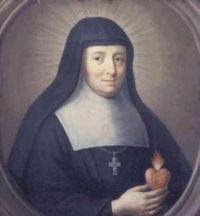
Saint of the Day – St. Jane Frances de Chantal

St. Jane Frances de Chantal was born in France in 1582, the daughter of the president of the Parliment of Burgundy. She married Baron de Chantal and had 6 children, three of whom died shortly after birth. She became a widow at the age of 28 as the result of a shooting accident. She was heart-broken and vowed never to marry again. She lived with her children in the home of her father-in-law for seven years before she was allowed to visit her father in 1604.

On that visit, she met St. Francis de Sales and he became her spiritual director. By 1610, in collaboration with Francis de Sales, she founded the Order of the Visitation of Holy Mary, for widows and lay women who were not called to such strict forms of religious life as were common at the time.

One description of the order states that its charism “combines gentleness with a valiant spirit; initiative with communal support; dedication to prayer with presence in the world; a contemplative life with an apostolic dimension. The order’s motto is “Vive Jésus” (French for “Live Jesus”).”

Visitationist sisters work with widows and women in poor health. They also have some schools. Their life includes a strong contemplative element.

One of St. Jane Frances de Chantal’s teachings to her sisters is as follows:

Fidelity toward God consists in being perfectly resigned to his holy will, in enduring everything that his goodness allows in our lives, and in carrying out all our duties, especially that of prayer, with love and for love. In prayer we must converse very familiarly with our Lord, concerning our little needs, telling him what they are, and remaining submissive to anything he may wish to do with us…

We should go to prayer with deep humility and an awareness of our nothingness. We must invoke the help of the Holy Spirit and that of our good angel, and then remain still in God’s presence, full of faith that he is more in us than we are in ourselves.

There is no danger if our prayer is without words or reflection because the good success of prayer depends neither on words nor on study. It depends upon the simple raising of our minds to God, and the more simple and stripped of feeling it is, the surer it is.

We must never dwell on our sins during prayer. Regarding our offenses, a simple humbling of our soul before God, without a thought of this offense or that, is enough…such thoughts act as distractions.

Saint Jeanne de Chantal, from Wings to the Lord

Read More

Posted by on Aug 14, 2008

Happy Birthday to our Trusted Authority, Jesse Manibusan!

Operation Kolbe – Continuing the Witness

The Kidnapped Colombia

– John Angée, artist


In preparation for the celebration of the feast of St. Maximilian Kolbe, Randy requested input from outside sources about Kolbe and his life. One of the responses came from a group in Colombia who offer themselves in exchange for persons kidnapped by rebels. This was their response.


El 14 de Agosto se recuerda y celebra la vida de Maximiliano KOLBE. Unidos a todos los secuestrados, Operación Kolbe, iniciativa de largo aliento, quiere renovar su ofrecimiento por la libertad.


Hemos expuesto un óleo titulado: “La Patria secuestrada” de John Angée (USA 2007) a la entrada del edificio Pedro Arrupe (Facultad de Teología) de la Pontificia Universidad Javeriana de Bogotá y seguimos alentando a Relevos, Orantes y Difusores para que se mantengan en la firme de decisión de acompañar solidariamente a tantos hombres y mujeres que siguen en cautiverio y a sus familiares y amigos.


No sabemos si algún día esta propuesta sea aceptada, pero sabemos, sí, que no descansaremos hasta ver en libertad al número desconocido de hermanos y hermanas que dramáticamente y en silencio nos piden no olvidarlos.

OPERACION KOLBE 2008
COLOMBIA

RESPONDER A:  operacionkolbe@hotmail.com

[On August 14 we remember and celebrate the life of Maximilian Kolbe. United with all those kidnapped, Operation Kolbe, a long term enterprise, wishes to renew its offer for liberty.

We have exhibited an oil painting titled: “The Kidnapped Colombia” by John Angée (USE 2007) at the entrance of the Pedro Arrupe building (Department of Theology) of the Pontificia Universidad Javeriana (Xavier Pontifical University) in Bogotá and we continue to encourage those who serve as Relief, those who Pray and Broadcasters to remain firm in their decision to accompany in solidarity the many men and women who remain in captivity and their family and friends.

We do not know if one day this offer will be accepted, but we know that, yes, we will not rest until we see the return to freedom of the unknown number of brothers and sisters who dramatically and in silence ask us not to forget them.

Operation KOLBE 2008

We can be reached at: operacionkolbe@hotmail.com

Translation by Kathy Pozos]

Thank you for your response. We will keep you and all kidnap victims and political prisoners in our prayers.

Read More

Posted by on Aug 14, 2008

Happy Birthday to our Trusted Authority, Jesse Manibusan!

Saint of the Day: St. Maximilian Kolbe – August 14

St. Maximilian Kolbe, a Conventual Franciscan, is widely known as the saint of the Nazi death camp Auschwitz, where he voluntered to take the place of a young husband and father who was one of ten innocent men condemned to death by starvation as a reprisal. As courageous as this was, he is also considered a martyr because of the abuse and torture he endured when he affirmed his faith in Christ.

Born Rajmund Kolbe (1894 – 1941), to a working class family in what is now Poland, he took the name of Maximilian when he entered the Conventual Franciscans. He had doctorates in philosophy and theology and founded a thriving monastery at Niepokalanow near Warsaw. St. Maximilian Kolbe was also a missionary to Japan and is remembered for his respect for Japanese culture and tradition as he created a thriving center near Nagasaki.

He lived a life of true Franciscan poverty, often living in very difficult circumstances, but always depending on God for the resources he needed for his apostolate. St. Maximilian Kolbe used publishing and radio to promote the Gospel and to defend the Church. He landed in Japan with a couple of companions and no money. They began their work sleeping on the ground in an improvised hut. Within a month he had a press and was publishing a weekly newspaper. He ventured into India where he wanted to create another foundation, but his superiors recalled him to Poland because of his ill health.

In 1939 the Nazis invaded Poland. St. Maximilian Kolbe and his fellow Franciscans sheltered 3,000 refugees at Niepokalanow including 2,000 Jews. On February 17, 1941 he was arrested by the Gestapo after publishing a defense of truth in the face of Nazi propaganda. In May he was transferred to Auschwitz, where he continued his ministry despite inhuman conditions and beatings. It was in late July that a prisoner from his cell block disappeared and he volunteered to take the place of one of the ten men selected to be executed as a reprisal for the missing prisoner. After three weeks of hunger and thirst, during which he encouraged the other men and led them in prayer, he was murdered by a lethal injection on August 14.

St. Maximilian Kolbe had a powerful effect on a young Polish man, Carol Wotyla, who as Pope John Paul II would declare him a saint.

St. Maximilian Kolbe has also inspired Operation Kolbe, a group in Colombia, to offer themselves in exchange for those who have been kidnapped by rebels. They can be reached at: operacionkolbe@hotmail.com.

Read More