Pages Menu
RssFacebook
Categories Menu

Posted by on Dec 17, 2012

Rejoicing When our Hearts are Breaking

Rejoicing When our Hearts are Breaking

Gaudete!

During the third week of Advent, we are called to rejoice because the Lord’s coming is imminent. The very name of the third Sunday of Advent, Gaudete, comes from the first word of the Entrance Antiphon for the day’s Mass, “Rejoice.” The prayer continues, quoting St. Paul, “Rejoice in the Lord always; again I say rejoice” (Phil 4:4). That little word, “always,” is not to be ignored.

Sometimes terrible things happen in our world. This past week we’ve seen the killing of many innocent children and adults at a school in the United States. In other parts of the world civil wars are raging, religious persecution is taking the lives of people as they gather for worship, girls and women are beaten or shot for daring to seek an education, and more mundanely, people die as a result of accidents, miscarriages, illness, or old age — holiday season or not! We find ourselves asking how a loving God can do that to us. How can God take the lives of innocent people? Where is God when we are hurting?

“Rejoice … Always”

Yet St. Paul is there to remind us with that little word, “always,” that there’s much more going on than we might actually see or recognize. Perhaps we’re not even noticing that it isn’t God who’s doing these terrible things to us. In our pain, with our hearts breaking, we don’t always see God present in the ones who step forward to help, in the ones who risk and sometimes give their own lives to protect the lives of others, in the ones who must help individuals and families pick up the pieces of their lives and continue onward despite the great hole left in their hearts. Yet that is exactly where God is. God is there with each grieving person, present in the friends and family who gather to be with those who have suffered a loss. God is there in the doctors, nurses and other healthcare providers who care for the sick or injured. God is there in those who send flowers because they can’t come in person. God is there. God is here. God is present in the silence of hearts that cannot speak because the pain is too great. God is present — crying with them and holding them close.

So we struggle to trust in God and find ways to give thanks through our tears for God’s presence. We try to rejoice that God notices each life born, each life lived, and each life that reaches its point of transition to new birth into eternity. We sing through our tears at funerals. We gather in family and religious communities to remember those who have passed on and to support and encourage each other in faith. We rejoice for the gift of life, however short, that each person has brought to our world. And we remember another one who died too young, taken in His prime, subjected to terrible torture, and publicly executed on trumped up charges. One whose birth we soon will celebrate. One who was raised up and will never die again — the Firstborn of the dead. And because we remember, we can begin to rejoice even when our hearts are breaking.

May peace and joy return to each of our hearts as we remember God’s great love. May we recognize God present in each other and work to help bring about the changes necessary to reduce the numbers of new people who will have to experience tragic deaths of loved ones and somehow find their way to seeing and rejoicing in God present, Emmanuel, among the ashes of their dreams and hopes.

Photo (Three Candles) by Alice Birkin – public domain

Read More

Posted by on Apr 18, 2012

Rejoicing When our Hearts are Breaking

Divine Mercy – Entering the Locked Rooms of our Hearts


Divine Mercy Sanctuary in Vilnius

Divine Mercy Sunday falls each year on the second Sunday of Easter. On this day we hear the story of Jesus’ appearance on Easter evening to his disciples who were hiding in the locked room where they had celebrated their last meal with him only a few days earlier. They were confused, frightened, bewildered, incredulous, and all the emotions in-between. They knew he had been executed. They knew that for the most part they had deserted him in his time of suffering. Yet the women had come bearing the message that he was risen from the dead. Peter and John had found the tomb empty. And now … here he was before them.

What would he say? “You blankety-blank sorry excuses for friends — I don’t know what I ever saw in you!” “How could you abandon me?” “Go take a long walk off a short pier.” “I’m done with you!”

The rest of us might have said such things. Such feelings would be accepted as only human. But Jesus said nothing of the sort. What did he say? “Peace be with you.” Not just once. He repeated it that night and again the next week, when he came again, with a special mission to reassure Thomas of his resurrection.

The early disciples were ordinary men and women like all of us alive today. Like them, we hide away, locking our fears, hurts, anger, doubts, shame, and uncertainty deep within. We hesitate to let anyone see or touch us in our pain, even our Risen Lord. So he comes to us too and offers peace. The mercy and absolute forgiveness of God are ours through Jesus. As our deacon, Patrick Conway, reminded us all Sunday morning, our best response is to allow Jesus to enter into our lives in their deepest, most hidden and hurting areas with God’s loving mercy and healing power. When we receive Communion, we, like the disciples in that locked room, find our Lord and Savior in the midst of our lives and we too receive the power to forgive and the gift of being forgiven.

As we bask in the gift of Divine Mercy this week, may the mercy, love and peace of the Risen Lord be with each of us. Then may we carry God’s mercy forward with us to all we meet in the year to come.

Painting by Eugene Kazimierowski.
Photograph by Alma Pater.
GNU Free documentation license.

Read More

Posted by on Mar 18, 2012

Asceticism and Mysticism: The Two are Linked

The point of all efforts to change and grow is happiness. Happiness  involves becoming more and more conscious of who we are, what we want and need, and how to get these.   A lot of life is spent exploring all of this. We enjoy ourselves and suffer in the journey to try things out, learn new skills, problem solve, experiment.  We also react to phenomena,and defend and harm ourselves and others at times.  In the midst of this we learn to distinguish between gains and satisfactions that are short term vs. long term and things that may feel good and are helpful and things that feel good and are toxic.  I may love ice cream but if I eat a  lot of it I may trade away my joy because it can make me sick.

Identifying how I feel when I do things is important.  If I feel peaceful when I make a decision, the decision is probably going to be beneficial.  If I feel uncomfortable when I make a decision but decide to do the activity or acquire the commodity anyway, the end will probably be harmful for me.  If I do something out of fear it probably will ultimately harm me – i.e. marrying someone so I will not be alone is  not a good reason to marry someone.   Taking a job one loaths because the money is needed is something one should only do as a last resort.  It would be wise to ransack one’s soul, talk to every friend, pray and brainstorm about any weird angle on jobs before just settling for a terrible job.  It is often the case that our lives are forcing us to look at possibilities that up to this point we have had a closed mind about.  These interior markers are very reliable if one learns the art of discernment and is also given the grace of discernment.  The famous historian of religion, Joseph Campbell, was asked by Bill Moyers if he had a sense that he was guided when he made decisions.  Campbell replied that he felt the helping hands of many beings when he had the courage to do what he knew was right.

So, making a commitment to live an honest, non-addictive life – a life in which I can be my true self – requires the skills to discern the right path for me.  That kind of life is surrendered to the truth.  It is a life that is not grasping, fearful or egotistical.  It can be a life that is loving, just, courageous.  This is not an easy thing.  From the Catholic point of view, it is impossible unless one is empowered by a love that keeps one from despair.  The more one seeks love and justice, the more one also sees insensitivity and selfishness. We also become acutely aware of our own entanglement in fear, loneliness, pain, anger and disappointment.  We want to feel safe but we want to be creative and compassionate.  How to do that?

If people are connected to a reality that is larger than themselves – a community or a transcendent being – that person can go beyond his/her fears and trust.  The ability to do this has to be rooted in experience.  Faith/trust in life cannot be totally blind.  It has to be based on an encounter with goodness/love.  In the Catholic context people have experiences all the time of peace, the presence of the Sacred, being blessed and guided.  No one can prove the existence of God.  Experts of all stripes can reduce religious belief to a projection of one’s neurons or psychology.  The scientific method can be paraded out and empiricism presented as the only acceptable measure of whether the spiritual is real.  In the end all of those super respectable criteria are a chimera.  We don’t have to accept the idea that our reality fits itself into an instrument of measurement that we have created if the reality we want to define is greater than the instrument – i.e. if God is infinite yet personal, that Sacred Reality is well beyond the physics of our situation as we know it.

In the normal committed spiritual life people educate themselves and have important insights and growth.  But, within the context of meditation and a reflected upon life people also have periodic religious experiences.  These experiences sustain and guide them.  They are not addictive but energizing, healing and challenging.  These experiences are not just for the Saints.  And, becoming closer to God is not a “crutch.”  It is a break through to the way reality is.  Asceticism and mysticism are brother and sister.  I wouldn’t have it any other way.

Read More

Posted by on Mar 14, 2012

Lent: How Could Asceticism Be Helpful to Me?

Catholics who grew up in the 50′s and 60′s and before often heard: “Offer it up!” We might have blown that idea off but we knew it had a deeper meaning. The heart of the maxim was closeness to the person of Christ – with a being of unconditional love and compassion.  No one wants to just torture oneself to rack up a extra “Brownie Points” with God. But, being with Christ and the poor is another thing. Even minor deprivation reminds us of how blessed and addicted we are.  We are all interconnected, in solidarity with every living thing. Knowing we are blessed and not complaining over the inconveniences of life makes us more compassionate. Being grateful can’t help but contribute to a holier world.

Some people  seek ways to actively promote their spiritual growth and more freedom from attachments by simplifying their lives or cultivating an awareness of what is controlling them  One term for this is “asceticism.”

“Asceticism” comes from the Greek words “Ascetikos” and “Askein” which refer to exercise.  It does not have anything to do with inflicting pain or enduring something just to prove that one is committed or is strong. The point of asceticism is to learn to identify one’s unhelpful attachments or addictions and to then learn ways to not have these rule us – to strengthen our ability to make conscious choices.  So, for example, when I eat I can observe what I want to eat the most and then see if that kind of food is good for me.  It is amazing how often or quickly we can see what is in charge of our lives.  I can at times feel an over whelming need to eat something to tamp down upsetting feelings.

Saint Ignatius of Loyola advised retreatants doing the retreat called the Spiritual Exercises to observe their attachment to things that led to unhappiness in their lives in general through the vehicle of observing their desires at a meal.  He pointed out that we usually want what he called “delicacies” rather than the healthier staple foods of the day (curly fries with cheese sauce as opposed to chicken and salad?)  Our desire can be fierce.  He also pointed out that at meals we may not be interested in being present to the other people.  We may converse but we may not be listening or really care what the other is expressing.  All of this is a potential goldmine for growth.  If we desire to know ourselves and to be of service to the world then we can consciously reflect on our attachments, desires and feelings.  In the Christian context, freedom from denial and negative patterns is not achieved by sheer exercise of one’s will.  Deciding to stop doing something does not necessarily change one’s interior life.  So authentic growth is not just on the surface.  Authentic growth in the Christian context is about moving away from something negative because one is moving towards something positive.  In technical terms asceticism cannot be separated from mysticism (meant as religious experience).  So, knowledge of what is going on at the microcosm of the dinner table which might be very self-centered or destructive can be transformed for even the most helplessly addicted foodaholic  into a victory of freedom.  That freedom though will be effected for the Christian by an encounter with the Sacred – a very positive experience of unconditional love.

Okay, but how does one have these experiences?!  (Stay tuned for more!)

Read More

Posted by on Feb 22, 2012

Rejoicing When our Hearts are Breaking

Almsgiving, Prayer and Fasting – Lenten Practices in Our Lives Today

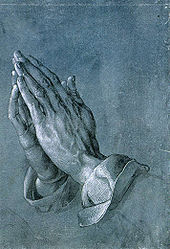
Praying Hands - Albrecht Durer

Ash Wednesday, the first day of Lent, brings with it a reminder from Jesus of the importance of 1) caring for each other, especially those in need, 2) staying in close communication with God, and 3) strengthening our physical, mental, and spiritual lives through actions that help us develop more control over the urges that don’t lead us to God. The traditional names for such activities are almsgiving, prayer, and fasting.

Catholics who grew up before and during the years of Vatican II often think first of fasting or giving up something as the activity of choice for Lent. This practice was generally phrased in terms of “What are you giving up for Lent?” There were (and still are) days in which fasting from normal amounts of food was required of adults between the ages of 21 and 59. However, there were other days in the year which were also set aside for fasting, so that was not unique to Lent. What was unique to Lent was giving up something: candy, television, movies, cigarettes, drinking, etc.

Ash Wednesday’s reading from Matthew 6:1-18 is a reminder that all three practices are important and even interdependent. They are also to be done quietly, without great fanfare, and without even congratulating ourselves on how well we’re managing to do them! So, how can we — citizens of a busy, busy world — find time to pray, identify and organize resources to share with others, and make fasting somehow different than dieting?

A few thoughts come to mind.

1) Almsgiving: The sharing of worldly treasures has been a mark of the Christian community since its earliest years. Christians recognized from at least the time of St. John’s Gospel, and before, that Jesus is present in the community.  To the extent that anyone is suffering from lack of basic necessities, those who do not lack them have failed to meet the needs of Jesus. This is a hard teaching sometimes, especially when times are tough and there is little left over to share. Remember: we are called to share our time, talents, and treasures. If what you have is time, then give of that. If what you have is talent (maybe for telephoning or organizing a bake sale), offer that talent to help provide for those who need food or shelter. If you have enough money (treasure) to support yourself and your family, then share from what you have; maybe eating more simply for a few meals or waiting an extra month before buying that new pair of jeans, and giving the savings to feed those who don’t have enough.

The important thing is to be open to sharing what you have and creatively listening for the opportunities to do so.

2) Prayer: Time for prayer is not easy to find —  if you think you have to set aside an hour a day to pray. On the other hand, if you remember to intersperse prayer into your entire day, then it becomes easier. A quick thank you for the morning as you open your eyes, a blessing over breakfast, a smiled expression of gratitude for a pretty sight on the way to work or the joy of a child exploring her world, a few moments of reflection on how the day is going at lunchtime, a quick prayer for the right words to say in conversation with a friend or co-worker, a blessing at the end of the day, a few moments of reading scripture while supervising a child’s bathing — all are ways to pray in a busy life. God is present in all of these moments and in the unpleasant, difficult moments as well. But God generally doesn’t burst into our lives and shout, “Do This Now!” God is much more subtle, inviting us to notice the presence of the divine in the everyday creation in which we live, and always leaving us free to respond to that presence as we choose.

3) Fasting: Limiting the amount of food eaten, or not eating at all, is the generally understood meaning of fasting. Going hungry on occasion is a good thing to do. It helps develop a greater appreciation of the gift of food. It also helps strengthen the will, so when other things must be declined, the will is strong enough to do so. However, fasting from food is only one way to fast. The practice of “giving up something” was a form of fasting. When we turned off the television on weekdays during Lent during my childhood, we broke its spell and no longer felt we had to watch any programs. We had time to do things together as a family that we didn’t do when the television was on: board games, music, conversation, outdoor play, cooking together, etc.

Fasting today may mean limiting our consumption of: consumer goods, recreational activities, social media including Facebook, television, text messages, tweets, online games, lunches or dinners out, or (insert your own time-consuming activity).  It creates a space for other things – for God to be noticed and heard.

Perhaps, out of fasting in this broader sense will come opportunities for prayer and resources for almsgiving as well. Then the circle of activities that quietly draw us closer to God will have become complete.

Praying Hands by Albrecht Durer – Public domain image

Read More

Posted by on Feb 20, 2012

Rejoicing When our Hearts are Breaking

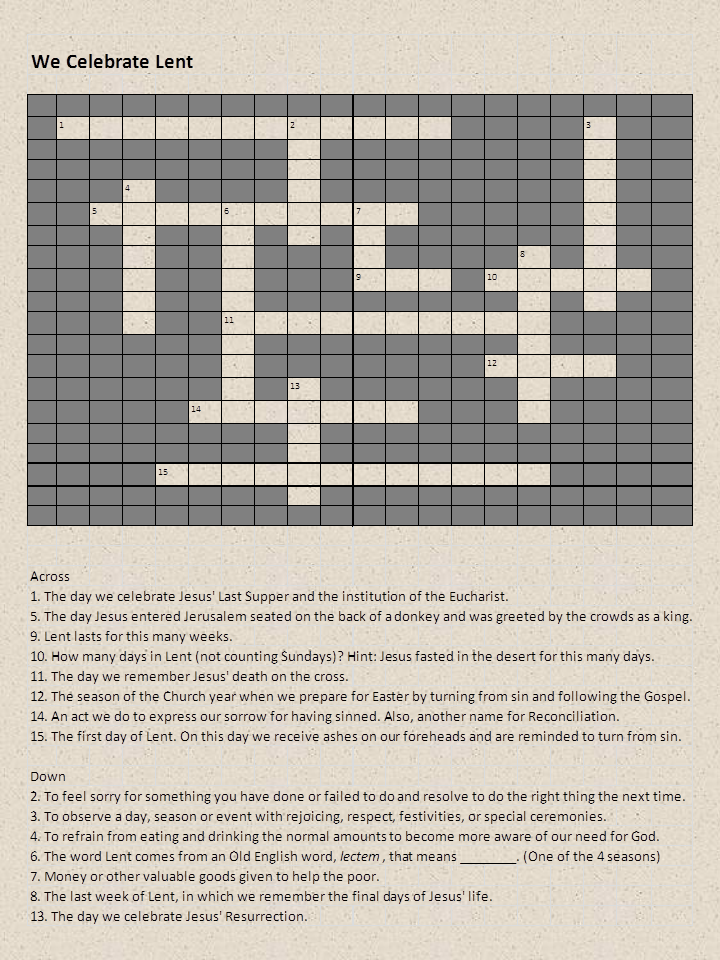
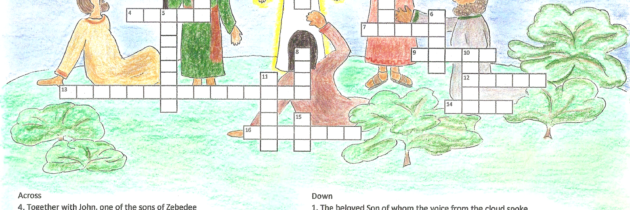
Celebrating Lent – A Puzzle to Get Started

As Lent begins this coming week, we are called to turn from activities or things that separate us from God and instead do something positive to clear our way to return to friendship and union with the Trinity. It is a time to celebrate God’s love for us, trusting that God is in charge and even hard lessons help us become closer to the One who loves us unconditionally.

In the spirit of celebration, then, let’s start with a puzzle. Click here for the solution once you’ve tried it. Click here for a version you can print.


Read More

Posted by on Dec 26, 2011

Rejoicing When our Hearts are Breaking

A Christmas-tide Reflection

CHRISTMAS STAR

Across the world once again, a star is in our sky,
a gift is in our hearts: It’s Christmas.

Right here at home: our highway is our backbone, our rivers,
our arms and legs.
The forest is our clothing.
The ocean is our blood.

As a people, we have known: Struggle, Isolation,
Darkness, and Bitterness.

But more importantly, we have also found: Success,
Security, Happiness, and One another.

It’s Christmas once again: time to focus on what makes light overcome
darkness and love overcome emptiness.

It’s time to believe once more that no matter how battered our lives are,
no matter how well off we are materially, there is still someone who knows
our darkness and lights it,
who knows our hurt and heals it.

It’s a moment for healing, and we really need it this time.

Healing is the medicine that can close the wounds
between parent and child, brother and sister,
government and people.

Healing comes from God – directly or indirectly.

We must do what we can do; God does the rest.

Merry Christmas

Received from Fr. Ron Shirley,
who received it from someone else.
Used with Fr. Ron’s approval.

Image from NASA – NGC 5584

Read More

Posted by on Dec 21, 2011

Rejoicing When our Hearts are Breaking

Advice and Encouragement from St. Peter Canisius

St. Peter Canisius, S.J.

“If you have too much to do, with God’s help you will find time to do it all.”

St. Peter Canisius, an early Jesuit, lived during the Reformation. He was active in teaching, ministering to the sick and the poor, in addition to being entrusted with implementation of the decrees of the Council of Trent. He was assigned to work in Germany following the Council, teaching and establishing colleges and seminaries. He developed a catechism for ordinary people, one of the first of its kind. He was a popular preacher and prolific writer, who was not afraid to write to Church leaders to encourage them to live up to their calling.

As we approach Christmas, with all the busyness of the season, we could do worse than to remember St. Peter Canisius’ words and ask God to help us do the things we need to do, and to let go those that really don’t matter.

Image in the Public Domain – painted in 1699.


Read More

Posted by on Dec 18, 2011

Waiting and Listening for the Coming of the Lord

On this last Sunday of Advent, as excitement for Christmas builds, it’s time to listen carefully for the ways God speaks to us as we go about our daily activities. Christmas is coming, but not here yet. It’s still Advent, with the Advent imperative to wait in quite wonder as our God transforms human existence and all of creation through the Incarnation. We heard the story of the Annunciation as told by St. Luke (1:26-38) in our liturgies today. A song I learned as a teen echoed in my heart through the rest of the day. “Our Lord has come today, let us rejoice now. Our Lord has come today, let us rejoice. The whispered ‘Yes’ of a lowly maid brought life to dying world, so rejoice now, my friend, rejoice now.”

This week, as we go about our work, whether in offices, factories, fields, homes, or other locations, let us keep our ears open to hear the voice of God speaking through our family members, co-workers, friends, children, senior citizens, and strangers we meet  along the way. Each person we meet can be God’s messenger to us, reminding us of who we are as God’s beloved children and calling us to be greater than we ever dreamed possible. In our dealings with other people, may we be patient, kind, thoughtful and understanding, so they too may receive the gift of peace at this time of preparation and be able to wait and listen to hear the Lord coming through all the excitement and hubbub. As we give and receive this gift of peace, our world can be transformed again, as the Lord lives through us, continuing to bring life to the world.

Read More

Posted by on Nov 30, 2011

Rejoicing When our Hearts are Breaking

An Advent Calendar to Make with Children

Advent Activities calendar

Advent calendars are a traditional way to mark the passage of days in December leading to Christmas Day. Unlike Advent itself, which varies in number of days, Advent calendars only count the 24 days of December before Christmas. Some have a candy or other treat for each day. Some have a picture of a toy or tell a bit of the Christmas story. Each day, one door is opened. As the month progresses, it becomes quite clear how close Christmas is coming.

Advent calendars are a wonderful way to help children experience Advent as a season unto itself. They also help children to experience in both tactile and visual form the passage of time.

I developed this Advent calendar for the children in grades 3-5 when I was teaching in our parish religious education program. It’s an easy project to do in an hour or two and offers a daily reminder of things to do together or individually to prepare for the coming of Christ in our daily lives, on the Last Day, and as he came historically – the day we celebrate at Christmas.


Advent Calendar

You will need:

2 – sheets of white  card stock or construction paper – 8 1/2 by 11
1 – small brad
1 – 5 inch ribbon (wrapping paper type is fine)
Crayons, watercolor paint, colored pencils, pastels or other “coloring” medium of your choice
Adhesive tape
Scissors
Needle

To make your Advent calendar:

Advent Calendar Cover Page Template

Activities page
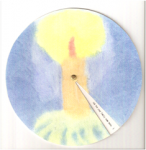
  • Draw/color a picture of a lighted candle on the larger circle that has only the “cut-out” marked. Be sure to draw your candle so that the cut-out points to the lower right side of the picture. Don’t worry if the coloring goes outside the lines of the circle. It won’t matter. The important thing is that the child draw the picture, not that it be a great work of art!

Advent Activities Picture

  • Cut out the cover picture (of the candle) and the activities page.
  • Cut out the area of the cover picture inside the dashed lines.
  • Make a loop with the ribbon and tape it to the back of the top of the cover picture, so the picture will look straight when you hang it up.
  • Poke a hole in the center of each page, where the black dot is.
  • Insert the brad through the holes, with the cover on top and the activities page underneath. Open the wings of the brad on the back side of the Advent calendar to hold it together. The activities page should be able to turn behind the cover.
  • Set the calendar to Day 1 and hang it where you will see it each day of December and remember to do something special to prepare for Christmas.

Happy Advent!


Read More

Posted by on Jun 8, 2011

Rejoicing When our Hearts are Breaking

Waiting in Anticipation for the Holy Spirit

Fresco from St. Charles Church, Vienna

Easter Season is drawing to a close this week. The season itself lasts fifty days. It begins with Jesus’ Resurrection and concludes with the arrival of the Holy Spirit at Pentecost. The last nine days, from the Feast of the Ascension until Pentecost, are a special time of prayer to invite the Holy Spirit to come into our lives ever more deeply as well.

Jesus promised his followers that when he returned to his Father, he would send a Paraclete to them. Some translations use the term Advocate for Paraclete. The choice of word, as is generally the case in translating, gives a slightly different sense to the promise and its implications.

Advocate is a term used to describe lawyers who plead the case of persons accused of wrongdoing. Advocates are also people who argue on behalf of people who are at a disadvantage in a social setting or a negotiation. Advocates are people everyone needs at one or another point in life. Having an Advocate sent from Heaven on our behalf is not a bad thing. It can be quite encouraging. Yet the term carries with it a sense of our unworthiness and sinfulness. We need someone to represent us in dealing with the Father.

A couple of weeks ago, our pastor suggested that the word Paraclete might actually be better translated as Cheerleader. In this sense, the Holy Spirit is the one who encourages us, seeing the good we do, how hard we try, how we keep falling and yet encouraging us to get up and try again. Fr. Ron explained that God – Father, Son and Holy Spirit – is our cheerleader, our biggest fan. God got excited enough about humans to become a human (Jesus). And Jesus returns to the Father, fully God and fully human, promising to share that spark of Love, the Holy Spirit, with all of us too.

What a wonderful promise! Not only do we have an advocate who’ll plead for us when we mess up; we also have a cheerleader who’ll be there to cheer us on as we keep trying and keep believing that we really are lovable.

In these final days before Pentecost, lets hold on to this promise, waiting for the gift of an even deeper relationship with our God. A relationship that doesn’t depend on how well we manage to live our lives, but rather on how crazy God is about each of us and how much God wants us to respond in love to that gift of love.

Come, Holy Spirit, come!

Read More

Posted by on May 7, 2011

Sharing in Divine Mercy

The second Sunday of Easter is known as Divine Mercy Sunday. The Gospel reading (Jn 20:19-31) tells of Jesus’ appearance to His disciples in the Upper Room on Easter Sunday evening. He appeared among them, wished them Peace, showed them His wounds and asked for something to eat. Then He breathed on them, the breath of the Holy Spirit,  and told them to forgive sins. He told them to continue the work He had begun, taking the Good News of God’s love out to all the world.

When I was growing up, the message of this Gospel’s story of the granting of power to forgive sin was generally presented in terms of the power of priest to forgive sins in the sacrament of Penance (now more often known as Reconciliation). However, as I listened to the Gospel proclamation last Sunday, the Good News I heard was of the gift given to all of us as followers and disciples of Jesus – the power to forgive those who hurt us in some way.

Forgiveness does not come easily to anyone. When hurts come along, it’s often much more satisfying to plot revenge, or bask in a stew of martyred pouting or otherwise hold on to the hurt. But Jesus knew something we often miss. The one most hurt, the one most diminished, the one who suffers most from such behavior is the one who engages in it! Perhaps that is why He was so quick to forgive those who had abandoned and denied Him just a few days earlier.

As we live our calling as followers of Jesus, we share the task of bringing forgiveness, reconciliation and peace to our families, communities, nations and world. Anything that stands in the way of this mission is to be suspect. We can’t forgive through our own power. Some wounds are just too deep for our human ability to heal. But Jesus is with us and He can heal them if we are willing to open them to His touch. And as we receive healing, we are called to pass it on, so that the waves of forgiveness and healing at last embrace all the people of the world. It’s truly a noble calling.

Peace be with you.

Read More

Posted by on Apr 28, 2011

Easter Week Daze

I tried to blog during Holy Week. I would like to say that I was too caught up in ecstasy to touch the keyboard, but I was really silenced. It wasn’t really writer’s block. It was more a sense of something I am learning in my old age – to keep my mouth shut. As an extrovert this is an occurrence of note, since I don’t often know what I am thinking until I am expressing it.

Per usual, after the stress of the event, I can begin talking or writing about my experiences of Lent and Holy Week now that we are in Easter Tide.

Easter Triduum, from Holy Thursday to Easter Vigil, is a montage of one highly charged event ebbing and flowing over many others. The breaking of the bread at the Last Supper; Judas sent off on his errand; Jesus looking for support and finding us asleep. The darkness at noon covers all creation. Nicodemus asks for the body of Jesus. Mary of Magdala weeping as she asked the Gardener, “Where have you laid him?” followed by the overpoweringly personal entreaty of a close Friend, “Mary.” The disillusioned disciples heading back home and being consoled by a stranger Whom they invited in for the evening. The guest only reveals Himself in the moment of the breaking of the bread. After all of the betrayals, the abandonment, with the marks of the crucifixion on His body, His first words to the men who “threw Him under the bus” was “Peace.” In all of previous salvation history, God’s messengers manifest with the same greeting of peace, but now God does it directly, for the first time.

I understand that the traditional teaching is that the sacrifice of Jesus satisfied the Father’s need for atonement, but somehow, it is hard for me to imagine that God, in Jesus, would not take offense at the rejection of his goodness. Yet, Jesus doesn’t take offense even as the disciples and all of us cower in hiding.

The only thing that I can compare this daze to is to singing the last note of Hadyn’s Creation Mass as a member of the Loyola Men’s Chorus. The director had told us that we would know if we had succeeded if there was a deafening silence before the audience responded. The last note hung in the air. The director brought his thumb and forefinger together; the note evaporated high in the nave. The silence was profound and seemed to last forever. The temperature dropped and then there was thunderous applause.

I am still in the coolness of the silence after that last note. It is not a bad place to be. I hope you are too. Peace.

Read More