Pages Menu
RssFacebook
Categories Menu

Posted by on May 21, 2015

Connie Fortunato’s Magnificat – Music Camp International

Connie Fortunato’s Magnificat – Music Camp International


Connie-With-Kids - Kiev - Music Camp InternationalWhen the Iron Curtain fell, it revealed the plight of Romanian children warehoused in orphanages. The Ceausescu regime had insisted that women have as many as children as possible, to provide soldiers for a huge army. Many of these children were abandoned and given no real love and very little food. As a music educator and the former music director of Twin Lakes Church in Aptos, California, Connie knew that music could restore these children to wholeness. At first the Romanian government wanted her to teach music only to the children of the leadership. Connie insisted on teaching the orphans and she prevailed.

He has put the mighty down from their thrones and exalted the lowly. (Luke 1:52)

Fourteen years later, Connie’s ministry, Music Camp International, has grown, yet it still flies by a wing and many prayers. Children in Ukraine and Romania are given musical instruments and a week’s instruction in playing and singing. The results are miraculous as the sound of sacred music returns to cathedrals and the hearts of children. The lowly are exalted and the future of all is brighter.

As Music Camp International’s website explains,

The healing gift of music has given hope and dignity to many who have previously been overlooked in a society that provides its resources for the “privileged” and the “promising.” Many children have held and played instrument for the first time. Many have discovered their singing voice. All have experienced the joy of music in a positive and nurturing environment. All have participated in making beautiful music with the finest professionals in their community. And ALL have discovered that in blending their talent with other children—from diverse backgrounds and social status—they can achieve a life-changing experience that is not possible alone.

Music Camp International: Developing Children, Training Teachers, and Strengthening The Global Community Through the Power of Music

Tax deductible donations can be made at www.musiccampinternational.org/


Read More

Posted by on Feb 23, 2015

Connie Fortunato’s Magnificat – Music Camp International

Sant’Egidio Communities Bring Friendship and Hope to the Poor

Sant'Egidio in RomeThe Community of Sant’Egidio is an international movement counting over 60,000 individuals on five continents who gather for common prayer, offering friendship and support for and with the poor in the cities where they live. The movement began in Rome in 1968 at the Church of Sant’Egidio and has expanded from there. No one is considered too poor or too marginalized to be a member of the community. All join together in work and prayer to bring the light of hope into the world.

Daily prayer is at the heart of life in a Community of Sant’Egidio. Gathering together in the evening the Word is proclaimed and together members of the community place the cares and concerns of the people of their local, regional, national, and international communities before the Lord. Each day’s prayer also includes a theme, beginning with the celebration of the Resurrection on Sunday and continuing through days dedicated to prayer for the poor, Eastern and Western churches, Sant’Egidio communities around the world, the memory of the cross, meditation on the courageous role of Mary in salvation history, and waiting for the resurrection along with Lazarus who was raised from the tomb.

Icons are present in all communities, reminding all of the unity of Eastern and Western churches and leading members more deeply into the mysteries of God’s presence and action in the world.

A statement from the community’s website clearly expresses the place of prayer: “Nothing is possible without prayer, all is possible with prayer and faith. … Prayer overcomes the helplessness of men. It goes beyond what is believed impossible and allows God to intervene in this world with his infinite power.”

Members of Communities of Sant’Egidio are committed to inter-religious dialog and working for peace. At a general audience with bishops gathered for an  international conference of the Community of Sant’Egidio on February 7, Pope Francis expressed his support, saying, “I am delighted to welcome you. I wish that you revive faith in the Lord and witness, with renewed enthusiasm, the Gospel tension towards the peripheries and towards the last.”

Read More

Posted by on Jan 21, 2015

Martin Luther King, Jr. — A Gift of One’s Self

Martin Luther King, Jr. — A Gift of One’s Self


January 19, 2105 is the Martin Luther King holiday in the United States. The first reading of the day in the lectionary is Hebrews 5: 1-10. Christ’s adherence to the will of the Father has led Him on a path of suffering, death and glorification. Dr, King took this path of God’s will to which we are all called.

“In the days when he was in the Flesh, he offered prayers and supplications with loud cries and tears to the one who was able to save him from death, and he was heard because of his reverence. Son though he was, he learned obedience from what he suffered; and when he was made perfect, he became the source of eternal salvation for all who obey him.” – Hebrews 5: 5-10

The Feast of Martin Luther King, Jr is not a feast of the Roman calendar, but it is a national holiday to celebrate a civil rights leader and a Baptist minister who advocated non-violence. Today is a tribute to all who work for human and civil rights for African-Americans and all people. Many of us are of an age to remember the Reverend King. The three television networks brought us live coverage in black and white of the marches, the sit-ins, and the fire hoses and police dogs that were part of the black struggle against white oppression. There was the famous “I have a dream speech” at the Lincoln Memorial. The haunting last speech before Dr. King was gunned down, “I Have Been to the Mountain Top” in which he saw the promised land of freedom, “I may not get there with you but I have seen it.”

Like all of us, Dr. King was an imperfect human being. Like all of us he was a sinner, but his redemption, like ours, is based in obedience to Christ, the source of eternal salvation for all. We know that precisely because Jesus is the Son of God, His will is perfectly aligned with that of the Father. Since Jesus was truly divine and truly human, his obedience came at a human cost. “In the days when he was in the Flesh, he offered prayers and supplications with loud cries and tears to the one who was able to save him from death, AND HE WAS HEARD because of His Reverence.

In his work of announcing the kingdom, healing the sick, feeding the multitudes, Jesus did not shy away from doing the will of his Father. But he knew where his call was leading. It became more and more obvious that if he stayed true to the person he was — the Divine Word become human — that His hands that had been raised in blessing and healing would be nailed to the cross. With loud cries and tears he asks the Father to take this cup away, but he is true to his calling and the will of the Father. “Let not my will be done but yours.” It is through this obedience that Jesus goes to his excruciating death on the cross and to the glory of the resurrection. He WAS HEARD because of His Reverence.

For Dr. King, Mahatma Gandhi, all Christian saints and martyrs, and ourselves, this call to obedience is not only a question of observing certain commandments but a deeper call to be the person God created us to be, to be at one with God, to hear at one with God, to accept God’s truth about our mission in life to advance the kingdom of heaven.

There were many black leaders in the civil rights movement of the 1960s. Dr. King didn’t need to have such a high profile in the movement. Yet it was something that Dr. King was drawn into despite all of the obvious risks to himself and his family. He was born and raised in Atlanta in a strictly segregated society. Dr. King knew what happened to black people who broke the rules. He certainly could have taken an easier type of ministry, but he heard the Word of God, the Will of the Father for his life and his death.

Most of us think that we are not called to such types of work. We are certain that God’s will for us involves something less “glamorous,” nothing so heroic as what Jesus and the saints like Mother Teresa and Dr. King did. But I wonder. All of us have that little voice within us to do something special, something only we can do, but we know that it will cost us. Dr. King used his gift of oratory, of speaking and preaching, to give voice to the prayers and aspirations of the millions enslaved and oppressed using the language, song, and rhythm that the Spirit had given them in their bondage and oppression.

Many of us see fewer years ahead of us than the ones that have fled so swiftly. The babies we held are now grown adults with their own babies. What are we called to do to announce the Kingdom of Heaven and to make it a reality? What can we do to end poverty, hunger, oppression, and violence? How do we draw closer to God and each other in prayer? How do we move toward reconciliation and forgiveness?

We can only do it if we take the time to be quiet and to listen — to pay attention to that little voice that comes to us or the massive cry that comes to us in outrage at the atrocities of the world visited upon the young, the poor, the defenseless. There is a price to be paid, and eternal life to be gained.


Read More

Posted by on Jan 20, 2015

Why Do Children Suffer? Pope Francis Speaks to Filipino Youth

Why Do Children Suffer? Pope Francis Speaks to Filipino Youth


The video and the text are largely in Spanish, though a simultaneous translation into English is included. This is a summary of a small part of the Pope’s extemporaneous speech.

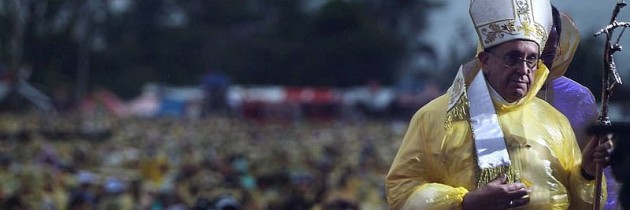
During a presentation to young people in the Philippines, the Holy Father set aside his prepared text to answer a question that had been raised by a 12 year old girl who had been rescued from the street. Tearfully weeping, Glyzelle Palomar, recounted the miseries of her life in a few words and asked, “Many children are abandoned by their own parents, many are victims of many terrible things such as drugs and prostitution. Why does God permit these things even though the children are not at fault.Why do so few people come forward to help?” In this video we can view the scene and the Pope’s compassionate embrace of the child.

What response is possible to the perennial problem of evil? Pope Francis did not try to evade the question with platitudes. He took the question head-on, educating about 30,000 of the faithful and challenging them. First, he noted the shortage of women among those making presentations and he emphasized the importance of the point of view of women. The Pope said that women pose questions which men could never stop trying to understand, that is, never grasp.

We can understand something, added the Holy Father, “when the heart reaches the place in which it can ask the questions and cry. Only through tears do we arrive at a true compassion which can transform the world.” Pope Francis described a common, worldly type of compassion as one in which we just take a coin out of our pocket. He added that if Christ had shown this type of compassion, he would simply have spent a little time with a few people and gone back to the Father. Jesus could comprehend our lives, the Pope said, when He was able to cry and did cry.

He notes, “In today’s world, there is a lack of crying. Although the marginalized, the poor, and the outcasts cry, those of us who do not lack anything essential do not cry. Only those eyes that have been cleansed by tears are able to so see things as they are.”

The Pope challenged the faithful. “Let us not forget (this young woman’s) testimony. She asked the great question ‘why do children suffer?’ crying. And the great answer all of us can give is to learn how to cry.”


Read More

Posted by on Nov 20, 2014

Connie Fortunato’s Magnificat – Music Camp International

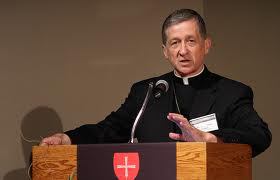
New Chicago Archbishop Blase Cupich

Chicago has new archbishop

Archbishop Blase Cupich

The Chicago Archdiocese officially has a new archbishop, Blase Cupich (soopitch) as of November 18. Cupich became the bishop of Spokane, WA in 2010. He has graduate training in Liturgy and has studied at the Pontifical Gregorian University in Rome. Originally from Omaha, Nebraska he was the third of nine children born to Blasé and Mary Cupich.

The Chicago Tribune calls him a charismatic clergyman, the grandson of Croatian immigrants, with a strong emphasis on social justice and a pastoral approach that involves listening and dialog. The same newspaper quotes him as saying, “The church can challenge society, but society also challenges the church.”

Cupich has become known for his more moderate approach for dealing with controversial issues such as abortion and gay marriage. As the bishop of Rapid City, South Dakota, Cupich was one of the bishops in 2004 who was not in favor of denying communion to candidates who supported abortion rights.  He said that we cannot cherry-pick particular issues. We have to be willing to talk about all issues. He emphasized that, while the Catholic position begins with protecting the unborn,  it doesn’t end there.

In 2011 Cupich headed the US Catholic Conference of Bishops Committee for Protection of Children and Young People. At that time there was a Grand Jury finding that the Archdiocese of Philadelphia had allowed 37 priests accused of abuse or inappropriate behavior to remain in active ministry. Cupich’s response to this failure to comply with the reforms listed in the Dallas Charter of 2002 was to express frustration and disappointment since so many people were working hard to implement the reforms. He later said that the Philadelphia situation was unusual.

As bishop of Spokane, Cupich lived in simple suite of rooms in the seminary. In Chicago he has announced that he will be living in the cathedral rectory and not in the opulent Gold Coast mansion with is the Archbishop’s official residence. Many have pointed out a similar tone and style in Archbishop Cupich and Pope Francis. Their simplicity, cordiality, and focus on engagement as opposed to separation or denunciation of those who disagree with the church are attributes they share.

Cupich gave a talk in June 2014 at the Catholic University of America in Washington, DC on the contradiction between Catholic social teaching and libertarianism in the United States. He supported the position of Pope Francis which focuses on encounter and accompaniment in society and the economy. In other words, Catholic social teaching focuses on our obligations to each other. This contrasts with the Libertarian view that the one’s interests as an individual come first.

Cupich is the first major appointment in the United States by Pope Francis. Additional appointments by the Pope will likely bring significant change to the church in the United States.


Read More

Posted by on Nov 15, 2014

Connie Fortunato’s Magnificat – Music Camp International

Showers for the Homeless at the Vatican

OLYMPUS DIGITAL CAMERA

A significant part of our faith journey is growing and being ministered to by the people we serve.  Bishop Konrad Krajewski is the Pope’s Almoner, which means that he is responsible for raising money for the poor and distributing it. When he took a homeless man to dinner at a Chinese restaurant for the man’s 50th birthday, Bishop Krajewski discovered an unmet need.The homeless get by with handouts of food but they have almost no bathing facilities.

Beginning with the public restrooms in St. Peter’s Square and parishes in Rome with large concentrations of the homeless, Pope Francis is paying for the construction and operation of showers. In addition to sanitation and promoting human dignity, Bishop Krajewski cites a deeper element of faith: “The Basilica exists in order to keep the Body of Christ, and we serve Jesus’ suffering body by serving the poor.”

Read more about this new apostolate.

Read More

Posted by on Oct 6, 2014

Connie Fortunato’s Magnificat – Music Camp International

Music Evokes the Sacred – The Piano Guys

The Flame of Music

The Flame of Music


The Piano Guys have produced many inspiring productions. Generally the Piano Guys will do a medley of two compositions. In this one they mix the theme from the movie The Mission with How Great Thou Art.  The Mission was a 1986 film which told the story of the Jesuit missions in Paraguay. The Iguassu Falls which form the backdrop of this video are also the general location of the Jesuit missions. The combination of the native Guarani music and dance with the European musical instruments and forms created a wonderful music that is still heard today.

The Guarani fought to maintain their freedom when Europeans sought to enslave them. In the war that followed, the missions were destroyed along with the Jesuits who stood with their Catholic parishioners. It is a tale of light and shadow, of grace and sin, and a struggle that still goes on in South America today as Pope Francis reminds us. Yet the music does not die but reflects the light of the Burning Bush.

Read More

Posted by on Aug 29, 2014

Connie Fortunato’s Magnificat – Music Camp International

Church: Organizing as a Community

Models of Church

A conversation overheard recently in the locker room of our local gym led me to consider the concept of community more deeply: what living as community implies, how our relationship with God shapes our lives, and how all of these are reflected in the way we structure our community.

Two women were visiting as they changed back into street clothes to leave the gym. One was Jewish and the other was from a small, evangelical Christian community. They seemed to be continuing a conversation they had begun on the exercise machines earlier that afternoon. We’ll call the Jewish woman Miriam and the Christian one Carol. Carol was describing her small church community. She noted that there had been some stress recently as the community dealt with a difference of opinion over what to believe and how to respond to a controversial issue. She expressed her opinion that it shouldn’t really be a serious problem for her church community because the important thing was that each person believe in Jesus and accept Him as Savior. The relationship is between the individual and Jesus.

Miriam did not agree with Carol that a personal relationship with God is all that is needed. She explained that she is Jewish and for Jews the fundamental relationship is between the community as a group and their God. Simply having a personal relationship with God does not suffice. Worship and relationship with God occur in a community and together have concrete implications and results for the community. They are not separate realities.

As an anthropologist, I found the conversation fascinating. I’d have loved to hear more, but they continued on their way and I was left to ponder community and our relationship with God.

A Faith Based in Community

Not too long ago, Carol’s beliefs might not have been all that unusual to hear expressed within Catholic circles as well. While Catholics have not traditionally believed that simply accepting Jesus as personal Lord and Savior will guarantee admission to Heaven, we have at times forgotten how deeply our responsibilities to the community of all human beings is tied to our salvation. We often forget that our faith began in Jewish faith and tradition. We come before God as a community of people, responsible to and for each other.

More recently, with a return to a greater focus on God as Trinity, the idea of each individual standing alone does not explain who we are quite as well. God is one, yet God is Trinity. Self-knowledge, the Word that expresses and embodies that self-knowledge, and the total loving acceptance of the reality as known and expressed, all swirl around in the reality of one God,  a God dancing  in beautiful harmony.

We live in the midst of the Divine Community as members of Christ’s Body. We meet Christ in and through each other. We share together in the Body and Blood of Christ. And we are responsible to care for each other, including the least loveable among us, because Jesus is there … “Whatsoever you do …”

Living in Community

How, then, do we live in community? What organizational models would be best for us as a community? How can our communal life best support our own journey of faith and growth in holiness? How does community bring us closer to God?

Cardinal Avery Dulles, SJ, in Models of the Church,  suggests that our community, the Church, can be better understood in term of six different models. The one that comes to the fore at any given moment will differ, based on the needs of the community in that moment. Each has strengths and each has weaknesses. Together they offer a picture of a vibrant community. Cardinal Dulles’ models reflect the images of church presented in the Documents of the Second Vatican Council, particularly Gaudium et Spes (Joy and Hope) The Pastoral Constitution on the Church in the Modern World and Lumen Gentium (Light of Nations) The Dogmatic Constitution on the Church. The First Vatican Council (1869-1870) emphasized the self-contained nature of the Church as an institution sufficient unto itself – a “perfect society”. Vatican II (1962-1965) focused on the Church in its relationship to the modern world including non-Catholics, and non-Christians.

Church as Institution: In this model, the focus is on the administrative role of Church leaders. The Pope, bishops, priests, and deacons (collectively known as clerics) are responsible to teach what the community has come to believe and understand about God. They help the community to become more holy (sanctified), more in tune with divine life, through the administration of the sacraments. Finally, clerics are responsible to set the standards for faith and morals, to govern or rule the church community. In their role as rulers, clerics have many of the same kinds of responsibilities as the civil authorities who govern our towns and countries.

Church as Community (The Body of Christ): In this model, the Church is a community of believers who worship together and through their faith and worship become both a sign of the union of God with humans and an instrument through which the union occurs.

Church as Sacrament: A sacrament is the visible form of an invisible grace, a grace that brings about the reality towards which the form or symbols/actions point. As Catholics, we recognize and celebrate seven formal Sacraments as part of our lives as Church. However, the Church also teaches that the source and authority for our seven sacraments actually comes from Jesus as the Sacrament of God and the Church as the Sacrament of Christ. The community (the church) is to be a sign of God’s grace in the world as Jesus was. With the help of the grace of God, we are made holy in Christ.

Church as Herald: This model is focused on the Word of God.  We are called to hear God’s word and keep it, putting our faith in Jesus as Lord and Savior and then sharing that faith with our world. This is much more like the model Carol (in our example above) would find familiar. The Word comes to us both to transform our lives and to be passed on to others as Good News.

Church as Servant: In this model, the church’s role is to serve those in need of help directly and work to change social and political institutions that promote injustice. The church is in the world and serves the human community, but its service is one with a spiritual foundation rather than a strictly secular one. We as community serve in imitation of the Lord who washed His disciples’ feet and called those at the lowest rungs of society His sisters and brothers.

Church as School of Discipleship: The final model was developed after the first edition of  Dulles’ work was published. It recognizes that to be followers of Jesus requires the community and its members to continue to learn what it means to be a Christian and members of a Christian community. In this school of discipleship, we are informed, we are formed, and we are transformed; all as part of the process of learning and growing in faith.

For a summary of the characteristics of each model see Fr. Yeo’s presentation on SlideShare.

The Organization Supports the Life and Faith of the Community

Which of these models is correct? None of them! Each offers important insights and helps describe the experience of Christian life in community. Even within one individual parish community, some will experience that life more in terms of one of the models than in terms of the others. Is that bad? I don’t think so. God created a world of wonderfully different people, each with special gifts needed by our world. Those gifts and our experience of them may lead us to favor one or another of the models of Church. But if we are honest, we would be a much poorer and more limited community if we did not embrace the richness that multiple models offer. After all, God is infinitely creative and loving. No human model could ever hope to define conclusively the limits of what God’s communal life  actually is. Yet we live within that divine community, continually loved into existence. So we move through our lives in this great community, with first one model and then another taking the lead. With the grace of God, we’ll all muddle through and reach our final goal: union with God.

For a more detailed summary of Cardinal Dulles’ models and other useful materials visit Young Adult CLC .


Read More

Posted by on Dec 1, 2013

Connie Fortunato’s Magnificat – Music Camp International

Stay Awake! See the Power of Hope!

Hope


The First Sunday of Advent brings a direct command from the Lord: “Stay awake! For you do not know on what day your Lord will come.” (Mt 24:42) Our eyes are to be open. Our hearts are to be hopeful. Our hands and feet are to be active in preparing for the Lord’s coming. In the face of all of the anger, pain, violence, and darkness in the world around us, we are to be people of hope  who “put on the armor of light” (Rom 13:12). Rather than being a people overwhelmed by darkness, we are to focus on the power of hope and light.

Stay Awake! Look to the Lord’s mountain. Listen to the Lord’s words. Learn the Lord’s ways. Walk in his paths. Become a people who turn swords and spears into useful tools for providing food and shelter for all, including the weakest and most vulnerable. Be a people who respect each other, refusing to exploit children or women for our own pleasure. Be a people who treasure differences in learning styles, abilities, talents, intelligence, gender identification, cultures, physical abilities. Seek out the lonely; learn how to be present in the moment; notice the gifts of the people the Lord sends into your life.

We sing, “Oh Come, Oh Come, Emmanuel.” Will we be awake when He comes? Will we see Him? Will we recognize Him? As we go rejoicing on our way up to the house of the Lord, see the little ones on the city streets who travel with us. See the those who hunger for physical food. See the people on the street who hunger for someone to talk with them or simply smile a greeting to them. See the old man or woman who longs for the touch of a gentle hand or a patient ear to hear a story for the umpteenth time. See the one who needs health care. See the one who needs help to learn how to read. See the one who struggles to walk. See the Lord, present in His most desperate reality. Reach out and welcome Him. Lend Him your hands, feet, and voice, so together we may see the power of hope transform our world.


Read More

Posted by on Jan 9, 2013

Connie Fortunato’s Magnificat – Music Camp International

Epiphany — The Coming of a Shepherd for All God’s People


The Adoration of the Magic by Murillo

The Adoration of the Magic by Murillo

The readings for the Feast of the Epiphany and the week that follows ring out with joy at the coming of the Lord, not just to the Jewish people, but to all the world. “Rise up in splendor, Jerusalem! Your light has come, the glory of the Lord shines upon you.” (Is 60:1) “… the Gentiles are coheirs, members of the same body, and co-partners in the promise in Christ Jesus through the gospel.” (Eph 3:6) “… behold, magi from the east arrived in Jerusalem, saying, ‘Where is the newborn king of the Jews? We saw his star at its rising and have come to do him homage.” (Mt 2:1-2) “All kings shall pay him homage, all nations shall serve him.” (Ps 72:11)

Yet amidst all of this joy and talk of kings and splendor, the reality of God’s kingdom quietly peeks out. Where has the child been born? Not in Jerusalem, the center of political and religious power. Those in Jerusalem — kings and priests alike — have not heard of the birth of a child to inherit the throne. The priests and teachers remember the prophecy of his birth: “And you, Bethlehem, land of Judah, are by no means the least among the rulers of Judah; since from you shall come a ruler, who is to shepherd my people Israel.” (Mt 2:6) Bethlehem, city of David, home of another child who grew up to replace an earthly king to whom he was not related, is once again to produce such a king! The news was not a source of joy to the rulers of the age; an attempt to thwart the prophecy was duly launched, leading to the massacre of all of the boys aged two and under in Bethlehem and the surrounding area. (Mt 2:16) The birth of a child to be the new king brings terrible suffering to many innocent children and their families.

The king of the prophecy will be different: he will be a shepherd for God’s people, Israel. A shepherd takes a different approach to governing and to leadership. The shepherd will govern with justice, protecting the afflicted ones and bringing peace “til the moon be no more” to the land. (Ps 72:7) The kings of the nations will pay homage to this king and all nations will serve him because this king rescues the poor who cry out for help. He takes pity on everyday people and the poor, rescuing them from all who would oppress or take advantage of them. Such a king would indeed be welcomed and his glory would truly shine forth. This king, blessed by God, will bring glory to Jerusalem — the center of the Lord’s presence among His people.

This great feast of Epiphany, the shining forth of the Lord’s splendor from Israel into the world at large, reminds us of our call as the People of God: a call to care for each other so that the splendor of love in all its practical applications will be a witness everywhere to the presence of the Shepherd, leading us in bringing justice and peace to our world.


Read More

Posted by on Nov 30, 2012

Connie Fortunato’s Magnificat – Music Camp International

Dorothy Day, Servant of God and Follower of Christ the King


Dorothy Day, 1934

Dorothy Day, cofounder with Peter Maurin of the Catholic Worker Movement, died 32 years ago, on November 29, 1980. Like many other activists who have struggled for social justice and worked among the poorest, most forgotten members of society, she is more respected by mainstream Americans, religious leaders, and commentators now than she was during all but the last decade of her life. In life she had the annoying habit of pointing out the discrepancies between our Gospel calling to serve the Lord in those around us, especially in the poor and most vulnerable, and our national focus on the value of making money and enjoying a middle class or higher lifestyle. She opposed war and participated in demonstrations against all wars, including World War II. She supported Cesar Chavez and the labor union movement. She was not unwilling to go to jail and did so on multiple occasions. She lived and died in a Catholic Worker house of hospitality in New York, providing services including food, clothing, shelter, and a cup of good coffee to the poor and homeless. With other activists, she also participated in non-violent direct actions aimed at changing the social structures that lead to poverty and homelessness.

Movies have been made and books written about this woman whose work led to the establishment of the Catholic Worker. Church leaders today speak of her with respect and support her cause for sainthood. Men and women around the world join together in soup kitchens, hospitality houses, and communal farms to carry on the work she began.

This year, Dorothy Day’s feast falls outside of Advent. Last Sunday we celebrated the Solemnity of Christ the King. The convergence of  our celebration of a King who was crucified, died, and rose from the dead with our celebration of the life of a woman whose life was focused on serving that King in the poorest of the poor is one that does not happen often. Yet it seems fitting that this connection should be noticed. Serving the poor and disenfranchised is hard, dirty, smelly, frustrating work. Most people who live on the street are not there by choice, yet some prefer to remain on the streets rather than deal with the requirements of the various shelters or programs in their communities. Some have mental illnesses that are untreated. Some battle post-traumatic stress. Some have lost their homes as a result of loss of employment or long-term illnesses. Families and single people live on the streets. Children and old men and women live on the streets. It’s cold, lonely and dangerous there and all too often, the rest of us pass by without noticing them or if we do see them, we somehow assume it’s their own fault and feel no compulsion to try to help.

Those who enter pastoral ministry, social workers, and others who regularly deal with the homeless and disabled quickly learn that it is not glamorous or easy to provide support and care for this population, particularly with scant resources and personnel. Yet as Dorothy noted, “The mystery of the poor is that they are Jesus, and what you do for them you do to Him.” This doesn’t mean she was never frustrated or angry with God. Anyone who regularly deals with impossibly difficult individuals, bureaucracies, social structures, and disdainful or fundamentally unaware fellow church members or citizens will experience times of total anger and frustration. Faithfulness to the call to serve Jesus in this way requires continuing anyway — telling God what a mess it all is, maybe telling God how angry one is feeling, complaining about how hard it is to keep going or to deal with the physical realities of life on the street or in poor neighborhoods, and then going out and continuing the work. This is the connection with Christ the King: faithful following of the call to service of the poor and vulnerable and to change those social institutions that keep so many people trapped in poverty.

Dorothy Day is on her way to officially recognized sainthood. Nevertheless, we would all do well to remember her thoughts about what might result in such an eventuality, “Don’t call me a saint. I don’t want to be dismissed so easily.”

Photograph from New York World-Telegram & Sun Collection

Read More

Posted by on Nov 5, 2012

Conscience-Based Voting: A Challenge for Catholic Voters

As American Catholics go to the polls to vote for President in 2012, many are experiencing confusion regarding whether they can in good conscience vote for a candidate or party with a platform that allows Americans of whatever religion or no religion to choose abortion, contraception, sterilization and gay marriage. Don’t they as faithful Catholics have to vote for the candidate and party whose policies agree with the moral teaching of the Church and deny these choices to all Americans? By the same token, the Church has take a strong position in support of health care for all, cradle to grave social services, and the right to organize unions. Does this mean that Catholics cannot vote for either party? Does it mean that Catholics cannot hold public office?

A Clarification from the Holy Office

In 2004, Pope Benedict XVI, while still Cardinal Joseph Ratzinger and the Church’s guardian of moral teaching as head of the Holy Office, offered guidance on this dilemma, underlining the principles involved for the Catholic voter. This guidance was issued in the context of whether and when Communion might be denied to Catholic politicians due to their actions in the arena of policy formulation and governing in a secular society.

“A Catholic would be guilty of formal cooperation in evil, and so unworthy to present himself for holy Communion, if he were to deliberately vote for a candidate precisely because of the candidate’s permissive stand on abortion and/or euthanasia,” Cardinal Ratzinger wrote.

“When a Catholic does not share a candidate’s stand in favor of abortion and/or euthanasia, but votes for that candidate for other reasons, it is considered remote material cooperation, which can be permitted in the presence of proportionate reasons,” he said. (emphasis added)

John Thavis, of Catholic News Service, in his report on Cardinal Ratzinger’s statement went on to explain:

“In other words, if a Catholic thinks a candidate’s positions on other issues outweigh the difference on abortion, a vote for that candidate would not be considered sinful.”

This position assumes that the individual Catholic’s conscience is in agreement with these Church sanctioned policies. A Catholic may decide that abortion is evil and wrong, that it is murder, but he or she may be reluctant to re-criminalize it for all Americans since it would lead to illegal and dangerous back street abortions. A Catholic might see such an anti-abortion law, refusal to pay for birth control, or rejection of gay civil marriage as a violation of the conscience of others that undermines basic freedoms in a secular republic. According to Catholic teaching, individual Catholics have the final responsibility for forming their conscience and making decisions. While Catholics are supposed to pay heed to the teaching and tradition of the Church, conscience is also the product of a prayerful reflection on all relevant domains of knowledge. To violate one’s conscience is a very serious sin.

And what of the Catholic politician who personally rejects abortion but refuses to vote to re-criminalize the practice? Does voting in a manner contrary to Church positions on these contentious issues automatically result in excommunication or other Church sanction? Are politicians required to vote in opposition to the positions of their constituents when those positions are not supported by Church teaching?

In Cardinal Ratzinger’s memorandum to Cardinal McCarrick of Washington, DC, he recommended a series of steps that might be followed by bishops in dealing with Catholic politicians. These include a process of pastoral guidance and correction. Denial of Communion, while certainly an option, was not presented as an essential step in the process, though it is included as an option in the case of “obstinate persistence” on the part of the politician. Comparison was made to Church rules allowing denial of Communion to divorced persons who remarry without receiving an annulment of their prior marriage and obstinately persist in receiving Communion. Nevertheless, some canon law experts have suggested that the situation of the politician may be much more complex than that of the divorced and remarried Catholic, so an automatic judgment that a case of “objective situation of sin” exists cannot be as easily made. The final decision of the American bishops on this question noted that a “prudential judgment” would be required in dealing with each case due to the complexity of the question.

Why a “prudential judgment” rather than an absolute, automatic condemnation? Because politicians are also required to form their own conscience and act in accordance with its dictates. The politician who personally opposes abortion, yet finds the risks to social order entailed by the re-opening of an entire field of criminal activity that exploits frightened girls and women too great to endorse re-criminalization of abortion, may in good conscience find that he or she must vote against such measures. Such an individual might be granted the same exemption as that received by the above-mentioned voter due to the “proportionate reasons” behind his or her decision.

Election 2012

The campaign of 2012 has seen a number of  ordained clerics, including bishops, stepping dangerously near, if not across the border between their role as teachers of the faith and their personal role as voting members of American society. This is unfortunate. It can confuse, frighten, and anger the faithful in a manner contrary to the teachings of our faith and the documents of the Second Vatican Council, including Dignitatis Humanae, which notes that coercion is never to be used as a means of bringing people to faith or influencing their decisions. Comments suggesting that the faithful who having struggled with the issues and come to a decision in good conscience that does not agree with that of their local bishop should abstain from receiving Communion are a form of coercion.

Canon Law experts take the position that the burden of deciding whether one can receive the sacraments is fundamentally a personal decision. If one is guilty of serious sin, then clearly one should not receive the sacrament. Yet who decides the state of my soul?

Both major parties have offered tickets in which the Vice Presidential candidate is a practicing Catholic. Yet the positions of the two candidates are not in agreement on significant issues of public policy, including reproductive rights, civil marriage rules, protection of the most vulnerable among us, the rights of workers, our place as a nation among others in the world, and protection of our common world’s environment. The United States Conference of Catholic Bishops has criticized the policies of the Democratic party on reproductive and homosexual issues. The Bishops have also criticized the economic and social justice policies of the Republican Party, as embodied in the proposed national budget developed by Vice Presidential candidate, Representative Paul Ryan, and endorsed by his Presidential running mate, Governor Mitt Romney.

Some argue that a hierarchy of “goods” exists that demands selection of leaders based on the relative position of the “good” in that hierarchy. Others argue that “single issue” choices fail to take into account a multitude of other considerations that play a much larger role in achieving the “common good” towards which we are to work.

Perhaps a case should also be made for pastoral guidance and correction for those politicians who fail to support the other pro-life issues we face – those, for instance, who would cut funding for programs such as WIC that provide nutrition support for pregnant and nursing mothers and their children. The right to life does not begin with conception and end with birth. As Cardinal Bernardin noted, life is a seamless garment: from womb to tomb. How we best support life through all of its stages is not always clear. That’s why we need to have Catholic politicians who are not afraid to face the complexity of these issues, struggle with the messiness of life, and, taking into account the teachings of their faith and their own experience of God’s love, make decisions to support or oppose measures that support life for their constituents and their fellow citizens – both those who share their faith and those who do not. Threats to refuse them the Bread of Life because their efforts to support life are not narrow enough threaten the freedom of all Catholics to enter the conversation, work to bring justice for all, and influence the development of the laws by which we govern ourselves. That would truly be a great tragedy – to close our ears to the whispers of the Holy Spirit in the signs of our times.

The Role of Ordained Clerics — To Teach and Clarify Church Teachings

The 1983 Code of Canon Law (Catholic Church Law) prohibits ordained clerics (deacons, priests, bishops, including cardinals) from publicly indicating in any way their personal preference in candidates. They are also forbidden to tell members of the faithful how to vote. They are, however, allowed to provide guidance regarding Church teachings and moral issues at stake.

In the light of this responsibility, the United States Conference of Catholic Bishops, in a statement first published in 2007, has laid out a series of guidelines for American Catholics: The Challenge of Forming Consciences for Faithful Citizenship. A summary of the document has been made available for distribution in parishes across the country. The document speaks of our duty to form our consciences carefully, to search for what is truly good in each situation and choose the best means to achieve it. Seven areas of Catholic teaching are included for consideration in the choice of elected officials.

  1. The Right to Life and the Dignity of the Human Person
  2. The Call to Family, Community and Participation
  3. The Rights and Responsibilities of Humans
  4. The Option for the Poor and Vulnerable
  5. The Dignity of Work and the Rights of Workers
  6. Solidarity with Other Humans
  7. Caring for God’s Creation

The bishops call us to focus on moral principles, including the defense of life, the needs of the weak, and the pursuit of the common good. These are all issues which must be considered in the formation of conscience. They are all issues we must consider as we go to the polls to choose the men and women who will represent us in dealing with the challenges we face as a nation and as members of a world-wide community of human beings.

As we cast our ballots, let us remember to pray for the men and women who have stepped forward to accept the challenge of leadership. May they be guided by the Holy Spirit speaking in the depths of their heart to be compassionate and wise in their decisions and efforts to support life: from conception, through all its stages, to natural death.


Read More

Posted by on Oct 9, 2012

Human Dignity: The Basis for the Right to Religious Freedom

“The right to religious freedom has its foundation, not in the church or society or the state, but in the very dignity of the human person.”  John Courtney Murray, SJ

Recently some Catholic leaders have been objecting to certain American civil laws and regulations which they see as conflicting with Catholic teaching as a violation of religious freedom rather than as issues of conscience. Conflicts between religious teaching and civil law in the United States have historically been called issues of conscience. For example, Americans who were opposed to war in principle could opt for alternative service as conscientious objectors. Religious freedom was defined as the protection of individuals to worship as they chose. Confusing conscientious objection to state policies with the notion of religious freedom undermines the Church’s obligation to be a sign of contradiction as a witness to the Gospel. It also undermines the value of religious freedom by implying that civil law must incorporate religious teaching and impose it on all. A review of Dignitatis Humanae shows that the Church’s formal teaching authority does not support this misconception of religious freedom.

The dignity of the human person is upheld to the extent that individual conscience, development of new understandings of what it is to be a human being, protection of fundamental rights, and freedom to explore new possibilities are recognized and encouraged for all members of the society. Churches have an important role to play in influencing the conversation, but theirs is not the final word and coercion is not an option. As the Council Fathers noted in Dignitatis Humanae:

In the end, when He completed on the cross the work of redemption whereby He achieved salvation and true freedom for men, He brought His revelation to completion. For He bore witness to the truth, but He refused to impose the truth by force on those who spoke against it. Not by force of blows does His rule assert its claims. (DH #11)

Freedom of religion comes from the dignity of the human person, not from the church or the state. It is not an issue of how many religious tenants of any given faith get written into civil law.  It is a question of the right of people of faith to worship freely and participate in social discourse and in this way move towards a more just society. Freedom of Religion is a right that belongs to every human being, springs from human dignity, and provides the space in which each person is freed to develop his or her conscience and then live justly in accord with its dictates.

Controversies Among Catholics

The relationship between church and state in regard to religious freedom has been the subject of much discussion in the United States in recent months, including what the appropriate role of the Church can be in the process of selection of the next Congress and presidential administration. We have seen bishops speaking out on such diverse issues as federal regulations regarding health care services that must be offered by employer-sponsored health plans, who is eligible to marry whom, how much of the social safety net in a just society can be dismantled to reduce the deficit, and whether wealthier individuals should pay more to maintain the safety net. We have seen “Nuns on the Bus” speaking against budgetary proposals, Cardinals and Bishops threatening excommunication of politicians who vote on issues based on their own conscience and/or on communications received from their constituents. There have been countless interviews and discussions on news media, social media, and comedy shows. Slogans are tossed around and reference made to the 1st Amendment to the Constitution – “Freedom of religion does not mean freedom from religion,” for just one example. Recently, some bishops have even suggested that Catholics who do not agree with them should abstain from receiving Communion, despite Church teachings regarding the primacy of individual conscience.

The Pre-eminence of Conciliar Documents

All of these voices bring aspects of the challenges faced by a modern, multi-cultural, industrialized society to a level of visibility that was not always seen in the past. Nevertheless, these many voices do not speak for The Church in its most formal, authoritative, teaching role. Only the bishops of the world, from both the Eastern and Western Catholic churches, gathered in Council and representing the people of their dioceses, speak for The Church. Documents of the Councils are the most authoritative teachings of The Church, second only to the books of the Bible. Other teachings are important, including encyclicals, the Catechism of the Catholic Church, and pastoral teachings of national Bishops Councils, but they do not supersede works of the Councils. Pastoral letters of individual bishops, writings of theologians, and works from other members of the Church, are the teachings of individuals. At their best, they are rooted in Church teaching and tradition. At their worst, they are simply the opinions of their authors and may be in error, however well-intentioned.

John Courtney Murray, SJ and the First Amendment

John Courtney Murray, SJ, (1904-1967) an American Catholic theologian of the twentieth century, wrote a series of essays regarding the way in which pluralism and religious liberty could be compatible with Catholicism, not just in the United States but throughout the world. The ideas he was proposing were contrary to hundreds of years of tradition – a tradition in which the Church played the role of both civil government and religious institution. This dual role of the Church – governing in both civil and religious realms – began during the decline and fall of the Roman Empire and continued well into the 18th century.  Murray, reflecting on the changes seen since the First Amendment to the Constitution of the United States separated Church and State, suggested that this separation actually freed the Church to follow its religious mission and teachings regarding human dignity and freedom. For his ground-breaking efforts as a theologian, he was silenced by the Vatican for many years. However, by the time of Vatican II, as adviser to Cardinal Spellman, he drafted the Declaration on Religious Freedom, Dignitatis Humanae. This declaration, finalized and approved by the bishops of the Church in Council, was promulgated on December 7, 1965, the last great work of Vatican II. The Council that began its work with the reform of the liturgy ended its work with a new understanding of the source of religious freedom: human dignity itself.

Murray’s insights shed light on the role of religion in addressing questions of public policy today. If freedom of religion indeed comes not from the Church, or society, or the state and is in fact based in human dignity, then certain principles become evident.

    1. The decisions of the state regarding how its members will live with and treat each other are just that — decisions of the state. They are civil issues. When a state decides that members may not kill each other, it is a civil issue. Another state might decide that certain activities (such as infidelity or murder) might justify murder as punishment, including state sponsored murder (capital punishment). That is also a civil issue.
    2. Decisions of religious communities and organizations regarding how their members will live and treat each other are also just that — decisions of religious communities. They are the domain of religious authorities.
    3. Religious leaders and members of religious communities may offer their insights and make decisions in their lives as members of a civil society based on their religious beliefs and values, but those religious beliefs do not govern that society to the extent that they are in conflict with the agreed upon values, standards, and laws of the larger community.
    4. When civil laws provide protections for citizens that are not provided by religious laws, the civil ones generally prevail in a society such as the United States, where separation of church and state are the law. An example of this is seen in the current case in which a group of Amish men and women have been charged and found guilty in civil courts for forcibly cutting the hair and beards of other members of their faith whom they judged to be less faithful to the beliefs and practices of their faith. Their actions have been seen as assault and they were tried for “hate crimes,” in part because the assault was committed in the name of their religion against members of a religion.
    5. Situations in which civil laws prevail are generally limited to issues of protection of life and health, safety of children, and protection of all members of the society from abuse or assault at the hands of others. On most other issues, the separation of church and state allows religious communities to establish their own rules and to follow them.
    6. Some protections of individuals by civil society take precedence over religious practices; others do not. However, the morality of civil law or religious practice must be evaluated according to Church teaching by its effect on the freedom, dignity, and well-being of the human person. The following are some examples of these situations:
      • Communion under both species (bread and wine) is allowed for children, though children may not be served alcohol under most other circumstances.
      • Sexual or other abuse of children is never permitted and must be reported to civil authorities when there is reason to suspect that it may have occurred.
      • Churches may refuse to bless a proposed marital relationship that civil authorities allow. For example, previously validly married individuals whose prior marriage has not been annulled may not re-marry in the Catholic Church. Civil societies do not care whether the Church has annulled a prior marriage or not as long as a civil divorce has been granted to end the prior marriage. A marriage license will be granted if and only if the couple meets the requirements for marriage in that legal  jurisdiction. The question of homosexual marriage would fit under this same principle — issuance of a marriage license would allow civil marriage. Churches would not be required to grant their blessing to the union.
      • Civil society, in the United States, allows only one spouse at a time. This is sometimes called “serial monogamy.” Polygamy is not allowed, whether polygyny (more than one wife) or polyandry (more than one husband). Some religions allow polygamy, but the practice is forbidden by civil law. The practice of polygyny was one of the things that got Mormons in trouble in the early years of their church in the 19th century, for example.
      • So called “honor” killings are not allowed in Western societies, even though this type of murder is required by religious and cultural beliefs in many countries of the world. In some societies, murder of the victim is the norm in situations such as infidelity of a wife or the rape of a wife, daughter, or other female relative. Generally the woman is punished by death at the hands of her husband, father, brother, or other male relative.
      • The refusal of vaccinations or blood transfusions may be allowed, unless such refusal endangers the life of a child.


Reflections from Anthropology

Perhaps the most important insight to be drawn is the one from social cultural anthropology. There are many ways of handling things such as interpersonal relationships, relationships between and among families, the structure of the family, child-rearing, inheritance, property rights, sexual activity, dietary rules, purity codes, and one’s relationship with the transnatural (which we refer to as God or, more broadly, the supernatural). Human beings have been very creative through the centuries in their development of ways to get along with each other and the ways they deal with differences within their communities.

Does this mean that any legally allowable behavior is morally good? Clearly, that is not the case. The “honor” killings noted above, for example, are not behaviors that are morally acceptable even if they are legal in many countries because violence is inflicted on another human being when they are practiced. However, above and beyond such obvious examples, we need to note that exploitation of workers, denial of access to basic needs such as food, clothing, shelter, health care, and education, destruction of the environment in pursuit of private profits, and other such activities that have been and/or are still legal are not morally acceptable either. In such cases, religious leaders of all faiths have a role in identifying the immorality of legal activities and working, through their teaching ministry, advocacy, and service to those harmed by such activities, to bring the members of the society to the point of recognizing the injustice and moving to correct it. Within the Church, “womb to tomb” is the phrase used to describe the commitment to support human life in all of its stages as a gift from God.

In a secular society such as the United States, in which church and state are separated by the Constitution, the church may speak and lobby and explain its reasoning on issues. In fact, the Catholic Church should do so. However, the churches do not make the final decisions or the laws that will govern all members of the society. Civil authorities, in turn, do not interfere lightly in the internal affairs of churches. Nevertheless, where the civil rights or the health and well-being of members of the society are threatened or unduly restricted by religious teachings or rules, civil rules take precedence for the protection of “the common good.” This is also in accord with Dignitatis Humane, which states, “…the function of government is to make provision for the common welfare” and later continues, “Provided the just demands of public order are observed, religious communities rightfully claim freedom in order that they may … join together for the purpose of ordering their own lives in accordance with their religious principles.” (DH #3,#4)

Working Together for the Common Good – Grounded in Human Dignity

As a matter of tradition and law in the United States, religious and civil governments are strictly separated. As a matter of Canon Law (Catholic Church law), ordained clerics — deacons, priests, bishops — are prohibited from taking an active role in politics and/or telling people how to vote. The same human dignity that is the basis of religious liberty also challenges  individuals to wrestle with issues of public policy and, taking into account the teachings of the Church, form their own consciences, make decisions based on the conclusions they reach, and vote according to their convictions.

In multi-cultural societies, where many divergent sets of religious beliefs are held by their members, all are protected by the legal separation of civil and religious realms. No single set of beliefs and religious laws is imposed on anyone. Together they must work to develop a set of rules and regulations for the common good that protect all. Religious leaders have a role in the process: teaching and helping identify principles that need to be considered. However, no religious group may force its beliefs and practices on the rest of society. Freedom of religion comes from the dignity of the human person. The separation of church and state – the structural form put in place to support freedom of religion – provides for the right of people of faith to worship freely and participate in social discourse and so to move towards a more just society. This freedom springs from human dignity, belongs to all, and opens the possibility for each person to develop his or her conscience in freedom. From that freedom, each one is called to live in a manner that builds up a more just society, promoting the well-being and full potential of each of its members – the common good.

Read More

Posted by on Aug 15, 2012

Connie Fortunato’s Magnificat – Music Camp International

Feast of the Assumption – God’s Gift through a Special Woman

Assumption of the Virgin

The Feast of the Assumption is celebrated on August 15. This feast has ancient roots and is celebrated throughout the Christian community. Some speak of the Assumption of Mary, others of the Dormition (going to sleep), the Commemoration, or the Passing of Mary.

In the Roman Church, today’s readings begin with the vision from the Book of Revelation (11:19a; 12:1-6a, 10ab) of the woman clothed in the sun with the moon beneath her feet and a crown of stars on her head who appears in the sky. She is in labor and threatened by a great dragon. The woman gives birth to a boy who is caught up to Heaven to rule the nations, while the woman finds refuge in a safe place in the desert.

The second reading is from the first Letter of St. Paul to the Corinthians. Paul (15:20-27) speaks of Jesus as “the firstfruits of those who have fallen asleep” and notes that the last enemy of God to be conquered by Christ is death itself.

Finally, Luke’s (1:39-56) account of Mary’s visit to Elizabeth treats us to Mary’s hymn to the great love of God, the Magnificat. “My soul proclaims the greatness of the Lord… He has cast down the mighty from their thrones, and has lifted up the lowly. He has filled the hungry with good things, and the rich he has sent away empty…”

Through Mary, God came “to the help of his servant Israel,” remembering his promise of mercy, “the promise he made to … Abraham and his children forever.” Today we honor her for her faithful response to God’s call and pray that we too (descendants in faith of Abraham) may be faithful in our response. Please join me in praying:

Like the woman in the reading from the Book of Revelation, women around the world today and their children face many dangers. May we, like the angels who protected her and her child from the dragon, act to protect women and children from the dragons that threaten them today, including violence, hunger, lack of education, and poor access to health care.

Through the “yes” of a young woman, Jesus came into our world, becoming the one through whom death would be overcome. May we too answer “yes” when God asks us to participate in the works of the Kingdom.

Like Mary, may we receive the courage to believe that God is really in charge when it seems that the desires of the powerful will once again outweigh the needs of the poor and vulnerable — and act accordingly.

As we evaluate the many possible paths into the future that we as a nation may choose, may we listen carefully to the voice of God within our hearts, rejecting fear-based choices and instead choosing to work for the good of all.

Painting by Peter Paul Rubens, currently in the Cathedral of Our Lady (Antwerp) – Public Domain


Read More

Posted by on Mar 24, 2012

Connie Fortunato’s Magnificat – Music Camp International

Archbishop Oscar Romero: A Martyr in Our Own Time – One of Too Many

March 24 is the anniversary of the assassination of Archbishop Oscar Romero of El Salvador in 1980. Archbishop Romero for most of his life was a pious, retiring, conservative priest and bishop. Nevertheless, he proved to be a man who could grow in response to the injustice of the social structure of his country, a structure that treated peasants and other poor people as less than human. When his friend, Fr. Rutilio Grande, S.J. was assassinated shortly after Romero had become archbishop, he came to see more clearly the systemic nature of the oppression and to speak on behalf of the voiceless poor. As he said, “A Church that does not unite itself to the poor … is not truly the Church of Jesus Christ.”

Romero’s words and actions on behalf of the poor were not welcomed by many of his friends and colleagues, let alone by the rich and powerful of his nation. In the face of threats against his life, he declared, “If God accepts the sacrifice of  my life, then may my blood be the seed of liberty. … A bishop will die, but the church of God — the people — will never die.” Ultimately, a day after his plea to the military, “I  beseech you, I beg you, I command you, stop the repression,” he was shot as he celebrated Mass.

A young Salvadoran agronomist was living with us at the time. She had been working in the countryside and had had the audacity to believe that peasants were human too. After one of her co-workers had been taken away by the death squads, her parents sent her to the United States, ostensibly to study English, but actually to save her life. When she heard the news of Archbishop Romero’s death, she was astounded and appalled. “If they would do that to the Archbishop, then none of us is safe!”

Blessedly, the civil war in El Salvador came to an end, and the death squads stopped spreading terror. Our friend was able to return home safely and resume her life. However, the oppression of the poor in countries around the world has not ended. The assassinations of Christians who work on behalf of the poor continue. Persecution of believers, not just in Islamic countries, but also in Latin America, Africa, and Asia continues. Real persecution. Not a difference of opinion about social policy and how to implement it. Persecution in which churches are bombed and people are killed. Those doing the “dirty work” are not only religious fanatics, they are representatives of business interests who would prefer not to have to recognize the rights of indigenous peoples. Some are drug traffickers who will brook no opposition to their trade. Others are members of religious groups, including Christians, who are convinced theirs is the only true faith — others have no right to their own beliefs or lives.

As Christians, we are called to stand in solidarity with the poor and the oppressed. Witnesses such as Archbishop Romero speak to us from the past. Yet the violence continues today. Will we open our eyes and ears to notice it? What will we do to support those against whom it is directed?

For more information on persecution of religious believers in our times, please see this workshop by John Allen, Jr. at the Los Angeles Religious Education Congress (2012).

Read More