Pages Menu
RssFacebook
Categories Menu

Posted by on Mar 8, 2012

Who Can I Blame for the Mess We’re In?

Who Can I Blame for the Mess We’re In?

"Grrrr!"

Conflict on individual, interpersonal, and larger societal levels seems to be a common experience of humans around the world. As the world has gotten smaller and contact made between members of  industrialized societies and hunter-gatherers in ever more isolated jungle settings, it has become increasingly clear that any sort of Eden in which everyone lives in harmony with each other, with nature, and with God simply is not to be found on planet Earth.

In the industrialized world, the airwaves are filled with voices of broadcasters and their guests “cussing and discussing” the issues of the day. How big should government be? What is the proper role of (women, men, government, church – insert noun here)? Who is responsible for the economic (crash, success, recovery – again, insert noun here)? How much wealth should one person have? Should wealth be redistributed? How should that be done? Who has a right to private property, health care, life, liberty, …? Why do some children not do well in school? Why are some neighborhoods more dangerous than others? Who should raise our children? If people can’t work, should we make sure they get to eat and have a roof over their heads?

On social media sites, coffee shops, school parking lots, family dinner tables, etc., the conversation rages on. “Did you hear about the person who did …..? Isn’t it awful? … There ought to be a law!” “I’ve always said that if we allow …  we’ll all end up in the gutter.”

Half-truths, statements taken out of context, down-right lies repeated until they take on an aura of truth, and even honest misconceptions get tossed into a pot with legitimate differences of opinion, cultural interpretations, and contrasting visions of an ideal society to create a smelly stew of controversy that poisons civil conversation. Everyone begins to speak loudly and with great conviction about what is RIGHT, without really stopping to listen deeply to what their opponent is trying to convey – the deeper concerns and fears that underlie seemingly simplistic notions of what might be needed to create a livable society for all of us.

During these middle of Lent days, let’s just stop for a moment and look at our interactions with others. Are we behaving like children on a playground? “He got more turns with the ball than I did.” “She got to start jumping first last time.” “I don’t like the way he looked at me.” “Mary told Kate that I don’t like Jane and Kate told Jane. But that’s not true. Now Jane is mad at me and I just don’t think it’s fair!”

One fundamental  key to creating and sustaining conflict is to divide individuals into groups of Us and Them. Classic examples are seen in wartime propaganda. Names used for the enemy are shortened to pejorative forms. Ethnic stereotypes are invoked to arouse fears of atrocities that will befall Us if They are victorious. Classic war movies from the World War II era provide abundant examples of this phenomenon. Unfortunately, this tactic is not limited to wartime. It is all too commonly used in politics and our social conversation, generating lots of heat and not much light in the process.

Perhaps we could fast for a few days from this diet of conflict and controversy that poisons our interaction with each other around the world. Let’s take some time to listen deeply to the concerns, fears, hopes, and dreams of people whose approach we find contrary to our own. Listen to their stories respectfully. Don’t make fun of them or call them names. Give them credit for being God’s children too and genuinely concerned about what is right and what is wrong. We may not end up agreeing with each other on national policy or religious interpretations, but at least let us respect each other as sisters and brothers — fellow humans who have also struggled with the difficult issues of our times. Then maybe, just maybe, we will become bearers of Christ’s Peace to our world, leading by example in the unveiling of God’s Kingdom in the here and now.

 Image by Petr Kratochvil – Public domain

Read More

Posted by on Dec 10, 2011

Who Can I Blame for the Mess We’re In?

Blessed Adolph Kolping – Caring for Workers and Families

Blessed Adolph Kolping

“Adolph Kolping gathered skilled workers and factory laborers together. Thus he overcame their isolation and defeatism. A faith society gave them the strength to go out into their everyday lives as Christ’s witnesses before God and the world. To come together, to become strengthened in the assembly, and thus to scatter again is and still remains our duty today. We are not Christians for ourselves alone, but always for others too” (Pope John Paul II, beatification homily).

Adolph Kolping was born the son of a German shepherd in 1813. As a teenager, he was apprenticed to a shoemaker and worked for 10 years at this trade. He had always been a good student, with dreams of continuing his education, and at the age of 23 he began secondary school. At 28, he entered the seminary and was ordained in 1845.

Kolping had expected to live the life of an academic, but during his first assignment he met school teacher Gragor Breuer, founder of an organization for journeymen. Influenced by Breuer, he became involved in ministering to journeymen, young men who worked in the newly industrializing cities of Germany.  He served as the second president of the Catholic Association of Journeymen with the intent of providing social and religious support to these men. Through the remaining years of his life, he worked to coordinate, unite and support associations of journeymen throughout Germany, forming family-like supportive communities.

Today his work continues through the International Kolping Society, with about 5,000 Kolping families in over 60 countries around the world, including the United States. Together, members of Kolping families help each other live as Christians in professions, marriage and families, Church and society, and work to improve and humanize the world in which they live.


Read More

Posted by on Nov 19, 2011

“The Poor You Always Have With You …” – So We Don’t Have to Do Anything About Poverty?

As the fallout from the Great Recession drags on, with high unemployment, a depressed housing market, high numbers of foreclosures, greater demand for food stamps and Medicaid, and the other woes we’ve seen in the United States over the past few years, the debate over what, if anything, we as a society can or should do to alleviate poverty has moved from theoretical discussions in ethics or political science classes to  the front lines of policy-making in our governmental institutions, as well as to our streets and family gatherings. In a recent Doonesbury cartoon (October 30, 2011), reporter Roland Hedley begins his report on poverty in America saying: “Jesus said, ‘The poor you will have always.” He goes on to speak of the American poor as “pampered”  because they are not as poor as people in Third World countries such as Bangladesh. He specifically mentions that many of our poor have dishwashers and cable TV. They are overweight, so he assumes they have plenty to eat, and he notes that medical care is available through the emergency room, so no one starves or bleeds to death here – both statements patently untrue.

If this were just a comic strip character speaking, I might not bother to address the issues raised. However, this character’s statements parallel those of other real-world individuals, including Robert Rector of the Heritage Foundation who noted that, based on federal surveys, most poor Americans have air conditioning, microwaves, TVs, adequate housing, nutritious food and about half even have personal computers. His point is that based on new ways of measuring poverty, “The overwhelming majority of poor people, not all, live in conditions that the average American wouldn’t recognize as poverty.” (The San Jose Mercury News, Oct 4, 2011, pA6). Both statements left me wondering if the speaker were advocating some sort of means test by which landlords would have to remove air conditioning and dishwashers from apartments rented to low income persons?!!!

But then I get serious again. All too often, that quotation from Jesus is used as a means to defuse efforts to draw attention to the reality of poverty and its impact on people all over the world. Poverty does not have to be life threatening to do great harm both to individuals and to nations. There are very real economic reasons why we should not join a race to the bottom in terms of how many people are left to live in dire poverty. However, since the door to consideration of religious implications of poverty gets opened through this commonly misquoted, misapplied and misunderstood quotation from St. John’s Gospel (Jn 12:8), the religious implications have become fair game and I will address them here.

As I am not a theologian and do not speak or read the Koine Greek in which the gospels are written, I asked a theologian friend, Dr. Megan McKenna, to explain the quotation and how it has been understood by the Christian community from its earliest years. Her response was longer than I want to quote here, but I’ll summarize it.

Jesus’ actual statement was, “The poor you always have with you, but me you will not always have.” It was made in response to a complaint by Judas Iscariot that an expensive ointment used by Jesus’ friend Mary to anoint his feet should have been sold rather than wasted on his feet because the proceeds could have been given to the poor. John notes in an aside that Judas was not particularly concerned about the poor, but rather used to help himself to the common purse.

According to Megan, Jesus’ statement was taken by the early church to mean “that whatever you want to do for me, you can do for the poor – and I will take it as done to me… a version of Matt 25: Whatever you do to the least of your brothers and sisters I take it that you did to me, and whatever you ignored or refused to do to the least of my brothers and sisters I take it you ignored me and refused to do it for me.”

She notes: “In the early church there was a saying: ‘See how those Christians love one another [the part they like to quote, the second part of the sentence being] there are no poor among them.’” Christians lived in common and shared what they had because they recognized Christ’s body as being no longer in the tomb but rather having become the Christian community. “What makes one a decent human being and the basis of Christianity is justice – and people deserve justice in all the basic necessities of life – food, water, clothing, shelter, education, health care, dignity, a job, freedom from harm and violence, etc. The rights of justice are listed in the first part of Pacem in Terris – and poverty is an insult to the God of Life who proclaimed that he had come that all might have life, ever more abundantly (here and now).”

Megan’s final point is that “love your neighbor as yourself” is not just a Christian concept. It comes from Jewish theology. “In the Old Testament if you were wealthy and didn’t share, you were considered violent and not a practicing or good Jew. Their understanding is that you are only worth what you give away and share with the poor, no matter what you actually have.”

I find it intriguing that those who are seemingly so concerned about the United States being a Christian nation, who would happily re-criminalize abortion and possibly outlaw birth control, who will spend hours debating and passing legislation re-affirming that the motto of the United States, printed on our money, is “In God We Trust,” would so cavalierly, almost in their next breath, speak of cutting unemployment, food stamps, and health care benefits for the millions of children, their unemployed or underemployed parents, senior citizens, and disabled Americans in order to balance the budget, rather than considering ways to increase revenues.

We as a nation have to decide which way we’ll go. We’ve got to come to an agreement on our social compact and how to fund the infrastructure and human capital development that will be necessary to keep this country and its ideals of freedom and justice for all in a position to lead by example as other peoples in the world reach for the prosperity and freedoms we enjoy. We’re all in this together. We’ve got to make hard choices and sacrifices. But the folks with the fewest resources, even if they have more than those in Third World countries, cannot bear the brunt of the sacrifice or we will all ultimately pay the price. And while that  may have nothing to do with religious beliefs or imperatives, for people of faith, Followers of the Way, Christians, those imperatives speak loudly and clearly and are ignored at our peril!

Read More

Posted by on Sep 2, 2011

Who Can I Blame for the Mess We’re In?

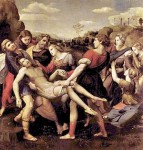
Joseph of Arimethea, Nicodemus and the Corporal Acts of Mercy

The Deposition - by Raphael, 1507

The joint feast of Joseph of Arimathea and Nicodemus is celebrated on August 31. Both men are named in the Gospels as quiet followers of Jesus who took a public stand on His behalf at the time of His death, requesting the body of Jesus and preparing Him for burial.

Joseph of Arimathea was a rich man, possibly a member of the Sanhedrin, and a secret follower of Jesus. He went to Pilate when Jesus was crucified and requested the body for burial. Roman law allowed members of an executed person’s family to claim the body and bury it in a family tomb. Decisions on claiming a non-family member’s body were on a case-by-case basis, but were not generally granted. Joseph, receiving Pilate’s permission, took Jesus’ body to be buried in a tomb that had been carved out of stone to serve as his own tomb.

Nicodemus was a member of the Sanhedrin who had come to Jesus secretly late one night to talk. (Jn 3:1-21) He was a supporter of Jesus. Once Jesus had died, Nicodemus brought the traditional spices, around 100 pounds of myrrh and aloe, as well as the burial cloths in which to wrap Him. Together with Joseph of Arimathea, Nicodemus prepared Jesus’ body for burial and laid him in that soon-to-be-famous tomb in the garden. They sealed the tomb with a great stone and returned home quickly, because the Sabbath was beginning.

These two men are the patron saints of undertakers and those who care for and prepare the dead for burial. They are also models for all of us of the practice of the Corporal Acts of Mercy.

The Corporal Acts of Mercy are:

  1. To feed the hungry
  2. To give drink to the thirsty
  3. To shelter the homeless
  4. To clothe the naked
  5. To visit and ransom the captive (prisoners)
  6. To visit the sick
  7. To bury the dead

These very practical activities have been seen since the earliest days of the Christian community as the tasks of Jesus’ followers. Jesus Himself told his followers that to the extent they perform these services for any of God’s children, they perform them for Him. (Mt 25:31-46) Burying the dead was not part of the original list Jesus gave in his discourse on the Last Judgement. This final Work of Mercy comes from the Book of Tobit, in which a just man, Tobit, defies the Assyrian conquerors to provide proper burial for fallen Israelites, despite being punished for doing so.

This call to service of people’s physical (corporeal) needs is fundamental to our calling as baptized Christians. The world has been transformed by Christians who have taken this charge seriously. Now it’s our turn to live out that calling.


Read More

Posted by on Jul 28, 2011

Who Can I Blame for the Mess We’re In?

Novena to St. Ignatius Loyola – Discernment – Seventh Day – July 29th

Roland Joffe’s 1986 Movie “The Mission” traces and telescopes the Jesuit missionary efforts in Paraguay. In 1995, the Vatican Film List singled out “The Mission” as one of 15 films of special religious significance. In this scene Fr. Gabriel (Jeremy Irons) plays his oboe to make contact with the Guarani after several of his brothers had been killed in similar attempts. The song is the now famous “Gabriel’s Oboe” by Morricone. Right click on this link to open it in another tab for a symphonic and choral arrangement as a background for your own meditation on this day of the novena.

The Invitation of Christ

St. Ignatius is very clear in his distinction between the Call of Christ and that of Satan. Like Gabriel’s Oboe, the call of Christ is peaceful, inviting, encouraging. The snares of Satan are fear, anxiety, and compulsion. These are the primary ways in which we can begin to discern the source of motions and movements within our soul. The banner of Satan has been called the path of least resistance while the banner of Christ is that of consciousness.

The banner of Christ requires openness, humility, and real courage, as we see in the scene from the movie. In fact, the Jesuit missionary experience in Paraguay would follow the path of the cross as the Portuguese killed the missionaries and enslaved the Guarani. This in turn was only the prelude to the suppression of the Society of Jesus in 1767 because of its opposition to the absolute power given to kings and emperors during the Enlightenment. The Society was restored in 1814.

A Growing Sensitivity

Wholeheartedness in the service of God demands a constant effort of discernment, a growing sensitivity to the will of God. Without this, generosity can lead only to ‘the expense of spirit in a waste of shame’…

At all events, Ignatius characterizes Lucifer as a tyrant who drives and compels his subjects (he uses a vocabulary of compulsion and trickery), whereas when describing Christ his vocabulary is one of friendship, persuasion, gentleness…

What I have to see is that my personal option must be made in the light of this universal vision. My choice must integrate me into the great movement of salvation already accomplished in Christ and now being worked out on earth. My choice will be a reproduction in me of the option of Christ who chose the cross, despising its shame. We may note that this idea finds its first development with Origen but is already contained in germ in the phrase of Ignatius of Antioch – ‘Let me be an imitator of the passion of my God’. – William Yeomans (emphasis not in the original)

Mother Teresa

Exercise:

Placing myself in God’s presence, I ask these questions of myself and the Holy Spirit. What is my path of consciousness? What is my path of least resistance?

Concluding Prayer

St. Ignatius, you signed your letters “pobre de bondad,” poor in goodness, and called yourself a pilgrim. Please pray for me to be open to what God is calling me to do to announce and build up the kingdom. Transform my petitions into questions of discernment and pray for us to remember that all of our true needs and desires are already known to God. Pray that I be taken beyond my wants, beyond my fears, from death into life.

In your writings and by your example we are reminded to pray for the Church and the Holy Father, for all who dwell in darkness, and for the millions lacking food, water, and other necessities. We join our prayer with yours for true openness so that we can contemplate the Divine presence in all things and praise, reverence, and serve God Our Lord in action.Pray for us to have the courage to meet and to serve the Lord Jesus in the poor and the suffering.

Praise be to the Father, the Son, and the Holy Spirit
Now and Forever. Amen.

Read More

Posted by on Oct 29, 2010

Hearing the Cry of the Poor

“The Lord hears the cry of the poor, Blessed be the Lord.” (Psalm 34)

We hear and sing these words from Psalm 34 at various times throughout the year, but I wonder how often we really heed them.  We are too easily tempted to focus on eternal rewards and happiness after death for those who suffer poverty here in this life – the rich man and Lazarus, for example. Such a focus may give some comfort to the suffering. It allows the one who may not be able to change the social realities to rest easier, assuming all will balance out in the end. But I don’t think that’s what it’s all about!

The psalm doesn’t say, “The Lord will hear…” It says, “The Lord hears…” That means here and now. Somehow I can’t believe that the Lord is very happy with folks who allow children to go to bed hungry or to die of illnesses that could be prevented with basic health care.

Structural factors in societies create barriers that effectively deny people the opportunity to “pull themselves up by their bootstraps.” Those without boots don’t have bootstraps on which to pull.

One simple exercise  (called “The Scramble”) that makes the reality of structural inequalities tangible goes this way. Take 100 pennies and scatter them on the floor. Three groups of people then have the chance to pick up as many pennies as they can. The catch is that only a few of them can use their bare hands. A larger group wear mittens on their hands. The third group, the largest group by far, must pick up their pennies with a spoon.

You can imagine which group will collect the most pennies and which the least.

Something of this nature is going on in countries all over the world. Emmanuel Saez, winner of one of this year’s MacArthur Foundation “Genius Grants,” has studied the relationship between tax policy and income in the United States. He notes that the top 1% of Americans earn 24% of all income. The earned income of the top one-tenth of 1% of Americans (approximately 310,000 people) equals that of the bottom 120 million people.   Yet those high earners only pay as much in taxes on their income as ordinary workers pay.

Folks caught on the middle and lower economic rungs are unhappy about today’s economic realities. Those paying the larger proportion of taxes wonder if they’re getting their money’s worth. Tea Party slogans ring true to many of these folks.

Economists tell us that economic gains, including reduction of the unemployment rate and recovery of the housing market, following the Great Recession will remain slow through 2011. There’s not going to be a quick fix for the situation in which we find ourselves.

As we Americans go to the polls to vote in this mid-term election, I hope and pray that we’ll remember that as hard as economic times are for people at all levels of income, they’re more desperate for those on the lower rungs of income and the unemployed. No matter what we do, it will take time to move back to prosperity. We must not forget or refuse to care for the poor, the children, the less fortunate among us.

“The Lord hears the cry of the poor…”

Read More

Posted by on Oct 14, 2010

Quote of the Day – M. Shawn Copeland

“If my sister or brother is not at the table, we are not the flesh of Christ. If my sister’s mark of sexuality must be obscured, if my brother’s mark of race must be disguised, if my sister’s mark of culture must be repressed, then we are not the flesh of Christ. For, it is through and in Christ’s own flesh that the ‘other’ is my sister, is my brother; indeed, the ‘other’ is me…”

From Enfleshing Freedom, by M. Shawn Copeland, 2009

Words to consider as we come together in communities for worship.

Who isn’t here? Why not? What do we need to do to be welcoming communities for all of God’s people?

Read More

Posted by on Sep 27, 2010

A Chasm Was Fixed Between Them

In the Gospel for the 26th Sunday of Ordinary Time, Cycle C, Jesus tells the story of the Rich Man and Lazarus (Lk 16:19-31).

A rich man lived sumptuously, with everything money could by at his disposal. We don’t know how he came to have his money. Probably he was not a bad man. He was, however, a man who was not overly concerned with the plight of the poor of his community. We can assume this because a poor man called Lazarus lay on the doorstep of the rich man day after day, covered with sores, and the rich man did not take care of him. Even the dogs paid more attention to Lazarus than the rich man did. They came and licked his sores.

Now, in defense of the rich man, there were lots and lots of poor people around. Lots and lots of sick people. Maybe even some people who didn’t work when they could have worked to support themselves. Jesus doesn’t tell us what the rich man was thinking or why he didn’t stop to help Lazarus. He just notes that Lazarus was hungry, sick, and licked by dogs.

As Americans, the idea of having a dog lick one’s sores is not appealing, but it was even worse in those days. Dogs were not the much loved pets that they are for us. Dogs worked for a living or they were strays that fended for themselves. In many countries, dogs that were not working (tending flocks or guarding something/someone) were considered fair game as food by the poor. So here is Lazarus, lying sick and hungry at the door, having stray dogs licking his sores and unable to chase them away. Not a pretty picture.

As happens in life, Lazarus died. The angels of God swooped down, picked him up and took him to Abraham. Abraham, father of the Jewish nation, welcomer of all who came to him, welcomed Lazarus as well. He cared for Lazarus as one of his own.

As also happens in life, the rich man’s turn came to die. He died and was buried. But he did not find himself with Abraham. He was alone and in torment. He could see Abraham. He could see Lazarus with Abraham. He longed for a single drop of water to ease his pain, so he asked Abraham to send Lazarus with a drop of water for him. Note well —  he didn’t ask Lazarus for forgiveness or for the gift of a drop of water. He asked Abraham to send/order Lazarus to bring the water.

Abraham reminds the rich man of the relationship that had existed in life between the two men. He also tells the rich man that there is a great chasm fixed between them, one that neither side may cross freely.

I had always wondered about that chasm. Why would a loving God set up a barrier that would keep those in His presence and company (Heaven) from reaching out and helping those who were not (Hell)? Wouldn’t those who were united with Love and in Love be so overflowing with love themselves that they’d want to help those who were separated from Love?

Our homilist this Sunday, Fr. Ken Lavarone, OFM, addressed this question. Fr. Ken pointed out that the chasm between the two men was one of lack of relationship. Lazarus could not come to the aid of the rich man because there was not a relationship between them. The rich man had always stepped over Lazarus or ignored him. Even after death, the chasm remained. The rich man spoke to Abraham, not to Lazarus.

Jesus’ story continued. The rich man asked Abraham to send Lazarus to warn his brothers of the fate that awaited them – sort of like in Charles Dickens’ A Christmas Carol. Abraham responded that the brothers had Moses and the prophets to warn him, as the rich man himself had had. When the rich man noted that the brothers wouldn’t listen to Moses and the prophets, Abraham retorted that those brothers would also not listen to one who returned from the dead.

These final lines of the story are of huge import for us as well. They were directed to the religious, church-going folks of Jesus time and of the early Church. Jesus returned from the dead. Affirming the message of Moses and the Prophets, Jesus said we are to care for the poor and helpless among us. How we do it will vary. Some will have monetary resources that will be shared. Others will have talents that can help make life more bearable for their less fortunate sisters and brothers. Some will only be able to offer a smile and a kind word — a recognition that the other person is also human and worthy of respect. Each of these responses is a way of entering into relationship with the other person. Each of these bridges chasms that would otherwise keep them apart.

In Jesus’ story, both men were children of Abraham due to their identity as Jews. Today, we know that we are all children/descendents of one woman who was a member of a group of people who lived in Africa around 200,000 years ago — a woman known as “Mitochondrial Eve.” We all have a responsibility to each other. We all can give the gift of a smile that raises another’s hopes and heart. We all sometimes turn away from the circle of community of God’s children. The good news is that someone did return from beyond the grave with a reminder that we can turn back at any time. We just need to remember that care of God’s little ones (the poor and the powerless) comes first when we choose our elected officials, design our social safety nets, vote for funding of community services, and allocate our personal resources of time, talents and treasure.

Read More

Posted by on Sep 12, 2010

Rejoicing among the angels of God …

 
“… What woman having ten coins and losing one would not light a lamp and sweep the house, searching carefuly until she finds it? And when she does find it, she calls together her friends and neighbors and says to them, ‘Rejoice with me because I have found the coin that I lost.’ In just the same way, I tell you, there will be rejoicing among the angels of God over one sinner who repents.” (Lk 15:8-10)

This passage of Luke’s gospel falls between the account of the shepherd who goes searching for one lost lamb from a flock of 100 sheep and the story of the Prodigal Son whose father, even more prodigal in his love, welcomes home the child who has betrayed him, the family and the community then returned to ask forgiveness.

As I listened to the Gospel at Mass this morning, I found myself musing that most of us wouldn’t really worry all that much if we lost a coin. It’s not an image that awakens immediate comprehension in an American audience. After all, for most of us the loss of a penny, nickel, dime, quarter or even a dollar coin will not make a huge difference in whether or not we eat or have a place to sleep tonight!

As happens sometimes, I began musing about what might make the gospel more immediate for Americans and I remembered an experience from my early teenage years.

When I was about 12 or 13 years old, my father led members of our parish in starting a credit union. For many years, the credit union “office” was our dining room table. Eventually a porch was enclosed and the new room became a more formal office. A few years after I got married, the credit union moved out of the family home to an office of its own. But there were many memorable moments before that move took place.

One of those moments happened on a bright summer morning when the phone rang around 10 o’clock. An elderly man in the parish had passed away a few months earlier. His children were cleaning out his home before selling it. They had moved the mattress off the bed and found an envelop containing ten one thousand dollar bills. They asked my mother to come over to the house and pick up the money as a deposit to their credit union account. Mom was bonded, so if anything happened to the money on the way to the bank, it would be insured.

Mom brought the envelop home to prepare the bank deposit and each of us got a chance to hold a $1,000 bill before she took it all to the bank. Now there was a “coin” for which an American woman (or man) would scour the house and even have a party when it was found!

Still, Jesus didn’t come to call only those with lots of $1,000 bills. And the point of the story was that there is rejoicing in Heaven when even seemingly small, unimportant folks are found. God, who is Love, welcomes all and is especially pleased when those who have turned away in ways great or small, turn back again to love.

Our pastor, Fr. Ron Shirley, spoke of an observation made by the director of Covenant House, a program for children living on the streets in the United States, Canada and Central America. The director noted that although the children/teens ask questions about practical needs, their deeper, unspoken concern is whether God could still love and forgive them for what they’ve had to do to survive their lives on the streets.

The story of the woman searching for her coin – her penny, nickel or dime – is the answer to the children’s question. Of course God still loves and forgives them. And even better, God still loves and forgives us – the adults who allow conditions to continue in which children are exploited, the poor are left to struggle on their own, the elderly are ignored or abandoned and people around the world are denied the opportunity to live with basic human dignity, food, clothing, shelter, health care and education.

The catch, of course, is that we are expected to do our part to make this a world with justice and peace for all as we turn back to our God. We are to pray for each other, including those who have harmed us, and we are to work to bring the kingdom of justice and peace into being here and now. That’s the good news Jesus brought to the men, women and children of His time. It’s the same word He speaks to us today. We all matter to God and the angels rejoice as we return to God and love others in turn. That love is to have practical consequences in our world.

Read More

Posted by on Sep 27, 2009

Who Can I Blame for the Mess We’re In?

“Anyone who gives you a cup of water to drink…”

Sharing water

Today’s reading from the Gospel of Mark (Twenty-sixth Sunday of Ordinary Time, Cycle B) is one of the more challenging ones. Jesus’ disciples have been struggling to figure out what it really means to be great in the Kingdom, to be a follower of Jesus, and what kind of exclusivity pertains to their role as His followers. John tells Jesus that someone who is not one of their group is driving out demons in Jesus’ name. Jesus’ followers are trying to get the man to stop doing it – he’s not authorized to use the power – almost as if it were under trademark protection or something. Jesus assures them that anyone not actively against them is for them, so it’s OK for the other person to cast out demons using Jesus’ name (a term also meaning power and authority). He continues, “Anyone who gives you a cup of water to drink because you belong to Christ, amen, I say to you, will surely not lose his reward.” (Mk 9:41)

The reading goes on to include Jesus’ teachings about removing things from our lives that get in the way of a free, loving  response to God’s presence and call  in our lives. It’s very dramatic in its images – plucking out an eye, or cutting off a hand or foot! But sometimes those physical actions might actually be easier than the spiritual work that is really required. Forgiving someone who has hurt us deeply, trusting again, giving freely of our time, talents and treasure when those gifts were not accepted graciously the last time we offered them, moving forward in faith when danger is all around and there seems no way that good can prevail… All in all, a couple of challenging passages.

Yet this year, the twenty-sixth Sunday of Ordinary Time coincides with the feast of St. Vincent de Paul.  And that has been on my mind all day today. Here was a man who took to heart the teaching that whatever is given to someone who belongs to Christ is given to Christ. Furthermore, he truly believed that whatever was given to the least of God’s children, was given to Christ. And he set about organizing groups of people, to care for those “children” of God, as well as working with political and religious leaders to change social and religious structures of oppression.

The work goes on today, some four hundred years after the time St. Vincent de Paul began his work. There are still oppressive social structures. People still struggle to survive. Many in the world go to bed hungry after spending all day hungry as well. Health care is not guaranteed to all. Education is not available to all children. Decent housing and clothing are not assured to all, even in the United States, the richest, most powerful nation in the world.

Still, we have Jesus’ promise and reassurance. “Anyone who gives you a cup of water to drink because you belong to Christ … will surely not lose his reward.” May we also be ones who give that cup of water to drink to others who belong to Christ, in all the beautiful and all the distressing forms in which they come to us.

Read More

Posted by on Aug 30, 2009

Who Can I Blame for the Mess We’re In?

Act on God’s Word – August 30, 2009

Fr. Ron Shirley

Fr. Ron Shirley

The following is today’s homily from Fr. Ron Shirley, pastor of Resurrection Parish in Aptos, CA. Today’s readings are for the 22 Sunday of Ordinary Time, Cycle B. (DT 4:1-2,6-8, JAS 1:17-18,21b-22,27, MK 7:1-8, 14-15, 21-23)

Fr. Ron’s homilies are available every week at www.FatherRon.com.

An elderly priest made a retreat. In the course of it he was struck deeply by three things that he’d always been aware of but never had really taken to heart.

First, there are millions of people in the world who are hungry and homeless. Second, he had spent his entire priestly life preaching comfortable sermons to comfortable people. Third, he had bent over backwards to avoid disturbing or alienating people.

In other words, the priest found himself to be much like the priest played by Jack Lemmon in the film “Mass Appeal.” He preached only about those things that didn’t disturb his parishioners and made them feel good.

And now, like the priest in “Mass Appeal,” the old priest suddenly realized that he had been more worried about pleasing his people than about preaching the Gospel. He had been more worried about rocking the boat than about challenging his parishioners to look into their hearts to see if they were satisfied with what they saw there.

The week following his eye-opening retreat, the old priest looked up the Scripture readings to prepare his Sunday homily.

As he read the Gospel, these words of Jesus leaped right off the page: “These people honor me with their lips, but their hearts are far from me.”

The priest resolved, then and there, that he was going to share his soul-searching with his parishioners. So he began his homily by saying:

“My homily this morning will be exactly 30 seconds long. That’s the shortest homily that I’ve ever preached in my life, but it’s also the most important homily I’ve ever preached.”

With that attention-grabbing introduction, the priest gave his 30-second homily. He said:

“I want to make just three points. First, millions of people in the world are hungry and homeless. Second, most people in the world don’t give a damn about that. Third, many of you are more disturbed by the fact that I just said damn in the pulpit than by the fact that I said there are millions of hungry and homeless people in the world.”

With that the elderly priest made the sign of the cross and sat down.

That homily did three things that many homilies don’t do.

First, it caught the attention of the people.
Second, it caught the spirit of Jesus’ words in the gospel.
Third, hopefully it made the people look into their hearts.

The story of this priest and the gospel reading make the same point.

Religion is not something we do on Sunday. It’s not primarily, observing certain laws, saying certain prayers, or performing certain rituals.

That’s what many people in Jesus’ time had turned religion into. To observe these rituals was to please God. Not to observe them was to sin. In short, observing rituals became identified with being religious.

To illustrate the hypocrisy of such legalism, William Barclay tells this story – about a Muslim pursing an enemy to kill him. In the midst of the chase, the Azan, or public call to prayer sounded. Instantly the Muslim got off his horse, unrolled his prayer mat, knelt down, and prayed the required prayers as fast as he could. Then he leaped back on his horse to pursue his enemy in order to kill him.

It was precisely this kind of legalism that Jesus opposed so vigorously in his time.

Jesus made it clear that religion isn’t something you do at certain times on certain days. It’s not saying certain prayers or performing certain rituals. It’s a thing of the heart. It’s a thing of the heart called love – love of God and love of neighbor. Love in action.

Today’s Scripture reading invites us to look into our hearts and to ask ourselves to what extent the words of Jesus in today’s gospel reading apply to us: “This people honor me with their lips, but their hearts are far from me.”

The Scriptures also invite us to look into our own hearts and ask ourselves to what extent the words of James in today’s second reading apply to us:

Act on (God’s) word.
If all you do is listen to it, you are deceiving yourselves.”

I hope this homily today did 3 things:

First – it caught your attention.
Second – it caught the spirit of Jesus’ words in the Gospel.
Third – it makes all of us look into our hearts!

Read More

Posted by on Aug 20, 2009

Who Can I Blame for the Mess We’re In?

All a Big Game?

cheerleading

About a year ago I had dinner with a lovely couple who happened to be members of a different political party than I. It was not long before the 2008 election, and the handwriting was pretty much on the wall that it was not going to go well for their candidate. It could have been a tense experience, but it wasn’t. I grew up in a family whose politics tend to be quite different from mine, so it doesn’t surprise me that some people of good will think differently on a variety of issues than I do. And it certainly doesn’t mean we can’t have a good time together talking about many things!

At any rate, as the conversation went forward during the evening, the question of how one might choose a candidate arose. It was at this point that I was surprised. In my family and experience, candidates are chosen based on their stand on the issues and their record. At least that’s what most of us would say publicly. It’s definitely conceivable that a vote would go across party lines, though not common. We tend to be pretty independent even when we are members of a party.

However, the gentleman with whom I was dining expressed a totally different idea. He described politics as if it were a game. The analogy he used was of rooting for a college football team. In college football, the record and beliefs of the team members don’t matter. If one is a fan of, say Cal Berkeley, one cheers for Cal Berkeley. If one favors Stanford, then Stanford receives the cheers and allegiance. (These were not the colleges mentioned at the table, but to protect the innocent I’ve changed the names!) In his opinion, politics is also a game. If my team doesn’t win this round, the next starts tomorrow and I’ll do anything in my power to make sure my team wins next time.

I’ve been watching with dismay the controversy over the proposed reform of the health care system and I find myself wondering if it’s become part of the “game” of politics for some. 

There are many complicated issues that must be addressed, many differences of opinion about what services should be offered and to whom, many challenges regarding funding and affordability. Most are not being addressed. Instead, some opponents of the reform bills are circulating outright lies about the proposed reform bills and repeating them at the top of their lungs. They’re out to frighten rather than enlighten middle America. And, I hate to say it, but they seem to be succeeding. Fear wins out over reason every time!

It happened again one morning this week as I was reading the morning paper and its comics page (sacred reading in my book – generally sets the day off to a happy start). Our paper has both conservative and liberal strips, as well as the general funnies and serials. The conservative strip showed a caricature of President Obama saying that he is determined to get rid of people’s clunkers and has him holding a picture of an elderly woman. Talk about fear-mongering and outright lies! I was furious. Nothing in any of the bills comes anywhere close to proposing what the comic strip implied.

The same newspaper, the same day, included an article in the news section reporting on a study published in the Journal of the American Medical Association (about as conservative as they come). According to the article, so called “end-of-life counseling” improved the mood and quality of life for cancer patients. The study was not done anticipating the current controversy, though it’s an example of the types of studies of outcomes/best practices that are proposed in some of the bills under consideration. What is the best way to care for the ill, the elderly, the young, etc.? The author of the study, nurse practitioner and researcher Marie Makitas, noted: “They [cancer patients] seem to feel a whole lot better knowing there’s someone who’s looking at the rest of them and not just the tumor.”

Isn’t that what quality care should include? Isn’t that an issue of personal rights to decide on important questions such as who will make decisions for me when I no longer can? It seems pretty conservative and pretty obvious to me. Yet critics keep shouting words that frighten rather than discuss the deeper issues and challenges we all face.

The only way I can make any sense of all this to think that for some very powerful people, it’s either just a big game or they have a financial stake in keeping the status quo as it is. Maybe it’s both.

It’s certainly not a big game for the family that lost the rental property they expected would help support them through retirement when their son, through no fault of his own, sustained a major closed head injury in a car accident while in his early 20s. The driver who injured him was not insured and he was between health insurance policies, so his parents ended up paying full price for his care.

It’s not a big game for the woman who is battling ovarian cancer and is concerned that the company for which she works may go out of business, taking her health insurance with it. She would qualify for coverage through the HIPPA program, but it costs more and offers fewer benefits than she currently gets. If she’s out of work and/or medical leave, she’d have to find a way to pay the entire cost of the plan.

It’s not a game for the woman who doesn’t have insurance now because she has a pre-existing condition but can’t get help because there’s a small trust set up with her as beneficiary. No state or federal help for such people!  Her only option is a high risk plan sponsored by the state that offers only $75,000 in total benefits per year and costs 3-4 times what a normal, healthy woman her age would pay for $5 million in coverage!

It’s not a game for the family whose new baby will cost them over $300 per month to insure on his mother’s insurance plan. Dad’s unemployed and Mom has to return to work 6 weeks after his birth so she can keep her job. (Fortunately for that family, the baby qualified for a “big government” program – Medicaid. Thank heavens for “big government” and the vision of those who fought for Medicare and Medicaid in the 1960s.)

It’s not a big game for the family whose employer had to reduce costs and so changed the company insurance plan to a high deductible plan that requires the family to pay the deductible before they receive any real benefits from the plan.

It’s not a big game for the thousands of people who find their employers no longer offer health insurance or their doctors no longer accept their insurance plan.

In over 30 years of working in the health care arena, including design of services and facilities, translation of patient informational materials, comparative studies of rates and costs of providing services, and many other assignments, as well as over 10 years in the insurance industry, I’ve seen a lot of cases in which the existing system has not lived up to the promises and claims made for it. We’ve come a long ways towards providing care for all, but we still fall far short and the system is too expensive to be sustainable as is. It’s not a game for too many people.  

Perhaps those who are in favor of health care reform need to know that for at least some of their opponents, it may all be a big game or a question of ratings or of who will win the next election. It may not have anything at all to do with economic realities or morality or social justice or even good patient care! Is it really all just a big game?

Read More

Posted by on Aug 13, 2009

Who Can I Blame for the Mess We’re In?

Camillus Health Concern – An Idea Worthy of a Presidential Medal of Freedom

Dr. Pedro Jose Greer, Jr.

Dr. Pedro Jose Greer, Jr.

President Barak Obama awarded the Presidential Medal of Freedom to Dr. Pedro Jose “Joe” Greer, Jr. this week. The White House comment on Dr. Greer’s work follows:

Dr. Pedro Jose “Joe” Greer Jr. has devoted his career to improving medical services for the uninsured. A native of Miami, he followed his passion for helping others to medical school and founded the Camillus Health Concern (CHC) in 1984 as a medical intern. Today, CHC treats thousands of homeless patients a year, serving as a model clinic for the poor and inspiring physicians everywhere to work with indigent populations. Dr. Greer’s tremendous contributions to the South Florida community and our nation as a whole stand as a shining example of the difference one person can make in the lives of many.

The Camillus Health Concern, named in honor of St. Camillus de Lellis, patron saint of nursing, has been a leader in providing health care services to low income and homeless residents of Miami-Dade County since 1984. The work of the Brothers of the Good Shepherd at Camillus House (founded in 1960), including providing food, shelter, housing, rehabilitative treatment, and health care for the poor and homeless, is an example of ways the Gospel call to service of “the least of my brothers and sisters” is being lived in our day. The fruit of Dr. Greer’s work, begun while still a medical intern, to add primary care health services to the mixture of services at Camillus House is recognized by this award.

A video of the Presidential Medal of Freedom award ceremony may be seen here.


We at Theologika.net add our congratulations to Dr. Greer and the other winners of the Medal of Freedom.

Read More

Posted by on Jun 5, 2009

Who Can I Blame for the Mess We’re In?

The Feast of Pentecost and the Age of the Holy Spirit

Eastern Orthodox Icon of Pentecost

Eastern Orthodox Icon of Pentecost

The Feast of Pentecost falls 50 days after Easter. Pentecost was originally a celebration of the first harvest and people came to Jerusalem from all over the known world to celebrate the feast.

For people in northern climes, the thought of a first harvest celebration in Spring may sound strange. After all, the snow has barely melted and crops are nowhere near ready to harvest. Even early crops like strawberries and lettuce aren’t ready yet. Nevertheless, in the Middle East, and by extension in that general latitude around the globe, many crops have already been harvested. Just go to a grocery store and you’ll see the fruits of our fields waiting for your table!

Within the Church, we celebrate the outpouring of the Holy Spirit on the disciples – men and women who had been friends, family and followers of Jesus. This outpouring of the Spirit of God, the God Who is Love, gave birth to the Christian community that endures to this day. Jesus’ friends and followers were transformed from frightened “mice” into fearless “lions” who proclaimed boldly that Jesus had been raised from the dead, that He is the long awaited Christ, that God has made Him both Lord and Savior, that a new age has dawned and the Kingdom of God has begun.

These early disciples wasted no time in putting their beliefs into action. They shared what they had. They cared for and healed the sick. They took care of widows and orphans – the powerless ones of their society. They recognized the gifts of women who were leaders in their communities. They spread the Good News of the Lord to all who would listen. And they struggled to understand the implications for themselves and their society of the Good News and the freedom of God’s children. Who were God’s chosen ones? Who could be followers of the Way? What parts of the Law were non-Jews required to obey? How can the pastoral needs of the community be met? Who will look out for the powerless ones in our own communities? How do we choose leaders for our communities? How should Christian family members behave with each other?

For nearly 2000 years we have dealt with these issues as a community. Today we still face many of them, though in a much wider context, as a global, international community that includes peoples of all cultures. More than ever we must count on the continued outpouring of the Spirit to guide us and make us bold witnesses to the Good News.

Much of what we take for granted today is the result of the work of Christians who actively put their beliefs into practice and stepped out to make their part of the world a better place. Institutions such as hospitals, schools for poor and even middle-class children, education for girls, social safety nets, and many others have resulted from the Christian insight that God cares about all humans, even those who traditionally have been excluded.

The Christian belief that all receive the gifts of the Holy Spirit in Baptism and Confirmation also leads to the understanding that all are responsible to share the gifts they have received and bear fruit in their lives. Together we listen to the Spirit and share in the development and shaping of both our Church community and the world.

As we move through these days following Pentecost, we face many challenges. It’s a time of global financial challenges. Governments are moving quickly to try to minimize the harmful effects of the banking crisis on their people. Social service agencies and churches are struggling to offer aid to the increasing numbers of people coming to their doors. Here in California there’s talk of dismantling all state funded social services, including health care programs for children of low income families and the welfare to work programs that helped so many families keep roofs over their heads and food on their tables.

What will we as children of God, brothers and sisters, do to address these challenges in our communities, states and countries? Will we say, as so many do, “It’s not my responsiblity to care for the children of the poor. Why don’t their parents just go get jobs?” Will we say, “Don’t ask me to pay more taxes. I shouldn’t have to cut back my lifestyle to pay for other people’s mistakes.” Will we sit in judgement of people who are losing their homes because they lost their jobs? Will we smugly assume that we’ve saved enough money to keep us safe if we get ill or lose a job? Will we criticize the people who lost their savings to the stock market when the money should have been somewhere safer? I hope not.

This year the time from Pentecost onward can be a time in which we truly listen to the Holy Spirit’s call to build up the Kingdom by caring for the poor, the powerless, those who are ill and who are losing their security (whether as a result of their own errors or those of others). It’s a time to trust that if we give of what we have, share from our abundance or our need, God will make sure that our needs are met. Our ethic of life must include not only the unborn but also those who are here and in need. Womb to tomb includes all those days in-between as well. Let’s not forget that as a Church community.

Read More

Posted by on Jun 2, 2009

Who Can I Blame for the Mess We’re In?

Late Term Abortion: A Mother’s Story

parents

Robin Young of National Public Radio’s “Here and Now” interviewed one of the patients of murdered late-term abortion provider, Dr. George Tiller.

“We speak with a former patient of late-term abortion provider Dr. George Tiller, the Wichita, Kansas doctor who was murdered on Sunday. She explains why the procedure was so necessary for her.”

Abortions past the 20 week “age of viability” are difficult to justify by pro-choice advocates. How could the loss of one of the three physicians who performs these procedures, which are less than 1% of abortions, represent any moral or clinical loss? The implications for the physical and mental health of families becomes evident in this interview. The values presented in this story are about the desire and wonder of having children, the anguish of carrying a doomed child, the inability of doctors to present the couple with any real alternatives.

An earlier ban on late term or “partial birth” abortions provides an exception for the health of the mother. Aren’t these just cavalier acts of barbarism by selfish women?

What would you do with a child that you wanted very much but who would not survive birth? What would be the most loving and caring thing to do? This is a very compelling story that should give us pause when we want to throw the first stone.

My Late-Term Abortion
President Bush’s attempt to ban partial-birth abortions threatens all late-term procedures. But in my case, everyone said it was the right thing to do — even my Catholic father and Republican father-in-law.
This article provides another instructive example from 2004 published in the Boston Globe.

In this second case, the situation seems to be less clear cut since the birth of this child would have meant a short and very unacceptable quality of life for the child as judged by the parents.

In both cases there were voices which opposed the choices made by the parents. Reviewing both cases is useful in terms of gaining a more nuanced perspective on the ethical and moral issues involved and the struggles of these couples.

Read More