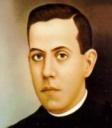

November 23 is the feast day of Blessed Miguel Agustin Pro, S.J. (1891-1927). Fr. Pro was a genial easygoing young priest shot by a firing squad for exercising his ministry against the laws of Catholic Mexico. A blind woman who attended his funeral and touched the coffin regained her sight. Other miracles followed. Fr. Pro was from a large family in Guadalupe, Zacatecas. He joined the Jesuits at the age of 20 after a happy and carefree youth. He was known for his quick and gentle wit. Due to the enforcement of anti-clerical laws in 1915, Fr. Pro and his fellow Jesuit novices left to continue their studies in California, Belgium, Nicaragua, and Spain.
To someone not familiar with the history of Mexico, it can be perplexing to understand how such a Catholic country could have outlawed the religion of the vast majority of its citizens. ( An excellent monograph in Spanish is “La Iglesia Catolica y la Politica en Mexico, 1910 – 1938.”) The story is a saga of ongoing conflict between the emerging secular state after Mexico’s independence from Spain in 1821 and the spiritual and economic power of the Church. For over 300 years prior to independence, the Church in Mexico fell under the sponsorship of the Spanish Crown. The Church, the religious orders, and lay institutes controlled vast resources of land and natural resources. In order to assert their power, the national elites knew that they needed to dis-establish the temporal power of the Church. Others believed that the only way to create a modern state was to get rid of religion altogether.
By the mid-1800’s, the Reform of President Benito Juarez attempted to deprive the Church of its lands and redistribute lands to the peasants and the native tribes. If this sounds socialist, it is. Mexico was one of the first countries to try to address the evils of social inequality by converting socialist philosophy into public policy. Just as socialist aspirations in European governments gave way to oppressive imperial governments, Mexico was ruled by dictators.
The Mexican bishops, under Popes Pius IX and Leo XIII, responded by developing a Christian social teaching focusing on peace, justice, and equality. The Christian social gospel emerged from Pope Leo XIII’s encylical letter, Rerum Novarum, in 1891 on the relationship between capital and labor. Many of the key bishops in Mexico in the early 20th century had been trained in Rome to provide a core of leaders.
The first socialist revolution of the the 20th century took place in Mexico in 1910. Industrialization, foreign control of natural resources, and endemic poverty passed the tipping point. After massive slaughter, destruction, and social dislocation, the Constitution of 1917 came into force. The anti-Church provisions of the Constitution were enforced unevenly until 1925, when President Calles passed additional legislation specifying penalties for infractions. Fortunately or unfortunately, Fr. Pro who had been recently ordained was sent back to Mexico that same year. His health had been declining and his superiors felt that he would get better away from the rigors of exile. When he returned, the situation had gotten so bad that he had to go underground and minister in secret.
The opposition to President Calles erupted in a rebellion called the Cristero war. The insurgents claimed to be fighting for religious freedom. Their cry was “Viva Cristo Rey,” “Long Live Christ the King.” Of course the history was much more complex, since practicing Catholics and anti-clericals often fought together against other factions that were also diverse in their composition. President Calles thought that the pictures of a public execution of Fr. Pro would demoralize the rebels, who were known as Cristeros. It had the opposite effect. Fr. Pro’s execution re-invigorated the fractured insurgency, drew international condemnation, and led to the involvement of the United States’ ambassador, who helped resolve the conflict in 1929. The activities and involvement of the Church in public life and education was highly restricted. However, the Church’s spiritual ministry was permitted under close control.
In 1988, Pope John Paul II visited Mexico amid jubilant throngs. At the time, he beatified Fr. Pro, who became Blessed Miguel Agustin Pro. In 1990, the Vatican and Mexico established diplomatic relations and began a decade long process of regularizing the independence of Church and state. Fr. Pro’s wish was to offer his life for Mexico. It was a wish that he confided a year before his death and a wish that was fulfilled.
Read More