Thoughtful Reflections on Religious Experience
Corpus Christi: The Body of Christ by RandyPozos on Saturday 24 May 2008 11:21 pm PDT

Stephen’s bright blue eyes smiled as we said, “Lamb of God, Give us Peace.” According to the rubrics we were now to show each other a sign of peace. Yet with Stephen’s attention deficit disorder, which had already taken him in and out the brief service at least twice, it seemed that a little catechesis might help him be a little more aware of what we were about to do. Stephen is not a little boy. He is a handsome man in his early 30s, with a number of tattoos poking out of the v-neck and short sleeves of his starched jail issued smock.

The readings had been those of Pentecost. The second reading was from First Corinthians 12. “No one can say Jesus is Lord except by the power of the Holy Spirit.” This had struck all four of the men, but had made a special impression on Stephen. “Does that mean that when I pray the Holy Spirit moves my heart?” Stephen had asked. When I answered “Yes” his eyes got wide and he said that since his attention came and went and his thoughts were often jumbled, he thought his prayers were more bothersome and must be irritating. The notion that he is a temple of the Holy Spirit was as novel to him as it was consoling.

Stephen was back now and I shared a few words on the Lamb of God, recounting the Last Supper and the passion, death, and resurrection of the Lord. We do this in His memory as He requested of us. We are invited to the Lord’s table. Stephen and his companions were not new to the faith, but this brief memorial of our Great Memorial brought a renewed awareness to the others and a slack jaw from Stephen. He did not doubt, but could not help but marvel at the wonder of it.

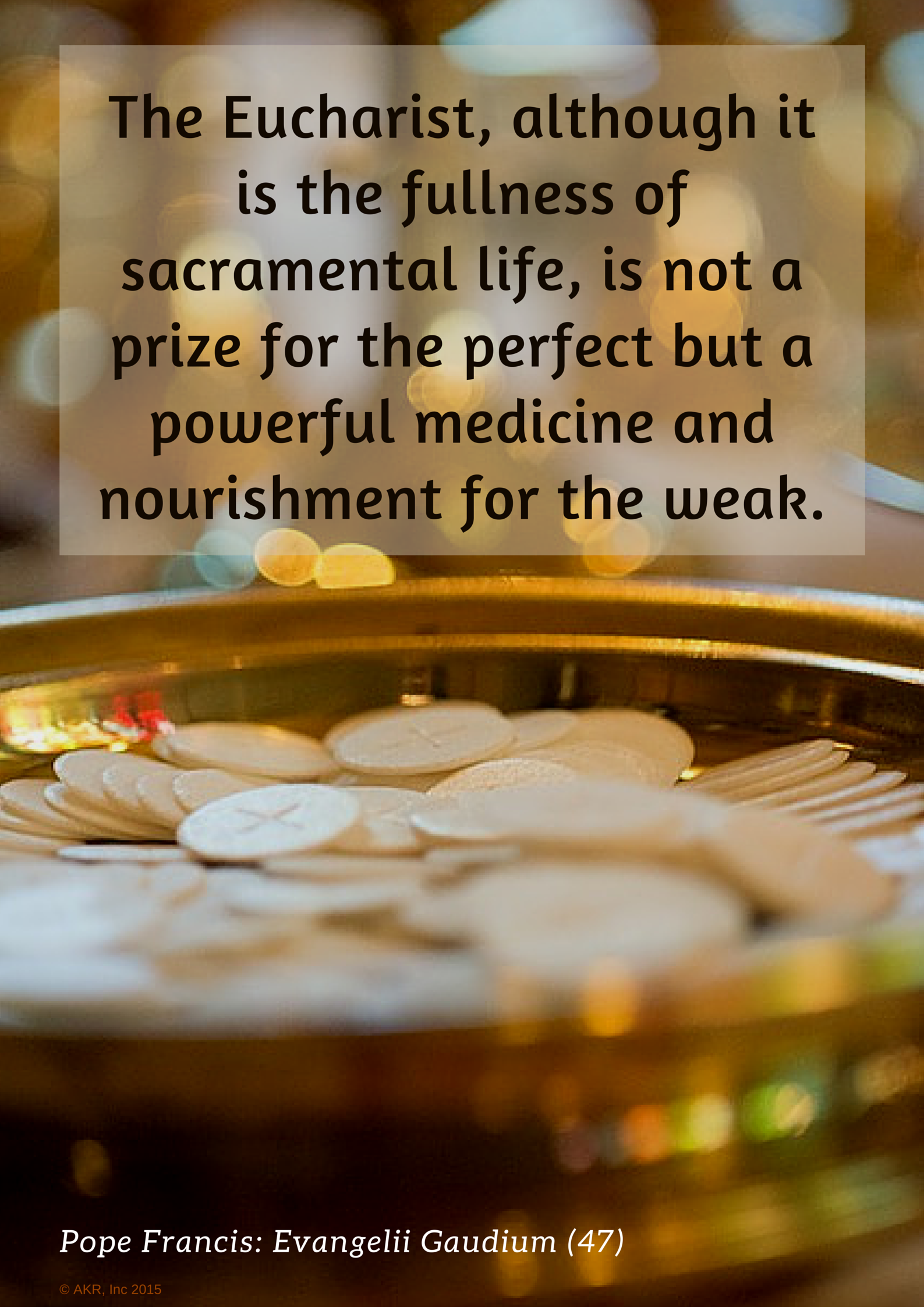
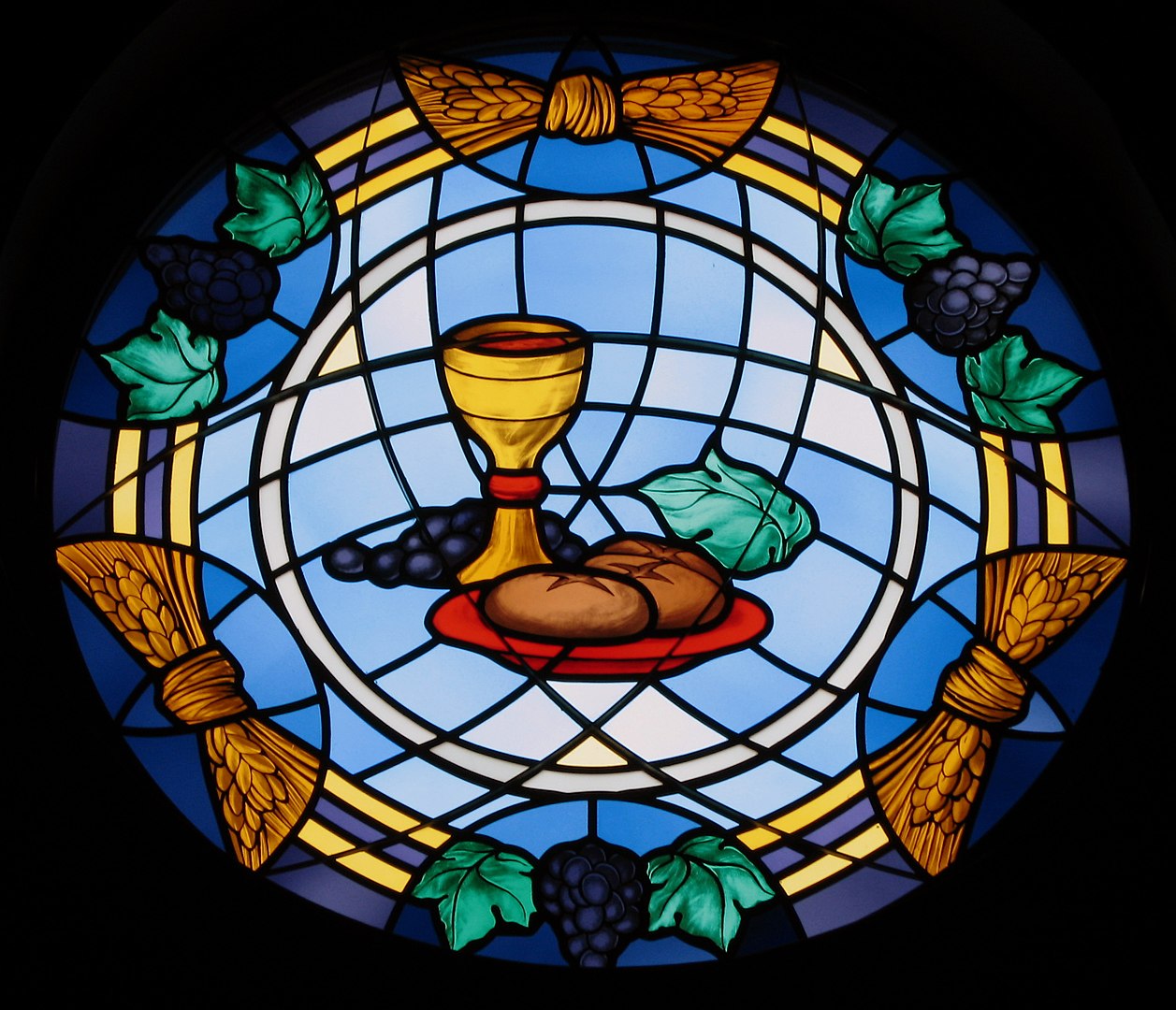
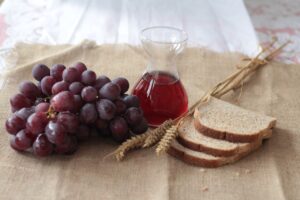
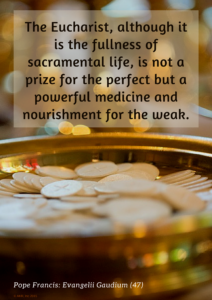
As we shared the wonder of the Blessed Sacrament, our communion was truly a sharing in the Body and Blood of Christ. Bread blessed and broken at the Eucharist, celebrated in the parish, given to all, shared with all, and sent to those in need and to those in prison. The Body of Christ - Corpus Christi - saving us all from our prison of loneliness, our hunger for love, and admitting us to the feast of heaven here and now.

The Encounter at Emmaus by RandyPozos on Sunday 6 April 2008 6:27 pm PDT

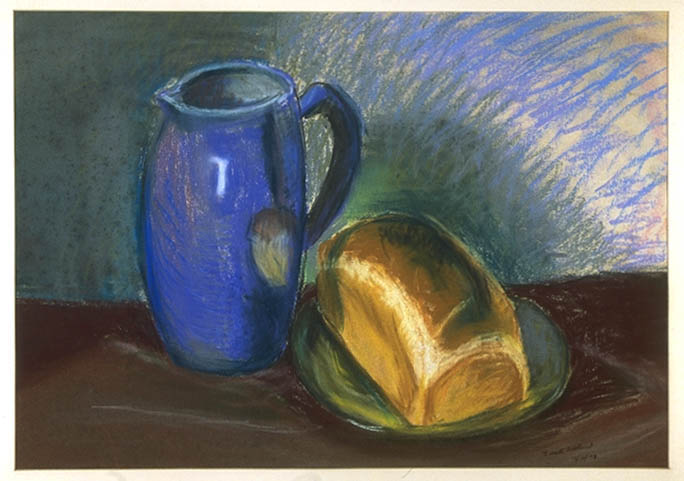
emmaus.jpg

I have been struck by the stories this Resurrection Season because for the first time, they strike me not as eye witness accounts of the Risen Christ, but as the challenge of faith for the disciples and us. The disciples on the way to Emmaus are leaving Jerusalem - returning home, perhaps, - grief stricken, but more importantly, disillusioned. The teacher has failed. The forces of evil have destroyed a very good and wonderful young man.

One way to see this story is to take it as another proof of the Risen Christ as encountered by his disciples. The story does convey this message. However, the story also tells us that we find the Risen Christ when He opens our minds to see the scriptures and when our hearts are opened at the Breaking of the Bread. Look for Him in the scriptures and invite Him in to dinner and your hospitality will be more than repaid.

There is just a glimpse - a flash of recognition and he disappears from our midst. The presence of the Risen Christ is a momentary and ongoing discovery. It is the result of searching, wandering, questing in grief and disillusionment and being open to the challenge of the Stranger.

All of us have moments, years, decades, in which everything we knew and had hoped for is swept away. The disciples had no clue of what was to become of their beloved teacher, but his torture and death threw them into utter grief and confusion. Yet their confusion only increased when they heard that other disciples had found the empty tomb and seen the angels. They were re-grouping, leaving town, trying to get some distance. A Stranger notices their grief and inquires. They listen and reflect on the scriptures and Break Bread.

This is the Christian life - the quest and the encounter in the village of Emmaus - continuing through all generations.

Easter Communion or Condemnation? by RandyPozos on Monday 31 March 2008 1:15 pm PDT

holy-communion.jpg

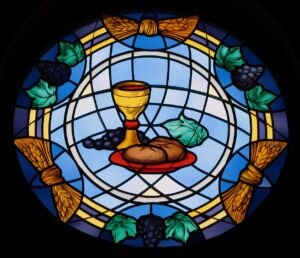
To receive communion during the Easter season has been a long established precept of the Catholic Church. It is a practice that we should examine more closely. To receive Christ in the Holy Eucharist requires one to be in the state of grace - free of serious or mortal sin. We are advised - wisely - to put our souls in order. We are to turn away from sin and return to the community through the grace of absolution. There must be peace and love in our hearts and a definite change in our lives.

Fr. Burke, a Discalced Carmelite from Australia, expands on the notion of communion in terms of our living out the Sacrament of the Holy Eucharist in our shared lives as Catholics and Christians. In his article, “St. Teresa and Two Spiritualities in the Church Today,” at http://www.carmelite.com/, Fr. Burke explains St. Teresa of Avila’s views on legalism as opposed to true and complete union with God and each other. It is well worth reading.

Fr. Burke has put into words what I have been feeling ever since I read selections from the popular blog, Cafeteria Closed, by Gerald Naus, who writes as Gerald Augustinus. Naus came to the United States from Austria in 1997. A former Jehovah Witness, he became a Catholic in 2005. His views are decidedly Restorationist. Unfortunately, they are generally stated in tones of arrogance, condescension, or condemnation. His posts on culture, politics, and religion are inflammatory and provocative, akin to those of Rush Limbaugh and Ann Coulter, except that Catholicism is now the justification for neo-fascism. Naus’s recent post, On the Status of Palestinian Education, uses photos and a few inflammatory lines to libel all young Palestinian men. One might argue that many of Naus’s views are Catholic in the officially regressive sense, but there seems to be little of Christian charity or communion about them. From this narrow point of view anyone who does not agree with him is wrong and should be attacked. As a major blogger, Naus has a large following in which to sow his seeds of dissension.

You will know them by their fruits. (Mt 7:20)

Each Little Light … by KathyPozos on Thursday 20 March 2008 11:23 pm PDT

western-electric-lantern.jpg

Dr. Megan McKenna uses many stories in her teaching, claiming that all stories are true and some actually happened. She tells this story, one that actually happened, about a community she visited in India. It was a very small village, with an even smaller Catholic community. The community generally gathered in the evening. As dusk fell, her hosts invited her to go outside and look around. In the gathering darkness, she saw the hills around the village come to life with little twinkling lights. The lights began to move across the hills and gradually to converge on the small building which served as their church.

In the middle of the church, there was a large iron contraption, with many arms jutting out from the center. As the people arrived, they hung their family’s lantern on one of the arms. When it became clear that no more people were coming, the contraption, now a chandelier, was hoisted up over the gathered people. It shone over the altar, giving light to the entire community as they celebrated Mass together. Then, when the time came to leave, the chandelier was again lowered and each family took its own lantern. But rather than go home, they went out from their celebration to visit the homes of the members of the community who had not been able to join them that night. They knew exactly who was missing because those lanterns had not been on the chandelier giving light to the community!

A lesson Megan drew from this experience and shared with my parish community is that we aren’t really a community until we know who is missing when we gather to worship.

I thought of this story when, along with many thousands of others, I attended Sunday afternoon liturgy in the Anaheim Arena as part of the Los Angeles Religious Education Congress 2008. The arena was beautifully decorated. The music was outstanding. Cardinal Mahoney was presiding, along with many bishops and priests of the archdiocese. The deacons were there with their wives, entering and leaving in the processions together. It was altogether a wonderful time and place to be.

It happened to be the Sunday when the Gospel is the story of the healing of the man born blind. This is one of the three Sundays when we celebrate “The Scrutinies” as part of the Rite of Christian Initiation for Adults (RCIA). The focus of the second Scrutiny is the ways in which we are blind. The prayer of those preparing for Baptism, Confirmation and/or Eucharist at Easter, as well as of the larger community, is for deliverance from those forms of blindness.

After the homily, when the time came for the Scrutiny, those preparing for the “Easter sacraments” (Baptism, Confirmation and Eucharist), were invited to kneel around the altar in the center of the Arena. Their sponsors stood before them as they knelt there. And we were all invited to pray with them, then raise our hands in prayer over them, asking the Lord’s blessing on them as they left with their catechists to continue reflecting on the Scriptures and preparing for Easter. Then they all rose and left the Arena.

I was sitting in the third tier of seats, so I had a great view of the floor and all the proceedings. It was an impressive sight, because approximately 5 rows of people on both sides of the aisle on the main floor left the room together. There was a huge hole in the middle of the community gathered there for worship. Although I didn’t know any of those people personally, I knew who was missing from that community! Those who will bring their own light of insights and God’s unique presence to our/their communities when they are welcomed into full participation in the Church at the Easter Vigil.

I remembered Megan’s story and also her statement that the gospels were written by the Christian community for those who were becoming new members of the community. They are for the instruction of new Christians, and the gift of the RCIA, and of those preparing to join the community, is the opportunity to see these stories anew and to experience their power to change lives - the lives of new followers of The Way and of those who maybe have begun to take it for granted.

As we celebrate the many liturgies of the next few days, I invite you to look around and see who is missing. Who needs us to reach out in love and ease a burden, or offer a word of hope and consolation? Who is homebound? Who is discouraged? Who has been hurt by our institution or our community? Who have we ourselves hurt? As we reach out in love to those missing, we will experience the Resurrection of Jesus in a deeper way and we will become a sign of love to the world, just as those little lights coming down the hillside were a sign of a loving community in one small Indian village.

To Trust the Incarnation: An Interview with Sara Miles by RandyPozos on Friday 7 September 2007 10:00 am PDT

Editor’s Note: Sara Miles, author of Take This Bread: A Radical Conversion took the time to answer three questions which I felt might be useful to our readers. Very often the organized structures of “religion” are put at odds with those of our personal religious experience or “spirituality.” Many church goers are secure in their routine and not really open to the uncontrollable God. Many spiritual people rejoice in a the delights of a life lived far from the annoying humanity of our neighbors and the concerns of those struggling to get by on the margins. Sara Miles’ spiritual memoir challenges us to go beyond religion and spirituality and to live the Divine Mystery.

Randy Pozos: How would you advise parents and godparents to prepare their children for First Communion?

Sarah Miles: I’m probably not the best person to answer this, as I took my own first communion as an unbaptized adult, at the age of 46. My church, St. Gregory of Nyssa Episcopal Church (www.saintgregorys.org) offers communion to everyone, without exception, believing that Jesus welcomes everyone to his Table — and that his chosen sign was eating with outcasts, sinners, the unclean and the unprepared.

I believe that churches can prepare people to be members of churches; they can catechize children and adults to understand church doctrine and practices. But nobody can be “prepared” for the experience of God, because God is here, right now, making all things new: whether you are ready or not.

Randy Pozos: It seems that in your experience there is a direct, almost tangible, relationship between communion and your food pantry ministry of feeding and being fed by others. How would you encourage others to find and celebrate that transcendent experience of Eucharist in other ministries and occupations?

Sara Miles: Eucharist is a Great Thanksgiving: whenever we pour ourselves out, giving not only to our friends and loved ones but to our enemies and to strangers, we participate in Jesus’ feast, and share a “foretaste of the Kingdom” where all will be united in a heavenly banquet.

The connection between Eucharist and daily life is not mysterious: in fact, the liturgy is a reminder that it is precisely the most ordinary things of our lives (eating, drinking, kissing) that are suffused with God’s presence.

Randy Pozos: As a journalist and author, it seemed that you brought a poetic vision of a reality beyond the common sense experience of bread and wine. How can we engender this sensibility in ourselves and others and be ready for this experience of surprise and wonder?

Sara Miles: There’s a wonderful quote from Rowan Williams, now Archbishop of Canterbury, who says, in an essay on the martyr Etty Hillesum, “A religious life is a material life. Forget for a moment the arguments we might have about the definition of the ’spiritual’; living religiously is a way of conducting a bodily life.”

To trust the Incarnation is to open yourself to God in the “common sense” experiences of human life. This means inevitably opening yourself to more pain, more suffering– and more joy.

Sara Miles - Food for the Journey by RandyPozos on Wednesday 5 September 2007 11:00 am PDT

Sara Miles

Sara Miles’ book, Take This Bread: A Radical Conversion, is breathtaking in many ways for the traditional Christian who believes in the Holy Eucharist. Ms. Miles’ story of conversion does not follow the usual pattern of experiencing a call, undergoing instruction, receiving Baptism and being admitted to the Lord’s table. In Ms. Miles’ case, this ancient path is telescoped and reversed.

Ms. Miles experiences a longing and endures a search that begins with a political turned spiritual sojourn in Central America and her love of restaurants and feeding people. Along the way, she meets with her first catechist, a man who would later become one of the Jesuit martyrs of El Salvador, Father Martin-Baro. She finds not only an open door at St. Gregory of Nyssa Episcopal Church in San Francisco, but a communion table that is open to all comers. Her First Communion is a radically transforming experience. It is far from regular bread or even something special, it is, for Sara, the body and blood, soul and divinity of Jesus the Christ.

St. Augustine’s writings total five million words. (That is about 40 books, each with about 300 pages.) Almost none of his writings allude to that most secret of mysteries reserved only to the baptized - the Liturgy of the Eucharist. Those undergoing instruction, the catechumens were dismissed from the assembly after the Liturgy of the Word. In the restored Rite of Christian Initiation in the Catholic Church, this pattern is still followed, but the Mass is far from secret and is often broadcast around the world on television.

Nevertheless, making one’s First Communion is not the usual entry point into the Christian life. For those of us from the Catholic, Orthodox, Episcopal, Lutheran and other churches with a Eucharistic center, the Table of the Lord is closely guarded. The ultimate sanction is be excluded from the community and the heavenly banquet.

Everything about Sara Miles - her atheist family, her support of leftist causes, her lack of a formal degree, her being a lesbian and mother, make her an updated version of the Parable of the Woman Who Loved Much. She is also a woman whom many Christians would like to reject. Then again, we killed the prophets didn’t we?

Miles’ Eucharistic theology is all about feeding the multitudes - literally and spiritually. The food pantry program, into which she dragooned her reluctant fellow parishoners at St. Gregory’s, led to a broader network of food pantries throughout San Francisco. Her faith and her vision made it more than social work. She brought food and companionship to those trapped in the run down housing projects.

Like the rest of us on the path, the way was seldom clear and never easy. Sara Miles is woman of more questions than answers because faith is not about certainty and certainly not about judgment. Her candor is not only refreshing but it is also healing.

Take This Bread is not only well written. It is moving. For all of us who grew up with First Communion as rite of passage and for all who cherish the Eucharist, this book and its author are a bucket of cold water on a hot summer day. In its pristine truth, the Eucharist is all about community and compassion. The transcendent and the sacred is definitely present in Sara Miles’ experience, but it is a love that overflows into feeding each other and finding God not only in the consecrated host but in the host of all the poor and needy in ourselves and in the world.

This is not a book for the faint of heart but those who want to take heart. Do yourself a favor. As St. Augustine was commanded in a vision ,”Tolle, Lege” - Pick this up and read it! Go to www.saramiles.net.

Categories

  • Angels (3)
  • atonement (13)
  • Christian Unity/Ecumenism (3)
  • Communion of Saints (7)
  • Conversion (25)
  • Doctor of the Church (19)
  • Edith Stein (2)
  • Eucharist (6)
  • Ever Ancient / New (46)
  • everyday revelation (69)
  • Faith and Reason (51)
  • Faith in Action (98)
  • Fathers of the Church (8)
  • Feasts - liturgical (54)
  • Festive recipes (3)
  • Forgiveness (12)
  • God in All Things (36)
  • Gratitude (16)
  • Holocaust (3)
  • Incarnation (21)
  • It's to laugh (1)
  • Jewish / Christian Relations (3)
  • Korean Martyrs (1)
  • Liturgical year (42)
  • love (35)
  • Marriage (5)
  • Ministry (1)
  • Miracles (13)
  • Missions (10)
  • Mother Teresa (3)
  • Mystics (11)
  • Pagan/Christian Relations (1)
  • Pope John Paul II (3)
  • Pope John XXIII (2)
  • Pope Paul VI (1)
  • problem of evil (9)
  • Sacraments (9)
  • Saints (107)
  • Salvation (24)
  • Second Vatican Council (5)
  • Site logistics (4)
  • Social Justice (31)
  • spiritual growth (67)
  • spirituality (53)
  • St. Augustine (1)
  • St. Faustina Kowalska (1)
  • St. Francis of Assisi (2)
  • St. Ignatius Loyola (2)
  • St. Jerome (1)
  • St. John Chrysostom (1)
  • St. Joseph of Cupertino (1)
  • St. Matthew (1)
  • St. Robert Bellarmine (3)
  • St. Therese of Lisieux (3)
  • St. Vincent De Paul (1)
  • St.Thomas of Villanova (1)
  • Theodicy (2)
  • Thomas Merton (1)
  • Uncategorized (10)
  • Virgin Mary (6)
  • Vocation (2)
  • Yom Kippur (1)
  • Youth Ministry (1)
  • Monthly Archives

  • January 2009
  • December 2008
  • November 2008
  • October 2008
  • September 2008
  • August 2008
  • July 2008
  • June 2008
  • May 2008
  • April 2008
  • March 2008
  • February 2008
  • January 2008
  • December 2007
  • November 2007
  • October 2007
  • September 2007
  • August 2007
  • July 2007
  • Recent Posts

    Recent Comments

    RSS Subscription

    Subscribe by Email

    Enter your Email


    Preview | Powered by FeedBlitz

    Visitors

    Locations of visitors to this page

    Creative Commons LICENSE

    This work is licensed under a Creative Commons License.