
Thoughtful Reflections on Religious Experience
The Star: Signs in the Heavens by RandyPozos on Wednesday 24 December 2008 5:56 pm PDT

christmas-eve-goa

Lackey #1:  Your Grace the neo-pagans are at the door.

His Grace:  Very Well. Let them in and call my theologians.

Lackey #1 to Visitors:  Please be seated, the palace theologians will be with you shortly. Would anyone like coffee or mineral water?

Visitor #1:  We appreciate the welcome but we were hoping to speak with his Grace. We have come a long way with a special message for his Lordship.

Lackey #1:  I’m sorry, it won’t be possible. Philosophers, sages, luminaries, and other thinking persons have to be interviewed by the court theologians. I’m afraid it is protocol.

Visitor #2:  We emailed our request for an audience some time ago and explained that we have a message based on Signs in the Heavens.

Lackey #1:  I’m sorry but we only receive messages, electronic or otherwise, from persons who are properly credentialed. It all started after that unfortunate affair with John the Terrorist and his threats against the government.

Visitor #3:  We thought that he was some sort of leader of revivals - a fringe sort of religious figure with some sort of discredited theology of liberation. We didn’t know he was a terrorist.

Lackey #1:  Most people don’t know that and we would prefer to keep it that way - but some of his followers confessed after some aggressive interrogation.

Visitor #1:  We thought that torture was outlawed here in the Commonwealth.

Lackey #1:  It is, but let’s just say that our less squeamish allies can be of great assistance. Besides, most of our citizens are in favor of  “necessary means” according to the polls if it will produce valuable information.

Visitor #2:  You mean they would give up their constitutional rights?

Lackey #1:  Not their own rights, mind you - just those of people opposed to his Grace. Well, here are the members of the Government’s Panel of Divinity. Please rise.

Theologian #1:  Welcome Ladies of the New Age or should I say Priestesses of the Orient?

Visitor #1:  Actually, we are astronomers and astrologers - scientists and visionaries.

Theologian #2:  We are interested in speaking with you. We are specially licensed to deal with the occult and other forms of demon worship.

Visitor #2:  We are not shamans or priestesses of the Crystal.

Visitor #3:  We study the stars and are accredited to the Global Space Research Council.

Theologian #3:  As unbelieving secularists how can you claim to be visionaries?

Visitor #1:  We are as perplexed as anyone else. The patterns of planetary alignments are most unusual. The probability that this is mere chance is very, very low.

Theologian #1:  Wouldn’t you say that it is just random chance in your Godless scheme of things? Besides, how would you know to come here? - and for what?

Visitor #2:  What indeed! The Star Regulus - the King Star -  in conjunction with Jupiter and Saturn in Pisces - the House of Judah - is a very unusual occurrence.

Theologian #2:  Reading the stars. Don’t you mean reading into the stars? Astrology was discredited centuries ago and now you want to revive it in your so called Age of Aquarius? You must be the laughingstock of your fellow scientists!

Visitor #3:  Empirical science is one mode of knowing certain things, including the mechanics of the stars, but it does not tell you what it means.

Theologian #3:  It is very clear from the Writings what it means. God made Creation whole out of nothing - everything in six days.

Visitor #1:  And the fossils?

Theologian #1:  A simple test of faith. God made the fossils to fool unbelievers like you.

Visitor #2:  We came here to honor the birth of a heavenly ruler. Has a child been born here?

Theologian #1:  What Child? That’s absurd. We are a republic founded by God fearing men. How could a child be the Ruler?

Visitor #3:  It has become more common for the sons of your rulers to be elected. But perhaps we are wrong.

Theologian #2:  That seems to be the case. The Child was born a long time ago and rules in Everlasting Glory. Have you not heard the Good News?

Visitor #1:  With all due respect, it hasn’t been such good news.

Theologian #3:  What the hell!

Visitor #2:  Yes, I am afraid that that has been the case.

Theologian #1:  Did you come here to insult us or did your stars send a message with you.

Visitor #3:  We will have to look elsewhere. She is not here.

Theologian #2:  You’re going to look a long time. He came as a man.

Visitor #1:  I thought it is written “He became one of us.”

Theologian #3:  The correct wording is “He became man.”

Theologian #2:  Perhaps you could let us know when you find her. We would be most interested in seeing who she is.

Visitor #2:  Yes, perhaps we should be on our way. We are free to leave aren’t we?

Theologian #1:  It’s a free country isn’t it?

Visitor #3:  Peace Be With You

Lackey #1:  Ladies - this way please.

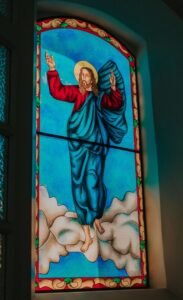
The Assumption by Murillo

The Assumption by Murillo

August 15th, the Feast of the Assumption, dates to the 6th and 7th centuries. The official proclamation of the Assumption by Pope Pius XII in Munificentisimus Deus as an article of faith for Catholics occurred recently, on November 1, 1950. Objections to this teaching cite the absence of support for it in Scripture and in the Fathers of the Church. These same arguments are also made against the doctrine of the Immaculate Conception, which states that Mary received the benefit of the redemption in advance from the moment of her conception. However, since the theological significance of Mary is intertwined with that of Christ, as mother and son, much of what we say about Mary (Mariology) derives from what we say about the identity and meaning of Christ (Christology).

For most Catholics, Orthodox, Coptics, and Anglicans, images and veneration of Mary, the Mother of Jesus, are part of the very fabric of their faith. This emotional and doctrinal emphasis on Miriam of Nazareth gives many in the Anabaptist and Calvinist traditions emotional and doctrinal heartburn. Some evangelicals are strident in their belief that Marian devotion - at best - detracts from the key act of salvation, which they formulate as “accepting Jesus as your personal Lord and Savior.”

The notion of salvation in the apostolic churches is centered on the church community. Christ’s death and resurrection has saved all and we enter into this paschal mystery embodied in the church. Our salvation is entering the faith community, the Body of Christ. From the earliest days, the Fathers of the Church identified Mary as the model of the Church. The following excerpt, taken from Wikipedia’s article on Roman Catholic Mariology, summarizes the position and importance of the Blessed Mother. Please note that the words in parentheses are my own.

Pope Benedict XVI addresses the issue, why Mariology is related to ecclesiology (the theology of the Church). On first sight, he argues, it may seem accidental, that the (Second Vatican) Council moved Mariology into ecclesiology. This relation helps to understand what “Church” really is. The theologian Hugo Rahner showed that Mariology was originally ecclesiology. The Church is like Mary.[96]

The Church is virgin and mother, she is immaculate and carries the burdens of history. She suffers and she is assumed into heaven. Slowly she learns, that Mary is her mirror, that she is a person in Mary. Mary on the other hand is not an isolated individual, who rests in herself. She is carrying the mystery of the Church.[97]

Pope Benedict XVI lamented that this unity of Church and Mary was overshadowed in later centuries, which overburdened Mary with privileges and removed her into a far away distance. Both Mariology and ecclesiology suffered under this. A Marian view of the Church and an ecclesiological view of Mary in salvation history lead directly to Christ. It brings to light what is meant by holiness and by God being human.[98]

It is interesting to note that Pope Benedict XVI laments the removal of Mary “overburdened … with privileges.” This is also the image of Mary lamented by the reformation. However, the close identification of Mary with the Church, in the sense that “Mary is carrying the mystery of the Church,” represents a notion of church that many of the reformers rejected. Consequently, they rejected the image and role of Mary, and with it, the redemptive grace and power of the feminine.

Saint of the Day: St. John the Baptist - June 24 by RandyPozos on Tuesday 24 June 2008 10:56 am PDT


St. John the Baptist is the last of the prophets and the first of those to approach the Kingdom. He occupies a place of transition. Christ acknowledges him in a strange way in Luke 7:24-28:

When the messengers of John had left, Jesus began to speak to the crowds about John. “What did you go out to the desert to see - a reed swayed by the wind?
Then what did you go out to see? Someone dressed in fine garments? Those who dress luxuriously and live sumptuously are found in royal palaces.
Then what did you go out to see? A prophet? Yes, I tell you, and more than a prophet.
This is the one about whom scripture says: ‘Behold, I am sending my messenger ahead of you, he will prepare your way before you.’
I tell you, among those born of women, no one is greater than John; yet the least in the kingdom of God is greater than he.”

Somehow the least in the Kingdom of God is greater than John. The least are greater than this courageous prophet who spoke truth to power and was beheaded for his efforts. Aren’t those of the Kingdom not born of women? Isn’t John’s courage and faithfulness a model for all Christians? Christians are born again of water and the Holy Spirit. John announces the coming of the Lord and for all of the wonder and importance of this role, it is not as privileged as the least in the Kingdom of God.

The feast of St. John the Baptist is a time to reflect on the privilege and grace of our invitation to the Kindgom. In the earlier verses of this chapter, Jesus tells the the messengers of St. John to report to him what the signs of the Kingdom are: the blind see, the lame walk, the sick are cured.

Maybe it’s time to see where we are in the Kingdom.

Easter Tide: The Age of Faith by RandyPozos on Sunday 30 March 2008 11:23 pm PDT

christ-carmelite-icon.jpg

It’s all so obvious - right? Jesus is Risen. The women and men closest to Him have all seen Him, touched Him.

Yet they only recognized Him with difficulty. St. Mary of Magdala’s grief was not broken until Jesus called her by name. The Apostles recognize Him with difficulty and Jesus takes the initiative to introduce Himself. There is an air of surprise - an awkwardness that Jesus breaks with the greeting used by Angels and other heavenly visitors, “Peace be with You”. It is easy enough to see this as a blessing, but not as the gesture of reassurance that it is. The Risen Christ is not the historical Jesus that He was. Beyond time and space, the Divine Word - God Eternal - is now and ever was.

We can all now live in the Risen Christ and He in us.

“Without seeing you, We love you;

Without touching you, We embrace;

Without knowing you, We follow;

Without seeing you, We believe.”

- David Haas, “Without Seeing You”, from the album “Glory Day”.

st-thomas-doubting.jpg

St. Thomas the Apostle is better known for his doubt than his faith. The story takes place after Jesus has appeared to the Apostles and shown them the wounds in His hands, feet, and side. The resurrected, glorified Christ still has his wounds. Why wasn’t He restored to His original whole state? Was it the way for His disciples to recognize Him, or is His passion and death such a part of Him that His very wounds have become part of His identity? It all sounds a little too good to St. Thomas when the others tell him of the Lord’s visit. The message to Thomas, and the rest of us, when he encounters Christ, is “blessed are those who have not seen and believe.” (John 20:29)

Faith.. Blessed are those with faith.

Blessed be the God and Father of our Lord Jesus Christ,
who in his great mercy gave us a new birth to a living hope
through the resurrection of Jesus Christ from the dead,
to an inheritance that is imperishable, undefiled, and unfading,
kept in heaven for you
who by the power of God are safeguarded through faith,
to a salvation that is ready to be revealed in the final time.
In this you rejoice, although now for a little while
you may have to suffer through various trials,
so that the genuineness of your faith,
more precious than gold that is perishable even though tested by fire,
may prove to be for praise, glory, and honor
at the revelation of Jesus Christ.
Although you have not seen him you love him;
even though you do not see him now yet believe in him,
you rejoice with an indescribable and glorious joy,
as you attain the goal of your faith, the salvation of your souls. (1Peter1:3-9)

Christ died for all, but salvation comes to us through faith? Why? Stay tuned…

Seven Stanzas at Easter - John Updike by RandyPozos on Saturday 29 March 2008 9:31 pm PDT
resurrection-of-jesus-kenya.jpg


Make no mistake: if He rose at all
it was as His body;
if the cells’ dissolution did not reverse, the molecules
reknit, the amino acids rekindle,
the Church will fall.

It was not as the flowers,
each soft Spring recurrent;
it was not as His Spirit in the mouths and fuddled
eyes of the eleven apostles;
it was as His Flesh: ours.

The same hinged thumbs and toes,
the same valved heart
that — pierced — died, withered, paused, and then
regathered out of enduring Might
new strength to enclose.

Let us not mock God with metaphor,
analogy, sidestepping transcendence;
making of the event a parable, a sign painted in the
faded credulity of earlier ages:
let us walk through the door.

The stone is rolled back, not papier-mache,
not a stone in a story,
but the vast rock of materiality that in the slow
grinding of time will eclipse for each of us
the wide light of day.

And if we will have an angel at the tomb,
make it a real angel,
weighty with Max Planck’s quanta, vivid with hair,
opaque in the dawn light, robed in real linen
spun on a definite loom.

Let us not seek to make it less monstrous,
for our own convenience, our own sense of beauty,
lest, awakened in one unthinkable hour, we are
embarrassed by the miracle,
and crushed by remonstrance.

Telephone Poles and Other Poems © 1961 by John Updike. Reprinted by permission of Alfred A. Knopf, a division of Random House Inc.

St. Mary at Easter Tide by RandyPozos on Wednesday 26 March 2008 11:08 pm PDT

rejoice-monica-stewart.jpg

The Blessed Virgin Mary has many beautiful titles. St. Mary at Easter Tide is my very own. Scripture is very silent about the Mother of Jesus after the Resurrection. We know that she is present in the upper room when the Spirit comes upon the Apostles at Pentecost. At the Annunciation, the Angel Gabriel tells her nothing about her future, except that her Son will be destined for the rise and fall of many in Israel. Mary’s first post-partum visit to the Temple portends a life of sorrow. According to Simeon, a sword will pierce her heart seven times. This most beloved young woman is left to ponder these things in her heart.

There are many good years together, until He leaves to find his cousin John at the Jordan. Then things go from bad to worse. Her friends and neighbors toss Him out of Nazareth. Jesus dies a horrible death; His mission a failure; her maiden’s vision becomes a bitter delusion. In his final words, Jesus entrusts St. John and Mary to each other - a final testament that seals the depth of grief.

There is no record of how Mary hears the news; of how she reacts. Who tells her? Jesus Himself? It seems that this duty falls to us. The noonday prayer echoes a wonderful joy - Regina Coeli laetare alleluia! Queen of Heaven Rejoice alleluia! … Resurexit sicut dixit! He has risen as He said (he would)!

Even though the words echo from my childhood at “Mid-century,” how well I remember and still experience the delightful childish skip in our hearts and step that we shared at Easter Tide. These are not the inspired words of the Gospel in the Hail Mary, nor the briefest of summaries of the Mystery of the Incarnation in the Angelus. For a prayer, Regina Coeli seems strangely out of character. There is no formality, no reserve. In our joy, we proclaim the Good News to the Mother of the Word Incarnate. God has turned our mourning into joy, but how could we ever begin to fathom what his news meant to the woman whose faith gave birth to us all?

Easter: Not Recognizing the Risen Christ by RandyPozos on Monday 24 March 2008 3:39 pm PDT

mary-magdalene.jpg

The very core of Christianity is the amazing tenacity of the believers to assert the impossible - a man publicly tortured to death rose from the dead. What is even more surprising is that they did not recognize Him.

Seeing loved ones after they are dead is not that uncommon among those stricken with grief. According to psychologists, this delusion always produces an immediately recognizable image of the dead person.

One of the most affecting scenes in the Gospel is the encounter between that most faithful of disciples, Mary of Magdala, and the Gardener in the Gospel According to St. John, Chapter 20: 10-18.

Then the disciples went back to their homes, but Mary stood outside the tomb crying. As she wept, she bent over to look into the tomb and saw two angels in white, seated where Jesus’ body had been, one at the head and the other at the foot.

They asked her, “Woman, why are you crying?”

“They have taken my Lord away,” she said, “and I don’t know where they have put him.” At this, she turned around and saw Jesus standing there, but she did not realize that it was Jesus.

“Woman,” he said, “why are you crying? Who is it you are looking for?”
Thinking he was the gardener, she said, “Sir, if you have carried him away, tell me where you have put him, and I will get him.”

Jesus said to her, “Mary.”
She turned toward him and cried out in Aramaic, “Rabboni!” (which means Teacher).

Jesus said, “Do not hold on to me, for I have not yet returned to the Father. Go instead to my brothers and tell them, ‘I am returning to my Father and your Father, to my God and your God.’ “

Mary Magdalene went to the disciples with the news: “I have seen the Lord!” And she told them that he had said these things to her.

In the the other encounters of the disciples with the Risen Christ, there is a similar pattern. The very people who lived with Him on a daily basis, shared His travels, and even argued with Him, didn’t recognize Him. The reality was so much beyond a delusion of grieving friends and followers, so much beyond irrational expectation, that we only get a glimpse of how preposterous it was in the expressed doubts of Thomas. (John, chapter 20)

More than any other event in the Gospels, the stories of the empty tomb, the encounters, the general chaos that occurred is hard for us to fathom, let alone appreciate, since we have heard the story so many times. The story of the suffering and death of Christ is always muted for us because we know how the story ends. The men and women who followed Jesus were more bewildered and confused on that first Easter because what they heard was so outlandish.
The term for Easter in Romance languages drives from Passover - “Pascua” in Spanish and Italian, and “Paques” in French. Since the English term doesn’t bear this heavy direct reference to Passover - the Passover of the Lord - we can miss a key fact of experiencing the Resurrection - being led out of bondage is a tumultuous, confusing, and fearful process. We can cope with grief, disillusionment, and grinding oppression, finding comfort in cynicism, skepticism, or addiction. Resurrection for us is only a painful beginning, an inconvenient surprise, getting stretched on a rack of hope.

Having seen the worst, Mary of Madgala, like us, could conceive of only the worst when she saw the empty tomb. These glorious “men” in white must have taken the only memento left of the Teacher whom she so desperately loved. Where was his body? She had come to do the courageous and loving act allowed to women of her time. But there was no body.

Everything shattered when she heard her name, in a voice that no other could have uttered. Her love would only cause more problems. Are we ready for that?

christ-of-maryknoll.jpg

For those who love Christ, remembering His passion and death is always an occasion for sorrow. However, such human acts as compassion are never simple. The pain of the impending loss of a loved one - anticipatory grief - can be worse than the actual loss. In fact, when death finally comes, we often feel guilty about experiencing relief. My friend Jim lost his father when Jim was in eighth grade, after a protracted two year battle with cancer. When we talked about it a couple of years later, Jim confessed that he still felt more relief than grief.

Of course, we couldn’t experience compassion without a close identification with the other. This becomes very complex in the person of the Christ. He did not fight his enemies. He did not curse. He did not condemn. He forgave. He blessed. This human-divine reaction to an injustice that is almost as inconceivable as it is enraging provides no adequate psychological outlet for the post-Freudian soul. How can we proclaim and fight for justice if God Himself did not? Tragically, the consolation in the Gospels and the wider testimony of the New Testament - that no evil, no matter how overwhelming, how senseless, can ever separate us from the love of God in Christ Jesus - escapes us. (Romans 8:38-39) Instead of experiencing this Passover of the Lord - the Blood of the Lamb on the door posts and lintel of our home that spares us from the Angel of Death - we run out into that night of despair by focusing on the ways we have been complicit with that evil.

When we hear that we are saved from a life defined by suffering and pain without meaning and no exit, we can think that we were saved from something we deserved. “Evil as you are … who among you would give his son a scorpion when he asked for bread?” (Loosely taken from Luke 11: 11-13) is a stark reminder to the disciples that Jesus could not conceive of His Father wanting anything less than we ourselves would want for our own children. Just as our children are all too much in our own image and likeness, we are in God’s. The teaching and life of Jesus in this regard is at odds with the vengeful patriarch of the Old Testament who punishes and chastises. (Lest we be tempted to think that Jews hold or held onto to this concept, we should remember that Jesus was not the only Jew who presented a view that had grown beyond it. The are interesting similarities between Jesus and his contemporary, Hillel the Elder.)

Enter God’s protectors:

“Ah hah! Now he has said it on his very own blog! Your own words condemn you. God doesn’t care about sin, you say. There are no consequences, no punishment, no reckoning. You present a God who is merciful, but not just. If Christ did not die for our sins how was the Father appeased? How is he the sacrificial victim?”

The Blogger Offers a Parable:

Once upon a time, there was a wonderful teacher who healed by word and touch and saved people from all kinds of physical, psychological, and social maladies. He made the mistake of speaking truth to power and telling religious and civil leaders that outward observance only made them into whitened sepulchers. They waited for the right time and got a close friend to betray him, and they took him off to Guantanamo, and then transferred him to a third world country, where he was tortured to death by specialists trained at the School of the Americas. Like so many thousands of his time, he was supposed to have become one of the disappeared. Fortunately for us, He didn’t stay dead and he didn’t stay hidden. Strangely though, he left again, said he would return, and in the meantime the were supposed to wait for a Holy Wind to make everything clear.

Yet His disciples wanted an explanation. If He was truly God’s Son, how could this have happened to Him? If he really was the Messiah, how could he have failed? He was just as maddening as those parables he used to tell them. Where are the answers? It was like one of those Eastern religions. “The question is the answer.” And that other junk the Beatles found in India, under the influence of something other than the great American mystic, Jack Daniels.

God finally sent them someone they could understand - sort of. “Like, well, yuh see, dude- God don’t need sacafices, ” The voice of the aging surfer was hoarse with too many years of funny cigarettes, his faced etched with too much salt and sun, his eyes opaque while he waited for the waves to rise. “It’s like, all ’bout love. All God wants is love. The torture and sufferin’ part, that’s what we do to us and each other. Man, like the Teacher Dude, the Guru Guy, like he couldn’t hang out forever. ‘Cause like, you guys were all brain dead on a kind a gnarly bad trip. Like he let it happen. The tube was closin’. Like there was just the wipeout; like really bad at Mavericks. He did it to show y’all that if yah stay in the water and go for it, sooner or later it’s gonna happen if ya stay true to the search for the Big One.  Dude, got some extra change? My old lady’s on me for the rent, like ya know.”

The words of reproach, as the seeker turned away, were familiar. “That sucks man. What a waste. I came to hear some guy explain some @$#%?! blogger’s crappy parable. I could’a been watchin’ the game on my big screen.” So he zipped up his jacket and marched straight home, out of the saving mystery, ignoring the glory of the sky, the dazzle of the water, and the carpet of color and bird song all about him.

Holy Thursday on the California Coast by RandyPozos on Thursday 20 March 2008 11:42 am PDT

cal-coast-spring.jpg

Holy Week on the California coast, from Pt. Mendocino above San Francisco to the Mexican border, is a place of spring time sun, deep blue skies, and blossoming flowers. At the Equinox, the ocean loses its grayness and picks up more yellows, subtle greens and muted turquoise. The salt air becomes more pungent, as the kelp forests put on new growth to accommodate the explosion of trillions upon trillions of sea plants and animals. The succulents and coastal chaparral burst out in purples, roses, and pinks, peppered with the bright yellow of sour grass blossoms. The Santa Cruz redwoods seem to stretch, fresh washed from the winter storms, looking forward to the morning and evening fog that gives them sustenance and flourishes their layered ecosystems that change every 20 feet upward, dancing in the dappled ray filled sunlight of the forest canopy.

It is a time of happiness and rejoicing. Sunglasses come out, flip flops slap the pavement, and shorts replace the winter denim, even though the day time temperatures are barely in the mid-60s. It is the coming of First Summer, before the Fog Season that begins on Memorial Day in late May and ends on Labor Day in early September. On the Central Coast, we host our first guests during Spring Break and settle in to enjoy the peaceful days before our June to August onslaught of shivering, fog-bitten visitors and their much welcome tourist dollars.

Aren’t we supposed to be down or at least subdued during Holy Week? How can we rejoice Saturday evening and Easter if we have somehow not rationed that joy? We should at least lament our unfaithful adherence to our Lenten resolutions - right? Christ’s terrible torture and death stayed the arm of a rightfully vengeful Father, so shouldn’t we show at least some token of fear for not being swept out into hellfire? If God’s Spring and Passover are any indication, maybe Cotton Mather had it wrong. Maybe we are a lot more than “Sinners in the Hand of an Angry God.”

If we, and all creation, are the overflowing love of the Trinity, are we the products of a God who can somehow demand the death of the the Eternal Word Made Flesh, God’s very immediate recognition and instantaneous self-acceptance, who shares the eternal dance of the Three in the joy of the Holy Spirit? Yes, much of the language that shapes our souls is a reflection of the fallen world where the Word “pitched his tent” - the actual Greek expression we use in the Creed. Yes, Jesus died and saved us in his rising from the dead. Yes, Jesus is the Lamb of God. Yes, we are the reason, we are his motivation for sharing our lives and submitting to the capital punishment of being tortured to death by an occupying superpower. Perhaps, the gravest sin of pride is to even think that we were the cause. Yes, God as Love couldn’t bear to leave us to the fate of hatred, despair, and alienation.

Why should people celebrating their rescue be glum, depressed, lost in narcissistic guilt? Why is this night different from any other night? It is the Passover of the Lord. If we are not washed in joyful Spring, can we share the Passover meal? Can we have any part in Him?

Categories

  • Angels (3)
  • atonement (13)
  • Christian Unity/Ecumenism (3)
  • Communion of Saints (7)
  • Conversion (25)
  • Doctor of the Church (19)
  • Edith Stein (2)
  • Eucharist (6)
  • Ever Ancient / New (46)
  • everyday revelation (69)
  • Faith and Reason (51)
  • Faith in Action (98)
  • Fathers of the Church (8)
  • Feasts - liturgical (54)
  • Festive recipes (3)
  • Forgiveness (12)
  • God in All Things (36)
  • Gratitude (16)
  • Holocaust (3)
  • Incarnation (21)
  • It's to laugh (1)
  • Jewish / Christian Relations (3)
  • Korean Martyrs (1)
  • Liturgical year (42)
  • love (35)
  • Marriage (5)
  • Ministry (1)
  • Miracles (13)
  • Missions (10)
  • Mother Teresa (3)
  • Mystics (11)
  • Pagan/Christian Relations (1)
  • Pope John Paul II (3)
  • Pope John XXIII (2)
  • Pope Paul VI (1)
  • problem of evil (9)
  • Sacraments (9)
  • Saints (107)
  • Salvation (24)
  • Second Vatican Council (5)
  • Site logistics (4)
  • Social Justice (31)
  • spiritual growth (67)
  • spirituality (53)
  • St. Augustine (1)
  • St. Faustina Kowalska (1)
  • St. Francis of Assisi (2)
  • St. Ignatius Loyola (2)
  • St. Jerome (1)
  • St. John Chrysostom (1)
  • St. Joseph of Cupertino (1)
  • St. Matthew (1)
  • St. Robert Bellarmine (3)
  • St. Therese of Lisieux (3)
  • St. Vincent De Paul (1)
  • St.Thomas of Villanova (1)
  • Theodicy (2)
  • Thomas Merton (1)
  • Uncategorized (10)
  • Virgin Mary (6)
  • Vocation (2)
  • Yom Kippur (1)
  • Youth Ministry (1)
  • Monthly Archives

  • January 2009
  • December 2008
  • November 2008
  • October 2008
  • September 2008
  • August 2008
  • July 2008
  • June 2008
  • May 2008
  • April 2008
  • March 2008
  • February 2008
  • January 2008
  • December 2007
  • November 2007
  • October 2007
  • September 2007
  • August 2007
  • July 2007
  • Recent Posts

    Recent Comments

    RSS Subscription

    Subscribe by Email

    Enter your Email


    Preview | Powered by FeedBlitz

    Visitors

    Locations of visitors to this page

    Creative Commons LICENSE

    This work is licensed under a Creative Commons License.