Pages Menu
RssFacebook
Categories Menu

Posted by on Jul 4, 2010

July 4, 2010 – Parades, Celebrations and Prayers

July 4, 2010 – Parades, Celebrations and Prayers

Fog near Monterey Bay

The Fourth of July dawned foggy and cold this morning in Santa Cruz. Not too surprising. It is, after all, “fog season.” Usually the fog lifts by early afternoon, but it’s after 3 now and except for it being a touch ligher, there’s no blue sky near the ocean.

It’s been an unusual Sunday for us. The celebration of the Mass we usually attend can’t take place when the 4th falls on a Sunday because the Aptos 4th of July Parade starts in the street beside the church (Resurrection Parish). Our pastor offered a “Park, Pray & Parade” special to all who wanted to attend the 8:15 Mass, but that’s a bit early for my family. So we chose to visit another parish community this week.

We arrived just on time for Mass at Holy Cross Church in Santa Cruz, after having been diverted by a detour due to closure of the road that passes the church. We came in the back way and parked behind the old school building. Arriving at the front of the church, the reason for the road closure was apparent. A brass band was playing, people were milling around, dressed in their “Sunday best,” (not a common sight in Santa Cruz on a holiday weekend) and lots of young girls were dressed in long white gowns, with capes and trains and wearing glittering crowns. We’ve lived here a long time, but this was the first time we’d arrived for this celebration.

We went into the church and discovered that the Portuguese community was having their annual celebration of the Feast of St. Elizabeth of Portugal. St. Elizabeth (1271 – 1336) was Queen of Portugal and noted for her devotion to the Holy Spirit and her care for the poor. Married at the age of 12, she was none-the-less a strong spirited woman who was not afraid to think for herself and even defy her husband. It is said that when he forbade her to take food to the poor, she continued to do so anyway. One day he caught her and asked what she had hidden under her cloak. She replied, “Roses.” He scoffed at that response because it was January and roses are not blooming in January in Portugal. He tore her cloak open and found, to his amazement, that she was indeed carrying roses.

St. Elizabeth of Portugal

Elizabeth (Isabel) was also known to be a peacemaker. When her husband and son, leading armies against each other, met on the battlefield, she marched out between them and made them come to terms of peace. Later, in her old age, she did the same when her son prepared to fight the king of Castile.

In Santa Cruz and around the world, where Portuguese communities live, the feast of St. Elizabeth is celebrated with special prayers to the Holy Spirit and blessings for the girls. This celebration occurs every year. I’d seen the procession after Mass – everyone walks from the church, up over the freeway and down to the Portuguese Hall in the park nearby for an afternoon of feasting and fun. It was a blessing to share Eucharist with them this year.

After the final hymn, in Portuguese, the choir led those who had not yet processed out of the building in the song, America the Beautiful. It seemed fitting. Here we all were. People literally from all over the world. Old folks and children. Parishioners and visitors to the community. People from all different walks of life. Social liberals and social conservatives. Gathered together to hear the word of God, celebrate Eucharist together and pray with thanksgiving for the gift of a wise and generous queen centuries ago, the gift of a nation with “freedom and justice for all” that we have received from our forebears in this country and to ask for the gift of wisdom for ourselves and our leaders now, in this time, with the challenges we face today.

The  original words of the hymn, and it is indeed a hymn, are worth pondering as we celebrate the freedoms we enjoy in this country today.

America the Beautiful

O beautiful for spacious skies,
For amber waves of grain,
For purple mountain majesties
Above the fruited plain!
America! America!
God shed his grace on thee,
And crown thy good with brotherhood
From sea to shining sea.

O beautiful for pilgrim feet,
Whose stern, impassioned stress
A thoroughfare for freedom beat
Across the wilderness!
America! America!
God mend thine every flaw,
Confirm thy soul in self control,
Thy liberty in law.

O beautiful for heroes proved
In liberating strife,
Who more than self their country loved,
And mercy more than life!
America! America!
May God thy gold refine,
Till all success be nobleness,
And every gain divine.

O beautiful for patriot dream
That sees beyond the years
Thine alabaster cities gleam,
Undimmed by human tears!
America! America!
God shed his grace on thee,
And crown thy good with brotherhood
From sea to shining sea.

Amen! May it be so.

Happy 4th of July!

(Words of America the Beautiful by Katherine L. Bates. Music by Samuel A. Ward.)
Read More

Posted by on Jun 18, 2010

July 4, 2010 – Parades, Celebrations and Prayers

Father’s Day – 2010


"Let's play Sandwich!"

“When we were children, we used to think that when we were grown-up we would no longer be vulnerable. But to grow up is to accept vulnerability. To be alive is to be vulnerable.”
Madeleine L’Engle

I have known many fathers in my years. Each is unique. Each brings his own special gifts to his family, friends, and associates. Some fathers love to hunt and fish. Others are gardeners. Some come home and watch TV. Others get lost in a book. Some pack up their families and go traipsing around the country every chance they get. Others are content to stay in their own community, considering a picnic at the park a fine outing.

Regardless of the particulars of each man’s habits and preferences, there are some characteristics that I think are common among fathers. Probably the first is that they really had no idea what they were getting into by fathering a child. (I must say that in my experience, mothers don’t know this bit of reality in advance either!) Nevertheless, hundreds of thousands of men have willingly entered into the path of fatherhood. And then the adventure began …

Fatherhood requires a willingness to be more than the progenitor of another human being. It requires a willingness to be vulnerable and to learn as you go. Parenthood brings out the best and the worst in each of us. We learn as we go along – making mistakes, making amends when possible and doing some things right the first time (even if by accident). We find out what deep darkness can lurk within us. We also find out what depths of patience and love can be tapped, especially if we remember to call for help from the Father of us all. We delight in watching our children discover the world and their own identities. We sorrow with them when they fall and help them get back up and try again. We grieve with them when something precious ends and can’t be regained.

To a child, the father is a powerful figure. He stands so tall and is so strong. He picks us up and twirls us around and the world whirls too. He comes home happy and the household sings. He comes home frustrated and tired and the household … Well, we hope the household reaches out to reassure and comfort him. Doesn’t always happen that way, but that’s the ideal. Sometimes he gets angry. Sometimes he laughs when he feels like crying. Sometimes he picks a flower to say, “I love you.” Sometimes he just lets his child crawl all over him and pull at his chin whiskers and ears.

Fathers come in many sizes and shapes. Some are old. Some are young. Once a man becomes a father, he never stops being a father, even if his children move far away or are estranged from him.

Being a father means being vulnerable. Vulnerable to love. Vulnerable to having your heart broken. Vulnerable to losing a precious person. Vulnerable to finding precious meaning in small, everyday ordinary activities.

Vulnerability is not necessarily a bad thing. Only hearts that are open and unshielded can receive the gift of love that is pouring into the world each day, keeping all in existence.

So as we approach Father’s Day and celebrate the lives of the men in our lives who have given their lives to us in so many ways – those who have physically given us life and those who have given us faith, hope and encouragement as “father-figures” or teachers or godfathers – let us be grateful and supportive of them. They have learned and continue to learn the great secret that by opening themselves and becoming vulnerable, they receive the greatest blessings of this life – the love and wonder of sharing in the work of creation with our Father.

Thank you to all of you men who have accepted the joys and challenges of being fathers to your children and to those who have come to you in need of a father’s guidance. May the Lord’s rich blessings be always yours as you do your best to share what you’ve learned and help the next generation along on their journey as well.

Happy Fathers Day!

Read More

Posted by on Jun 6, 2010

Corpus Christi: Who’s Feeding on Whom?

Today is the feast of Corpus Christi, the Body and Blood of Christ. We celebrate the great gift of the Eucharist – a feast of thanksgiving. We celebrate that the Lord has given His very being to us to be food for our journey through our lives here and now – from this day to the day of our birth into eternal life in the next here and now.

I’m struck today by the contrast between the Lord’s gift of allowing us to eat of His body and blood, soul and divinity and the way in which those spirits not in union with God, the evil ones, feed on our energies when we choose to welcome them into our lives even for a moment.

It became very clear to me again yesterday how quickly and subtly they will move in and start draining energy away from individuals and families. I received a notice in the mail regarding a challenge we’ve been facing as a result of the problems in the global financial markets hitting “Main Street.” I don’t know what the notice means, but it’s not a great situation and it could be the first step of more challenges coming. On the other hand, it might not mean anything negative at all.

But I was tired and a bit stressed and I found myself fretting about it. Then other things started popping up with their “… and did you remember that he …” and “… can you believe the nerve of …” Nothing huge involved. Nothing to which I would not have agreed. Just that quiet, insidious little voice encouraging me to feel upset, tired, a little resentful, or whatever.

As I got more out of sorts, others in the family also got edgy, including the resident baby.

Finally, my children sent me for a walk with the baby and fixed dinner themselves. On the walk, a relatively quiet activity with a very young child in a stroller, I realized what was happening. I closed the feeding trough to the spirits who had crept in and I asked my Guardian Angel and the Holy Spirit to protect me and us from their influence.

One thing I’ve learned – that kind of prayer is never ignored. I was better immediately and we had a lovely dinner and pleasant evening.

So, how does this relate to Corpus Christi? We can choose to allow the evil spirits to invade. We can feed them. The expression, “What’s eating you?” is absolutely an accurate description of an unseen reality. Or we can keep closing that restaurant when they come around and instead feed on the love of God, the body and blood of our Lord.

The neat thing is this. To the extent we feed on the Lord, we can then help feed those around us in positive ways. Everything becomes manageable again. Problems can be solved. Joy returns.

I still don’t know what that notice means, but whatever it means, all will be well as long as I/we remember Who should feed whom.

Happy Feast of Corpus Christi.

Read More

Posted by on Jun 3, 2010

On Falling in Love – A Thought from Pedro Arrupe, SJ

I’ve seen this quote from Father Pedro Arrupe, S.J. in the past and always been delighted with it. I came across it again today. It seems quite apt as we are celebrating the time of the Holy Spirit of Love during this season of Ordinary Time.

Nothing is more practical than
finding God, that is, than
FALLING IN LOVE
in a quite absolute, final way.
What you are in love with,
what seizes your imagination,
will affect everything.
It will decide
what will get you out of bed
in the morning,
what you do with your evenings,
how you spend your weekends,
what you read, who you know,
what breaks your heart,
and what amazes you with
joy and gratitude.
Fall in love, stay in love,
and it will decide everything.

Pedro Arrupe, SJ

Read More

Posted by on May 26, 2010

July 4, 2010 – Parades, Celebrations and Prayers

Pentecost Insights on Laundry Day

Dove of Peace by Pablo Picasso

We celebrated the feast of Pentecost this past Sunday. It’s the Birthday of the Church and one of my favorite celebrations. Without the coming of the Holy Spirit on Pentecost, we would most likely never have heard the Good News of Jesus’ life, death and resurrection. His followers were just plain too scared to tell what they had witnessed.

At Pentecost, the Lord’s promise that He would ask the Father to send an Advocate to us, one who would continue to teach us what we need to know, was fulfilled. We entered the age of the Holy Spirit, an age that continues to our day.

I was musing on the wonders of the coming of the Spirit and the importance of the event yesterday while doing laundry and caring for my 14 month old grandson. (Yes, he’s a beautiful child and a rare delight!) I’d had a conversation on Sunday with a non-Catholic friend who had really never heard of Pentecost in her religious experience. We had talked about the coming of the Holy Spirit, the timing of the feast in relation to Easter and the effect of the Spirit’s coming on the early Christian community. I’m always surprised to find again that people are not aware of the story of the Church and the many twists and turns of its history. There is so often a sense that all was clear and settled from the start. The Acts of the Apostles makes it clear that the first followers of The Way were feeling their way and responding to the promptings of the Holy Spirit just as we must today.

My grandson loves to fold clothes. Up until a week ago, he simply stood by the davenport (sofa, couch) and pulled the clothes off as fast as he could. Once they were all on the floor, he’d hand them to me as fast as he could. Then I’d pick all of them up and we’d repeat the process, with a few more actually getting folded at each repetition! Last week he discovered that he no longer needs to hold a big person’s hand to walk or even run. So now he grabs an article of clothing from the stack and takes off racing across the room with it, dropping it at some point along his way.

He was laughing happily and carrying a handkerchief when suddenly he stopped. Several of us, including the child, have had colds, including runny noses. He’s been fascinated by the blowing of noses that has been occurring around the household. He put the handkerchief to his nose and made a loud blowing sound through his lips. He was so proud of himself. He was certain he’d figured out how to make that amazing noise that all of us had been making. In fact, he was so delighted, that he raced back to the davenport, grabbed a shirt and repeated the feat. Then a sock… Then a pair of pants…  Each time he simply beamed with delight and laughed uproariously.

It struck me, as I watched and laughed with him, that we are blessed that the gifts of the Holy Spirit continue to be poured out among us, with the Spirit continuing to teach us in our day too. As we learn so much more in the worlds of science, math, psychology, anthropology and all the other realms of human knowledge, it is truly a blessing that the Holy Spirit is with us, enlightening our hearts so we can see the Lord’s hand in all of creation in ever more wondrous ways. Imagine how sad it would be if we were forever condemned to the level of understanding of a small child who believes that blowing his nose requires use of his mouth! It’s a fine step on the way to understanding of the real way to perform the task, but only a step. With the grace of the Holy Spirit, we too move forward in our journey, growing up a little more each day and each generation, to see the wonders the Lord has wrought for us.

Happy Birthday, Church.

Read More

Posted by on Apr 23, 2010

July 4, 2010 – Parades, Celebrations and Prayers

St. George and The Dragons Within

St. George - 15th Century icon from Novgorod

April 23 is the feast of St. George. George was a Roman soldier in the third century, during the time of the Emperor Diocletian. He was from a Christian family and his father was an army officer. As a young man, he also entered the service of the Empire and rose to the rank of Tribune, enjoying a position of trust with the Emperor. When Diocletian turned against Christians and ordered the arrest of Christian soldiers, George went to him and protested the action. The Emperor was not swayed by George’s appeal and instead ordered him to renounce his Christian beliefs. George refused, was tortured and eventually was beheaded.

Most of the stories of St. George are non-verifiable legends. At least some of them seem to be confusions with the stories of others named George or others who had similar positions or histories.

The stories with which he is most often identified have him in the role of Dragon-slayer. They are found in many countries and cultures, even crossing religious lines between Christian and Muslim worlds. In most stories St. George slays the dragon. In some, he subdues the dragon.

I like the idea of subduing the dragon. I first came across it when my sons were young and attending Waldorf school. For the Feast of Michaelmas, in September, the second graders performed a play in which St. Michael faces a dragon that has been terrorizing a village. The play has a character more like St. George who is supported by St. Michael. In this particular version of the story, the dragon is tamed and provides energy to run the mill so the villagers can grind the wheat they have grown to make flour for their bread.

Dragons come in many sizes and shapes in stories from cultures all over the world. In China, dragons are respected and seen in a much more positive light than in Western European stories. In fact, when my first son was born, my Mother’s cousin who was a priest in Hong Kong sent a gift of a red dragon to us in celebration. The Dragon Wars stories of novelist Laurence Yep are some of my favorites. Written for middle school and older children, they present Chinese folklore in a very engaging way. Dragons are to be respected, held in awe and definitely not destroyed. Their presence and the gifts of passion and energy they bring are necessary for all of creation.

I like to think of dragons in these more Chinese terms. Having been born in a “Year of the Dragon” myself, and being somewhat choleric in nature, I have had to come to terms with the passionate, powerful energy within myself that can burst out in good ways and in not-so-good ways. That “dragonish” energy can bring forth wonderful things. It can also blast potentially wonderful things to smithereens if released inappropriately. I’m sure sometimes God winces in dismay as a carefully set up pattern of events that would lead to something really good gets derailed by such blasts. (Not to say that God can’t still bring something good out of it, but it’s so much more bother!)

So when I think of the feast of St. George and the stories of dragons slain or subdued or celebrated, I pray that the dragonish power within me – the Greek “dunamis” or power, potential, capacity – will be focused by the Holy Spirit for service of the Kingdom. I hope that will be your prayer as well.

Read More

Posted by on Apr 15, 2010

Tax Day 2010 – We’re All In This Together

April 15 is the deadline for Americans who have received income from any source in the prior year to pay any taxes due on that income. Needless to say, it is not the favorite time of year for most people. Generally there is a certain amount of hullaballoo about the whole thing. People complain about how much is taken from their wages, how people who don’t work still get help from the government, that they never personally agreed to the taxation, that people should be responsible for taking care of themselves, that some other generation is not doing its share or being appropriately responsible finacially, and so forth. The list of complaints goes on and on.

I’d like to offer a quick thought about the whole issue of taxation.

I seem to recall stories from our Judeo-Christian tradition in which the question “Am I my brother’s keeper?” arise in one form or another. Again and again, the response from God has been, “Yes, you are.”

From the earliest days of our tradition, through the Law and the prophets, to the days of Jesus and the early Church and up to the present day, we hear again and again, “We are all in this together.” We are to look out for each other. Yes, we are to do our best to take care of ourselves and those personally entrusted to us (spouses, parents, children, siblings), but we are also to take care of the widows and orphans among us (i.e., those who don’t have family or identity within the society). That means we are responsible for those who can’t work, even if they seem able-bodied, those who may not have proper legal documents allowing them to be here but who have had the misfortune to get sick or injured, those whose parents can’t earn enough to buy food, clothing, books, or health care for them, those elderly who have no children with whom they can live or who could afford to pay for shelter, food, and medical care for them, those for whom there is no job. Again, the list goes on and on.

We also share responsibility to pay the cost of keeping our communities safe, our roads, buildings and bridges safe, our educational systems safe and effective, our environment healthy, and those whose work is to serve the larger community paid a decent living wage, with access to health care and time off to renew their spirits and raise their families.

Some of us have been blessed with more resources. Some of us receive money for work done by others (parents, grandparents, etc.). Some have investments that provide income without the necessity of doing any physical or mental labor. Some have barely enough income to keep simple shelter overhead and food on the table. Some have enough for a comfortable lifestyle, without much left for the frills.

Whoever we are, whatever our circumstances, we are all responsible for each other. We’re all in this together.

So let’s pray for the grace to be willing to give of what we have. Some will receive more than they have paid in taxes as a refund this year. Believe me, when that happens to an ordinary family, they really need the money. They haven’t had a great year financially. It’s truly a gift from God to have enough income to have to pay taxes. There are so many deductions from taxable income, so many credits to help families and business owners, that if we still owe some tax, generally speaking, we have been blessed. It doesn’t always feel that way, but in the big picture, we have been blessed.

So today, as we send in our checks and our forms, let’s ask a blessing for ourselves and each other, a blessing for our country and our world, and a word of thanks to the Lord for the rich blessings of opportunity, environment and loving community that we have received.

Read More

Posted by on Mar 4, 2010

July 4, 2010 – Parades, Celebrations and Prayers

Divided by the Bonds of a Common Religion

When I was growing up, one of the questions always asked when two people began dating  was, “Is she/he Catholic?” It was quite rightly assumed that differences in religion within a marriage could be a major source of stress and potentially lead to break-up of the marriage. In those days, we were just barely past the time that “mixed marriages” took place at the rectory or in the vestibule, and the non-Catholic partner had to promise to raise the children Catholic before a marriage could be blessed. Presumably, sharing the bonds of a common religion would serve to strengthen the marriage.

Imagine my surprise, then, when I married a Catholic man of Mexican ancestry and discovered that we were divided by the bonds of a common religion. Many aspects of his cultural experience of Catholicism were different from the Irish-German Catholic experience of my childhood. (And no, the German Catholic side were not converts.  They had been Catholic for centuries.)

Things we found that differed ranged from the relative importance of certain feast days (those of Our Lady were never to be missed) to questions as “serious” as Friday abstinence (could one eat gravy served on potatoes at a restaurant on a Lenten Friday?).

Fortunately, we were both graduate students in Anthropology and had a vocabulary with which to discuss and appreciate the cultural differences over which we were tripping. Feasts of Our Lady are extremely important in Hispanic culture and, as Our Lady of Guadalupe, she is trusted to handle any and all problems that arise. Friday abstinence from meat has been somewhat optional within Spanish speaking culture since the time of the Crusades. The male head of household had the prerogative to excuse the family from following the rule of abstinence. So the question of gravy on potatoes was moot! Simply a minor cultural difference in the experience of faith and definitely not something requiring confession. (Further research done in the course of writing this post indicates that meat based gravy was never actually prohibited, but general understanding of the rules within my culture of origin excluded it.)

This all came to mind again in the past couple of weeks. One of our daughter’s classmates is also Catholic, from a somewhat more traditional family than ours. On Ash Wednesday, the friend ruefully confessed that she had already forgotten and had a piece of candy that day. She had intended to give up candy for Lent. As it turned out, she had also forgotten (or perhaps never realized) that Ash Wednesday is a day of abstinence. She had packed a wonderful turkey sandwich for lunch that day. When apprised of the fact, she looked at the sandwich, declared, “Well, it would be a shame to waste it,” and ate her entire lunch.

When I was their age, the poor sandwich would have been returned to its wrapper and taken home for another day, or perhaps even thrown away. Some might have chastised the young woman for breaking a Church rule and eating the sandwich. She probably would have felt the need to confess her sin. Blessedly, she does not seem to have such worries today.

So a few questions arise.  How do rules fit into our experience of faith? Why even have rules of fast and abstinence if they aren’t going to be taken extremely seriously? How can religious rules be applied to one group of people and not another? That’s not fair! Aren’t there more important things to worry about than what people eat and when? Should religions have rules at all?

In looking at religion and behaviors associated with religion, Clifford Geertz‘ insight, in “Religion as a Cultural System,” that religion serves both as a model of society and a model for society provides a useful platform for analysis. Religions all around the world have codes of behavior — expectations of how people will act and for what reasons they will act as they do. These codes are normally posited to be the will of the deity. Generally, they uphold the social structure of the society and provide the rationale for the way social interactions occur. The song, “Tradition,” from the musical, Fiddler on the Roof, is an excellent example of the structuring of such social expectations and the recourse to God as their source.

This works pretty well when the religion in question is a small, localized one with a limited number of adherents. With groups that are larger and spread out over a larger geographic area, modifications begin to be seen. As Christianity spread out through the Roman Empire, accomodations were made to make it more understandable to peoples with different geographical, economic and cultural realities. If evergreen boughs are a symbol of everlasting life in a culture, for example, it’s a short jump to include them as symbols in Christian settings as well. But if evergreens mean nothing in a culture, they will often mean nothing in liturgical settings either. For this reason we are careful what we include in liturgy that must of its nature be open to be experienced cross-culturally.

The underlying reason for a practice is also important in analysis of how that practice plays out in the lived experience of a people. If the underlying reason is that there must be atonement for one’s failings, a penitential reason, then denying oneself something good but not necessary for life is often valued. If growth in self discipline is an underlying reason, again, denying oneself something makes sense. If one’s salvation from a nearly eternal cycle of birth and rebirth requires attaining perfection or enlightenment in this life, such practices again make sense. If the reason is that we choose to enter into a time and process of transformation of who we are so that we can be more open to meet our God when He comes, then it again makes sense.

Most religions and “spiritual” movements or quests require their adherents to make sacrifices during certain seasons or as part of their daily life. There is a recognition that we are not perfect and we do not live in a perfect world. It takes work to make things better and to become better persons. We only grow through difficult experiences, not when all is easy. So times of prayer and fasting and  giving alms are commonly found.

The trick in all of this is to keep things in perspective. What is a more serious offense, eating meat on Friday, for example, or betraying a friend? Is it more offensive to God and the community to miss Mass on Sunday because guests arrived unexpectedly or to turn away the guests because one has to get to church? Should we look to larger issues of how we use resources locally and globally in planning the forms our fasting and almsgiving will take? How do our religious beliefs lead us to act in our communities and countries? How do we weigh the relative importance of the wide variety of issues that must be addressed by our representatives when we decide who will represent us in government? Can people of good will take different positions and still be part of our community?

It seems to me that all of these questions and more are reflected in the simple decisions we make about things like abstaining from meat on Friday or wasting the food that has been prepared for us. Some things are simply matters of traditional practice and can vary from place to place or family to family. Others are fundamental issues that go to the heart of our relationship with God and creation. Nevertheless, we must be gentle with each other in addressing them. God does not go around bashing people over the head and we must not either. If our religious beliefs and practices do act as models of the societies in which we live and models for what those societies should be like, and in my experience they do, then let’s be careful to use them to shape a society in which God’s “little ones” are protected and supported, people are free to ask questions, think for themselves, and grow in wisdom, age and grace,  and the resources we have been given can be used wisely to benefit all of God’s creatures, human as well as non-human.

Just as my husband and I found we were divided by the bonds of a common religion, humans are divided by the bonds of our common human habit of designing social systems to meet the environment in which we find ourselves and the perception of reality that goes with and shapes those systems that we design. Only by accepting each other in love, giving up the attempt to change the other into our own image and culture, and laughing a lot as we go along can we be transformed so we are ready to meet the Lord who comes to us telling stories and trusting in His Father’s bounty and love to sustain Him.

Read More

Posted by on Feb 16, 2010

July 4, 2010 – Parades, Celebrations and Prayers

And Once Again, The Seasons Turn

Mardi Gras beads

It’s Tuesday afternoon, the day before Ash Wednesday, a day called Mardi Gras  or Carnival in many places. The sun is shining yet again here in Santa Cruz, as it did all weekend, with warm breezes, bird song, blooming fruit trees, sour grass, wild radish, camelias and daffodils to celebrate the wonder and promise of Spring. A far cry from the winter so many people are still experiencing here in the Northern Hemisphere. It should be noted, that this beautiful weather will not last for long. Already storms are lining up out on the ocean for the end of the week. But today it is beautiful.

I’m sitting here thinking about the interesting confluence of themes that have met this week. Sunday was Valentine’s Day, a day of hearts and flowers, a day of many marriages, the birthday of a friend from graduate school whom I remember fondly, a day of gifts and remembrances for those we love. For some it’s a day of disappointment or sadness, when a loved one is not thrilled, or when no one is there to say “I love you,” or when a relationship has ended and the hurt has not begun to heal.  

Sunday was also the day many people in the world celebrate the beginning of a new year, a day we call Chinese New Year, though it isn’t only the Chinese who celebrate this day. Parades, parties, special foods, gifts, and good wishes abound.  It’s a day of hope for the future.

This particular Sunday, the readings of Cycle C from Jeremiah, Paul and Luke challenged us to keep our focus on the Lord and not put our fundamental trust in the things of this world. Calling the poor, the hungry, the weeping and the excluded ones among us blessed, Jesus warns that those who find life easy and who never challenge the status quo for fear of arousing the enmity of those in power are not close to the kingdom of God. It’s a message that is far from our American cultural concept, drawn from the earliest colonial days, that those who are economically secure and respected by their fellows are those blessed by God, while those who are poor, sick, injured, or otherwise disadvantaged are somehow not pleasing to God and are being punished.

Father Ron Shirley, our pastor, in his homily told the story of a wedding toast. The best man offered a toast wishing only the best for the bride and groom, with never a moment of pain or sadness. Then a stranger stepped up and offered a toast. He was dressed simply and seemed out of place. He assured the couple that he loved them deeply then offered a series of strange wishes for them – that poverty, sorrow, pain, and controversy would be part of their lives.

Today we celebrate Mardi Gras – with rich foods, parties, celebrations of abundance and the promise of good things to come.  And tomorrow we enter into a time of reflection, of conversion, and of returning our attention and our intentions to God and the works of God. Are they opposites or mutually exclusive? I don’t think so. Jesus and his followers certainly didn’t go around in sack cloth and ashes, continually fasting. They were criticized for their love of good times and celebrations. But there is a time and a place for abstaining from some of the good things of live in order to be open to the deeper fundamentals of God’s life and love for us. Jesus and his followers quietly entered into those times as well.

And so we follow them into these weeks of reflection and self-control, as we break our addictions to the excesses of the world around us and try to be more open to the quiet wonders of God’s love in people and in nature. The season is turning. New hope is in the air. Easter is coming soon.

May these days of Lenten preparation be full of the awareness of the Lord’s presence in your life and of the abundance of His love and support in all of life’s challenges.

Read More

Posted by on Feb 10, 2010

July 4, 2010 – Parades, Celebrations and Prayers

Stressful Times and Tizzies

Joyce Rupp

As I was working today I came across a poem/prayer by Joyce Rupp. It’s from her book, Out of the Ordinary: Prayers, Poems and Reflections for Every Season.

As I read the  prayer, it struck me that in our world today, with all the uncertainty caused by such ‘minor’ concerns as the global financial crisis, the health care reform debate in the U.S., issues of global climate change, the changes in personal fortunes, high unemployment rates, wars, and all the other reasons for worry and stress that assualt each of us, it’s all too easy to get caught up in a tizzy about things over which we may or may not have any control. In my experience, often the things that lead me into a tizzy are ones that are not at all related to the real issue I’m facing. They simply allow me to get all “hot and bothered” about the issue of the day, but they don’t lead to any resolution of the deeper issues, whether they be personal or societal.

So today and in the days to come, as we all deal with the insecurities and uncertainties of our lives, let’s remember to ask God to help us with our tizzies, so we can stay on track with our true calling of loving service in the kingdom of God. 

A Prayer to Be Free From Tizzies*

Dear God,
you who did not invent tizzies,
be with me when I get caught
in the wild worrying of my mind,
and the needless scurrying around
in my fearful heart.

Trip me up when I fret and stew
so I can see the trap of tizzies,
with their schemes to keep me
bunched up in stress and strain.

Let me fall headfirst into the truth
of your never-ending presence,
wrap your kind arms around me
and calm my doubts and fears.

Shout loudly in my spiritual ear
when my nerves get knotted,
my mind feels cramped,
and my stomach screams.

It may be difficult,
but do try to get my full attention,
because tizzies are not healthy,
and they definitely chase peace
out the front door of my heart.

Dear God, you did not invent tizzies,
I did,
and only I can send them on their way,
and I will,
if you strengthen me
to let go of my anxious hold
on what is nonessential.

—Joyce Rupp

*A tizzy is a “state of frenzied excitement or distraction, especially over some trivial matter” (Webster’s New Unabridged Dictionary).

Taken from Out of the Ordinary, Copyright 2000 by Joyce Rupp. Used by permission of Ave Maria Press. All rights reserved.


Read More

Posted by on Feb 5, 2010

July 4, 2010 – Parades, Celebrations and Prayers

A Community of Fishermen (and Women)

Going Fishing

The Sunday readings over the past few weeks have touched on the theme of being called. Called to speak on the Lord’s behalf as a prophet, called to preach the good news, called to teach, called to lead the people, and so forth. In years past and today, in all times and places, the Lord calls ordinary people to speak and act on his behalf.

The readings for this coming Sunday, the 5th Sunday in Ordinary Time, Year C, tell of the vision and call of Isaiah, the call of Paul to be an apostle and the call of Peter, James and John. Each of them responded in a similar manner when they realized Who was calling them. “Woe is me, I am doomed!” says Isaiah. “…I am the least of the apostles, not fit to be called an apostle, because I persecuted the church of God,” says Paul. “Depart from me, Lord, for I am a sinful man,” says Peter.

However, the Lord does not leave. Instead, a seraphim takes an ember from the altar of the Lord and purifies the mouth of Isaiah. Paul comes to faith through a period of physical blindness, receiving care from those he had journeyed to persecute. Peter and his companions are comforted, “Do not be afraid; from now on you will be catching men.”

Each then responds with willing service. Isaiah hears the voice of the Lord, “Whom shall I send?” and responds “Here I am. … send me.”  Paul tells us, “by the grace of God I am what I am and his grace to me has not been ineffective.” Peter, James and John took their boats to the shore, left everything and followed Jesus.

Each of these ordinary people heard the Lord’s call in his own way and within his own everyday world. Their response is remembered today. Unfortunately, we often think that they were some sort of unusual people, extra holy or something – worthy to be called by God. But really, they were just ordinary people. When they heard God’s call, they answered “yes.” They hadn’t gone out of their way looking for God. They didn’t consider themselves particularly prepared or inclined to teach or preach or lead a community. Yet when the Lord asked them to do these things, they did them.

We too are called. We too have something the Lord needs and wants us to do. Each of us is to listen for the voice of the Holy Spirit guiding our way and leading us into our worlds to share the good news, to remind others that God loves even those whose lives seem least worthwhile or important. We don’t know when or how it will happen that we will speak the Lord’s words to the person who needs to hear them. That’s OK. It doesn’t matter if we know. All we have to do is keep trusting the Holy Spirit to guide and then live as lovingly as we can.

A woman I’ve known since childhood has an approach that I often remember. She talks of “going fishing” when she finds herself in a position to share her experience of God’s love and care with others. Each of us is called to “go fishing” with the Lord. He’ll make us partners in his mission of fishing for men, women and children to build the kingdom of God together.

Read More

Posted by on Jan 6, 2010

July 4, 2010 – Parades, Celebrations and Prayers

The Magi, the Epiphany, and the Stars of the New Age

There is often a lot of hand wringing and concern about the revival of pre-Christian earth based religions or neo-paganism. Whether it is the five pointed star -the pentagram- demons and vampires, or dancing and drumming at the equinoxes and solstices, all the signs seem to herald something worse than the age of atheism – the return of polytheism. We have now gone full circle from the one God back to many gods and goddesses.

New Age spiritualism allows people to celebrate the reality that is deeper than the merely physical without any of the doctrine or historical messiness of Christianity or any “organized” religion. It allows people to access the transnatural directly or in small groups led by a shaman. There is no need for big buildings, big groups, or any separation from the sacredness of nature.

The Magi or Wisemen were actually following the stars that announced the birth of a new King of Israel. The arrival of the Magi is called the Shining Forth – the Epiphany – the appearance of God to all of the world beyond Bethlehem of Judea.

What was wondrous to good people willing to see the obvious signs was hidden from the evil King Herod.

Although the resurgence of paganism is characteristic of something called the New Age perhaps it represents a search for the Divine in Creation, for the feminine, a faith that the Gaia may rally to overcome the forces threatening to destroy the biosphere and save us from ourselves.

The Magi today are poets, scientists, and dreamers led by Grace to see and understand the portents of the night sky as they search for Day. Caught up in our temples, traditions, and tedium have we missed the Star calling us forth?

Read More

Posted by on Dec 31, 2009

July 4, 2010 – Parades, Celebrations and Prayers

New Year’s Greetings and Wishes

New Year's Eve in Rio

New Year's Eve in Rio

It’s New Year’s Eve in Santa Cruz. A year has nearly ended and a new one is fast upon us. On top of that, the first decade of the new century is coming to a close. So much has happened in the past 10 years – for all of us. Some has been good. Some has been bad. Some has been just normal. That’s the way life goes.

Still, as Christians, we live with the belief and hope that God is in it all and brings good out of even the terrible times of our lives. The God who couldn’t bear to sit back in isolation from all of creation and from the human beings He created entered into our lives and history, to bring us all back into union again. It’s not up to us to become perfect and worthy of God. God became one of us and in doing so, made that re-union possible. We just have to let go of anger, jealously, hatred, fear, and all the other negative energies which we so easily hold onto and nurture. God will even help us let go of them.  It’s all a free gift!

So, at this time of a New Year and a New Decade, may the Love and Peace and Joy of God fill each of our hearts, so that no room remains for harboring the negative, life-draining spirits that lurk among us. May we look at each other and at ourselves and see the Face of God looking back at us. May we rejoice in the beauty of creation and of each person. May we trust that when the hard times come, as they certainly will, God will be with us personally, holding our hand and helping us through them. And may we move forward with confidence that we are loved and lovable, just as we are. Of course, there’s room for growth in love, patience, faithfulness, joy, and so forth, but we are each loved NOW, by our God who is absolutely crazy about us and just wants to hold us close in a huge, big hug.

What great good news that is!

Happy New Year.

Read More

Posted by on Dec 24, 2009

July 4, 2010 – Parades, Celebrations and Prayers

Merry Christmas to All

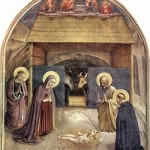
Adorazione del Bambino - Fra Angelico

Adorazione del Bambino - Fra Angelico

Christmas is upon us here in Santa Cruz, California. It’s been a lovely, sunny day for Christmas Eve. Not hot, but not cold either. A fine day for a walk by the ocean. Tomorrow promises to be as lovely.

I’ve been reflecting a lot recently on the great miracle that is life. I don’t do church work for a living. Randy and I work as consultants in the design of health care services and delivery of care, among other things.  One of my areas of expertise is translation of health care related materials into Spanish. These past couple of months, I’ve been working on a glossary of terms for a basic Biology textbook. It’s been absolutely fascinating.

Over 30 years ago, I graduated from Gonzaga University with undergraduate majors in Biology and Spanish. Through the years, I’ve combined the interests in a lot of ways, but I really haven’t had the chance to keep completely up to date with my knowledge of science. As a result, a lot of what I’m translating is new information for me. I’m spending a lot of time on the Internet, learning the new basics of Chemistry, Biology and Enviornmental Sciences so I can translate the definitions in a way that they will make sense in another language. I spend a lot of that time reading in Spanish, to find correct technical terms for things like “blebbing” and “Wobble base pairing of nucleotides,” as well as whether a particular metabolic pathway is generally called a “ruta” or a “vía.” As I said, it’s been a fascinating, though time consuming project.

So what does this have to do with theology and Christmas? The thing that keeps blowing my mind is that all that I see around me, all the people in my life, all the wonders of nature and of technology, all keep going because of simple positive and negative charges in atoms and the way those atoms interact with each other! Without those very fundamental chemical reactions, none of this, none of us, would even be, let alone be who and what we are. And yet, beyond the chemistry that underlies the biology, there is a spark of Divine life within each of us as humans. There is something that makes us different. While we can sometimes be as blind to other possiblities as the family cat who couldn’t figure out this morning that she could go around her perch to get up on it and eat her breakfast away from the neighbor cats, we do have the capacity to look at a challenging situation or something that is different than we expected and find new  and different solutions.  And we can think up new and better ways to do things, making life easier for all. We can choose to do great evil, but we can also choose to do great good. That spark of Divine life is a tremendous gift.

And then we come to Christmas. And at Christmas we remember that the Creator of all, the One who Is and Was and Ever Will Be, the One who loves all of creation into being and keeps us in existence with love, didn’t stop with being above it all and loving it into being. God chose to become one of us. And on top of that, God became a baby boy. A tiny, helpless child. All I can say is, Wow. We are truly blessed.

Merry Christmas to all. May this coming year be one of great joy and peace for you, through all the challenges you face, and may you know deeply the great love of our God who is Father/Parent, Son/Brother and Holy Spirit of Love.

Read More

Posted by on Dec 14, 2009

An Advent Gift

An Advent Gift

Terry Hershey is one of my favorite columnists/bloggers. I look forward each week to his Sabbath Moment column. Today he offers this prayer. I suggest we all make it our own.

Our Prayer (and, Christmas gift suggestions)

Lord, in this Advent season, may we give
To our enemy, forgiveness.
To an opponent, tolerance.
To a friend, our heart.
To a customer, service.
To all, charity.
To every child, a good example.
To our self, respect.
Amen.

Read More