Pages Menu
RssFacebook
Categories Menu

Posted by on Jun 14, 2009

The Feast of the Body and Blood of Christ

The Feast of the Body and Blood of Christ

Cyprian Consiglio, OSB Cam

Cyprian Consiglio, OSB Cam

Cyprian Consiglio, OSB Cam. offered some interesting thoughts about the Feast of the Body and Blood of Christ (AKA Corpus Christi) today in his homily and his blog. He has graciously agreed to allow me to share them in a post for this feast.

The Inner Meaning

During this time of year when there are so many of our rites of passage taking place––weddings, graduations, ordinations (even birthdays)––it’s interesting to take a look at the purpose of ritual. Anthropologically speaking, a ritual is a way of expressing and passing on our understanding of reality or of an experience to someone else. So, for instance, a graduation is not about a piece of paper and a cap and gown: it’s weightier, it’s heavy; that’s why tears flow from the eyes of parents as they see their child graduate or get married. The ritual is trying to carry all those memories and meanings, and summarize them in a single gesture: an exchange of rings, the laying on of hands, a birthday card, an embrace, throwing a shovelful of dirt on a coffin: all these rituals mean more than they mean, they carry an almost indescribable load of treasures.

In the Roman rite we celebrate the Solemnity of the Body and Blood of Christ this week, and it’s safe to ask what Jesus was trying to convey to his disciples when he performed this rather odd ritual––not just breaking the bread and passing out the cup, but claiming that it was his very self. What exactly was he asking them to remember when they did it over and over again? I thought of five things, which certainly don’t exhaust the list of possible meanings.

1. First of all, this gesture looks backward and forward at Jesus’own life. Backward in that Jesus’ whole life had been spent being broken and passed out; his whole life had been dedicated to feeding those around him: taking care of their bodily needs through healing and feeding; and also feeding and healing them in a real way with the Wisdom of God, this incredible good news of God’s undying boundless care for every single hair on the head of very single human being from the greatest to––especially––the least. This ritual also looked ahead to the next day when Jesus allowed his body to be broken like bread and his blood poured out like wine––to say that it’s alright: you can survive even this, your real self cannot be annihilated, but like a seed that falls into the earth and dies it will yield a rich harvest of resurrection life.

2. This ritual symbolized––again what Jesus’ whole life symbolized––that Divine Love gives itself to humanity––that’s what God is like! The Divine is present, really present: divine love is offering itself to the world in this ritual meal.

3. This ritual also conveyed (and conveys) that this Divine Mystery is present everywhere, in creation, “in the earth and its produce.” Unfortunately the kind of hosts we use and our ornate chalices can actually hide the fact that this is actually wheat and grapes, real food: “which earth had given,” as we say, “fruit of the earth.” I think that this conveys that all matter is meant to be brought into right relationship with God, and that all matter can reveal and be a vehicle for the Grace of God. St Irenaeus wrote,

    “This is why he took a part of creation, gave thanks and said: This is my body. In the same way he declared that the cup, an element of the same creation as ourselves, was his blood: he taught them that this was the new sacrifice of the new covenant.” (Irenaeus, Against Heresies)

But we add a line to the prayer over the gifts: it’s not just what ”the earth has given,” or “the fruit of the earth”; it’s also the work of human hands. There is a beautiful prayer of Teihard de Chardin:

    I, your priest, will make the whole earth my altar––
    And on it I will offer you all the labors and sufferings of the world…
    I will place on the paten the harvest to be won by labor. . .
    Into my chalice I will pour all the sap which is to be pressed out this day from the Earth’s fruits.

So, the fruit of the earth and the work of our hands all become vehicles for God’s grace, all is meant to be brought into right relationship with God.

4. This ritual is also meant to convey to us that God wants us to participate in the work of creation, and in divinity itself. That’s why we pray that incredible prayer, “by the mystery of the water and wine may we come to share in the divinity of Christ who came to share in our humanity.”

5. And how do we participate? Well, that’s the last thing I want to mention that this ritual is trying to convey (though we could go on and on): it conveys that this divine mystery is especially present whenever and wherever human beings meet and share together, that God is present in every gesture of unselfish love, in every occasion of someone laying down their life for another. That’s why we read the story of the washing of the feet before we celebrate the Mass of the Lord’s Supper on Holy Thursday.

The Hebrews didn’t need another ritual, another sacrifice; we don’t need another ritual; and God certainly didn’t and doesn’t either. The prophets leading up to Jesus kept telling the people how God was sick of their sacrifices and rituals! Jesus himself quotes the prophet Hosea twice saying: “Go and learn the meaning of these words, ‘It is love that I desire, not sacrifice. Knowledge of God rather than burnt offerings.’”

The church, and this ritual, has no other purpose but to communicate and convey and reveal that––the love and knowledge of God that is hidden in the heart of creation and poured into the center of every human being as our very source and our ground. This is what we will be judged on as a church, as individuals, as communities and as a whole: not the forms of our rituals and doctrines, but by the reality of the love and knowledge of God that we manifest.

Bede Griffiths wrote that: “All myth and ritual, all doctrine and sacrament, is but a means to awaken our souls to this hidden mystery, to allow the divine presence to make itself known.”

So: as we participate in this ritual, as we receive the Body and Blood of Christ, and/or when we gaze at the reserved Blessed Sacrament in the Tabernacle or in a monstrance, let’s remember how weighty it is, how much it carries and conveys. And let’s especially pray that it would awaken us to the mystery of the knowledge of God, and the love of God that is poured into our hearts, so that we might make it manifest in our world, so that we might be the body and blood of Christ––that we might be broken and poured out for the sake of the world as Jesus was.

cyprian
14 june 09

Read More

Posted by on Jun 5, 2009

The Feast of the Body and Blood of Christ

The Feast of Pentecost and the Age of the Holy Spirit

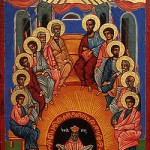
Eastern Orthodox Icon of Pentecost

Eastern Orthodox Icon of Pentecost

The Feast of Pentecost falls 50 days after Easter. Pentecost was originally a celebration of the first harvest and people came to Jerusalem from all over the known world to celebrate the feast.

For people in northern climes, the thought of a first harvest celebration in Spring may sound strange. After all, the snow has barely melted and crops are nowhere near ready to harvest. Even early crops like strawberries and lettuce aren’t ready yet. Nevertheless, in the Middle East, and by extension in that general latitude around the globe, many crops have already been harvested. Just go to a grocery store and you’ll see the fruits of our fields waiting for your table!

Within the Church, we celebrate the outpouring of the Holy Spirit on the disciples – men and women who had been friends, family and followers of Jesus. This outpouring of the Spirit of God, the God Who is Love, gave birth to the Christian community that endures to this day. Jesus’ friends and followers were transformed from frightened “mice” into fearless “lions” who proclaimed boldly that Jesus had been raised from the dead, that He is the long awaited Christ, that God has made Him both Lord and Savior, that a new age has dawned and the Kingdom of God has begun.

These early disciples wasted no time in putting their beliefs into action. They shared what they had. They cared for and healed the sick. They took care of widows and orphans – the powerless ones of their society. They recognized the gifts of women who were leaders in their communities. They spread the Good News of the Lord to all who would listen. And they struggled to understand the implications for themselves and their society of the Good News and the freedom of God’s children. Who were God’s chosen ones? Who could be followers of the Way? What parts of the Law were non-Jews required to obey? How can the pastoral needs of the community be met? Who will look out for the powerless ones in our own communities? How do we choose leaders for our communities? How should Christian family members behave with each other?

For nearly 2000 years we have dealt with these issues as a community. Today we still face many of them, though in a much wider context, as a global, international community that includes peoples of all cultures. More than ever we must count on the continued outpouring of the Spirit to guide us and make us bold witnesses to the Good News.

Much of what we take for granted today is the result of the work of Christians who actively put their beliefs into practice and stepped out to make their part of the world a better place. Institutions such as hospitals, schools for poor and even middle-class children, education for girls, social safety nets, and many others have resulted from the Christian insight that God cares about all humans, even those who traditionally have been excluded.

The Christian belief that all receive the gifts of the Holy Spirit in Baptism and Confirmation also leads to the understanding that all are responsible to share the gifts they have received and bear fruit in their lives. Together we listen to the Spirit and share in the development and shaping of both our Church community and the world.

As we move through these days following Pentecost, we face many challenges. It’s a time of global financial challenges. Governments are moving quickly to try to minimize the harmful effects of the banking crisis on their people. Social service agencies and churches are struggling to offer aid to the increasing numbers of people coming to their doors. Here in California there’s talk of dismantling all state funded social services, including health care programs for children of low income families and the welfare to work programs that helped so many families keep roofs over their heads and food on their tables.

What will we as children of God, brothers and sisters, do to address these challenges in our communities, states and countries? Will we say, as so many do, “It’s not my responsiblity to care for the children of the poor. Why don’t their parents just go get jobs?” Will we say, “Don’t ask me to pay more taxes. I shouldn’t have to cut back my lifestyle to pay for other people’s mistakes.” Will we sit in judgement of people who are losing their homes because they lost their jobs? Will we smugly assume that we’ve saved enough money to keep us safe if we get ill or lose a job? Will we criticize the people who lost their savings to the stock market when the money should have been somewhere safer? I hope not.

This year the time from Pentecost onward can be a time in which we truly listen to the Holy Spirit’s call to build up the Kingdom by caring for the poor, the powerless, those who are ill and who are losing their security (whether as a result of their own errors or those of others). It’s a time to trust that if we give of what we have, share from our abundance or our need, God will make sure that our needs are met. Our ethic of life must include not only the unborn but also those who are here and in need. Womb to tomb includes all those days in-between as well. Let’s not forget that as a Church community.

Read More

Posted by on May 21, 2009

The Feast of the Body and Blood of Christ

The Feast of the Ascension

Ascension

Ascension

The Feast of the Ascension traditionally occurs 40 days after Easter. Since it falls on a Thursday, it’s often called Ascension Thursday.

Recently, with the transition of our work lives from an older, more flexible agrarian routine to modern industrialization’s insistance on time clocks, 24/7 availability of services, and the challenges of two income households, child care, school schedules and after school activities, taking time as a community of faith to stop and celebrate this feast has become a luxury available only to the fortunate few. Recognizing this reality in the lives of the faithful, bishops in many dioceses have allowed celebration of the feast to be moved to the Sunday before Pentecost. To the extent that this allows more people to be consciously aware of and celebrate the feast, I see this as a good step. Nevertheless, it is important to note that the feast actually falls today.

The feast of the Ascension marks the day on which Jesus was taken up to heaven (Lk 24:50-53). After the Resurrection, Jesus appeared on many occasions to his followers. He continued to teach them and explain all that had happened through His passion and why it had to happen as it did. At the end of both the Gospels of Mark and of Luke, as well as the beginning of the Acts of the Apostles, we are told that Jesus instructed His followers to go out as witnesses of all they had seen and heard, calling all peoples to turn from sin and accept baptism and the forgiving love of God. Then Jesus told His followers just before He was taken from their sight, to go back to Jerusalem and pray, waiting to receive the “promise of the Father” (Acts 1:4), the Holy Spirit who would give them power from on high to become His witnesses.

These events happened nine days before the Jewish feast of Pentecost. The apostles, Mary and other followers of Jesus did indeed return to Jerusalem. They gathered in the upper room where they had been staying after the Resurrection and devoted themselves to prayer. (They also took care of some administrative details – including selecting another person to take the place of Judas Iscariot. But that’s another part of the story not critical to today’s feast!)

On the feast of Pentecost, the Holy Spirit was poured out on them and the Church was born as Peter and the others fearlessly stepped out and witnessed to the world regarding all they had seen and experienced. The time of the Holy Spirit had begun.

A particularly important thing to remember regarding the Ascension, is that it is the beginning of a period of prayer for the outpouring of the Holy Spirit – a period of prayer mandated by Jesus Himself.

Since those early times in the church, we have developed a tradition of novenas, nine days of prayer with a particular focus or request. Typically the novena is addressed to a specific saint, requesting the saint’s intercession with God – much like asking a big brother or sister for help with a problem.

In the case of this first novena, the focus was much more direct. The novena from the Ascension to Pentecost is addressed directly to the Holy Spirit. With the early followers of Jesus, we too can pray for the outpouring of the Holy Spirit into our lives and world.

Imagine what could happen if we truly believe that we are to go out and be His witnesses — speaking His words of challenge and comfort, feeding the hungry, clothing the naked, housing the homeless, caring for the sick, acting as if a better world could really exist and all could really love and care for each other! This can only happen if we are filled with the Holy Spirit, clothed in power from on high. It is a daunting calling, but one that is implicit in our baptism and confirmation. We sing the ancient hymn, “Come Holy Ghost, Creator blest, and in our hearts take up thy rest…” It’s a beautiful prayer and truly dangerous if we take it to heart, meaing and believing what we are asking.

A younger hymn, from Zimbabwe, is also particularly appropriate for our novena to the Holy Spirit in these coming nine days. “If you believe and I believe and we together pray, the Holy Spirit must come down and set God’s people free. And set God’s people free, and set God’s people free; The Holy Spirit must come down and set God’s people free.” Free to be His witnesses — His hands, feet, voice and heart in our world.

Let’s again join together in these coming days to ask the Holy Spirit for a new outpouring of power into our lives and times. Pray with me with hope and confidence, trusting that with God’s help everything is possible, because “If you believe and I believe and we together pray, the Holy Spirit must (will) come down and set God’s people free.”

Read More

Posted by on Apr 14, 2009

The Feast of the Body and Blood of Christ

Easter Monday 2009: The Post Modern Blues

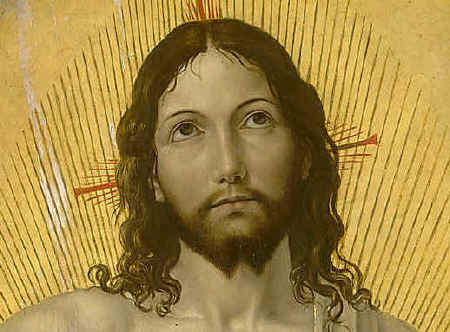
Borgognone 1510

Borgognone 1510

Easter time in the 21st century is a curious season. We are living in a time in which the rationality of the Enlightenment has been obliterated by the irrational violence and deconstruction of the Modern Era which ended with the creation of the atom bomb. In the 20th century we saw the the rise of the irrational as a counter to the idea of reason as the engine of human progress. Advances in science and engineering led to death on a massive scale whether in its industrial production form in the genocide of Jews and other peoples or its explosion from the sky in carpet bombing of Dresden or the incineration of Hiroshima and Nagasaki. The darkness within the brilliance of the human heart and mind was also manifest in the Vietnam War epic movie “Apocalypse Now” based on the theme that facing the horror of one’s evil can only lead to self destruction.

So here we are on the cusp of the third millennium. Human progress seems more of an illusion. In fact, our Post-Modern sensibility is all about the inability of reason and science to get at ultimate truth. Everything is examined and found wanting. Physics has become the study of relativity, uncertainty, and mathematical models. Religion and philosophy are the products of language we create. The scriptures of Christianity are cultural creations which tell us more of the people who wrote them. They are robbed of their revelation.

Human romance and love are reduced to methods for the socio-biological dispersion of one’s genetic load. Religious experience is suspect because there is no way to know whether one is just engaging in psychological projection to create a hideout from the ultimate reality of the purposelessness of human existence. We are here by virtue of  a cosmic accident with a very low probability.

In our world, there is the torture and death of Good Friday but there is no need for a Resurrection or any life beyond our current suffering because it is not possible since we can never know the nature anything beyond nature with any certainty. So here is the greatest event of all human history and our greatest personal hope – the Resurrection and it is a non-event on a beautiful spring day that is to be borne with a grim courage in a time when miracles cannot happen.

The news is too good. Maybe that is why we are stuck on the Friday of Crucifixion. The pain we know is better than risking its loss in the certain joy of Resurrection. As people of the Resurrection we would have to leave too much behind – hurt, anger, fear, and death.

Read More

Posted by on Apr 12, 2009

The Feast of the Body and Blood of Christ

Resurrection Sunday – 2009: Jesus Did Not Die for Me

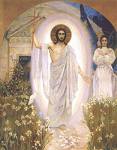
Resurrection of Christ - Mikhail Nesterov (late 1890s)

Resurrection of Christ - Mikhail Nesterov (late 1890s)

Jesús No Murio Por Mi

Jesus Did Not Die for Me

Holy Weekend
The time of customary rituals
Of words spoken a thousand times
A season of the silence of death
Fasting, resolutions, and processions
A time of self-contained euphoria
As it seems sin sees the ending
We already know
and will flood all with life
A shallow season of hypocrisy
“Happy Easter”

A season of churches in a thousand different ways
yet a thousand ways the same
Cannot say other than what they have always said
“Jesus died for our salvation”
But “You know what?”
Jesus didn’t die for me
Jesus died because of cowardice,
greed, arrogance, love of power
by those who did not understand his message
by those afraid of the new
by those who had made a god to their own stature
by those who did not accept his offer of life to the full
not for just a few but for all men and women.
That death did not save anybody
Not even those who believed that they are saved by Jesus.

What saved me and you
And continues to save
Is that Jesus who became a person
Who identified with the people
Who was a baby and cried,
Who was a boy and played
Who grew and worked
Who was called to a mission and took it on
Who paused before the pain of men and women
Who in solidarity of gestures, words, and actions
Who did not silence what had to be said
And who though fearful, moved ahead
out of love, sheer love.

It was not his death, so cruel and unjust.
It was his life!
If death can be salvation
Whan can resurrection mean?
What sense does it make to celebrate Easter?
Death does not save
Even if it scandalizes theology
Life saves.
That is why resurrection is the great cry,
The lead story, the great news of our time
For this the stone rolls aways, the tomb opens
And foot steps are heard in the garden

God raises up Jesus
To condemn death forever
To announce that Life has won out
and that faith in the this Jesus who lives
who conquers the mercenaries of terror
is the faith that saves and
is the faith that makes us free.
What Peter said with such clarity
“This same Jesus whom you crucified
God has made Messiah and Lord”.

Jesus did not die for me.
They killed Jesus!
Jesus died because they tortured him in a blind rage
Because they wanted to shut him up and make him disappear
And because the powerful have always killed Him.

Yes, Jesus was born for me.
He also lived for me,
He taught, healed, pardoned, loved and rose again for me
for you and and for everyone.

Jesus did not die for me
nor for you nor anyone else
Perhaps, some day
We will stop honoring his death
In order to begin celebrating His LIFE.

Gerardo Oberman

translated by Randolfo R. Pozos 2009

Read More

Posted by on Feb 2, 2009

The Feast of the Body and Blood of Christ

February 2 – A Day to Celebrate Three Feasts and a Blessing

The Meeting of the Lord - Orthodox Icon from Belarus (1731)

The Meeting of the Lord - Orthodox Icon from Belarus (1731)


February 2, a day falling 40 days after Christmas in the western Christian calendar, is a day when we celebrate 3 feasts and a blessing – The Presentation of Jesus at the Temple, The Purification of the Virgin, The Meeting of the Lord and Candlemas.

There’s a sort of game going around Facebook these days in which people are asked to give 25 random bits of information about themselves to their friends and ask 25 others to do the same. It’s been fun to see what people have to say about themselves and who they ask for information.

In the spirit of the game, I’d like to give 25 bits of information about today’s feasts and blessing.

1. The Presentation of Jesus has been celebrated since at least the 4th Century AD.

2. First-born sons belong to God in Jewish tradition – originally to serve as leaders of worship/sacrifice. Fathers of the boys were required to offer a sacrifice to “redeem” them from the obligation to serve at the temple rather than remain with their families. This tradition continues in modified form today.

3. Today’s feasts are not the same as the Feast of the Naming of Jesus or the Circumcision – celebrated 8 days after Christmas.

4. When Joseph and Mary offered the sacrifice to “redeem” Jesus, they were allowed to choose between offering a lamb and a dove or simply two doves or two pigeons. They offered the birds, the gift of those who were not wealthy.

5. Childbirth rendered a woman ritually “unclean.” A purification ceremony was required to restore her freedom to interact socially with family, friends and community, including her worship community.

6. Periods of time for this unclean status varied by sex of the child born. A woman was unclean for 80 days following the birth of a girl. For a boy she was only unclean for 40 days. In both cases, a ritual was required to purify her.

7. Mary went to the temple in Jerusalem for her purification ceremony.

8. Simeon was an old man who had been promised by God that he would see the Messiah before he died. He recognized Jesus as the fulfillment of that promise when Jesus was presented for the sacrifice of his redemption at the temple and Mary for her purification.

9. Simeon told Joseph and Mary that their son was “destined for the fall and rise of many in Israel.” (Luke 2:34)

10. Simeon told Mary that she would be pierced with a sword. Our understanding is that this was the sword of sorrow as she watched her son’s life and mission unfold.

11. Anna was an old woman who spent her days and nights at the temple. She too recognized Jesus and his family, blessed God for the gift of seeing him and told all she met about him.

12. The Feast of the Purification has been celebrated since at least the 7th century.

13. The Feast is known as The Meeting of the Lord in some Eastern Christian churches.

14. Candlemas is a celebration of the blessing of candles (traditionally beeswax ones) for use in homes and churches in the coming year.

15. First evidence of the celebration of Candlemas dates from the 4th century in Rome, but it spread to the rest of Europe more slowly. It had reached England by the 10th or 11th century.

16. Candlemas is probably a feast whose focus was changed to a Christian one from older non-Christian ones that included fire, candles, ash and purification in a variety of European cultures.

17. Before the Second Vatican Council, the Christmas/Epiphany season lasted until Candlemas. It was considered bad luck to have Christmas decorations (including holly, ivy and bay leaves) still in the house on Candlemas.

18. Some cultures had celebrations in which young women carried candles in a procession at this time of year or in which young men and women had to jump over fires for purification before they could be married.

19. These are the last feast days whose date is set based on the date of Christmas.

20. Many traditions link Candlemas to the actions of animals as predictors of future weather – including bears, wolves and groundhogs!

21. Candlemas was one of the days certain taxes had to be paid in Scotland until 1991.

22. The French celebration of Candlemas includes eating crepes for dinner after 8 pm.

23. Mexican tradition includes tamales on the menu for Candlemas.

24. Some believe Candlemas was a “Christianization” of the feast of  Brigid the Goddess – an oracle and predictor of the success of the growing season – but little historical evidence exists for this claim. The feast of St. Brigid, an Irish abbess, is February 1. 

25. These feasts are celebrated in both Eastern and Western Christianity, but on different dates. In all traditions, however, they are celebrated 40 days after Christmas.

Whew!  So … there you have it. More than you probably ever wanted to know about Christian celebrations for February 2!

I think we’ll put the last of the Christmas decorations away, light some candles, and have tamales for dinner!

Read More

Posted by on Jan 7, 2009

The Feast of the Body and Blood of Christ

Merry Christmas to our Orthodox Sisters and Brothers – January 7

Celebrating Orthodox Christmas - Photo by Muhammed Muheisen, AP

Celebrating Orthodox Christmas - Photo by Muhammed Muheisen, AP

January 7 is the Feast of Christmas in much of the Orthodox world. We don’t hear much about it in our Western cultures, in part because it is not the big commercial event that it has become in North America and Europe. Nevertheless, it is a time for celebration and remembering that we share the roots of our faith with these ancient communities as well.

For more information about Orthodox history and beliefs, as well as why our calendars don’t match, there’s a good explanation on the BBC’s website. The quick answer is that most Orthodox communities still follow the Julian calendar for certain feasts. That calendar is 13 days behind the Gregorian calendar, so Christmas falls on January 7. 

Western Christians who’d like to celebrate in solidarity with Orthodox Christians might want to try a dish typical of Christmas celebrations in the Eastern Church. Some interesting ones can be found at: http://www.prosphora.org/page17.html.

So, as the festival arrives, we wish you a Blessed Christmas, with time for family and friends to gather and enjoy the gift of love. We also pray for peace – in our entire world, and especially in those areas torn by war. May the coming of the Prince of Peace bring hope and courage to all of us, to work together and make it real in our day.

Read More

Posted by on Jan 6, 2009

The Feast of the Body and Blood of Christ

Epiphany

Hieronymus Bosch - The Adoration of the Magi

Hieronymus Bosch - The Adoration of the Magi

The Feast of Epiphany is traditionally celebrated January 6 in the Western Church. Recently, we have begun to celebrate it as a community on the first Sunday of January after the Feast of Mary, Mother of God (January 1st).

Epiphany, from the Greek “to manifest” or “to show forth,” is a celebration of God’s presence bursting forth and becoming visible in human lives. For Western Christians, the focus has been on the visit of the Magi, the wise ones, who followed a star from the East to find the newborn king. In this story, we see God’s presence being revealed to non-Jews, to Gentiles. For Eastern Christians, the focus is on the Baptism of Jesus, when Jesus became identified as the Son of God. The feast is sometimes known as Theophany in the East. (In the Western Church, we too celebrate the feast of the Baptism of Jesus, but on the Sunday after we celebrate Epiphany.)

In many Christian countries, especially those bordering the Mediterranean and in former colonies of those countries, gifts are exchanged at the Feast of Epiphany. This is because the Magi brought gifts to the child Jesus – gold, incense (frankincense) and myrrh. The gifts named in Matthew’s gospel can be seen as symbolic of the roles Jesus would play in salvation history – as king, deity, and human victim/sacrifice – as a result of the incarnation. Songs such as “The First Nowell” and “We Three Kings” remind us of the story and tell it again to our children.

During this season of Epiphany, may our eyes be open to see God’s presence in the people around us – the children, the babies, the old ones, the ones on the street, the ones at our work or in our homes. God is forever peeking around corners, knocking on doors in our hearts, smiling out of flowers, singing through the voices of birds and trying in every way possible to shine forth into our lives. May we be gifted to see and to smile in return.

Read More

Posted by on Dec 12, 2008

The Feast of the Body and Blood of Christ

Our Lady of Guadalupe – December 12

Once again, today we celebrate the feast of Our Lady of Guadalupe.

When I was a girl, this feast was not a major focus of my life. Growing up in Eastern Washington, in a community with relatively few Mexican Americans, we simply didn’t celebrate this feast.

Then I married into a Mexican American family and all that changed. I learned much more about Our Lady of Guadalupe. I discovered the traditions associated with her feast day. I got up early one morning to join the community in Oakland in singing the mañanitas at 5:30 a.m. We celebrated together in the liturgy and then had a wonderful breakfast of posole, champurrado and pan dulce (soup, chocolate/cocoa, and sweet Mexican bread) with the Mexican immigrants who were our English language students and friends.

When I was pregnant with our first child and nervous about the course of the pregnancy, my mother-in-law advised, “Just put it in Our Lady of Guadalupe’s hands. It’ll all be OK.” She was right. More than once since then Our Lady has gotten a problem dumped into her hands. It always turns out OK – not always the way I expected, but always OK.

Tonight we’ll again celebrate the feast of Our Lady of Guadalupe. We don’t get up for mañanitas these days, but we do celebrate. We’ll get out the nice dishes, have a tasty dinner, and eat pan dulce with champurrado for dessert. And once again, we’ll celebrate the special relationship with Our Lady we enjoy as a Mexican American family.

Read More

Posted by on Nov 25, 2008

The Feast of the Body and Blood of Christ

The Last Week of the Year – From the Feast of Christ the King to Advent

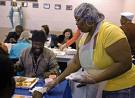
Feeding the Hungry in Jesus' Name - Baton Rouge

Feeding the Hungry in Jesus' Name - Baton Rouge, LA

Last Sunday we celebrated the Feast of Christ the King. The Gospel reading was from Matthew, speaking of the judgement of the nations on the last day. The King, a.k.a. The Son of Man, invites “the righteous” to enter the kingdom saying, “For I was hungry and you gave me food, I was thirsty and you gave me drink, a stranger and you welcomed me, naked and you clothed me, ill and you cared for me, in prison and you visited me.” When they ask when they gave him this service, He assures them, “Whatever you did for one of these least brothers [and sisters] of mine, you did for me.” He goes on to tell those who are not invited to enter the kingdom that when they denied this same care to the least, they denied it to Him. (Mt 25:31:46)

At this time of global economic crisis, with millions of people facing financial troubles they never expected to see, and other millions finding resources that were never enough in the first place becoming even more limited, these words ring loudly. They are a challenge to all of us – those who have just barely enough, those who still have plenty, those who have not enough at all. How do we recognize the Son of Man around us and what do we do to reach out and help?

I suggest that we look at this time as one for affirmation of hope and trust in our King. We have a King who cares so much about all of us, who loves us each so deeply, that He was willing to live among us and share in all that we experience. He was willing to challenge unjust structures and interpretations of the Law. He spoke up for God’s “little ones,” however old they were, who couldn’t speak up for themselves. He insisted that we are all created for the freedom of God, a freedom that allows us to do what is right and good for those in need, without worry about whether it is approved by those in power or authority. A freedom that lets us give of the little we have to help those with less. A freedom that can lead to the cross, but also to the joy of new life.

In the United States we celebrate Thanksgiving this week. Churches, schools, even gyms have been collecting food for weeks to share with “those less fortunate.” Many will offer dinners on Thanksgiving for those who are homeless or have no one with whom to share a meal. It is a special time when we reach out to each other in care.

The outreach will continue through Christmas. Gifts will be collected again at churches, schools, banks, and gyms for children and adults who might not receive a gift otherwise. Food baskets aren’t prepared and distributed for Christmas dinner, but collection of food for food pantries will continue throughout the year.

Then one calendar year ends and a new one begins – with hope and expectation of better times to come. It will be a time of especially high hopes in this country, as we see the beginning of a new presidency. And I wish all the best to those who will govern us. It’s not an easy job in the best of times – and these are not the best of times!

But what do we as people of faith bring to the party?

As Christians, we begin our new year at the end of this week. The first Sunday of Advent is next Sunday. A new year. New hopes. New expectations. New dreams.

Let us together move into this new year with a commitment to hope, to service, to caring for each other. Most of us will not ever have the chance or the means to effect dramatic change in this world. But remember, the little things are the ones that can be HUGE for an individual or a family. A gift of food, a gift of a smile, a gift of a kind word, a gift of hope, a gift of time for a visit. All of these affirmations of the value of the other person help ease the burden of hard economic times. Jesus wants to live in us and through us. We are to be His face, His voice, His touch to those around us. And when we reach out in service, we reach out to serve Him. When we graciously accept the loving help and kindness of people who reach out to us as well, we receive His love as well as return it to them.

As we move from the Feast of Christ the King into the new season of Advent, let it be with hope, trust and joy. Our God is with us. The Kingdom has begun. “Whatever you did for one of these … you did for me.”

(Picture from http://www.2theadvocate.com/news/16945146.html in Baton Rouge, LA.)

Read More

Posted by on Sep 29, 2008

The Feast of the Body and Blood of Christ

Celebrating the Feast of the Archangels, Michael, Gabriel and Raphael

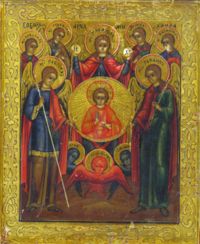
Angelic Council – an Orthodox icon from the Wikipedia entry on Archangels

The Feast of the Archangels – Michael, Gabriel and Raphael – brings a day for fun and celebration at our house. My father’s name is Michael, so even as a child, this was a day to note. We didn’t particularly celebrate it, but I knew it was his feast day. Each of these archangels had their special day, but the feasts have since been combined into one. So today many men in my family celebrate feast days, including my father, brother, cousin, nephew, husband and sons. We don’t have a Gabriel, but Michael and Raphael (Rafael) are common.

When my children started Waldorf school (known as Steiner schools outside the United States), we were introduced to the celebration of Michaelmas. In Northern Hemisphere Waldorf schools, Michaelmas is the first festival of the year. It is seen as a time to remember that, as days grow shorter and darkness seems to grow stronger, we depend on the forces of light and strength to bring us safely through our lives. Many stories of Michael include mention of dragons – drawing on the story from the Book of Revelations describing a battle in the heavens between the dragon and Michael (Rev. 12:7-9). So confrontations between Michael and dragons are often portrayed theatrically by children as part of the celebration. The stories I’ve enjoyed the most have the dragons being “tamed,” in the sense that their great stores of energy are turned to building up the community. That’s a lesson that speaks even to adults – who among us doesn’t sometimes need to channel great energies that surge from deep within us and that can be destructive or constructive?

At the elementary schools our children attended, following the play, the community joined together around a great loaf of bread baked in the shape of a dragon by the third graders. A blessing was sung, the bread was cut and the community shared in eating it. (Always reminded me of certain liturgical activities with which many of us are very familiar!) Lunch, followed by a great pot luck of desserts came next. Then making apple juice in the orchard and other fun activities completed the day.

After the Michaelmas celebration (generally celebrated on a Saturday so entire families could come), we were always tired when we got home. When it came time for dinner, nobody was up to cooking a big meal. So we developed a fun little custom of making and eating dragon cakes.

So here’s the Pozos family method of celebrating Michaelmas. We make dragon cakes (pancakes shaped in the form of dragons). Add dragon eggs (fried potatoes cut in circles), dragon nests (grated apples with cinnamon for spicing) and dragon food (scrambled eggs with spicy sausage – we like Mexican chorizo). Light a candle. Use special dishes if you want. Share some sparkling cider. And, most importantly, work together to make the meal and then sit around afterward and enjoy each other’s company.

I’m looking forward to the celebration tonight! Hope you have fun too.

Read More

Posted by on Sep 15, 2008

The Feast of the Body and Blood of Christ

Feast of the Day – Our Lady of Sorrows – September 15

Mothers of the Plaza de Mayo

The Feast of Our Lady of Sorrows follows the Feast of the Exaltation of the Holy Cross by one day. On this day we remember the prophecy of Simeon when Mary and Joseph took Jesus to the temple for the first time. Simeon blessed them and said to Mary, “Behold, this child is destined for the fall and rise of many in Israel, and to be a sign that will be contradicted; and you yourself a sword will pierce, so that the thoughts of many hearts may be revealed.” (Lk 2:33-35)

This feast was not part of the official liturgical cycle of the Church until the mid-1600s, though it was celebrated in some locations as early as the 13th century. Sometimes it is known as the feast of the Seven Sorrows of Mary and includes mention of seven events from Jesus’ childhood and passion.

Our Lady of Sorrows is a title of Mary with which many women and men can identify. Bearing and raising a child is not an easy task, though it can be an extremely rewarding adventure. There are countless joys and sorrows along the way. And make no mistake about it – the commitment of parent to child is one that does not stop when the child reaches adulthood! It is a commitment for life and beyond. In our belief in the Communion of Saints and life after death, we recognize that those who went before us still care about us and look out for us. Parents who are with the Lord do not cease to be parents of those who still remain here. The relationship is just transformed.

In thinking about this feast, it came to me that surely Our Lady of Sorrows is especially close to mothers, fathers and family of those who are killed prematurely. I’m thinking of those who “disappeared” in Central and South America in recent years – victims of political violence and/or persecution for their actions in living and teaching the Gospel. I’m thinking of victims of terrorism in the Middle East – including those on both sides of the Israeli-Palestinian question and those dying almost daily in Iraq. I’m thinking of those whose children were killed in wars – Iraq, Iran, Afghanistan, India, Pakistan, Bangladesh, Sudan, Ruwanda, Brundi and so many, many others. We see the pictures year after year and our hearts become numb. Yet for all of them, and with all of them, Our Lady of Sorrows weeps. And so should we all.

And then … we must commit ourselves to work for peace. So that those who have given their lives will not have died in vain. So that those who believe that “might makes right” will learn that only love makes right. So that we truly become a community where we live our belief that what we do to the least of Jesus’ sisters and brothers, we do to Him.   

May it be so.

Read More

Posted by on Aug 15, 2008

The Feast of the Body and Blood of Christ

Marian Theology: The Feast of the Assumption – August 15

The Assumption by Murillo

The Assumption by Murillo

August 15th, the Feast of the Assumption, dates to the 6th and 7th centuries. The official proclamation of the Assumption by Pope Pius XII in Munificentisimus Deus as an article of faith for Catholics occurred recently, on November 1, 1950. Objections to this teaching cite the absence of support for it in Scripture and in the Fathers of the Church. These same arguments are also made against the doctrine of the Immaculate Conception, which states that Mary received the benefit of the redemption in advance from the moment of her conception. However, since the theological significance of Mary is intertwined with that of Christ, as mother and son, much of what we say about Mary (Mariology) derives from what we say about the identity and meaning of Christ (Christology).

For most Catholics, Orthodox, Coptics, and Anglicans, images and veneration of Mary, the Mother of Jesus, are part of the very fabric of their faith. This emotional and doctrinal emphasis on Miriam of Nazareth gives many in the Anabaptist and Calvinist traditions emotional and doctrinal heartburn. Some evangelicals are strident in their belief that Marian devotion – at best – detracts from the key act of salvation, which they formulate as “accepting Jesus as your personal Lord and Savior.”

The notion of salvation in the apostolic churches is centered on the church community. Christ’s death and resurrection has saved all and we enter into this paschal mystery embodied in the church. Our salvation is entering the faith community, the Body of Christ. From the earliest days, the Fathers of the Church identified Mary as the model of the Church. The following excerpt, taken from Wikipedia’s article on Roman Catholic Mariology, summarizes the position and importance of the Blessed Mother. Please note that the words in parentheses are my own.

Pope Benedict XVI addresses the issue, why Mariology is related to ecclesiology (the theology of the Church). On first sight, he argues, it may seem accidental, that the (Second Vatican) Council moved Mariology into ecclesiology. This relation helps to understand what “Church” really is. The theologian Hugo Rahner showed that Mariology was originally ecclesiology. The Church is like Mary.[96]

The Church is virgin and mother, she is immaculate and carries the burdens of history. She suffers and she is assumed into heaven. Slowly she learns, that Mary is her mirror, that she is a person in Mary. Mary on the other hand is not an isolated individual, who rests in herself. She is carrying the mystery of the Church.[97]

Pope Benedict XVI lamented that this unity of Church and Mary was overshadowed in later centuries, which overburdened Mary with privileges and removed her into a far away distance. Both Mariology and ecclesiology suffered under this. A Marian view of the Church and an ecclesiological view of Mary in salvation history lead directly to Christ. It brings to light what is meant by holiness and by God being human.[98]

It is interesting to note that Pope Benedict XVI laments the removal of Mary “overburdened … with privileges.” This is also the image of Mary lamented by the reformation. However, the close identification of Mary with the Church, in the sense that “Mary is carrying the mystery of the Church,” represents a notion of church that many of the reformers rejected. Consequently, they rejected the image and role of Mary, and with it, the redemptive grace and power of the feminine.

Read More

Posted by on Aug 6, 2008

The Feast of the Body and Blood of Christ

The Feast of the Transfiguration of Jesus – August 6

The Transfiguration of Jesus was reported in the Gospels of Matthew, Mark and Luke, as well as in the second letter of Peter. Jesus and three disciples, Peter, James and John, went up a high mountain (traditionally identified as Mt. Tabor) and “He was transfigured before them; his face shone like the sun and his clothes became white as light.” Two men joined Jesus on the mountain top and spoke with Him there, Moses and Elijah – representing the Law and the Prophets. Peter, ever ready to act, offered to put up three tents for Jesus, Moses and Elijah. But just then a cloud overshadowed them all and a voice from the cloud proclaimed, “This is my beloved Son, with whom I am well pleased; listen to him.” The disciples fell down and were terrified when they heard the voice, but Jesus touched them and told them not to be afraid. He also told them not to tell anyone else about what they had seen “until the Son of Man has been raised from the dead.” (Mt 17:1-9)

Following the Transfiguration, Jesus continued on his way to Jerusalem and his eventual death and resurrection. Only following the Resurrection did the experience on the mountain top make sense to Peter, James and John.

While most of us don’t have such dramatic “mountain top experiences,” in the course of our lives as believers we do have special times. It may be our Baptism or First Communion. It may be Confirmation. It may be an experience of healing through Reconciliation or Anointing of the Sick. It may be a homily that particularly spoke to a trouble or concern and gave the hope needed to continue moving forward in faith. Sometimes the mountain top comes during private personal prayer. Sometimes it comes during a group activity.

Mountain top experiences are to be treasured. They don’t happen often. And they are always followed by a return to the ordinary activities of life – activities that seem dull, boring, unimportant, even worthless, in comparison with where we have been and what we have experienced. Yet both are part of life and both move us forward on the path to our ultimate goal, union with the Lord.

When you’ve had a mountain top experience, be patient with yourself and with your family and friends who may or may not have shared it with you. It’s not easy to jump back into the hustle and bustle of daily life. Do what has to be done to keep soul and body together (i.e. prepare meals, get some rest, go to work, “chop wood, carry water”), but do these activities with an awareness that there’s a transcendent reality just beyond your ability to perceive it normally, that gives meaning to all of the day to day activities of life.

As time goes on, you’ll undoubtably have cause to remember the mountain top and draw on the strength and consolation you experienced there. Jesus went from the mountain top to the cross. His followers rarely have to crash quite so dramatically into disgrace and apparent failure as He did, but the hard times will come – no need to go looking for them. And when they come, try to remember the love you experienced on the mountain top. Our God loves you – just as you are – and will be with you in the hard times as well as the good times. Jesus went before us, and He stands with us. On the mountain top and in all the other times as well.

Read More

Posted by on Jun 30, 2008

The Feast of the Body and Blood of Christ

The Feast of Sts. Peter and Paul – June 29

It’s the time of year when we remember and celebrate the witness of two men who played foundational roles in the community of believers that has grown to include well over 1 billion people – St. Peter and St. Paul.

Peter was a fisherman from Galilee. He was known as Simon. He was brash and decisive and protective of his friends. He didn’t hesitate to argue if he thought a request was unreasonable (but we’ve been fishing all night and haven’t caught anything!) or a plan was unwise (they want to kill you in Jerusalem!). Yet when Jesus came into his life, he was open enough to the Spirit that he left everything and followed when he was called. Jesus named him Peter, calling him the Rock on which the community would be built. (Jn 1:42)

Peter became the leader of Jesus’ followers, at least in part because he spoke his mind and looked out for the safety of them all. He was the one who answered Jesus’ question, “Who do you say that I am?” with the profession of faith, “You are the Messiah, the Son of the living God.” (Mt 16:15-16)

Peter was not perfect. He expressed his doubts about Jesus’ plans to go to Jerusalem, trying to dissuade him from that plan, and was rebuked as “Satan” for his efforts. He walked on water towards the Lord, and sank into the waves when he stopped to think about what he was doing. He promised undying support for Jesus at the Last Supper, and denied him 3 times before the sun came up.

No, Peter was not perfect. But he was a perfect leader for the new community because he knew he was imperfect and still loved, chosen, and trusted to do his best. It was a big job for a big person. Figuring out who this Jesus was and is, how to live as a community who follow His ways, how it all fit into the faith in which he was born and raised, what to do about all those non-Jews who also received the Spirit and wanted to be part of the community. A big job.

Paul was from Tarsus, a Roman city. So he was a Roman citizen. He had been trained as a tent maker, but he had also been educated. He was a Pharisee, the son of a Pharisee, and a student of the great teacher Gamaliel. He was not a follower of Jesus before the Crucifixion and Resurrection. In fact, he was one of those who saw the new Way of living as a huge threat to the larger Jewish community and to their faith. The Romans were not gentle with those who opposed them or to those who upset the day-to-day routine of life in the provinces. And certainly, the Jews had seen time after time through history what happened to the whole people if groups of them stopped worshipping according to the traditional ways of their people. War, exile, persecution by conquerors. It was not something to risk.

The first time we hear of Paul is at the trial and stoning of St. Stephen, the first martyr. He was called Saul at the time and he consented to Stephen’s death. Saul was an enthusiatic participant in the persecution of Jesus’ followers that followed. He saw that the new teachings were doctrinally quite different from those of traditional Jewish Law and worship at the temple. He was determined to crush the new movement. (Acts 8:3)

When the persecution began in Jerusalem, followers of the Way (as Christians called themselves at that time) had scattered throughout the surrounding area. So Saul got letters from the authorities and traveled north to Damascus, to arrest them there too and bring them back to Jerusalem for trial. It was on the road to Damascus that he met the Lord. A bright light flashed around him. He fell down. A voice called to him, “Saul, Saul, why are you persecuting me?” He asked who was speaking and was told, “I am Jesus, whom you are persecuting. …” Acts 9:1-30 tells the story of his conversion, his first preaching, the reactions of his fellow Christians and of his fellow Jews, and his return to Tarsus (where he would be safe from those who wanted to kill him). And then in Acts 9:31 we read, “The church throughout all Judea, Galilee and Samaria was at peace.”

Peace. A lovely thought. But peace is a state that seems never to last very long – perhaps because growth so often brings unexpected changes, stresses, and strains in its wake. Perhaps because some growth can’t happen except in times of difficulty, when new ideas and new solutions must be discovered. Perhaps because God is too unlimited, too expansive, too inclusive, TOO BIG to be kept in any of our human boxes.

And so the Fisherman baptized a Gentile, Cornelius, and his family. And the community adjusted its thinking about who could be called to the new Way. (Acts 10:1-49, 11:1-18)

Those who had been scattered from Jerusalem shared their faith in new communities in Phoenicia, Cyprus and Antioch. They spoke not just to Jews, but also to Greeks and many believed. The community in Jerusalem sent Barnabas to meet them. Barnabas was so impressed that he went down to Tarsus, collected Saul, and went back to Antioch for a year, teaching the growing community there – where followers of Jesus were first called Christians.

Saul and Barnabas were sent forth from the community at Antioch, to proclaim the word of God in Cyprus. It was the first of Saul’s many missionary trips. (From this point on, he is called Paul in the Acts of the Apostles.)

And things would never again be the same. The Fisherman and the Pharisee didn’t always see eye to eye. They argued. They tussled. They sent letters and messengers back and forth to each other. They had meetings. And through it all, they (and the community) worked things out. And the Christian community became more and more a separate community and faith from the Jewish one into which they had been born.

It was not a time of perpetual peace and smiles. But at the end of their lives, both Peter and Paul, in Rome, died as witnesses to their faith in the Lord – Peter upside down on a cross and Paul, the Roman citizen, by the sword. And the tensions and struggles within the growing community, as well as the growth in understanding of the Good News, and of who Jesus was/is, and of how we are to relate to the Father, and of many, many other things, continued.

In future posts, I’ll talk about some of those “other things” that came along, and use some of the tools of anthropology to look at them. For now, it’s enough to say that Peter and Paul can be seen as representing two essential roles within our community of faith. Their passion and courage in hearing the Lord’s call and stepping out faithfully to spread the Good News is a gift to us all.


Read More