Pages Menu
RssFacebook
Categories Menu

Posted by on Jun 24, 2008

Saint of the Day: St. John the Baptist – June 24

Saint of the Day: St. John the Baptist – June 24


St. John the Baptist is the last of the prophets and the first of those to approach the Kingdom. He occupies a place of transition. Christ acknowledges him in a strange way in Luke 7:24-28:

When the messengers of John had left, Jesus began to speak to the crowds about John. “What did you go out to the desert to see – a reed swayed by the wind?
Then what did you go out to see? Someone dressed in fine garments? Those who dress luxuriously and live sumptuously are found in royal palaces.
Then what did you go out to see? A prophet? Yes, I tell you, and more than a prophet.
This is the one about whom scripture says: ‘Behold, I am sending my messenger ahead of you, he will prepare your way before you.’
I tell you, among those born of women, no one is greater than John; yet the least in the kingdom of God is greater than he.”

Somehow the least in the Kingdom of God is greater than John. The least are greater than this courageous prophet who spoke truth to power and was beheaded for his efforts. Aren’t those of the Kingdom not born of women? Isn’t John’s courage and faithfulness a model for all Christians? Christians are born again of water and the Holy Spirit. John announces the coming of the Lord and for all of the wonder and importance of this role, it is not as privileged as the least in the Kingdom of God.

The feast of St. John the Baptist is a time to reflect on the privilege and grace of our invitation to the Kindgom. In the earlier verses of this chapter, Jesus tells the the messengers of St. John to report to him what the signs of the Kingdom are: the blind see, the lame walk, the sick are cured.

Maybe it’s time to see where we are in the Kingdom.

Read More

Posted by on Jun 9, 2008

Saint of the Day: St. John the Baptist – June 24

Saint of the Day – St. Ephrem the Syrian, June 9

The Feast of St. Ephrem the Syrian is celebrated June 9 in the Roman Catholic and Anglican churches. It is celebrated January 28 in the Eastern Orthodox Church and the 7th Saturday before Easter in the Syriac Orthodox Church. Whatever the day on which the feast is celebrated, he was a remarkable man!

Ephrem was born around 306 in the city of Nibisis, an area currently part of Turkey. His family was part of a thriving Christian community. The persecution of Diocletian had just ended when he was born. The Edict of Milan, proclaimed in 313, provided for religious tolerance in the Roman Empire. However, controversies raged among various groups of believers as the community struggled to understand the mystery of Jesus’ relationship with the Father and the Holy Spirit. Some issues were resolved at the First Council of Nicea in 325. Ephrem probably did not attend that council, but his bishop, Jacob of Nibisis, did attend and was one of those who signed the Council documents.

Ephrem was not one of those people who were “perfect little angels” from childhood. He was not even particularly religious as a child and teen. He described some of his mis-adventures in the story of his conversion.  Following his conversion, he lived as part of a community of people who shared their lives and faith. They were not “monks” in the later sense of the word, but monasticism grew from these types of communities. He became a deacon and teacher within the community.

He wrote hundreds of hymns, prayers, poems, and homilies. Some of the homilies were in poetry and others in prose. The hymns were designed to teach Christian beliefs and to discount the teachings of heretical groups. Many were arranged for choirs of women to sing, accompanied by the lyre. (One of the symbols often seen in pictures of Ephrem is the lyre.) Over 400 of his hymns have survived to the present, with some still in use in the Eastern Church.

Ephrem was also a prolific writer of homilies and Biblical commentaries and reflections. His writings led Pope Benedict XV to name him Doctor of the Church in 1920. His supportive approach to the role of women in the church, his sense of the presence of God in all of creation and of the interconnectedness of all things, the image of “healing” found in many of his reflections and his Eastern sensibility apparent in his poetry and hymns all make his writings relevant to the Christian community today, as we struggle to help bring the Kingdom to life in our multi-cultural, multi-ethnic 21st Century world.

Read More

Posted by on May 30, 2008

Saint of the Day: St. John the Baptist – June 24

Feast of the Day – The Sacred Heart of Jesus

Sacred Heart of Jesus - Fronhofen Pfarrkirche

The Feast of the Sacred Heart is celebrated 19 days after Pentecost each year. It is always on a Friday.

Devotion to the Sacred Heart began to develop in the Middle Ages, but it was considered a private devotion, not a specific feast day. Saint Margaret Mary Alacoque  (1647-1690), a French nun and mystic, promoted devotion to the Sacred Heart in its current form and over time it was adopted as a formal feast. This devotion also includes Mass and Communion on the first Friday of each month.

A friend of mine was raised Catholic in an Irish family in Rhode Island. One day we were talking and laughing about some of the funny things that had happened when we were girls. She told of the time a non-Catholic friend of hers was visiting her family for the first time. The friend, a young man, commented that he was always shocked when he went into Catholic homes and was immediately confronted with a statue or picture of Jesus, with his heart showing – pierced and bleeding. He said something about how glad he was not to find that image in her parents’ home. He had begun to think that all Catholics were somehow off balance with this insistence on having the image around them. Then they went around the corner into the living room, and there was the picture on the wall, where it couldn’t be missed by anyone!

My friend and I were working together at the time. As we went around the corner into my home office, what was on the wall, but a picture of the Sacred Heart – more modern than the traditional one in her home, but unmistakably still, the Sacred Heart. We just laughed and knew again how much we had in common!

So what is it about the Sacred Heart? First, it’s important to remember that it’s not really about worshipping a physical human heart. The Feast of the Sacred Heart reminds us of the overwhelming love of God for us, as seen in the love of Jesus for us. As the Son of God, second person of the Blessed Trinity, Jesus became one of us, lived as one of us, died as one of us. God’s overflowing love poured through Jesus to us. It still does. Symbolically, Jesus’ pierced heart is a reminder that love is not always easy. It can be costly. Love flows out of the heart of God as the water flowed out of the heart of Jesus when pierced by the centurion’s sword. Nothing can stop that love’s flow but our refusal to accept it.

The Sacred Heart also reminds us that Jesus always forgives. God always forgives. Nothing we can do will keep God from loving us and forgiving us. We can turn away, but God is always there calling us back. Hoping we will once again accept love and mercy. Because God’s mercy is unfailing, all we need do is ask and accept it.

In celebrating the Feast of the Sacred Heart, we are called to love as Jesus loves, forgive as Jesus forgives and be compassionate and merciful as Jesus is compassionate and merciful. A tall order for our human hearts, but one to which, with the help of Our Lord, we are called.

Read More

Posted by on May 24, 2008

Saint of the Day: St. John the Baptist – June 24

Corpus Christi: The Body of Christ

Stephen’s bright blue eyes smiled as we said, “Lamb of God, Give us Peace.” According to the rubrics we were now to show each other a sign of peace. Yet with Stephen’s attention deficit disorder, which had already taken him in and out the brief service at least twice, it seemed that a little catechesis might help him be a little more aware of what we were about to do. Stephen is not a little boy. He is a handsome man in his early 30s, with a number of tattoos poking out of the v-neck and short sleeves of his starched jail issued smock.

The readings had been those of Pentecost. The second reading was from First Corinthians 12. “No one can say Jesus is Lord except by the power of the Holy Spirit.” This had struck all four of the men, but had made a special impression on Stephen. “Does that mean that when I pray the Holy Spirit moves my heart?” Stephen had asked. When I answered “Yes” his eyes got wide and he said that since his attention came and went and his thoughts were often jumbled, he thought his prayers were more bothersome and must be irritating. The notion that he is a temple of the Holy Spirit was as novel to him as it was consoling.

Stephen was back now and I shared a few words on the Lamb of God, recounting the Last Supper and the passion, death, and resurrection of the Lord. We do this in His memory as He requested of us. We are invited to the Lord’s table. Stephen and his companions were not new to the faith, but this brief memorial of our Great Memorial brought a renewed awareness to the others and a slack jaw from Stephen. He did not doubt, but could not help but marvel at the wonder of it.

As we shared the wonder of the Blessed Sacrament, our communion was truly a sharing in the Body and Blood of Christ. Bread blessed and broken at the Eucharist, celebrated in the parish, given to all, shared with all, and sent to those in need and to those in prison. The Body of Christ – Corpus Christi – saving us all from our prison of loneliness, our hunger for love, and admitting us to the feast of heaven here and now.

Read More

Posted by on May 21, 2008

Saint of the Day: St. John the Baptist – June 24

Trinity Suggestions

I asked our Theologika trustees for recommendations of materials on the Trinity for our readers. Patrick Conway, M.Div., Pastoral Associate at Resurrection Parish in Aptos, CA sent these ideas.

“On the Trinity: Abhishiktananda (Henri Le Saux) was a contemplative theologian who wrote of his mystical intuition of the Trinity, so anything by him. One of his landmark writings was Saccidananda: A Christian Approach to Advaitic Experience (Delhi: ISPCK Press, 1974). There is also an article, “Abhishiktananda’s Mystical Intuition of the Trinity”, by Wayne Teasdale in Cistercian Studies 18:1 (1983). In fact, I believe that entire issue was dedicated to Abhishiktananda.

“Then there is Rahner’s “Remarks on the Dogmatic Treatise ‘De Trinitate'” in Theological Investigations, Vol. 4, pp. 77-102. In this article he notes that, given the post-modern mentality, the only Christians would have to be mystics, particularly when it comes to faith in the Trinity. Perhaps he had Abhishiktananda in mind.

Also, Catherine LaCugna’s God For Us: The Trinity and the Christian Life. San Francisco: Harper, 1992.”

Some of these materials are easily available. Others are more likely found in libraries. If you come across them online, please let me know so I can tag them for other readers to access.

My thanks to Patrick for his quick and thoughtful response.

Read More

Posted by on May 20, 2008

Saint of the Day: St. John the Baptist – June 24

Celebrating the Trinity

Trinity by Andrei Rublev (ca 1410-1420)

The first Sunday after Pentecost is celebrated as Trinity Sunday. God is Father, Son, and Holy Spirit, yet one God. The Trinity is a reality over which Christians have puzzled for centuries. Jesus spoke of His Father. He stated that He and the Father were One. He promised to send their Holy Spirit. But what did it all mean?

We speak of the dogma of the Trinity as being a mystery. The use of the word mystery can be problematic. It can imply that if we just focus our attention and uncover the right clues, we can solve the mystery and get to its core. After all, that’s the way it works in detective novels and television shows! But that’s not the kind of mystery we’ve got in the Trinity. The reality of God is so much more than we can ever imagine, let alone comprehend, that the best we can do is look for threads that give us a small sense of the dimensions and reality of the whole.

Fr. Richard Rohr, OFM and the late Fr. John O’Donohue have both gifted us with meditative reflections on the Trinity in recent years. They speak of the Trinity in terms of rhythms and flow and surpise. Richard Rohr speaks of a “family resemblance” between the Trinity and all of creation, from the depths of the atom to the furthest extent of the universe, there is a similarity of pattern. All are in movement, all are in relationship to each other, the power is in the “in between.” Life is in the movement, the flow.

Fr. Rohr notes that the Greek Fathers of the Church described the Trinity as a relationship of perichoresisa mutual interpenetration and indwelling. He explains that perichoresis can be translated as dance. God is the dance and we come to know God only from within the dance of the Trinity. As long as we remain open and allow ourselves to be pulled into the flow of mutuality, to the perfect giving and perfect receiving that is the life of God, we will experience the communion, intimacy and relationship characteristic of God’s life. Anything that stops the flow of loving – anger, resentment, judgement – cannot be part of who God is. To the extent that we harbor those blocks to love, we block the flow of God’s life/love in ourselves.

John O’Donohue, in a workshop for the Religious Education Congress of the Archdiocese of Los Angeles in 2005, also spoke of the Trinity in terms of rhythm and flow, touching on many of the same themes described above. A poet and storyteller, he looks at the mystery of the Trinity through poetic images – the flow of a river, a dream of the divine, dance, music, between-ness. He speaks of God as the “secret music of the heart and the universe… the primal music and dance of all that is.”

We most often experience the world in terms of dualities such as inside/outside, masculine/feminine, divine/human, light/dark and so forth. Yet O’Donohue points out that in reality we actually find ourselves at the threshold between those dualities most of the time. It’s a threshold that must be permeable if we and our relationships are to be healthy, so that the qualities of each side of the duality can pass between, refreshing, supporting and enlivening the other. As he points out, there’s the one side, the other side and the place in between. For O’Dononue, the place in between is where we find the Holy Spirit, holding “all the between-ness together.”

The insights of these two men are well worth hearing and pondering. There’s far more to what each has said than can be described in a short blog post. But the depth of the wisdom they bring resonates with the insights of the mystics from all the ages. As John O’Donohue notes, “Once you get a taste of God, nothing else tastes the same.” And again, “That’s what it’s about – coming fully alive to the dream of the Divine within you.”

May the dream of the Divine resonate within you and lead you ever more deeply into the life of the Trinity.


Read More

Posted by on May 7, 2008

Saint of the Day: St. John the Baptist – June 24

Are You Ready for Pentecost yet?

holy-spirit.jpg

In the United States, we are used to hearing questions like, “Are you ready for Christmas yet?” or “Are you ready for Easter?” The assumption is not that we have been spending time in spiritual preparation for these wonderful feasts, but rather that we’ve done our shopping, wrapped our gifts, mailed surprises to our loved ones, sent the Christmas cards, and so on and on and on. There always seems to be one more thing that must be done to assure a perfect holiday experience for ourselves and our families. Spiritual preparation often takes a back seat in the excitement of getting ready for a holiday. Yet, if the holiday is all about the material gifts and the perfect meal and the family all being on best behavior, it is bound to be a disappointing experience. No matter how wonderful the toy looked in the catalog, or the meal looked in the recipe book, they cannot fill the empty spot in our hearts that is longing for the Divine. And certainly, no one can control the behavior of children, family or friends who may not always act in kind, loving, patient ways. If celebrating the feasts requires that all be perfect, the celebration will certainly not be joyful.

Pentecost is a different sort of holiday. It isn’t even seen as a holiday by the culture as a whole. We never see “Pentecost Sale” in the newspaper or on TV, for example. We don’t have special dishes we prepare for Pentecost. No candies are stacked by the check-out stands to tempt the unwary. No cards or wrapping paper displays vie for our attention. It is almost a secret festival – an un-event.

This year, Pentecost comes very early, because Easter was very early. Pentecost comes on the 50th day after Easter every year. It was originally a Jewish feast. It became a Christian feast because that was the day the Holy Spirit came to the Apostles and others who had been hiding out in the upper room, afraid of what would happen to them because they had been followers of Jesus. With the coming of the Holy Spirit, the fear that had bound them was dispelled. They went out and witnessed boldly to what they had seen and heard. That Jesus who had been crucified had been raised from the dead and, in Peter’s words, “… God has made him both Lord and Messiah…” (Acts 2:36)

Pentecost is the birthday of the Christian Church. If the Holy Spirit had not come, the followers of Jesus would never have found the courage to go out into the world and share the Good News. But as He promised, Jesus asked the Father and the Father sent the Advocate, the Paraclete, the Holy Spirit of Love to us. And so, two thousand years later, we can celebrate Pentecost, our birthday.

So how do we celebrate? Certainly with liturgy. Make time in your day to join with the larger community for Mass. Make a joyful noise, sing praise. Invite the Spirit to come into your life in a special way. Join often in that ancient prayer, “Come Holy Spirit,” both in the days leading up to Pentecost and on the feast itself. Be as open as you can be to the coming of the Spirit and you will receive wondrous gifts. Then, take time to enjoy nature. Spend time with your family and friends. Light a candle for dinner – maybe a red one. Use a table cloth – red any one? Bake a birthday cake. Wear a touch of red in your clothing or jewelry. Every reminder of the coming of the Spirit in “tongues as of fire” (Acts 2:3) is good.

And this year, when Pentecost and Mother’s Day fall on the same day in the United States, celebrate the love of your mother, and remember that although God is neither masculine nor feminine, the Holy Spirit of Love is often described in terms of qualities seen as feminine in our culture – loving, tender, wise, compassionate, patient.

So … are you ready for Pentecost yet?

Read More

Posted by on May 5, 2008

Saint of the Day: St. John the Baptist – June 24

Ascension Blahs

water_ripple.JPG

There is only so much joy and sunshine the soul can take. There is a rhythmic moodiness to California’s central coast. Unlike the interior valleys and the Sierra, which have more constant moods in concert with the sun and stars, the ribbon world on the sands and coastal planes changes from delight to gloom overnight — or sometimes within the hour. On our street, the fog, known by its more fluffy image as “the marine layer,” sometimes tiptoes and sometimes billows through the cypresses on Lighthouse Field and blots out the sun, roiling half way down the block before stopping on a whim in an evanescent whirl.

The Resurrection blossoms and the fulgent greens are quickly muted in the filtered gray light of the salty chill. The natives, loath to give up their flip flops and shorts, shiver in their sweatshirts as they pull their hoods over their brows to the bridge of their sunglasses.

So where has the Son gone? Why do we stand here looking up in the chill? Who turned off the party? Just when we found Him, they took him away again. No that would have been easier. It would be renewed grief. He said that it was time for Him to return to the Father and that He would send the Advocate who would teach us all the things that He still had for us to learn. Left behind … our consolation turned to desolation.

… And what to do? According to Father Ignatius, it is time to discern, to prepare for the movements of the soul that eddy from the Paraclete, that ripple from the heart, and echo in the fountain drops of the barely conscious. What now? Be still and know that I am the Lord.

Read More

Posted by on May 1, 2008

Saint of the Day: St. John the Baptist – June 24

The Feast of St. Joseph the Worker – May 1

christ-in-the-house-of-his-parents-sir_john_everett_millais_002.jpg 

The Feast of St. Joseph the Worker is a relatively new one in the Catholic liturgical calendar, though feasts of St. Joseph are not. Celebrating St. Joseph’s vocation as a carpenter, a worker, dates formally to 1955 when the feast was proclaimed by Pope Pius XII as a response to Communist celebrations of a festival honoring workers on May 1.

It’s not uncommon for the Church to take non-Christian celebrations and give them a Christian focus. Celebrations such as Christmas and the Feast of All Saints, for example, have been set for times when non-Christian communities into which Christian witnesses/missionaries were entering were celebrating their own religious or civic feasts. Sometimes we say those feasts were “baptized” — a kind of shift in interpretation to give new meanings to old rhythms and rituals.

Reverence for human labor and an insistence on the protection of workers predated the Communist revolutions in the Soviet Union and other nations of the world. The writers of the Gospels noted that Jesus was the son of a carpenter from Nazareth, and that He was also a carpenter. His first disciples were fishermen, tax collectors, home makers — the everyday, ordinary folk now celebrated as “workers” on May Day.

Pope Leo XIII laid out the biblical and intellectual foundations of contemporary Catholic social teaching with his encyclical, Rerum Novarum, subtitled On Capital and Labor, in 1891. From that first encyclical, through the 20th Century and into the 21st, the Church, through the writings of its Popes and Bishops, has insisted that the dignity of human labor and human laborers is to be respected and protected. No perfect social system exists – from communism through capitalism, the negative excesses of all have been critiqued and the benefits of all have been noted.

The Church insists that laborers are entitled to a fair wage. Employers have a right to make a reasonable profit, but not to excessive profits at the expense of the health and safety of their employees. Working conditions must be safe. The poorest of the poor must have a chance to live with basic human dignity and security assured. Those who are in positions of power must use that power to protect the powerless. Those with education must look out for those who have not. People of faith must speak on behalf of those treated unjustly.

Fundamentally, we are a family — God’s family. And we are responsible for each other. Each of us has our own “work” to do. Whether our work is to build bridges, tend the sick, educate the children, prepare the meals, or write blog posts, we each have a calling to work for the good of all and to build up the community.

On this Feast of St. Joseph the Worker, may we be aware of the work of great and small in this world, respect the gifts we all bring, and be attentive to protect those whose labors are least valued and respected.

Read More

Posted by on Apr 6, 2008

Saint of the Day: St. John the Baptist – June 24

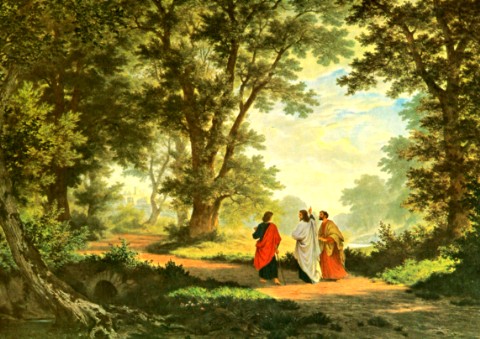
The Encounter at Emmaus

emmaus.jpg

I have been struck by the stories this Resurrection Season because for the first time, they strike me not as eye witness accounts of the Risen Christ, but as the challenge of faith for the disciples and us. The disciples on the way to Emmaus are leaving Jerusalem – returning home, perhaps, – grief stricken, but more importantly, disillusioned. The teacher has failed. The forces of evil have destroyed a very good and wonderful young man.

One way to see this story is to take it as another proof of the Risen Christ as encountered by his disciples. The story does convey this message. However, the story also tells us that we find the Risen Christ when He opens our minds to see the scriptures and when our hearts are opened at the Breaking of the Bread. Look for Him in the scriptures and invite Him in to dinner and your hospitality will be more than repaid.

There is just a glimpse – a flash of recognition and he disappears from our midst. The presence of the Risen Christ is a momentary and ongoing discovery. It is the result of searching, wandering, questing in grief and disillusionment and being open to the challenge of the Stranger.

All of us have moments, years, decades, in which everything we knew and had hoped for is swept away. The disciples had no clue of what was to become of their beloved teacher, but his torture and death threw them into utter grief and confusion. Yet their confusion only increased when they heard that other disciples had found the empty tomb and seen the angels. They were re-grouping, leaving town, trying to get some distance. A Stranger notices their grief and inquires. They listen and reflect on the scriptures and Break Bread.

This is the Christian life – the quest and the encounter in the village of Emmaus – continuing through all generations.

Read More

Posted by on Mar 24, 2008

Saint of the Day: St. John the Baptist – June 24

Dance: The Easter Sacrament

dancing-children-nolde-1913.jpg

Yesterday on Easter Sunday, we sang a second communion hymn in Spanish and English “Resucitó” (He Is Risen). The latin beat, punctuated by conga drums and a driving bass line, turned most of us cradle Catholics into momentary Baptists, as our middle class “cool” gave way to clapping, toe tapping and widespread joyous singing. We were too well brought up to be too demonstrative, but this did not stop the smaller children from launching into a marvelously free dance of joy, aided by their older siblings. It was all in keeping with our name – Resurrection. Granted, we are not the most conventional group, which is saying something in Santa Cruz County. The concluding bars were punctuated by “gritos,” those characteristically Mexican musical shouts of joy, from the smaller children, whether Mexican or not. Things got more animated when we ended Mass with the spiritual, “O They Rolled The Stone Away”.

Terry Hershey, in the March 24, 2008 issue of his newsletter, Sabbath Moments, is also carried away by dance. Yes, Easter Week is a time to stop pursuing happiness and to just be happy.

Read More

Posted by on Mar 24, 2008

Saint of the Day: St. John the Baptist – June 24

Easter: Not Recognizing the Risen Christ

mary-magdalene.jpg

The very core of Christianity is the amazing tenacity of the believers to assert the impossible – a man publicly tortured to death rose from the dead. What is even more surprising is that they did not recognize Him.

Seeing loved ones after they are dead is not that uncommon among those stricken with grief. According to psychologists, this delusion always produces an immediately recognizable image of the dead person.

One of the most affecting scenes in the Gospel is the encounter between that most faithful of disciples, Mary of Magdala, and the Gardener in the Gospel According to St. John, Chapter 20: 10-18.

Then the disciples went back to their homes, but Mary stood outside the tomb crying. As she wept, she bent over to look into the tomb and saw two angels in white, seated where Jesus’ body had been, one at the head and the other at the foot.

They asked her, “Woman, why are you crying?”

“They have taken my Lord away,” she said, “and I don’t know where they have put him.” At this, she turned around and saw Jesus standing there, but she did not realize that it was Jesus.

“Woman,” he said, “why are you crying? Who is it you are looking for?”
Thinking he was the gardener, she said, “Sir, if you have carried him away, tell me where you have put him, and I will get him.”

Jesus said to her, “Mary.”
She turned toward him and cried out in Aramaic, “Rabboni!” (which means Teacher).

Jesus said, “Do not hold on to me, for I have not yet returned to the Father. Go instead to my brothers and tell them, ‘I am returning to my Father and your Father, to my God and your God.’ “

Mary Magdalene went to the disciples with the news: “I have seen the Lord!” And she told them that he had said these things to her.

In the the other encounters of the disciples with the Risen Christ, there is a similar pattern. The very people who lived with Him on a daily basis, shared His travels, and even argued with Him, didn’t recognize Him. The reality was so much beyond a delusion of grieving friends and followers, so much beyond irrational expectation, that we only get a glimpse of how preposterous it was in the expressed doubts of Thomas. (John, chapter 20)

More than any other event in the Gospels, the stories of the empty tomb, the encounters, the general chaos that occurred is hard for us to fathom, let alone appreciate, since we have heard the story so many times. The story of the suffering and death of Christ is always muted for us because we know how the story ends. The men and women who followed Jesus were more bewildered and confused on that first Easter because what they heard was so outlandish.

The term for Easter in Romance languages drives from Passover – “Pascua” in Spanish and Italian, and “Paques” in French. Since the English term doesn’t bear this heavy direct reference to Passover – the Passover of the Lord – we can miss a key fact of experiencing the Resurrection – being led out of bondage is a tumultuous, confusing, and fearful process. We can cope with grief, disillusionment, and grinding oppression, finding comfort in cynicism, skepticism, or addiction. Resurrection for us is only a painful beginning, an inconvenient surprise, getting stretched on a rack of hope.

Having seen the worst, Mary of Madgala, like us, could conceive of only the worst when she saw the empty tomb. These glorious “men” in white must have taken the only memento left of the Teacher whom she so desperately loved. Where was his body? She had come to do the courageous and loving act allowed to women of her time. But there was no body.

Everything shattered when she heard her name, in a voice that no other could have uttered. Her love would only cause more problems. Are we ready for that?

Read More

Posted by on Mar 22, 2008

Saint of the Day: St. John the Baptist – June 24

Good Friday: Identifying with Christ or Christ Identifying With Us?

christ-of-maryknoll.jpg

For those who love Christ, remembering His passion and death is always an occasion for sorrow. However, such human acts as compassion are never simple. The pain of the impending loss of a loved one – anticipatory grief – can be worse than the actual loss. In fact, when death finally comes, we often feel guilty about experiencing relief. My friend Jim lost his father when Jim was in eighth grade, after a protracted two year battle with cancer. When we talked about it a couple of years later, Jim confessed that he still felt more relief than grief.

Of course, we couldn’t experience compassion without a close identification with the other. This becomes very complex in the person of the Christ. He did not fight his enemies. He did not curse. He did not condemn. He forgave. He blessed. This human-divine reaction to an injustice that is almost as inconceivable as it is enraging provides no adequate psychological outlet for the post-Freudian soul. How can we proclaim and fight for justice if God Himself did not? Tragically, the consolation in the Gospels and the wider testimony of the New Testament – that no evil, no matter how overwhelming, how senseless, can ever separate us from the love of God in Christ Jesus – escapes us. (Romans 8:38-39) Instead of experiencing this Passover of the Lord – the Blood of the Lamb on the door posts and lintel of our home that spares us from the Angel of Death – we run out into that night of despair by focusing on the ways we have been complicit with that evil.

When we hear that we are saved from a life defined by suffering and pain without meaning and no exit, we can think that we were saved from something we deserved. “Evil as you are … who among you would give his son a scorpion when he asked for bread?” (Loosely taken from Luke 11: 11-13) is a stark reminder to the disciples that Jesus could not conceive of His Father wanting anything less than we ourselves would want for our own children. Just as our children are all too much in our own image and likeness, we are in God’s. The teaching and life of Jesus in this regard is at odds with the vengeful patriarch of the Old Testament who punishes and chastises. (Lest we be tempted to think that Jews hold or held onto to this concept, we should remember that Jesus was not the only Jew who presented a view that had grown beyond it. The are interesting similarities between Jesus and his contemporary, Hillel the Elder.)

Enter God’s protectors:

“Ah hah! Now he has said it on his very own blog! Your own words condemn you. God doesn’t care about sin, you say. There are no consequences, no punishment, no reckoning. You present a God who is merciful, but not just. If Christ did not die for our sins how was the Father appeased? How is he the sacrificial victim?”

The Blogger Offers a Parable:

Once upon a time, there was a wonderful teacher who healed by word and touch and saved people from all kinds of physical, psychological, and social maladies. He made the mistake of speaking truth to power and telling religious and civil leaders that outward observance only made them into whitened sepulchers. They waited for the right time and got a close friend to betray him, and they took him off to Guantanamo, and then transferred him to a third world country, where he was tortured to death by specialists trained at the School of the Americas. Like so many thousands of his time, he was supposed to have become one of the disappeared. Fortunately for us, He didn’t stay dead and he didn’t stay hidden. Strangely though, he left again, said he would return, and in the meantime the were supposed to wait for a Holy Wind to make everything clear.

Yet His disciples wanted an explanation. If He was truly God’s Son, how could this have happened to Him? If he really was the Messiah, how could he have failed? He was just as maddening as those parables he used to tell them. Where are the answers? It was like one of those Eastern religions. “The question is the answer.” And that other junk the Beatles found in India, under the influence of something other than the great American mystic, Jack Daniels.

God finally sent them someone they could understand – sort of. “Like, well, yuh see, dude- God don’t need sacafices, ” The voice of the aging surfer was hoarse with too many years of funny cigarettes, his faced etched with too much salt and sun, his eyes opaque while he waited for the waves to rise. “It’s like, all ’bout love. All God wants is love. The torture and sufferin’ part, that’s what we do to us and each other. Man, like the Teacher Dude, the Guru Guy, like he couldn’t hang out forever. ‘Cause like, you guys were all brain dead on a kind a gnarly bad trip. Like he let it happen. The tube was closin’. Like there was just the wipeout; like really bad at Mavericks. He did it to show y’all that if yah stay in the water and go for it, sooner or later it’s gonna happen if ya stay true to the search for the Big One.  Dude, got some extra change? My old lady’s on me for the rent, like ya know.”

The words of reproach, as the seeker turned away, were familiar. “That sucks man. What a waste. I came to hear some guy explain some @$#%?! blogger’s crappy parable. I could’a been watchin’ the game on my big screen.” So he zipped up his jacket and marched straight home, out of the saving mystery, ignoring the glory of the sky, the dazzle of the water, and the carpet of color and bird song all about him.

Read More

Posted by on Mar 20, 2008

Saint of the Day: St. John the Baptist – June 24

Each Little Light …

western-electric-lantern.jpg

Dr. Megan McKenna uses many stories in her teaching, claiming that all stories are true and some actually happened. She tells this story, one that actually happened, about a community she visited in India. It was a very small village, with an even smaller Catholic community. The community generally gathered in the evening. As dusk fell, her hosts invited her to go outside and look around. In the gathering darkness, she saw the hills around the village come to life with little twinkling lights. The lights began to move across the hills and gradually to converge on the small building which served as their church.

In the middle of the church, there was a large iron contraption, with many arms jutting out from the center. As the people arrived, they hung their family’s lantern on one of the arms. When it became clear that no more people were coming, the contraption, now a chandelier, was hoisted up over the gathered people. It shone over the altar, giving light to the entire community as they celebrated Mass together. Then, when the time came to leave, the chandelier was again lowered and each family took its own lantern. But rather than go home, they went out from their celebration to visit the homes of the members of the community who had not been able to join them that night. They knew exactly who was missing because those lanterns had not been on the chandelier giving light to the community!

A lesson Megan drew from this experience and shared with my parish community is that we aren’t really a community until we know who is missing when we gather to worship.

I thought of this story when, along with many thousands of others, I attended Sunday afternoon liturgy in the Anaheim Arena as part of the Los Angeles Religious Education Congress 2008. The arena was beautifully decorated. The music was outstanding. Cardinal Mahoney was presiding, along with many bishops and priests of the archdiocese. The deacons were there with their wives, entering and leaving in the processions together. It was altogether a wonderful time and place to be.

It happened to be the Sunday when the Gospel is the story of the healing of the man born blind. This is one of the three Sundays when we celebrate “The Scrutinies” as part of the Rite of Christian Initiation for Adults (RCIA). The focus of the second Scrutiny is the ways in which we are blind. The prayer of those preparing for Baptism, Confirmation and/or Eucharist at Easter, as well as of the larger community, is for deliverance from those forms of blindness.

After the homily, when the time came for the Scrutiny, those preparing for the “Easter sacraments” (Baptism, Confirmation and Eucharist), were invited to kneel around the altar in the center of the Arena. Their sponsors stood before them as they knelt there. And we were all invited to pray with them, then raise our hands in prayer over them, asking the Lord’s blessing on them as they left with their catechists to continue reflecting on the Scriptures and preparing for Easter. Then they all rose and left the Arena.

I was sitting in the third tier of seats, so I had a great view of the floor and all the proceedings. It was an impressive sight, because approximately 5 rows of people on both sides of the aisle on the main floor left the room together. There was a huge hole in the middle of the community gathered there for worship. Although I didn’t know any of those people personally, I knew who was missing from that community! Those who will bring their own light of insights and God’s unique presence to our/their communities when they are welcomed into full participation in the Church at the Easter Vigil.

I remembered Megan’s story and also her statement that the gospels were written by the Christian community for those who were becoming new members of the community. They are for the instruction of new Christians, and the gift of the RCIA, and of those preparing to join the community, is the opportunity to see these stories anew and to experience their power to change lives – the lives of new followers of The Way and of those who maybe have begun to take it for granted.

As we celebrate the many liturgies of the next few days, I invite you to look around and see who is missing. Who needs us to reach out in love and ease a burden, or offer a word of hope and consolation? Who is homebound? Who is discouraged? Who has been hurt by our institution or our community? Who have we ourselves hurt? As we reach out in love to those missing, we will experience the Resurrection of Jesus in a deeper way and we will become a sign of love to the world, just as those little lights coming down the hillside were a sign of a loving community in one small Indian village.

Read More

Posted by on Mar 20, 2008

Saint of the Day: St. John the Baptist – June 24

Holy Thursday on the California Coast

cal-coast-spring.jpg

Holy Week on the California coast, from Pt. Mendocino above San Francisco to the Mexican border, is a place of spring time sun, deep blue skies, and blossoming flowers. At the Equinox, the ocean loses its grayness and picks up more yellows, subtle greens and muted turquoise. The salt air becomes more pungent, as the kelp forests put on new growth to accommodate the explosion of trillions upon trillions of sea plants and animals. The succulents and coastal chaparral burst out in purples, roses, and pinks, peppered with the bright yellow of sour grass blossoms. The Santa Cruz redwoods seem to stretch, fresh washed from the winter storms, looking forward to the morning and evening fog that gives them sustenance and flourishes their layered ecosystems that change every 20 feet upward, dancing in the dappled ray filled sunlight of the forest canopy.

It is a time of happiness and rejoicing. Sunglasses come out, flip flops slap the pavement, and shorts replace the winter denim, even though the day time temperatures are barely in the mid-60s. It is the coming of First Summer, before the Fog Season that begins on Memorial Day in late May and ends on Labor Day in early September. On the Central Coast, we host our first guests during Spring Break and settle in to enjoy the peaceful days before our June to August onslaught of shivering, fog-bitten visitors and their much welcome tourist dollars.

Aren’t we supposed to be down or at least subdued during Holy Week? How can we rejoice Saturday evening and Easter if we have somehow not rationed that joy? We should at least lament our unfaithful adherence to our Lenten resolutions – right? Christ’s terrible torture and death stayed the arm of a rightfully vengeful Father, so shouldn’t we show at least some token of fear for not being swept out into hellfire? If God’s Spring and Passover are any indication, maybe Cotton Mather had it wrong. Maybe we are a lot more than “Sinners in the Hand of an Angry God.”

If we, and all creation, are the overflowing love of the Trinity, are we the products of a God who can somehow demand the death of the the Eternal Word Made Flesh, God’s very immediate recognition and instantaneous self-acceptance, who shares the eternal dance of the Three in the joy of the Holy Spirit? Yes, much of the language that shapes our souls is a reflection of the fallen world where the Word “pitched his tent” – the actual Greek expression we use in the Creed. Yes, Jesus died and saved us in his rising from the dead. Yes, Jesus is the Lamb of God. Yes, we are the reason, we are his motivation for sharing our lives and submitting to the capital punishment of being tortured to death by an occupying superpower. Perhaps, the gravest sin of pride is to even think that we were the cause. Yes, God as Love couldn’t bear to leave us to the fate of hatred, despair, and alienation.

Why should people celebrating their rescue be glum, depressed, lost in narcissistic guilt? Why is this night different from any other night? It is the Passover of the Lord. If we are not washed in joyful Spring, can we share the Passover meal? Can we have any part in Him?

Read More