Pages Menu
RssFacebook
Categories Menu

Posted by on Jun 6, 2010

Corpus Christi: Who’s Feeding on Whom?

Today is the feast of Corpus Christi, the Body and Blood of Christ. We celebrate the great gift of the Eucharist – a feast of thanksgiving. We celebrate that the Lord has given His very being to us to be food for our journey through our lives here and now – from this day to the day of our birth into eternal life in the next here and now.

I’m struck today by the contrast between the Lord’s gift of allowing us to eat of His body and blood, soul and divinity and the way in which those spirits not in union with God, the evil ones, feed on our energies when we choose to welcome them into our lives even for a moment.

It became very clear to me again yesterday how quickly and subtly they will move in and start draining energy away from individuals and families. I received a notice in the mail regarding a challenge we’ve been facing as a result of the problems in the global financial markets hitting “Main Street.” I don’t know what the notice means, but it’s not a great situation and it could be the first step of more challenges coming. On the other hand, it might not mean anything negative at all.

But I was tired and a bit stressed and I found myself fretting about it. Then other things started popping up with their “… and did you remember that he …” and “… can you believe the nerve of …” Nothing huge involved. Nothing to which I would not have agreed. Just that quiet, insidious little voice encouraging me to feel upset, tired, a little resentful, or whatever.

As I got more out of sorts, others in the family also got edgy, including the resident baby.

Finally, my children sent me for a walk with the baby and fixed dinner themselves. On the walk, a relatively quiet activity with a very young child in a stroller, I realized what was happening. I closed the feeding trough to the spirits who had crept in and I asked my Guardian Angel and the Holy Spirit to protect me and us from their influence.

One thing I’ve learned – that kind of prayer is never ignored. I was better immediately and we had a lovely dinner and pleasant evening.

So, how does this relate to Corpus Christi? We can choose to allow the evil spirits to invade. We can feed them. The expression, “What’s eating you?” is absolutely an accurate description of an unseen reality. Or we can keep closing that restaurant when they come around and instead feed on the love of God, the body and blood of our Lord.

The neat thing is this. To the extent we feed on the Lord, we can then help feed those around us in positive ways. Everything becomes manageable again. Problems can be solved. Joy returns.

I still don’t know what that notice means, but whatever it means, all will be well as long as I/we remember Who should feed whom.

Happy Feast of Corpus Christi.

Read More

Posted by on May 26, 2010

Pentecost Insights on Laundry Day

Pentecost Insights on Laundry Day

Dove of Peace by Pablo Picasso

We celebrated the feast of Pentecost this past Sunday. It’s the Birthday of the Church and one of my favorite celebrations. Without the coming of the Holy Spirit on Pentecost, we would most likely never have heard the Good News of Jesus’ life, death and resurrection. His followers were just plain too scared to tell what they had witnessed.

At Pentecost, the Lord’s promise that He would ask the Father to send an Advocate to us, one who would continue to teach us what we need to know, was fulfilled. We entered the age of the Holy Spirit, an age that continues to our day.

I was musing on the wonders of the coming of the Spirit and the importance of the event yesterday while doing laundry and caring for my 14 month old grandson. (Yes, he’s a beautiful child and a rare delight!) I’d had a conversation on Sunday with a non-Catholic friend who had really never heard of Pentecost in her religious experience. We had talked about the coming of the Holy Spirit, the timing of the feast in relation to Easter and the effect of the Spirit’s coming on the early Christian community. I’m always surprised to find again that people are not aware of the story of the Church and the many twists and turns of its history. There is so often a sense that all was clear and settled from the start. The Acts of the Apostles makes it clear that the first followers of The Way were feeling their way and responding to the promptings of the Holy Spirit just as we must today.

My grandson loves to fold clothes. Up until a week ago, he simply stood by the davenport (sofa, couch) and pulled the clothes off as fast as he could. Once they were all on the floor, he’d hand them to me as fast as he could. Then I’d pick all of them up and we’d repeat the process, with a few more actually getting folded at each repetition! Last week he discovered that he no longer needs to hold a big person’s hand to walk or even run. So now he grabs an article of clothing from the stack and takes off racing across the room with it, dropping it at some point along his way.

He was laughing happily and carrying a handkerchief when suddenly he stopped. Several of us, including the child, have had colds, including runny noses. He’s been fascinated by the blowing of noses that has been occurring around the household. He put the handkerchief to his nose and made a loud blowing sound through his lips. He was so proud of himself. He was certain he’d figured out how to make that amazing noise that all of us had been making. In fact, he was so delighted, that he raced back to the davenport, grabbed a shirt and repeated the feat. Then a sock… Then a pair of pants…  Each time he simply beamed with delight and laughed uproariously.

It struck me, as I watched and laughed with him, that we are blessed that the gifts of the Holy Spirit continue to be poured out among us, with the Spirit continuing to teach us in our day too. As we learn so much more in the worlds of science, math, psychology, anthropology and all the other realms of human knowledge, it is truly a blessing that the Holy Spirit is with us, enlightening our hearts so we can see the Lord’s hand in all of creation in ever more wondrous ways. Imagine how sad it would be if we were forever condemned to the level of understanding of a small child who believes that blowing his nose requires use of his mouth! It’s a fine step on the way to understanding of the real way to perform the task, but only a step. With the grace of the Holy Spirit, we too move forward in our journey, growing up a little more each day and each generation, to see the wonders the Lord has wrought for us.

Happy Birthday, Church.

Read More

Posted by on Feb 16, 2010

Pentecost Insights on Laundry Day

And Once Again, The Seasons Turn

Mardi Gras beads

It’s Tuesday afternoon, the day before Ash Wednesday, a day called Mardi Gras  or Carnival in many places. The sun is shining yet again here in Santa Cruz, as it did all weekend, with warm breezes, bird song, blooming fruit trees, sour grass, wild radish, camelias and daffodils to celebrate the wonder and promise of Spring. A far cry from the winter so many people are still experiencing here in the Northern Hemisphere. It should be noted, that this beautiful weather will not last for long. Already storms are lining up out on the ocean for the end of the week. But today it is beautiful.

I’m sitting here thinking about the interesting confluence of themes that have met this week. Sunday was Valentine’s Day, a day of hearts and flowers, a day of many marriages, the birthday of a friend from graduate school whom I remember fondly, a day of gifts and remembrances for those we love. For some it’s a day of disappointment or sadness, when a loved one is not thrilled, or when no one is there to say “I love you,” or when a relationship has ended and the hurt has not begun to heal.  

Sunday was also the day many people in the world celebrate the beginning of a new year, a day we call Chinese New Year, though it isn’t only the Chinese who celebrate this day. Parades, parties, special foods, gifts, and good wishes abound.  It’s a day of hope for the future.

This particular Sunday, the readings of Cycle C from Jeremiah, Paul and Luke challenged us to keep our focus on the Lord and not put our fundamental trust in the things of this world. Calling the poor, the hungry, the weeping and the excluded ones among us blessed, Jesus warns that those who find life easy and who never challenge the status quo for fear of arousing the enmity of those in power are not close to the kingdom of God. It’s a message that is far from our American cultural concept, drawn from the earliest colonial days, that those who are economically secure and respected by their fellows are those blessed by God, while those who are poor, sick, injured, or otherwise disadvantaged are somehow not pleasing to God and are being punished.

Father Ron Shirley, our pastor, in his homily told the story of a wedding toast. The best man offered a toast wishing only the best for the bride and groom, with never a moment of pain or sadness. Then a stranger stepped up and offered a toast. He was dressed simply and seemed out of place. He assured the couple that he loved them deeply then offered a series of strange wishes for them – that poverty, sorrow, pain, and controversy would be part of their lives.

Today we celebrate Mardi Gras – with rich foods, parties, celebrations of abundance and the promise of good things to come.  And tomorrow we enter into a time of reflection, of conversion, and of returning our attention and our intentions to God and the works of God. Are they opposites or mutually exclusive? I don’t think so. Jesus and his followers certainly didn’t go around in sack cloth and ashes, continually fasting. They were criticized for their love of good times and celebrations. But there is a time and a place for abstaining from some of the good things of live in order to be open to the deeper fundamentals of God’s life and love for us. Jesus and his followers quietly entered into those times as well.

And so we follow them into these weeks of reflection and self-control, as we break our addictions to the excesses of the world around us and try to be more open to the quiet wonders of God’s love in people and in nature. The season is turning. New hope is in the air. Easter is coming soon.

May these days of Lenten preparation be full of the awareness of the Lord’s presence in your life and of the abundance of His love and support in all of life’s challenges.

Read More

Posted by on Jan 6, 2010

Pentecost Insights on Laundry Day

The Magi, the Epiphany, and the Stars of the New Age

There is often a lot of hand wringing and concern about the revival of pre-Christian earth based religions or neo-paganism. Whether it is the five pointed star -the pentagram- demons and vampires, or dancing and drumming at the equinoxes and solstices, all the signs seem to herald something worse than the age of atheism – the return of polytheism. We have now gone full circle from the one God back to many gods and goddesses.

New Age spiritualism allows people to celebrate the reality that is deeper than the merely physical without any of the doctrine or historical messiness of Christianity or any “organized” religion. It allows people to access the transnatural directly or in small groups led by a shaman. There is no need for big buildings, big groups, or any separation from the sacredness of nature.

The Magi or Wisemen were actually following the stars that announced the birth of a new King of Israel. The arrival of the Magi is called the Shining Forth – the Epiphany – the appearance of God to all of the world beyond Bethlehem of Judea.

What was wondrous to good people willing to see the obvious signs was hidden from the evil King Herod.

Although the resurgence of paganism is characteristic of something called the New Age perhaps it represents a search for the Divine in Creation, for the feminine, a faith that the Gaia may rally to overcome the forces threatening to destroy the biosphere and save us from ourselves.

The Magi today are poets, scientists, and dreamers led by Grace to see and understand the portents of the night sky as they search for Day. Caught up in our temples, traditions, and tedium have we missed the Star calling us forth?

Read More

Posted by on Dec 24, 2009

Pentecost Insights on Laundry Day

Merry Christmas to All

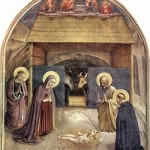
Adorazione del Bambino - Fra Angelico

Adorazione del Bambino - Fra Angelico

Christmas is upon us here in Santa Cruz, California. It’s been a lovely, sunny day for Christmas Eve. Not hot, but not cold either. A fine day for a walk by the ocean. Tomorrow promises to be as lovely.

I’ve been reflecting a lot recently on the great miracle that is life. I don’t do church work for a living. Randy and I work as consultants in the design of health care services and delivery of care, among other things.  One of my areas of expertise is translation of health care related materials into Spanish. These past couple of months, I’ve been working on a glossary of terms for a basic Biology textbook. It’s been absolutely fascinating.

Over 30 years ago, I graduated from Gonzaga University with undergraduate majors in Biology and Spanish. Through the years, I’ve combined the interests in a lot of ways, but I really haven’t had the chance to keep completely up to date with my knowledge of science. As a result, a lot of what I’m translating is new information for me. I’m spending a lot of time on the Internet, learning the new basics of Chemistry, Biology and Enviornmental Sciences so I can translate the definitions in a way that they will make sense in another language. I spend a lot of that time reading in Spanish, to find correct technical terms for things like “blebbing” and “Wobble base pairing of nucleotides,” as well as whether a particular metabolic pathway is generally called a “ruta” or a “vía.” As I said, it’s been a fascinating, though time consuming project.

So what does this have to do with theology and Christmas? The thing that keeps blowing my mind is that all that I see around me, all the people in my life, all the wonders of nature and of technology, all keep going because of simple positive and negative charges in atoms and the way those atoms interact with each other! Without those very fundamental chemical reactions, none of this, none of us, would even be, let alone be who and what we are. And yet, beyond the chemistry that underlies the biology, there is a spark of Divine life within each of us as humans. There is something that makes us different. While we can sometimes be as blind to other possiblities as the family cat who couldn’t figure out this morning that she could go around her perch to get up on it and eat her breakfast away from the neighbor cats, we do have the capacity to look at a challenging situation or something that is different than we expected and find new  and different solutions.  And we can think up new and better ways to do things, making life easier for all. We can choose to do great evil, but we can also choose to do great good. That spark of Divine life is a tremendous gift.

And then we come to Christmas. And at Christmas we remember that the Creator of all, the One who Is and Was and Ever Will Be, the One who loves all of creation into being and keeps us in existence with love, didn’t stop with being above it all and loving it into being. God chose to become one of us. And on top of that, God became a baby boy. A tiny, helpless child. All I can say is, Wow. We are truly blessed.

Merry Christmas to all. May this coming year be one of great joy and peace for you, through all the challenges you face, and may you know deeply the great love of our God who is Father/Parent, Son/Brother and Holy Spirit of Love.

Read More

Posted by on Nov 23, 2009

Pentecost Insights on Laundry Day

Christ the King

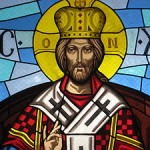
Christ the King - Annunciation Melkite Catholic Church

Christ the King - Annunciation Melkite Catholic Church

We’re rapidly coming to the end of the liturgical year. Last Sunday we celebrated the Feast of Christ the King. The week before we heard readings speaking of the end of time. This coming Sunday we’ll celebrate the beginning of a new season, Advent. It’s the Church’s New Year’s Day.

As this year draws to a close, there’s much talk of a new movie about the destruction of the Earth, this time in 2012, based on an ancient indigenous calendar’s timing of the end of a cycle of life. Almost certainly, the movie is and will remain fiction. Yet, we know that at some point, life on Earth as we know it will come to an end – both for each individual and for humans as a species. Eventually, the Earth will become uninhabitable for any life forms due to changes in our Sun – but that’s a long time in the future and we living here now really don’t need to worry much about it!

So, how do we mark this time of transition from one year to the next? How do we celebrate and hope for the coming of Christ the King? How do we live a life of faith that the Kingdom is already begun in the here and now? When our plans fall short and all seems lost, how do we trust that “All will be well”?

These questions are ones that many of us are facing today. The past months have brought many challenges economically, socially, physically, and in every other way one might imagine. In my own family there have been births and deaths, marriages and divorces, graduations from high school and colleges, first days of first grade, birthdays that mark a new decade of life, a home lost to a fire and two families joining into one household for a time of regrouping and new beginnings, jobs lost and new careers found. Some of these events were planned. Some were not. But somehow, all are part of the Kingdom and we are invited to see the face of Christ the King in the faces of those around us who love and encourage and help us through the tough times, as well as rejoice with us in the hard ones.

Fr. Ron Shirley, in his homily November 15, spoke of a conversation he had with a wise priest when he was a boy. He had been concerned about all the readings and predictions of the end of the world and the travails that were to come on the world. The priest reassured him, “Make sure to keep yourself in the love of God today – the rest will take care of itself.” Fr. Ron reminded us that staying in the love of God involves keeping our thoughts, words and actions loving – right now, in our lives today.

Deacon Patrick Conway, on the Feast of Christ the King, shared the stories of people from our own parish and their reflections on the way they have seen Christ in their lives.

As we leave this year behind us and move into our new liturgical season and year, my prayer is that we’ll all remember to stay in God’s love, in our thoughts, words and deeds, and to trust that the rest will take care of itself. Life is not predictable. Life “happens.” But when we can remember that God is able to bring good out of all circumstances, we can hold out in hope that all will be well, in God’s good time and we can celebrate the Kingship of our Lord in our lives today and in the future.

Read More

Posted by on Nov 1, 2009

Pentecost Insights on Laundry Day

Saints and Stained Glass Windows – The Feast of All Saints

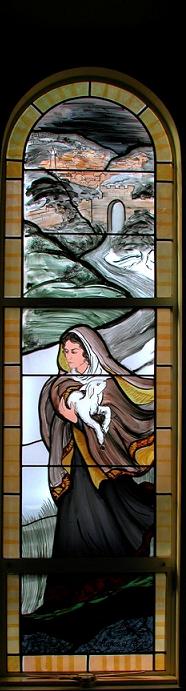
St. Agnes of Assisi - St. Joseph's Monastery of Poor Clares in Aptos, CA

St. Agnes of Assisi - St. Joseph's Monastery of Poor Clares in Aptos, CA

In his homily today at Mass, Fr. Ken Lavarone, OFM, included the story of a third grade girl’s response to the question, “What is a saint?” The little girl answered that saints are the people in the stained glass windows on the walls of the church. The light shines through all of them, spreading bright colors over all of us.  

Fr. Ken used this example to remind us that the light of God shines through the lives of the saints, all of them/all of us, both those living  in the here and now and those living with God in eternal life. That light brings color and joy, hope and beauty into our lives, through the good times and the hard times.

May the light and love of God shine into your life today and always and may you be, in turn, a window through which God’s light and love shine for others.

Read More

Posted by on Oct 7, 2009

Pentecost Insights on Laundry Day

Our Lady of the Rosary – Feast of the Day – October 7

Large_Rosaries_02

 Rosaries made by my Brother-in-law, Larry Perkins

October 7 is the feast of Our Lady of the Rosary. This feast was established in 1573 to celebrate the naval victory at Lepanto over invading Turkish forces. Pope Pius V attributed the success of the smaller Europen forces in defeating larger numbers of invaders to the prayers of people throughout Europe who were praying the rosary and asking God for help. The feast became part of the calendar for the universal Church in 1716.

The rosary is a string of beads used to help keep track of a series of prayers which are repeated in a specific order. On each bead in the rosary a prayer is said. These include the Our Father, Hail Mary, Apostle’s Creed and Doxology (the Glory Be). The Hail Holy Queen is traditionally the last prayer of the rosary before the final Sign of the Cross. 

When I was a girl, a retreat house was opened in our diocese. As part of the campaign needed for its successful completion, we were asked to pray the rosary. In place of the Hail Holy Queen, we all prayed the Memorare. So for me, that became the concluding prayer of the rosary.

The rosary includes 20 mysteries related to the life of Christ and of Mary. The Joyful Mysteries are: the Annunciation, the Visitation, the Birth of Jesus, the Presentation and the Finding of the Child Jesus in the Temple. The Luminous Mysteries include: The Baptism of Jesus, Jesus Reveals Himself in the Miracle at Cana, Jesus Preaches the Good News of Conversion, Repentance and Forgiveness, The Transfiguration of Jesus, and The Institution of the Eucharist. The Sorrowful Mysteries include: the Agony in the Garden, the Scourging at the Pillar, the Crowning with Thorns, the Carrying of the Cross, and the Crucifixion. The Glorious Mysteries are: the Resurrection, the Ascension, the Coming of the Holy Spirit on the Apostles, the Assumption of Mary and the Coronation of Mary as Queen of Heaven and Earth.

The rosary has been an aid to Christian prayer since the time of St. Dominic in the 1200s. (Buddhists and Moslems also use strings of beads to help them in their prayers.) In praying with the rosary, we can have a focus for our thoughts while being open to God’s presence. The repetition of prayers gives us a base to hold while our thoughts are turned to God. The rosary is a good prayer to use in the evening or in the morning or even in the middle of the night if a person wakes up then. It is not necessary to complete the entire rosary at one time. Falling asleep during the rosary is OK. God is always happy to have us fall asleep relaxed comfortably in the arms of prayer, just like a parent rocking a small child to sleep.

On this day, a feast originally established to commemorate a naval victory, may our prayers be for peace, understanding, and cooperation among people of good will, regardless of religious  and other differences that divide us.

Read More

Posted by on Sep 8, 2009

Pentecost Insights on Laundry Day

The Birthday of Mary – September 8

Russian Icon of the Birth of Mary

Russian Icon of the Birth of Mary

The birthday of the mother of Jesus, Mary, daughter of Joachim and Ann, is celebrated on September 8. It is an ancient feast, dating from the fifth century dedication of a church in Jerusalem. The church is known today as the basilica of St. Ann, mother of Mary. The feast is celebrated both in the Eastern and Western churches. 

In honor of her birthday, I offer what is perhaps her second most famous prayer, a prayer banned even in our times by despots and dictators who feared its power to inspire hope, courage and trust in God’s goodness and love of the poor and oppressed. May this be our prayer too.

My soul proclaims the greatness of the Lord;

                my spirit rejoices in God my savior.

For he has looked upon his handmaid’s lowliness;

                behold, from now on will all ages call me blessed.

The Mighty One has done great things for me,

                and holy is his name.

His mercy is from age to age

                to those who fear him.

He has shown might with his arm,

                dispersed the arrogant of mind and heart.

He has thrown down the rulers from their thrones

                but lifted up the lowly.

The hungry he has filled with good things;

                the rich he has sent away empty.

He has helped Israel his servant,

                remembering his mercy,

according to his promise to our fathers,

                to Abraham and to his descendants forever.

(Lk 1:46-55)

Read More

Posted by on Jun 14, 2009

Pentecost Insights on Laundry Day

The Feast of the Body and Blood of Christ

Cyprian Consiglio, OSB Cam

Cyprian Consiglio, OSB Cam

Cyprian Consiglio, OSB Cam. offered some interesting thoughts about the Feast of the Body and Blood of Christ (AKA Corpus Christi) today in his homily and his blog. He has graciously agreed to allow me to share them in a post for this feast.

The Inner Meaning

During this time of year when there are so many of our rites of passage taking place––weddings, graduations, ordinations (even birthdays)––it’s interesting to take a look at the purpose of ritual. Anthropologically speaking, a ritual is a way of expressing and passing on our understanding of reality or of an experience to someone else. So, for instance, a graduation is not about a piece of paper and a cap and gown: it’s weightier, it’s heavy; that’s why tears flow from the eyes of parents as they see their child graduate or get married. The ritual is trying to carry all those memories and meanings, and summarize them in a single gesture: an exchange of rings, the laying on of hands, a birthday card, an embrace, throwing a shovelful of dirt on a coffin: all these rituals mean more than they mean, they carry an almost indescribable load of treasures.

In the Roman rite we celebrate the Solemnity of the Body and Blood of Christ this week, and it’s safe to ask what Jesus was trying to convey to his disciples when he performed this rather odd ritual––not just breaking the bread and passing out the cup, but claiming that it was his very self. What exactly was he asking them to remember when they did it over and over again? I thought of five things, which certainly don’t exhaust the list of possible meanings.

1. First of all, this gesture looks backward and forward at Jesus’own life. Backward in that Jesus’ whole life had been spent being broken and passed out; his whole life had been dedicated to feeding those around him: taking care of their bodily needs through healing and feeding; and also feeding and healing them in a real way with the Wisdom of God, this incredible good news of God’s undying boundless care for every single hair on the head of very single human being from the greatest to––especially––the least. This ritual also looked ahead to the next day when Jesus allowed his body to be broken like bread and his blood poured out like wine––to say that it’s alright: you can survive even this, your real self cannot be annihilated, but like a seed that falls into the earth and dies it will yield a rich harvest of resurrection life.

2. This ritual symbolized––again what Jesus’ whole life symbolized––that Divine Love gives itself to humanity––that’s what God is like! The Divine is present, really present: divine love is offering itself to the world in this ritual meal.

3. This ritual also conveyed (and conveys) that this Divine Mystery is present everywhere, in creation, “in the earth and its produce.” Unfortunately the kind of hosts we use and our ornate chalices can actually hide the fact that this is actually wheat and grapes, real food: “which earth had given,” as we say, “fruit of the earth.” I think that this conveys that all matter is meant to be brought into right relationship with God, and that all matter can reveal and be a vehicle for the Grace of God. St Irenaeus wrote,

    “This is why he took a part of creation, gave thanks and said: This is my body. In the same way he declared that the cup, an element of the same creation as ourselves, was his blood: he taught them that this was the new sacrifice of the new covenant.” (Irenaeus, Against Heresies)

But we add a line to the prayer over the gifts: it’s not just what ”the earth has given,” or “the fruit of the earth”; it’s also the work of human hands. There is a beautiful prayer of Teihard de Chardin:

    I, your priest, will make the whole earth my altar––
    And on it I will offer you all the labors and sufferings of the world…
    I will place on the paten the harvest to be won by labor. . .
    Into my chalice I will pour all the sap which is to be pressed out this day from the Earth’s fruits.

So, the fruit of the earth and the work of our hands all become vehicles for God’s grace, all is meant to be brought into right relationship with God.

4. This ritual is also meant to convey to us that God wants us to participate in the work of creation, and in divinity itself. That’s why we pray that incredible prayer, “by the mystery of the water and wine may we come to share in the divinity of Christ who came to share in our humanity.”

5. And how do we participate? Well, that’s the last thing I want to mention that this ritual is trying to convey (though we could go on and on): it conveys that this divine mystery is especially present whenever and wherever human beings meet and share together, that God is present in every gesture of unselfish love, in every occasion of someone laying down their life for another. That’s why we read the story of the washing of the feet before we celebrate the Mass of the Lord’s Supper on Holy Thursday.

The Hebrews didn’t need another ritual, another sacrifice; we don’t need another ritual; and God certainly didn’t and doesn’t either. The prophets leading up to Jesus kept telling the people how God was sick of their sacrifices and rituals! Jesus himself quotes the prophet Hosea twice saying: “Go and learn the meaning of these words, ‘It is love that I desire, not sacrifice. Knowledge of God rather than burnt offerings.’”

The church, and this ritual, has no other purpose but to communicate and convey and reveal that––the love and knowledge of God that is hidden in the heart of creation and poured into the center of every human being as our very source and our ground. This is what we will be judged on as a church, as individuals, as communities and as a whole: not the forms of our rituals and doctrines, but by the reality of the love and knowledge of God that we manifest.

Bede Griffiths wrote that: “All myth and ritual, all doctrine and sacrament, is but a means to awaken our souls to this hidden mystery, to allow the divine presence to make itself known.”

So: as we participate in this ritual, as we receive the Body and Blood of Christ, and/or when we gaze at the reserved Blessed Sacrament in the Tabernacle or in a monstrance, let’s remember how weighty it is, how much it carries and conveys. And let’s especially pray that it would awaken us to the mystery of the knowledge of God, and the love of God that is poured into our hearts, so that we might make it manifest in our world, so that we might be the body and blood of Christ––that we might be broken and poured out for the sake of the world as Jesus was.

cyprian
14 june 09

Read More

Posted by on Jun 5, 2009

Pentecost Insights on Laundry Day

The Feast of Pentecost and the Age of the Holy Spirit

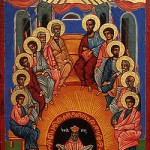
Eastern Orthodox Icon of Pentecost

Eastern Orthodox Icon of Pentecost

The Feast of Pentecost falls 50 days after Easter. Pentecost was originally a celebration of the first harvest and people came to Jerusalem from all over the known world to celebrate the feast.

For people in northern climes, the thought of a first harvest celebration in Spring may sound strange. After all, the snow has barely melted and crops are nowhere near ready to harvest. Even early crops like strawberries and lettuce aren’t ready yet. Nevertheless, in the Middle East, and by extension in that general latitude around the globe, many crops have already been harvested. Just go to a grocery store and you’ll see the fruits of our fields waiting for your table!

Within the Church, we celebrate the outpouring of the Holy Spirit on the disciples – men and women who had been friends, family and followers of Jesus. This outpouring of the Spirit of God, the God Who is Love, gave birth to the Christian community that endures to this day. Jesus’ friends and followers were transformed from frightened “mice” into fearless “lions” who proclaimed boldly that Jesus had been raised from the dead, that He is the long awaited Christ, that God has made Him both Lord and Savior, that a new age has dawned and the Kingdom of God has begun.

These early disciples wasted no time in putting their beliefs into action. They shared what they had. They cared for and healed the sick. They took care of widows and orphans – the powerless ones of their society. They recognized the gifts of women who were leaders in their communities. They spread the Good News of the Lord to all who would listen. And they struggled to understand the implications for themselves and their society of the Good News and the freedom of God’s children. Who were God’s chosen ones? Who could be followers of the Way? What parts of the Law were non-Jews required to obey? How can the pastoral needs of the community be met? Who will look out for the powerless ones in our own communities? How do we choose leaders for our communities? How should Christian family members behave with each other?

For nearly 2000 years we have dealt with these issues as a community. Today we still face many of them, though in a much wider context, as a global, international community that includes peoples of all cultures. More than ever we must count on the continued outpouring of the Spirit to guide us and make us bold witnesses to the Good News.

Much of what we take for granted today is the result of the work of Christians who actively put their beliefs into practice and stepped out to make their part of the world a better place. Institutions such as hospitals, schools for poor and even middle-class children, education for girls, social safety nets, and many others have resulted from the Christian insight that God cares about all humans, even those who traditionally have been excluded.

The Christian belief that all receive the gifts of the Holy Spirit in Baptism and Confirmation also leads to the understanding that all are responsible to share the gifts they have received and bear fruit in their lives. Together we listen to the Spirit and share in the development and shaping of both our Church community and the world.

As we move through these days following Pentecost, we face many challenges. It’s a time of global financial challenges. Governments are moving quickly to try to minimize the harmful effects of the banking crisis on their people. Social service agencies and churches are struggling to offer aid to the increasing numbers of people coming to their doors. Here in California there’s talk of dismantling all state funded social services, including health care programs for children of low income families and the welfare to work programs that helped so many families keep roofs over their heads and food on their tables.

What will we as children of God, brothers and sisters, do to address these challenges in our communities, states and countries? Will we say, as so many do, “It’s not my responsiblity to care for the children of the poor. Why don’t their parents just go get jobs?” Will we say, “Don’t ask me to pay more taxes. I shouldn’t have to cut back my lifestyle to pay for other people’s mistakes.” Will we sit in judgement of people who are losing their homes because they lost their jobs? Will we smugly assume that we’ve saved enough money to keep us safe if we get ill or lose a job? Will we criticize the people who lost their savings to the stock market when the money should have been somewhere safer? I hope not.

This year the time from Pentecost onward can be a time in which we truly listen to the Holy Spirit’s call to build up the Kingdom by caring for the poor, the powerless, those who are ill and who are losing their security (whether as a result of their own errors or those of others). It’s a time to trust that if we give of what we have, share from our abundance or our need, God will make sure that our needs are met. Our ethic of life must include not only the unborn but also those who are here and in need. Womb to tomb includes all those days in-between as well. Let’s not forget that as a Church community.

Read More

Posted by on May 21, 2009

Pentecost Insights on Laundry Day

The Feast of the Ascension

Ascension

Ascension

The Feast of the Ascension traditionally occurs 40 days after Easter. Since it falls on a Thursday, it’s often called Ascension Thursday.

Recently, with the transition of our work lives from an older, more flexible agrarian routine to modern industrialization’s insistance on time clocks, 24/7 availability of services, and the challenges of two income households, child care, school schedules and after school activities, taking time as a community of faith to stop and celebrate this feast has become a luxury available only to the fortunate few. Recognizing this reality in the lives of the faithful, bishops in many dioceses have allowed celebration of the feast to be moved to the Sunday before Pentecost. To the extent that this allows more people to be consciously aware of and celebrate the feast, I see this as a good step. Nevertheless, it is important to note that the feast actually falls today.

The feast of the Ascension marks the day on which Jesus was taken up to heaven (Lk 24:50-53). After the Resurrection, Jesus appeared on many occasions to his followers. He continued to teach them and explain all that had happened through His passion and why it had to happen as it did. At the end of both the Gospels of Mark and of Luke, as well as the beginning of the Acts of the Apostles, we are told that Jesus instructed His followers to go out as witnesses of all they had seen and heard, calling all peoples to turn from sin and accept baptism and the forgiving love of God. Then Jesus told His followers just before He was taken from their sight, to go back to Jerusalem and pray, waiting to receive the “promise of the Father” (Acts 1:4), the Holy Spirit who would give them power from on high to become His witnesses.

These events happened nine days before the Jewish feast of Pentecost. The apostles, Mary and other followers of Jesus did indeed return to Jerusalem. They gathered in the upper room where they had been staying after the Resurrection and devoted themselves to prayer. (They also took care of some administrative details – including selecting another person to take the place of Judas Iscariot. But that’s another part of the story not critical to today’s feast!)

On the feast of Pentecost, the Holy Spirit was poured out on them and the Church was born as Peter and the others fearlessly stepped out and witnessed to the world regarding all they had seen and experienced. The time of the Holy Spirit had begun.

A particularly important thing to remember regarding the Ascension, is that it is the beginning of a period of prayer for the outpouring of the Holy Spirit – a period of prayer mandated by Jesus Himself.

Since those early times in the church, we have developed a tradition of novenas, nine days of prayer with a particular focus or request. Typically the novena is addressed to a specific saint, requesting the saint’s intercession with God – much like asking a big brother or sister for help with a problem.

In the case of this first novena, the focus was much more direct. The novena from the Ascension to Pentecost is addressed directly to the Holy Spirit. With the early followers of Jesus, we too can pray for the outpouring of the Holy Spirit into our lives and world.

Imagine what could happen if we truly believe that we are to go out and be His witnesses — speaking His words of challenge and comfort, feeding the hungry, clothing the naked, housing the homeless, caring for the sick, acting as if a better world could really exist and all could really love and care for each other! This can only happen if we are filled with the Holy Spirit, clothed in power from on high. It is a daunting calling, but one that is implicit in our baptism and confirmation. We sing the ancient hymn, “Come Holy Ghost, Creator blest, and in our hearts take up thy rest…” It’s a beautiful prayer and truly dangerous if we take it to heart, meaing and believing what we are asking.

A younger hymn, from Zimbabwe, is also particularly appropriate for our novena to the Holy Spirit in these coming nine days. “If you believe and I believe and we together pray, the Holy Spirit must come down and set God’s people free. And set God’s people free, and set God’s people free; The Holy Spirit must come down and set God’s people free.” Free to be His witnesses — His hands, feet, voice and heart in our world.

Let’s again join together in these coming days to ask the Holy Spirit for a new outpouring of power into our lives and times. Pray with me with hope and confidence, trusting that with God’s help everything is possible, because “If you believe and I believe and we together pray, the Holy Spirit must (will) come down and set God’s people free.”

Read More

Posted by on Apr 14, 2009

Pentecost Insights on Laundry Day

Easter Monday 2009: The Post Modern Blues

Borgognone 1510

Borgognone 1510

Easter time in the 21st century is a curious season. We are living in a time in which the rationality of the Enlightenment has been obliterated by the irrational violence and deconstruction of the Modern Era which ended with the creation of the atom bomb. In the 20th century we saw the the rise of the irrational as a counter to the idea of reason as the engine of human progress. Advances in science and engineering led to death on a massive scale whether in its industrial production form in the genocide of Jews and other peoples or its explosion from the sky in carpet bombing of Dresden or the incineration of Hiroshima and Nagasaki. The darkness within the brilliance of the human heart and mind was also manifest in the Vietnam War epic movie “Apocalypse Now” based on the theme that facing the horror of one’s evil can only lead to self destruction.

So here we are on the cusp of the third millennium. Human progress seems more of an illusion. In fact, our Post-Modern sensibility is all about the inability of reason and science to get at ultimate truth. Everything is examined and found wanting. Physics has become the study of relativity, uncertainty, and mathematical models. Religion and philosophy are the products of language we create. The scriptures of Christianity are cultural creations which tell us more of the people who wrote them. They are robbed of their revelation.

Human romance and love are reduced to methods for the socio-biological dispersion of one’s genetic load. Religious experience is suspect because there is no way to know whether one is just engaging in psychological projection to create a hideout from the ultimate reality of the purposelessness of human existence. We are here by virtue of  a cosmic accident with a very low probability.

In our world, there is the torture and death of Good Friday but there is no need for a Resurrection or any life beyond our current suffering because it is not possible since we can never know the nature anything beyond nature with any certainty. So here is the greatest event of all human history and our greatest personal hope – the Resurrection and it is a non-event on a beautiful spring day that is to be borne with a grim courage in a time when miracles cannot happen.

The news is too good. Maybe that is why we are stuck on the Friday of Crucifixion. The pain we know is better than risking its loss in the certain joy of Resurrection. As people of the Resurrection we would have to leave too much behind – hurt, anger, fear, and death.

Read More

Posted by on Apr 12, 2009

Pentecost Insights on Laundry Day

Resurrection Sunday – 2009: Jesus Did Not Die for Me

Resurrection of Christ - Mikhail Nesterov (late 1890s)

Resurrection of Christ - Mikhail Nesterov (late 1890s)

Jesús No Murio Por Mi

Jesus Did Not Die for Me

Holy Weekend
The time of customary rituals
Of words spoken a thousand times
A season of the silence of death
Fasting, resolutions, and processions
A time of self-contained euphoria
As it seems sin sees the ending
We already know
and will flood all with life
A shallow season of hypocrisy
“Happy Easter”

A season of churches in a thousand different ways
yet a thousand ways the same
Cannot say other than what they have always said
“Jesus died for our salvation”
But “You know what?”
Jesus didn’t die for me
Jesus died because of cowardice,
greed, arrogance, love of power
by those who did not understand his message
by those afraid of the new
by those who had made a god to their own stature
by those who did not accept his offer of life to the full
not for just a few but for all men and women.
That death did not save anybody
Not even those who believed that they are saved by Jesus.

What saved me and you
And continues to save
Is that Jesus who became a person
Who identified with the people
Who was a baby and cried,
Who was a boy and played
Who grew and worked
Who was called to a mission and took it on
Who paused before the pain of men and women
Who in solidarity of gestures, words, and actions
Who did not silence what had to be said
And who though fearful, moved ahead
out of love, sheer love.

It was not his death, so cruel and unjust.
It was his life!
If death can be salvation
Whan can resurrection mean?
What sense does it make to celebrate Easter?
Death does not save
Even if it scandalizes theology
Life saves.
That is why resurrection is the great cry,
The lead story, the great news of our time
For this the stone rolls aways, the tomb opens
And foot steps are heard in the garden

God raises up Jesus
To condemn death forever
To announce that Life has won out
and that faith in the this Jesus who lives
who conquers the mercenaries of terror
is the faith that saves and
is the faith that makes us free.
What Peter said with such clarity
“This same Jesus whom you crucified
God has made Messiah and Lord”.

Jesus did not die for me.
They killed Jesus!
Jesus died because they tortured him in a blind rage
Because they wanted to shut him up and make him disappear
And because the powerful have always killed Him.

Yes, Jesus was born for me.
He also lived for me,
He taught, healed, pardoned, loved and rose again for me
for you and and for everyone.

Jesus did not die for me
nor for you nor anyone else
Perhaps, some day
We will stop honoring his death
In order to begin celebrating His LIFE.

Gerardo Oberman

translated by Randolfo R. Pozos 2009

Read More

Posted by on Feb 2, 2009

Pentecost Insights on Laundry Day

February 2 – A Day to Celebrate Three Feasts and a Blessing

The Meeting of the Lord - Orthodox Icon from Belarus (1731)

The Meeting of the Lord - Orthodox Icon from Belarus (1731)


February 2, a day falling 40 days after Christmas in the western Christian calendar, is a day when we celebrate 3 feasts and a blessing – The Presentation of Jesus at the Temple, The Purification of the Virgin, The Meeting of the Lord and Candlemas.

There’s a sort of game going around Facebook these days in which people are asked to give 25 random bits of information about themselves to their friends and ask 25 others to do the same. It’s been fun to see what people have to say about themselves and who they ask for information.

In the spirit of the game, I’d like to give 25 bits of information about today’s feasts and blessing.

1. The Presentation of Jesus has been celebrated since at least the 4th Century AD.

2. First-born sons belong to God in Jewish tradition – originally to serve as leaders of worship/sacrifice. Fathers of the boys were required to offer a sacrifice to “redeem” them from the obligation to serve at the temple rather than remain with their families. This tradition continues in modified form today.

3. Today’s feasts are not the same as the Feast of the Naming of Jesus or the Circumcision – celebrated 8 days after Christmas.

4. When Joseph and Mary offered the sacrifice to “redeem” Jesus, they were allowed to choose between offering a lamb and a dove or simply two doves or two pigeons. They offered the birds, the gift of those who were not wealthy.

5. Childbirth rendered a woman ritually “unclean.” A purification ceremony was required to restore her freedom to interact socially with family, friends and community, including her worship community.

6. Periods of time for this unclean status varied by sex of the child born. A woman was unclean for 80 days following the birth of a girl. For a boy she was only unclean for 40 days. In both cases, a ritual was required to purify her.

7. Mary went to the temple in Jerusalem for her purification ceremony.

8. Simeon was an old man who had been promised by God that he would see the Messiah before he died. He recognized Jesus as the fulfillment of that promise when Jesus was presented for the sacrifice of his redemption at the temple and Mary for her purification.

9. Simeon told Joseph and Mary that their son was “destined for the fall and rise of many in Israel.” (Luke 2:34)

10. Simeon told Mary that she would be pierced with a sword. Our understanding is that this was the sword of sorrow as she watched her son’s life and mission unfold.

11. Anna was an old woman who spent her days and nights at the temple. She too recognized Jesus and his family, blessed God for the gift of seeing him and told all she met about him.

12. The Feast of the Purification has been celebrated since at least the 7th century.

13. The Feast is known as The Meeting of the Lord in some Eastern Christian churches.

14. Candlemas is a celebration of the blessing of candles (traditionally beeswax ones) for use in homes and churches in the coming year.

15. First evidence of the celebration of Candlemas dates from the 4th century in Rome, but it spread to the rest of Europe more slowly. It had reached England by the 10th or 11th century.

16. Candlemas is probably a feast whose focus was changed to a Christian one from older non-Christian ones that included fire, candles, ash and purification in a variety of European cultures.

17. Before the Second Vatican Council, the Christmas/Epiphany season lasted until Candlemas. It was considered bad luck to have Christmas decorations (including holly, ivy and bay leaves) still in the house on Candlemas.

18. Some cultures had celebrations in which young women carried candles in a procession at this time of year or in which young men and women had to jump over fires for purification before they could be married.

19. These are the last feast days whose date is set based on the date of Christmas.

20. Many traditions link Candlemas to the actions of animals as predictors of future weather – including bears, wolves and groundhogs!

21. Candlemas was one of the days certain taxes had to be paid in Scotland until 1991.

22. The French celebration of Candlemas includes eating crepes for dinner after 8 pm.

23. Mexican tradition includes tamales on the menu for Candlemas.

24. Some believe Candlemas was a “Christianization” of the feast of  Brigid the Goddess – an oracle and predictor of the success of the growing season – but little historical evidence exists for this claim. The feast of St. Brigid, an Irish abbess, is February 1. 

25. These feasts are celebrated in both Eastern and Western Christianity, but on different dates. In all traditions, however, they are celebrated 40 days after Christmas.

Whew!  So … there you have it. More than you probably ever wanted to know about Christian celebrations for February 2!

I think we’ll put the last of the Christmas decorations away, light some candles, and have tamales for dinner!

Read More